

Confidence in Sales: How to Build It, Keep It, and Stop Faking It
It's 8:47 AM. You're staring at your call list, coffee going cold, mentally rehearsing what you'll say if someone actually picks up. You've done this a thousand times, but today the doubt is louder than usual. Win rates dropped into the 21-25% bracket last year, down from 31-40% the year prior. The market is harder, cycles are longer, and confidence in sales is the first casualty.
Here's the thing: this isn't something you're born with. It's engineered. The reps who treat it like a system - not a feeling - are the ones still hitting quota.
The Quick Version
If you're short on time, here's the playbook in three moves:
- Learn the tonality framework - question, statement, command - and practice it on your next five calls.
- Run one structured role-play drill per week. Progressive difficulty, not improv theater.
- Fix your prospect data. Bounced emails and dead numbers train your brain to expect failure before you even dial. Prospeo's free tier gives you 75 verified emails/month and 100 Chrome extension credits/month - enough to test the difference clean data makes.
Now let's get into the mechanics.
What Sales Confidence Actually Is
Most reps think confidence means feeling good before a call. It doesn't. Confidence is a behavior - a set of actions you take regardless of how you feel. It's showing up prepared, asking the uncomfortable question, and guiding the conversation even when your stomach is doing backflips.
Integrity Solutions nails the deeper issue: people tend to achieve the level of success they believe they deserve. If your internal ceiling is "mid-pack rep," your behaviors will match - you'll avoid the big accounts, soften your close, and settle for "good enough" pipeline. They also emphasize that buyers care early about the value and insights you bring, but reps default to product talk because that's their comfort zone. Confidence means leading with value, not retreating to features.
There's a trap on the other side, too. Many reps confuse confidence with arrogance, so they overcorrect into passivity. They hold back competence because they don't want to seem pushy. That's not humility - it's underconfidence wearing a polite mask. Learning how to be a confident salesperson starts with recognizing that holding back your expertise hurts the buyer more than it helps.
Why It Directly Impacts Revenue
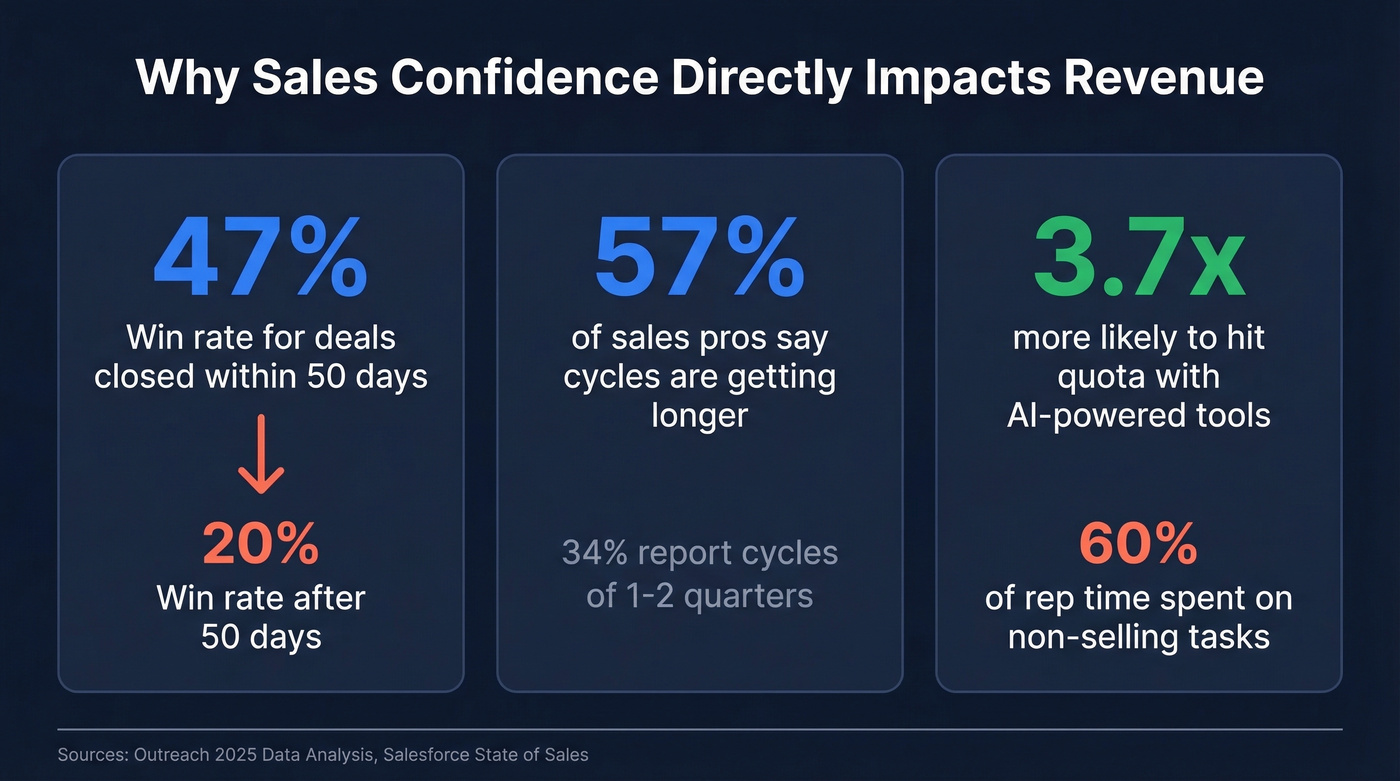
The data here is blunt. Deals closed within 50 days carry a 47% win rate. After 50 days, that number drops to 20% or lower. Confident reps qualify harder, ask for next steps sooner, and don't let deals drift into the graveyard of "checking in" emails.
Speed and conviction are inseparable.
Meanwhile, 57% of sales professionals say cycles are getting longer, and 34% of revenue teams now report average cycles of one to two quarters. Longer cycles demand more sustained conviction - you can't white-knuckle your way through a four-month enterprise deal on adrenaline alone.
The tools angle matters too. Salesforce data shows reps using AI-powered tools are 3.7x more likely to meet quota, yet reps spend 60% of their time on non-selling tasks like admin, CRM updates, and chasing bad data. Less time selling means less practice, and less practice means less self-assurance. It's a flywheel, and it spins in both directions.
The Psychology Nobody Talks About
Imposter Syndrome in Sales
Sandler's framework identifies three behaviors that signal imposter syndrome is running the show: avoiding big opportunities, hesitating to ask tough questions, and chasing validation instead of outcomes. This pattern is rampant among high performers, not just new reps.
The internal narrative is always some version of "I got lucky" or "they'll figure out I don't belong here." A useful coaching prompt cuts through it: "What story are you telling yourself about this deal?" That single question forces a rep to separate the facts of the opportunity from the fiction their anxiety is writing.
You can't outperform your own self-image. If you believe you're a $50K-deal rep, you'll unconsciously sabotage the $200K opportunity sitting in your pipeline.
The Fear of Sounding Arrogant
This one is sneaky. Plenty of competent sellers hold back because they're terrified of being "that salesperson" - the aggressive, pushy stereotype. So they soften their language, avoid direct recommendations, and let buyers wander through indecision unchallenged.
That's not humility. It's underconfidence masquerading as politeness. Authentic conviction means guiding the conversation with the right questions and trusting your expertise. The buyer hired you to help them make a decision. Do the job.

Every bounced email and dead number trains your brain to expect failure. Prospeo's 98% email accuracy and 7-day data refresh mean you reach real people on real calls - so your confidence compounds instead of eroding.
Stop rehearsing for voicemail. Start reaching verified buyers.
How to Build Confidence in Sales
Confidence isn't built by reading motivational quotes. It's built by stacking specific, repeatable systems. We've seen five that consistently work across teams of different sizes and deal complexities.

Master the Three Tonalities
Close.com's tonality framework is one of the most underused tools in sales:
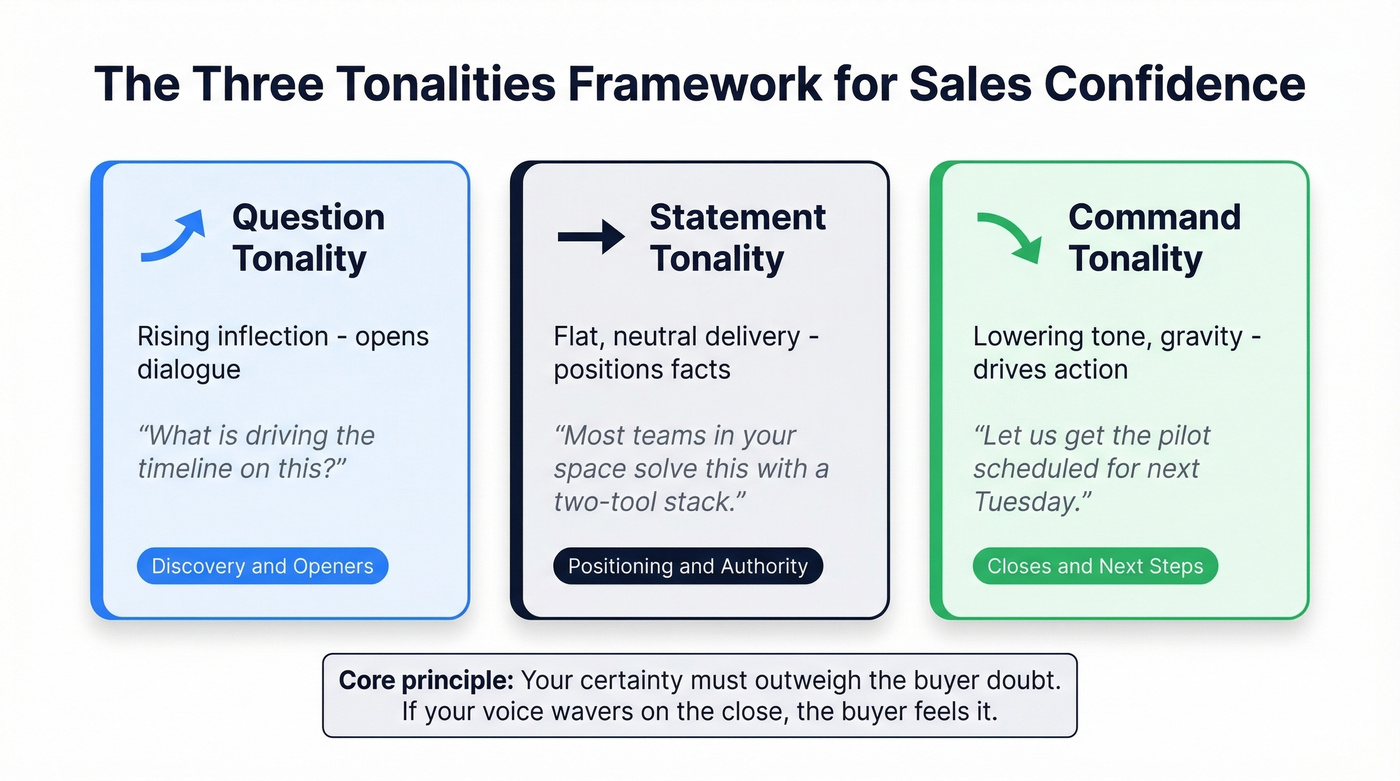
- Question tonality - rising inflection. Opens conversations and invites dialogue. "What's driving the timeline on this?"
- Statement tonality - flat, neutral delivery. Facts and positioning. "Most teams in your space solve this with a two-tool stack."
- Command tonality - lowering tone, gravity. Closes and next steps. "Let's get the pilot scheduled for next Tuesday."
The concept behind all three is confidence transfer. Your certainty needs to outweigh the buyer's doubt. If your voice wavers on the close, the buyer feels it - and they stall. Mastering tonality is one of the most practical ways to sell with conviction on every call.
Run Progressive Role-Play Drills
We've seen teams transform their call quality in 4-6 weeks with structured role-play. The key word is structured. Hyperbound's framework lays out a solid progression:
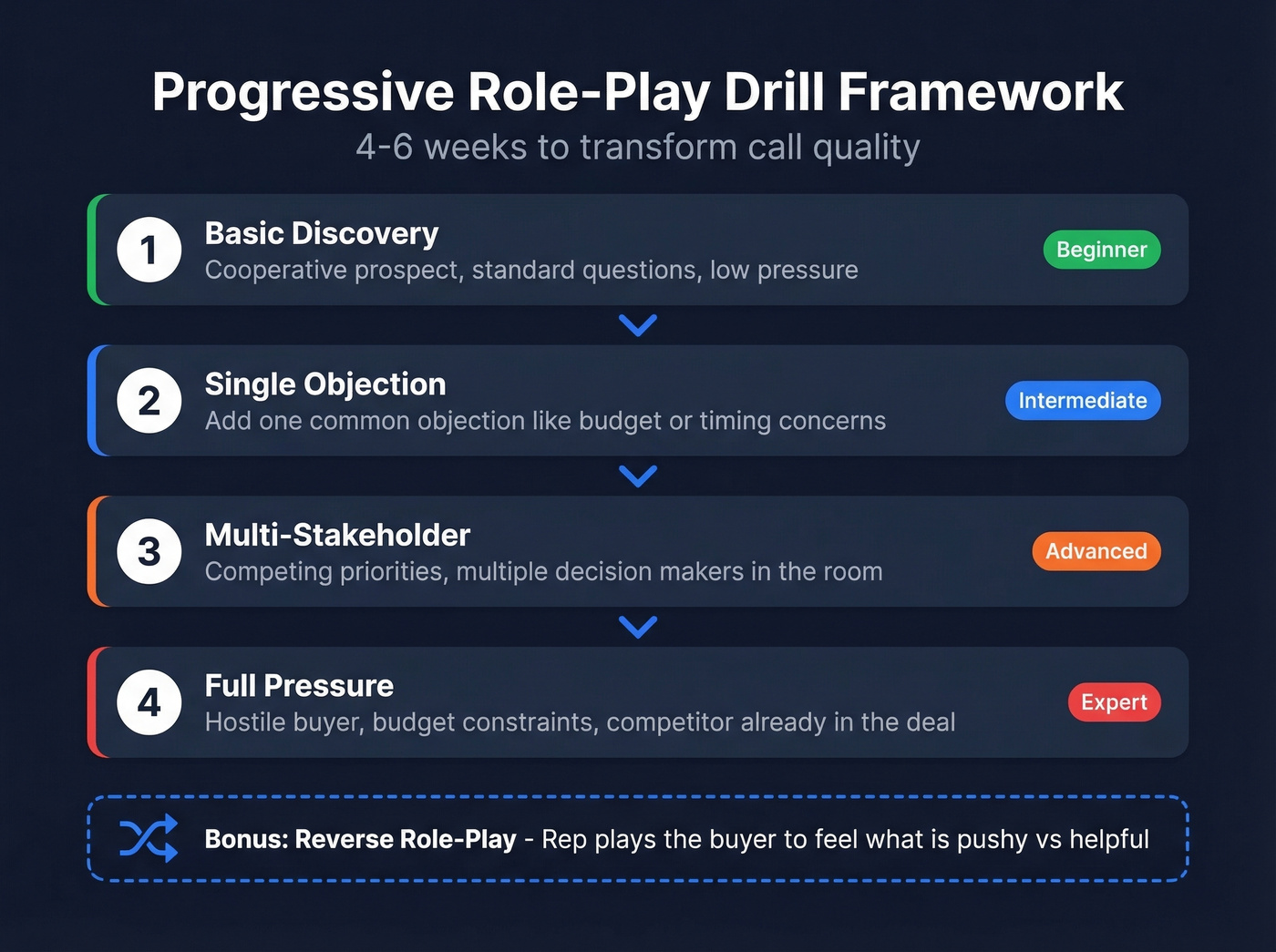
Level 1: Basic discovery with a cooperative prospect. Level 2: Add one common objection. Level 3: Multi-stakeholder scenario with competing priorities. Level 4: Hostile buyer, budget constraints, and a competitor already in the deal.
Reverse role-play is equally powerful - the rep plays the buyer. You'd be surprised how quickly reps identify what feels pushy versus helpful when they're on the receiving end.
Reps dread role-play for two reasons: performance anxiety and unrealistic scenarios. Address both directly. Progressive difficulty solves the second, and small-group formats reduce the first. Acknowledge the cringe factor with your team, then do it anyway. Discomfort is the price of competence.
Increase Rejection Exposure
This is exposure therapy for salespeople. Call bigger targets. Pitch tougher accounts. Add 20% more dials to your daily block. The goal isn't to win every one - it's to normalize rejection so it stops triggering a confidence spiral.
If you're only calling accounts you're comfortable with, you aren't growing. Deliberate rejection exposure is one of the fastest ways to strengthen your sales mindset because it rewires your emotional response to "no" from a threat signal into background noise.
Fix Your Data First
Here's a confidence killer nobody puts in the self-help articles: bad data. When emails bounce, phone numbers are disconnected, and half your list is stale, your brain learns to expect failure before you even pick up the phone. That's not a mindset problem. It's an infrastructure problem.
Prospeo addresses this with 98% email accuracy and a 7-day data refresh cycle versus the 6-week industry average. When you trust your list, you dial with intent instead of dread. Snyk's 50-person AE team experienced this firsthand - their bounce rate dropped from 35-40% to under 5%, and AE-sourced pipeline jumped 180%.
Skip this step if your bounce rate is already under 5%. But if it's north of 15%, no amount of mindset work will fix the problem - your data is sabotaging you before you open your mouth. (If you need benchmarks and fixes, start with bounce rate and work backward.)
Product Knowledge as a Foundation
Record your calls. Listen back to two per week - one that went well and one that didn't. You'll catch tonality shifts, filler words, and moments where you backed down from a question you should've asked. Pair this with deep product study. The reps who know their solution inside and out rarely hesitate when a buyer throws a curveball. It's the fastest confidence audit available, and it costs nothing.
The Overconfidence Trap
Confidence has a ceiling where it becomes a liability. Visualize's diagnostic is worth memorizing. If you can't clearly articulate these five things for every deal in your pipeline, you're probably overconfident:
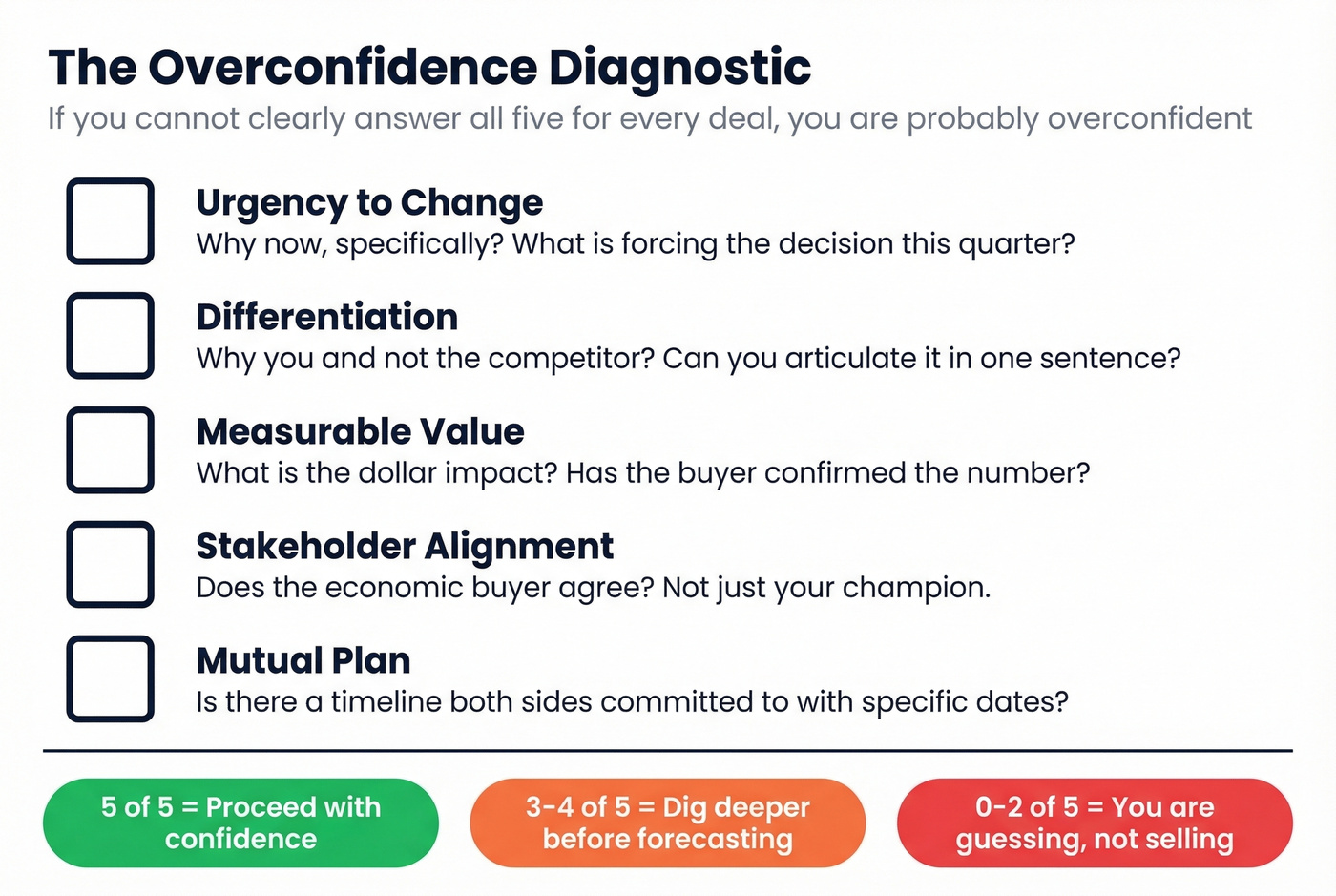
- Urgency to change - why now, specifically?
- Differentiation - why you, not the competitor?
- Measurable value - what's the dollar impact?
- Stakeholder alignment - does the economic buyer agree?
- Mutual plan - is there a timeline both sides committed to?
I've watched reps in workshops claim "I already know this" while repeating the exact habits that stall their deals. The fix is simple: come to forecast reviews with questions, not statements. "What am I missing?" beats "This one's closing next week" every time.
One caveat: if you're working deals under $25K, overconfidence is rarely your problem. Underconfidence is. Most reps at that deal size need to push harder, not pull back. Save the overconfidence audit for your enterprise pipeline.
Surviving Sales Slumps
A rep on r/sales described the spiral perfectly: canceled appointments stacking up, commission-only pay amplifying the stress, watching the leaderboard in Slack while everyone else seems to be crushing it. The comparison spiral is real, and it feeds on itself.
Look - when you're in a slump, go back to basics, but be specific about which basics. Not "try harder." Audit your data hygiene, recommit to call volume targets, and tighten your qualification criteria. If 30% of your contacts are stale, your "basics" are broken before you dial.
The slump doesn't break because you feel better. It breaks because you do the boring, mechanical work that creates the conditions for confidence to return. In our experience, the reps who recover fastest are the ones who treat a slump like a process failure, not a personal one.
Reps spend 60% of their time on non-selling tasks - including chasing bad data. Prospeo gives you 300M+ verified profiles with 30+ filters so you prep faster, dial with conviction, and keep the confidence flywheel spinning.
Clean data is the confidence system nobody talks about.
Building a Confident Team
If you're a sales leader, your job isn't to motivate - it's to create the conditions where confidence develops naturally. That starts with a weekly 1:1 coaching cadence. Not pipeline reviews disguised as coaching. Actual skill development conversations.
The data backs this up: 75% of reps say they're more likely to hit targets with a coach or mentor. The biggest opportunity? Invest in the middle 60% of your team. Your top performers are already self-assured. Your bottom performers may need a different role. But your core performers - the ones who could go either way - that's where coaching creates the most lift.
Coach the belief, not just the behavior. Ask reps what stories they're telling themselves about their deals, their abilities, their ceiling. Then challenge those stories with evidence. Measure behavior changes alongside revenue: Is the rep asking tougher questions? Following up faster? Calling higher in the org chart? Those leading indicators tell you whether confidence in sales is building before the lagging numbers confirm it. (If you want a tighter coaching structure, borrow from sales leadership systems and keep it consistent.)
FAQ
How long does it take to build confidence in sales?
Most reps report a noticeable shift after 100-300 deliberate dials and 4-6 structured role-play sessions. Confidence compounds - expect meaningful improvement within 6-8 weeks of consistent practice with feedback loops built in.
Can you be confident without being pushy?
Yes - they're opposites, not neighbors. Confidence is asking the right questions and guiding the conversation; pushiness is ignoring the buyer's signals. The fear of sounding aggressive is usually underconfidence in disguise. Preparation and genuine curiosity about the buyer's problem are what separate the two.
Does prospect data quality really affect sales confidence?
Absolutely. When emails bounce and phone numbers are dead, reps learn to expect failure before they dial. Verified contact data eliminates one of the biggest hidden confidence killers in outbound - every call starts with a real person at a real number, which changes your mental state before you say a word.