

The Consultative Sales Process That Actually Works (Not the One Your $15K Trainer Taught You)
A rep on r/sales posted about sitting through six hours of consultative selling training led by a $15K consultant. The next day, he asked a prospect, "What's keeping you up at night regarding your current solution?" The prospect said, "Are you reading from a script?" and hung up. That's not a consultative sales process failing - that's a training program failing.
The real version isn't a script. It's a discipline. And the gap between what's taught in corporate workshops and what actually closes complex deals is enormous. Here's the practitioner's version: the full 7-step process, a discovery template you can steal, and the benchmarks that explain why this matters more in 2026 than it ever has.
What Is Consultative Selling?
The term traces back to Mack Hanan's 1970 book Consultative Selling. Hanan popularized a simple idea: stop vending products and start improving your customer's profits. He introduced the "Profit Improvement Proposal" as a way to frame decisions around measurable business outcomes instead of feature comparisons.
That's different from solution selling, which maps product capabilities to stated problems. The consultative method goes further - you might redefine the problem entirely before proposing anything. You're operating as a business advisor who happens to sell something, not a rep who happens to ask questions.
Why This Approach Matters More Than Ever
The B2B buying environment has changed structurally, not just incrementally. Buying committees now average 25 stakeholders, up from 16 in 2017. Average sales cycles run 6.5 months, up from 4.9 in 2019. Win rates hover around 20-21%. Only 16% of reps hit quota in 2023.
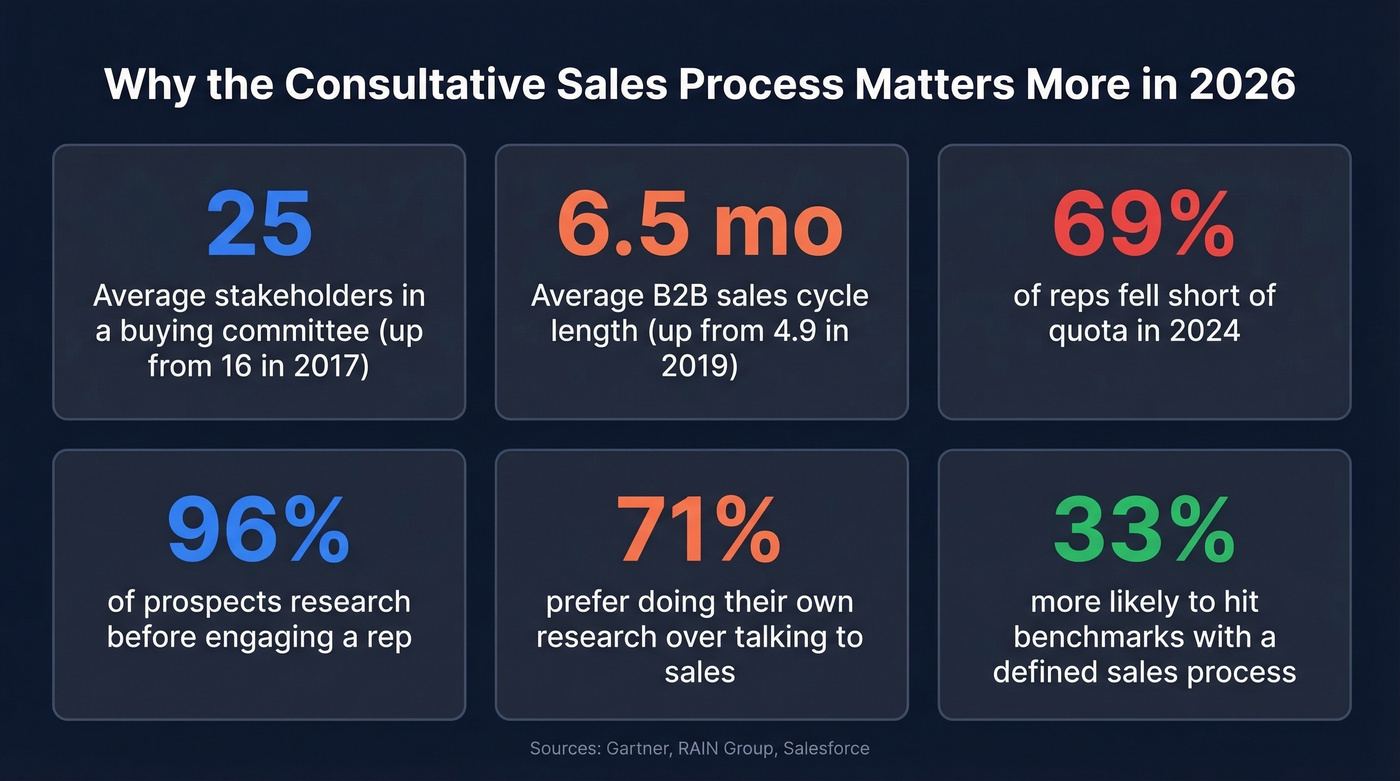
The buyer side is even more telling. 96% of prospects research companies before engaging a sales rep, and 71% prefer doing their own research over talking to someone in sales. By the time a prospect takes your call, they've already formed opinions. Show up with generic discovery questions and a product demo, and you're behind before you start.
Here's the thing: 69% of reps fell short of quota in 2024. The reps who are winning aren't winning because they ask better questions - they're winning because they bring insights the buyer couldn't find on their own. That's the consultative difference. Not "tell me about your challenges." Instead: "Companies like yours typically lose 12-15% of pipeline to [specific problem]. Is that showing up for you, and how are you handling it?"
The old playbook - ask open-ended questions, listen actively, propose a solution - is table stakes now. The 2026 version requires you to walk in with a hypothesis, challenge the buyer's assumptions when warranted, and quantify impact in their language. Anything less gets you a polite "we'll get back to you."
One caveat: if your average contract value is under $15K and your cycle is under three weeks, you probably don't need a full consultative approach. Use BANT, close fast, and save the deep discovery for deals where the cost of a bad purchase justifies it. Consultative selling is powerful, but it isn't free - it costs time, and time is the one resource most sales teams can't afford to waste on the wrong deals.
Consultative Selling vs. Other Methodologies
These frameworks aren't interchangeable, and picking the wrong one for your deal size and cycle length is a common mistake.
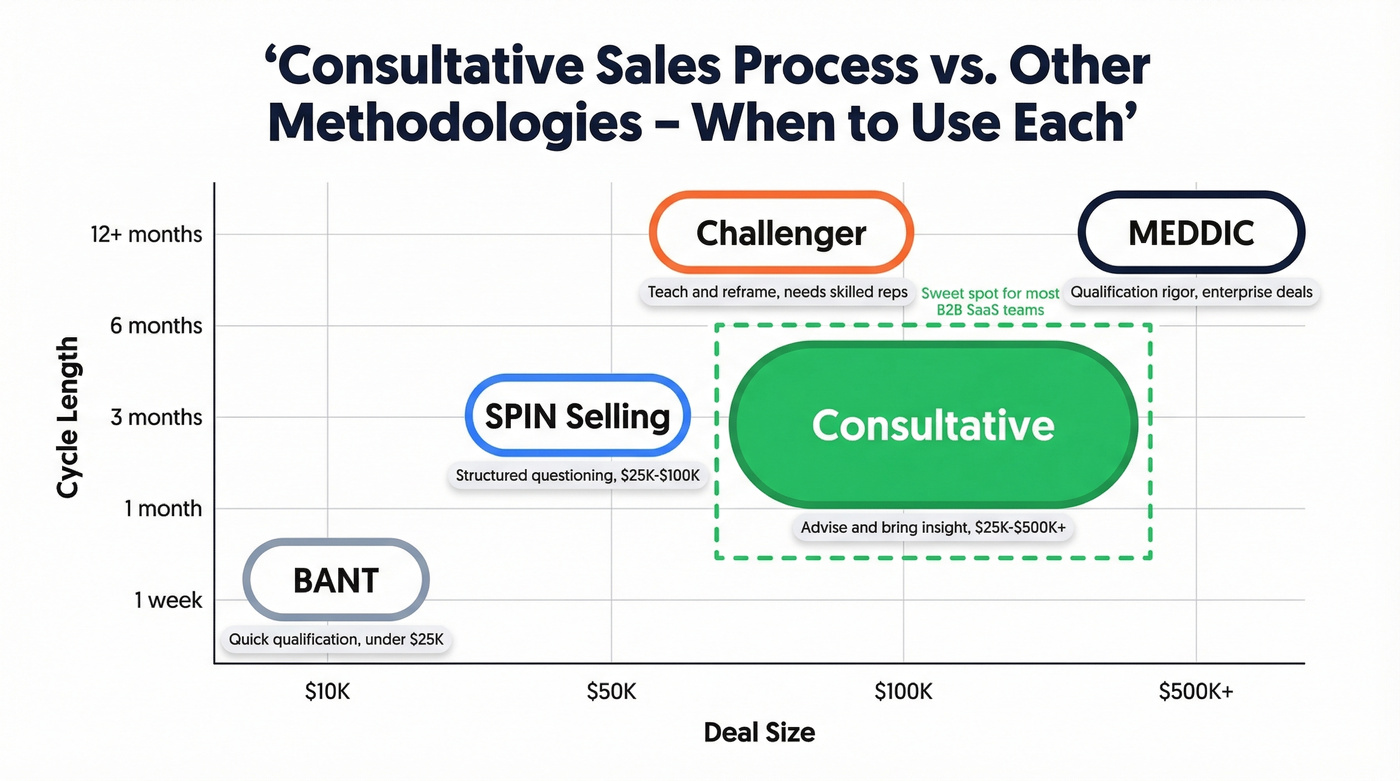
| Methodology | Best Deal Size | Cycle Length | Core Motion | Key Risk |
|---|---|---|---|---|
| Consultative | $25K-$500K+ | 3-12 months | Advise + insight | Slow for simple deals |
| SPIN | $25K-$100K | 3-6 months | Structured questioning | Time-consuming |
| Challenger | $50K-$500K+ | 3-12 months | Teach + reframe | Aggressive if unskilled |
| MEDDIC | $100K+ | 6-18 months | Qualification rigor | Over-qualifies early |
| BANT | Under $25K | 1-4 weeks | Quick qualification | Shallow for complex |
SPIN Selling was built on research analyzing 35,000+ sales calls across 20+ countries over 12 years. The Challenger Sale drew from CEB's study of 6,000+ reps. Xerox reported a 17% increase in sales and $65M in contract value after implementing Challenger.
But here's a finding that should reshape how you think about the process: RAIN Group studied 700+ B2B purchases and ranked 42 factors that separated winners from second-place finishers. "Deepened my understanding of my needs" - the core consultative move - ranked 40th. Second-place finishers actually focused more on diagnosis than winners. Winners brought ideas, educated, and challenged.
That doesn't mean discovery is useless. It means discovery alone doesn't win. Companies with a defined sales process are 33% more likely to hit high-performance benchmarks. The process matters, but it has to go beyond asking good questions.
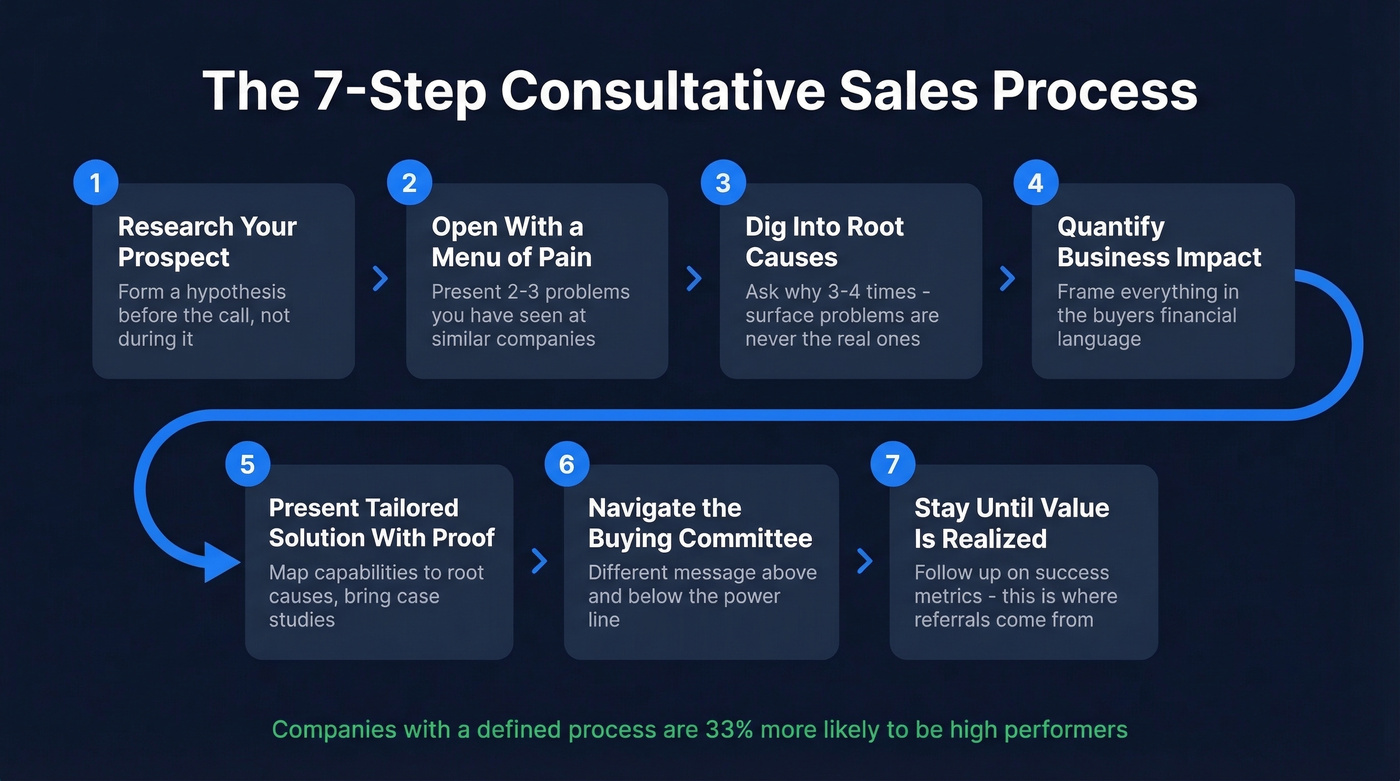
The 7 Consultative Sales Process Steps
1. Research Your Prospect
This is where most reps cut corners, and it determines everything downstream. You can't bring insights if you don't understand the prospect's business, tech stack, recent hires, and competitive pressures before the call.
Don't spend 45 minutes manually piecing together a prospect's profile from their company website and press releases. Use a B2B data platform like Prospeo to pull verified contact data, technographics, and buyer intent signals in minutes - with a 7-day data refresh cycle so nothing's stale. The goal isn't just knowing their name and title. It's forming a hypothesis about their pain before you ever pick up the phone.

2. Open With a Menu of Pain
Forget "What's keeping you up at night?" That's the question that gets you hung up on. Instead, present the top 2-3 problems you've seen at similar companies and let the prospect pick which resonates.
"We work with a lot of [industry] companies your size, and the three things we hear most are [problem A], [problem B], and [problem C]. Which of those is most relevant to you right now - or is it something else entirely?" This establishes credibility and gets to the real issue in 30 seconds instead of 15 minutes of open-ended fishing.
3. Dig Into Root Causes
Once you've identified the pain, don't jump to your solution. Go 3-4 layers deep with "why" questions. The surface problem is rarely the real problem.
"Why do you think that's happening?" Then again. Then again. You're looking for the root cause that, if solved, would cascade into fixing multiple symptoms. We've watched reps hear something that maps to their product and start mentally composing the pitch by minute three. Stay in discovery mode. The deeper you go, the harder it becomes for the prospect to dismiss your eventual recommendation as generic.
4. Quantify Business Impact
This is Hanan's original insight, and it's still the most underused step. Frame everything in the buyer's financial language.
"You mentioned losing 15% of qualified pipeline to slow response times. At your average deal size, that's roughly $400K per quarter walking out the door. If we cut that loss in half within 90 days, what does that do to your Q3 number?" That's not a sales pitch. That's a business case - and it's the language that gets forwarded to the CFO.
One behavioral note: the first number you put on the table anchors the entire conversation. Lead with the cost of inaction, not the cost of your product. 76% of buyers say personalized, value-adding outreach significantly influences purchase decisions, and nothing is more personal than showing someone exactly what their problem costs.
5. Present a Tailored Solution With Proof
Now - and only now - you present your solution. Not as a feature walkthrough. Map every capability directly to the root causes you uncovered in steps 3 and 4.
Bring proof assets. 88% of top SaaS companies use case studies, averaging 45 per company, and 93% follow a Challenge-Solution-Impact framework. Your prospect doesn't care about your product's architecture. They care about whether someone like them solved a problem like theirs.
Close's AEs take this further - they go into a prospect's free trial account and set up workflows specific to that prospect's use case. They call these "sticky trials." The prospect doesn't see a generic demo; they see their own workflow already built. That's consultative selling in action.
6. Navigate the Buying Committee
With 25 stakeholders in the average buying committee, your champion alone can't close the deal. You need to understand who's above the power line - VPs and executives focused on strategic outcomes - and who's below it - managers and end users focused on tactical execution.
Tailor your messaging accordingly. The VP of Sales wants to hear about pipeline velocity and revenue impact. The Sales Ops manager wants to hear about integration complexity and admin overhead. Same product, completely different conversations. If your product doesn't solve their integration problem, say so. Recommend a competitor if needed. That honesty is what gets you invited back for the next deal.
7. Stay Until Value Is Realized
The process doesn't end at the signature. The fastest way to lose a customer - and the referrals they'd generate - is to disappear after the deal closes.
Define success metrics during the sales process, then follow up on them during onboarding. When customers hit the outcomes you sold, they become references, case studies, and sources of warm introductions. The consultative relationship compounds over time. This isn't a nice-to-have - it's where your next three deals come from.

Step 1 of the consultative process is research - and it's where most reps lose. Prospeo gives you buyer intent data across 15,000 topics, technographics, and 30+ filters so you walk into every call with a hypothesis, not a generic question. Data refreshes every 7 days, not 6 weeks.
Show up with insights, not scripts. That's how consultative reps win.
A Discovery Call Template You Can Steal
85% of sales professionals say their biggest challenge is getting prospects to open up during discovery. Here's a template that fixes that - and it's the single most practical answer to how to do consultative selling day-to-day.
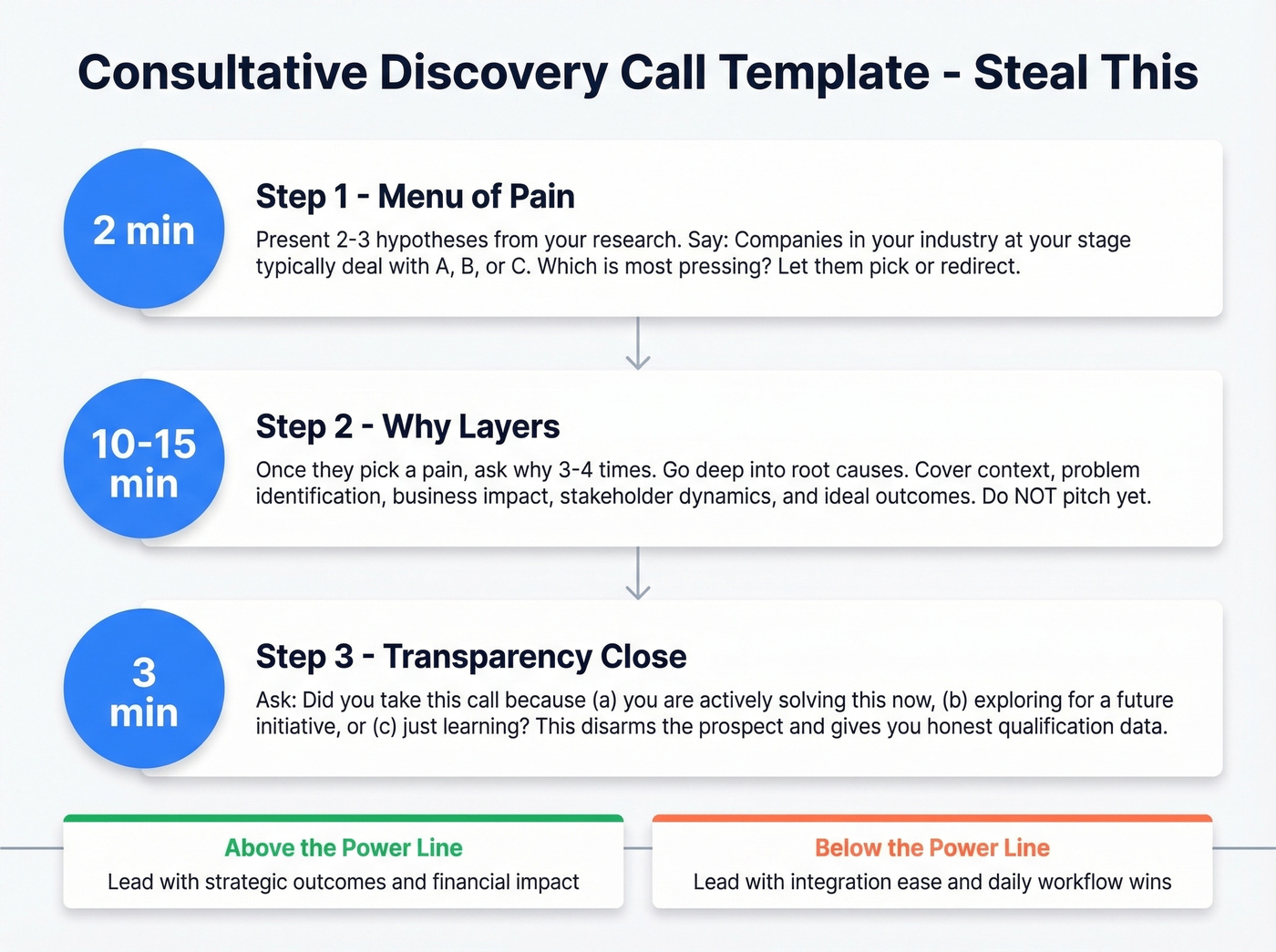
Step 1 - Menu of Pain (first 2 minutes). Present 2-3 hypotheses based on your research. "Companies in [industry] at your stage typically deal with [A], [B], or [C]. Which is most pressing?" Let them pick or redirect.
Step 2 - Why Layers (10-15 minutes). Once they've identified the pain, go deep. Ask "why" 3-4 times. You're looking for root causes, not symptoms. Categorize your questions across context, problem identification, business impact, stakeholder dynamics, and ideal outcomes.
Step 3 - Transparency Close (last 3 minutes). Use a multiple-choice prompt to qualify intent: "Just so I can be helpful - did you take this call because (a) you're actively solving this right now, (b) you're exploring for a future initiative, or (c) you're just learning?" This disarms the prospect and gives you honest qualification data.
For persona adaptation: above the power line, lead with strategic outcomes and financial impact. Below the power line, lead with tactical pain and workflow friction. Same framework, different emphasis.
The transparency close feels counterintuitive. You're giving the prospect permission to say "I'm not ready to buy." But that honesty accelerates your pipeline by killing dead deals early and deepening engagement with real ones. We've seen teams cut their average cycle by two weeks just by qualifying intent honestly on the first call.
Five Obstacles That Kill Consultative Selling
TheSalesBlog identifies five challenges that prevent reps from executing this methodology. The consensus on r/sales echoes the same failure mode - training that systematizes conversations until reps sound robotic.
Lack of business acumen. You can't advise on business problems if you don't understand how businesses work. Reps who can't read a P&L will default to product pitching every time.
Borrowed credibility from the brand. Reps at well-known companies lean on the logo instead of developing their own authority. When they move to a startup, the consultative muscle was never built.
Lack of confidence to advise. Telling a VP they're thinking about a problem wrong requires conviction. Most reps would rather agree and move to the demo.
Conflict aversion. Consultative selling sometimes means surfacing inconvenient truths. A rep who "gets the process" but won't challenge a client's assumptions isn't being consultative - they're being polite.
Insufficient domain knowledge. You need deep expertise to provide genuine counsel. Without it, you're asking about a problem while already planning to solve it with your product. Buyers see through shallow discovery immediately.
Tools That Support Consultative Selling
The process is skill-dependent, but the right tools cut the time investment significantly. 61% of sellers say admin tasks and inefficient processes slow them down most, and reps spend roughly 70% of their time on non-selling tasks. The goal is to automate research and admin so reps can focus on the actual consulting.
Prospect research and data is the foundation. Prospeo covers 300M+ professional profiles with 98% email accuracy and intent data tracking 15,000 topics via Bombora. The 30+ search filters - including technographics, buyer intent, job changes, and headcount growth - mean the research step takes minutes instead of hours.
CRM is where your consultative insights live between conversations. Salesforce, HubSpot, or Close - pick the one that matches your team size. If your discovery notes aren't structured and searchable, you're starting from scratch every call.
Call recording and AI notes from tools like Fathom capture discovery calls and surface key moments automatically. This matters because the insights from call three need to inform call seven. AI-partnered reps are 3.7x more likely to meet quota.
Sales enablement - case studies, ROI calculators, competitive battle cards - makes step 5 work. Without enablement content, even the best consultative rep is pitching with words instead of evidence.
You can't quantify business impact if you're emailing the wrong people. Prospeo delivers 98% email accuracy and 125M+ verified mobile numbers so your consultative approach actually reaches decision-makers - at $0.01 per email, not $1.
Stop losing deals before discovery even starts. Get verified contact data.
Building Your Consultative Playbook
Organizations investing in full sales enablement see 49% higher win rates on forecasted deals. But the moment you reduce consultative selling to a flowchart, you've already lost. The playbook is a scaffold, not a script.
Your playbook should include:
- Defined stages with clear exit criteria that mirror the seven steps above
- Discovery guides organized by persona and industry vertical
- An objection handling repository that evolves with real call data
- Value messaging anchored to case studies with measurable outcomes
- Regular role-play sessions that stress-test the framework against realistic scenarios
Let's be honest about the role-play piece: it's non-negotiable. We've seen teams adopt a consultative methodology on paper and revert to product pitching within two weeks because nobody practiced the hard parts - the "why" layers, the business impact quantification, the moments where you challenge a prospect's assumptions. Practice those specific moments, not the full call flow.
The playbook gives reps a starting point and a shared language. The skill - the part that actually closes deals - develops through repetition, coaching, and honest feedback. No $15K consultant can shortcut that.
FAQ
What's the difference between consultative selling and solution selling?
Consultative selling shapes the buyer's understanding of their problem through dialogue and insight, often redefining it entirely before proposing anything. Solution selling maps product capabilities to stated problems. The consultative approach goes deeper - you might tell a prospect their perceived problem isn't the real issue.
How long does it take to implement a consultative sales process?
Expect 3-6 months for meaningful adoption across a team. The skills develop through structured role-play and coaching, not a single training session. Teams with documented playbooks and weekly practice ramp roughly twice as fast.
Does consultative selling work for transactional deals?
Not well. Skip this approach for deals under $25K with short cycles - BANT is more efficient there. The consultative approach delivers the highest ROI in mid-market and enterprise motions where multiple stakeholders, long evaluation periods, and high switching costs justify the deeper investment.
What's the biggest mistake reps make?
Over-discovery without insight. RAIN Group's research found that diagnosis ranked 40th out of 42 factors separating winners from second-place finishers. Discovery without a point of view is just an interview - bring a hypothesis, not just questions.
What tools help with the research step?
A B2B data platform with verified contact info, technographic data, and buyer intent signals lets reps walk into discovery calls with a genuine hypothesis instead of surface-level prep. Pair that with a CRM for structured notes and a call recorder for insight capture.