

Contact-Level ABM: What It Is, Why Account-Level Falls Short, and How to Do It
Your ABM platform fires a "surge alert" for a target account. Marketing celebrates. Then your SDR opens Salesforce and asks the question that kills momentum: "Who do I actually email?"
That gap - between account-level signal and buyer-level action - is exactly what contact-level ABM exists to close. It requires three things: a mapped buying committee, verified contact data, and role-specific messaging. Miss any one of them and you're just running expensive display ads.
What Contact-Level ABM Actually Is
Most ABM programs target companies showing intent, serve ads to those companies, and hope the right people notice. Contact-level ABM flips the model. It targets the specific humans inside those accounts who influence or make the purchase decision.
You'll see it called contact-based marketing, person-based marketing, or individual-level ABM. They all mean the same thing: stop treating a company as a monolith and start engaging the 5-11 decision makers who actually decide whether to buy.
| Account-Level ABM | Contact-Level ABM | |
|---|---|---|
| Target | Company / logo | Individual buyers |
| Signal | "Acme is surging" | "VP Eng at Acme read 3 competitor pages" |
| Action | Display ads to IP range | Personalized email to VP Eng |
| Measurement | Account engagement score | Contact-level response rates |
Why Account-Level ABM Falls Short
A Forrester study of 163 enterprise ABM leaders found that 58% have, at best, a moderate ability to drive engagement from key accounts. The biggest barrier to moving ABM to the individual decision-maker level? 42% cited limited access to accurate, actionable contact data.
The consequences aren't abstract. 40% of those teams reported stunted pipeline growth, and 38% attributed lost revenue directly to the inability to engage decision-makers. Account-level ABM isn't broken - it's incomplete. It tells you where to focus. A contact-level approach tells you who to reach and what to say.
The Match-Rate Problem Nobody Talks About
Here's the thing: even teams that try to go contact-level hit a wall most vendors won't mention. Match rates. A Go Addressable/CIMM/Truthset study found that IP-to-email matches are accurate only about 16% of the time. Your intent platform correctly identifies the account, but the contact data it resolves is wrong five out of six times.
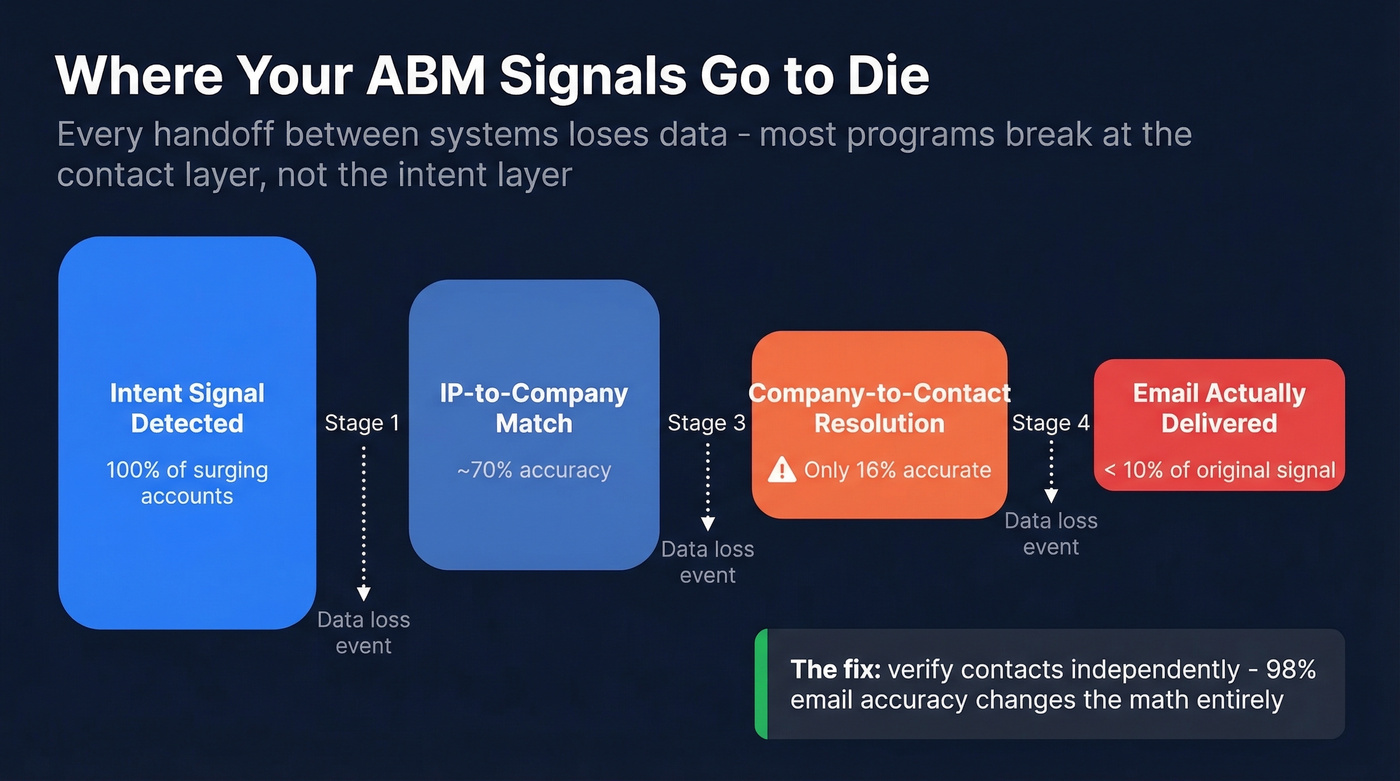
As Yahoo's advertising team has noted, match rate and reach rate aren't the same thing. A 50% match rate doesn't mean 50% of your audience is reachable - every handoff between systems is another data loss event. In our experience, this data quality layer is where most ABM programs break, not the orchestration platform. If the email bounces, the signal was worthless.
Let's be honest: most teams overspend on intent platforms and underspend on contact verification. Intent platforms like 6sense often run around $60K/year. Feeding unverified emails into sequences is just an expensive way to tank your domain reputation.

Most ABM programs overspend on intent and underspend on contact verification. Prospeo delivers 98% email accuracy with a 7-day refresh cycle - so your SDRs reach real buyers, not bounced inboxes. At ~$0.01/email, you spend less verifying an entire buying committee than one day of wasted ad spend on unresolved accounts.
Stop paying $60K/year to identify accounts you can't actually email.
How to Run Contact-Level ABM
One practitioner on r/sales rebuilt their ABM program by unifying data from Salesforce, 6sense, HG Insights, and historical sales notes, then used Mutiny to create personalized microsites. The results in 90 days: 100% reach of target accounts, 56% engagement, and 63% meeting-to-opportunity conversion. Here's the framework that makes those numbers possible.
Map the Buying Committee
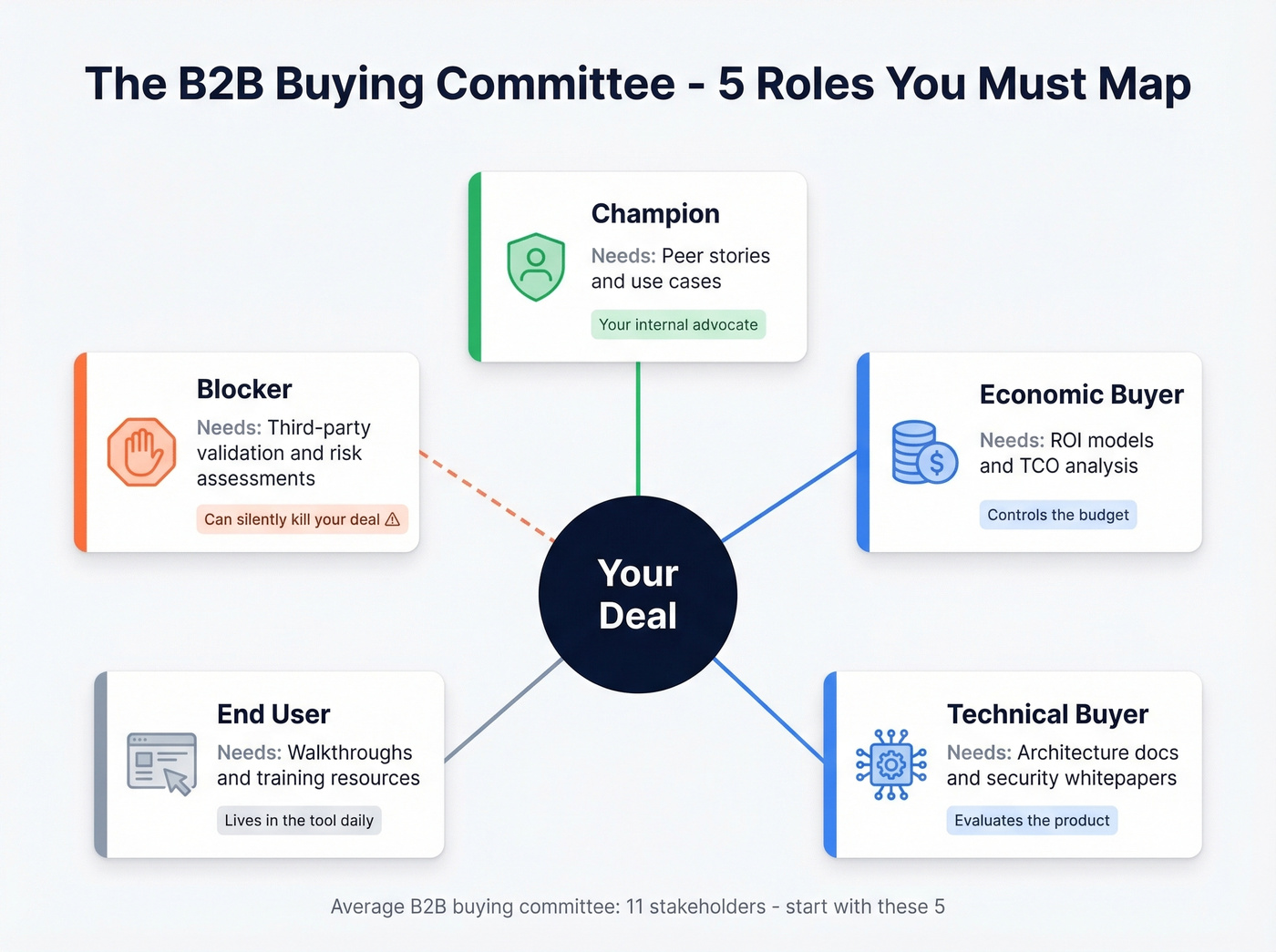
The average B2B buying committee includes 11 stakeholders. You don't need all 11 on day one, but map at least five roles:
| Role | What they need |
|---|---|
| Champion | Peer stories, use cases |
| Economic Buyer | ROI models, TCO analysis |
| Technical Buyer | Architecture docs, security whitepapers |
| End User | Walkthroughs, training resources |
| Blocker | Third-party validation, risk assessments |
Don't deprioritize the Blocker. A skeptical security lead or Salesforce admin can silently kill a deal during evaluation if they feel ignored. Single-threading through one champion is how deals die.
Building a contact matrix - where each row is a target account and each column is a buying committee role - gives your team a clear visual of coverage gaps. We've used this exact format in spreadsheets and it immediately shows which accounts are under-mapped.
Tier Accounts and Segment Contacts
Not every account gets the same treatment. Run 1:1 programs for your top 10-20 accounts with fully custom plays, 1:few for 50-100 accounts grouped by industry or pain point, and 1:many for 100-200+ accounts with programmatic personalization.
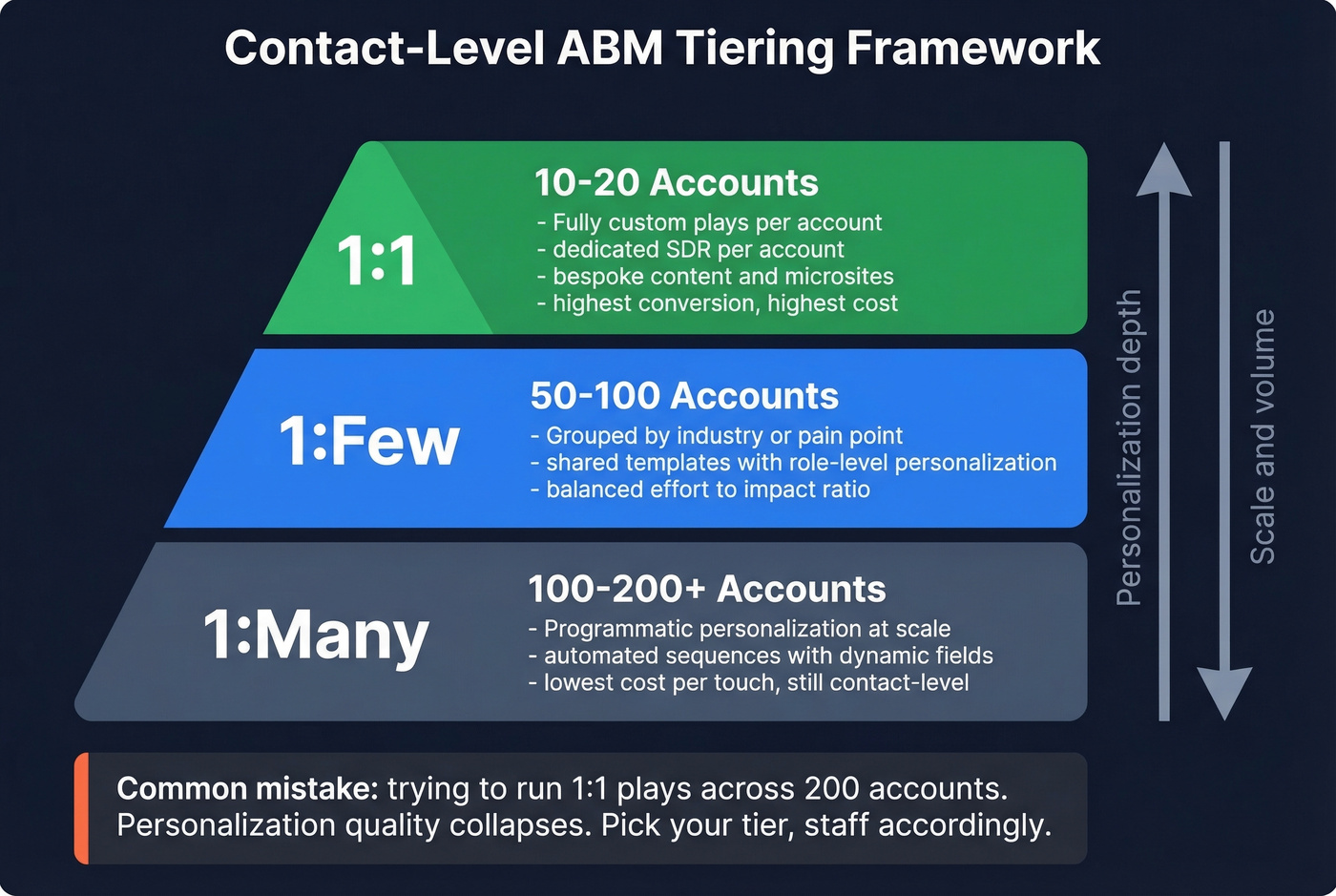
Within each tier, segment contacts by role, seniority, and engagement level so the right message reaches the right person. We've seen teams waste months trying to run 1:1 plays across 200 accounts - the personalization quality collapses and results look worse than a well-executed 1:many program. Pick your tier, staff accordingly, be honest about capacity.
Verify Your Contact Data
Once you've mapped the committee, you need emails that actually land. Prospeo covers 300M+ professional profiles with 98% email accuracy and refreshes data every 7 days, so your SDRs aren't emailing ghosts from six months ago. Upload your target account list, filter by job title and seniority to match buying committee roles, and export verified contacts directly into your CRM or sequencer. With an 83% enrichment match rate and 50+ data points per contact, you're filling committee gaps at scale rather than grinding through one manual search at a time.

Build Role-Specific Messaging
A CFO and a DevOps lead don't care about the same things. Build content tracks per role: ROI calculators for economic buyers, technical documentation for evaluators, peer case studies for champions.
Consider ungating content for target contacts. If you already know who they are, the gate adds friction without adding data. This is counterintuitive for demand gen teams used to measuring MQLs, but in a contact-level ABM motion, you already have the contact - you need engagement, not form fills.
Measure at the Contact Level
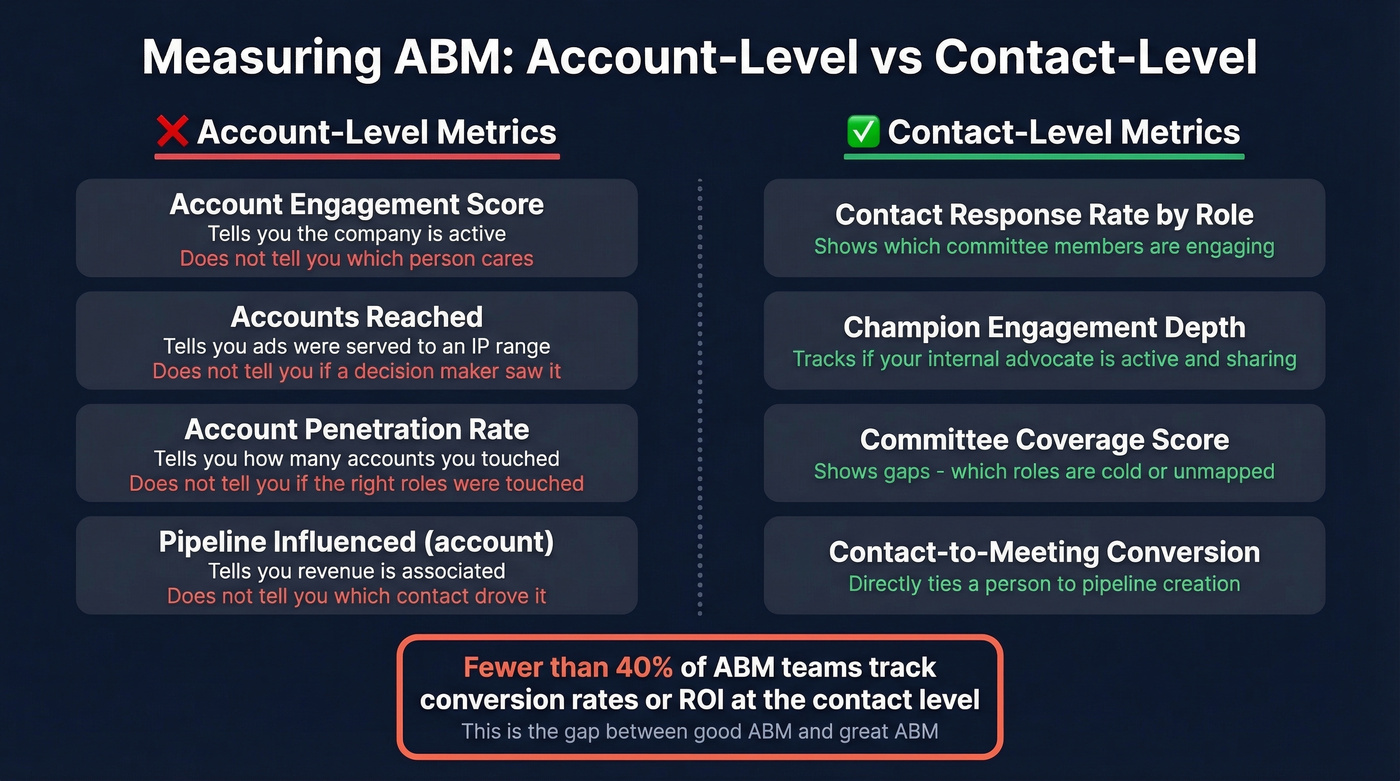
Stop measuring ABM by account engagement scores alone. Track which contacts opened, clicked, replied, and booked. Fewer than 40% of teams track conversion rates or ROI at the contact level. If you can't tell which committee member is engaged and which is cold, you can't give sales the context they need to close.
What Your Tech Stack Needs
You don't need to replace your ABM platform. You need to fix the data feeding it.
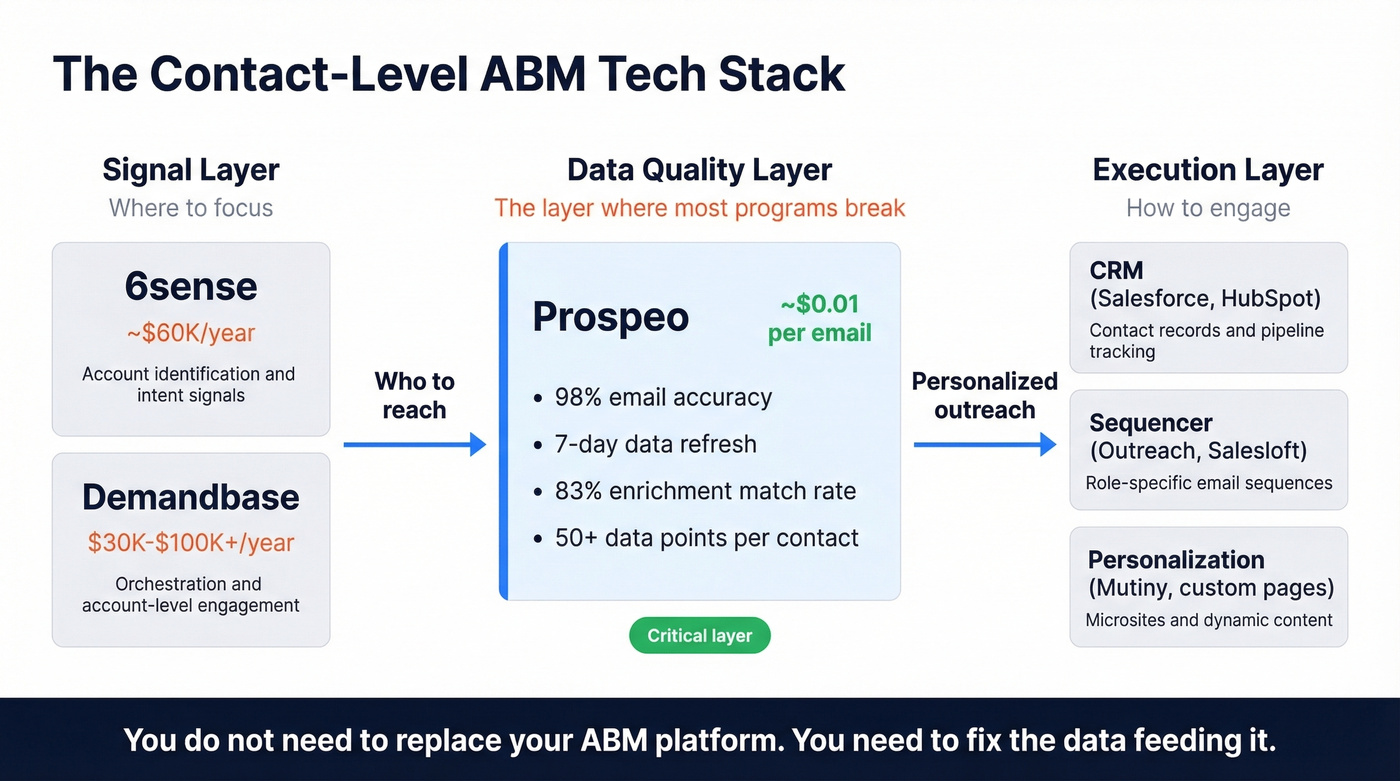
Platforms like 6sense (~$60K/year) and Demandbase (typically $30K-$100K+/year) handle orchestration and intent well. But the data quality layer underneath is where programs break. Prospeo runs at roughly $0.01 per email - a fraction of what enterprise ABM platforms charge - and covers the verified contact data that makes everything downstream work. Its intent data tracks 15,000 topics via Bombora, so you can layer buyer intent signals with job role and company growth filters in a single platform.
Pair it with your existing CRM and sequencer, and you've got a contact-level data foundation without a six-figure commitment.
Skip this if you already have a verified contact database with bounce rates under 5% and weekly refresh cycles. But if your bounce rate is above 8%, your data layer is the bottleneck - not your orchestration. (If you need benchmarks and fixes, see bounce rate and email deliverability.)
Mapping 5-11 stakeholders per account manually is a pipeline killer. Prospeo's 30+ search filters let you target by job title, seniority, and department to fill every buying committee role - champion, economic buyer, blocker - across your entire target account list. 83% enrichment match rate. 50+ data points per contact. Exported straight to your CRM.
Fill every seat on the buying committee before your competitor does.
Privacy and Compliance
Contact-level targeting means you're working with personal data. Collect only what you need, honor opt-outs promptly, and don't repurpose contact data for unrelated outreach. Use GDPR-compliant data sources with enforced opt-out policies - this isn't optional for EMEA contacts, and it's increasingly expected everywhere else. (If you're building processes around this, align with your lead generation workflow and ethics in sales.)
FAQ
What's the difference between contact-level and account-level ABM?
Account-level ABM targets companies as units. Contact-level ABM targets the specific individuals - champions, economic buyers, technical evaluators - who influence or make the buying decision. Every touchpoint is tailored to a real person's role and priorities, not just a company's firmographic profile.
How many contacts should I map per target account?
Start with 3-5 per account covering the champion, economic buyer, and a technical evaluator. For enterprise deals with average contract values above $50K, map closer to the full 11-person committee. Thorough mapping at this stage prevents coverage gaps that stall deals later.
What tools do I need for contact-level ABM?
You need a CRM with clean data, a verified contact database for accurate emails and direct dials, and a way to deliver role-specific content - personalized landing pages, targeted ads, or tailored email sequences. Layer intent data on top to prioritize in-market accounts.