Contact Rate in Outbound Sales: Benchmarks, Formulas, and How to Fix Yours
It's Thursday at 4:15pm. Your SDR has logged 800 dials this week. Two meetings booked. Seventy-two percent of calls went straight to voicemail. Leadership's answer? "Dial more." That's like pouring water into a bucket with a hole in it - the problem isn't effort. It's data, number reputation, and a fundamental misunderstanding of what contact rate in outbound sales actually measures.
The Quick Version
Contact rate formula: Live Contacts / Total Attempts x 100
2026 benchmarks:
- Cold call conversation rate: 2.3%
- Email reply rate: 3.43% average, 5.5% top quartile
- Connect rate range: 5-15% depending on data quality
Fix priority: Data → Number reputation → Timing → Script
If you fix nothing else, fix your data. Bad contact data is the single biggest reason outbound teams underperform, and it's why reps lose huge chunks of productive time to wrong numbers, bounced emails, and people who left the company two quarters ago.
What Is Contact Rate?
Contact rate measures the percentage of outbound attempts that result in a live human interaction:
Contact Rate = (Live Contacts / Total Attempts) x 100
Five hundred dials, 40 live humans - that's an 8% contact rate.
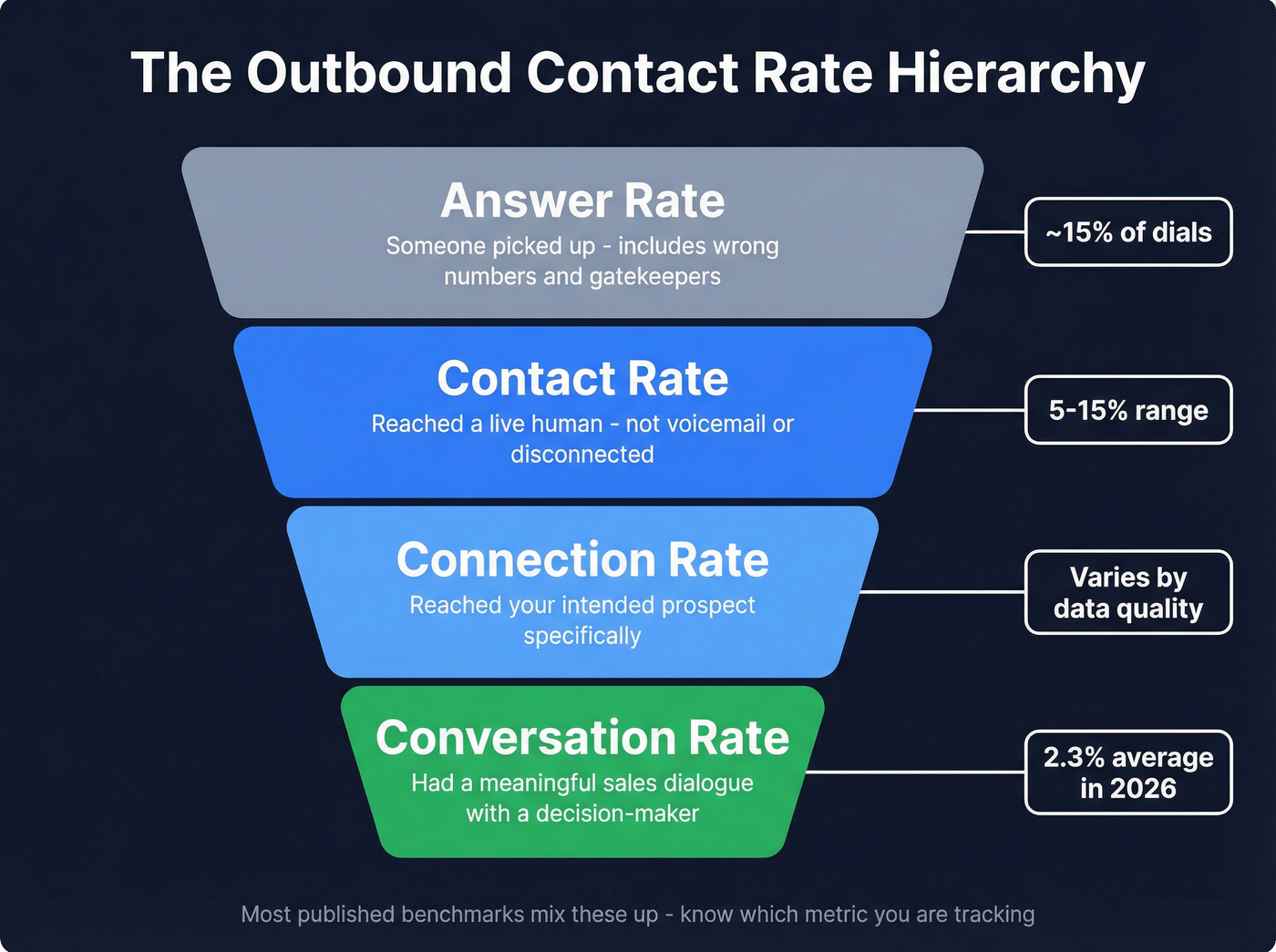
But the metric gets muddied because teams use different names for different things. Here's the hierarchy that actually matters:
- Answer rate - someone picked up, including wrong numbers and gatekeepers
- Contact rate - you reached a live human, not voicemail or a disconnected line
- Connection rate - you reached your intended prospect specifically
- Conversation rate - you had a meaningful sales dialogue with a decision-maker
Most published benchmarks mix these up. When you see "2.3% success rate," that's conversation rate - actual sales dialogues. When teams report "15% connect rate," they usually mean any live pickup. Know which metric you're tracking, or your benchmarks are meaningless. The same confusion applies to the reach rates sales teams report internally - some count any pickup, others only count verified decision-maker conversations.
2026 Benchmarks by Channel
Phone
| Metric | Benchmark |
|---|---|
| Conversation rate | 2.3% |
| Connect rate range | 5-15% |
| Meeting booking rate | 1-3% |
| Calls per appointment | 209 |
| Don't reach a human | 72% |
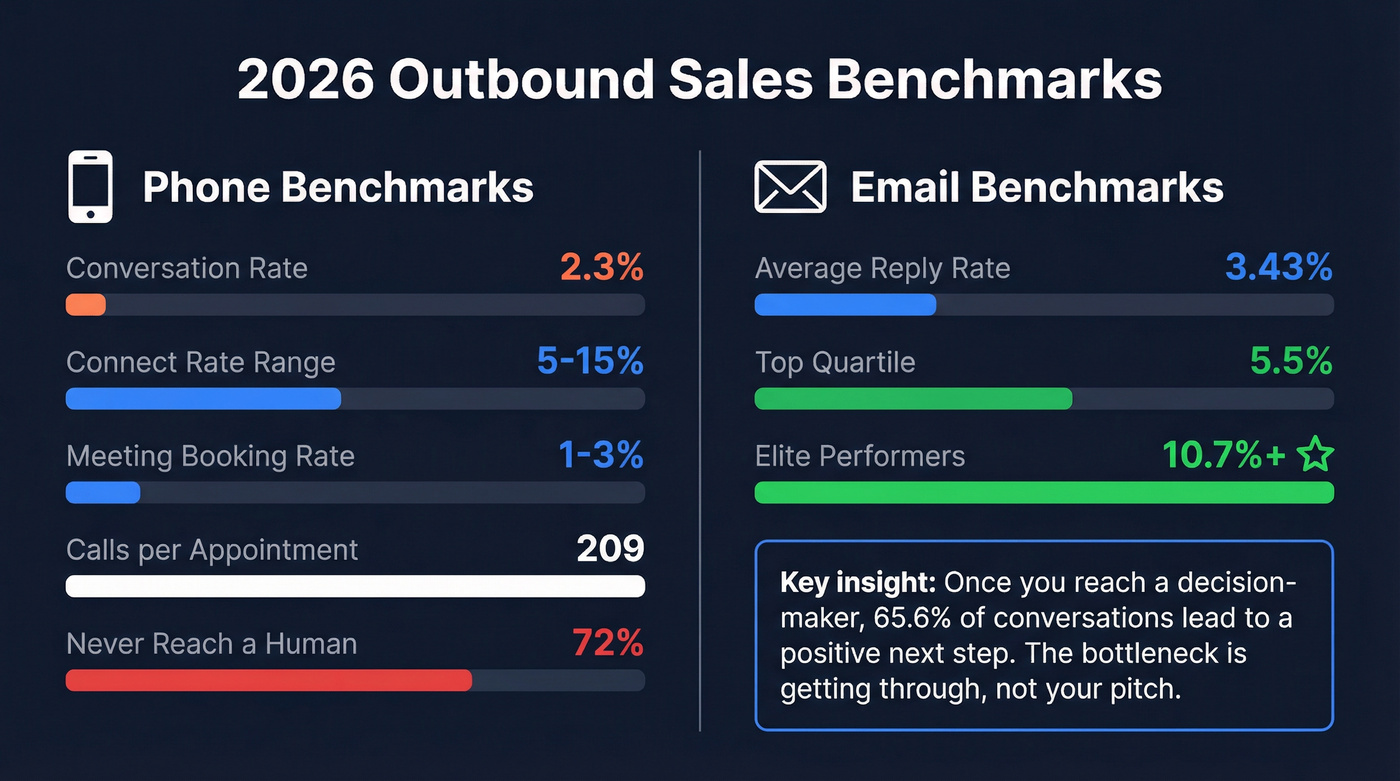
That 2.3% conversation rate is down from 4.82% the prior year - a brutal decline driven by B2B contact data decay and the spam-labeling crisis. But here's the number that should reframe your entire approach: once you actually reach a decision-maker, 65.6% of conversations lead to a positive next step. The bottleneck isn't your pitch. It's getting through.
SaaS teams typically see higher connect rates (8-15%) thanks to direct-dial availability, while regulated industries like insurance and financial services often land at 3-8% due to compliance-driven call screening.
| Metric | Benchmark |
|---|---|
| Average reply rate | 3.43% |
| Top quartile | 5.5% |
| Elite performers | 10.7%+ |
One caveat on open rates: Apple Mail Privacy Protection inflates them by roughly 18 percentage points. Track reply rate instead - it's the only email metric that actually correlates with pipeline.
If your team's hitting 8%+ connect rate on phone and 5%+ reply rate on email, you're in the top quartile. Below 5% connect rate? The problem is almost certainly upstream - your data or your number reputation, not your script.
Here's the thing: only 27-30% of B2B reps hit quota in 2024. Most sales orgs responded by hiring more reps or demanding more dials. Wrong answer. A team of five SDRs with verified data will outproduce a team of fifteen dialing garbage lists every single time.

72% of your dials never reach a human. The fix isn't more dials - it's better data. Prospeo's 125M+ verified mobile numbers deliver a 30% pickup rate vs. the 12% industry baseline, and every record refreshes every 7 days so you're never dialing someone who left two quarters ago.
Triple your connect rate this week - not next quarter.
Why Your Contact Rate Is Dropping
Bad Data Is the #1 Killer
B2B data decays roughly 22.5% per year. Thirty percent of employees switch jobs annually. That "verified" list you bought six months ago? Nearly a quarter of it is already wrong.
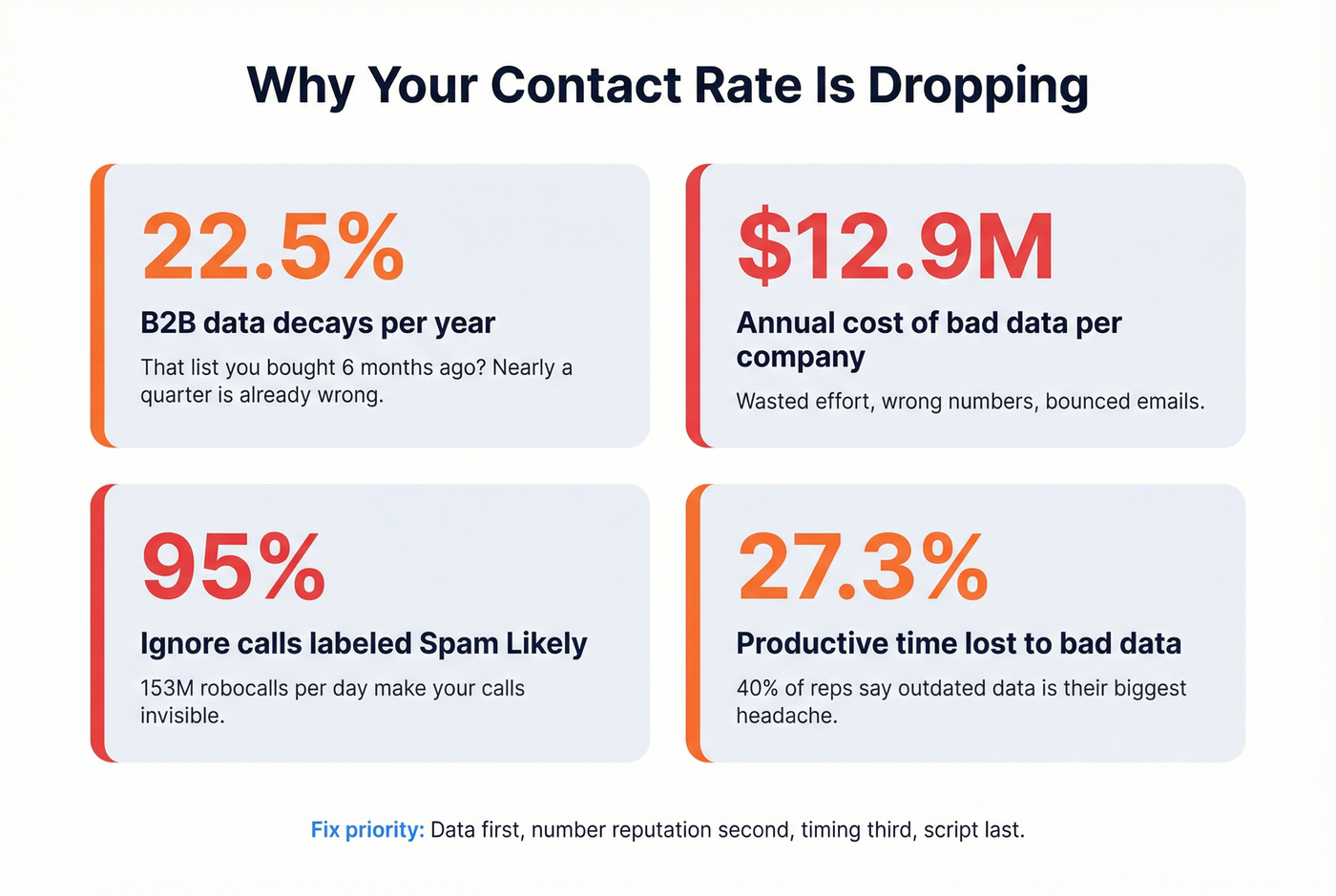
Sales reps lose 27.3% of their productive time to bad contact data - wrong numbers, bounced emails, people who left the company two quarters ago. For the average company, that translates to $12.9M per year in wasted effort and lost revenue. We've watched teams spend entire quarters blaming scripts and objection handling when the real culprit was a stale list purchased from a provider that refreshes data every six weeks. And 40% of reps say outdated data is their single biggest headache - not objection handling, not competition. Data.
The Spam Labeling Crisis
Even with clean data, your calls might never ring through. Eighty percent of unidentified calls go unanswered. When a call gets labeled "Spam Likely," 95% of recipients ignore it entirely.
Americans receive approximately 153 million robocalls per day. In H1 2024, Hiya's network flagged around 20 billion calls as suspected spam - 107 million daily. Your legitimate outbound calls are swimming in that ocean of garbage.
What triggers the label? High call volume from a single number, low answer rates that create a vicious cycle, ultra-short call durations, and bad data leading to disconnected numbers. Numeracle completed 161,440+ spam-label remediations in 2025 across 1,032,800+ phone numbers, a 44% increase year-over-year. This isn't a niche problem - it's an industry-wide crisis that the consensus on r/sales confirms is getting worse, not better.
How to Improve Your Contact Rate
Stop obsessing over dial volume. More dials into bad data just burns your numbers faster. Four levers, in priority order.
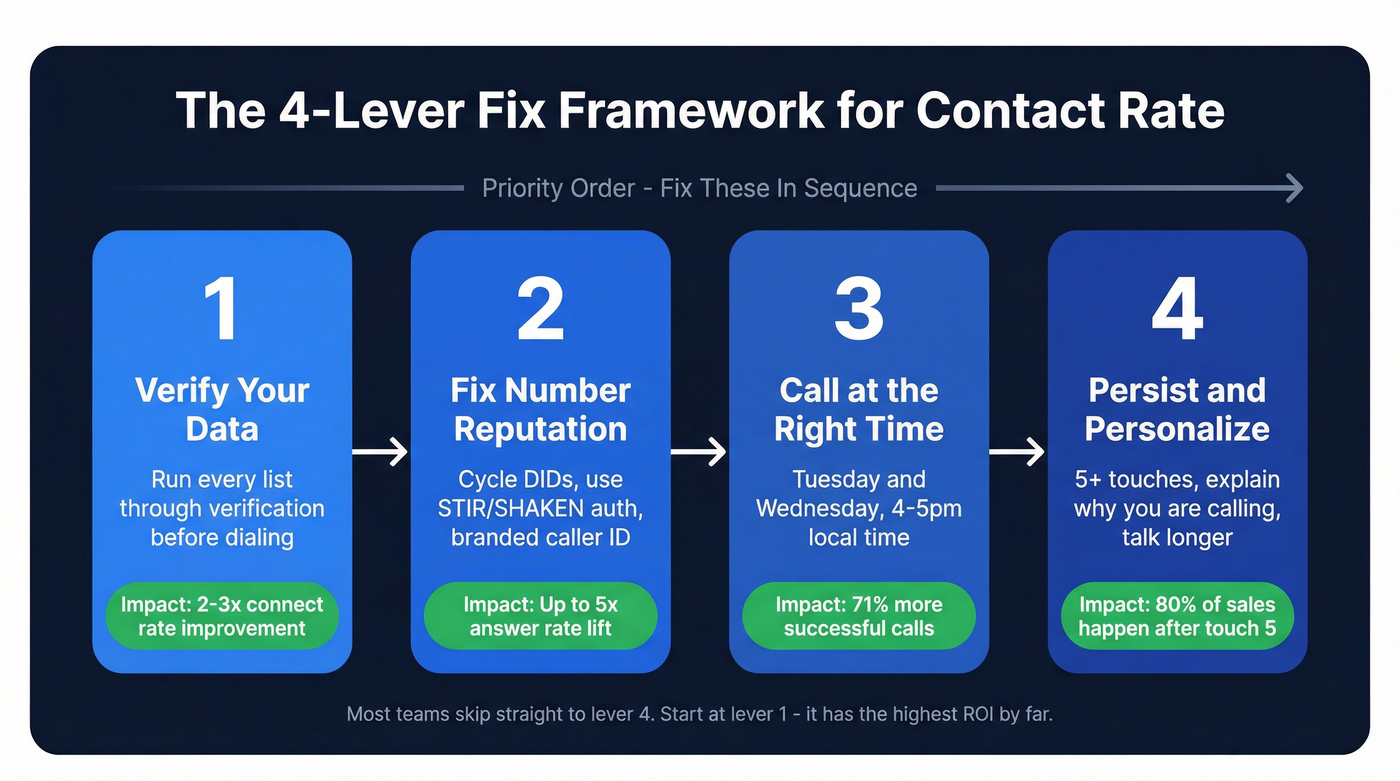
1. Verify Your Data First
Before your next dial session, run your list through a verification tool. This is the single highest-ROI activity in outbound.
Meritt, an outbound agency, was running a 35% email bounce rate before switching to verified data. After implementing Prospeo's verification, bounce rate dropped under 4% and connect rates tripled to 20-25%. GreyScout saw a similar pattern - bounce rate from 38% to under 4%, pipeline up 140%. In our experience, teams that verify data before dialing see 2-3x improvements within the first week. That's not a gradual curve. It's immediate.
Prospeo's database covers 125M+ verified mobile numbers with a 30% pickup rate across all regions, compared to the roughly 12% industry baseline. Email accuracy runs at 98% through a 5-step verification process that catches spam traps and honeypots before they tank your sender reputation. Records refresh on a 7-day cycle - compared to the 6-week industry average - so you're dialing data that's actually current.
2. Fix Your Number Reputation
If your calls are getting flagged, no amount of data quality will save you.
Implement a DID lifecycle management strategy: automatically procure fresh numbers, rest underperforming ones, and cycle DIDs before they get burned. Don't hammer 200 daily dials through a single number. Use STIR/SHAKEN authentication - properly authenticated calls can see answer rates jump up to 5x compared to unauthenticated ones. Branded calling, where your company name displays instead of just a number, is gaining traction fast. If you're running any kind of volume, caller ID reputation management is infrastructure, not a nice-to-have.
Skip this lever if you're a small team doing under 50 dials a day. Your numbers probably aren't getting flagged yet. Focus on data quality and timing instead.
3. Call at the Right Time
ZoomInfo analyzed 1.4M+ outbound calls and found clear patterns. Tuesday is the best day overall - Tuesday and Wednesday combined produced 44% of all demos. Friday is the worst day on every metric.
Calls between 4-5pm are 71% more successful than other time slots. That late-afternoon window catches prospects wrapping up their day, more willing to take a quick call. But these are averages. Your prospects might span three time zones. Test your own data by segment and adjust.
4. Persistence Beats Perfection
Eighty percent of sales occur after the fifth touch. Most reps quit after two. That gap is where deals die.
When you do connect, talk longer. Successful cold calls average 5:50 in duration versus 3:14 for failed ones. Explaining why you're calling - a specific, relevant reason - makes you 2.1x more likely to succeed. "I noticed your team just expanded the SDR org" beats "I'm reaching out to see if you have 15 minutes" every time. Build sequences that weave phone, email, and social touches together, and verify emails before sending so bounces don't tank your domain reputation.
Bad data costs the average company $12.9M/year in wasted effort. Meritt cut their bounce rate from 35% to under 4% and tripled connect rates to 20-25% with Prospeo's 5-step verified data. At $0.01 per email, fixing your contact rate costs less than one dead dial session.
Stop blaming scripts when the problem is your list.
How to Track Contact Rate
Track in your CRM using Salesforce activity reports or HubSpot call outcomes. The three metrics that matter:
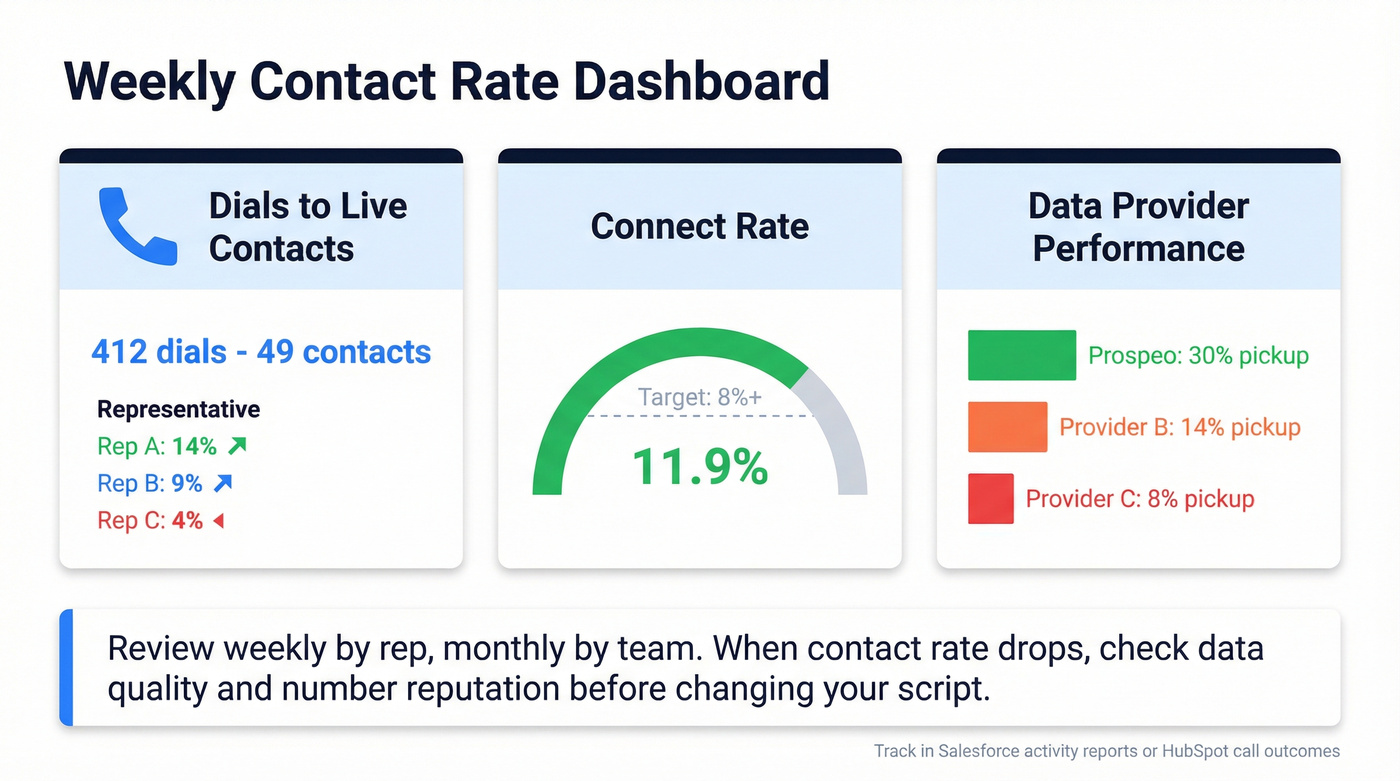
- Dials to live contacts - broken down by rep, by day, and by list source
- Connect rate - benchmarked against 8%+ as a target
- Data provider performance - which sources produce the highest reach rates
Review weekly by rep, monthly by team. When your outbound contact rate drops, check CRM hygiene and number reputation before you change your script or increase dial targets. Nine times out of ten, the problem is upstream. Let's be honest - most managers default to "dial harder" because it's easier than auditing data pipelines. Don't be that manager.
FAQ
What's a good contact rate for cold calling?
A 5-15% connect rate is the typical range for outbound teams in 2026. Top performers consistently hit 8%+, while the average conversation rate sits at 2.3%. Below 5% connect rate, fix your data and number reputation before touching your script.
What's the difference between contact rate and connection rate?
Contact rate measures any live human interaction from your dials. Connection rate means reaching your intended prospect specifically. A 10% contact rate with a 50% right-person rate equals a 5% true connection rate - the metric that actually predicts pipeline.
How does data quality affect contact rate?
B2B data decays 22.5% per year, making it the single biggest drag on outbound performance. Teams using verified mobile numbers consistently see 2-3x higher connect rates. Meritt tripled their connect rate to 20-25% after switching to verified data with a 7-day refresh cycle.
How many dials does it take to book a meeting?
On average, 209 calls to book one appointment. That number drops dramatically with better data - teams running verified direct dials against in-market buyers can cut it to 60-80 calls per meeting by eliminating wrong numbers and outdated contacts from their lists.