

Cost Per Customer: The Only Guide With Actual Numbers
You just got out of a board meeting. The CEO asked, "What does it cost us to get a customer?" You said $180. The real number - once you add SDR salaries, tooling, and that agency retainer nobody tracks - is closer to $540.
That gap is where bad decisions live.
Customer acquisition costs jumped 40-60% between 2023 and 2025, and digital ad costs climbed another 5.13% on top of that. The average B2B SaaS sales cycle now stretches to 134 days, up from 107 in early 2022. Every extra day in that cycle is money piling up against your cost per customer - and most teams aren't measuring it right.
The Quick Version
- "Cost per customer" is the plain-English term for Customer Acquisition Cost (CAC).
- Simple formula: (Sales + Marketing Costs) / New Customers.
- Benchmarks: B2B SaaS ~$239 combined, ecommerce ~$86, financial services ~$784.
- CAC rose 40-60% between 2023 and 2025. It's not going back down.
- The metric that matters more than CAC itself: CAC payback period - how fast you earn it back.
What Is Cost Per Customer?
Cost per customer is exactly what it sounds like: how much money you spend to turn a stranger into a paying customer. In finance and ops circles, it goes by Customer Acquisition Cost (CAC), or CAC. Same metric, different packaging. You'll also hear "consumer acquisition cost" in DTC contexts or "client acquisition cost" in services businesses - the underlying math is identical.
The confusion starts when people mix it up with related-but-different acronyms. One B2B distributor on Reddit reported a $385-$415 cost per new customer on a $3,500 SKU and wasn't sure if that was good or bad. Without knowing their LTV, neither can we. But the bigger issue is that people constantly confuse CPA, CPL, and CAC, which leads to wildly misleading "benchmarks."
| Term | What It Measures | Scope |
|---|---|---|
| Cost Per Customer (CAC) | All sales + marketing spend / new customers | Business-level, strategic |
| CPA (Cost Per Acquisition) | Campaign spend / conversions | Campaign-level, tactical |
| CPL (Cost Per Lead) | Spend / leads generated | Lead-stage only |
Here's the distinction that actually matters: CPA is tactical, CAC is strategic. Your Facebook CPA tells you whether a campaign is efficient. Your CAC tells you whether your acquisition model is financially viable.
How to Calculate It
Not all CAC calculations are created equal. The right one depends on who's asking and what decisions they're making. We use a three-tier framework that scales from napkin math to board-ready reporting.
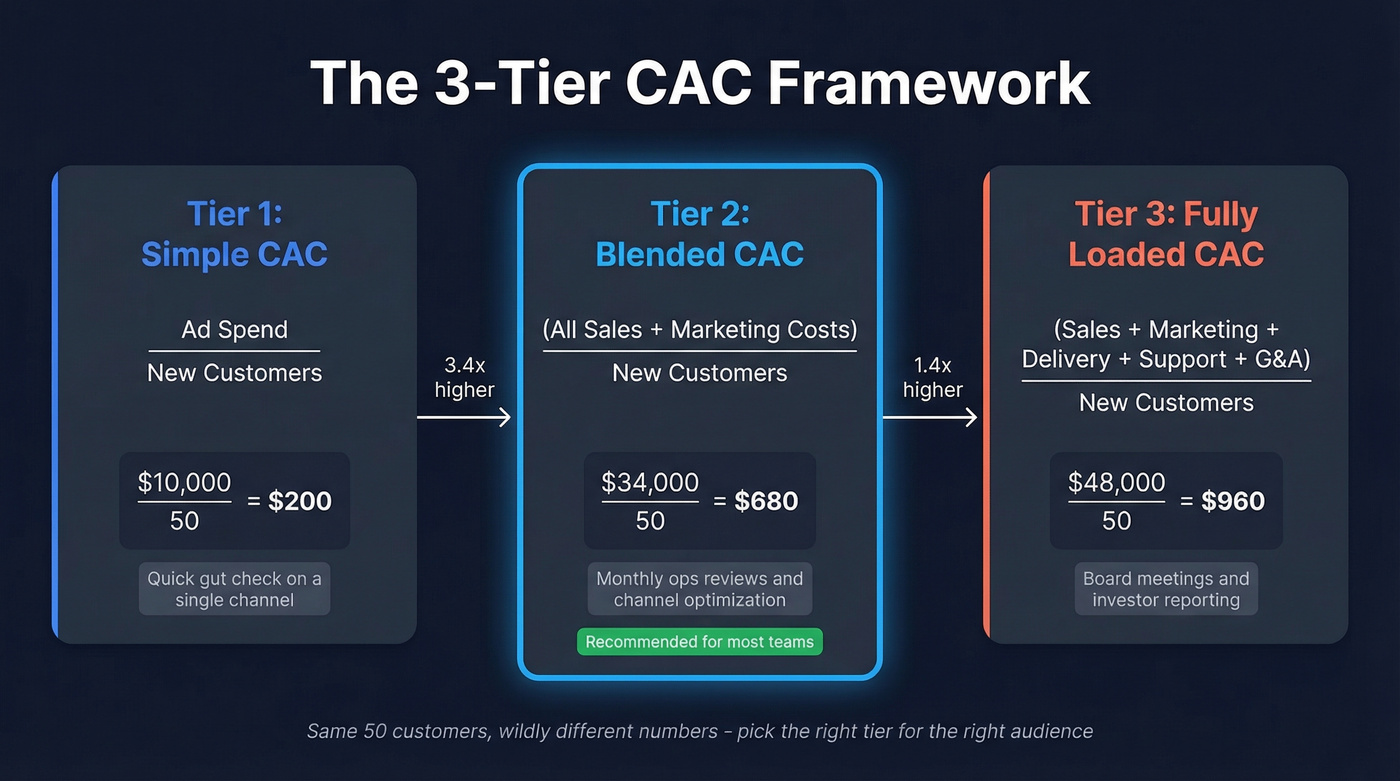
Tier 1: Simple CAC
Formula: Ad Spend / New Customers
You spent $10,000 on Google Ads last month and acquired 50 customers. Simple CAC = $200. Useful for a quick gut read on a single channel, but it ignores everything else your team spends to close deals.
Tier 2: Blended CAC
Formula: (All Sales + Marketing Costs) / New Customers
Same company, but now you add the SDR team's $15,000 monthly salaries, your $2,000 CRM and tooling bill, the content writer at $4,000, and that $3,000 agency retainer. Total: $34,000. Same 50 customers. Blended CAC = $680.
That's 3.4x the simple number. This is the version you should use for channel optimization and monthly ops reviews. It's also the version that makes most teams uncomfortable, because the true acquisition expense is always higher than expected.
Tier 3: Fully Loaded CAC
Formula: (Sales + Marketing + Product Delivery + Support + Infrastructure + G&A) / New Customers
Now add onboarding costs, customer support for new accounts, infrastructure, and a slice of G&A. That $34,000 becomes $48,000. Same 50 customers. Fully loaded CAC = $960. This is the number your CFO and investors want.
The denominator matters as much as the numerator. A "customer" is a contracted, paying customer - not an MQL, not a free trial signup, not a paid pilot. If you're fuzzy on that definition, your CAC is meaningless.
What Costs to Include
Most teams undercount. Here's the full checklist for a blended CAC calculation:
- Paid media - ads, sponsorships, paid placements
- Salaries - marketing, sales, SDRs, BDRs proportional to acquisition work
- Software and tools - CRM platforms running $50-$300 per user per month, email verification and data tools, sequencing software, analytics
- Commissions and bonuses - anything tied to closing new business
- Agency fees - creative, media buying, SEO, PR
- Event costs, conference sponsorships, and trade show booths
- Creative production including design, video, and copywriting
- Demos and physical product samples for sales-led motions
- Product acquisition cost - free trials, freemium tiers, and sample units that serve as lead-generation tools
For fully loaded CAC, layer in customer support allocated to new accounts, onboarding and implementation labor, infrastructure costs tied to new customer provisioning, and a proportional slice of G&A.
The line between "acquisition cost" and "operating cost" gets blurry. The key is consistency - pick a definition and stick with it quarter over quarter.
2026 Benchmarks by Industry
Benchmarks are only useful if they're specific. "Average CAC is $200-$500" tells you nothing. Let's break down what the numbers actually look like.
Industry-Level Data
This data draws from FirstPageSage CAC benchmarks republished by HubSpot:
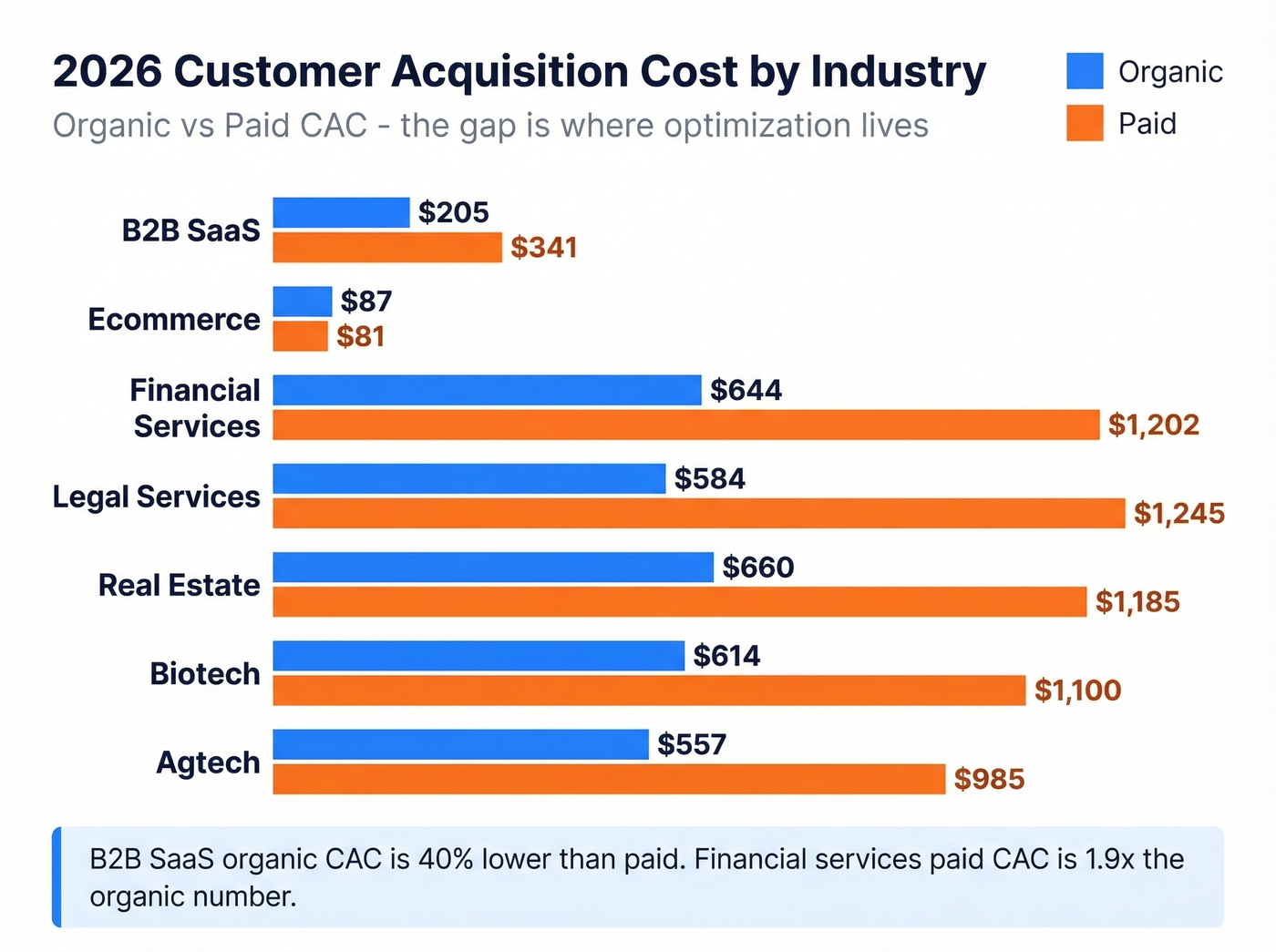
| Industry | Organic CAC | Paid CAC | Combined CAC |
|---|---|---|---|
| B2B SaaS | $205 | $341 | $239 |
| Ecommerce | $87 | $81 | $86 |
| Financial Services | $644 | $1,202 | $784 |
| Legal Services | $584 | $1,245 | $749 |
| Real Estate | $660 | $1,185 | $791 |
| Agtech | $557 | $985 | $712 |
| Biotech | $614 | $1,100 | $743 |
| Higher Education | - | - | ~$1,423 |
B2B SaaS organic CAC runs about 40% lower than paid CAC. Financial services paid CAC is roughly 1.9x the organic number. These gaps are where optimization lives - and they're invisible in a blended metric.
Benchmarks by Channel
Channel-level CAC is where most teams find their biggest wins and their biggest waste.
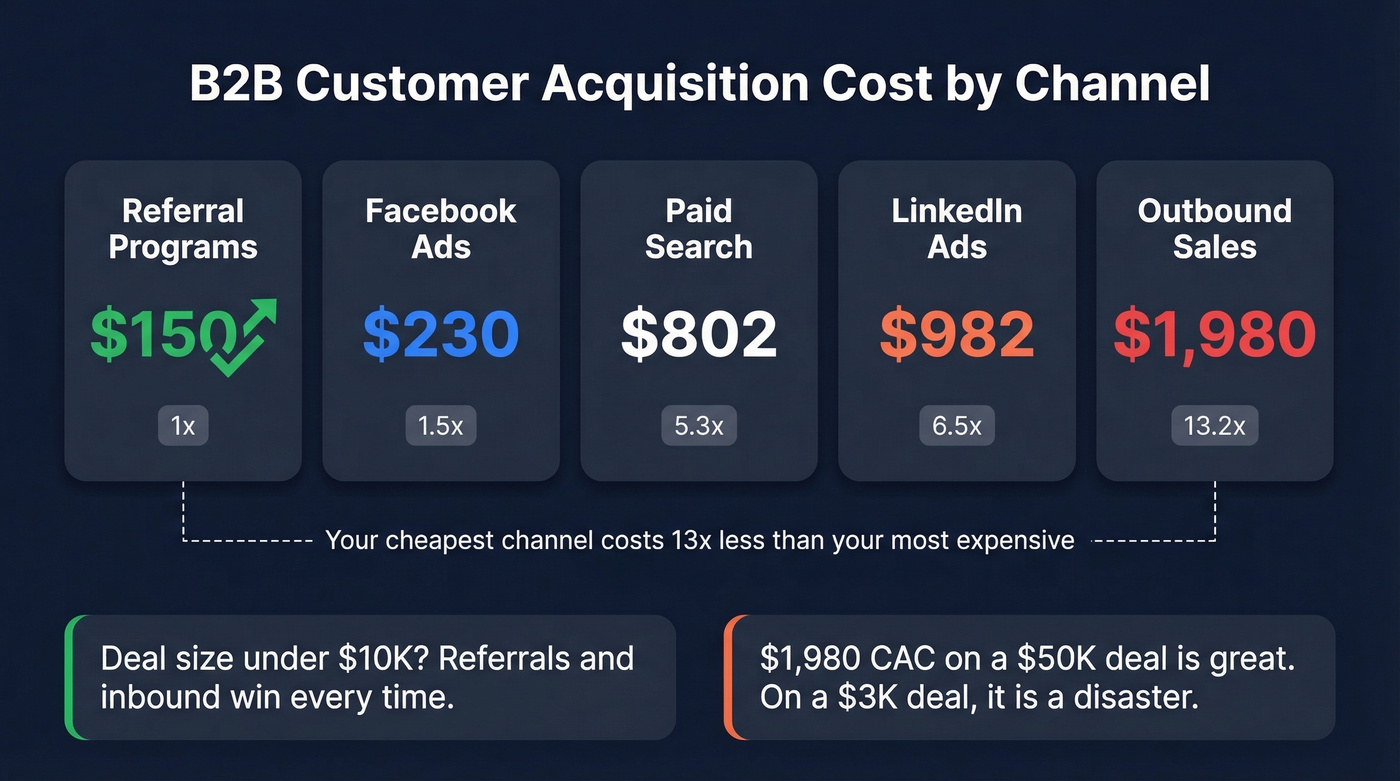
| Channel | Avg B2B CAC |
|---|---|
| Referral Programs | $150 |
| Facebook Ads | $230 |
| Paid Search | $802 |
| LinkedIn Ads | $982 |
| Outbound Sales | $1,980 |
Your cheapest channel costs 13x less than outbound. That doesn't mean outbound is bad - a $1,980 CAC on a $50,000 ACV deal is excellent. But a $1,980 CAC on a $3,000 deal is a disaster. Context is everything.
Here's our honest take: most B2B teams with deal sizes under $10K shouldn't be running outbound at all. The math rarely works. They'd be better off investing that SDR budget into referral programs and content-driven inbound, where the CAC is 5-10x lower.
SaaS-Specific Benchmarks
The median SaaS company now spends $2.00 to acquire $1 of new ARR - up 14% in 2024 alone. Fourth-quartile companies spend $2.82 per dollar of new ARR.
Vertical extremes tell the real story. Fintech SaaS CAC runs $1,461 for SMB deals and $14,772 for enterprise. Legaltech sits at $299. Medtech: $921. Security: $805. If you're benchmarking your fintech startup against a legaltech average, you'll think you're failing when you're actually performing fine for your vertical.

Tooling costs are a direct line item in your CAC formula. Most B2B data platforms charge $1+ per lead with 79-87% accuracy - which means you're paying twice: once for the data, again for the bounces killing your domain. Prospeo delivers 98% verified emails at $0.01 each, with a 7-day refresh cycle that keeps your data clean.
Stop inflating your CAC with bad data and overpriced tools.
CAC Payback Period
Raw CAC is half the picture. A $500 CAC that pays back in two months is dramatically better than a $100 CAC that takes eight months to recover.
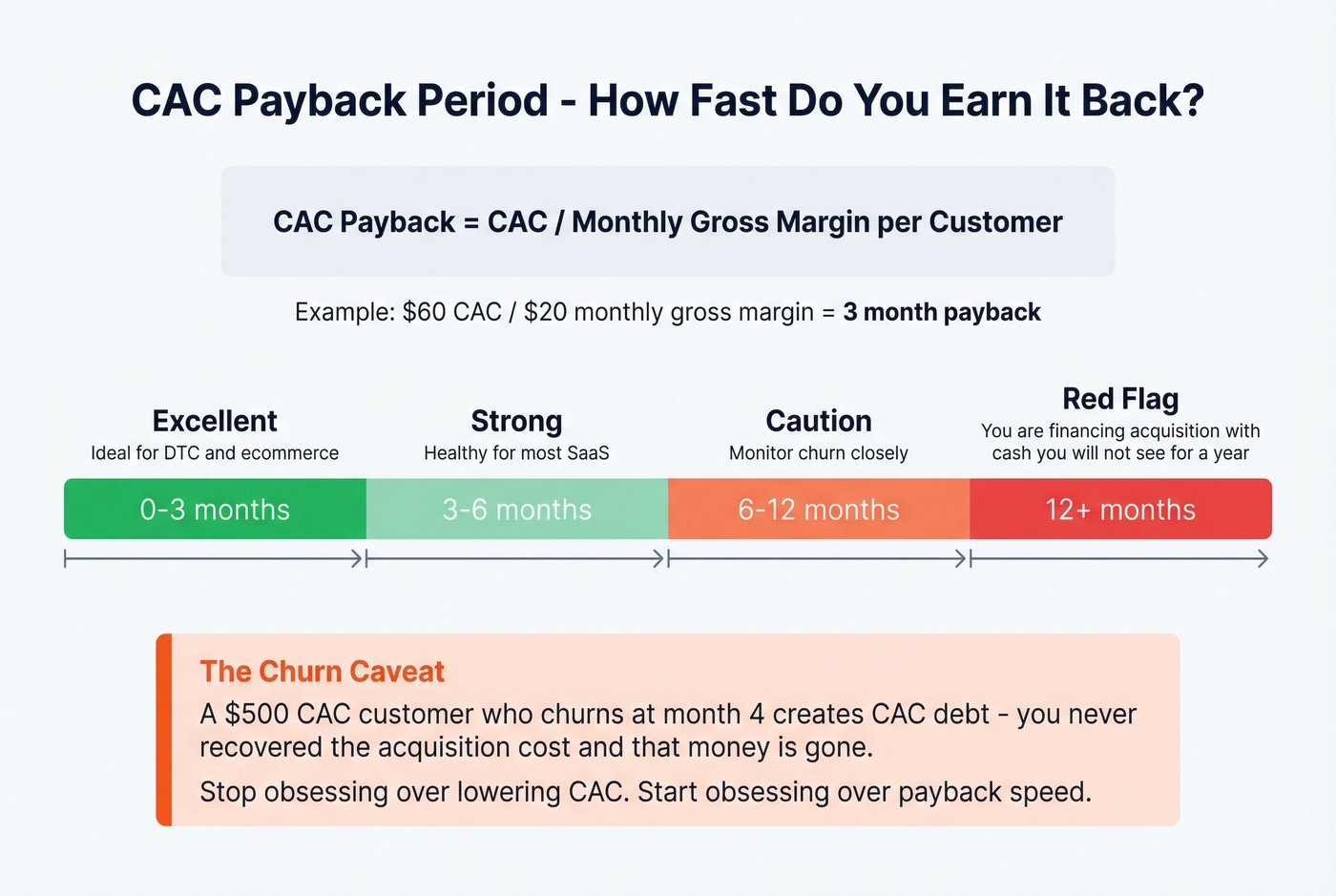
The Formula
CAC Payback = CAC / Monthly Gross Margin per Customer
Your CAC is $60 and each customer generates $20/month in gross margin. Payback period = 3 months. You've recovered your acquisition investment by month three, and everything after that is profit contribution.
What "Good" Looks Like
For DTC and ecommerce, under 3 months is ideal. Under 6 months is strong. Over 12 months is a red flag - you're financing customer acquisition with cash you won't see for a year.
For SaaS, use subscription gross margin percentage and factor in your churn rate. A 75% gross margin SaaS product with $200 CAC needs about $267 in cumulative revenue to pay back - roughly 3-4 months at a $75/month price point.
The Churn Caveat
Most payback calculations ignore churn, and that's dangerous. A $500 CAC customer who churns at month four has created CAC debt - you never recovered the acquisition cost, and that money is gone. Traditional payback also ignores the time value of money. A 12-month payback at a 15% cost of capital is worse than the raw number suggests.
Stop obsessing over lowering CAC. Start obsessing over CAC payback period speed.
LTV:CAC Ratio
The 3:1 LTV:CAC ratio is the benchmark everyone cites, and it's a reasonable starting point. For every dollar you spend acquiring a customer, that customer should generate at least three dollars in lifetime value.
But context matters more than the ratio itself. Early-stage companies intentionally operate at 1:1 or even below - they're buying growth and market share, not optimizing for margin. Mature companies should aim for 5:1 or higher. And a 10:1 ratio sounds great until you realize it means you're underinvesting in growth and leaving market share on the table.
We've seen teams obsess over hitting exactly 3:1 when their real problem was a 14-month payback period. The ratio is a guardrail, not a target. Pair it with payback period and channel-level CAC for the full picture.
Five Mistakes That Inflate CAC
Most CAC calculations are wrong. If you're only dividing ad spend by customers, you're lying to yourself and your board.
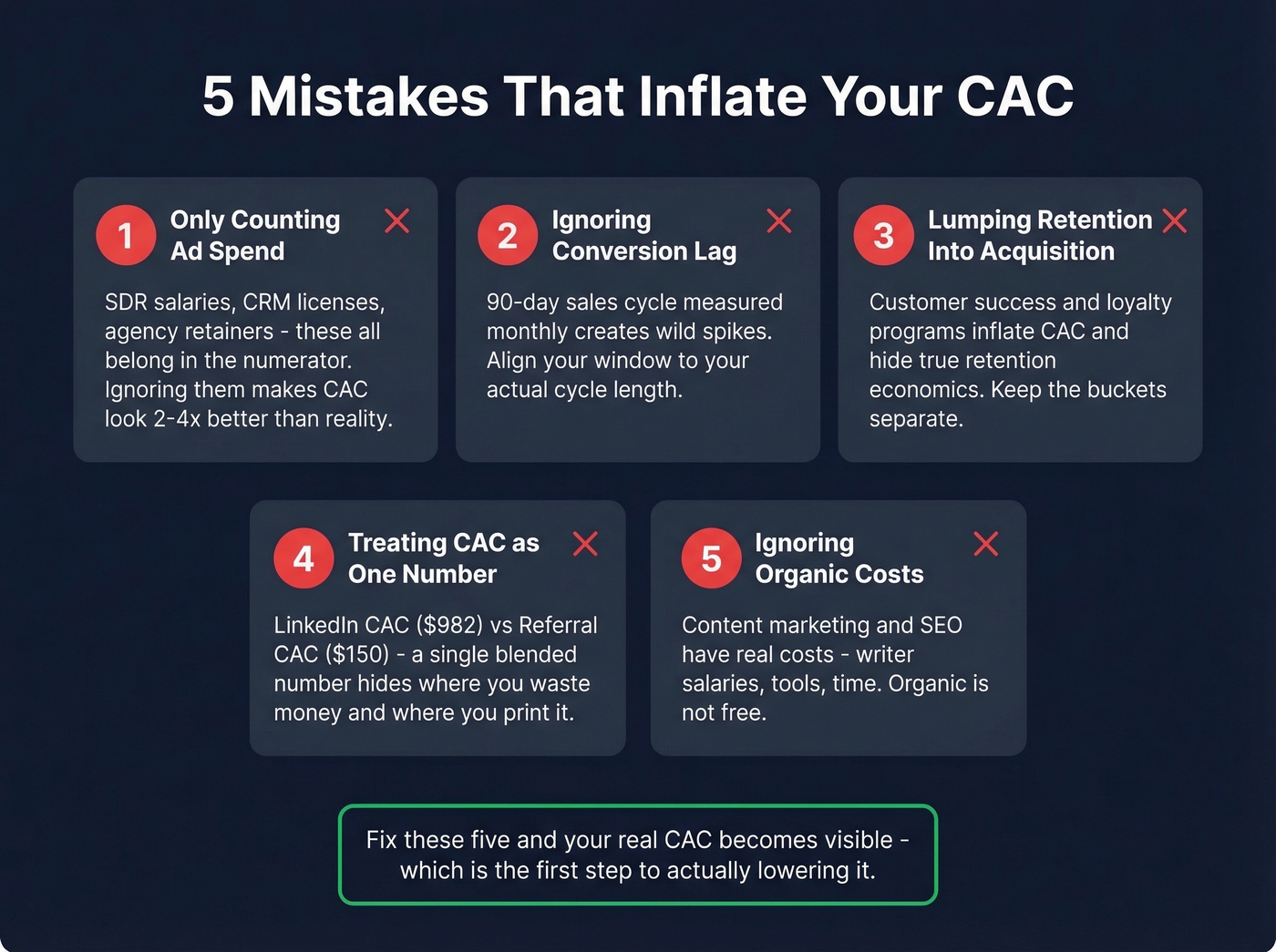
1. Only counting ad spend. Your SDR's $80,000 salary, your CRM license, your agency retainer - those are all acquisition costs that belong in the numerator. Ignoring them makes your CAC look 2-4x better than reality.
2. Ignoring conversion lag. If your sales cycle is 90 days but you're measuring CAC monthly, you'll see wild spikes and valleys that don't reflect actual performance. Align your measurement window to your average sales cycle length.
3. Lumping retention spend into acquisition. Customer success, loyalty programs, brand campaigns aimed at existing customers - these inflate CAC and hide your true retention economics. Keep the buckets separate.
4. Treating CAC as one number. Your LinkedIn Ads CAC ($982) is wildly different from your referral CAC ($150). A single blended number masks where you're wasting money and where you're printing it.
5. Ignoring organic costs. Content marketing and SEO aren't free. Writer salaries, tooling, design, distribution - all acquisition costs. "Organic" just means you're paying with labor instead of ad dollars.
How to Reduce Your Cost Per Customer
Lowering CAC isn't about cutting budgets. It's about eliminating waste and doubling down on what converts.
Invest in Referrals and Personalization
At $150 CAC versus $1,980 for outbound, referral programs are the highest-return channel most teams underinvest in. Referrals can cut CAC by roughly 15% even as a secondary channel. Pair that with personalized landing pages and segmented nurture sequences - personalized experiences lift conversion rates, which directly compresses acquisition costs without touching your spend.
Fix Your Data Quality
Every bounced email and disconnected phone number is wasted SDR salary. Your SDR costs $80/hour fully loaded. If half their dials hit disconnected numbers, that's $40/hour in wasted spend quietly inflating your CAC.
Prospeo verifies emails at 98% accuracy and provides 125M+ verified mobile numbers with a 30% pickup rate - at roughly $0.01 per lead. Cleaning your prospect data before outreach is one of the fastest ways to cut acquisition costs without changing your strategy.
Optimize Channels and Conversions
Kill channels running 3x or more above your average CAC - unless the deal sizes justify it. Redirect that budget to your lowest-cost channels. Simultaneously, work the conversion side: A/B test landing pages, tighten qualification criteria, fix your demo-to-close handoff. A 20% conversion rate improvement drops CAC by ~17%. Same spend, more customers, lower number.
Shorten Cycles, Retain Customers
With B2B SaaS cycles averaging 134 days, every week you shave off reduces accumulated cost per deal. Better qualification, faster follow-up, and multi-threaded deals all help.
On the retention side, every customer you keep is one fewer you need to replace. A mid-market SaaS team we worked with reduced blended CAC from $680 to $410 by cutting their sales cycle from 95 to 62 days and improving first-year retention by 18%. Retention spend is almost always cheaper than acquisition.
Automate Low-Value Tasks
Free your SDRs to sell instead of researching contacts, cleaning data, and updating CRM fields. Teams using CRM enrichment APIs cut manual data entry dramatically, freeing several hours per SDR per week. The ROI on automation isn't just time saved - it's CAC reduced.
Outbound CAC hits $1,980 per customer because reps waste hours on wrong numbers and bounced emails. Prospeo gives your SDRs 125M+ verified mobiles with a 30% pickup rate and 300M+ profiles with 30+ filters - so every dollar of outbound spend actually reaches a real buyer.
Cut your outbound CAC by connecting reps to real buyers on the first touch.
Cost Per Customer FAQ
What's a good cost per customer?
B2B SaaS averages $239, ecommerce ~$86, and financial services $784. The number alone means little - compare it against customer lifetime value. A 3:1 LTV:CAC ratio is the standard benchmark, and anything below 1:1 signals an unsustainable model.
What's the difference between CAC and CPA?
CPA measures campaign-level cost per conversion from a specific ad or channel. CAC measures all acquisition costs - salaries, tools, agencies, ads - divided by total new customers. Use CPA to optimize campaigns; use CAC to evaluate whether your business model is financially viable.
How do I calculate CAC payback period?
Divide your CAC by monthly gross margin per customer. A $300 CAC with $100/month gross margin equals a 3-month payback. Under 6 months is strong for SaaS; under 3 months is excellent for ecommerce and DTC.
How can I lower my cost per customer quickly?
Start with data quality - bad contact data wastes SDR time and inflates CAC invisibly. Then audit channel-level CAC to cut your most expensive channels and redirect spend to referrals or organic, where acquisition costs run 5-13x lower.
Does cost per customer include salaries?
Yes. A proper CAC calculation includes proportional salaries for sales, marketing, SDRs, and BDRs involved in acquisition. Excluding salaries makes your number look 2-4x better than reality and leads to underinvestment in the channels that actually drive growth.