

Creative Email Subject Lines: Frameworks That Outperform Template Dumps
You sent 10,000 emails. Your dashboard says 52% open rate. Clicks: 1.2%. Something doesn't add up - and it's not your subject lines. It's the way you're measuring them, the templates you copied from a 2019 blog post, and a list full of dead addresses you never cleaned.
Most creative email subject line advice gives you 177 examples to copy-paste. That's useless. Frameworks compound over time. Templates go stale by next quarter.
What "Good" Actually Looks Like in 2026
ActiveCampaign analyzed its customer campaign data and published the numbers: a 39.26% average open rate and a 6.21% average click rate.
| Industry | Open Rate | Click Rate |
|---|---|---|
| Media / Publishing | 43.16% | 7.32% |
| Healthcare | 41.48% | - |
| Software | 36.20% | 6.67% |
| E-commerce / Retail | 35.66% | 5.07% |
| Overall average | 39.26% | 6.21% |
Now the caveat that changes everything. Apple Mail Privacy Protection [preloads tracking pixels via proxy servers](https://support.apple.com/guide/mail/use-mail-privacy-protection-mlhl03be2866/mac), firing "opens" even when nobody read the email. One documented case showed open rates jumping from 28% to 55% overnight after MPP adoption. Those 39% benchmarks? Inflated.
Apple Mail's AI-generated previews - rolled out in 2025 - can replace what recipients see instead of your preheader text. And Apple's Link Tracking Protection strips tracking parameters like UTMs in Safari and Mail, so your attribution gets muddier by the quarter. Measure clicks, replies, and conversions. Treat open rate as a deliverability pulse check, nothing more.
Five Frameworks for Creative Email Subject Lines
Forget the template dump. These five frameworks let you generate unlimited subject lines rooted in how people actually make decisions.
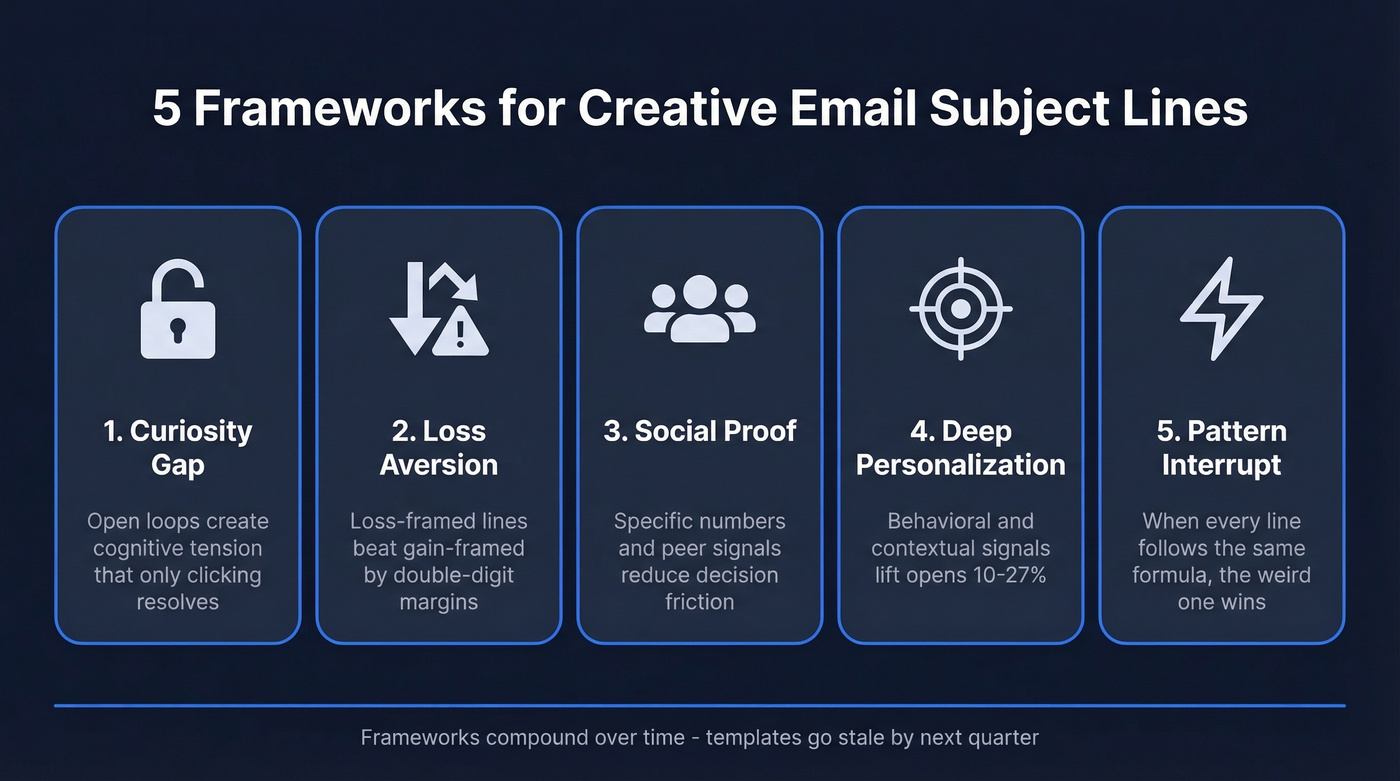
Curiosity Gap (Zeigarnik Effect)
The Zeigarnik effect says people remember incomplete tasks better than completed ones. An open loop creates cognitive tension that only clicking resolves - and it's one of the most reliable ways to write subject lines that get opened.
- "We analyzed 10M emails. One finding surprised us."
- "The metric your dashboard isn't showing you"
- "Three words killing your cold emails"
- "What happened after we stopped A/B testing"
Loss Aversion & Scarcity
People feel losses roughly twice as strongly as equivalent gains. In our testing, loss-framed subject lines consistently beat gain-framed ones - often by double-digit margins.
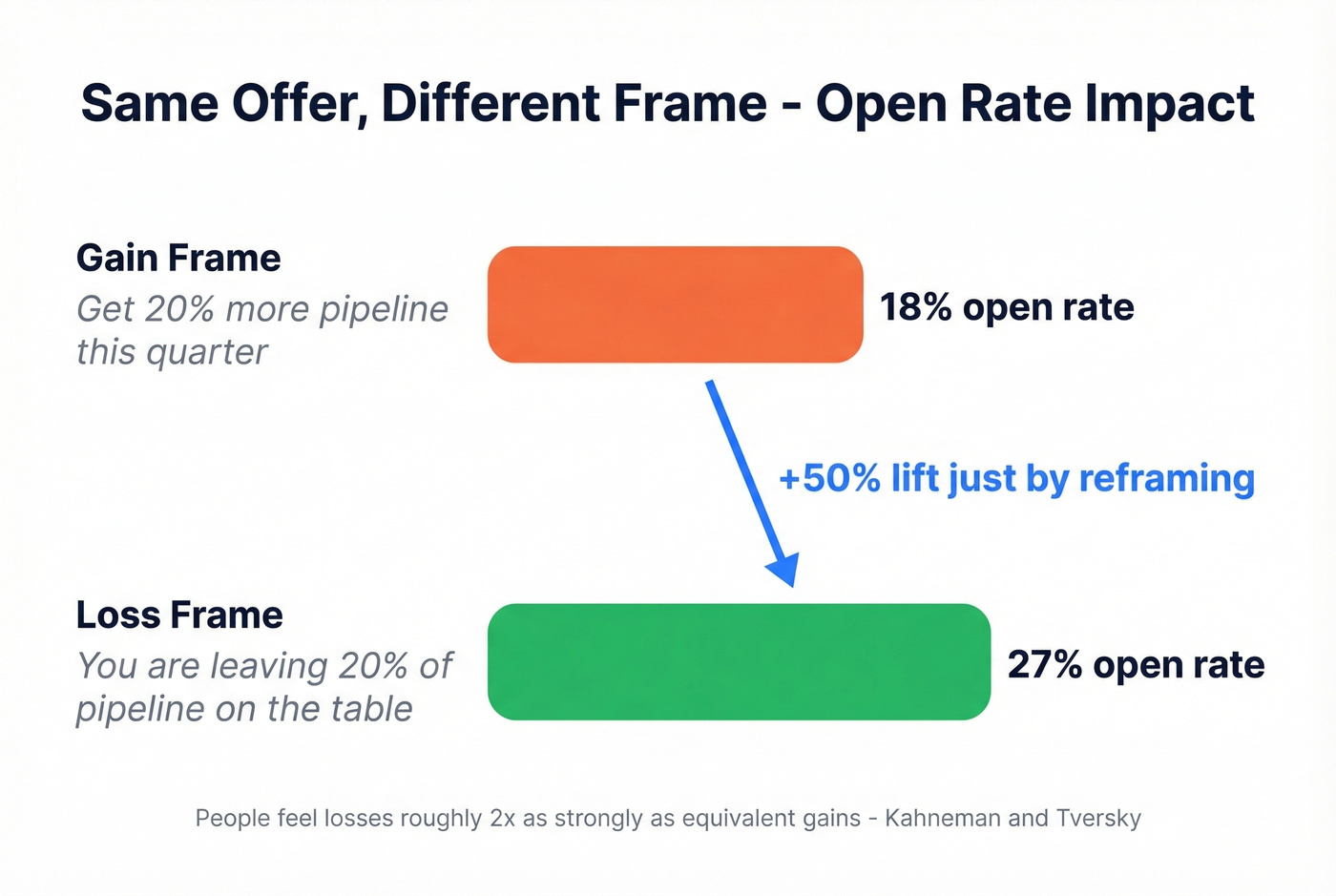
Before: "Get 20% more pipeline this quarter" - 18% open rate
After: "You're leaving 20% of pipeline on the table" - 27% open rate
Same offer, reframed. Other loss-framed lines that work: "Your free credits expire at midnight," "Last chance: 3 spots left in the cohort," and "This report comes down Friday." Concrete deadlines beat vague urgency every time. They also produce some of the most enticing subject lines you can write because the reader feels the cost of ignoring them.
Social Proof
Social proof - named by Cialdini in Influence - remains one of the strongest persuasion levers in email. 47% of recipients decide to open based on the subject line alone, so a line like "12,000 marketers already downloaded this" works because the specific number beats vague claims like "thousands." Competitive anxiety compounds the effect: "3 of your competitors switched this quarter" triggers both social proof and loss aversion simultaneously. Tribal identity pulls its weight too - "The playbook Series B founders keep sharing" implies endorsement from a peer group the reader wants to belong to. And straightforward authority signals like "Rated #1 by 500+ G2 reviewers" still convert because they reduce decision friction.
Personalization Beyond First Name
First-name personalization is table stakes. The real lift - 10-27% higher open rates - comes from behavioral and contextual signals. These personalized touches are what separate clever subject lines from generic ones.
- "Still thinking about [Product]?" - Browse-abandonment trigger.
- "Time to restock? Your last order was 30 days ago" - Replenishment timing.
- "Seattle's getting cold - here's what's selling" - Geo + weather relevance.
- "[Company name]'s tech stack just changed" - Technographic signal.
For cold outreach, that last one is gold. If you're pulling technographic or job-change data from a platform like Prospeo, you can reference a real signal the prospect recognizes - which makes the email feel researched, not blasted.
Pattern Interrupt
When every subject line in the inbox follows the same formula, the weird one wins. Short, lowercase, one-word subject lines often outperform templated approaches.
Here's the thing: "quick question" is dead. It's so overused it's actively burning domain reputations. Skip it entirely. Try "one thing about [Company]" instead - specific enough to feel personal, short enough to interrupt.
Other pattern interrupts that work: "no" (one word, forces a double-take), "tuesday?" (lowercase, reads like a real person), and a single emoji like a flame (high risk, high reward - A/B test first). The key is rotation. Use them once and they're memorable. Use them every send and they become the new pattern.

Your subject line framework is only as good as the data behind it. Personalization beyond first name - technographic signals, job changes, company growth - requires accurate, fresh contact data. Prospeo refreshes 300M+ profiles every 7 days and delivers 98% email accuracy, so your carefully crafted subject lines actually reach real inboxes instead of bouncing into the void.
Stop writing great subject lines for dead email addresses.
Words That Send You to Spam
An estimated 45% of all emails land in spam folders. Modern filters use machine learning, not just keyword blacklists - but certain patterns still reliably trigger higher scores, especially in combination. Even the best subject line won't help if it never reaches the inbox.
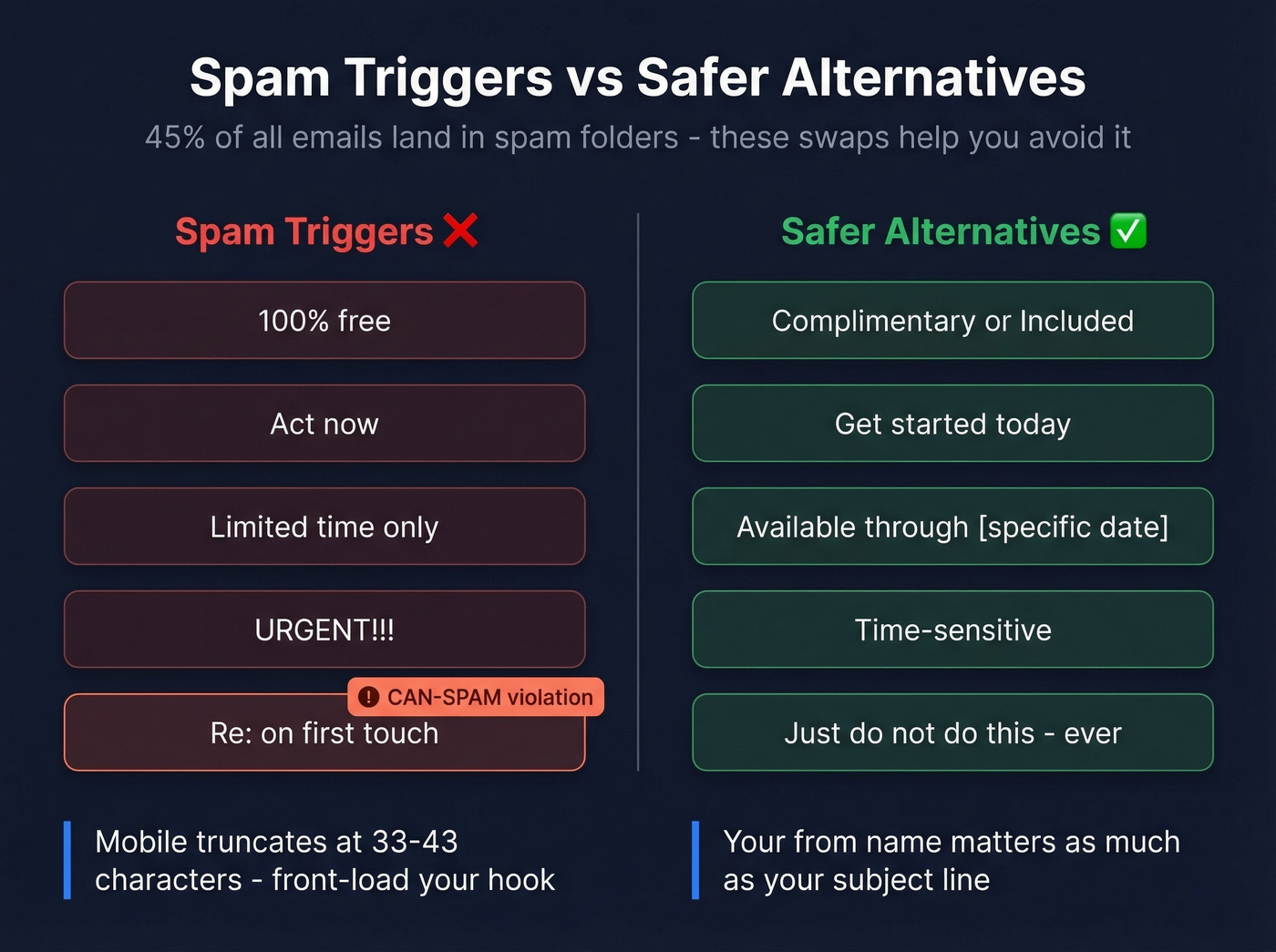
| Spam Trigger | Safer Alternative |
|---|---|
| "100% free" | "Complimentary" or "Included" |
| "Act now" | "Get started today" |
| "Limited time only" | "Available through [date]" |
| "URGENT!!!" | "Time-sensitive" |
| "Re:" on first touch | Don't. Just don't. |
That last one deserves emphasis. Using "Re:" or "Fwd:" on a first-touch cold email isn't just sleazy - it violates CAN-SPAM's prohibition on misleading subject headings. ALL CAPS and multiple exclamation marks compound the problem, materially increasing spam scoring when combined.
Two things people forget: mobile clients truncate subject lines at 33-43 characters, and many inboxes show about 70 characters in Gmail's preview. Front-load your hook in the first five words. And your "from" name matters as much as your subject line - recipients scan sender first.
How to A/B Test Subject Lines
Most teams "test" subject lines by sending two versions to their entire list simultaneously. That's not a test. It's a coin flip.
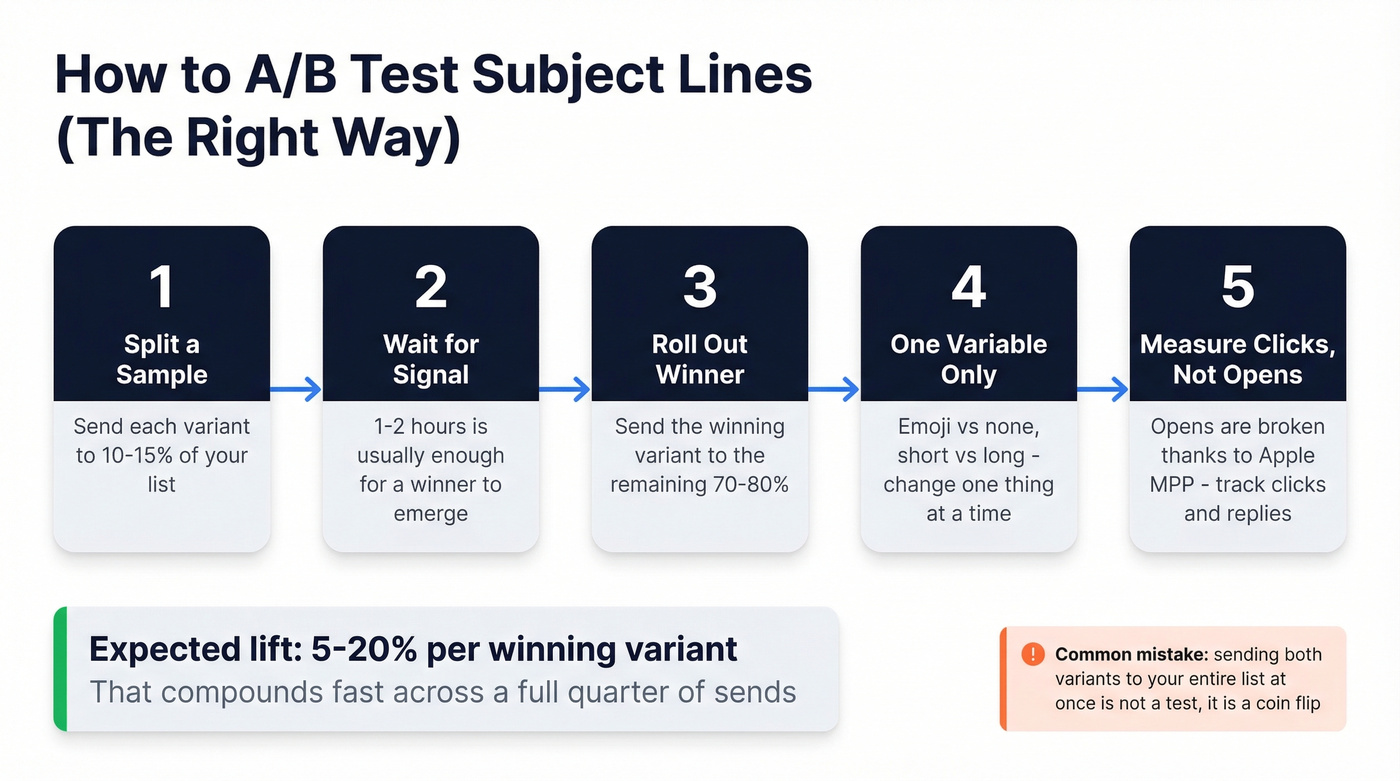
- Split a sample. Send each variant to 10-15% of your list.
- Wait. We've found the winning variant typically emerges within 1-2 hours.
- Roll out the winner to the remaining segment.
- Test one variable at a time. Emoji vs. none. Short vs. long. If you change three things, you learn nothing.
- Measure clicks and replies, not opens. Opens are broken.
Expect a 5-20% lift from a winning variant. That compounds fast across a full quarter of sends.
For generating variations quickly, AI tools like Jasper and Copy.ai produce 5-10 options in seconds - Persado reported a 41% open-rate lift with AI-generated lines. Use AI for volume, then let your A/B test pick the winner. I've personally found that AI-generated subject lines work best as starting points you edit, not finished products you send as-is.
Clean Your Data Before You Optimize Copy
Let's be honest about something most subject line guides ignore entirely: bad data leads to bounces, bounces damage sender reputation, and damaged reputation routes you to spam. Once you're in spam, the world's most creative subject line is irrelevant.
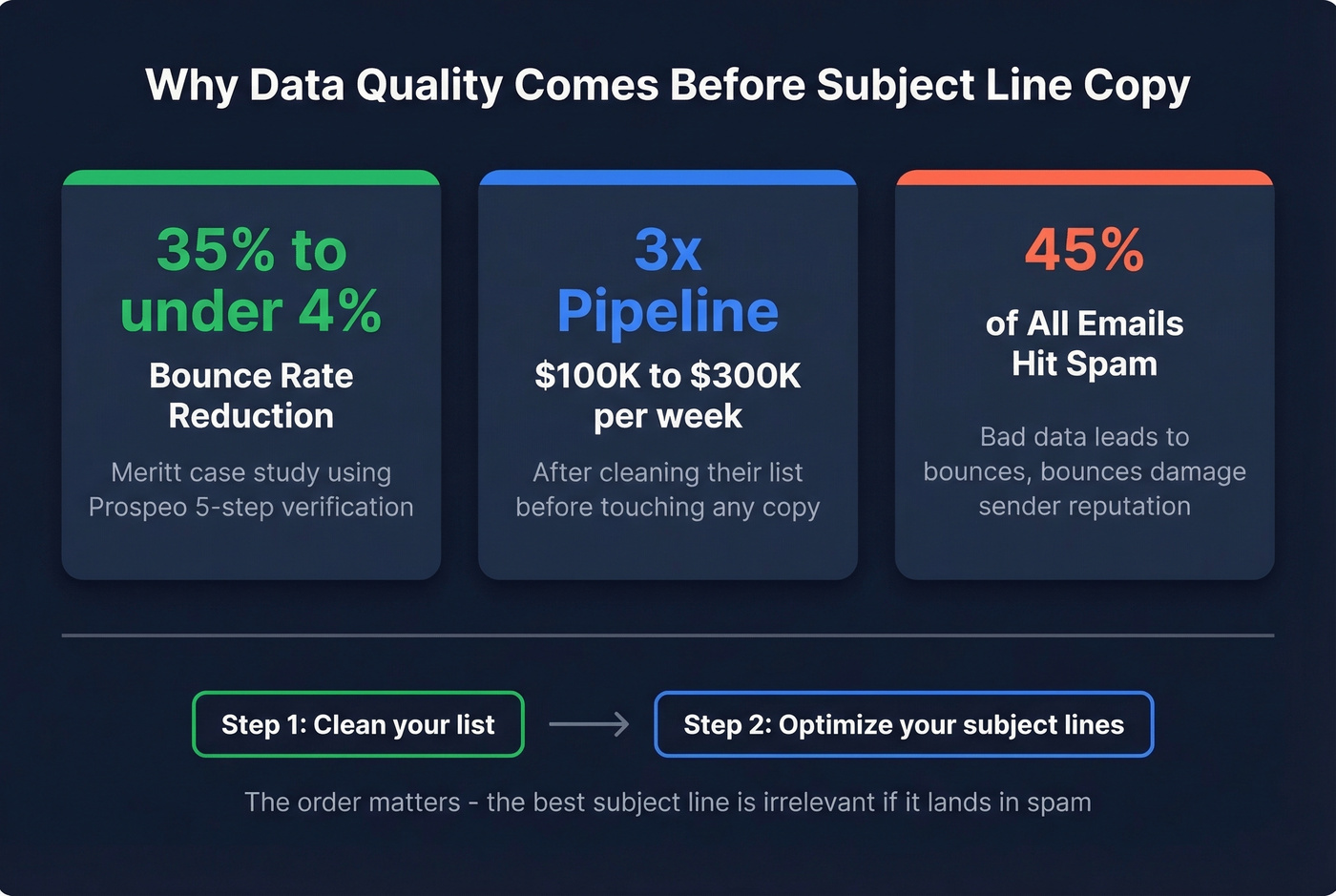
We've seen teams triple their pipeline just by cleaning their list before touching a single word of copy. Meritt, for example, cut their bounce rate from 35% to under 4% using Prospeo's 5-step verification - catch-all handling, spam-trap removal, honeypot filtering - and their pipeline tripled from $100K to $300K per week. The free tier covers 75 verifications per month, enough to test the workflow before committing.
If you want to benchmark and fix bounces systematically, start with bounce rate basics, then move into a full email deliverability audit. If your domain is already taking hits, prioritize sender reputation before you scale volume.
The article above shows that personalized subject lines lift open rates 10-27%. But you need real signals to personalize - tech stack changes, job moves, intent data. Prospeo gives you 30+ filters including technographics, buyer intent across 15,000 topics, and job change alerts at $0.01 per verified email. That's the difference between "Hi {first_name}" and a subject line that makes someone stop scrolling.
Turn every framework above into pipeline with data that's actually current.
FAQ
How long should a subject line be?
Aim for 30-50 characters. Gmail previews show about 70 characters, but mobile clients truncate at 33-43. Front-load the hook - the first five words carry the entire message for mobile readers.
Do emojis help or hurt open rates?
It depends on your audience. Some segments see 5-10% lifts; others see spam-filter penalties. A/B test a single emoji against plain text on a 10-15% sample before rolling out. Never stack multiple emojis - that's a reliable spam trigger across most inbox providers.
How do I measure subject line performance if open rates aren't reliable?
Track click-through rate, reply rate, and downstream conversions. Apple Mail Privacy Protection inflates opens via proxy pixel preloading - clicks are the only intentional engagement signal left. Verify your list first so bounces aren't skewing your metrics before you start testing.
What separates creative from gimmicky?
Relevance. Creative email subject lines connect the hook to genuine value inside the email - a curiosity gap the body copy resolves, or a loss-aversion frame tied to a real deadline. Gimmicky lines use clickbait with no payoff, training recipients to ignore future sends and tanking long-term engagement.