


Cresta Pricing, Reviews, Pros and Cons (2026)
Cresta doesn't publish pricing. Their site funnels you straight to "book a demo." If you're trying to figure out what this thing actually costs before committing to a sales cycle, here are the real numbers.
The 30-second verdict: Cresta is a powerful real-time agent coaching platform built for enterprise contact centers - typically 100+ agents with six-figure budgets. Expect $60K-$150K/year, annual contracts, and a multi-week implementation. If your team is smaller or you need transparent pricing, Balto or Observe.AI are better starting points.
What Is Cresta?
Cresta is a generative AI platform purpose-built for contact centers. It delivers real-time coaching to agents in under 200 milliseconds - fast enough that reps get guidance mid-sentence, not after the call ends. Where traditional quality management reviews 1-3% of interactions through manual sampling, Cresta analyzes 100% of conversations across voice and chat.

The platform runs on Cresta's Ocean-1 model and integrates with major CCaaS and CRM systems including Genesys, Five9, Amazon Connect, Salesforce, Zendesk, and ServiceNow. Cresta's streaming architecture means transcripts are analyzed in real time with no customer data copied to external systems. The company was founded in 2017, employs roughly 300 people, and has raised $270M+ in total funding including a $125M Series D.
What Cresta Actually Costs
The best public anchor comes from AWS Marketplace listings: Agent Assist for Chat (up to 125,000 chats) runs $150,000/year, and Agent Assist for Voice (up to 100,000 calls) also runs $150,000/year. Overage rates kick in at $1.20 per chat and $1.50 per call. A separate GetVoIP estimate puts the floor closer to $60,000/year for smaller deployments.
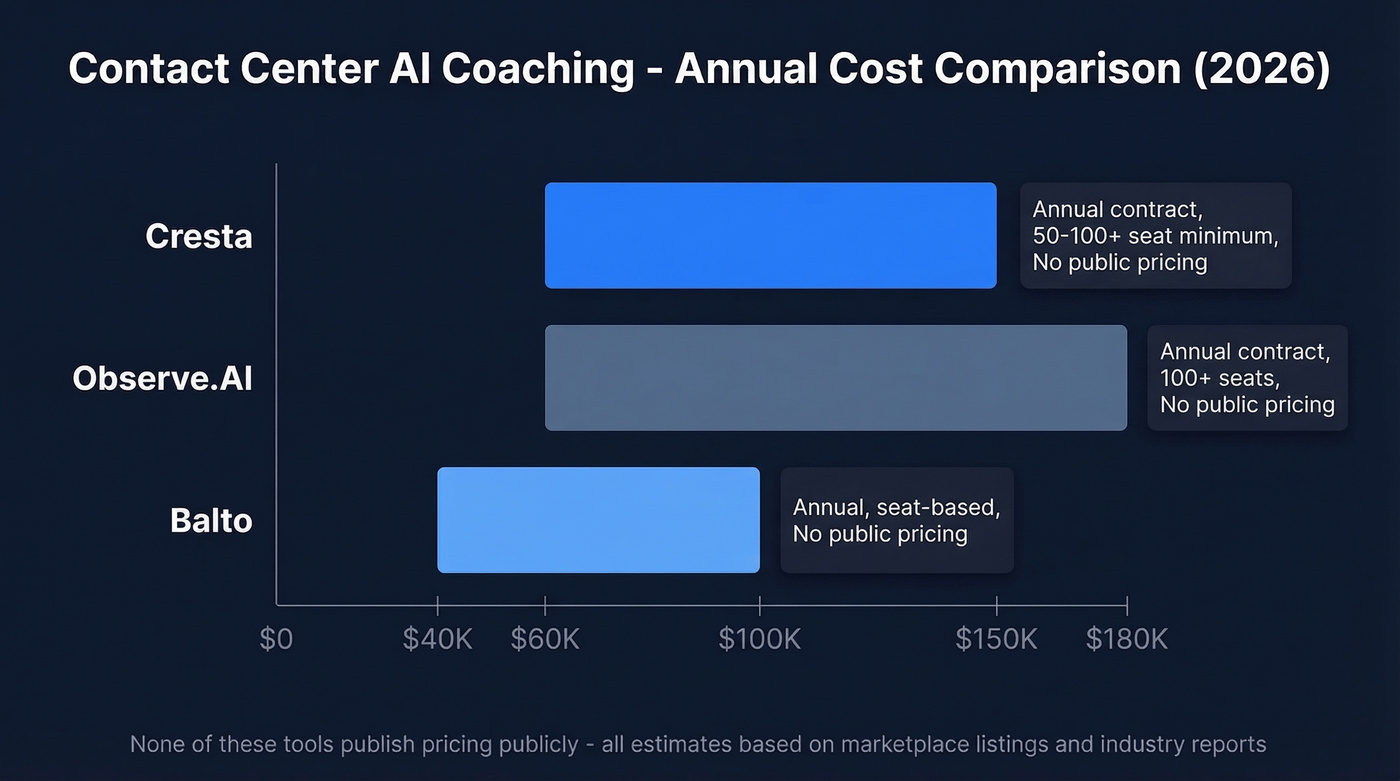
So the realistic range is $60K-$150K/year depending on modules, volume, and seat count. Annual contracts, minimum seat thresholds around 50-100 agents, and multi-week procurement cycles are standard.
| Tool | Est. Annual Cost | Contract | Public Pricing? |
|---|---|---|---|
| Cresta | $60K-$150K/yr | Annual, 50-100+ seats | No |
| Observe.AI | $60K-$180K/yr | Annual, 100+ seats | No |
| Balto | $40K-$100K/yr (est.) | Annual, seat-based | No |
None of these tools publish pricing. That's the norm in this category, and it's frustrating.
What Users Like and Dislike
Pros
- Real-time coaching with measurable impact. Users on G2 consistently praise the live guidance. One mid-market reviewer described watching "B players rising up the ranks" after deployment.
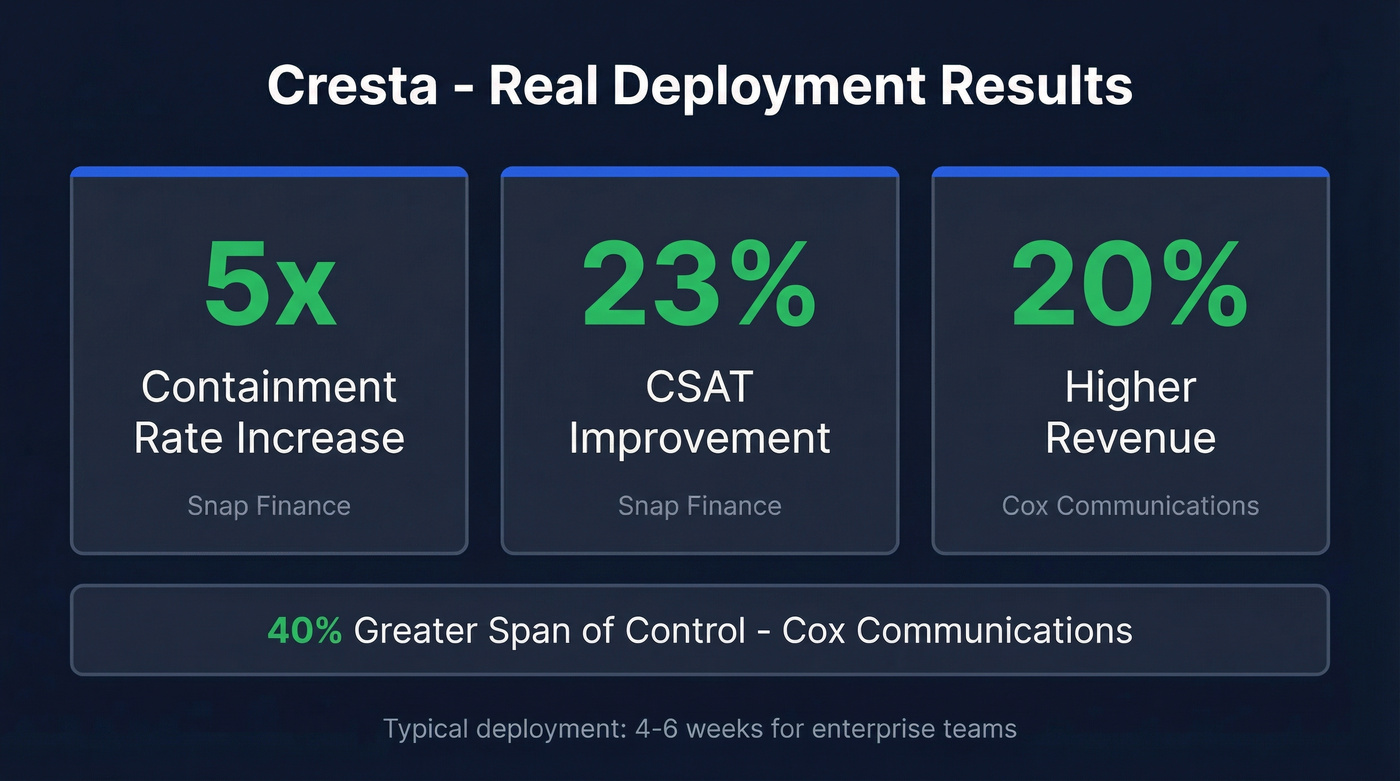
- Quantified ROI from real deployments. Snap Finance saw containment rates jump 5x and a 23% increase in CSAT. Cox Communications achieved 20% higher revenue and 40% greater span of control.
- Fast implementation for an enterprise tool. Typical deployment takes 4-6 weeks, which is genuinely quick for this category.
- Streaming architecture keeps data secure. No customer data gets copied to external systems - guidance is generated and delivered in real time.
Cons
- AI accuracy isn't always there. The G2 pros and cons page surfaces a recurring theme: the knowledge assist model struggles with caller intent. One verified mid-market user wrote that the "model used for knowledge assist is not very accurate in understanding the overall caller's intent." That's a problem when the entire value prop is real-time guidance.
- You need a dedicated AI tuner. Multiple reviewers flag the learning curve. Without someone managing and refining the AI full-time, you won't extract full value.
- Bugs and odd behavior crop up. A TrustRadius review documented the AI calling a customer "Mother" instead of their name, plus intermittent downtime where the coaching overlay simply wouldn't appear.
- Enterprise-only pricing shuts out smaller teams. No self-serve tier, no monthly option, no way to evaluate without a sales cycle. If you run a 30-agent team, Cresta usually isn't a fit.
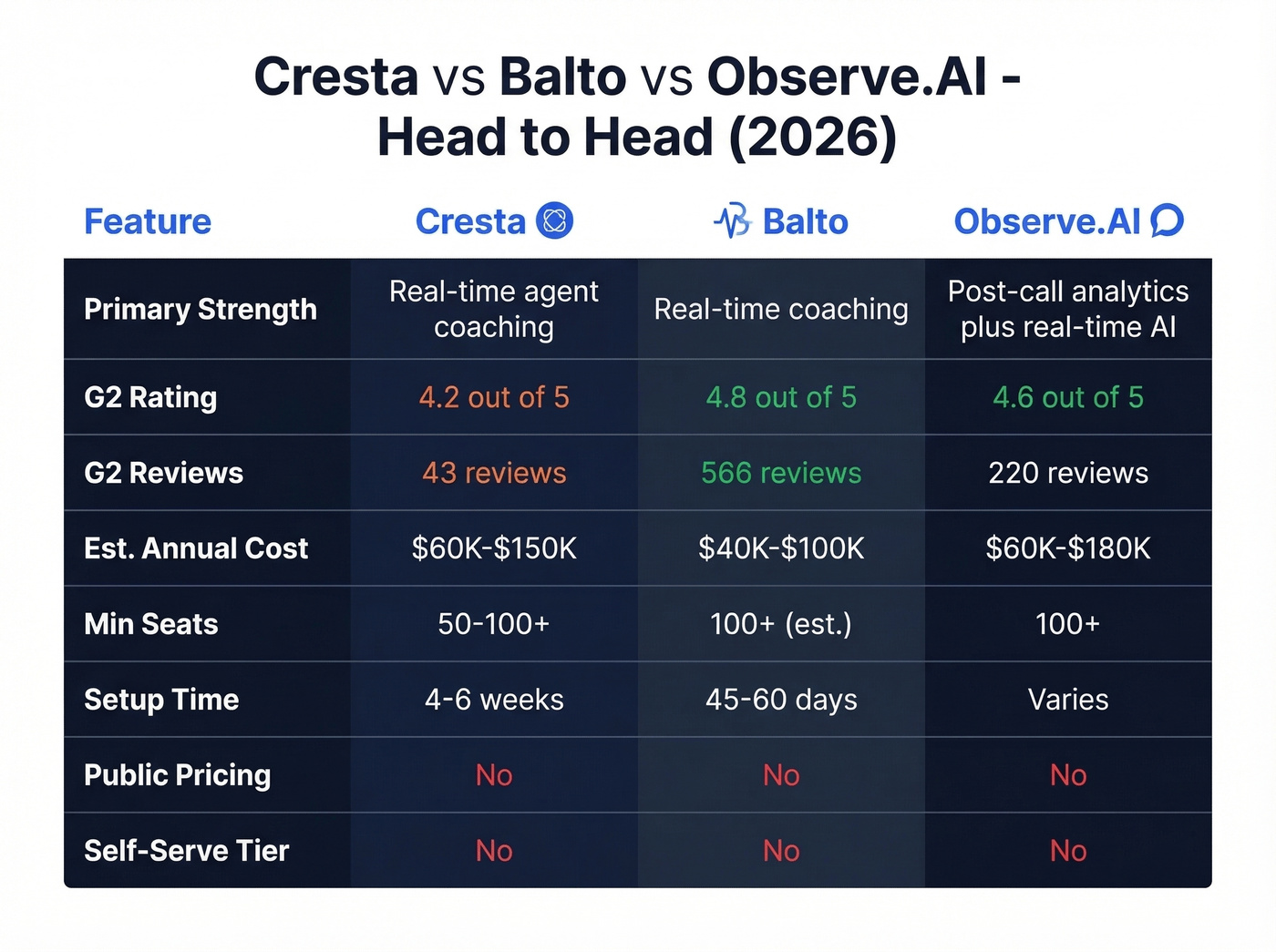
- Thin review base. Cresta sits at 4.2/5 on G2 from 43 reviews, and TrustRadius shows a single detailed review. You're not getting the depth of feedback you'll find with more widely reviewed tools.

Cresta costs $60K-$150K/year to coach agents on live calls. But coaching can't fix bad data - if reps are dialing wrong numbers or emailing dead addresses, no AI overlay will save the conversation. Prospeo gives you 125M+ verified mobiles with a 30% pickup rate and 98% email accuracy, starting at ~$0.01/email. No demo required, no annual contract.
Fix the input layer before you spend six figures on the coaching layer.
Who Should Use Cresta
Use Cresta if you have 100+ agents, a dedicated AI/ops person to tune the platform, a six-figure annual budget, and complex conversations where real-time coaching moves metrics.
If you're evaluating this as part of a broader enterprise sales motion, make sure you model the full cost (licenses + implementation + internal headcount) before you commit.
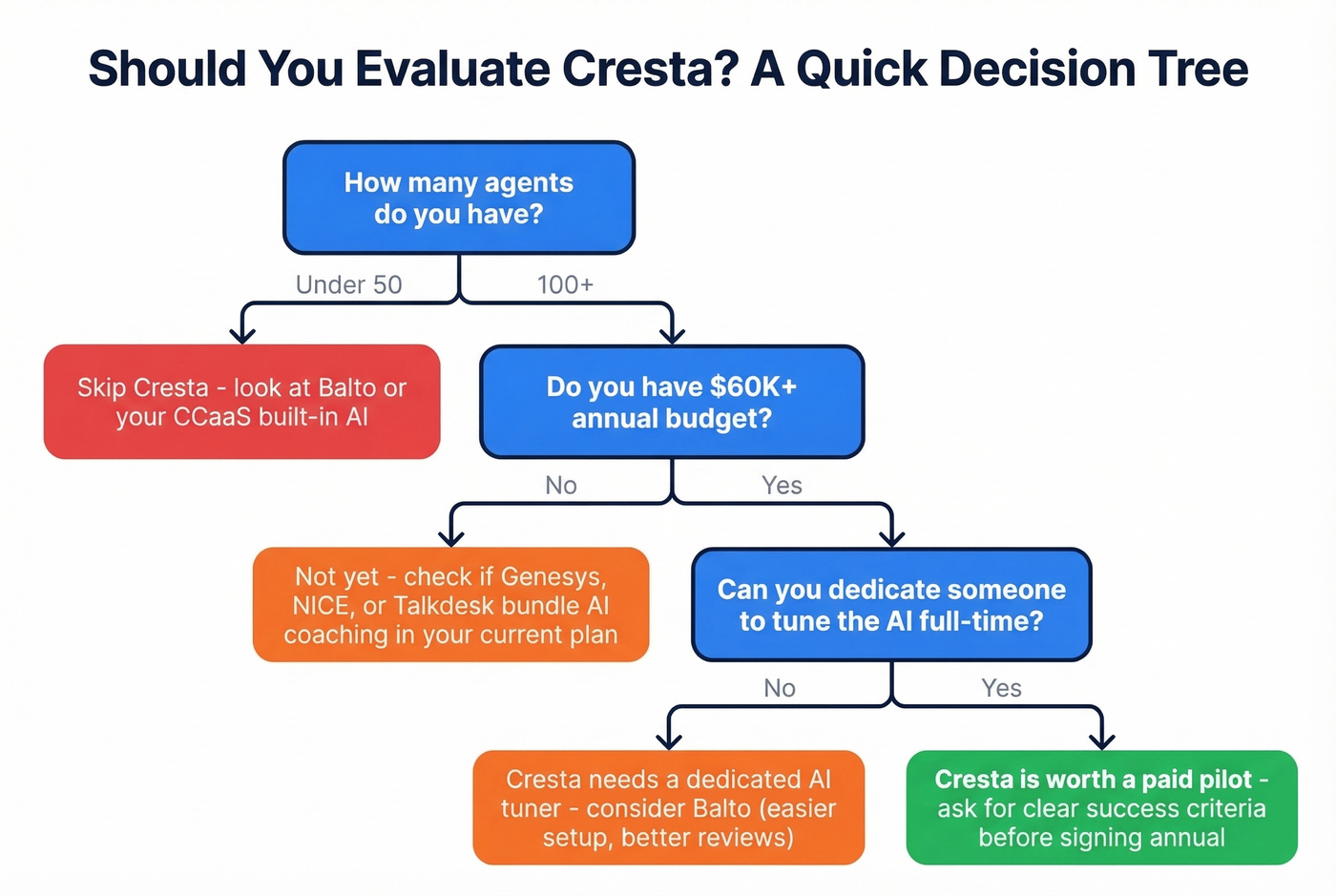
Skip Cresta if you have fewer than 50 agents, no one to own the AI tuning process, or an SMB budget that can't absorb $60K+ annually.
Here's the thing: 27% of contact centers plan to deploy AI/ML within 12 months, but most of them don't need a standalone product like Cresta. Genesys, NICE, and Talkdesk are all bundling real-time AI coaching into their CCaaS platforms. If you're already on one of those, check what's included before paying a premium for a separate tool.
Alternatives Worth Considering
Balto
Balto is the strongest alternative for real-time coaching, and it has far more social proof: 4.8/5 on G2 with 566 reviews - that's 13x Cresta's count. Claimed outcomes include a 16% lift in sales, 53-second lower AHT, and 65% faster ramp time. Setup runs 45-60 days. We've seen estimates in the $40K-$100K/year range for 100+ agent teams, which typically undercuts Cresta for comparable seat counts. For teams that want real-time coaching without the six-figure floor, Balto is the first place to look.
If you're also tightening your outbound motion, pair coaching with better sales prospecting techniques so reps have more (and better) conversations to begin with.
Observe.AI
Observe.AI sits at 4.6/5 on G2 with 220 reviews and covers both post-interaction analytics and real-time AI. If your primary use case is understanding what happened on calls rather than coaching in the moment, Observe.AI is the better pick. Estimated pricing runs $60K-$180K/year for 100 seats, so it's in the same ballpark as Cresta.
For teams building a full stack, it’s worth comparing this category against broader SDR tools and your existing CRM workflows.
Fix the Input Layer First
No coaching tool helps if your agents are calling wrong numbers or emailing dead addresses. Prospeo handles that input layer with 300M+ professional profiles, 98% email accuracy, and 125M+ verified mobile numbers - ensuring reps actually reach the right people before any coaching kicks in. Self-serve from ~$0.01/email with no contracts.
If you're cleaning lists before outreach, use an email deliverability guide and track your email bounce rate so you can see whether data quality is improving.

Every tool on this list - Cresta, Balto, Observe.AI - locks you into opaque pricing and annual contracts just to evaluate. Prospeo is the opposite: self-serve, transparent credits, and a free tier with 75 emails/month. 300M+ profiles, 30+ search filters, and data refreshed every 7 days - not every 6 weeks.
Stop booking demos just to see a price tag. Start prospecting in minutes.
The Verdict
Cresta is worth evaluating if you run a 100+ agent contact center, have six-figure budget room, and can dedicate someone to tuning the AI. The real-time coaching genuinely moves performance metrics when it works well.
But let's be honest about the risks: a thin review base, recurring accuracy complaints, and completely opaque pricing make this a tool you should pilot carefully before committing long-term. Ask for a paid pilot with clear success criteria before signing an annual deal. Most write-ups on Cresta can't tell you what it costs. Now you have the numbers - decide accordingly.