

CRM Data Governance: A Practitioner's Guide (2026)
Your reps spend 13 hours a week hunting for basic information in the CRM. 76% of CRM users say less than half of their organization's data is accurate and complete. And 37% of staff regularly fabricate data to tell leadership what they want to hear. That's not a data quality problem. It's a governance failure, and it's costing you deals every quarter.
What You Need (Quick Version)
Governing CRM data boils down to three things: a framework that assigns ownership, input-layer controls that prevent garbage from entering, and automated enrichment that keeps data fresh. If you only do one thing today, measure your duplicate rate and required-field fill rate. If either is worse than 2% and 90% respectively, you've got a governance problem.
The rest of this guide breaks down the framework, the metrics, the platform controls, and the compliance mappings you need to build a program that actually sticks.
What Data Governance in a CRM Actually Means
It's not data cleaning. Cleaning is a task. Governance is the system of policies, roles, and metrics that ensures cleaning - and everything else - happens consistently.
The distinction matters because governance sits above data management. ISACA frames it as a board-level concern: accountability, transparency, risk management, and ethical data use. When your governance program works, data management becomes execution against defined standards. When it's missing, you get a CRM that nobody trusts and reports that nobody believes.
Here's the thing: "the CRM is a mess" almost always means nobody owns definitions and nobody trusts reports. The mess isn't a cleaning problem. It's a governance vacuum.
The Business Case for Governing CRM Data
Validity's 2025 survey of 602 CRM users and administrators - the latest published benchmark - paints a grim picture.
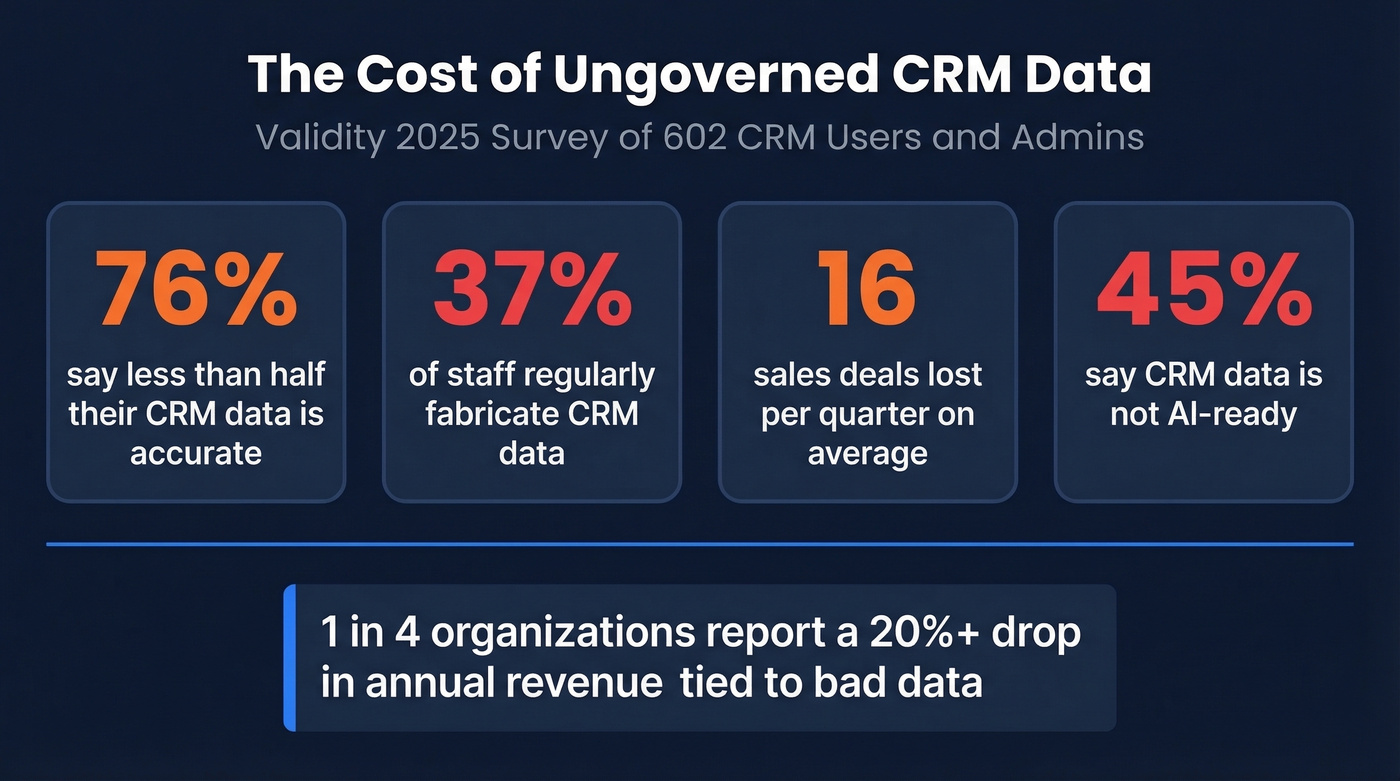
The revenue damage is direct. 37% of organizations lose revenue from poor data quality. One in four report a 20%+ drop in annual revenue tied to bad data. Companies lose an average of 16 sales deals per quarter.
The stat that should terrify every CRO: 37% of staff regularly fabricate CRM data to tell leadership what they want to hear. If your reps don't trust the data, they'll invent their own. That's not a training problem - it's a system failure.
AI makes the gap worse, not better. 54% of organizations already deploy generative AI tools, but 45% say their CRM data isn't AI-ready. You can't feed garbage into an AI model and expect good output. Every AI initiative built on ungoverned data is a liability.
What good governance changes. ZS Associates estimates 5-15% revenue growth and 15-30% reduction in data-related inefficiencies when governance is done right. The exact uplift depends on your baseline data quality, but the direction is consistent across every study we've seen. Meanwhile, Dresner Advisory Services research shows 68% of organizations still struggle to find reliable data and analytic content. The gap between governed and ungoverned CRM data is where revenue goes to die.
CRM Data Governance Framework (6 Parts)
A working framework needs six components. We've adapted this from ZS's governance model, with practical artifacts for each.
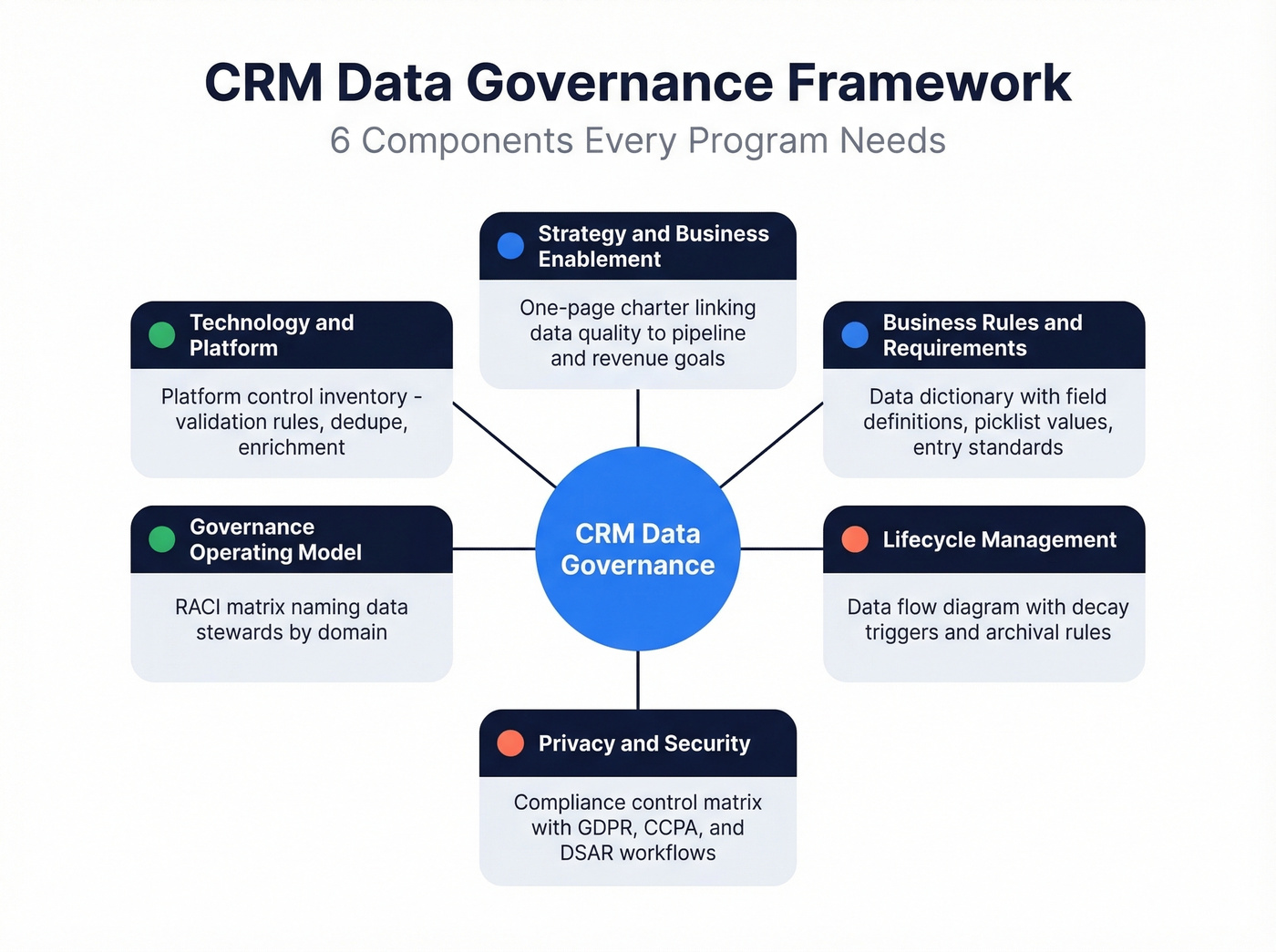
Strategy & business enablement - Define why governance exists and what business outcomes it serves. Artifact: a one-page charter linking data quality to pipeline and revenue goals.
Business rules & requirements - Standardize field definitions, picklist values, and data entry standards. Artifact: a data dictionary that every team references.
Lifecycle management - Map how data enters, moves through, ages, and exits the CRM. Artifact: a data flow diagram with decay triggers and archival rules.
Privacy & security - Embed GDPR, CCPA, and internal security controls into the data lifecycle. Artifact: compliance control matrix with DSAR workflows.
Governance operating model - Assign ownership. Artifact: a RACI matrix naming data stewards by domain (marketing data, sales data, customer success data).
Technology & platform - Select and configure tools that enforce rules automatically. Artifact: platform control inventory covering validation rules, duplicate detection, and enrichment automation.
Gousto's implementation is a good reference: they assigned domain stewards, automated quality checks, standardized definitions through a data catalog, and built a single source of truth. The key was making governance invisible to end users - controls baked into the input layer, not policies posted on a wiki nobody reads.
Artifacts You Should Create
Most governance programs fail because they produce strategy decks instead of operational artifacts. Build these six, assign an owner to each, and set a review cadence:
| Artifact | Owner | Review Cadence |
|---|---|---|
| Data dictionary (field definitions, picklists) | RevOps | Monthly |
| RACI matrix (steward assignments by object) | VP Ops | Quarterly |
| Data flow diagram (entry -> enrichment -> archival) | RevOps | Quarterly |
| Compliance control matrix (GDPR/CCPA mappings) | Legal + RevOps | Semi-annually |
| Escalation workflow (who fixes what, SLAs) | Data steward per domain | Monthly |
| Platform control inventory (validation rules, dedupe config) | CRM Admin | Monthly |
If you can't name an owner for each row, your governance program exists on paper only.
Three Rules Before You Do Anything Else
In our audits, duplicate rate and required-field fill rate predict reporting trust better than any "data quality score" widget. Before you build a governance committee or buy a tool, answer these three questions:
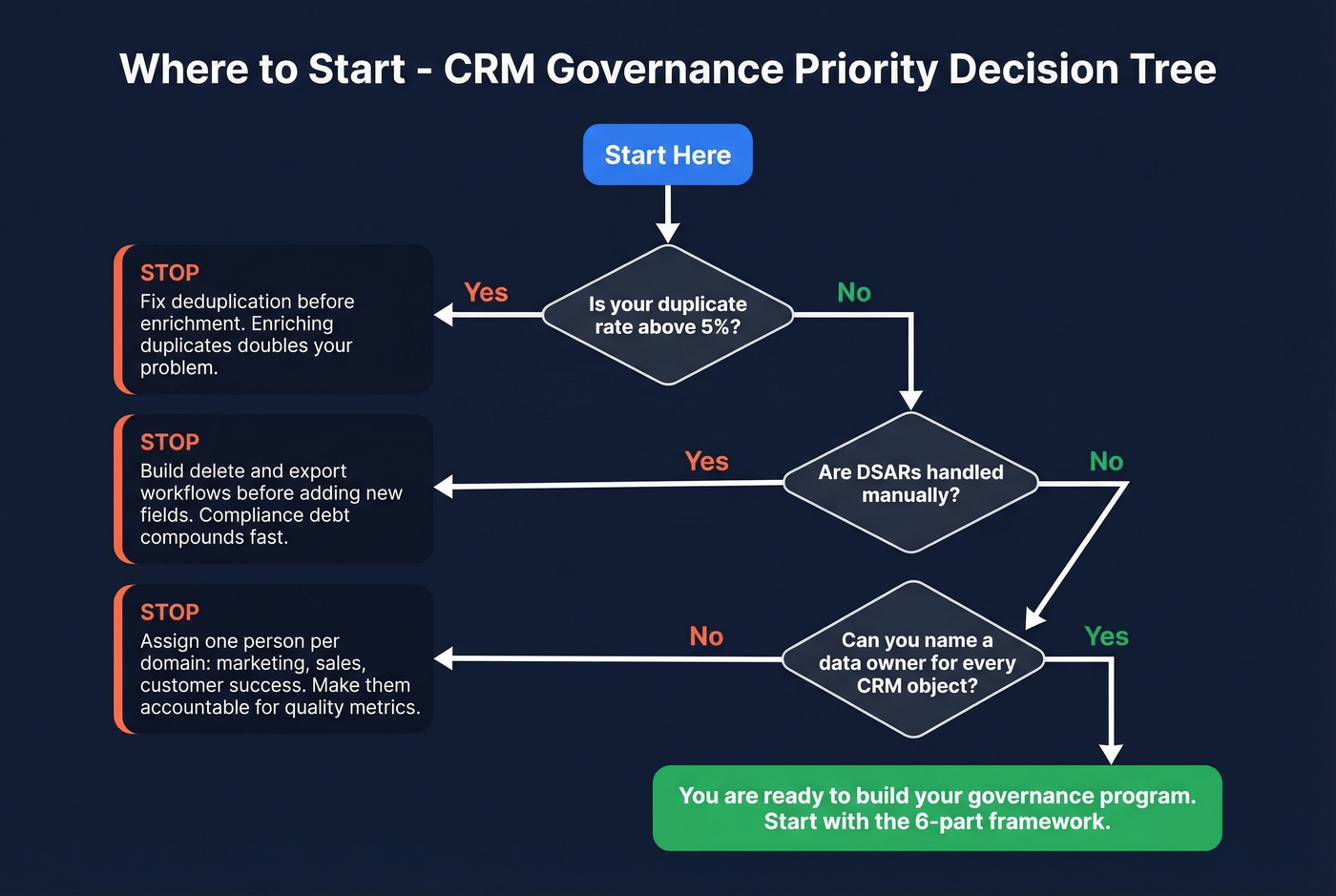
- If duplicates exceed 5%, fix deduplication before enrichment. Enriching duplicate records doubles your problem.
- If DSARs are manual, stop adding fields until you can delete and export reliably. Compliance debt compounds faster than data debt.
- If you can't name a data owner per object, governance isn't real. Assign one person per domain - marketing, sales, customer success - and make them accountable for quality metrics.
Let's be honest: most teams don't need a governance platform. They need three validation rules, one person who owns data quality, and an enrichment tool that actually refreshes weekly. The governance-industrial complex sells six-figure MDM implementations to teams that haven't configured required fields yet.
Governance Metrics That Matter
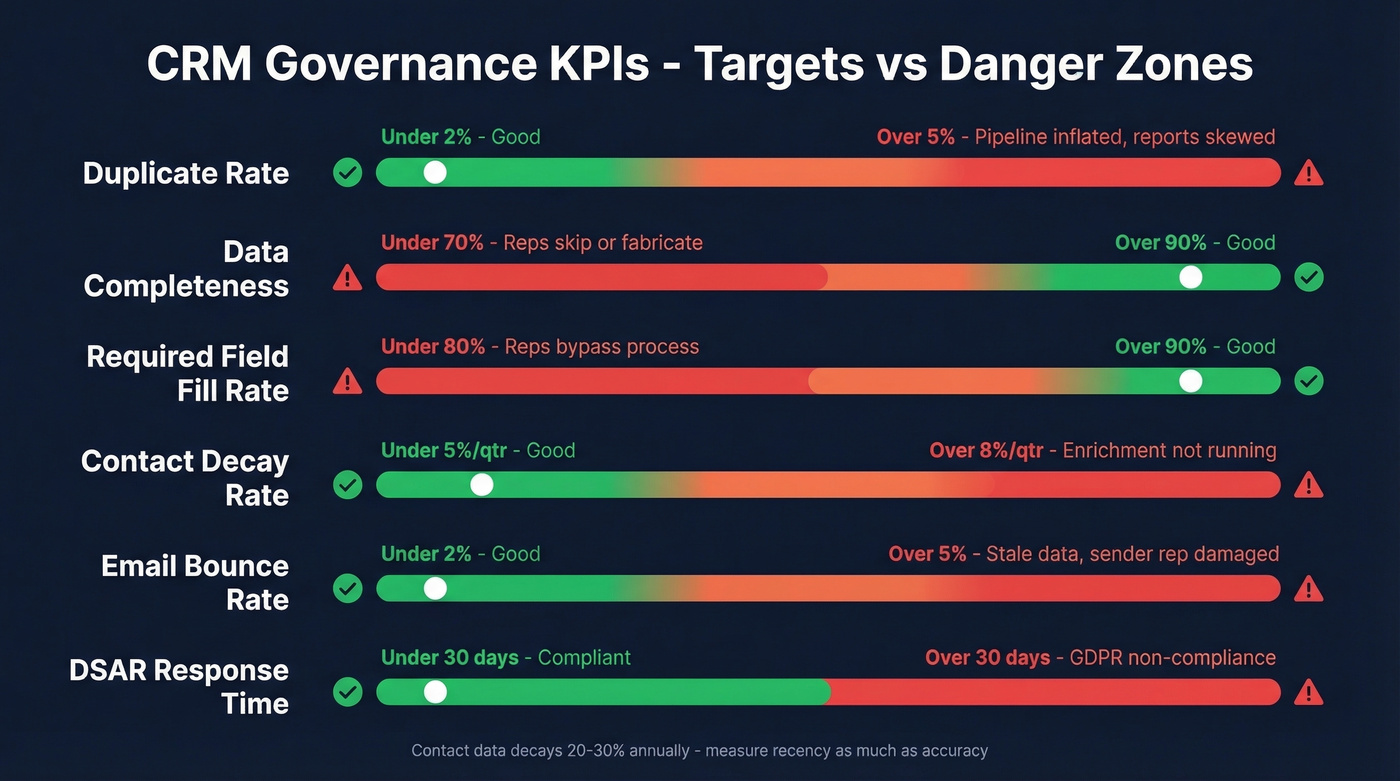
You can't govern what you don't measure. These KPIs separate real programs from paper programs.
| KPI | Target | What "Bad" Looks Like |
|---|---|---|
| Duplicate rate | <2% | >5% inflates pipeline, skews reports |
| Data completeness | >90% required fields | <70% means reps skip or fabricate |
| Required-field fill rate | >90% | <80% means reps bypass process and reporting breaks |
| Contact decay rate | <5%/quarter | >8% means enrichment isn't running |
| Email bounce rate | <2% | >5% signals stale data, damages sender reputation |
| DSAR response time | <30 days | >30 days = GDPR non-compliance |
Contact data decays 20-30% annually - people change jobs, get promoted, switch companies. Measuring data recency matters as much as accuracy. A 7-day refresh cadence is the practical benchmark for what "fresh" looks like; the industry average sits closer to six weeks.

Your governance program is only as good as the data flowing in. Prospeo enriches CRM records with 50+ data points at a 92% match rate, refreshed every 7 days - not the 6-week industry average. 98% email accuracy means fewer bounces, fewer duplicates, and reports your team actually trusts.
Kill data decay at the source instead of cleaning up after it.
Platform-Specific Controls
Salesforce (Data Cloud Governance)
Salesforce made Data Cloud Governance generally available in 2025, and it's the most significant platform-level governance update in years. Their strategic push toward trusted data signals how central governance has become to their AI roadmap.
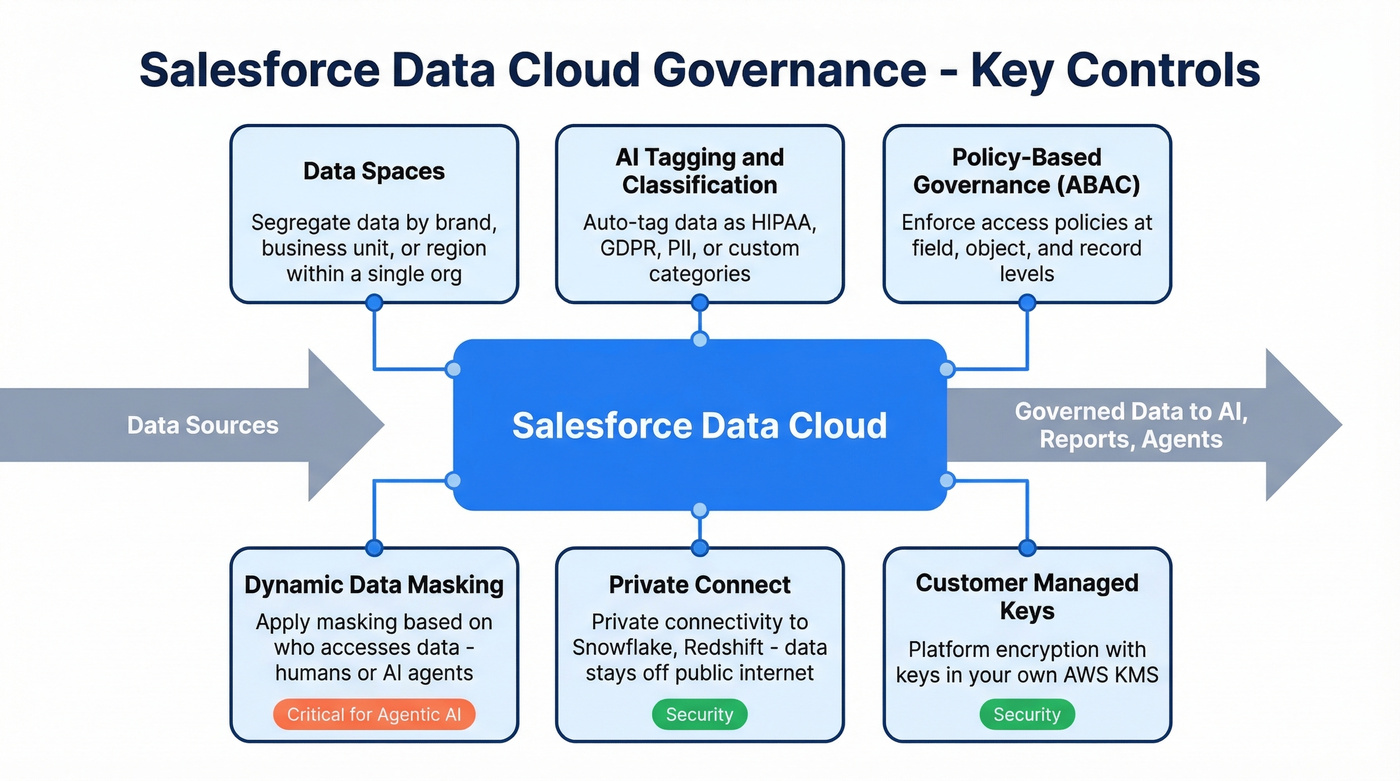
The key features to configure:
- Data Spaces - Segregate data and metadata by brand, business unit, or region within a single org. Essential for multi-geo teams navigating different compliance regimes.
- AI Tagging & Classification - Automatically tag data as HIPAA, GDPR, PII, or custom categories. This is the foundation for policy enforcement.
- Policy-Based Governance (ABAC) - Author and enforce access policies at field, object, and record levels across all Data Cloud surfaces.
- Dynamic Data Masking - Apply masking policies based on who's accessing data - humans or AI agents. Critical now that autonomous agents can read and write CRM records.
- Private Connect - Private connectivity to sources like Snowflake and Redshift, keeping data off the public internet.
- Customer Managed Keys - Platform encryption with keys stored in your own AWS KMS.
HubSpot (Native Data Quality Tools)
HubSpot's built-in data quality tools are lighter than Salesforce's but surprisingly capable for mid-market teams. The core features include duplicate management with custom daily alert limits, formatting fixes for object properties, property insights showing where and how fields are used, and weekly data quality digest emails.
Access requires Super Admin or explicit Data quality tools permissions - don't assume your ops team can see this by default. One limitation worth knowing: if a record is corrected through the data quality overview but later manually updated incorrectly, HubSpot won't re-flag it. For more advanced governance workflows, you'll need Operations Hub.
Dynamics 365 and SAP
Both platforms support the same core governance categories: role-based and attribute-based access control, data masking, audit logging, deduplication, and DSAR workflows. Dynamics 365 leans on Dataverse security roles and the Customer Insights module for data quality. SAP CRM governance runs through SAP Master Data Governance. The principles in this guide apply directly - map the same controls to your platform's native tooling.
Agentic AI Guardrails
With AI agents now capable of creating, updating, and deleting CRM records autonomously, your governance framework needs new controls. Skip this section if you aren't deploying autonomous agents yet, but bookmark it - you'll need it sooner than you think.
- Write permissions - Restrict which objects and fields agents can modify. No agent should have blanket write access to your CRM.
- Human-in-the-loop approvals - Require human sign-off for record deletions, ownership changes, and any field that feeds pipeline reporting.
- Audit trails - Log every agent action with the same granularity as human actions. If you can't trace who (or what) changed a record, your audit is broken.
- Purpose policies and data minimization - Define what data an agent can access and why. An email-drafting agent doesn't need revenue fields.
These aren't theoretical concerns. Salesforce's Dynamic Data Masking already differentiates between human and agent access. If your platform doesn't offer that, build the controls yourself before deploying autonomous agents against live CRM data.
Compliance Mapping
GDPR Rights -> CRM Capabilities
Your CRM must support all eight data subject rights with a 30-day response window. Here's what that looks like in practice:
| GDPR Right | CRM Capability Required |
|---|---|
| Access | Export tools + access management |
| Rectification | Correction workflows |
| Erasure | Deletion with verification |
| Restrict processing | Processing flags/controls |
| Portability | Machine-readable export (CSV/JSON) |
| Object | Objection tracking fields |
| Automated decisions | Human review override options |
| Right to be informed | Transparency notice management |
Security measures should include AES-256 encryption at rest, MFA for all CRM users, and audit logging for every data access event.
CCPA/CPRA Checklist
CCPA applies if you hit any one threshold: $25M+ annual revenue, 100,000+ California consumers' personal information processed annually, or 50%+ revenue from selling or sharing personal information.
Map retargeting pixels as "sharing" - this triggers opt-out requirements most teams miss. Build DSAR intake, verification, and routing workflows directly in your CRM. Honor Global Privacy Control (GPC) signals automatically. Classify vendors as contractors vs. third parties - the distinction changes your obligations entirely.
Keeping CRM Data Clean at Scale
That 20-30% annual contact decay rate means your CRM is rotting faster than most teams can manually clean it. The answer isn't more manual effort - it's treating enrichment and verification as governance mechanisms, not just sales tools.
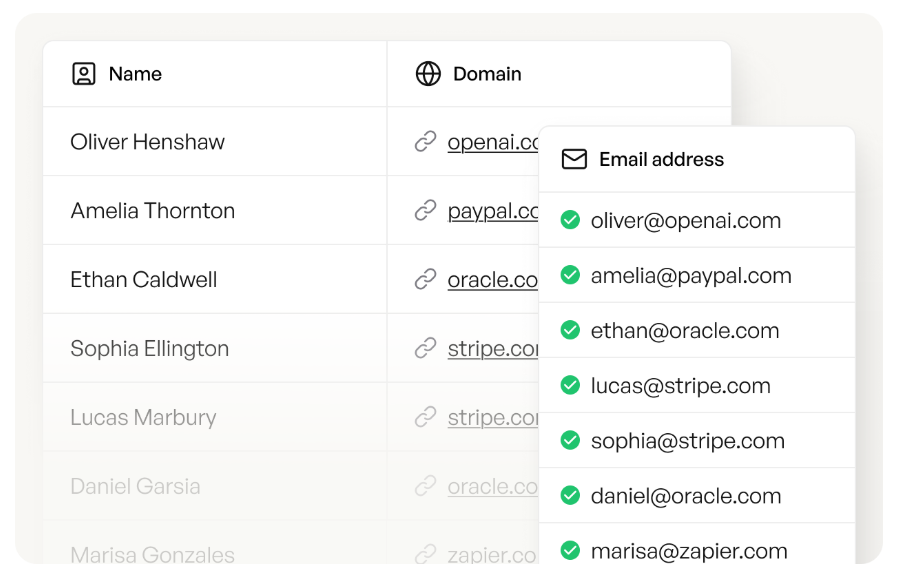
Two layers make this work. Validation rules and required fields at point of entry act as invisible governance - they prevent garbage from getting in. Automated enrichment keeps existing records current without anyone lifting a finger. Prospeo handles the second layer: 50+ data points per contact, 98% email accuracy, a 92% API match rate, and a 7-day refresh cycle running through native Salesforce and HubSpot integrations. Self-serve, no contracts, and a free tier mean you can operationalize enrichment as a governance control without a procurement cycle. When your enrichment tool refreshes weekly instead of every six weeks, your decay rate drops from a governance problem to a rounding error.
If you're evaluating vendors, start with a shortlist of data enrichment services and compare refresh cadence and match-rate methodology.
You just read that 45% of organizations say their CRM data isn't AI-ready. Prospeo's 5-step verification, catch-all handling, and spam-trap removal ensure every record entering your CRM meets governance standards - at $0.01 per email. Native Salesforce and HubSpot integrations mean enrichment runs inside your existing workflows.
Governance without clean input is just paperwork. Automate the input layer.
Common Mistakes
Treating governance as a one-time cleanup. You scrub the database, declare victory, and watch it decay back to chaos within two quarters. Governance is a system, not a project.
Single-champion dependency. We've seen governance programs collapse the moment one RevOps lead leaves. If your program lives in one person's head, it doesn't exist. Build it into platform controls and documented processes.
Writing policies nobody reads. A 40-page data governance policy document is worthless if your validation rules don't enforce it. Build controls into the input layer - required fields, picklist standardization, duplicate blocking - instead of relying on training decks.
Choosing overly complex tools. Enterprise MDM platforms that take six months to implement kill adoption before governance ever takes hold. Start with your CRM's native tools and add complexity only when you've outgrown them. The stakes are real - IBM's Cost of a Data Breach Report pegs the average breach cost at $4.45M.
Next Steps This Week
Don't build a governance program. Build three controls. Run your CRM's duplicate detection report and measure your duplicate rate. Check your required-field fill rate - if it's below 80%, tighten validation rules before doing anything else. Set up automated enrichment on a weekly cycle to stop the 20-30% annual decay from undoing your work. One person, three metrics, one week. That's how CRM data governance starts.
If you want a practical way to operationalize this, tie governance KPIs to sales operations metrics and review them in your weekly ops cadence.
FAQ
What's the difference between data governance and data management?
Data management is the operational work - cleaning, deduplicating, migrating records. Data governance is the framework of policies, roles, and metrics that ensures management happens consistently. Governance defines who owns the data, what quality standards apply, and how compliance is enforced. Management executes against those standards.
How often should CRM data be audited?
Run automated quality checks continuously - duplicate detection, completeness scoring, bounce rate monitoring. Conduct a formal governance review quarterly to assess metrics against thresholds, review steward performance, and update policies. Enrich and verify contact data on at least a weekly cycle to counteract 20-30% annual decay.
Can small teams implement CRM data governance?
Yes - start with three things: required fields and validation rules at data entry, automated duplicate detection (built into both Salesforce and HubSpot), and a weekly enrichment workflow to keep contact data current. You don't need a governance committee of twelve. You need input-layer controls and one person accountable for data quality metrics.