

Cross Selling Best Practices: Stop Selling on the Second Purchase
A RevOps lead we know rebuilt their entire post-purchase email flow around cross-sell offers. Open rates looked fine. Conversions were abysmal. Turns out, 77% of their customers' second purchases were reorders of the exact same product - and the cross-sell emails were just getting in the way.
Fewer than 20% of organizations actually hit their cross-selling goals. These are the practices that separate that 20% from everyone else.
Cross Selling vs. Upselling
| Cross-Selling | Upselling | |
|---|---|---|
| Definition | Offer a complementary product | Offer a higher-tier version |
| Example | Buy a laptop, add a case | Buy a laptop, upgrade to Pro |
| Revenue model | Widens the basket | Deepens the ticket |
A commonly cited benchmark is that around 30-35% of Amazon's revenue is influenced by recommendations and cross-sells. Most teams aren't close. The gap isn't strategy - it's execution.
Why Most Cross-Sell Programs Fail
A Blue Ridge Partners case study nails this. A portfolio tech company was 30% off its cross-sell target at midyear. After targeted interventions, they hit 107% of the annual goal and lifted win rates 40% in the second half.
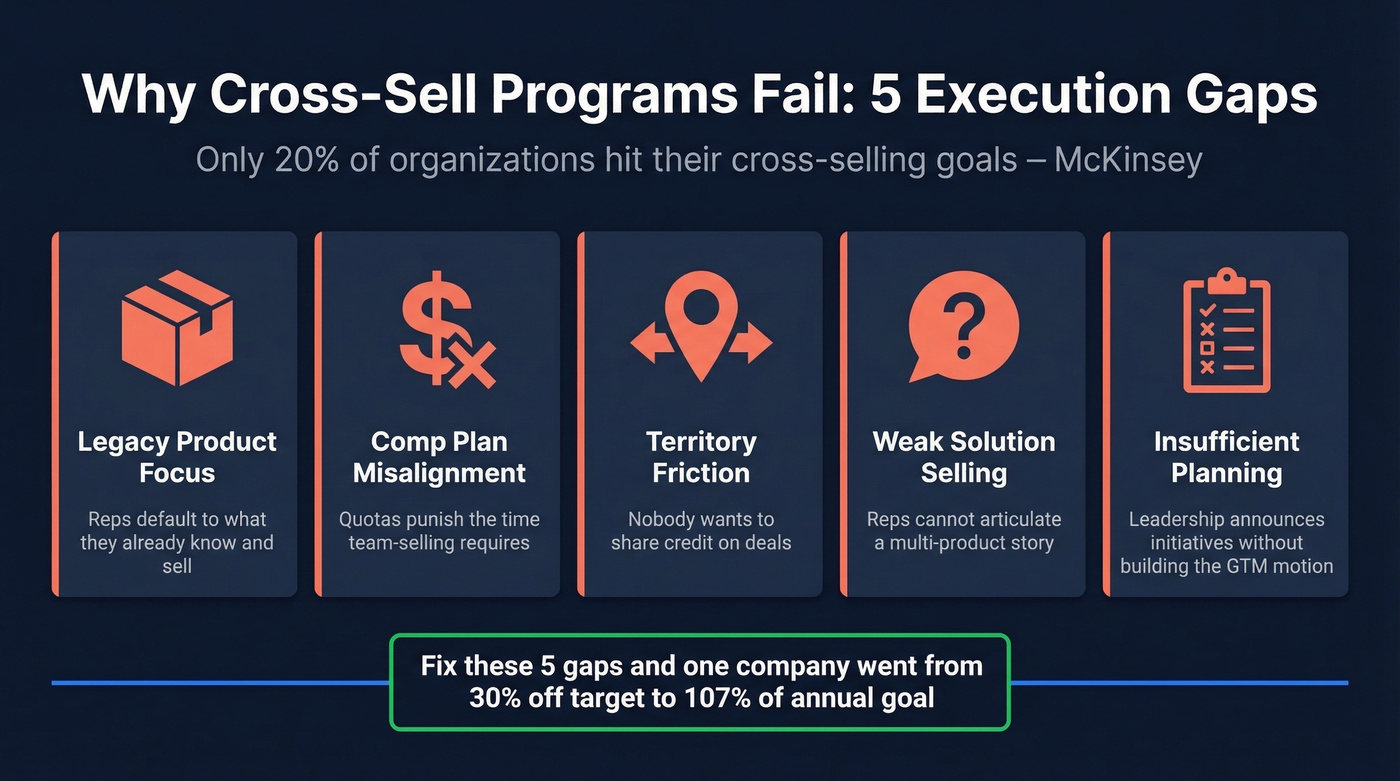
The difference wasn't a new product. It was fixing five execution failures:
- Legacy product focus - reps default to what they know
- Comp plan misalignment - quotas punish the time team-selling requires
- Territory friction - nobody wants to share credit
- Weak solution-selling skills - reps can't articulate a multi-product story
- Insufficient planning - leadership announces a cross-sell initiative without building the GTM motion
If three or more sound familiar, you've got a structural problem, not a messaging problem.

Cross-sell programs fail when reps can't reach decision-makers. Stale CRM data means bounced emails and wasted offers. Prospeo refreshes 300M+ profiles every 7 days with 98% email accuracy - so your cross-sell campaigns land in real inboxes, not spam traps.
Stop losing cross-sell revenue to bounced emails.
Practices That Actually Drive Cross-Sell Revenue
1. Stop Cross-Selling on the Second Purchase
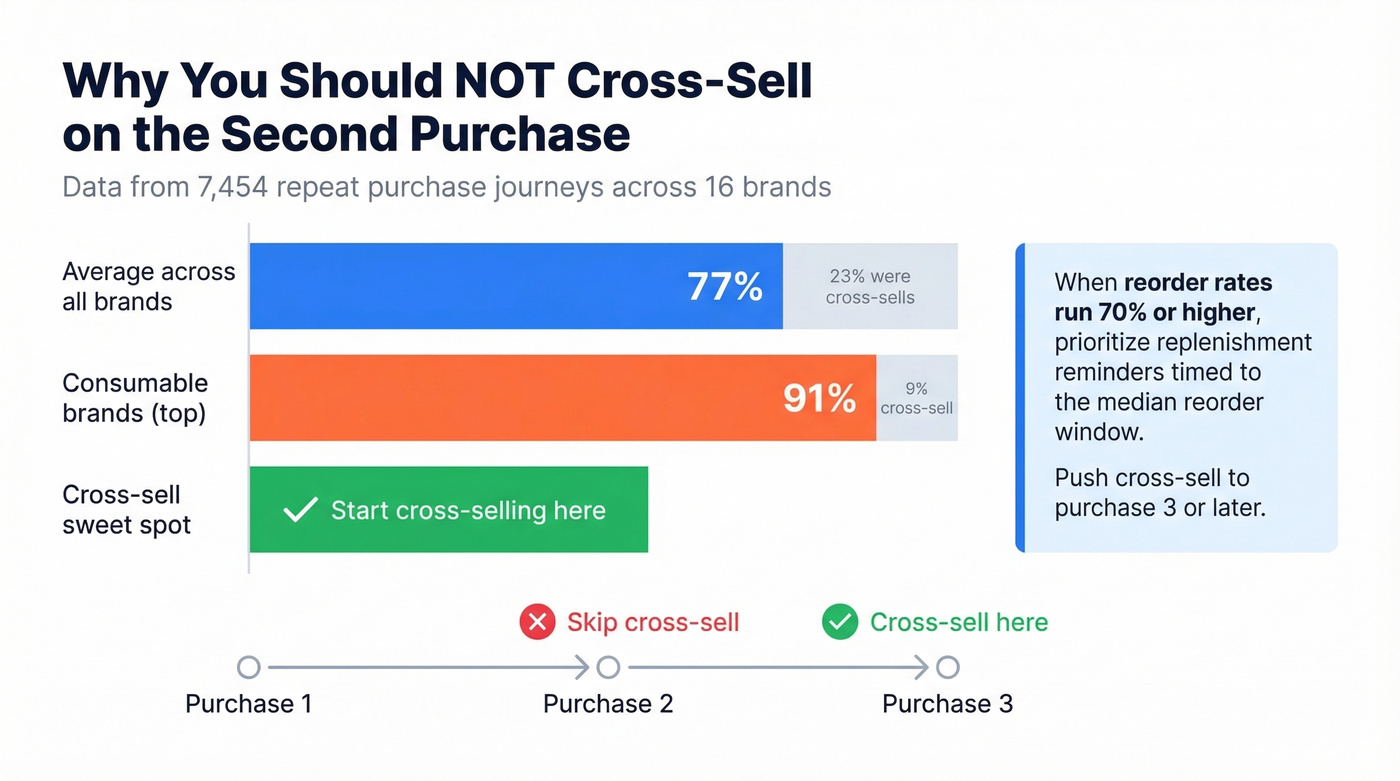
Across 7,454 repeat purchase journeys from 16 brands, 77% of second purchases were reorders. For consumables, one brand hit 91%. When reorder rates run 70%+, your post-purchase flow should prioritize replenishment reminders timed to the median reorder window - not a cross-sell pitch the customer isn't ready for. Push cross-sell to purchase three or later.
2. Use Product Usage Data as Your Trigger
In SaaS, the best cross-sell signal isn't time since purchase. It's behavior. If someone's maxing out API calls, that's a trigger. If they've filed three tickets about a problem your adjacent product solves, that's a trigger.
Cross-sell cycles in SaaS often run 30-50% shorter than new-logo deals at similar ACV, which makes sense - you've already earned trust, and the buyer already knows your platform, so the evaluation phase compresses dramatically. Build your playbook around usage events, not arbitrary timelines, and track that velocity to justify the program to leadership.
3. Time Email Offers Within 24-72 Hours
Post-purchase cross-sell emails perform best when they land within 24-72 hours, while buying momentum is still high. After that window, conversion drops fast.
As a practical benchmark, post-purchase offers convert around 3-8%. Trigger-based sends beat batch campaigns almost every time.
4. Keep the Price Under 25%
The sweet spot for cross-sell pricing is 10-25% of the original order value. A $30 add-on feels trivial next to a $200 purchase. A $75 add-on triggers a second buying decision. Keep the ratio tight.
5. Fix Comp Plans Before Launching
McKinsey found that roughly 75% of executives call incentives important or critically important to cross-sell success. But SPIFs alone don't work.
Here's the thing: clarifying opportunity ownership matters more than bonus dollars. If a rep doesn't know whether they'll get credit, they won't pursue it. We've watched teams throw money at cross-sell bonuses while leaving the territory rules ambiguous, and the result is always the same - reps stick with what's safe.
6. Use Social Proof, Not Discounts
Discounting a cross-sell offer trains customers to wait for the discount. Lean on consistency (they already bought from you), social proof ("Frequently Bought Together"), and scarcity (limited-time bundles). UGC and reviews on the complementary product outperform a generic coupon almost every time.
7. Clarify Ownership Between Sales and CS
Accounts where reps had strong decision-maker relationships hit an 80% cross-sell rate within a year. Accounts without those relationships took roughly 18 months longer. That's a massive gap.
Define who owns the relationship with each buying persona. Don't overlook support - agents solving a customer's problem have more credibility to recommend a complementary product than a quota-carrying rep does.
8. Verify Contact Data Before Scaling
The best cross-sell strategy produces nothing if your emails bounce. We've seen campaigns die quietly because CRM emails were stale - contacts changed roles, companies switched domains, and nobody noticed until reply rates cratered. Before you scale any cross-sell outreach, run your contact list through a verification tool like Prospeo. A 7-day data refresh cycle and 98% email accuracy mean you're not working off decayed data.

How to Measure Cross-Selling Success
The core formula is attach rate:
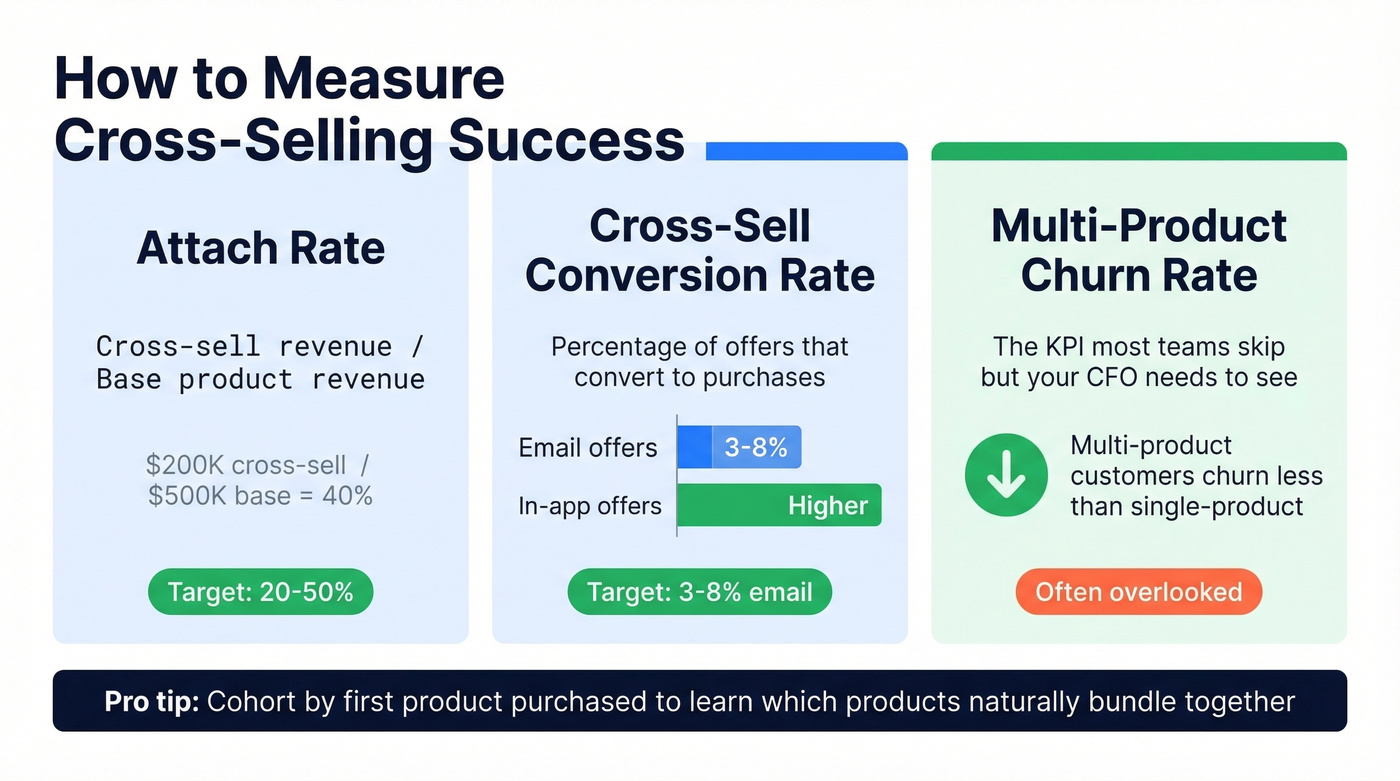
Attach Rate = Cross-sell revenue / Base product revenue
Worked example: $200K in cross-sell bookings from accounts with $500K in base product revenue = 40% attach rate. Cohort by first product purchased to learn which products naturally bundle.
| KPI | What It Tells You | Target Range |
|---|---|---|
| Attach rate | Revenue leverage | 20-50% (varies by industry) |
| Cross-sell conversion rate | Offer effectiveness | 3-8% (email), higher for in-app |
| Multi-product churn rate | Stickiness impact | Often lower than single-product |
Multi-product churn rate is the one most teams skip - and it's the one that proves cross-selling's long-term value to your CFO.
Let's be honest: if your deal size is under $15K and you don't have a dedicated CS team, skip the complex cross-sell playbook entirely. Nail replenishment timing and bundle pricing on your checkout page. You'll capture most of the value with a fraction of the operational cost.
Cross-Sell Email Templates
Three subject lines that work:
- "We also recommend..."
- "Customers who bought [X] also grabbed [Y]"
- "[Name], complete the setup with [product]"
Fill-in-the-blank body:
Hi [Name],
Thanks for [purchasing / renewing] [Product X]. Most teams using [X] also add [Product Y] to [specific benefit - e.g., "cut onboarding time in half"].
[One sentence of social proof - e.g., "A large share of our [X] customers use both."]
Want to see how it fits? [CTA button: "See [Product Y] in action"]
One product recommendation per email. One CTA. That's it.
McKinsey says accounts with strong decision-maker relationships hit 80% cross-sell rates. You can't build those relationships if you're emailing the wrong person. Prospeo gives you verified emails and direct dials for every buying persona - at $0.01 per email.
Reach the right contact on the first try, every time.
FAQ
What's the difference between cross-selling and upselling?
Cross-selling offers a complementary product alongside the original purchase; upselling offers a higher-tier version of the same product. Both increase revenue per customer but target different buying decisions - wider basket vs. deeper ticket.
When should you start cross-selling to customers?
Not on the second purchase. Data across 16 brands shows 77% of those are reorders. Start at purchase three or later, once reorder behavior is established and the customer trusts your core product.
How do you measure cross-sell performance?
Track attach rate (cross-sell revenue divided by base revenue), cross-sell conversion rate (3-8% is typical for email), and multi-product churn rate. Cohort by first product purchased to identify which items naturally bundle together.
How do you keep cross-sell emails from bouncing?
Run your contact list through a verification tool before launching. Stale CRM data is the silent killer of cross-sell campaigns - contacts change roles, companies switch domains, and bounce rates climb without anyone noticing until it's too late.