


CUFinder vs Forager: Which B2B Data Tool Is Worth Your Money?
Bad data costs organizations an average of $15M per year, per Gartner estimates. If you're comparing CUFinder and Forager, good luck finding a single page that puts them side by side. One directory lists Forager at $675/month when the real price is $50 - and the same page lists CUFinder at $34. That's the state of B2B software research right now.
30-Second Verdict
- Pick CUFinder if you want a proven platform with 988 peer reviews, more credits per dollar, and a free tier to start.
- Pick Forager if you want always-on web crawling, intent signals, and a 2.5-week refresh cycle. Just know you're trusting a tool with one review.
What Is CUFinder?
CUFinder is an all-in-one B2B sales intelligence platform covering prospecting, enrichment, and API-driven workflows. The database spans 262M+ companies and 419M+ contacts with a claimed 98% accuracy rate. It holds a 4.8/5 rating across 988 G2 reviews - 97% of which are five stars.
The Growth plan runs $49/month for 1,000 credits, and a free tier gives you 50 credits to test. Chrome extensions pull contact and company data from web pages, and a Google Sheets add-on supports bulk enrichment without leaving your spreadsheet. For teams that want a straightforward search-and-export workflow, it's hard to argue with the simplicity here.
What Is Forager?
Forager takes the opposite approach. Instead of a static database, it runs always-on web crawlers that continuously discover and enrich prospects matching your ICP across 50+ attributes, then syncs them to your CRM. The dataset covers 850M+ person and company records and 200M+ verified mobiles, with a claimed 99% accuracy.
Data refreshes every 2.5 weeks. Forager ingests 100M+ intent signals monthly - job posts, tech adoption, funding events - and exposes Make.com modules for work email lookup, phone lookup, and custom API calls. Integrations include HubSpot, Salesforce, Snowflake, and Zapier. One gap worth noting: Forager lacks built-in reporting, so you'll need your CRM or a BI tool for pipeline analytics.
Head-to-Head Comparison
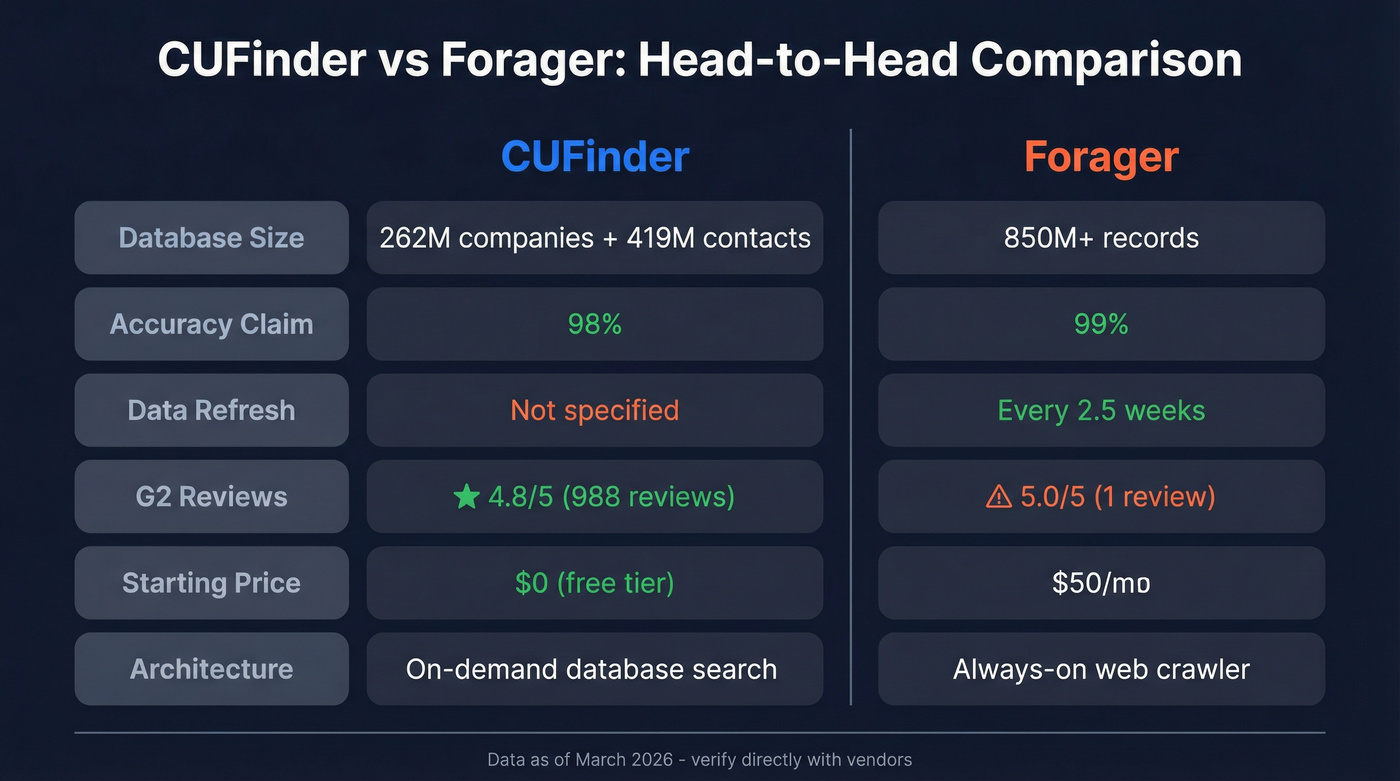
| Feature | CUFinder | Forager |
|---|---|---|
| Database size | 262M companies + 419M contacts | 850M+ records |
| Accuracy claim | 98% | 99% |
| Data refresh | Not specified | Every 2.5 weeks |
| G2 rating | 4.8/5 (988 reviews) | 5.0/5 (1 review) |
| Starting price | $0 (free tier) | $50/mo |
| CRM integrations | HubSpot, Salesforce (and more) | HubSpot, Salesforce, Snowflake, Zapier |
Let's address the elephant in the room: 988 reviews versus 1. CUFinder is heavily reviewed on G2, with 97% five-star ratings. Forager's perfect score is statistically meaningless at that sample size. That doesn't make Forager bad - it means you can't validate its claims through peer feedback yet. We didn't find meaningful Reddit discussion for either tool, which makes that review volume gap even more important when you're deciding where to put budget.
The architectural difference matters more than the numbers suggest. CUFinder is a traditional database-search model: you query, you get results. Forager's crawler approach continuously discovers prospects and pushes them to your CRM. If you want hands-off prospecting, Forager's model is genuinely interesting. For on-demand search, CUFinder is more intuitive.
Here's the thing: most teams under 10 reps don't need a crawler. They need accurate data they can search on demand. The crawler model sounds futuristic, but in our testing, credit-based models like CUFinder's are easier to budget for than Forager's split mobile/email allocations. Crawlers also tend to shine for well-indexed mid-market and enterprise companies while producing thinner results for smaller or newer firms - a pattern we've seen with similar tools before.

CUFinder doesn't publish a refresh cycle. Forager refreshes every 2.5 weeks. Prospeo refreshes every 7 days across 300M+ profiles - with 98% email accuracy at $0.01/email. That's the freshness gap most comparison pages won't tell you about.
Stop paying more for data that's already stale.
Pricing Breakdown
CUFinder:
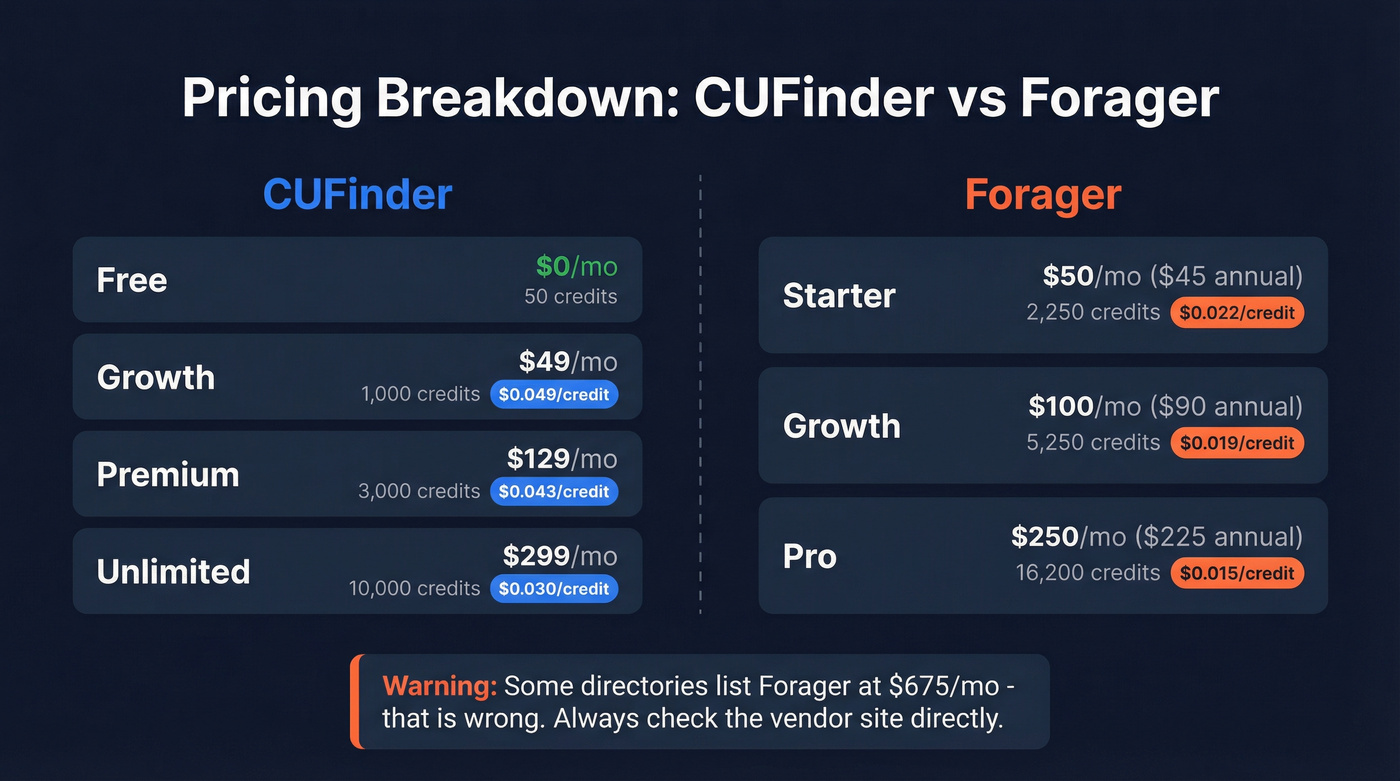
| Plan | Price | Credits/mo |
|---|---|---|
| Free | $0 | 50 |
| Growth | $49/mo | 1,000 |
| Premium | $129/mo | 3,000 |
| Unlimited | $299/mo | 10,000 |
Forager:
| Plan | Monthly | Annual | Credits/mo |
|---|---|---|---|
| Starter | $50 | $45 | 2,250 |
| Growth | $100 | $90 | 5,250 |
| Pro | $250 | $225 | 16,200 |
Forager's per-unit costs break down to roughly $0.23-$0.33 per mobile and $0.08-$0.11 per email depending on tier. If you're spending under $100/month, CUFinder gives you more credits and a proven track record. At $250/month, Forager's per-unit economics improve, but you're paying a premium for the crawler model.
One thing that drove us nuts during research: some directories list Forager at $675/month. That's flat-out wrong. Always verify on the vendor's pricing page directly. Directory data in this category is notoriously unreliable.
Reviews and Social Proof
You're comparing two tools most B2B teams haven't heard of. That's actually smart research - the well-known platforms are often overpriced for smaller teams.
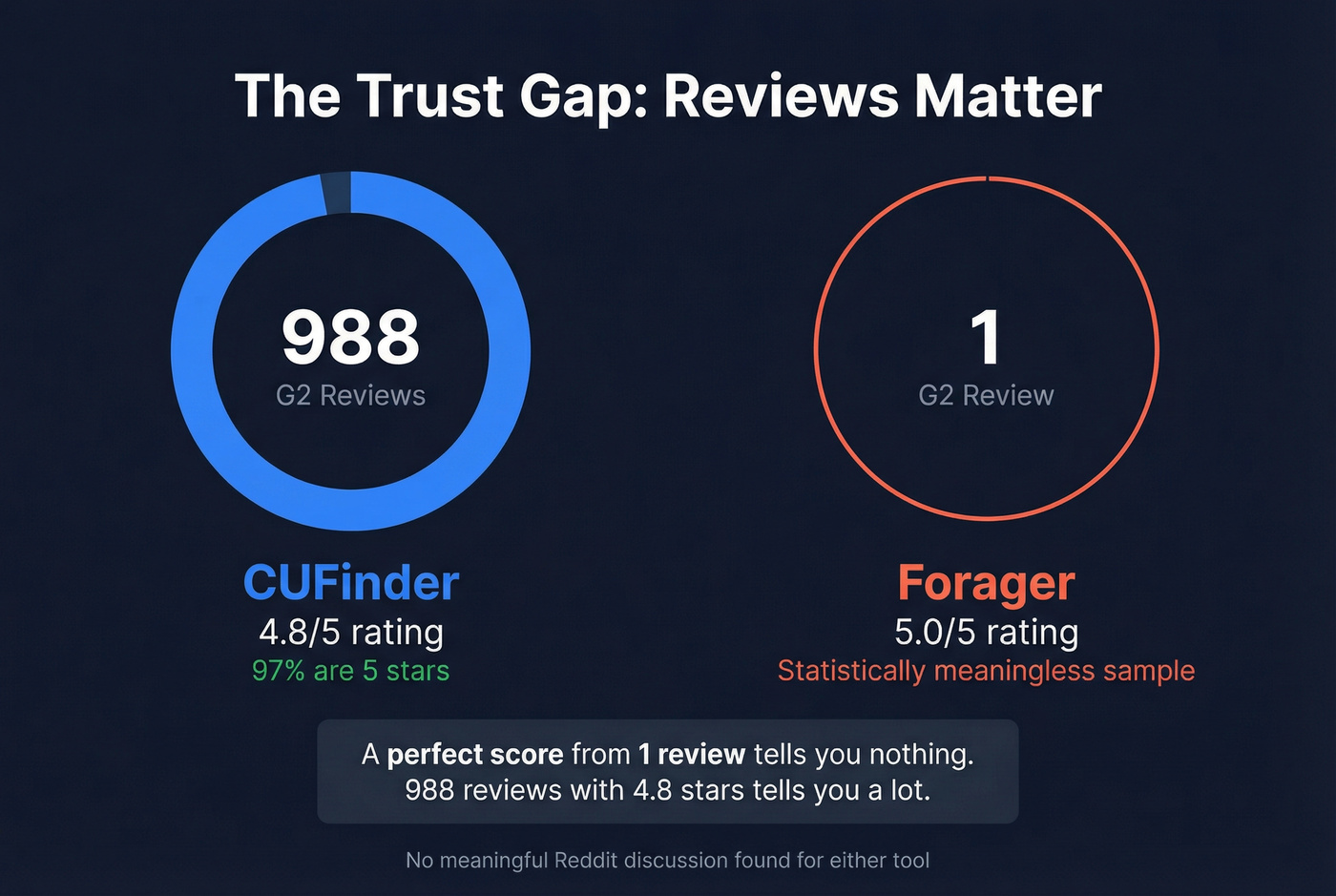
CUFinder's 988 reviews consistently praise accuracy and ease of use. The recurring complaint is that data can occasionally be outdated, which isn't surprising for any platform that doesn't publish a refresh cycle. Forager's single review and on-site testimonials point to high data quality but sometimes lower coverage. I've seen this pattern with crawler-based tools before: great precision on well-indexed companies, thinner results for smaller or newer firms. If your ICP skews toward early-stage startups, test carefully before committing.
If Neither Feels Right
For teams where data freshness is the deciding factor, neither tool matches a 7-day refresh cycle. Prospeo covers 300M+ professional profiles, 143M+ verified emails, and 125M+ verified mobiles at 98% accuracy - roughly $0.01 per email. It's fully self-serve with no contracts, and the free tier lets you test before committing a dollar. With 30+ search filters including buyer intent powered by Bombora, technographics, and job-change signals, it handles both on-demand search and enrichment workflows. Native integrations with Salesforce, HubSpot, Smartlead, Instantly, Lemlist, Clay, Zapier, and Make mean less manual work for outbound teams.
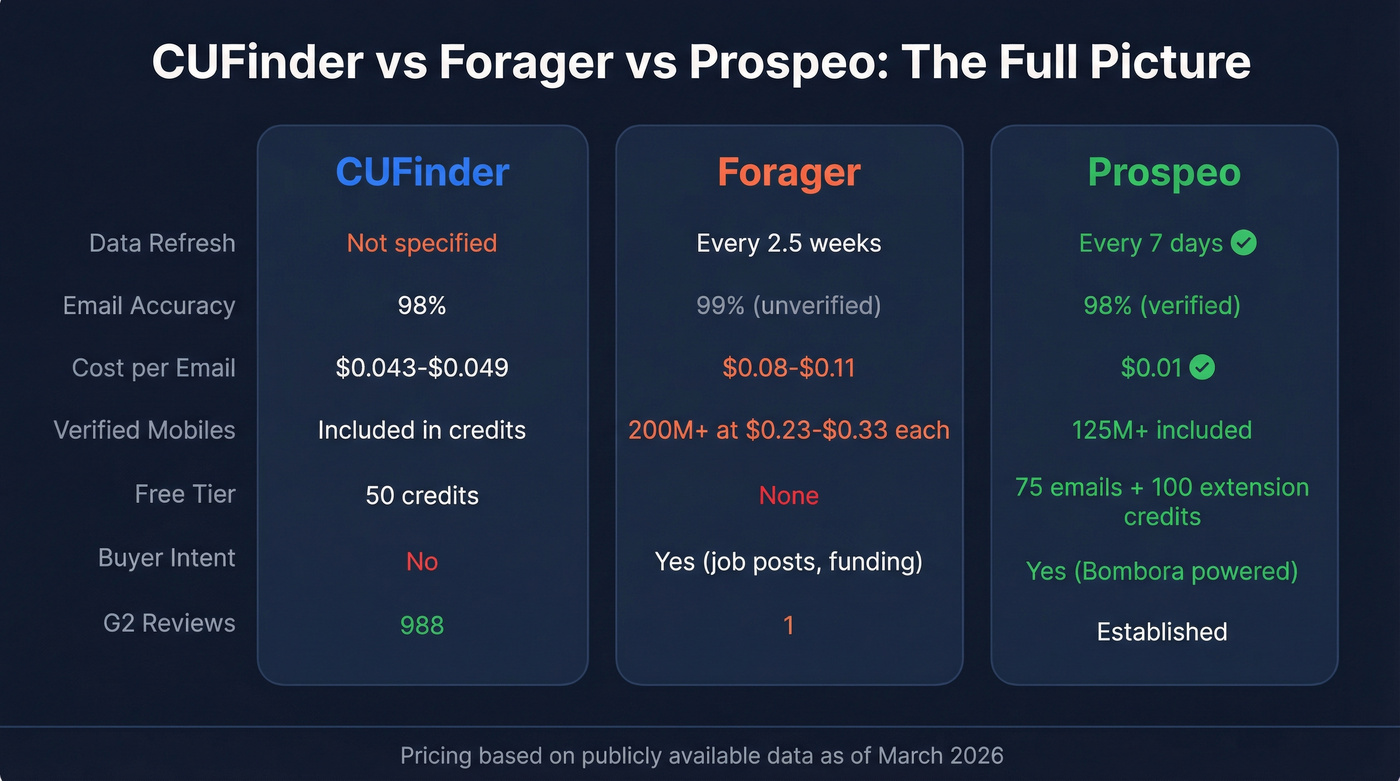
Forager charges $0.23-$0.33 per mobile. Prospeo gives you 125M+ verified mobiles with a 30% pickup rate - plus 30+ filters including buyer intent, technographics, and job-change signals. No contracts, no sales calls, 75 free emails to start.
Better mobiles, better emails, a fraction of the cost.
Final Verdict
CUFinder is the right pick for SMB teams who want proven, well-reviewed software at $49/month. The free tier lets you validate before spending.
Forager is for teams obsessed with always-on ICP crawling who accept the thin review footprint. The crawler model is genuinely differentiated - just go in with eyes open about the lack of third-party validation.
For everyone else weighing CUFinder vs Forager, a 7-day refresh cycle and $0.01/email is hard to beat on pure economics.
FAQ
Is Forager really $50/month or $675/month?
Forager starts at $50/month ($45 on annual billing). The $675 figure appearing on some software directories is incorrect - always verify pricing directly on Forager's website.
Which has more accurate data?
Both claim high accuracy (98% and 99%), but CUFinder's claim is backed by 988 peer reviews while Forager has one. A faster data refresh cycle also reduces stale records reaching your sequences - weekly refreshes outpace both tools on freshness.
Can I try either tool for free?
CUFinder offers a free plan with 50 credits/month - enough for a basic test. Forager has no free tier; plans start at $50/month. Prospeo's free plan includes 75 email credits plus 100 Chrome extension credits monthly, no card required.
Which is better for small teams?
CUFinder. The free tier, lower entry price, and 988 reviews make it the safer choice for teams still validating their outbound process. Forager's crawler model adds complexity most small teams don't need yet.