


CUFinder vs QuickEnrich: Which B2B Enrichment Tool Is Worth It?
Your SDR lead just asked you to evaluate two enrichment tools they found in a LinkedIn post, and you've never heard of either one. That's the reality with CUFinder vs QuickEnrich - neither is a household name, and you're stuck doing due diligence on tools with very different levels of market proof. B2B contact data decays at roughly 2.1% per month, so picking the wrong enrichment provider doesn't just waste budget - it actively degrades your pipeline.
30-Second Verdict
- Pick CUFinder if you want the safer bet. It has 988 G2 reviews, a 4.8/5 rating, a free tier, and CRM integrations.
- Pick QuickEnrich if you're optimizing purely on cost-per-credit ($0.0048 vs $0.049) and comfortable betting on an unreviewed tool.
Feature Comparison at a Glance
| Feature | CUFinder | QuickEnrich |
|---|---|---|
| Database | 269M+ companies | 130M+ contacts |
| Email Accuracy | 98% (claimed) | 97% (claimed) |
| Verification | Not detailed publicly | SMTP + catch-all, double verified |
| Mobile Numbers | Yes | Yes (~25% of contacts) |
| API Access | Yes (paid plans) | Yes (all plans, 1000 req/min) |
| Chrome Extension | Yes | Not highlighted |
| CRM Integrations | Varies by plan | Clay, custom via API |
| G2 Rating | 4.8/5 (988 reviews) | No presence |
| Free Tier | Yes (50 credits/mo) | Not highlighted |
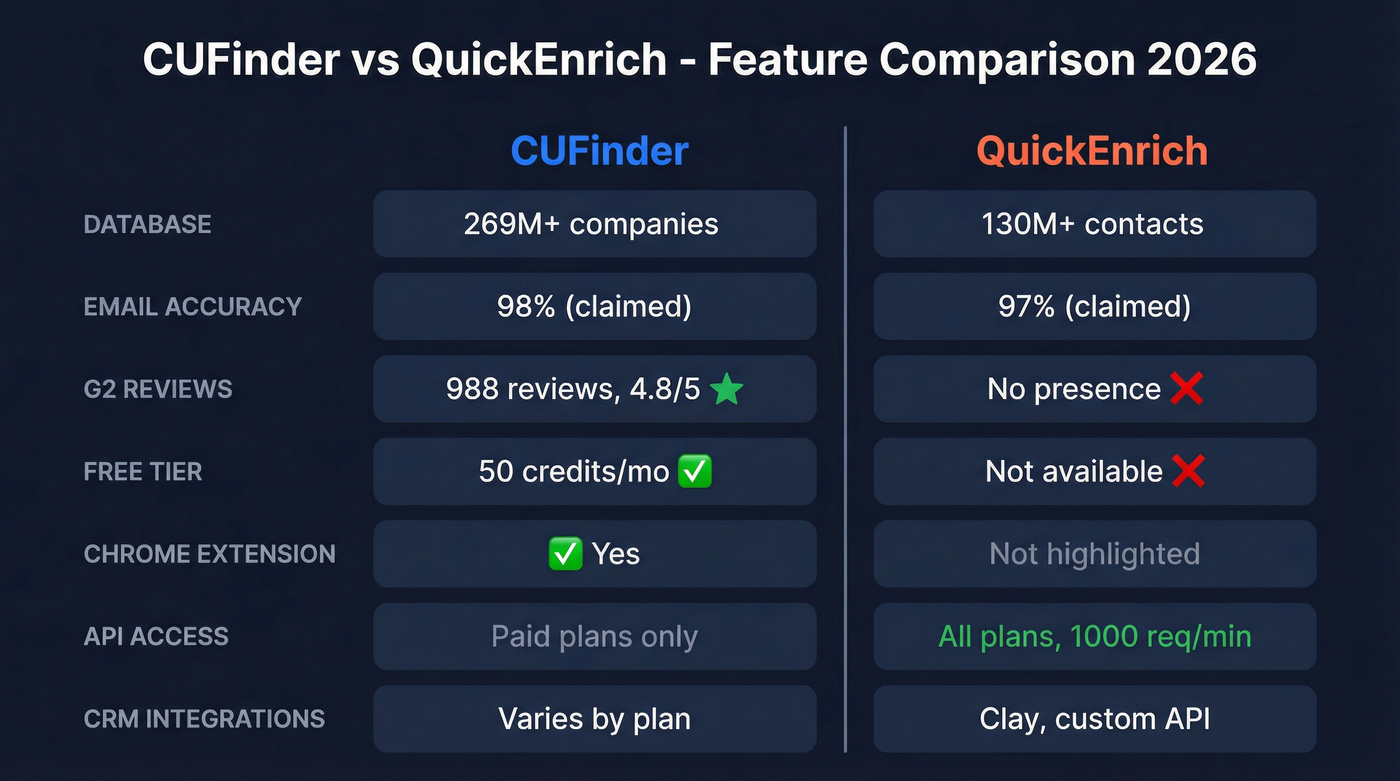
CUFinder lists a bigger dataset on its site. But raw database size tells you nothing about match rates for your specific ICP. The real story is in the pricing and trust signals.
Pricing Breakdown
CUFinder
| Plan | Price/mo | Credits | Cost/Credit |
|---|---|---|---|
| Free | $0 | 50 | - |
| Growth | $49 | 1,000 | $0.049 |
| Premium | $129 | 3,000 | $0.043 |
| Unlimited | $299 | 10,000 | $0.030 |
Annual billing reduces the effective monthly price - check CUFinder's pricing page directly for current rates.
QuickEnrich
| Plan | Price/mo | Credits | Cost/Credit |
|---|---|---|---|
| Starter | $29 | 6,000 | $0.0048 |
| Growth | $99 | 25,000 | $0.004 |
| Unlimited | Custom | Custom | - |
Annual billing drops to $24/mo and $83/mo respectively.
The Real Math
QuickEnrich is roughly 10x cheaper per credit. That's a massive gap.
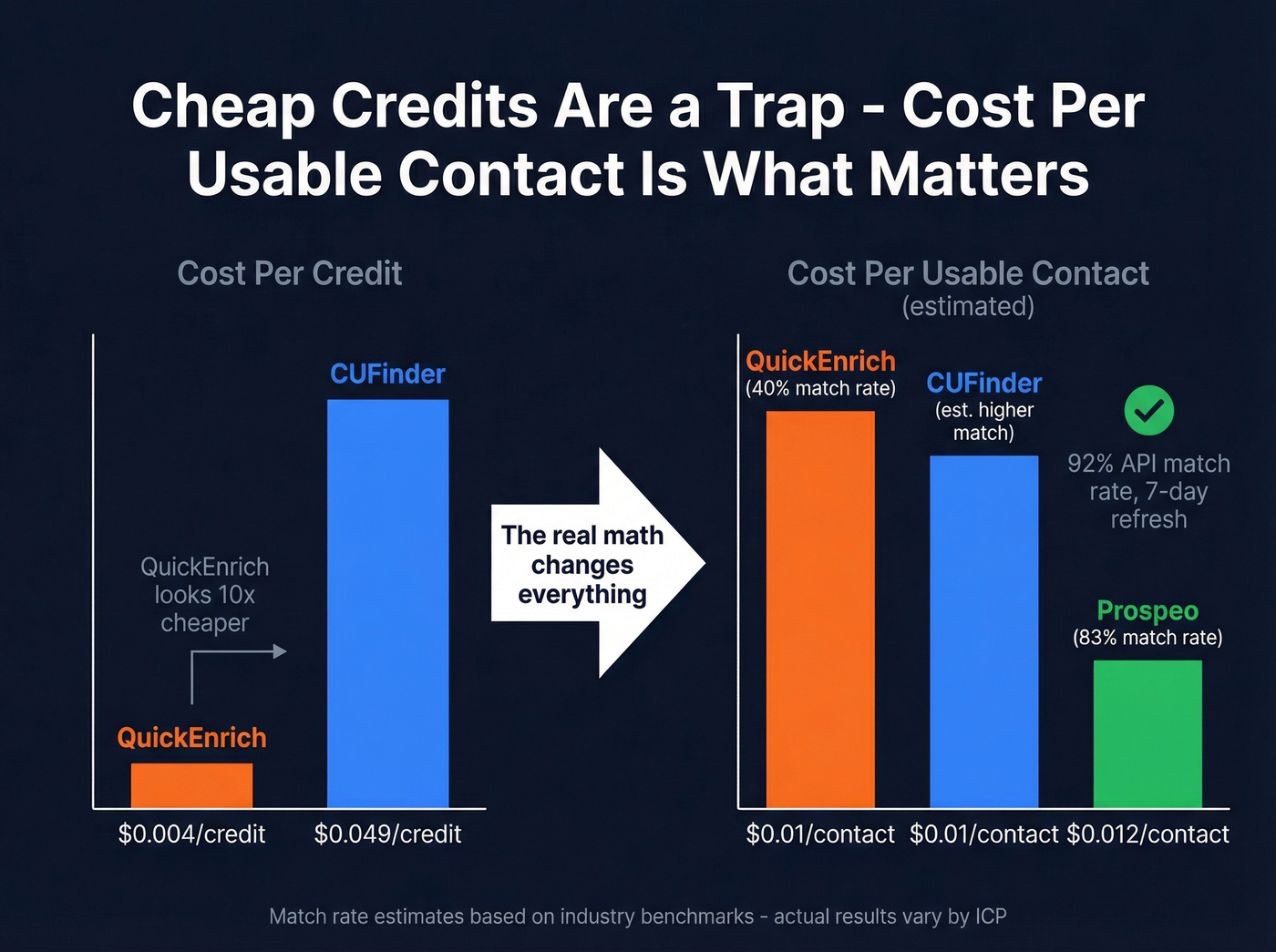
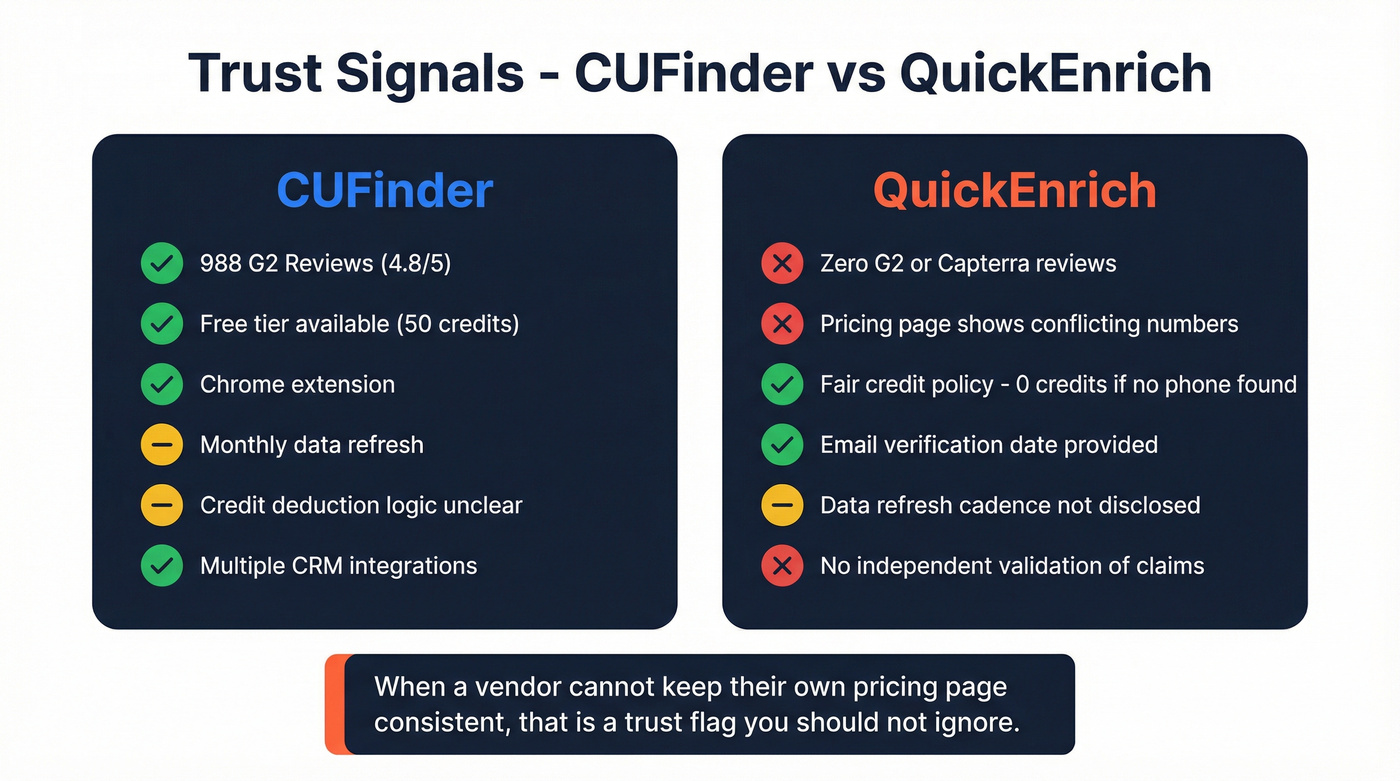
But credits aren't apples-to-apples. QuickEnrich deducts 1 credit only when a phone number is returned and charges 0 credits when no phone is found, which is genuinely fair. CUFinder's credit logic is less transparent - you'll want to confirm exactly what counts as a deduction before committing.
In our testing across enrichment tools, credit-based pricing only tells half the story. What matters is the match rate you actually get. A $0.004 credit that returns data 40% of the time costs more per usable record than a $0.01 credit with an 83% match rate.
Here's the frustrating part: QuickEnrich's pricing page shows conflicting credit quantities - 6,000 vs 3,000 for Starter, 25,000 vs 11,000 for Growth. When a vendor can't keep their own pricing page consistent, that's a trust flag you shouldn't ignore.

Conflicting pricing pages and zero independent reviews are red flags you can't afford in your enrichment stack. Prospeo's 92% API match rate means fewer wasted credits, and the 7-day data refresh cycle keeps records fresh while CUFinder updates monthly and QuickEnrich won't even say.
Stop paying for credits that return stale data half the time.
What Actually Separates Them
The review gap is the elephant in the room. CUFinder has 988 G2 reviews. QuickEnrich has no G2 or Capterra footprint at all. That doesn't make QuickEnrich bad - it makes it unproven. We've seen teams adopt early-stage tools and get burned when coverage drops or the API changes without notice.
We didn't find substantive Reddit threads with tool-specific feedback for either one. When you're evaluating enrichment providers, community sentiment is one of the few honest signals available, and it's basically absent here.
QuickEnrich positions itself as "waterfall-first," meaning you should use it as your primary enrichment source before falling back to other providers. That's a bold stance for a tool with no independent validation. Single-source providers typically leave 40-60% of prospects unreachable, which is exactly why waterfall approaches exist in the first place.
One genuine differentiator worth noting: QuickEnrich provides an email verification date with each record, so you can see exactly when it was last checked. That's a nice transparency touch that CUFinder doesn't emphasize. QuickEnrich also supports lookup by professional profile URL and name/company fallback logic in its API, giving technical teams flexible options.
Both tools market 97-98% email accuracy. Let's be honest - without independent benchmarks, those are marketing numbers. Industry accuracy rates range from 70-95% depending on provider and segment, so take any self-reported figure with a grain of salt.
Here's the thing: if your total enrichment budget is under $200/month, you probably don't need either of these tools. You need one provider with verified data and a high match rate, not a cheap credit that returns stale records half the time.
A Stronger Alternative to Both
If neither tool inspires confidence, Prospeo is worth a serious look. The database covers 300M+ profiles with 143M+ verified emails and 125M+ verified mobile numbers - outpacing both CUFinder and QuickEnrich on verified coverage. Email accuracy sits at 98%, backed by a proprietary 5-step verification process and a 7-day data refresh cycle. CUFinder updates monthly; QuickEnrich doesn't disclose its refresh cadence at all.

The free tier gives you 75 verified emails plus 100 Chrome extension credits per month. Paid plans run at roughly $0.01/email with no contracts and no sales calls. Native integrations with Salesforce, HubSpot, Clay, Instantly, and Lemlist mean you won't need to duct-tape workflows together.
If you're still shopping around, compare options in our guide to the best sales prospecting databases and broader outbound lead generation tools.
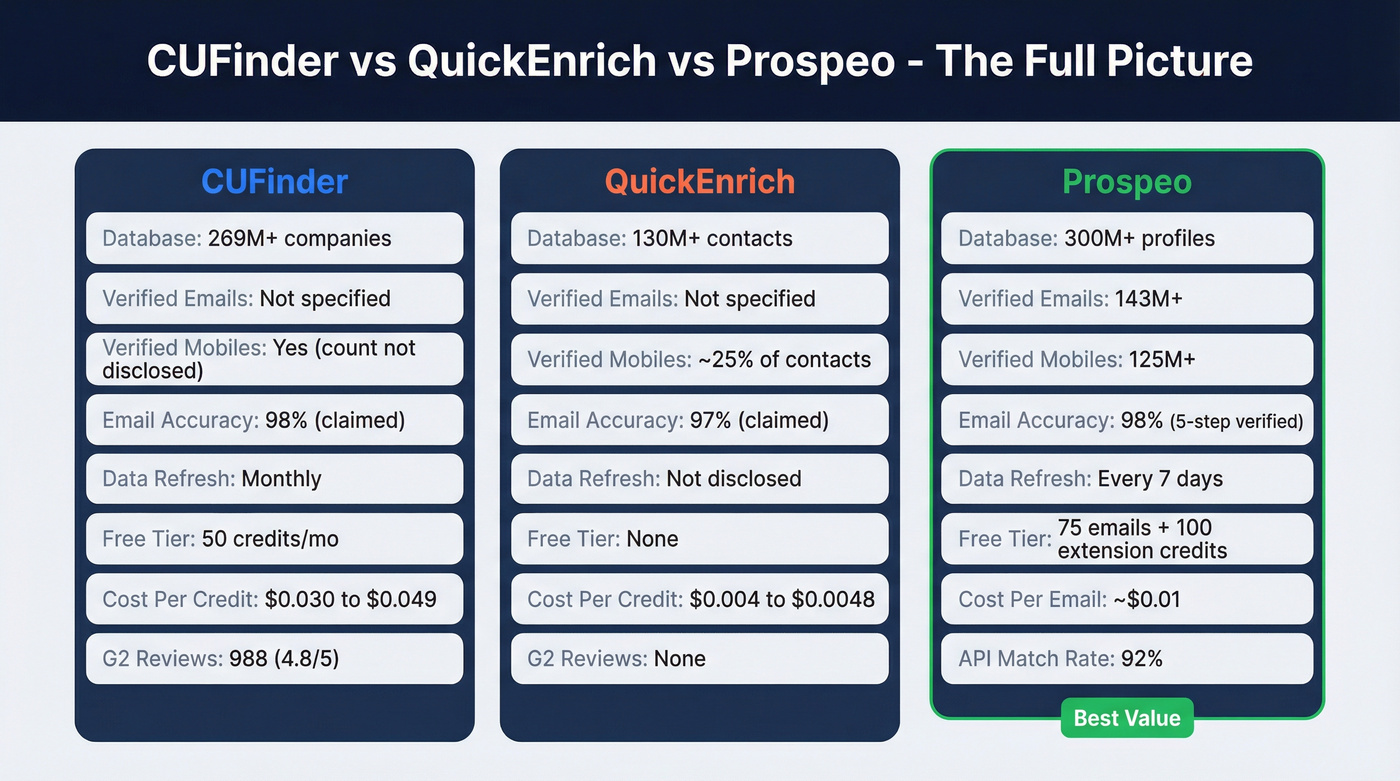
A $0.004 credit with a 40% match rate costs more per usable contact than Prospeo at $0.01 with an 83% enrichment match rate. Add 143M+ verified emails, 125M+ verified mobiles, and a 5-step verification process - and the math isn't close.
Real cost-per-contact beats cheap credits every time.
The Verdict
Pick CUFinder if you need social proof, a free tier, and CRM integrations out of the box. It's the safer choice between these two.
Pick QuickEnrich if you're budget-constrained, comfortable with early-stage risk, and primarily need API-driven enrichment at the lowest per-credit cost. Skip it if pricing page inconsistencies make you nervous - they should.
Pick Prospeo if data accuracy and freshness are non-negotiable. The 7-day refresh cycle, 98% email accuracy, and 125M+ verified mobiles put it in a different category entirely, and the free tier lets you prove it before spending a dollar.
FAQ
Is QuickEnrich legit?
QuickEnrich is a real product with a working API and published pricing. It has no G2 or Capterra footprint, though, and its pricing page shows conflicting credit quantities. Treat it as an early-stage bet, not a safe default for teams running production outbound.
Does CUFinder have a free plan?
Yes. CUFinder offers 50 free credits per month - enough to test data quality on a small sample before committing to a paid tier.
What's a good free alternative to both?
Prospeo's free tier includes 75 verified emails and 100 Chrome extension credits monthly, which is more generous than CUFinder's 50 credits and more transparent than QuickEnrich. Paid plans start at roughly $0.01/email with no contracts, and the 92% API match rate means fewer wasted lookups.
How do I compare enrichment tools beyond pricing?
Focus on three metrics: match rate (percentage of lookups returning data), data freshness (how often records are re-verified), and independent reviews. A tool with a 40% match rate at $0.004/credit costs more per usable record than one with 83% at $0.01. We've run this math across dozens of providers, and the cheapest-looking option almost never wins on a cost-per-usable-contact basis.