

D7 Lead Finder vs ListKit: Pricing, Data, and the Better Pick
You need 500 leads for a client campaign by Friday. You're choosing between a $44.99/mo scraper and an $83/mo verified database. This isn't really a feature shootout - it's a maturity question: are you scraping "good enough" lists, or are you buying data you can actually send to without torching deliverability?
D7 Lead Finder and ListKit can both produce a spreadsheet of prospects. Only one is built to hold up once you're sending at scale, tracking outcomes, and trying to keep bounce rates low across multiple inboxes.
30-second verdict
D7 Lead Finder is the cheap, fast way to pull local business lists. But it only checks email syntax, so you should expect meaningful bounce unless you verify elsewhere. It's also heavy on generic inboxes (info@, sales@).
ListKit is the better pick for data quality and outbound workflows: triple-verified emails, deeper filters, and real integrations. The tradeoff is the credit system. Your real cost per usable lead depends on what you pull (email only vs email + mobile + intent).
Full comparison table
| D7 Lead Finder | ListKit | Winner | |
|---|---|---|---|
| Starting price | $44.99/mo (Starter) | $83/mo (annual) / $97 monthly | D7 (by a wide margin) |
| Database size | 65M+ business records | 731M triple-verified contacts | ListKit |
| Email verification | Syntax-only | Triple-verified (~98% deliverability) | ListKit |
| Decision-maker contacts | ~15% of results | Yes, with job title filters | ListKit |
| Search filters | 2 (keyword + location) | Advanced filters (intent, technographics, etc.) | ListKit |
| CRM integrations | API only (Professional plan) | Salesforce, HubSpot, Pipedrive, Zoho, Smartlead, Instantly, Zapier (plus more) | ListKit |
| G2 rating | 3.7/5 (5 reviews) | 4.7/5 (388 reviews) | ListKit |
| Best for | Budget local-biz scraping | Scaled B2B outbound | Depends on your stage |
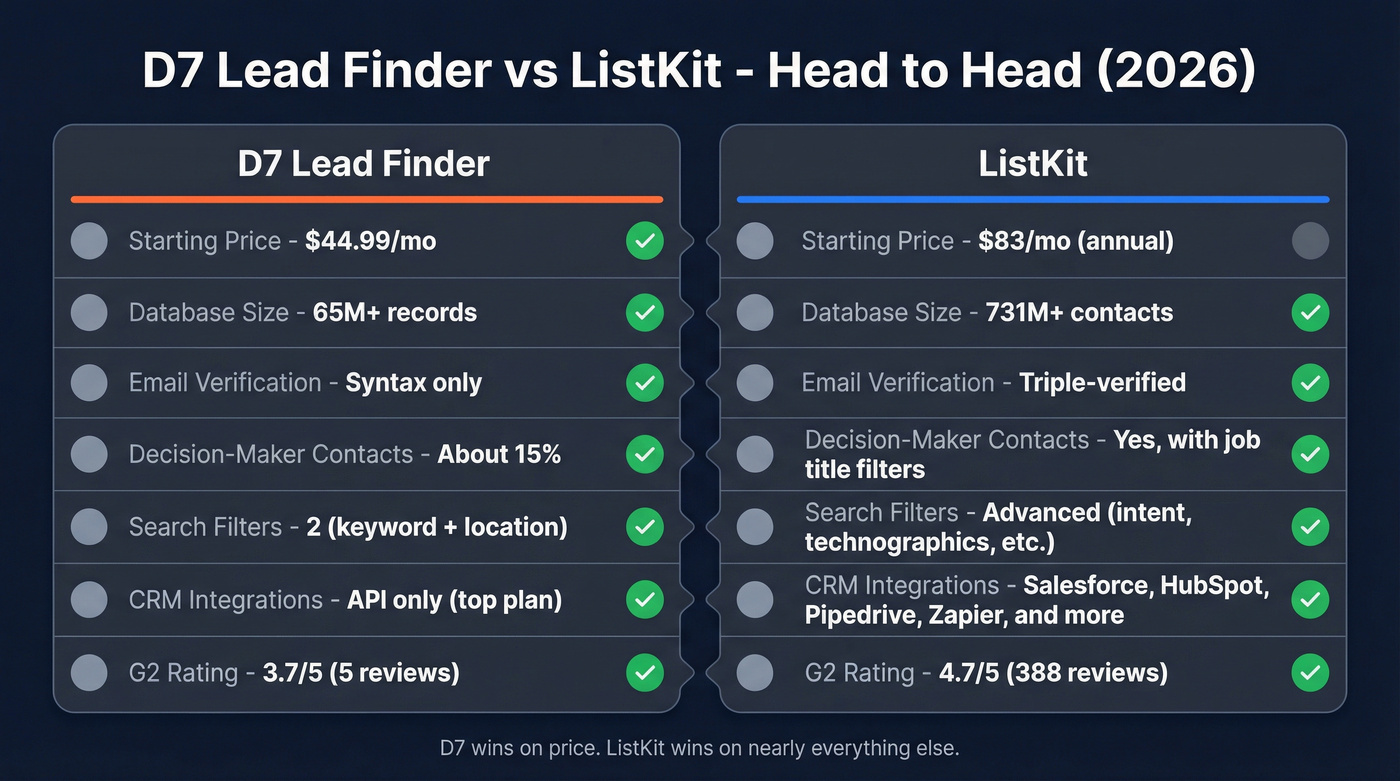
If you're scraping local businesses on a shoestring, D7 wins on price. For almost everything else - verified contacts, filtering, integrations, and repeatable outbound - ListKit's the stronger platform.
Pricing breakdown (and why ListKit's math surprises people)
| D7 Lead Finder | ListKit | |
|---|---|---|
| Cheapest paid plan | $44.99/mo (Starter) | $83/mo (annual) / $97 monthly |
| Mid tier | $54.99/mo (Agency) | $253/mo (Scale, annual) |
| Top tier | $119.99/mo (Professional) | $508/mo (Ultimate, annual) |
| Free plan | No | Yes (100 credits) |
| Annual discount | None | ~14% vs monthly |
D7's pricing is refreshingly simple: three flat-rate plans with daily search limits. No credits. No "wait, how many leads did that export cost me?" moments. It even accepts Bitcoin and PerfectMoney, which is rare in this category and handy for some international teams.
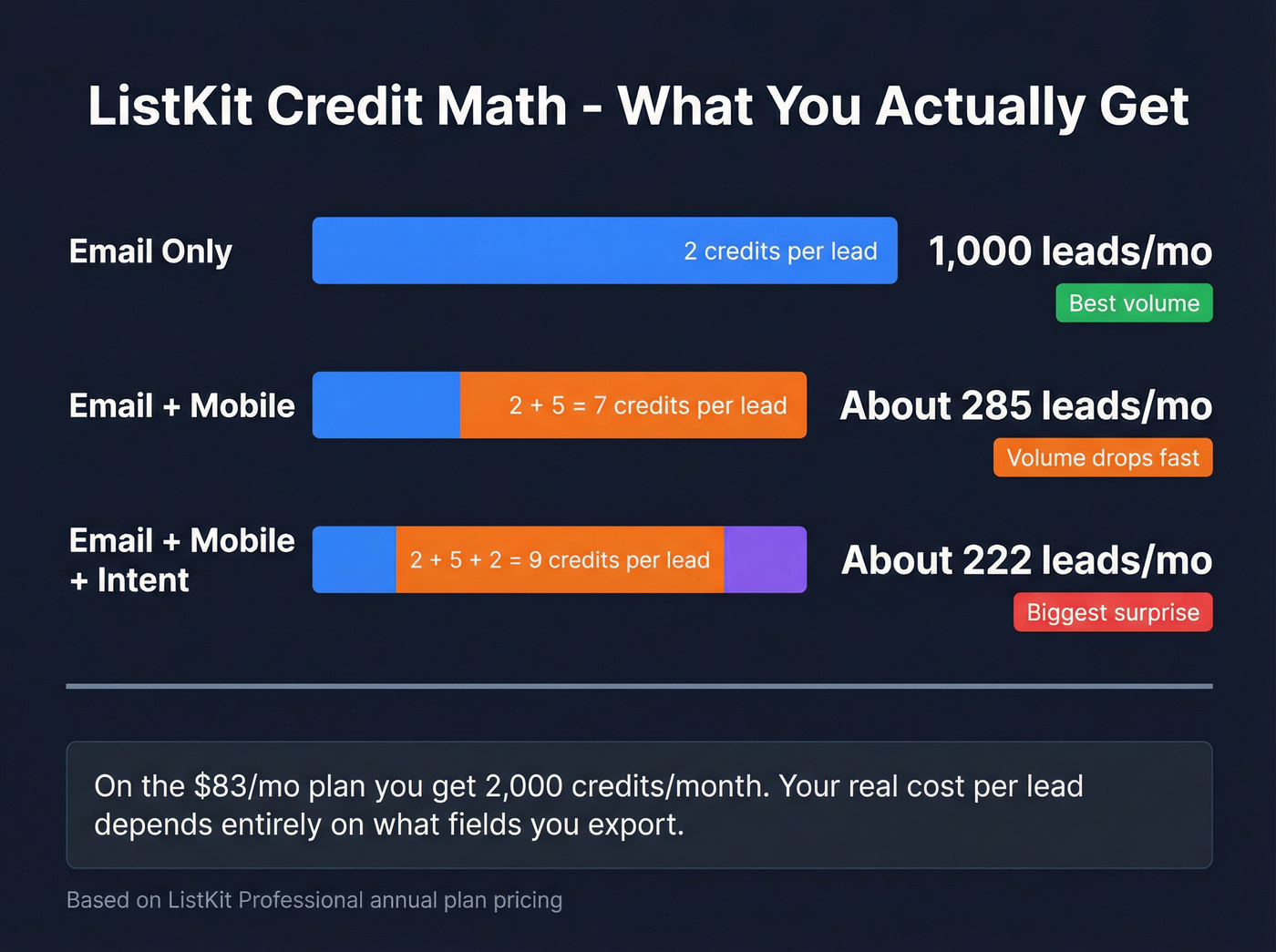
ListKit runs on credits, and that's where teams get tripped up. A verified business email costs 2 credits (1 for the email, 1 for triple verification). On Professional (24,000 credits/year), that's about 2,000 credits/month, or roughly 1,000 verified emails/month.
Now the part people forget to model: once you add mobile numbers (5 credits each) and intent signals (2 more credits), your monthly volume drops fast. If you build lists with email + mobile + intent, you're not buying 1,000 leads/month anymore - you're buying something closer to a few hundred, depending on your mix.
Here's the thing: credit pricing isn't "bad." It's just easy to underestimate, especially when you're under pressure and exporting lists like it's free.
Data quality: the real difference
This is where the comparison stops being close.
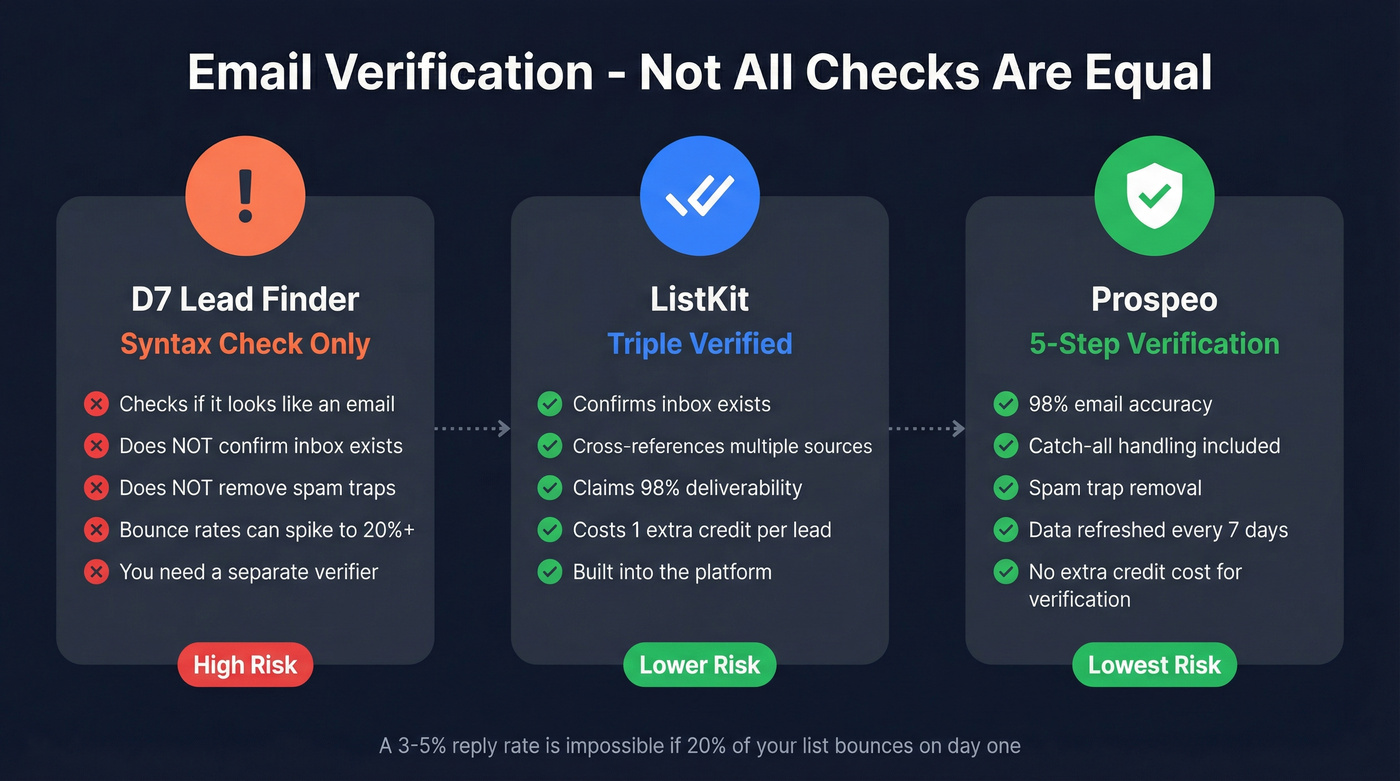
D7 only verifies email syntax. That means it checks whether an address looks like an email address, not whether it exists or can receive mail. In practice, syntax-only lists need external verification before you send, and bounce rates can get ugly if you skip that step. D7 also skews toward generic inboxes; only about 15% of results include decision-maker contacts, and direct dials sit around 8%.
ListKit's pitch is deliverability: triple-verified emails across a 731M-contact database. That's the right direction if you're doing serious outbound, because deliverability isn't a "nice to have"--it's the whole game. If your list bounces, your domain reputation takes the hit, and your next campaign suffers even if the copy's great.

Real talk: a 3-5% reply rate is a good outcome for cold email. You don't get there if 20% of your list bounces and your inboxes start landing in spam by day three. We've watched agencies burn a sender domain in a week because they rushed list building, skipped verification, and tried to "power through" with volume.
One scenario we keep seeing: someone uses D7 to pull "wedding photographers" in a city, then ends up with portrait studios, commercial photographers, and a bunch of irrelevant categories mixed in. The list looks big, but the campaign performance tells the truth.
If you're going to use D7, budget time and money for verification and cleanup. If you don't, you'll pay for it later.

D7 skips real verification. ListKit charges 2+ credits per lead. Prospeo delivers 98% email accuracy with proprietary 5-step verification, 300M+ profiles, and 30+ search filters - at roughly $0.01 per email. No credit math surprises.
Stop paying twice - once for the list, again for verification.
Features and workflow
D7: dead-simple local scraping
D7 is basically keyword + location. Two filters, quick results, and exports in CSV/Excel/PDF. It can return up to 1,200 results per search and usually finishes in minutes.
Don't buy it expecting a modern outbound workflow. There's no native CRM integration unless you're on the $119.99 Professional plan (API access), and there's no browser extension or sequencing layer. It's a list tool, not a system.
Where D7 quietly does a great job is business context. You can pull review scores from Google/Facebook/Yelp, Instagram follower counts, ad activity detection, and tracking pixel detection. For local agencies trying to spot businesses that already spend money on marketing, those signals are genuinely useful.
Coverage is broad too: US, Canada, Europe, Australia, New Zealand, the UK, Asia, Africa, and Latin America. For a $45/mo tool, that's a lot of reach.
ListKit: outbound infrastructure (not just a database)
ListKit is built for teams running multi-campaign B2B outreach. You get deeper filtering, enrichment, and integrations with tools like Salesforce, HubSpot, Pipedrive, Zoho, Smartlead, Instantly, Google Sheets, Slack, and Zapier.
It also launched a built-in sequencer called Email Engine, so you can send directly from ListKit. And unlimited users on paid plans is a real operational win if you're an agency or a team with multiple SDRs.
Their community is active too. The ListKit Skool community has thousands of members, and people share workflows and results pretty openly.
One gap: no browser extension. If your team likes building lists while researching companies on the fly, that absence is annoying.
ListKit also sells a done-for-you outbound service and publishes some performance stats (27,468 dials resulting in 19 closed deals and $39,439 collected). That's useful context, but managed services are always a fit question: process, approvals, and brand voice matter as much as the tool.
What users actually say (G2 + community chatter)
D7's G2 presence is thin: 3.7/5 with five reviews, and the profile's been unclaimed for a long time. The harshest review calls customer support "a concept alien to them." Ouch, but also not shocking for a budget scraper.
On Reddit, complaints tend to be more operational than philosophical. The consensus in a few r/b2bmarketing threads is that D7 can feel flaky at times: caps, partial data, or runs that stop midstream. Some folks eventually build their own scraping setup once they hit those limits.
ListKit's feedback is more consistent. On G2, support gets praised constantly, and ease of use comes up a lot too. The main complaint is price, and a few reviewers mention billing headaches. If you're going annual, use a virtual card or set a calendar reminder to review renewal terms - basic hygiene, but it saves drama.
Who should pick which
Pick D7 Lead Finder if you:
- need local business lists fast and cheap (under $50/mo)
- don't care if most emails are generic inboxes
- want extra business signals like reviews and pixel detection
- are willing to verify and clean every list before sending
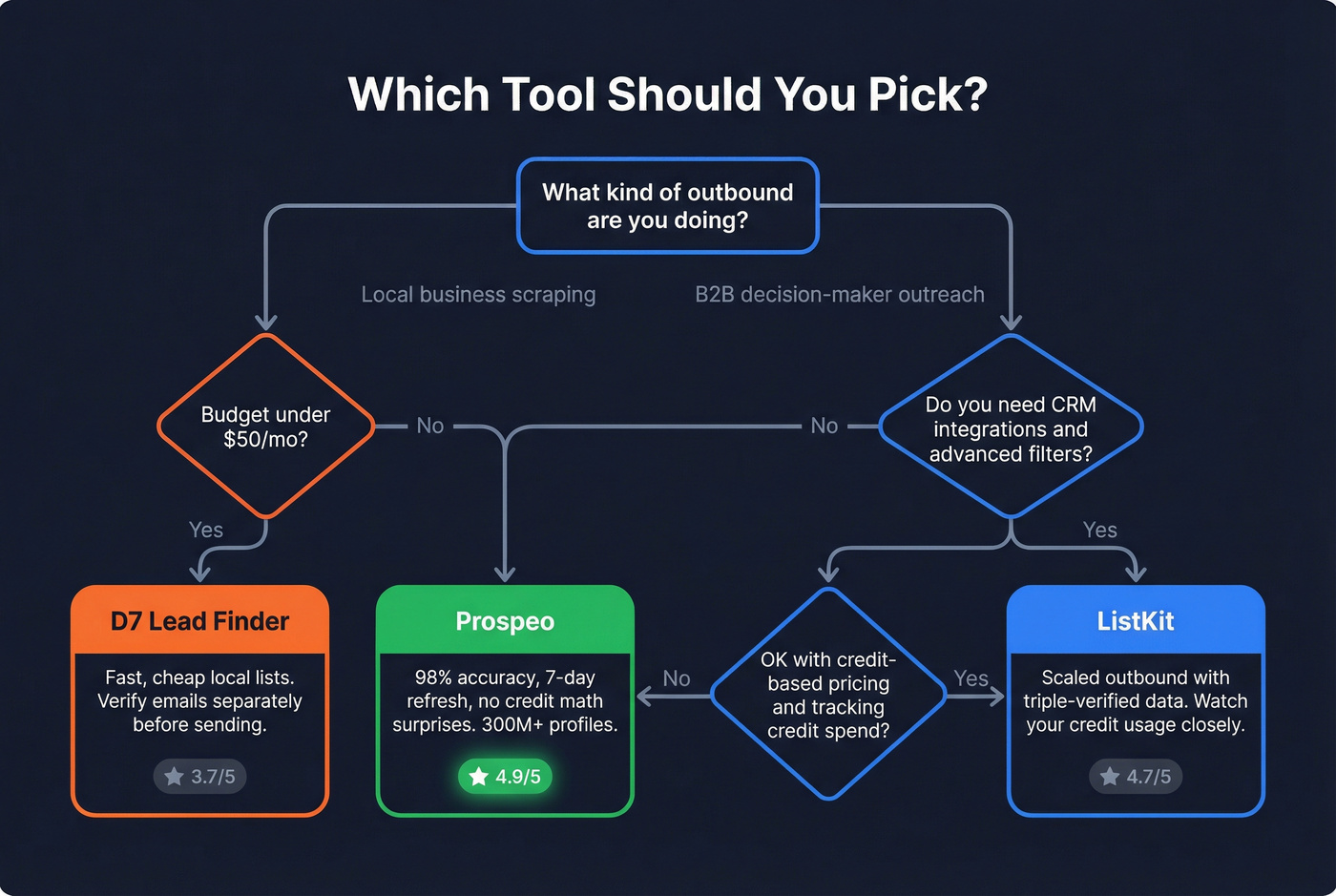
Pick ListKit if you:
- run scaled B2B outbound across multiple campaigns
- need decision-maker contacts, not just business listings
- want integrations and a workflow that fits a real outbound stack
- can live with credit math and you know what fields you'll pull
One strong opinion from our side: if you're doing cold email for clients, don't gamble on syntax-only data. It's not "scrappy." It's how you end up explaining to a client why their domain got burned.
A third option worth testing (if you want accuracy without the credit headache)
If D7's data quality makes you nervous but ListKit's credits feel like a spreadsheet tax, Prospeo is the clean middle ground - and it's the best option here for email accuracy and data freshness.
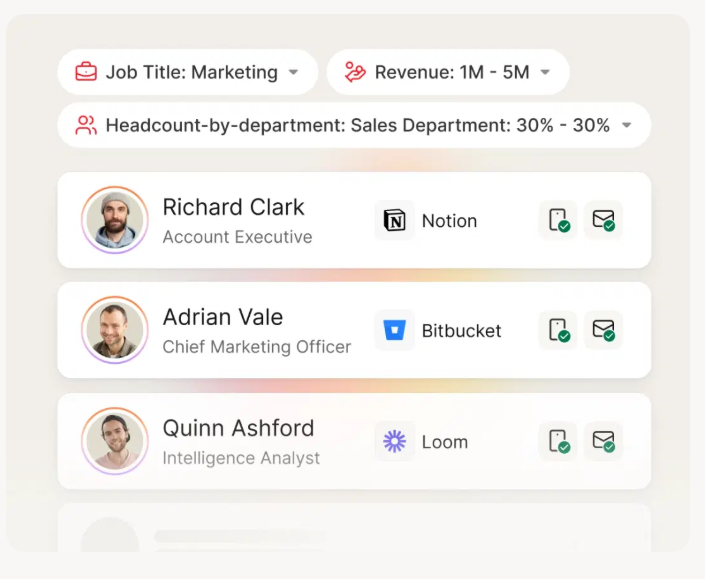
Prospeo gives you 300M+ professional profiles, 143M+ verified emails, and 125M+ verified mobile numbers, with 98% email accuracy and a 7-day data refresh cycle (the industry average is about six weeks). You also get 30+ search filters and 15,000 intent topics powered by Bombora, plus native integrations with Salesforce, HubSpot, Smartlead, Instantly, Lemlist, Clay, Zapier, and Make.
The practical upside is simple: you can build lists you can actually send to, without guessing what your export will cost until after you've spent credits. And if you're doing data enrichment, Prospeo's APIs hit a 92% match rate, with enrichment returning contact data for 83% of leads.
If you want to sanity-check any tool before committing, do what we do: pull 200 contacts, verify outcomes (bounces, replies, connects), and only then decide. Pricing pages don't tell you what your campaign will feel like.
Burning sender domains with unverified lists costs more than any tool subscription. Prospeo refreshes all data every 7 days, includes catch-all handling and spam-trap removal, and integrates natively with Smartlead, Instantly, HubSpot, and Salesforce.
Protect your deliverability with data that's verified before you hit export.
FAQ
Is D7 Lead Finder good for cold email?
It's fine only if you verify every email before sending. D7 checks syntax but doesn't confirm inbox existence, so bounce rates can spike if you send raw exports. Pair it with a verifier like NeverBounce or use a platform that verifies emails as part of the workflow.
How many leads do you get per month on ListKit Professional?
On the Professional plan ($83/mo annual), you get 24,000 credits per year, or about 2,000 credits per month. A verified business email costs 2 credits, so that's roughly 1,000 verified emails/month. Add mobile numbers at 5 credits each and your volume drops quickly, so model your mix before you commit to annual billing.
Is there a free alternative to both D7 and ListKit?
ListKit has a free tier (100 credits, which works out to about 50 verified emails). Prospeo's free tier gives you 75 verified emails per month plus 100 Chrome extension credits to test real workflows. For broader prospecting, Apollo also has a free tier, and for local business scraping, teams often mention tools like Outscraper.