

Data-Driven Lead Generation: The 2026 Playbook With Actual Numbers
92% of B2B buyers already have a vendor in mind before they start "researching." The winning vendor lands on the Day One shortlist 95% of the time. So the question isn't whether to use data for lead generation - it's whether you're using the right data, with real benchmarks, fast enough to matter.
Most data-driven lead generation advice gives you frameworks without numbers and dashboards without targets. That's not a playbook. It's a poster.
Funnel Benchmarks That Matter
Most teams track "leads generated" and call it analytics-driven. That's like measuring a restaurant by how many people walk past the door.
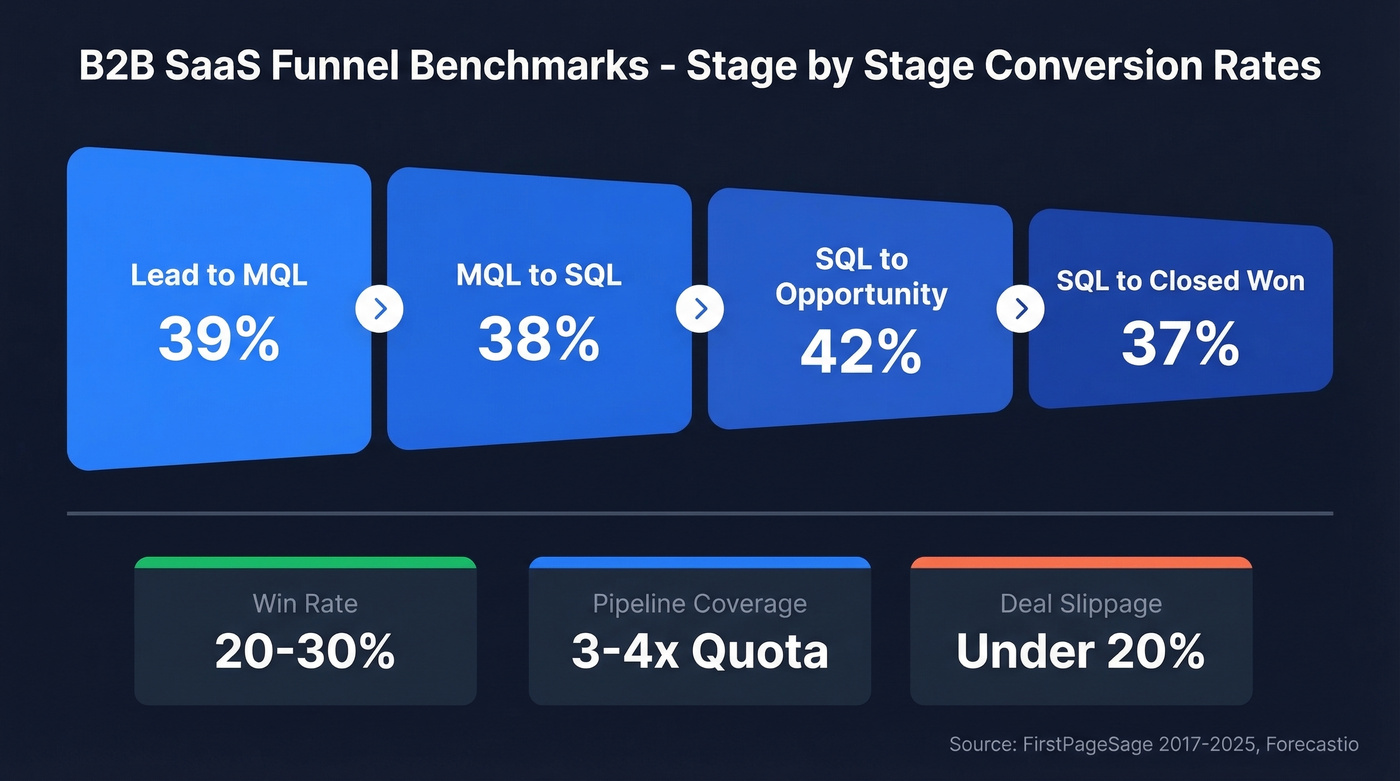
Here are the stage-by-stage conversion rates that tell you where your funnel is actually broken, drawn from FirstPageSage's 2017-2025 dataset across a roughly 65% B2B client mix:
| Stage | B2B SaaS Benchmark |
|---|---|
| Lead to MQL | 39% |
| MQL to SQL | 38% |
| SQL to Opportunity | 42% |
| SQL to Closed Won | 37% |
Pair those with these operational KPI targets from Forecastio's research:
- Win rate: 20-30%
- Pipeline coverage: 3-4x quota
- Deal slippage: under 20%
If your MQL-to-SQL rate sits well below 38%, the problem is misaligned definitions between marketing and sales - not lead volume. We've watched teams throw six figures at "more leads" when a 30-minute alignment meeting between their CMO and VP Sales would've fixed the actual bottleneck.
The Five-Step Framework
1. Build Your ICP From Your Top 20%
Pull your best 20% of customers by revenue, retention, or expansion. What do they share? Map three dimensions: firmographic traits like industry and headcount, behavioral patterns such as content consumed pre-purchase, and technographic signals from the tools they already run. This isn't guesswork - it's pattern recognition from your own revenue data, and it's the foundation of finding B2B target audiences that actually convert. Revisit quarterly. ICPs drift faster than most teams realize.
2. Layer Intent Signals by Strength
Not all intent signals deserve the same response. Intent-based lead generation works best when you think in three tiers:
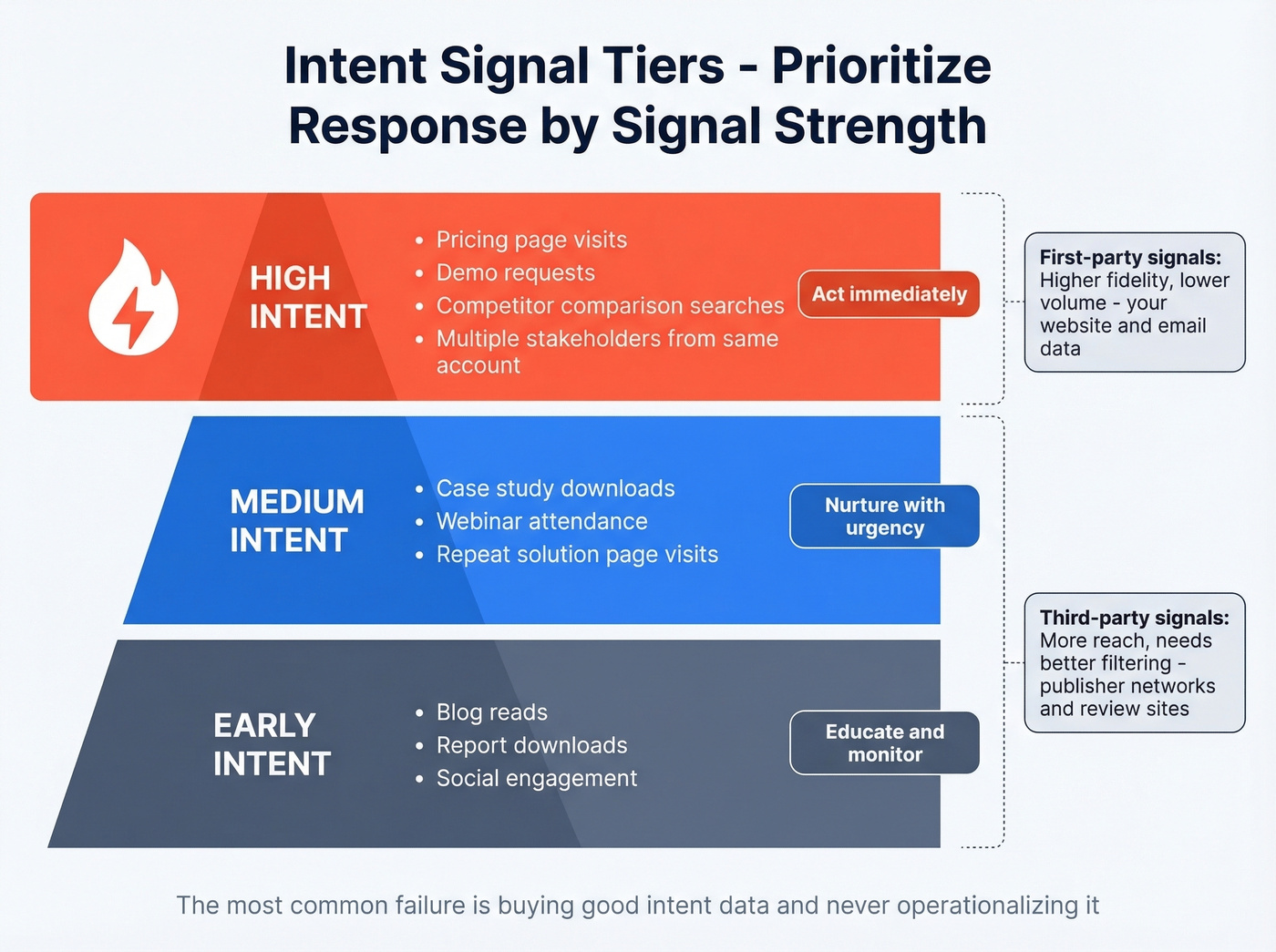
- High intent: Pricing page visits, demo requests, competitor comparison searches, multiple stakeholders from the same account visiting your site.
- Medium intent: Case study downloads, webinar attendance, repeat solution-page visits.
- Early intent: Blog reads, report downloads, social engagement.
First-party signals from your own website and emails are higher fidelity but lower volume. Third-party signals from publisher networks and review sites give you reach but demand better filtering. Here's the thing: the most common failure mode isn't buying the wrong intent data - it's buying good intent data and never operationalizing it. Don't be that team.
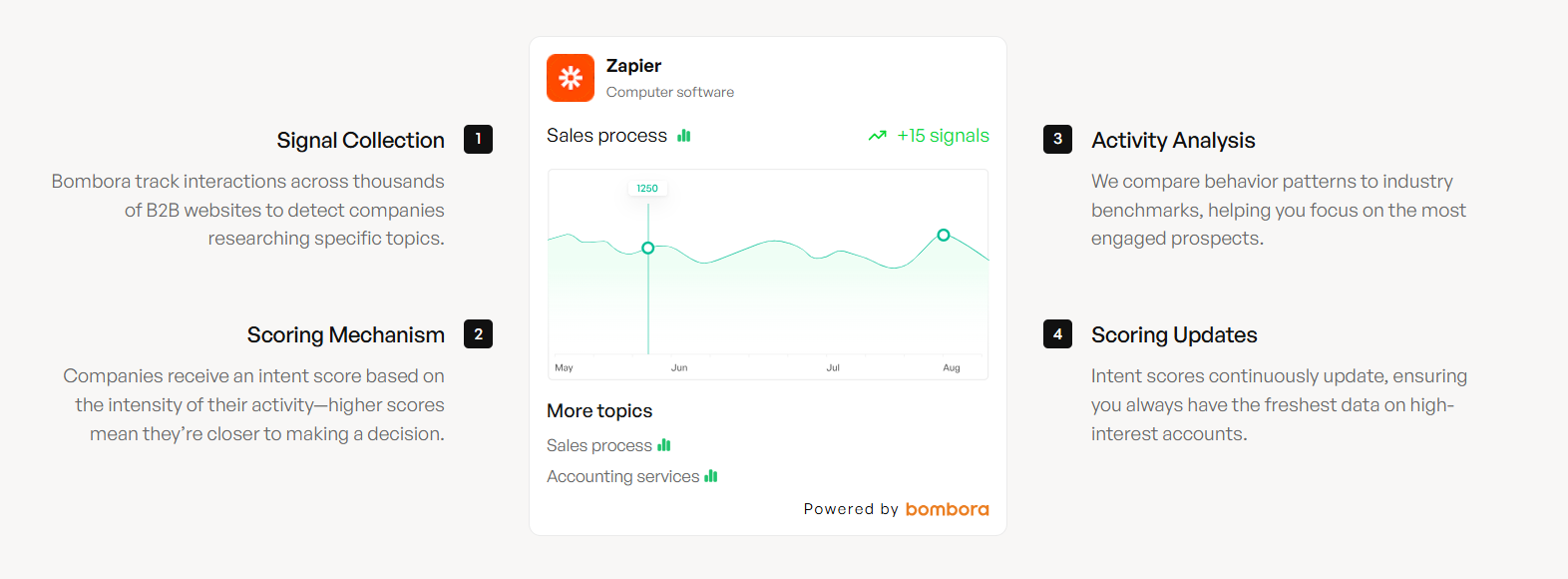
3. Score Leads, Then Go Predictive
Lead scoring works across four dimensions: firmographic fit, behavioral engagement, timing and recency, and sales qualification. Most teams only score on the first two and wonder why conversion rates stall.
Traditional scoring with manual rules and static weights tops out quickly. Predictive scoring uses ML to weigh hundreds of data points dynamically, pushing lead-to-customer conversion rates toward 6% versus the 3.2% industry average. You don't need a data science team for this - HubSpot and Salesforce both offer predictive scoring features that are good enough for most mid-market teams.
4. Fix Your Data Foundation
This is where most programs quietly die.
B2B contact data decays roughly 30% per year. The industry-average refresh cycle is about six weeks, which means for most of the quarter, you're prospecting with data that's already rotting. The cost isn't just bounced emails - it's damaged sender reputation, which tanks deliverability across your entire domain. That kills pipeline.
Meritt was running a 35% bounce rate before switching to Prospeo's verified data. Bounces dropped under 4%, and pipeline tripled from $100K to $300K per week. With a 7-day refresh cycle across 300M+ profiles and 98% email accuracy at roughly $0.01 per email, the math speaks for itself. Compare that to ZoomInfo's roughly 87% accuracy at $15-50K/year - a 10-point accuracy gap on a 50,000-contact campaign means thousands of extra bounces eating your domain reputation.
5. Align Sales and Marketing Definitions
If marketing calls something an MQL and sales disagrees, your funnel metrics are fiction. Shared definitions, documented SLAs for follow-up timing, and speed-to-lead as an explicit KPI aren't optional - they're the infrastructure that makes everything else measurable.
First contact in B2B happens at 61% of the buying journey. If your team is slow to engage, someone else gets there first.
Let's be honest: if your average deal size is under $10K, you probably don't need ZoomInfo-level tooling. A verified data source, a sequencer, and disciplined ICP work will outperform a $50K platform that your reps use as a glorified email lookup.

You just read that B2B data decays 30% per year and the industry refreshes every 6 weeks. Prospeo refreshes every 7 days across 300M+ profiles with 98% email accuracy - at $0.01 per email. Meritt cut their bounce rate from 35% to under 4% and tripled pipeline.
Stop feeding your funnel with data that's already rotting.
Five Failure Modes That Kill Lead Gen
- Misaligned handoffs. Marketing and sales disagree on "qualified." Fix with shared MQL/SQL definitions and a written SLA.
- Vanity volume. Lead count looks great; downstream conversion collapses. Measure cost-per-SQL, not cost-per-lead.
- Fragmented data. CRM, marketing automation, and intent tools don't talk to each other. Build a single source of truth, even if it's ugly.
- Slow activation. Manual routing and delayed follow-up let competitors engage first. Target speed-to-lead under 5 minutes.
- Dead-end nurture. Generic drip sequences with no intent-based branching. Tier nurture by signal strength, not just time delay.
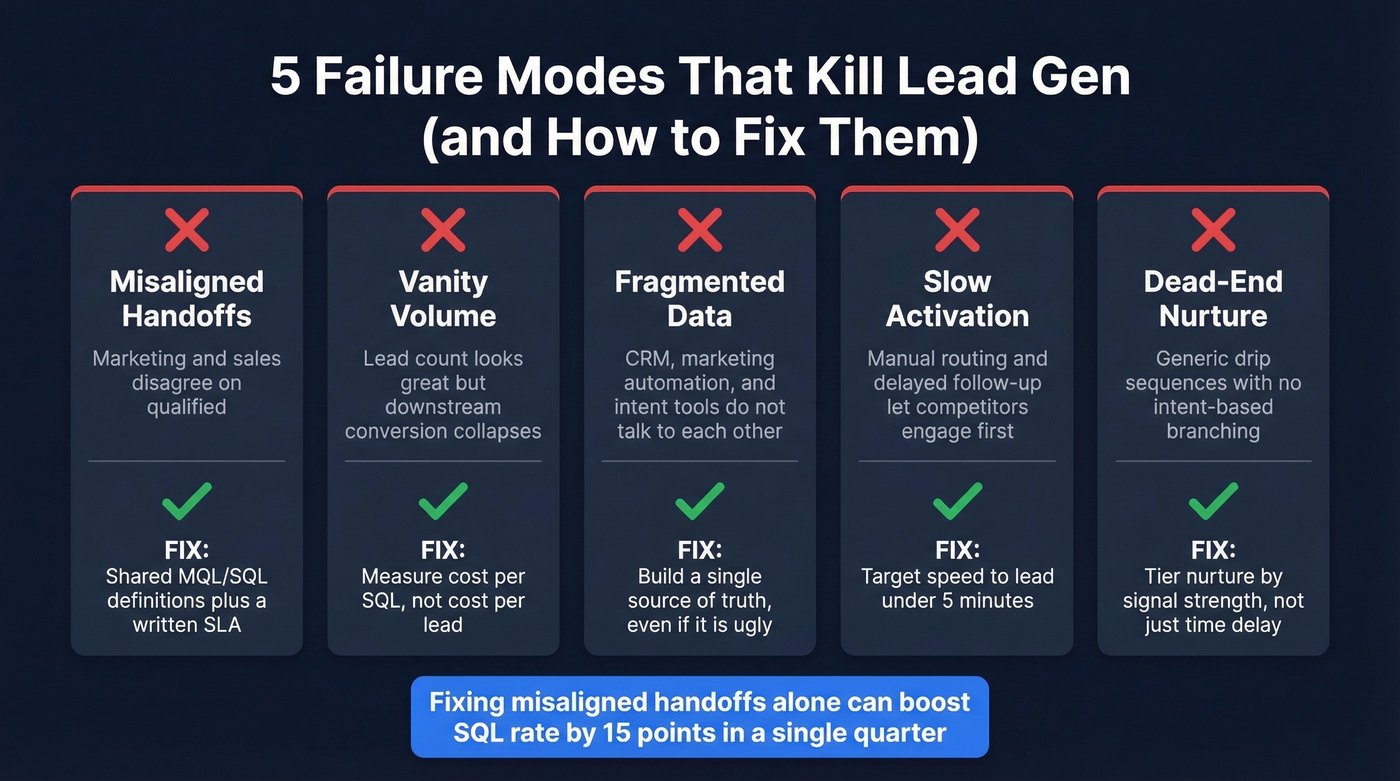
We've seen teams fix #1 alone and watch their SQL rate jump 15 points in a single quarter. The consensus on r/sales backs this up - most pipeline problems aren't lead problems, they're handoff problems.
Your 2026 Starter Tool Stack
You need three things: a CRM, a verified data source, and an intent layer. Everything else is optimization.
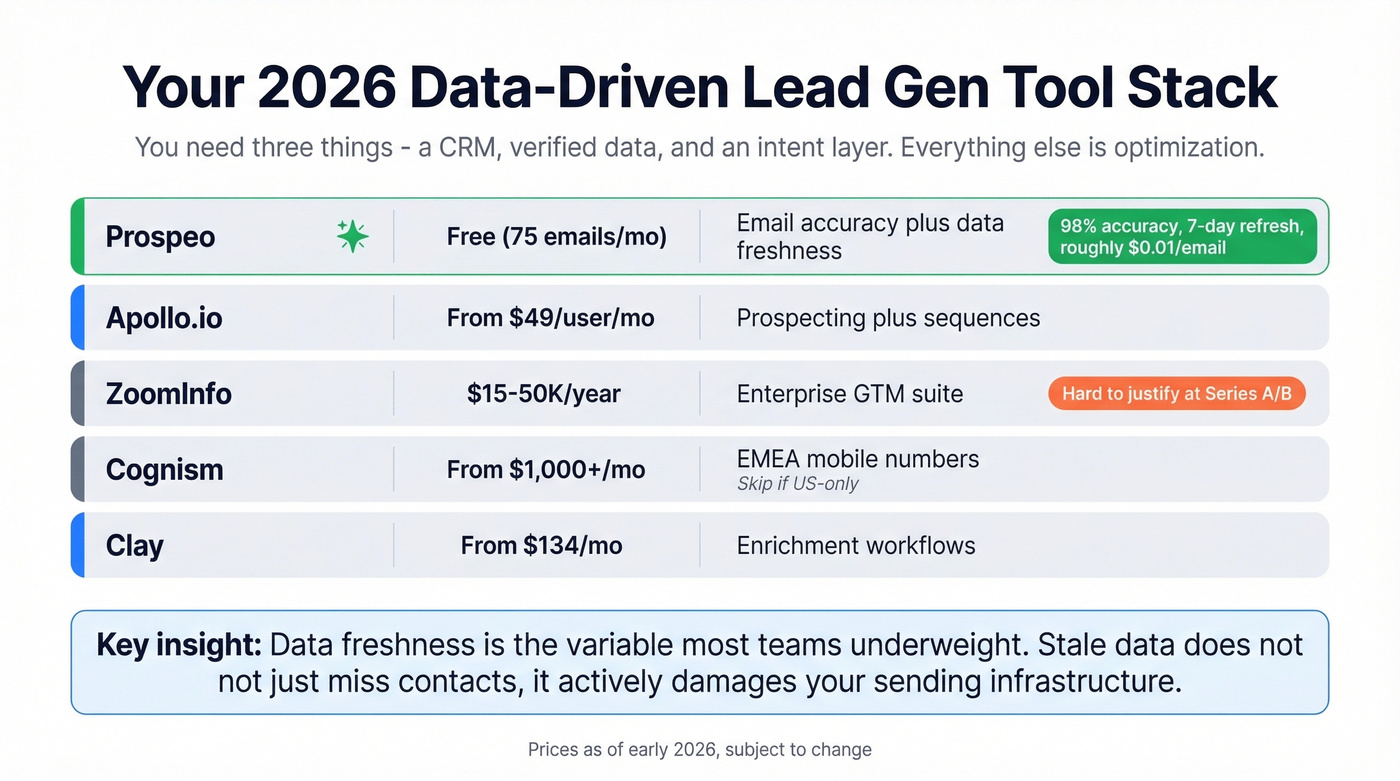
| Tool | Starting Price | Best For |
|---|---|---|
| Prospeo | Free (75 emails/mo) | Email accuracy + data freshness |
| Apollo.io | ~$49/user/mo | Prospecting + sequences |
| ZoomInfo | $15-50K/yr | Enterprise GTM suite |
| Cognism | ~$1,000+/mo | EMEA mobile numbers |
| Clay | From ~$134/mo | Enrichment workflows |
For Series A or B companies, ZoomInfo's price tag is hard to justify. We've tested dozens of enrichment tools, and data freshness is the variable most teams underweight - stale data doesn't just miss contacts, it actively damages your sending infrastructure. Start with verified data for your foundation, add your sequencer of choice for outreach, and layer intent when you're ready to prioritize accounts.
Skip Cognism if you're US-only. Their strength is EMEA mobile numbers, and you'd be paying a premium for coverage you don't need.
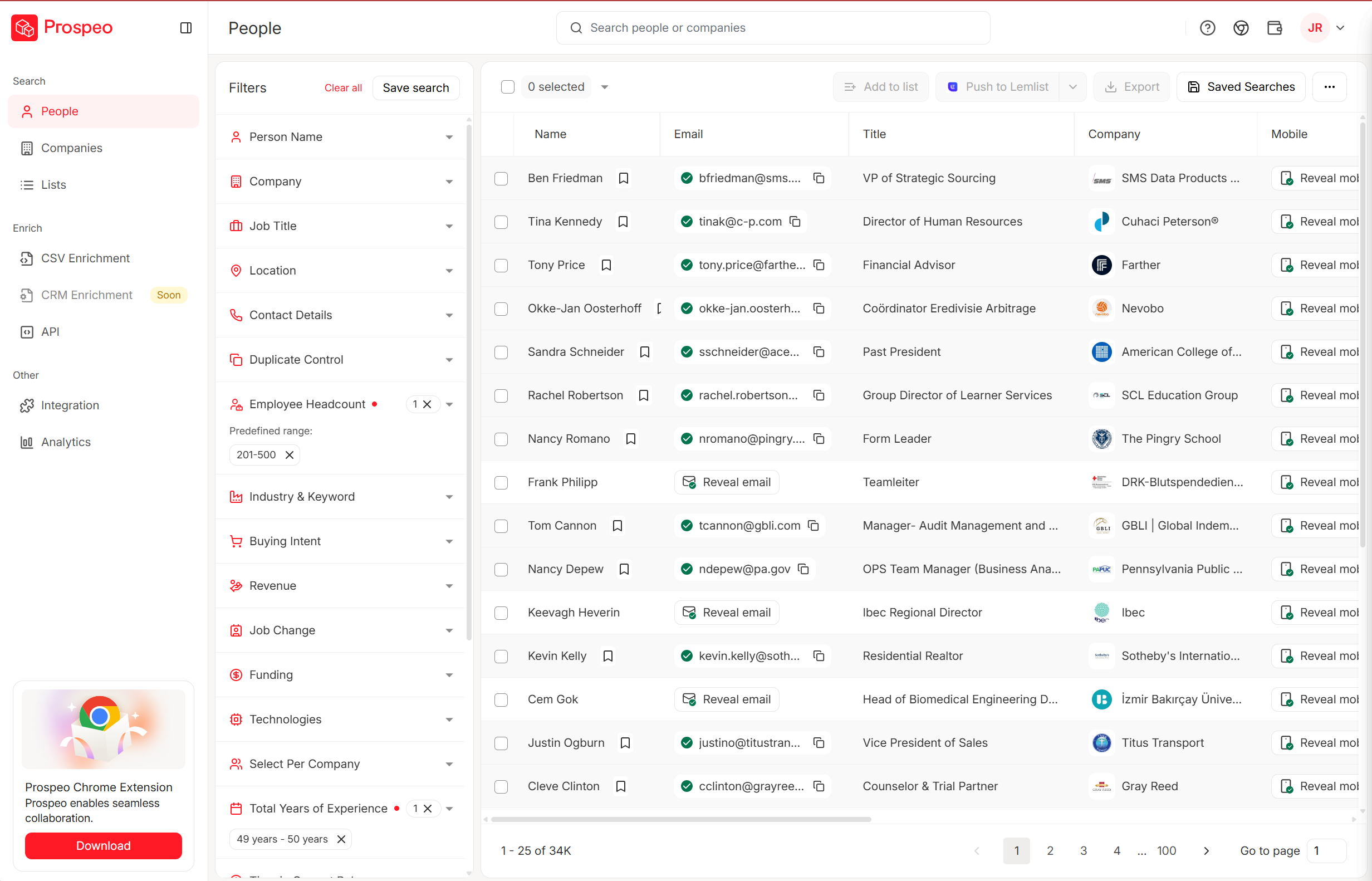
You've got the benchmarks, the framework, and the failure modes. Now you need a data foundation that won't wreck your domain. Prospeo gives you 30+ ICP filters, Bombora intent across 15,000 topics, and verified contacts - no $50K contract required.
Build your data-driven lead gen stack on data you can actually trust.
GDPR + CCPA: The Non-Negotiables
Running a data-driven lead generation program without compliance isn't a strategy. It's a liability.
GDPR fines run up to EUR 20M or 4% of global annual turnover - whichever is higher. Purpose limitation is real: an email collected for a webinar can't be repurposed for cold outreach without a valid legal basis. DSARs must be fulfilled within 30 days, and cross-border transfers require Standard Contractual Clauses if you're moving EU data outside the EEA. Sign DPAs with every data provider. If your vendor isn't compliant, neither are you.
CCPA gives California residents the right to know what personal data you've collected, the right to opt out of its sale or sharing, and the right to request deletion. Non-compliance carries fines of $2,500 per violation and $7,500 per intentional violation - those add up fast on a large contact database. If you're running outbound into US contacts, treat CCPA opt-out requests with the same urgency as GDPR DSARs. The IAPP's CCPA resource page is worth bookmarking.
FAQ
What separates data-driven from traditional lead generation?
Traditional lead gen relies on bought lists, cold spray, and gut instinct. A data-driven approach uses ICP modeling, intent signals, lead scoring, and funnel benchmarks to prioritize the right accounts at the right time. The difference shows up in conversion rates: teams using predictive scoring see roughly 6% lead-to-customer rates versus the 3.2% industry average.
How often should I refresh B2B contact data?
At minimum monthly, ideally weekly. B2B contact data decays roughly 30% per year, and the industry-average refresh cycle is about six weeks. Prospeo refreshes every 7 days; most enterprise providers lag at 4-6 weeks. Weekly refreshes keep your data current through the quarter instead of going stale after week two.
What's a good MQL-to-SQL conversion rate?
For B2B SaaS, 38% is the benchmark based on FirstPageSage's 2017-2025 data. If you're significantly below that, the issue is usually misaligned qualification definitions between marketing and sales - not lead volume. A 30-minute alignment meeting often fixes more than a five-figure ad spend increase.
Do I need enterprise tools for data-driven lead gen?
No. Self-serve platforms deliver comparable or better accuracy at a fraction of enterprise pricing. ZoomInfo runs $15-50K/year; Prospeo starts free at 75 emails/month with 98% accuracy, and Apollo.io begins at roughly $49/user/month. Enterprise pricing only makes sense if you need the full GTM suite - intent, chat, workflow automation - under one roof.