


Datagma Reviews: Is It Worth It in 2026?
You just pulled up Datagma's pricing page, did the math on credits, and realized the plan that includes 3,000 verified emails per month also only includes 100 mobile phone numbers per month. Not 3,000 phones. A hundred. That credit-to-phone ratio is the single most important thing to understand about this tool, and almost nobody explains it clearly.
B2B contact data decays at roughly 30% per year, so the enrichment tool you pick matters. With only 5 Datagma reviews on G2 and limited editorial coverage, finding honest analysis is tough. We've dug through every review, tested the credit math, and compared it against what we know from running enrichment workflows daily.
30-Second Verdict
Datagma is a strong phone number finder with competitive pricing. It's not a strong email finder. If you need mobile numbers on a budget, give it a serious look. If email accuracy is your priority, look elsewhere - Prospeo hits 98% email accuracy with a free tier to test before you commit.
Here's the credit system gotcha: 1 credit = 1 email, but 30 credits = 1 mobile phone number. Your $49/mo Regular plan gets you 3,000 emails or 100 phones (or a mix). Not both at full volume.
Buy it if: you're primarily hunting mobile numbers. Skip it if: email deliverability is the thing keeping you up at night.
What Datagma Does
Datagma positions itself as a real-time enrichment tool that doesn't rely on a static database. It retrieves data from the public web and verifies emails in real time using NeverBounce and UseBouncer, providing up to 75 data points per contact.
The Chrome extension lets you pull contact details from professional profiles and export up to 2,500 leads at once from Sales Navigator searches. Datagma also offers job-change detection, flagging when contacts switch roles - useful for re-engaging churned prospects or timing outreach to new decision-makers. You're only charged credits when Datagma actually finds data. No result, no charge. Catch-all emails are free, which is a nice touch for domains where verification is ambiguous.
Integrations cover HubSpot, Zapier, Make, n8n, Captain Data, Phantom Buster, and WhatsApp. API access is included on all plans, and the API comes with 160 free matches to test - Datagma says setup takes under 5 minutes. That matters when Kaspr charges ~$6,000/year and Lusha ~$7,000/year for comparable API access.

Pricing Breakdown
Pay close attention to the phones column. That's where the credit math gets interesting.
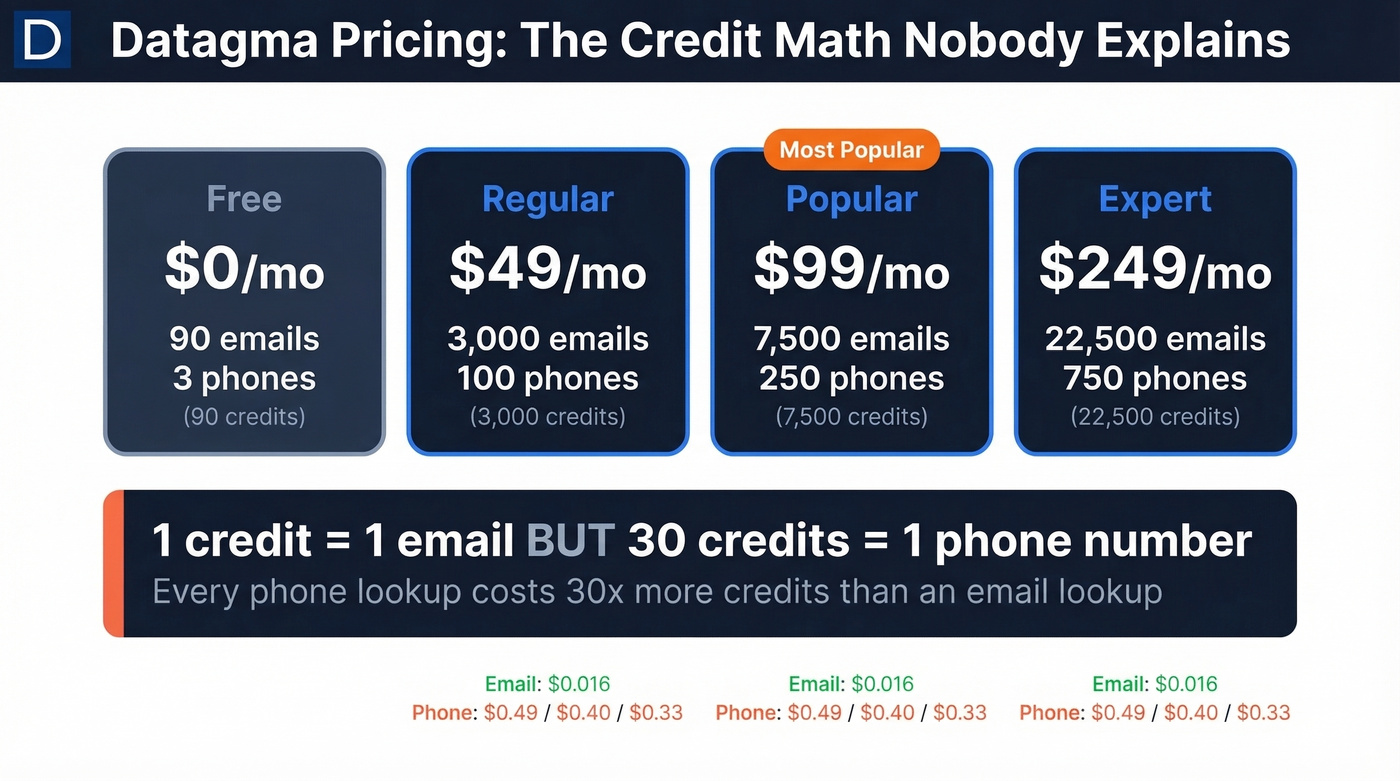
| Plan | Monthly | Annual/mo | Emails/mo | Phones/mo |
|---|---|---|---|---|
| Free | $0 | $0 | 90 | 3 |
| Regular | $49 | $39 | 3,000 | 100 |
| Popular | $99 | $79 | 7,500 | 250 |
| Expert | $249 | $209 | 22,500 | 750 |
We calculated the per-unit costs so you don't have to. On the Regular plan, emails run about $0.016 each and phones cost $0.49 each. The Popular plan drops phones to about $0.40. Expert brings them down to roughly $0.33.
Every plan allocates credits that convert at different rates: one credit per email, thirty credits per mobile phone number. So your Regular plan could be 3,000 emails, 100 phones, or some mix - but every phone lookup eats 30x the credits of an email lookup. That ratio shapes everything about how you should think about this tool.
Unused credits roll over for up to 12 months while you're subscribed. Annual plans grant all credits upfront, which works well for seasonal prospecting. All plans include 10 seats. You'll need a business email to sign up; Gmail and Yahoo won't work.
If you're comparing vendors, it helps to benchmark against other B2B data platforms too.

Datagma charges $0.016/email with 'limited' accuracy according to its own users. Prospeo delivers 98% email accuracy at $0.01/email - with 143M+ verified addresses refreshed every 7 days, not pulled from the web in real time and hoping for the best.
Stop paying more for emails that bounce.
What Real Users Say
Datagma carries a 4.7/5 on G2 from just 5 reviews (80% five-star, 20% four-star). That's a thin sample, so the rating tells you less than the actual feedback does.
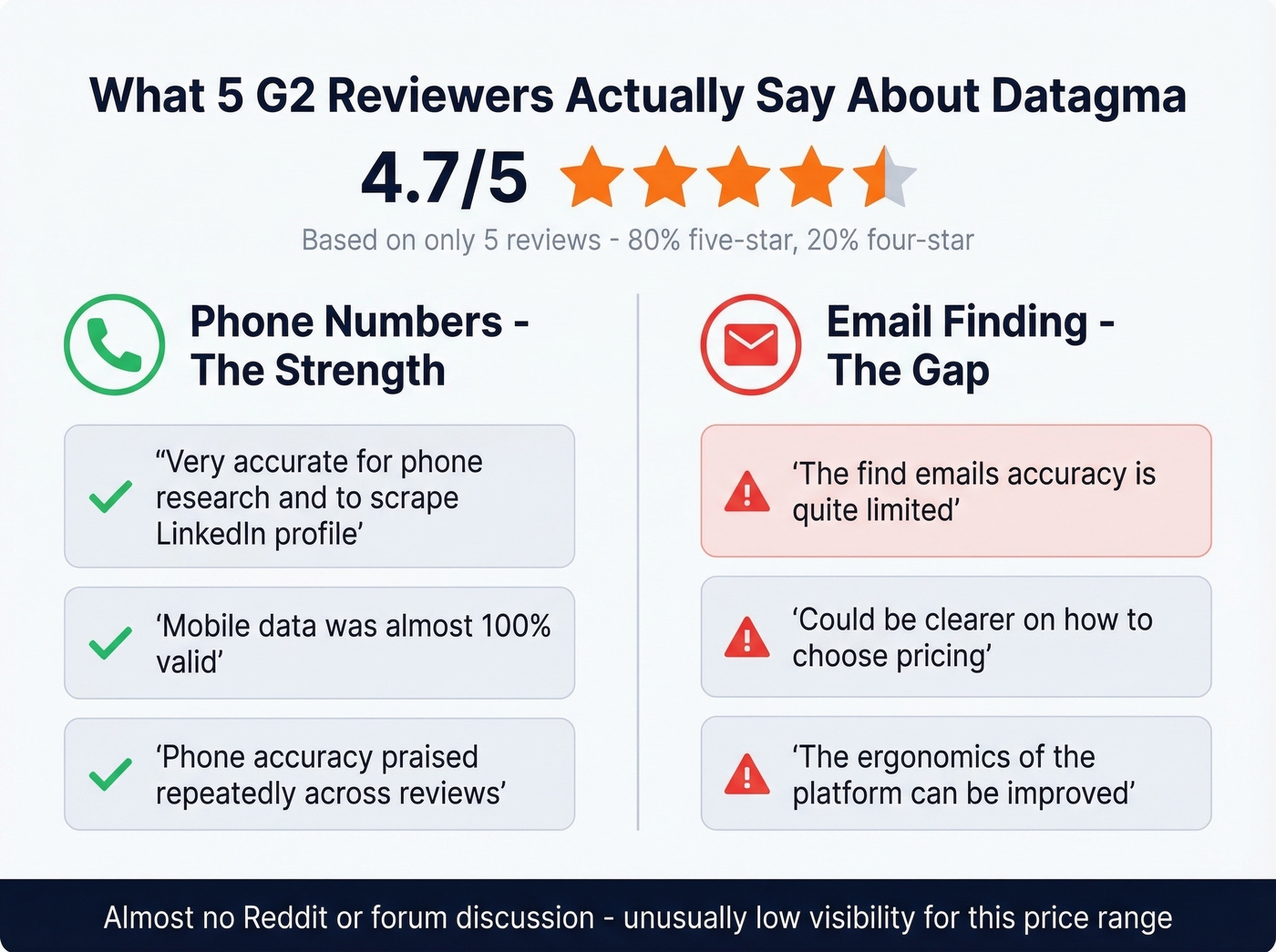
Phone accuracy gets praised repeatedly. One reviewer called it "very accurate for phone research and to scrape LinkedIn profile." Another noted their mobile data was "almost 100% valid" for certain French mobile enrichment. Ease of use also gets consistent praise.
Email accuracy is a different story. The most direct criticism: "The find emails accuracy is quite limited." That reviewer otherwise praised the phone data, which matches the overall pattern - phones are the strength, emails are the gap.
UI and pricing clarity need work too. "Could be clearer on how to choose pricing" and "the ergonomics of the platform can be improved" came up independently. The integrations list also drew criticism, with one reviewer flagging the need to "work more on the api's and integrations."
There's almost no public discussion of Datagma on Reddit or sales forums. That's unusual for a tool in this price range and suggests the user base is still relatively small.
Accuracy: Phones vs. Emails
Let's be honest about what the data shows. A Cleanlist benchmark across 15 providers reported approximate email accuracy of 85% for ZoomInfo, 80% for Apollo, and 90% for Cognism. Waterfall enrichment tools - which chain multiple providers together - pushed toward 90-98%.
Where does Datagma land? The clearest signal we have is qualitative: G2 reviewers consistently praise phone accuracy, and one explicitly calls out email-finding accuracy as limited. If you're building an outbound system where email deliverability is the KPI, that's the risk.
Here's how we think about it: if your deals average under $15K and you're dialing first, Datagma's phone pricing at $0.33-$0.49 per number is hard to beat. But if you're running cold email at any scale, lower email accuracy racks up bounces and hurts domain reputation fast. We've seen teams burn sender domains in weeks because their data provider couldn't keep up with verification - it's not a theoretical risk. If you want to reduce bounces, use a dedicated bounce checker and broader email deliverability tools.

Who Should (and Shouldn't) Buy
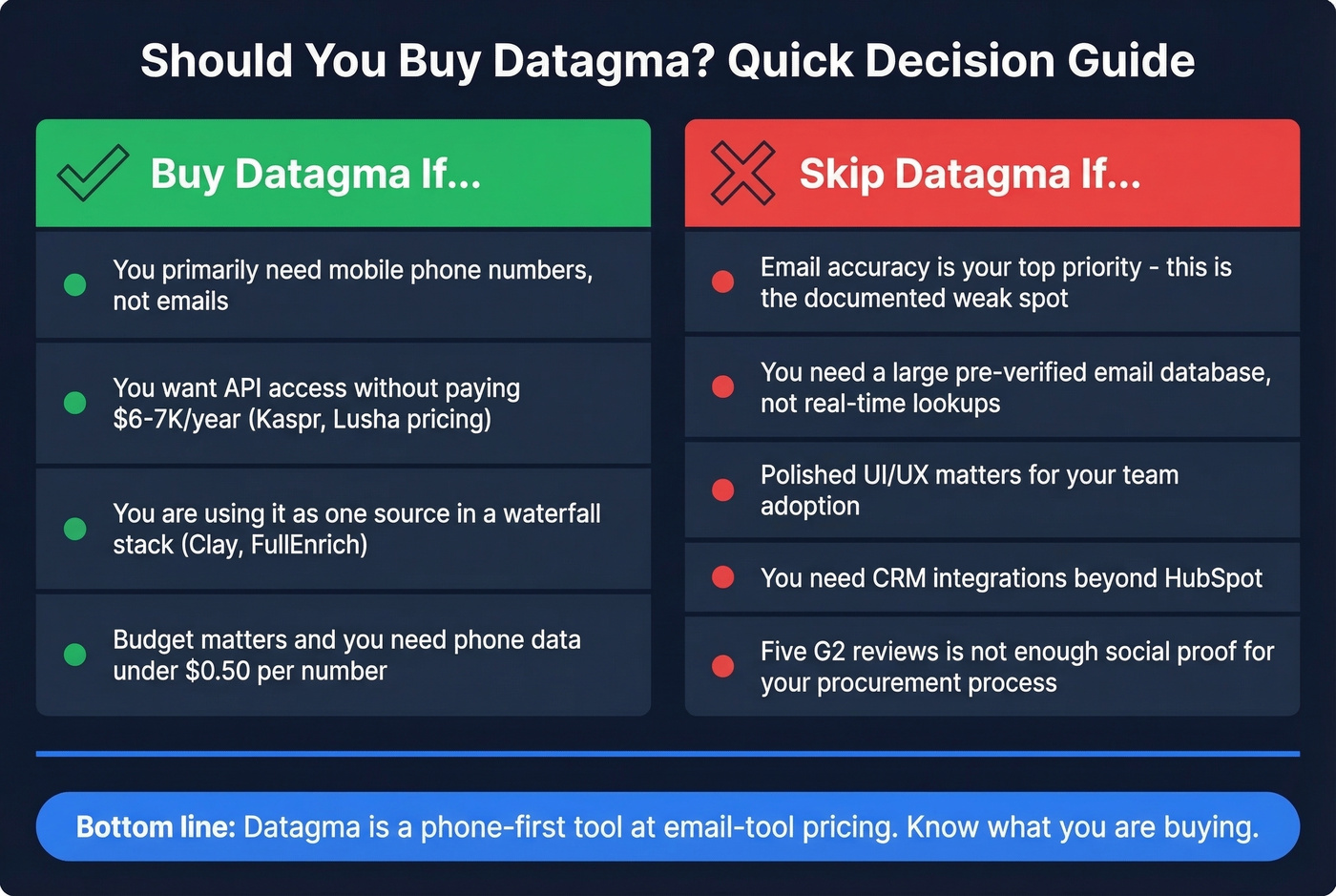
Buy Datagma if:
- You primarily need mobile numbers, not emails
- You want API access without paying $6-7K/year like Kaspr or Lusha charge
- You're using it as one source in a waterfall stack through Clay or FullEnrich
- Budget matters and you need phone data under $0.50/number
Skip Datagma if:
- Email accuracy is your priority - this is the tool's documented weak spot
- You need a large, pre-verified email database rather than real-time lookups
- Polished UI/UX matters to your team's adoption
- You need CRM integrations beyond HubSpot
- Five G2 reviews isn't enough social proof for your procurement process
The Alternative Worth Considering
Beyond raw enrichment, the platform offers 30+ search filters including buyer intent powered by Bombora (15,000 topics), technographics, job-change signals, and headcount growth. That turns it into a full prospecting platform, not just a data provider. Native integrations span Salesforce, HubSpot, Smartlead, Instantly, Lemlist, Clay, Zapier, and Make.
Self-serve pricing starts free (75 emails + 100 Chrome extension credits/month), with paid plans running ~$0.01/email and 10 credits per mobile number. No contracts, no sales calls required. If you're building outbound at scale, pairing better data with proven cold email playbook fundamentals and high-performing prospecting email templates tends to move results faster than tweaking enrichment alone. For context, teams like Snyk cut bounce rates from 35-40% to under 5% after switching, and Meritt tripled their pipeline from $100K to $300K per week.
If you're evaluating Datagma for enrichment, compare the full picture. Prospeo returns 50+ data points per contact at a 92% API match rate, with native Salesforce, HubSpot, Clay, and Zapier integrations. Snyk cut bounce rates from 35% to under 5%. Meritt tripled pipeline to $300K/week.
See what 98% accuracy does to your pipeline - free tier, no sales call.
FAQ
Is Datagma accurate for finding emails?
Email accuracy is Datagma's weakest point per user reviews. One of the most direct G2 criticisms is: "The find emails accuracy is quite limited." Phone data, by contrast, gets consistently praised. For teams where deliverability is the priority, that gap matters.
How does the credit system work?
One credit equals one email lookup; thirty credits equal one mobile phone number. The $49/mo Regular plan gets you 3,000 emails or 100 phone numbers - not both at full volume. Unused credits roll over up to 12 months while subscribed. Catch-all emails are free, and failed lookups don't consume credits.
Is Datagma GDPR compliant?
Datagma positions itself as 100% GDPR compliant, uses publicly accessible sources, and stores phone lookup data for 30 days before erasing it. An opt-out exclusion list is available, with processing within 7 days of request.
What's a good alternative if I need better email data?
Prospeo is the strongest option for email-first teams: 98% accuracy, 143M+ verified emails, and a free tier (75 emails/month) to test. Apollo (~80% accuracy) and Cognism (~90% accuracy) are other options, but neither matches the 7-day data refresh cycle or ~$0.01/email pricing you'll find at Prospeo.