

How to Enrich Company Data From Domains (2026 Guide)
You exported 5,000 domains from your CRM, ran them through your enrichment provider, and 2,200 came back empty. Of the 2,800 with emails, 800 bounced on the first sequence. That's not a data problem - that's a revenue problem.
Company data enrichment from domains is the fastest path from raw websites to actionable prospect data. Here's how to do it without burning money on garbage records.
What Is Domain-Based Enrichment?
Domain enrichment takes a company's website URL and returns structured data about that organization and its people. Feed in acme.com and get back firmographics like revenue, headcount, industry, and HQ location. You'll also get technographics showing what software they run, contact records with verified emails and direct dials, and sometimes intent signals revealing whether they're actively researching solutions like yours.
Domains are usually the cleanest input identifier because they're stable and easy to normalize. Unlike company names - ambiguous and riddled with duplicates - domains dedupe better and produce higher match rates. You'll still hit edge cases like redirects, holding-company domains, multi-brand sites, and parked domains, but those are manageable with the right prep work.
Why Enriching From Domains Matters
85% of businesses say poor-quality customer data harms their operational efficiency. B2B contact data decays at roughly 30% per year. U.S. businesses collectively lose approximately $3.1 trillion annually due to poor data quality, and Gartner pegs the average cost to a single organization at $15 million per year.

For outbound teams, the math is brutal. If your provider returns data for 60% of domains and 80% of those emails are deliverable, you're working with 48 usable contacts per 100 domains. Every bounced email chips away at your sender reputation. Every empty record is a prospect your competitors are reaching first.
Single-Source vs. Waterfall Enrichment
A single enrichment provider typically covers 50-70% of domains, with email accuracy around 80-85%. No vendor has every company and every contact. Waterfall enrichment pushes coverage to 85-95% by cascading unmatched records through multiple providers in sequence - often across 15+ data sources.
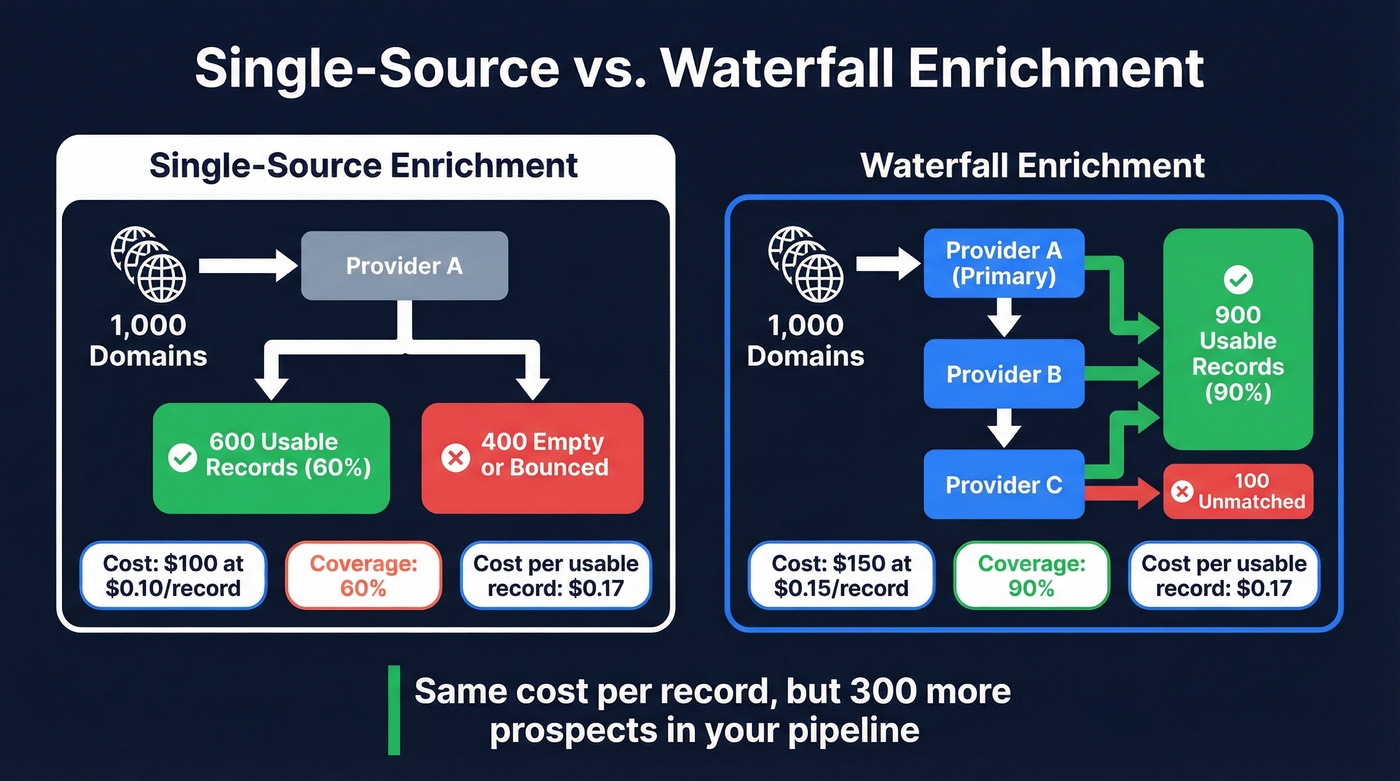
Let's break down the real cost-per-usable-record math. Single-source on 1,000 records at $0.10/record costs $100. At 60% coverage, that's 600 usable records, or $0.17 each. Waterfall on 1,000 records at $0.15/record costs $150. At 90% coverage, you get 900 usable records - also $0.17 per usable record. Same effective cost, 300 more records in your pipeline.
A VP of Finance at Descript reported they "doubled enrichment coverage to over 70%" with a 5-6x uplift compared to a single-vendor setup. In practice, starting with a high-accuracy provider reduces cascade volume - fewer records need secondary sources, which saves credits and time. Layer in region-specific vendors after that: Cognism for European data, ZoomInfo for US-heavy coverage and company hierarchy data.
Here's the thing: false positives cost more than missing data. A bad email damages your sender reputation. A missing email just means you didn't reach that prospect yet. Accuracy first, coverage second - always.

Your domains deserve better than 60% coverage and 80% accuracy. Prospeo's enrichment API returns 50+ data points per record at a 92% match rate - with 98% verified email accuracy and a 7-day refresh cycle. At $0.01 per email, every domain you enrich costs less than the bounce that damages your sender reputation.
Feed in your domains. Get back data you can actually send to.
Best Tools for Domain Enrichment
Prospeo
Prospeo is the strongest first layer in any domain enrichment workflow. The API returns 50+ data points per enrichment call with a 92% match rate and 98% email accuracy across 300M+ professional profiles verified through a proprietary 5-step process. The database includes 143M+ verified emails and 125M+ verified mobile numbers, all refreshed on a 7-day cycle - the industry average is six weeks, which means most providers are serving you data that's already going stale by the time you use it.

Pricing is transparent and self-serve at roughly $0.01 per email, with a free tier offering 75 emails per month. No annual contracts, no sales calls. Meritt tripled their pipeline from $100K to $300K per week after switching, with bounce rates dropping from 35% to under 4%. Snyk saw similar results across 50 AEs: bounce rates fell from 35-40% to under 5%, and AE-sourced pipeline jumped 180%.
Apollo
4.8/5 on G2 across 7,850+ reviews - one of the biggest review footprints in this category. Apollo's 275M+ contact database with built-in sequencing and a dialer makes it a strong all-in-one for teams that don't want to stitch tools together. Email accuracy runs around 80%. Free tier available, then $59-$149/user/month on paid plans. Good breadth, but we've found the accuracy gap shows up fast once you're sending at volume.
ZoomInfo
ZoomInfo is one of the deepest options for firmographics and company hierarchy data, with 300M+ contacts and email accuracy around 85%. But you'll pay $15-40K+/year with 4-6 week refresh cycles, and enterprise users consistently flag APAC and EMEA coverage gaps. If you're a US-focused enterprise team with budget, the depth is hard to beat. For everyone else, you're overpaying for features you won't use.
Clearbit / Breeze Intelligence
Use this if you're a HubSpot shop wanting native CRM enrichment. Clearbit adds 100+ attributes and includes data on 250M+ decision-makers. G2: 4.4/5 across 620+ reviews. Breeze Intelligence starts at $45/month.
Skip this if you need transparent credit mechanics - users on G2 and Reddit threads consistently call the system "fairly unintuitive."
People Data Labs
Developer-first enrichment APIs with per-credit pricing and trial credits. Best for engineering teams building custom pipelines who want raw data without a UI. Not for sales teams.
Hunter.io
Email-focused with a generous free tier of 50 credits/month. Paid plans run $49-299/month. G2: 4.4/5 across 550+ reviews. Good for email-only use cases on a budget, but don't expect firmographics or phone numbers.
Cognism
The European data specialist with phone-verified mobile numbers - actual human verification plus algorithmic checks. G2: 4.6/5 across 760+ reviews. Typically $8-15K/year. This is the pick when EMEA coverage is your primary gap.
Comparison Table
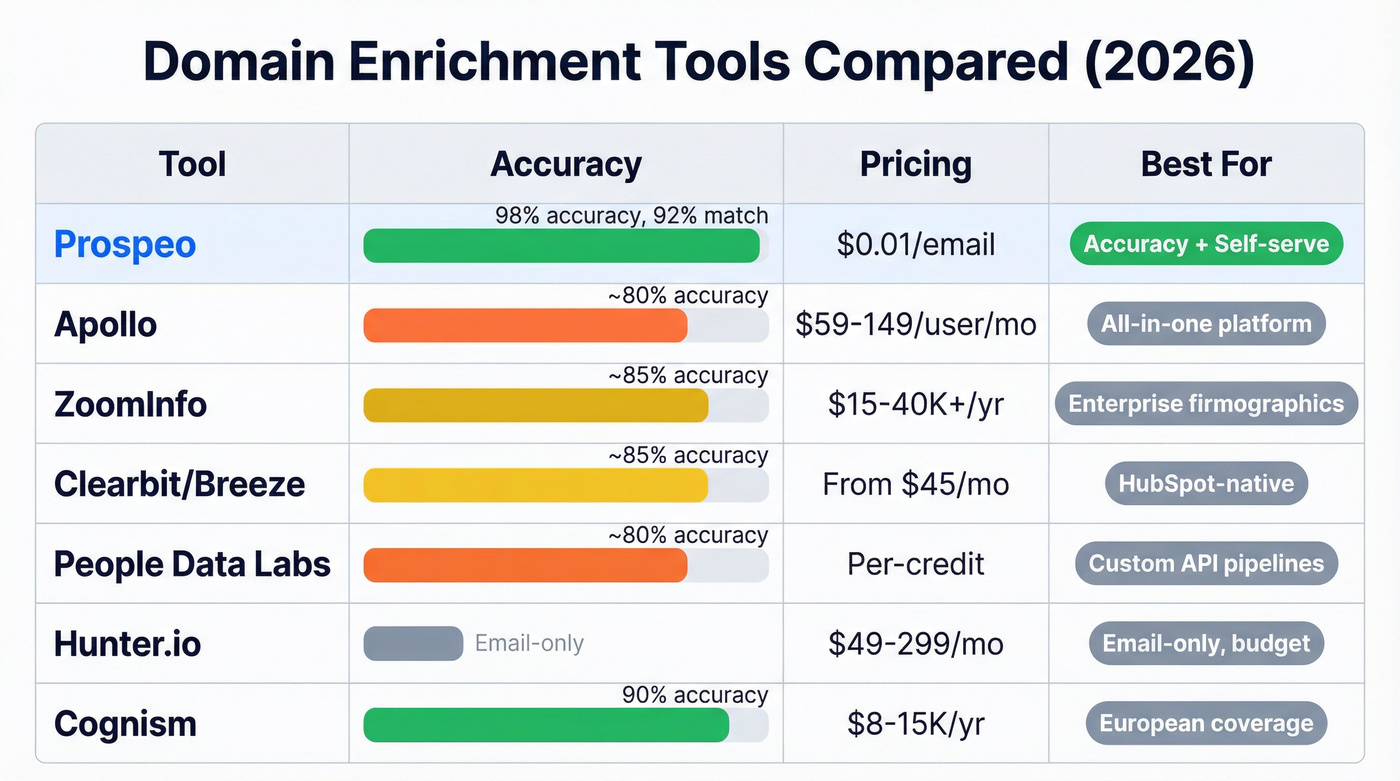
| Tool | Accuracy / Coverage | Pricing | Best For |
|---|---|---|---|
| Prospeo | 98% accuracy, 92% match | ~$0.01/email | Accuracy + self-serve |
| Apollo | ~80% accuracy | $59-149/user/mo | All-in-one platform |
| ZoomInfo | ~85% accuracy | $15-40K+/yr | Enterprise firmographics |
| Clearbit/Breeze | ~85% accuracy | From $45/mo | HubSpot-native |
| People Data Labs | Per-credit API | Per-credit pricing | Custom API pipelines |
| Hunter.io | Email-only | $49-299/mo | Email-only, budget |
| Cognism | ~90% accuracy | $8-15K/yr | European coverage |
Meritt dropped bounce rates from 35% to under 4% and tripled pipeline to $300K/week. Snyk cut bounces from 40% to under 5% across 50 AEs. The difference wasn't strategy - it was starting the waterfall with a provider that covers 92% of records at 98% accuracy before anything cascades.
Make Prospeo your first enrichment layer and shrink the cascade.
Implementation Workflow
Five steps from raw domains to CRM-ready data:
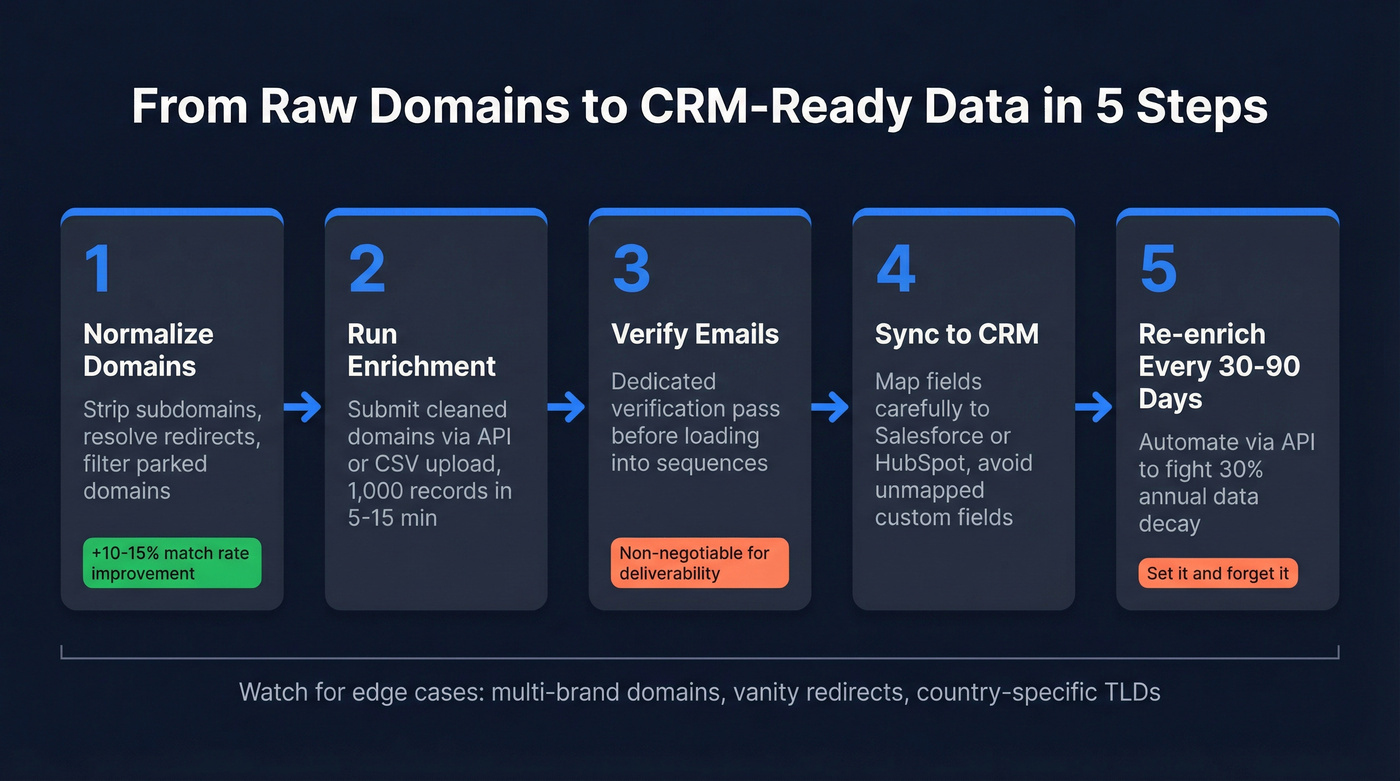
1. Normalize your domain list. Strip subdomains like blog.acme.com down to acme.com, resolve 301 redirects, and filter parked or expired domains. This step alone improves match rates by 10-15%. We've seen teams skip this and wonder why half their records come back empty - don't be that team.
2. Run enrichment via API or CSV upload. Submit cleaned domains to your primary provider. In bulk workflows, 1,000 records typically process in 5-15 minutes. You can also enrich company data by email when domains aren't available - many providers accept work email addresses as an input key and resolve them to the parent organization.
3. Verify emails post-enrichment. Even "verified" emails from enrichment providers can bounce. Run a dedicated verification pass before loading into sequences. This is non-negotiable if you care about email deliverability.
4. Sync to your CRM. Map fields carefully when pushing to Salesforce or HubSpot. Dumping 50+ attributes into unmapped custom fields creates more problems than it solves - our team learned this the hard way during a HubSpot migration that took three days to untangle.
5. Re-enrich every 30-90 days. With 30% annual decay, quarterly refreshes keep your database current. Automate it via API, or use an MCP for company data that connects your enrichment provider directly to your AI agent or internal tooling for hands-off refresh cycles.
Watch for edge cases: multi-brand companies with one parent domain and multiple subsidiaries, vanity domains that redirect, and international domains with country-specific TLDs.
Common Pitfalls
Not verifying emails after enrichment. Enrichment and verification are different steps. Every bounce chips away at sender reputation, and once that's damaged, even good emails land in spam. The consensus on r/coldemail is that this single mistake kills more outbound programs than bad targeting does.
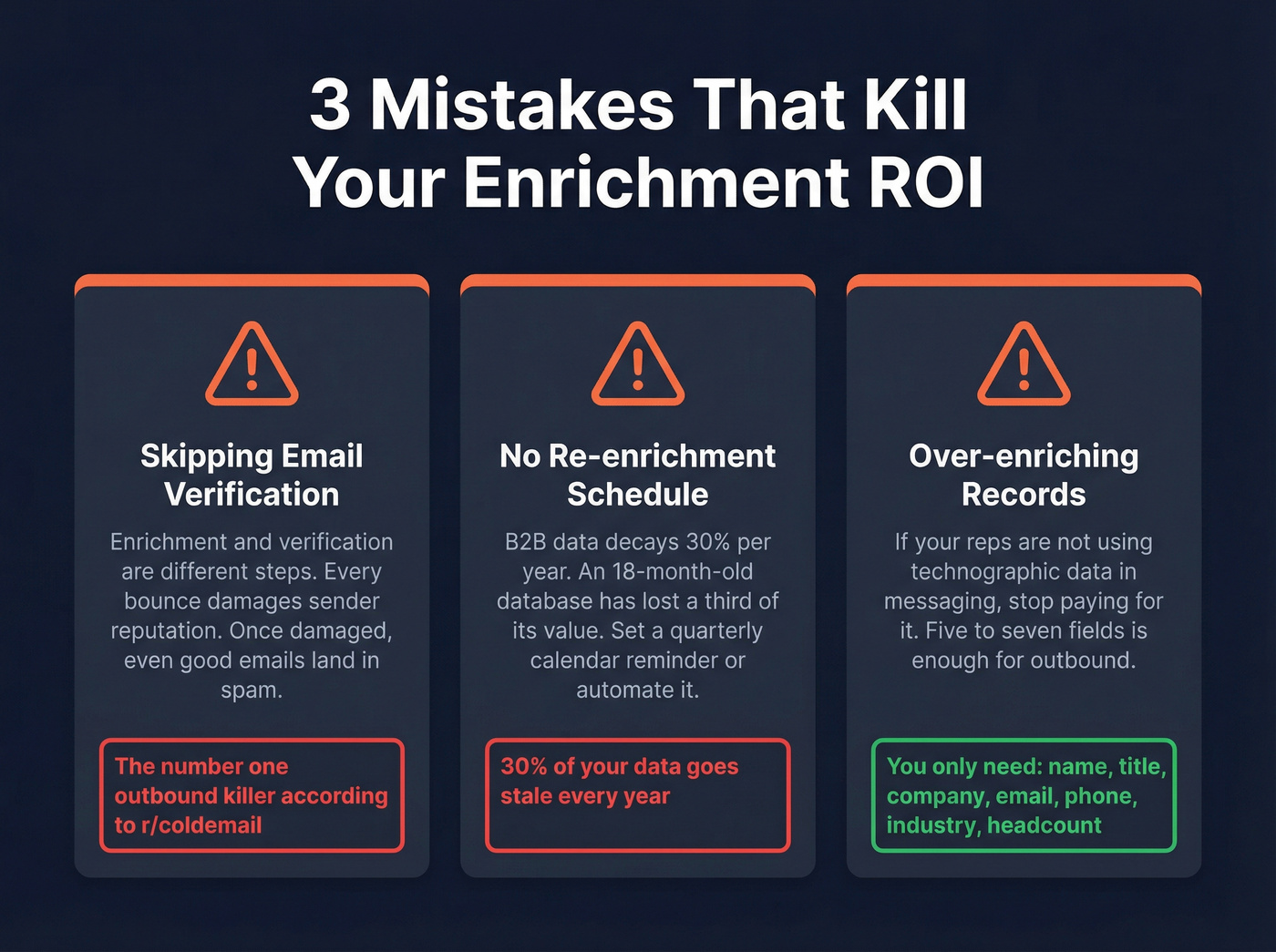
No re-enrichment schedule. We've watched teams build a beautiful enriched database, then let it rot for 18 months. By then, a third of the data is stale. Set a calendar reminder. Automate it. Whatever works - just don't ignore it.
Over-enriching. Look, if your reps aren't using technographic data in their messaging, stop paying for it. Five to seven fields is enough for outbound: name, title, company, verified email, direct dial, industry, headcount. Everything else is nice-to-have until you've proven you'll actually use it.
FAQ
How often should I re-enrich company data?
Every 30-90 days. B2B contact data decays at roughly 30% per year, so monthly refreshes are better for high-volume outbound teams. Providers with a weekly data refresh cycle reduce stale records between your own re-enrichment runs.
What's a good match rate for domain enrichment?
Single-source providers typically return data for 50-70% of domains. Waterfall enrichment pushes coverage to 85-95% by cascading unmatched records through multiple vendors in sequence.
Can I enrich data from subdomains or redirected domains?
Most enrichment APIs resolve subdomains to root domains automatically. For redirects, normalize your list first - resolve 301s to the final destination URL before submitting to avoid duplicate or empty records.
What's the cheapest way to start?
Prospeo's free tier gives you 75 emails per month at 98% accuracy - enough to test workflows before committing budget. Hunter offers 50 free credits monthly but lacks firmographics and phone numbers. For teams running real campaigns, full enrichment at ~$0.01 per email is the most cost-effective entry point in the market right now.