

The 10 Best Bounce Checker Tools in 2026 - Pricing, Accuracy, and What Actually Works
Your SDR just uploaded a purchased list of 8,000 contacts and hit send. By morning, 600 emails bounced, your domain reputation tanked, and half your sequences are landing in spam. That's what happens without a bounce checker in your workflow. With 392.5 billion emails sent daily in 2026, inbox providers have zero tolerance for sloppy senders - and a single bad campaign can set your outbound back weeks.
Here are the 10 email verification tools worth your time, ranked by accuracy, pricing, and what actually works in production.
What Is an Email Bounce Checker?
An email bounce checker verifies whether an address can receive mail before you send to it. That's the simple version. The real process runs four layers deep.
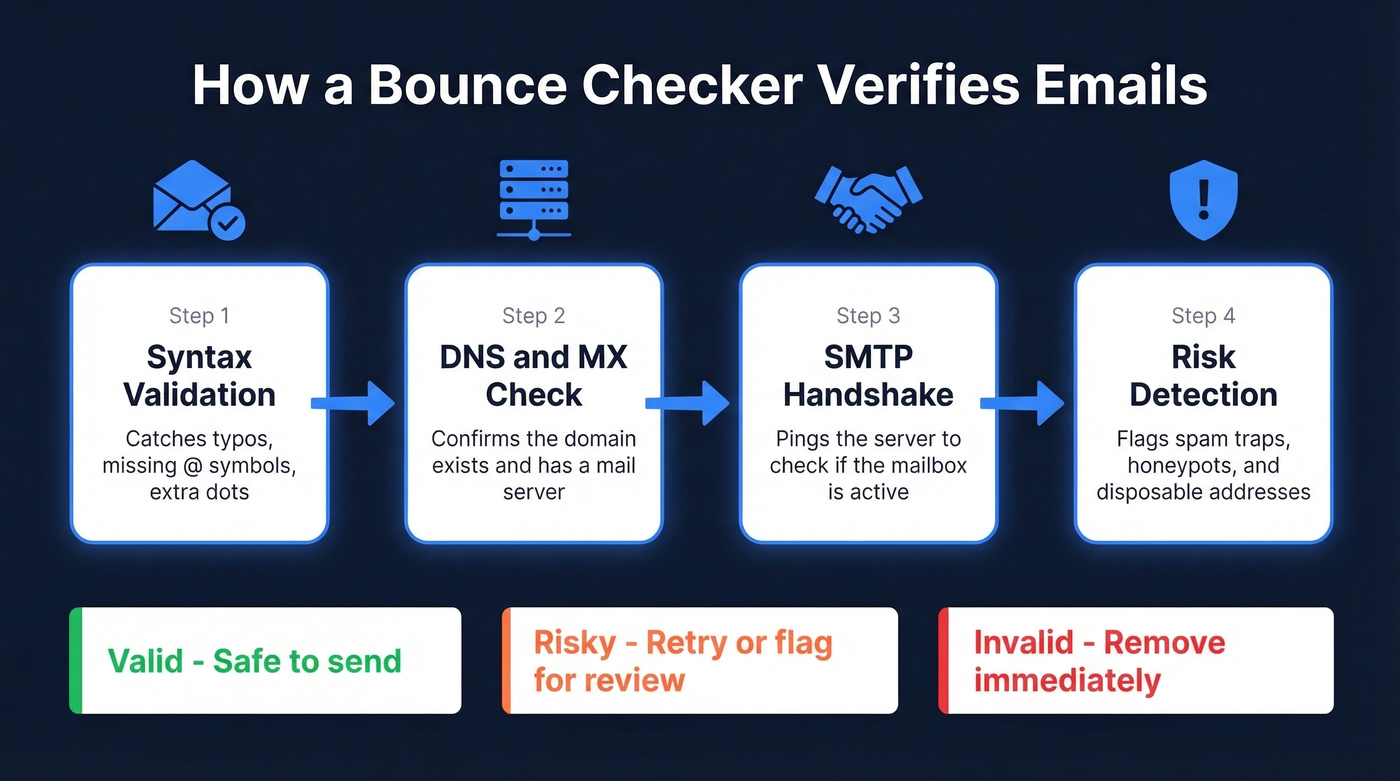
First, syntax validation catches formatting errors - missing @ symbols, extra dots, typos. Second, DNS and MX record checks confirm the domain exists and has a mail server. Third, an SMTP handshake pings the mail server to ask whether the specific mailbox is active. Fourth, risk detection flags spam traps, honeypots, and disposable addresses that pass the first three checks but will still wreck your deliverability.
Hard bounces are permanent failures - the address doesn't exist or the domain is dead. Remove these immediately. Soft bounces are temporary: full inbox, server timeout, that kind of thing. Retry after 24-48 hours, but if the same address soft-bounces three times, treat it as a hard bounce and cut it.
What Bounce Rate Should You Target?
The widely accepted threshold is 2% total bounce rate. Stay under that and most ESPs won't flag you. Push above 5% and you're risking blacklisting.
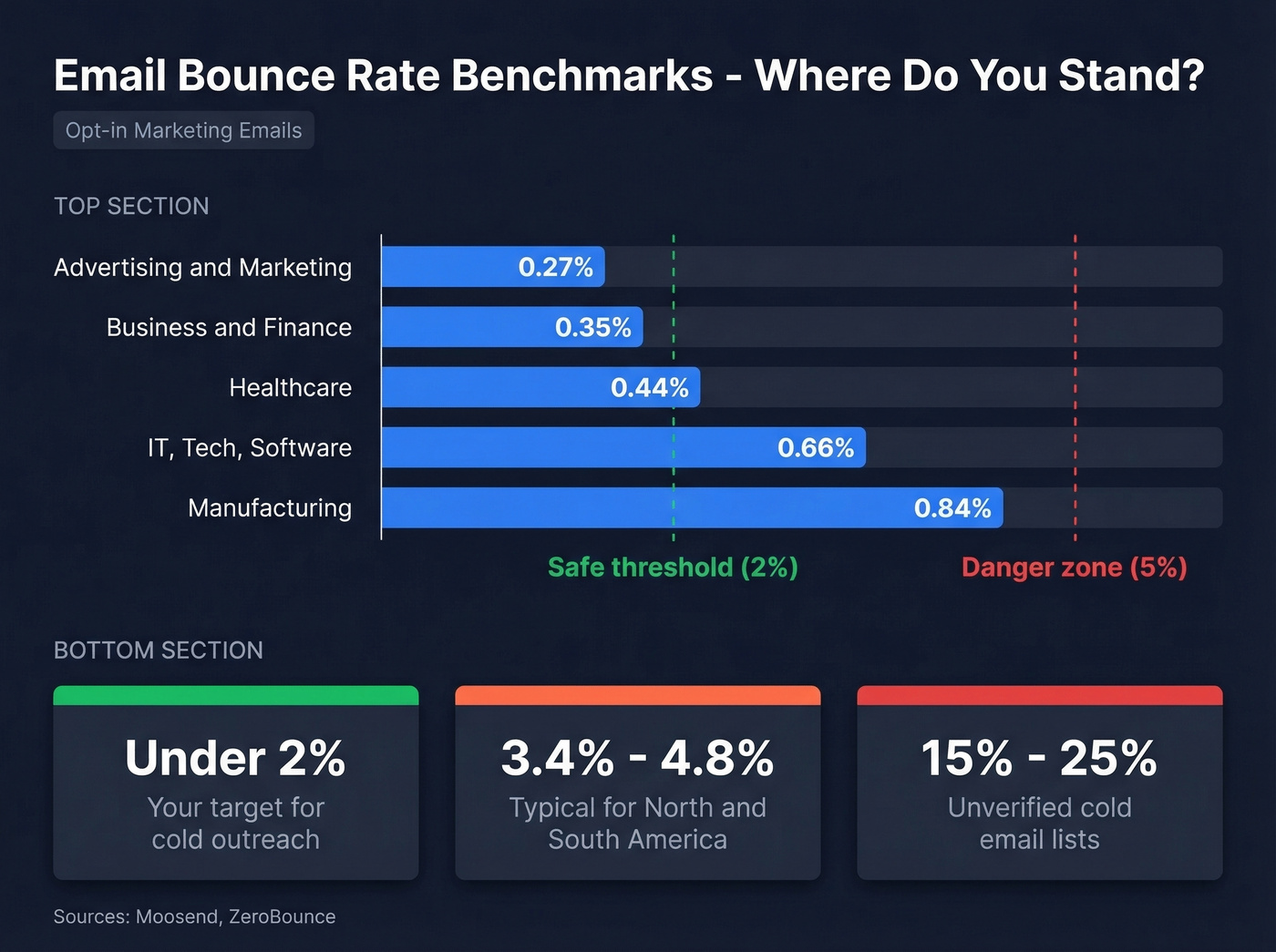
Those numbers sound easy to hit until you look at the benchmarks. Marketing email bounce rates by industry run surprisingly low:
| Industry | Bounce Rate |
|---|---|
| Advertising & Marketing | 0.27% |
| Business & Finance | 0.35% |
| Healthcare | 0.44% |
| IT/Tech/Software | 0.66% |
| Manufacturing | 0.84% |
Source: Moosend industry benchmarks
But those are opt-in newsletter numbers. Cold outreach looks nothing like this. Regional data tells a more honest story - North America averages 3.42%, South America hits 4.82%. And cold email lists without verification? We've seen bounce rates of 15-25% routinely. That's domain-reputation suicide.
Here's the thing: if you're running cold outbound, you should target under 2% on every campaign. Anything above that means your data source or verification workflow has a gap.
Our Picks (TL;DR)
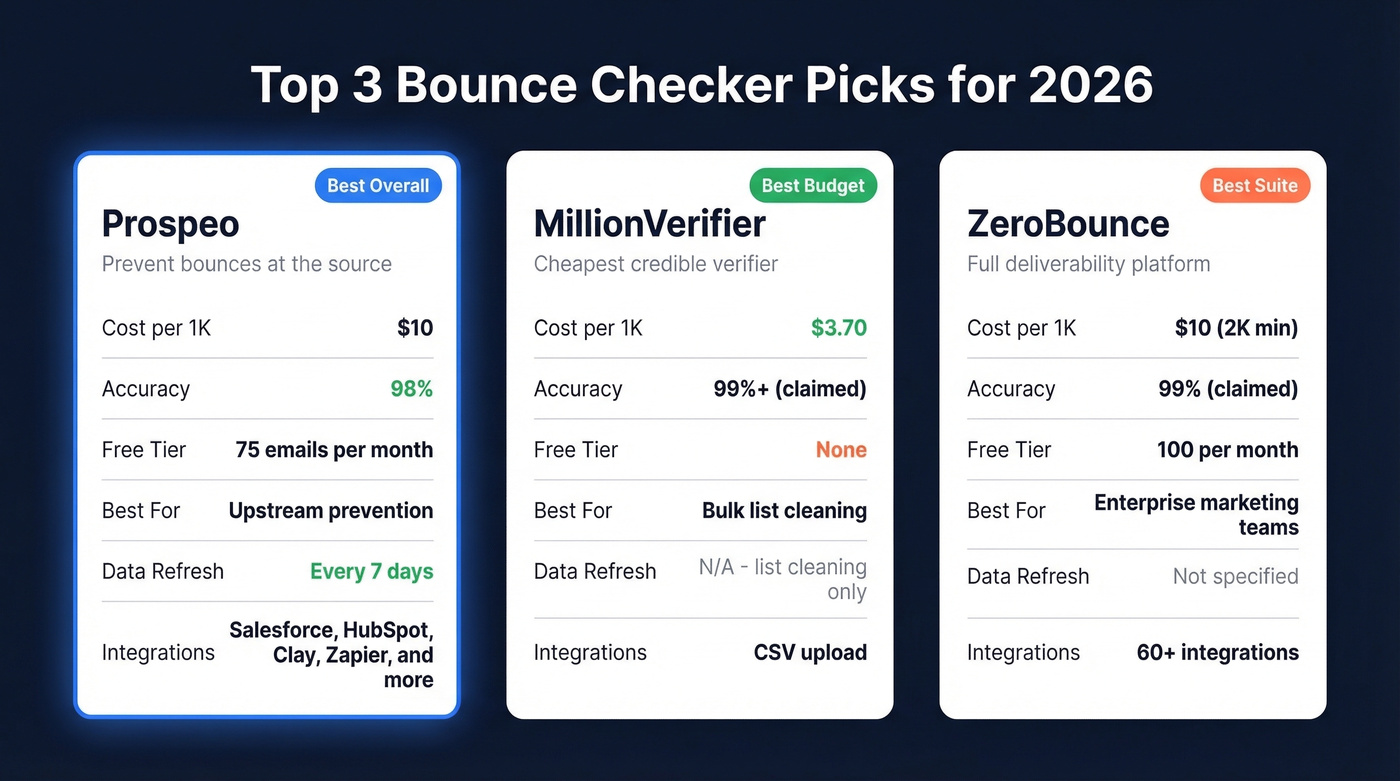
Prospeo - Best for preventing bounces at the source. 98% email accuracy with a 7-day refresh cycle means fewer bad emails enter your pipeline in the first place. Verification is built in, not bolted on.
MillionVerifier - Best budget option for bulk list cleaning. At ~$3.70 per 1,000 verifications with credits that never expire, nothing else comes close on pure cost-per-check.
ZeroBounce - Best full deliverability suite. AI scoring, spam trap detection, activity tracking, and 60+ integrations. You're paying for the ecosystem, not just verification.

Every bounce checker on this list fixes problems after the damage is done. Prospeo prevents bounces before they happen - 98% email accuracy, 5-step verification, and a 7-day data refresh cycle that keeps stale contacts out of your sequences entirely.
Stop cleaning dirty lists. Start with data that doesn't bounce.
The 10 Best Tools Ranked for 2026
| Tool | Best For | Cost/1K | Free Tier | Accuracy |
|---|---|---|---|---|
| Prospeo | Upstream prevention | ~$10 | 75 emails/mo | 98% |
| MillionVerifier | Budget bulk cleaning | $3.70 | None | 99%+ (claimed) |
| ZeroBounce | Full suite | $10 (2K min) | 100/mo | 99% (claimed) |
| NeverBounce | Established verifier | $8 | 10 credits | 97-99% (claimed) |
| Bouncer | Mid-tier PAYG | $7 | None | 65.43% (benchmarked) |
| Bouncify | Budget w/ reviews | ~$5-8 | None | 99% (claimed) |
| Hunter | Email finding + verify | $24.50 | 50/mo | 70.00% (benchmarked) |
| BriteVerify | Enterprise PAYG | $10 | None | Not benchmarked |
| QuickEmailVerification | Generous free tier | $8 | 3,000/mo | Not benchmarked |
| Email Hippo | Free daily checks | ~$5-10 (est.) | 100/day | Not benchmarked |
Prospeo
Most verification tools clean up messes after the fact. Prospeo prevents the mess from happening. Its database covers 300M+ professional profiles with 98% email accuracy, powered by a 5-step verification process that includes catch-all handling, spam-trap removal, and honeypot filtering. Every record refreshes on a 7-day cycle - the industry average is six weeks. The API match rate sits at 92%, so enrichment workflows pull back usable data on nearly every query.
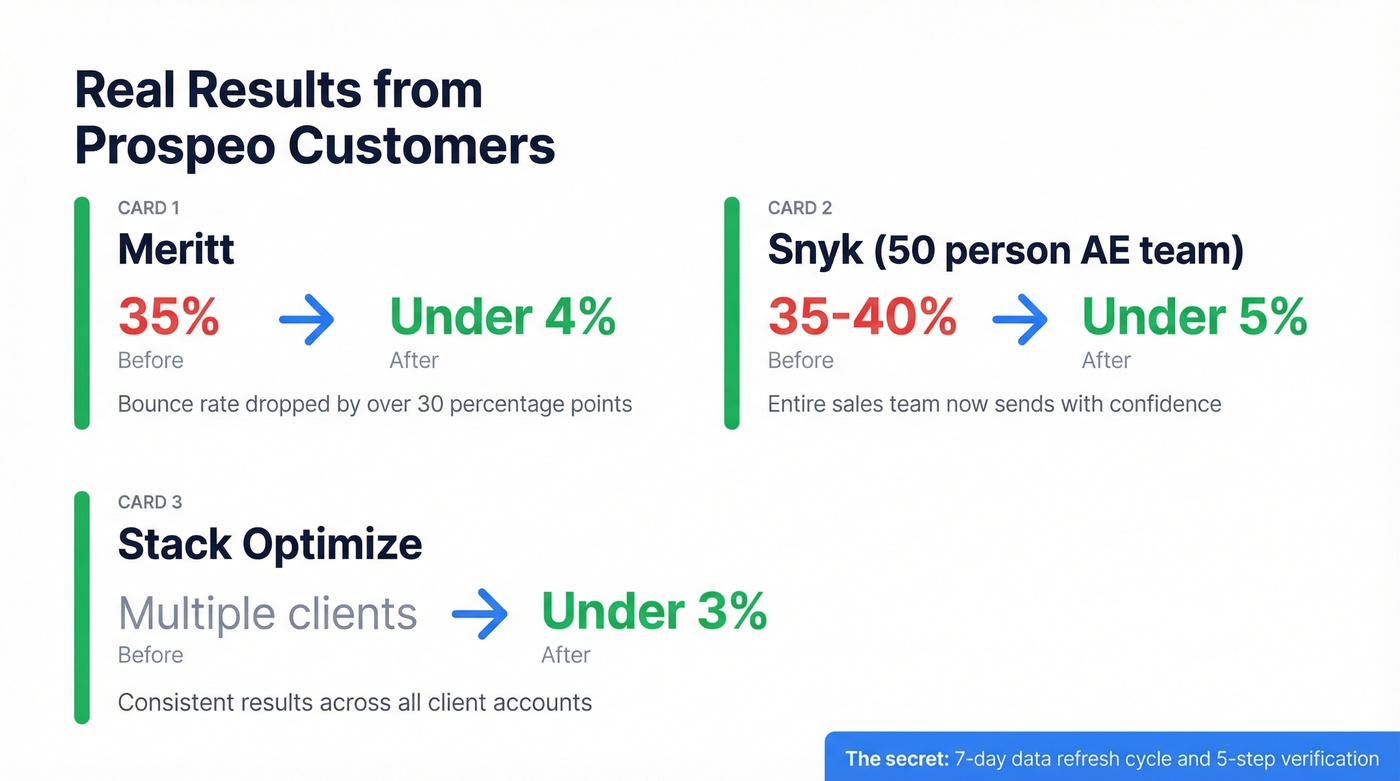
The results speak for themselves. Meritt dropped their bounce rate from 35% to under 4%. Snyk's 50-person AE team went from 35-40% bounces to under 5%. Stack Optimize maintains under 3% bounce rates across all their clients. These aren't cherry-picked case studies - they're the natural outcome of starting with clean data instead of cleaning dirty data after the fact.
If you're evaluating upstream prevention vs downstream cleanup, compare it against other data enrichment options too.
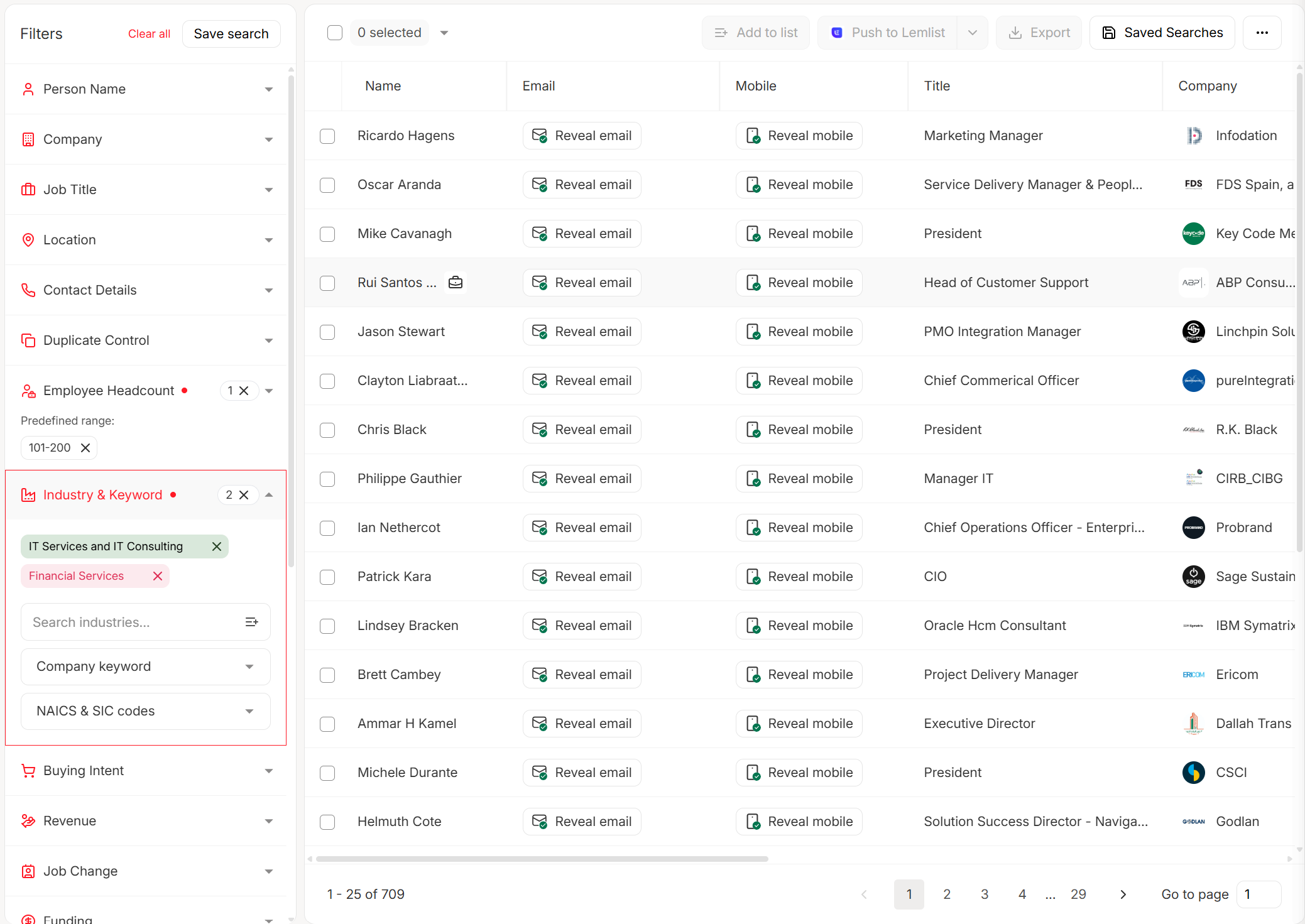
Pricing runs ~$0.01 per email on a credit-based system. Free tier gives you 75 emails plus 100 Chrome extension credits monthly. Native integrations with Salesforce, HubSpot, Smartlead, Instantly, Lemlist, Clay, Zapier, and Make mean verified contacts flow straight into your sequences without manual CSV juggling.
If you're building a full outbound stack, this also fits into most SDR tools lineups.
Use it if you want to eliminate bounce problems upstream instead of paying to clean bad data downstream. The cheapest verification is the one you never have to run.
Skip it if you already have a data source you trust and just need a standalone list-cleaning pass.
MillionVerifier
MillionVerifier is the tool you recommend when someone says "I just need to clean this list and I don't want to spend a fortune." At ~$3.70 per 1,000 verifications, it's the cheapest credible email verifier on the market. Credits never expire, it's pure pay-as-you-go, and the interface is dead simple - upload a CSV, get results.
The "99%+" accuracy figure is marketing. Every verifier says some version of this. But for pure list hygiene on a budget, MillionVerifier delivers solid results at a price point that makes verification a no-brainer even for small lists. We've used it for quick one-off cleans and it does exactly what it promises.
Use it if you're cleaning purchased or aged lists and cost matters more than bells and whistles.
Skip it if you need deliverability scoring, activity data, or integrations beyond basic CSV upload.
ZeroBounce
ZeroBounce packs more features into its verification platform than any other tool on this list. Beyond standard bounce checking, you get AI-powered email scoring, spam trap detection, email activity tracking, and email appending. It's the tool enterprise marketing teams gravitate toward because it covers the full deliverability stack.
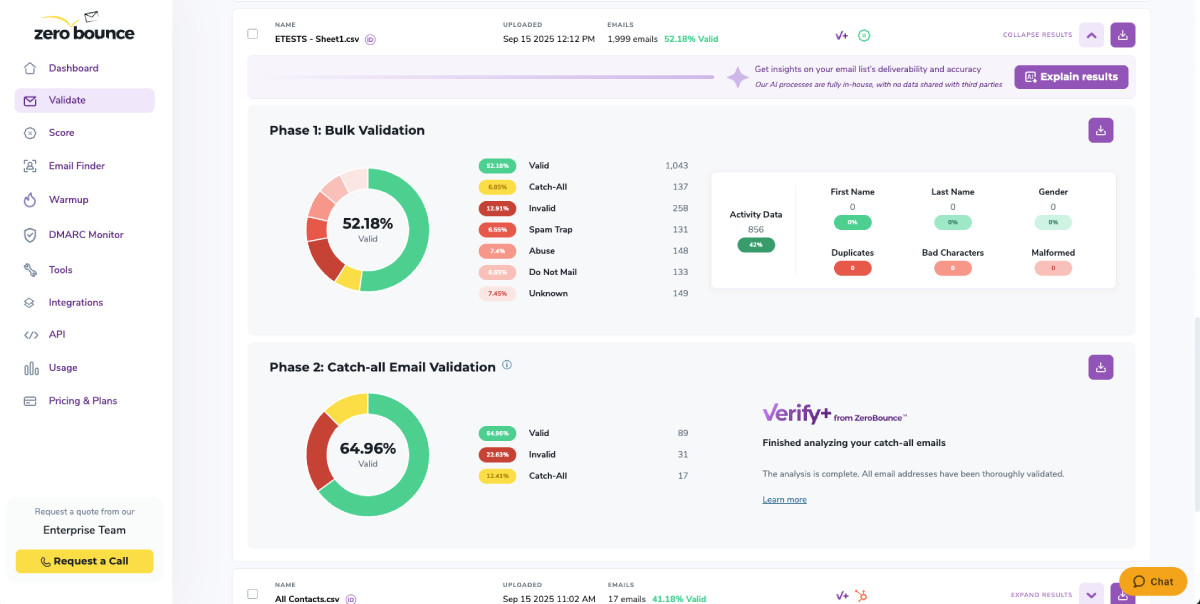
Pricing starts at $10 per 1,000 with a 2,000-email minimum purchase. The free tier gives you 100 verifications monthly - enough to test but not enough to rely on. Over 60 integrations cover most marketing and sales stacks. For teams that want a single platform handling verification, scoring, and monitoring, ZeroBounce is the obvious pick.
Use it if you're a marketing team running large opt-in lists and you want deliverability intelligence beyond pass/fail verification.
Skip it if you're an outbound sales team that just needs clean emails before loading sequences. You'll pay for features you won't touch.
NeverBounce
The "safe" choice. NeverBounce has been around long enough that procurement teams recognize the name, and its bounce-rate guarantee sounds compelling - they promise results or you don't pay. The guarantee's methodology is vague enough that we wouldn't bank on it as a differentiator, though. At $8 per 1,000 verifications, pricing is mid-range. Over 80 integrations and a clean API make it easy to plug into existing workflows.
Use it if you want a proven verifier with broad integration support and your company values vendor longevity.
Skip it if you're price-sensitive - MillionVerifier does the same core job at less than half the cost.
Bouncer
Here's what's interesting about Bouncer: it scored 65.43% in an independent 3,000-email benchmark across 15 tools tested. That's a real number against real business emails, not a marketing claim. At $7 per 1,000 verifications with no subscription commitment, it's low-risk to test. The pay-as-you-go model means you can run a batch, compare results against another verifier, and decide without being locked in.
If you're considering it, you may also want to review Bouncer alternatives before committing.
Use it if you want straightforward pay-as-you-go verification and don't mind mid-tier accuracy.
Skip it if you need advanced features like activity scoring or spam trap detection.
Bouncify
A 4.3/5 on G2 from 14 reviews. A 4.6/5 on Trustpilot from 32 reviews. Users consistently praise the accuracy and budget-friendly pricing. Credits never expire, and the pay-as-you-go model keeps things simple.
The consistent complaint? Speed. Large list processing can hang or slow to a crawl, which is frustrating if you're cleaning 50K+ contacts on a deadline. For smaller batches, the value is hard to beat at roughly $5-8 per 1,000 verifications.
Use it if you're verifying smaller batches and want good accuracy at a low price.
Skip it if you regularly process large lists - the speed issues are a real bottleneck.
Hunter
Hunter publishes one of the most detailed benchmark-style comparisons of email verifiers, and it also sells email finding plus verification on unified credits. At ~$24.50 per 1,000 (unified credits shared with email finding), it's expensive for pure verification. In its own benchmark, Hunter scored 70.00% - transparent, but not exactly inspiring. Free tier gives you 50 verifications monthly.
If you're shopping around, it's worth comparing Hunter alternatives for cost-per-verified-email.
Use it if you're already paying for Hunter's email finder and want unified credits across finding and verification.
BriteVerify
Owned by Validity, BriteVerify charges $10 per 1,000 with no subscription required - pure pay-as-you-go. It's the enterprise-friendly option for teams that want to run email verification through procurement without a recurring contract. Solid but unremarkable.
Use it if your company requires vendor approval and Validity's name carries weight with your procurement team.
QuickEmailVerification
The most generous free tier in this list: 3,000 free credits monthly. Paid plans start at $4 for 500 verifications. If you're a startup verifying small batches, test this before you spend anything.
Use it if you're a startup or solo operator who needs decent verification volume without paying a dime.
Email Hippo
Around since 2009, Email Hippo offers 100 free verifications daily. Paid plans require contacting sales - pricing likely falls in the $5-10 per 1,000 range based on market positioning, but expect enterprise-tier minimums. Reliable, but not the most transparent option.
Use it if you need a long-established provider and your volume justifies a sales conversation.
How Accurate Are These Tools, Really?
Let's be honest: every verifier on this list markets "97-99% accuracy." The reality is more sobering.
Hunter ran an independent-style benchmark using 3,000 real business emails - 2,700 valid addresses collected from actual outreach campaigns plus 300 known invalids. They segmented by company size and ran 40,000+ verifications across 15 tools. Hunter acknowledged potential bias in their own dataset, which is refreshingly honest for a company that also sells verification.
If you want the deeper deliverability context behind these numbers, see our email deliverability guide.
The results? The top scorer hit 70.00%. Clearout managed 68.37%. Kickbox came in at 67.53%. Bouncer scored 65.43%. Even the best standalone verifier misclassified roughly 1 in 3 emails when tested against real-world data. The "99% accuracy" numbers on marketing pages measure something different from what matters in production.
DeBounce was once the cheapest option at $1.50-2 per 1,000, but it's now not accepting new users - which tells you something about the sustainability of rock-bottom pricing in this space.
Our take: Most teams obsess over which verification tool to use when the real problem is their data source. If you're feeding a verifier 20% bad emails, even a perfect tool still leaves you cleaning up someone else's mess. The highest-ROI move isn't a better verifier - it's better data upstream. Integrated platforms like Instantly bundle verification at ~$0.008-0.016 per lead, but you're locked into their ecosystem. The smarter play is starting with accurate data and verifying only what slips through.
5 Mistakes That Kill Your Bounce Rate
1. Verify-and-forget. Email data decays at roughly 2% per month. A sample found 2.3% of a list was outdated after just eight weeks. Verifying once and sending for months is a slow-motion domain reputation disaster.
If you want a full breakdown of bounce codes, benchmarks, and fixes, see our guide to email bounce rate.
2. Treating accept-all as valid. Accept-all (catch-all) addresses are 27x more likely to bounce than standard addresses. Most verifiers return these as "accept-all" or "risky" - don't lump them in with your valid contacts.
3. Verifying after bounces instead of before sending. By the time you see bounce notifications, the damage is done. Your sender reputation already took the hit. Verify before the first message leaves your outbox, not after.
To reduce spam placement risk alongside bounces, run a dedicated email spam checker as part of QA.
4. Paying twice by not syncing tools. When your CRM, sequencer, and verification tool aren't connected, you'll re-verify the same contacts across platforms. Filter inactive contacts before bulk verification to save credits. Automate via API or Zapier.
If you're scaling outbound, keep an eye on email velocity so verification and sending limits stay aligned.
5. Ignoring source data quality. Garbage in, garbage out. If your data source delivers 20% bad emails, you're burning verification credits to clean up someone else's mess. Starting with a high-accuracy data source that refreshes weekly means fewer bad emails enter your pipeline in the first place - and that's a cheaper fix than any standalone verifier.
The Reverification Playbook
Monthly reverification is the minimum cadence for any active outbound list. The math is straightforward: at 2% decay per month, a list verified in January has roughly 6% stale addresses by April. That's enough to push you past the 2% bounce threshold on a single campaign.
Accept-all addresses deserve even more scrutiny. Either reverify them on a two-week cycle or exclude them from cold outreach entirely. The 27x bounce risk multiplier makes them a liability in any high-volume sequence.
Automate this. Set up a monthly Zapier or Make workflow that pulls contacts from your CRM, runs them through verification, and flags or removes invalids. If your data provider offers an enrichment API, you can re-enrich and reverify in the same pass - keeping contact data fresh and deliverable without manual CSV juggling. In our experience, the teams that maintain sub-2% bounce rates aren't doing anything magical. They're just reverifying on a schedule instead of waiting for problems to surface.
Meritt went from 35% bounces to under 4%. Snyk's 50 AEs dropped from 40% to under 5%. The pattern is clear: teams that source from Prospeo's 300M+ verified profiles don't need a bounce checker in the first place - at $0.01 per email.
The cheapest verification is the one you never have to run.
FAQ
What's the difference between a hard bounce and a soft bounce?
Hard bounces are permanent delivery failures - the address doesn't exist or the domain is dead. Remove these immediately. Soft bounces are temporary issues like a full inbox or server timeout. Retry after 24-48 hours, but treat any address that soft-bounces three consecutive times as a hard bounce and cut it.
Are free bounce checkers accurate enough for cold outreach?
Free tiers work for testing small batches under 100 emails, but they typically skip deeper verification layers like spam trap identification and catch-all handling. For production cold outreach, paid tools with SMTP-level checks are far more reliable. Prospeo's free tier of 75 emails/month includes full 5-step verification, which makes it a better starting point than most free-only tools.
How often should I reverify my email list?
Every 30 days minimum. Email data decays at roughly 2% per month, so a list verified in January carries about 6% stale addresses by April. High-volume senders running daily sequences should reverify every two weeks to stay safely under the 2% bounce threshold.
What should I do with "accept-all" results?
Treat them as high-risk. Accept-all addresses are 27x more likely to bounce than standard verified addresses. Either exclude them from cold outreach entirely or send to them in small, throttled batches while monitoring bounce rates closely. Never mix them into your main send list without caution.
Can a bounce checker replace good source data?
No. Even the best standalone verifiers score 65-70% accuracy in independent benchmark testing - far from the "99%" marketing claims. Starting with a high-accuracy data source that delivers pre-verified emails on a weekly refresh cycle drastically reduces your reliance on downstream verification. Better data in means less cleaning needed out.