

15 Prospecting Email Templates That Actually Get Replies in 2026
Your SDR just sent 500 emails using a prospecting email template they found on a blog. The results: 12% open rate, 0.4% reply rate, and half the list bounced. The template wasn't the problem - the system around it was.
Most template guides dump 30 emails and zero data. You can't improve what you can't measure. Here's the opposite approach: 15 templates backed by benchmarks from billions of emails, a deliverability checklist, and the mistakes that tank reply rates before your prospect ever reads a word.
2026 Cold Email Benchmarks
Instantly's 2026 benchmark report analyzed billions of cold email interactions across thousands of active workspaces:
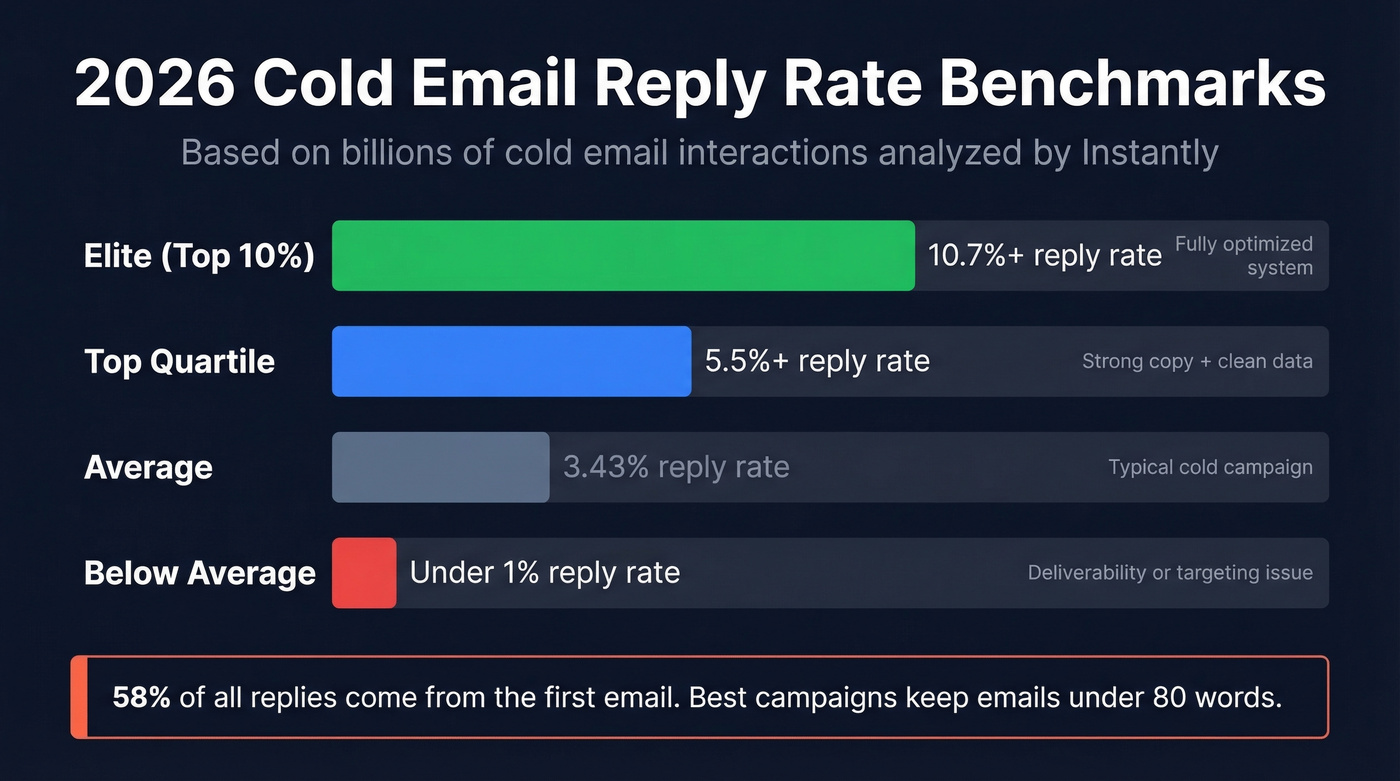
| Performance Tier | Reply Rate | What It Means |
|---|---|---|
| Below average | <1% | Deliverability or targeting issue |
| Average | 3.43% | Typical cold email campaign |
| Top quartile | 5.5%+ | Strong copy + clean data |
| Elite (top 10%) | 10.7%+ | Fully optimized system |
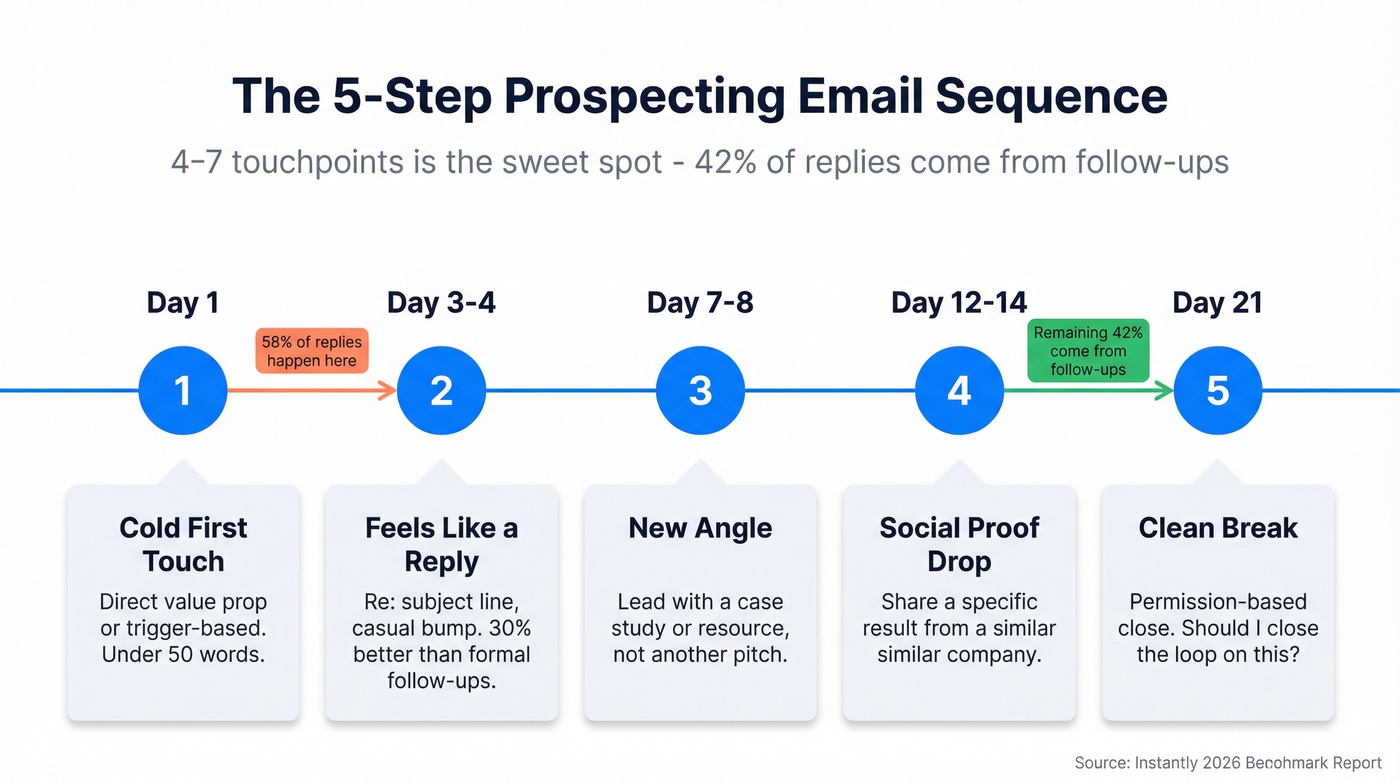
GMass's analysis of thousands of campaigns confirms the typical range lands between 1% and 5%, with outliers reaching 25%+. 58% of all replies come from the first email, and follow-ups drive the other 42%. Best-performing campaigns keep emails under 80 words and send on Tuesday or Wednesday. The sweet spot for sequence length is 4-7 touchpoints.
Here's the thing: the gap between average and elite isn't about having a better template. It's about data quality, deliverability, targeting, and cadence working together.
Before You Write: The Deliverability Checklist
None of these templates matter if your emails land in spam. Run through this before you send anything:
- SPF, DKIM, and DMARC configured and passing. Non-negotiable since the May 5, 2025 bulk sender enforcement.
- Spam complaint rate under 0.3%. Gmail Postmaster Tools will tell you where you stand.
- Bounce rate under 2%. Anything higher increases spam-filter risk and damages your domain.
- Warm up new domains for 2-4 weeks. Start at 5-10 emails per day, ramp gradually. (If you need tooling, see email warmup tools.)
- One-click unsubscribe header (RFC 8058). Required for bulk senders.
- Separate sending domain. Never send cold outbound from your primary domain.
- Verify your list before sending. Run every list through a verification tool before it touches your sequencer. Prospeo's 5-step verification process catches invalid addresses, spam traps, and catch-all domains - with a 98% accuracy rate and 7-day data refresh cycle, you're not sending to stale contacts. (More on this in our email deliverability guide and email bounce rate breakdown.)

We've seen teams obsess over template copy for weeks while sending to unverified lists. Bounce rates above 2% silently destroy domain reputation, and no amount of clever copywriting fixes that. Fix deliverability first. Then worry about your words.
Subject Lines That Get Opened
Belkins partnered with Reply.io to analyze 5.5M emails sent throughout 2024. The data is clear.
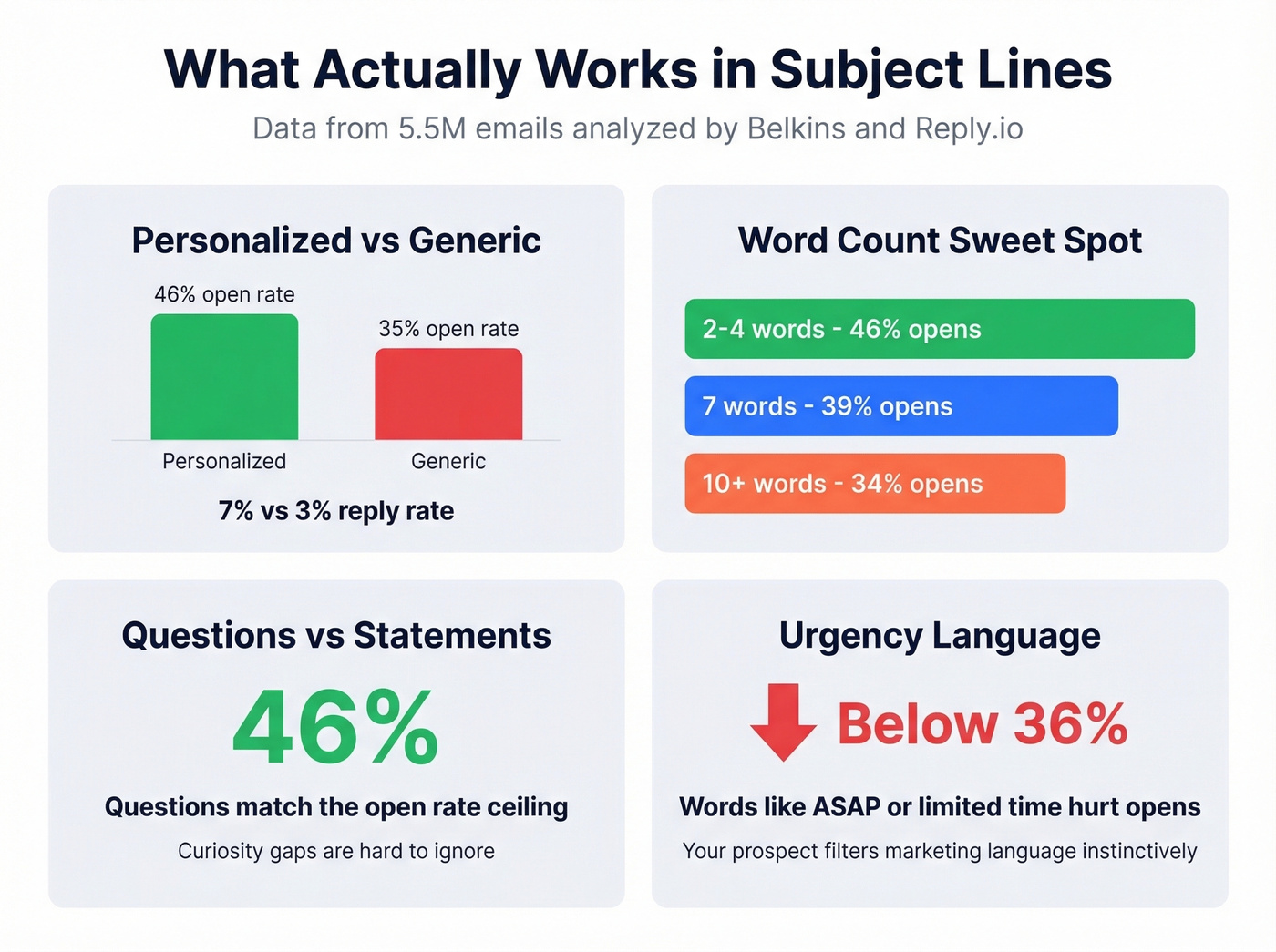
Personalized subject lines hit a 46% open rate vs 35% without personalization. Reply rates more than doubled - 7% vs 3%. That's the single biggest lever you can pull.
Keep subject lines to two to four words for 46% open rates. Once you pass seven words, opens drop to 39%. Ten words? Down to 34%. Questions outperform statements, matching the 46% open rate ceiling by creating a curiosity gap that's hard to ignore. For more options, pull from these cold email subject line examples or our broader prospecting email subject lines guide.
Numbers in subject lines don't help as much as you'd think - 27% open rate vs 28% without. And urgency language like "ASAP" or "limited time" drags opens below 36%. Your prospect filters marketing language instinctively. Don't trip the alarm.

The article says it: bounce rates above 2% silently destroy your domain - and no template fixes that. Prospeo's 5-step verification delivers 98% email accuracy with a 7-day refresh cycle, so every prospecting email you send hits a real inbox.
Fix your data before you fix your copy. Start free with 75 verified emails.
Writing Rules for Effective Templates
Six rules that separate templates getting replies from templates getting archived:
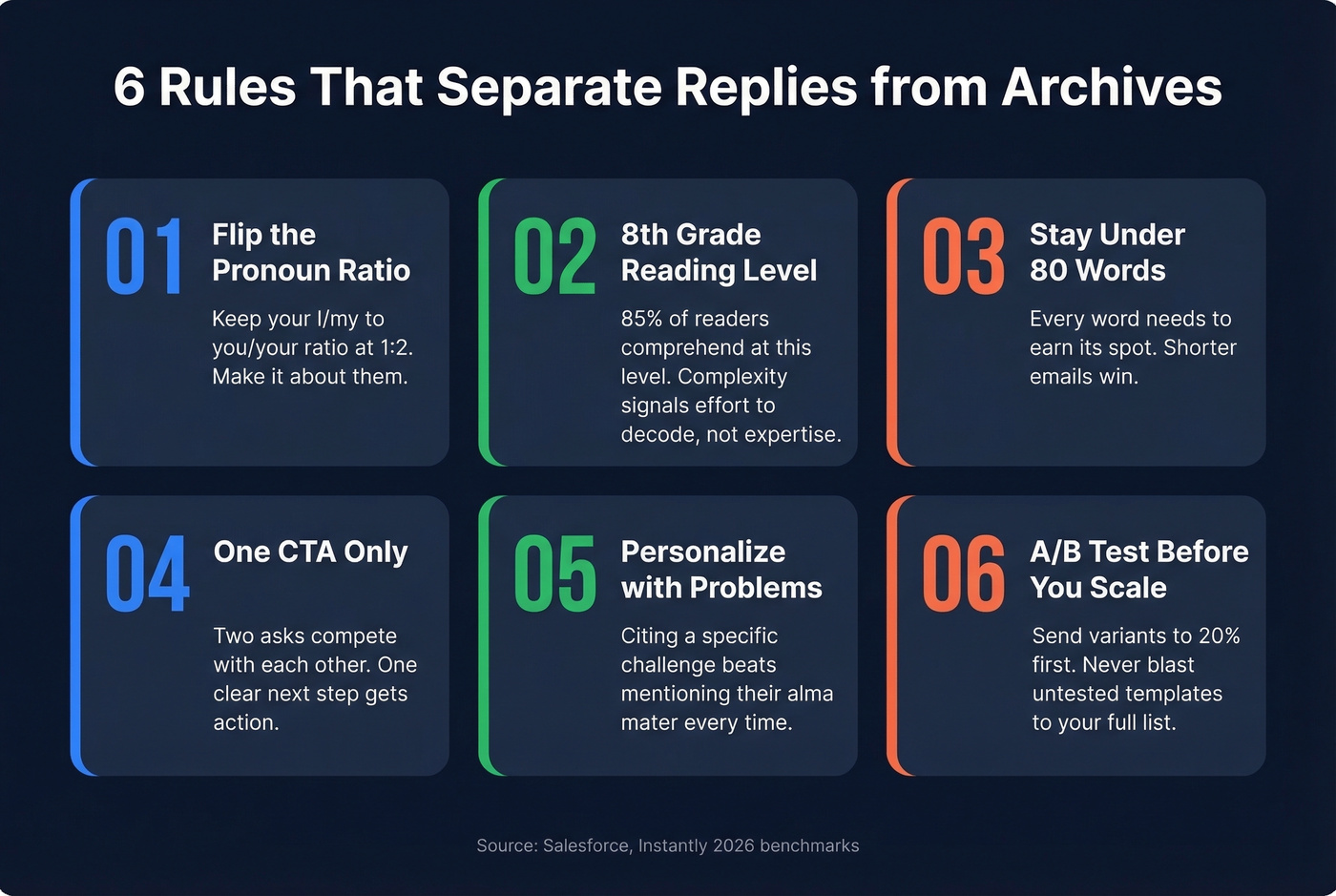
- Flip the pronoun ratio. Your "I/my" to "you/your" ratio should be 1:2. Make the email about them, not you.
- Write at an 8th-grade reading level. 85% of readers comprehend information at this level. Complexity doesn't signal expertise - it signals effort to decode.
- Stay under 80 words. Every word needs to earn its spot. (More email copywriting rules here.)
- One CTA only. Two asks compete with each other. One clear next step gets action. If you want patterns, use these email call to action examples.
- Personalize with problems, not trivia. "I see you went to Michigan State" is lazy. Citing a specific challenge their company faces or referencing a trigger event - that's personalization that earns a reply. The consensus on r/salestechniques is blunt: copy-paste templates rarely work because they can't match tone or relevance. (See more on personalized outreach.)
- A/B test before you scale. Send your variant to 20% of your list first. If it outperforms your control, roll it to the remaining 80%. Never blast an untested template to your full list - that's how you burn a domain in a day.
15 Cold Prospecting Email Templates
Cold First Touch
Template 1: Direct Value Proposition
Subject: Cut [metric] by [X]%?
Hi {{firstName}},
{{Company}} is scaling fast - which usually means [specific pain point] starts eating into [metric]. We helped {{similar company}} reduce that by 34% in one quarter.
Worth a 15-minute call to see if we can do the same for you?
{{Your name}}
Under 50 words, single CTA, leads with their problem. Use this when you have a clear, quantifiable result to lead with.
Template 2: Question-Based
Subject: {{firstName}}, quick question
Hi {{firstName}},
How are you handling [specific process] now that {{Company}} has grown past [milestone]?
Most [title]s I talk to are spending 6+ hours a week on this manually. We built a way to cut that to under one.
Curious if that's relevant?
{{Your name}}
Question subject lines hit 46% open rates in the Belkins dataset. This template continues that curiosity loop. Best for when you don't have a warm trigger but know the role well.
Template 3: Trigger-Based
Subject: Congrats on the Series B
Hi {{firstName}},
Saw {{Company}} just closed your Series B - congrats. In our experience, that's usually when [specific scaling challenge] becomes urgent.
We work with post-Series B teams like {{reference company}} to solve exactly that. Happy to share what's worked for them if useful.
{{Your name}}
Trigger-based personalization is the strongest signal that you're not mass-blasting. Funding rounds, leadership hires, product launches, earnings calls - any real event works. For deals under $15k, you probably don't need this level of research per prospect. But above that threshold, trigger-based emails consistently outperform everything else we've tested.
Framework Templates
Template 4: AIDA (Attention-Interest-Desire-Action)
The AIDA framework moves from a grabby observation to a single clear action. The competitor reference creates urgency without hype. (If you want the full funnel view, see AIDA sales funnel.)
Subject: {{Company}}'s [metric] gap
Hi {{firstName}},
{{Company}} is growing revenue but [specific attention-grabbing observation about their business].
Teams like {{competitor}} closed that gap and saw a 28% lift in [outcome] within 90 days. We helped them build the system.
I can walk you through exactly what they did - takes 15 minutes.
Open to it?
{{Your name}}
Best when you have a strong social proof story from their industry.
Template 5: PAS (Problem-Agitate-Solve)
PAS works because 95% of sales decisions are emotional - citing a prospect's actual numbers makes the problem feel personal, not generic.
Subject: {{Company}}'s [problem area]
Hi {{firstName}},
{{Company}} is pulling about 99K monthly visits but converting under [benchmark]. That's a lot of traffic leaving without a conversation.
Most [title]s try to fix this with more content. The real issue is usually [root cause].
We built a system that fixes [root cause] directly. {{Reference company}} went from [X] to [Y] in 60 days.
Worth exploring?
{{Your name}}
Only use this when you can pull a specific, public data point about their business. Without real numbers, PAS falls flat.
Template 6: PPP (Praise-Picture-Push)
Subject: Impressed by {{Company}}'s [achievement]
Hi {{firstName}},
What {{Company}} did with [specific initiative] stood out - it's clear you're thinking about [strategic area] differently than most.
Imagine pairing that with [your solution's outcome] - {{reference company}} did exactly that and hit [result] in [timeframe].
Would you be open to a quick call to explore it?
{{Your name}}
Use when the prospect or company recently published something notable. Genuine praise earns attention - flattery doesn't.
Referral and Mutual Connection
Template 7: Warm Referral
Subject: {{Referrer name}} suggested I reach out
Hi {{firstName}},
{{Referrer}} mentioned you're the right person to talk to about [topic] at {{Company}}. We've been working with their team on [outcome], and they thought it'd be relevant for you too.
Would a 15-minute call next week work?
{{Your name}}
Don't fake this one. Referral emails consistently outperform cold outreach because trust transfers. If you don't have a genuine referral, use Template 8 instead.
Template 8: Shared Community
Subject: Fellow [community/group] member
Hi {{firstName}},
We're both in [community/Slack group/industry association] - I've seen your posts on [topic]. Thought it'd be worth connecting directly.
We help [title]s at companies like {{Company}} solve [problem]. Happy to share a few things that've worked for similar teams, no pitch attached.
Interested?
{{Your name}}
Shared identity creates in-group trust. The "no pitch attached" lowers the barrier to reply.
Follow-Up Sequence
Template 9: Step 2 - "Feels Like a Reply"
Subject: Re: {{original subject line}}
Hi {{firstName}},
Wanted to bump this up in your inbox - I know [day of week]s get buried.
Quick version: we help [title]s at [company type] solve [problem]. Worth 15 minutes?
{{Your name}}
Send 2-3 days after your first email. Step-2 emails that feel like replies outperform formal follow-ups by roughly 30%. The "Re:" subject line and casual tone mimic a real reply thread. If you want more variations, use these cold email follow-up templates.
Template 10: Step 3 - New Angle
Subject: Different angle on [problem]
Hi {{firstName}},
Instead of the pitch - here's a case study from {{similar company}} that's useful regardless.
[One-sentence summary of case study with specific result.]
Happy to send the full breakdown if you're curious.
{{Your name}}
Skip this if you don't have a real case study to share. Promising value and delivering a generic PDF destroys credibility. Send on Day 7 when your first two emails didn't land.
Template 11: Step 4 - Social Proof
Subject: What {{competitor}} is doing differently
Hi {{firstName}},
{{Competitor or peer company}} just [achieved specific result] using [approach]. Thought you'd want to know, since {{Company}} is in a similar position.
I can share exactly how they did it - takes 10 minutes.
{{Your name}}
Day 14. Nobody wants to be the last company in their space to adopt something that's working. Competitive intelligence is the strongest motivator in a follow-up sequence - use it here, not earlier.
Template 12: Step 5 - Breakup
Subject: Should I close your file?
Hi {{firstName}},
I've reached out a few times and haven't heard back - totally fine. I don't want to be that person who keeps emailing.
If [problem] becomes a priority, I'm here. Otherwise, I'll stop reaching out.
Either way - good luck with [specific initiative].
{{Your name}}
Day 21. Breakup emails often get the highest reply rates in a sequence. The prospect feels the loss of access - the psychology of loss aversion is real.
Re-engagement and Executive
Template 13: Re-engagement After Silence
Subject: Things change
Hi {{firstName}},
We talked [timeframe] ago about [topic], and the timing wasn't right. Totally get it.
Since then, we've [new capability, result, or social proof]. Wondering if anything has shifted on your end.
Worth a fresh conversation?
{{Your name}}
Send 60-90 days after a stalled conversation. The "things change" framing gives them permission to re-engage without awkwardness.
Template 14: Last-Chance Gift
Subject: One last thing
Hi {{firstName}},
I put together a [specific resource - benchmark report, ROI calculator, competitive analysis] for {{Company}}. It's yours regardless of whether we talk.
[Link]
If it sparks any questions, I'm around.
{{Your name}}
Leading with a gift instead of an ask changes the dynamic entirely. It also gives you a natural follow-up: "Did you get a chance to look at that report?"
Template 15: Executive-Level
Subject: {{firstName}} - quick ask
{{firstName}},
Running [your company]. We help [company type] solve [one problem] - [one proof point].
Worth 10 minutes this week?
{{Your name}}
Three lines. That's it. Executives don't read long emails - they scan and decide in seconds. Peer-to-peer tone, one ask, zero preamble. For VP+ prospects, compress your entire sequence to 3-4 touches over 14 days. They respond fast or not at all, and long sequences waste effort on both sides.
The Complete 5-Email Sequence
Let's stitch these templates into a working cadence:
| Day | Email Type | Template # | Intent |
|---|---|---|---|
| 1 | Cold first touch | 1, 2, or 3 | Open the conversation |
| 3 | Reply-style follow-up | 9 | Bump without pressure |
| 7 | New angle / case study | 10 | Shift the value prop |
| 14 | Social proof / competitor | 11 | Create urgency |
| 21 | Breakup | 12 | Trigger loss aversion |
Don't stop after two emails - that's how you miss the 42% of replies that come from follow-ups. Space your touches out enough to avoid annoyance, but don't let three weeks pass between emails. Each step should introduce a new angle, not just repeat "circling back." We ran a test last quarter where swapping the Day 7 email from a generic check-in to a real case study bumped sequence-level reply rates by 18%. The new angle matters more than the follow-up itself. (More on the importance of follow-up in sales.)
7 Mistakes That Kill Reply Rates
- Using your primary domain for cold outreach. One spam complaint spike and your entire company's email reputation is damaged. Set up a dedicated sending domain.
- Skipping warmup. New domains need 2-4 weeks of gradual ramp. Jumping straight to 100 emails/day is a fast path to the spam folder.
- Not verifying your list. Bounce rates above 2% trigger spam filters. Run every list through a verification tool that catches invalid addresses, spam traps, and catch-all domains before they damage your sender reputation. This is the single easiest fix for most underperforming campaigns.
- Multiple CTAs. "Book a call, check out our blog, and follow us on Twitter" gives the prospect three reasons to do nothing. Pick one ask.
- No follow-up plan. Sending one email and waiting isn't a strategy. Build a 5-step sequence before you send email one. (If you need more options, use these sales follow-up templates.)
- Generic personalization. "I see you went to [college]" isn't personalization - it's a mail merge field. Cite a specific business problem, a trigger event, or a data point about their company.
- Sending too many emails from one account. Spread volume across multiple sending accounts. High volume from a single mailbox is the fastest way to get flagged. (See email velocity for safe limits.)
Trigger-based templates need trigger data. Prospeo tracks 15,000 intent topics, funding events, job changes, and headcount growth - so you can personalize every prospecting email with real signals, not guesswork. At $0.01 per email, scaling outreach costs less than your coffee.
Stop guessing who to email. Let buyer signals write your targeting for you.
FAQ
What reply rate should I expect from cold prospecting emails?
The average cold email reply rate in 2026 is 3.43%. Top-quartile senders hit 5.5%+, and elite performers exceed 10.7%. If you're consistently below 3%, that points to a deliverability or targeting problem, not a template problem.
How many follow-ups should I send?
Four to seven touchpoints total. Follow-ups contribute 42% of total replies, and most reps stop after two emails - leaving nearly half their potential responses on the table.
How long should a prospecting email be?
Under 80 words. Every sentence should establish relevance, deliver value, or ask for a next step. If it doesn't do one of those three, cut it.
Do personalized subject lines actually work?
Yes. Across 5.5M emails analyzed by Belkins, personalized subject lines hit 46% open rates versus 35% without. Reply rates more than doubled - 7% vs 3%.
How do I keep prospecting emails out of spam?
Configure SPF, DKIM, and DMARC. Keep bounce rates under 2% and spam complaints under 0.3%. Verify your list before every campaign, warm up new domains for 2-4 weeks, and never use your primary domain for cold outreach.