

How to Run Deal Reviews That Actually Improve Your Win Rate
A RevOps lead we know ran a pipeline audit last quarter and found a painful pattern: "commit" deals with no mutual next step, no confirmed economic buyer, and contact data that was months stale. The forecast missed badly. That's not a forecasting problem - it's a deal reviews problem. Structured inspections would've caught most of those gaps before the quarter ended.
Here's how to run them.
What You Need (Quick Version)
Deal reviews are structured inspections of specific opportunities - not status updates, not pipeline scans, not forecast calls. Run them weekly for 1:1s and bi-weekly for team sessions. Build each one around eight core questions that force reps to prove buyer engagement with evidence, not optimism. Use MEDDPICC as the scaffolding. And none of it matters if your CRM data is garbage - stale contacts and wrong titles mean you're reviewing fiction, not deals.
What a Deal Review Actually Is
A deal review is a focused inspection of 3-5 specific opportunities, designed to validate deal health, surface risks, and assign concrete next steps. It's not a pipeline review (which scans the full portfolio for coverage and velocity), not a QBR (which evaluates strategic performance over a quarter), and not a forecast call (which defends a number to leadership).
The distinction matters because most managers blend all four into a single meeting and end up doing none of them well. A deal review goes deep. A pipeline review goes wide. You need both, but they're different muscles.
Why Rigorous Inspection Matters Now
Quota attainment has been sliding for years. RepVue's Cloud Sales Index tracked it dropping from 53% in Q1 2022 to 42.8% by Q3 2023, and the trend hasn't reversed. Fewer reps are hitting number, and the deals they're working are getting squeezed harder than ever.
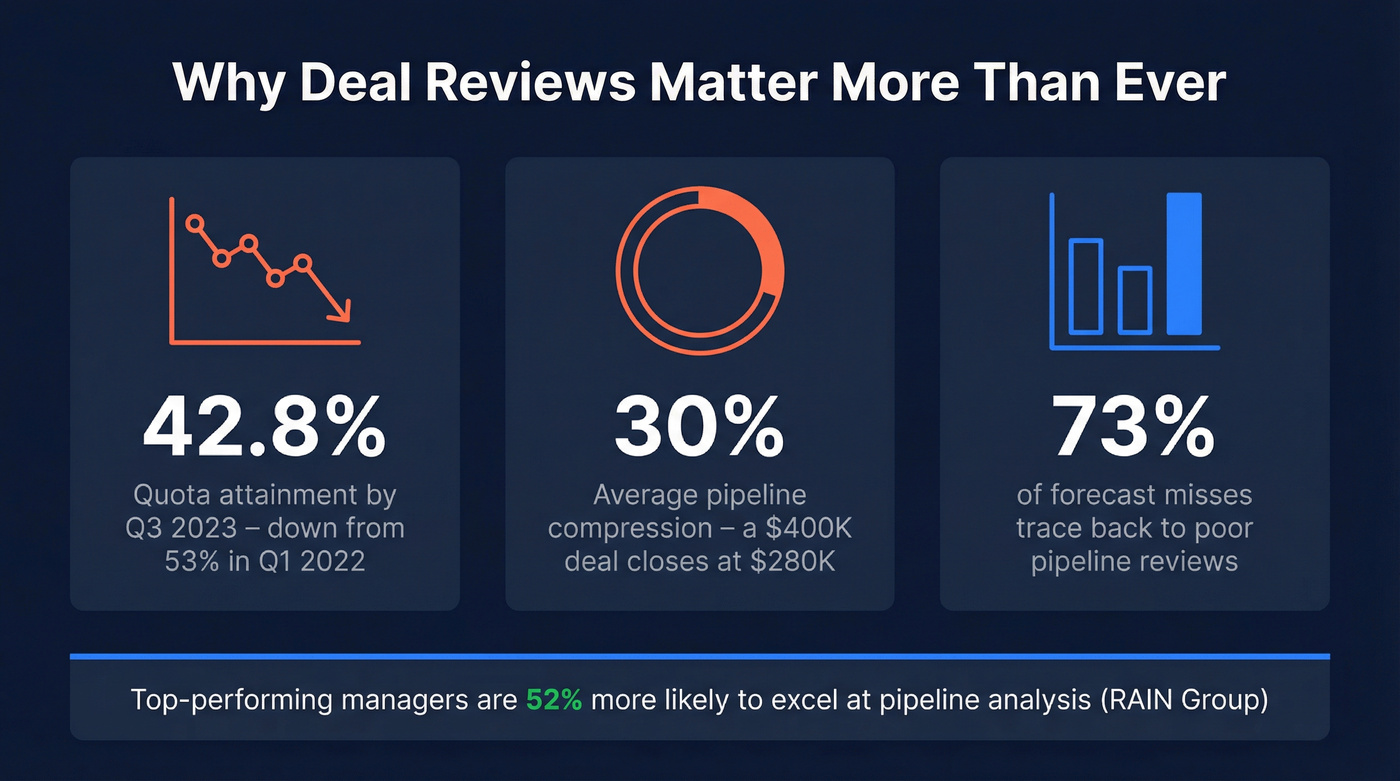
Pipeline compression is real. Deals that enter the pipeline at $400K can close at $280K - a 30% haircut that Amolino's forecast accuracy research calls "pipeline compression." Across a portfolio, 15-25% compression is common. That's the difference between hitting plan and missing by a mile.
Let's be honest: 73% of forecast misses trace back to poor pipeline reviews. Not bad reps. Not bad markets. Bad inspection. RAIN Group's research shows top-performing sales managers are 52% more likely to excel at pipeline analysis than their peers. The managers who inspect deals rigorously build teams that win more.
Three Types of Deal Reviews
Stop reviewing every deal. Go deep on 3-5 per session and rotate coverage across the quarter.
| Type | Cadence | Duration | Participants | Focus |
|---|---|---|---|---|
| Sales Manager 1:1 | Weekly | 30-45 min | Manager + AE | 3-5 at-risk or high-value deals |
| Team Review | Bi-weekly | 60-90 min | Full team + leadership | Cross-team learning, resource allocation |
| Executive / Forecast | Monthly | 90-120 min | Leadership + RevOps | Defend forecast with inspection evidence |
The weekly manager 1:1 is non-negotiable for any team with more than three reps. The bi-weekly team session is where reps learn from each other - a junior AE hearing how a senior rep navigated a procurement stall is worth more than any training module. Monthly executive reviews hold the pipeline accountable to a number, and they only work if the weekly inspections actually happened.
The Deal Review Process Step by Step
A strong review process draws from Spinach.ai's agenda template, which includes 21 inspection questions worth bookmarking. It breaks the conversation into four phases:
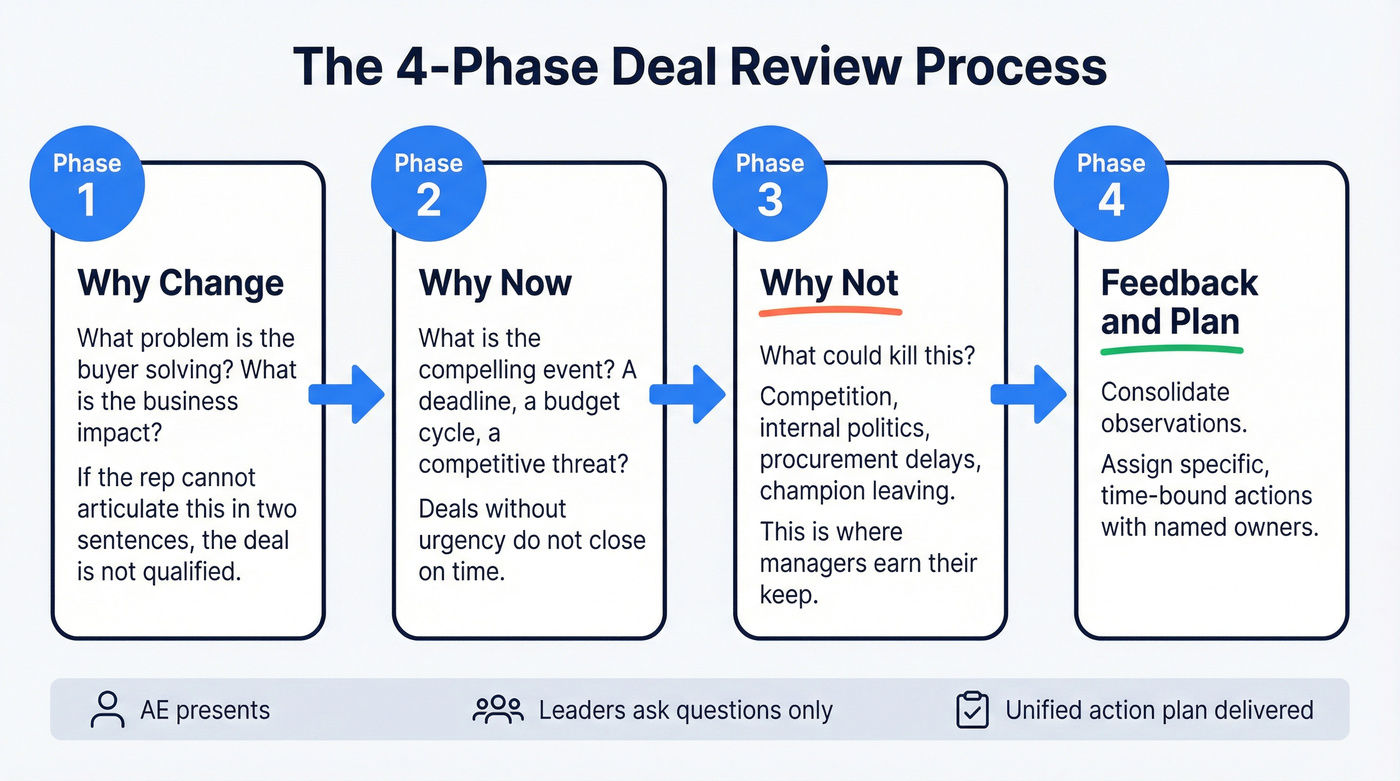
- Why Change - What problem is the buyer solving? What's the business impact? If the rep can't articulate this in two sentences, the deal isn't qualified.
- Why Now - What's the compelling event? A deadline, a budget cycle, a competitive threat? Deals without urgency don't close on time.
- Why Not - What could kill this? Competition, internal politics, procurement delays, champion leaving. This is where managers earn their keep.
- Feedback & Plan - Consolidate observations and assign specific, time-bound actions with named owners.
Run it as a panel: the AE presents, executives ask clarifying questions only (no solutioning during the review), then the AE steps out while leaders consolidate feedback. The AE comes back for a unified action plan. This prevents the "seven managers giving contradictory advice" problem that kills rep confidence.
Preparation is everything. Before the meeting, the AE should update CRM fields, confirm contact data is current, and have a written hypothesis on the deal's biggest risk. If they show up unprepared, send them back and reschedule. It sets the standard fast.

You just read it: deal reviews fail when CRM data is stale. Prospeo refreshes 300M+ profiles every 7 days - not every 6 weeks. Verified emails at 98% accuracy, confirmed titles, and 50+ data points per contact so your reps review real deals, not fiction.
Stop reviewing deals built on dead contacts. Start with data you can trust.
8 Questions Every Review Must Answer
SalesGrowth's deal review framework nails the core inspection questions. Every session should cover these eight:
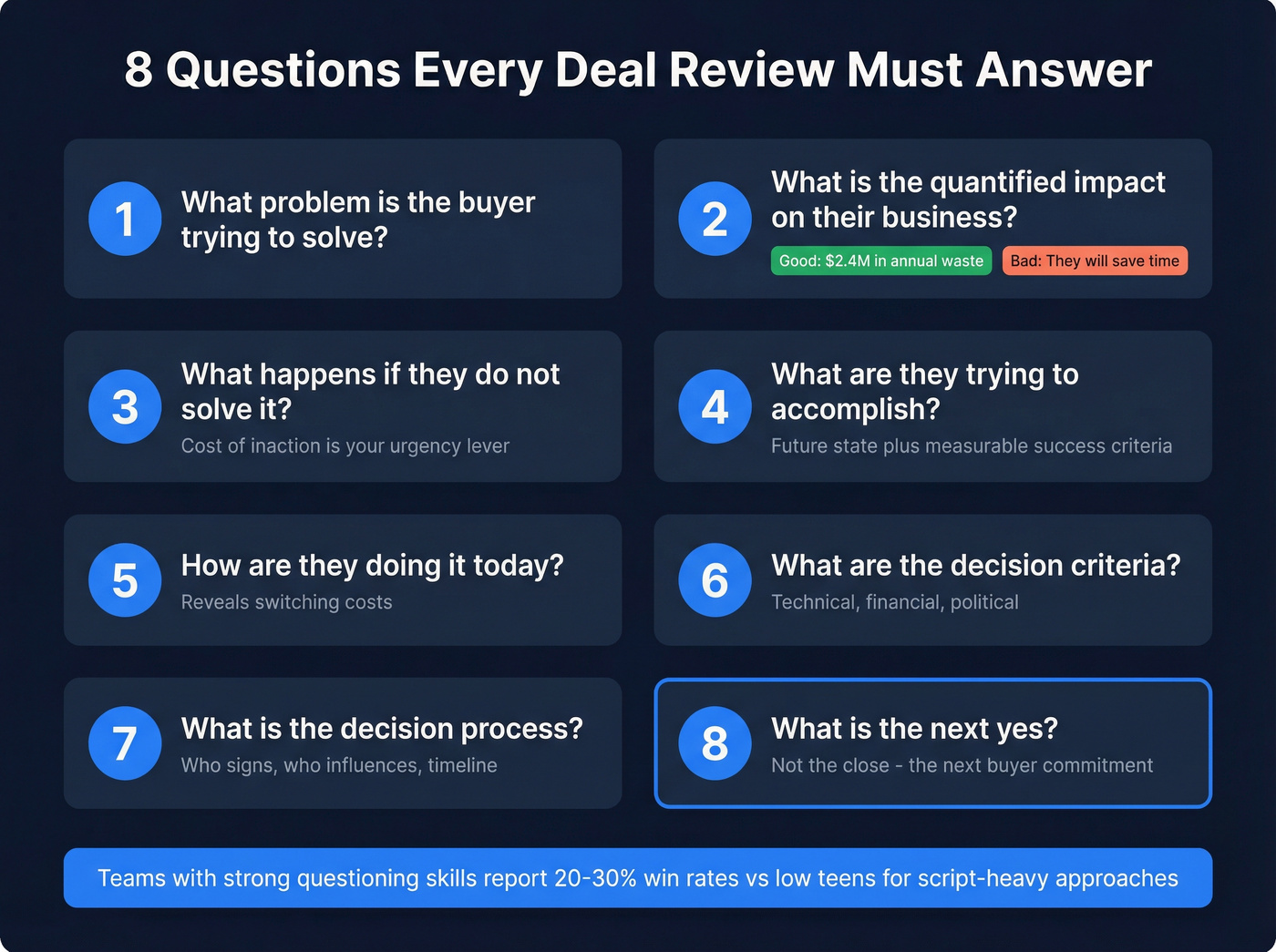
- What problem is the buyer trying to solve?
- What's the quantified impact on their business? "They'll save time" isn't an answer. "$2.4M in annual waste from manual processes" is.
- What happens if they don't solve it? The cost of inaction is your urgency lever.
- What are they trying to accomplish? Future state plus measurable success criteria.
- How are they doing it today? Current state and process - this reveals switching costs.
- What are the decision criteria? Technical, financial, political.
- What's the decision process? Who signs, who influences, what's the timeline.
- What's the next yes? Not the close - the next buyer commitment that advances the deal. A meeting with the CFO. A technical evaluation. A signed NDA.
Teams with strong questioning skills report win rates of 20-30%, compared to low teens for script-heavy approaches.
Question #2 is where most opportunities fall apart: reps love to describe the problem but can't quantify the impact. And #8 separates pipeline from forecast - a deal without a clear "next yes" is stalled, regardless of what stage it's in. If your rep can't answer all eight, the deal isn't qualified. It's a hope.
MEDDPICC as Your Scoring Scaffolding
MEDDPICC - Metrics, Economic Buyer, Decision Criteria, Decision Process, Paper Process, Identify Pain, Champion, Competition - evolved from MEDDIC in the 1990s at PTC. The Paper Process element is the one most teams underestimate. Legal redlines, security questionnaires, vendor onboarding - this phase can add 30-90 days to a close. When a rep says "we'll handle procurement later," that's a late-stage failure waiting to happen.
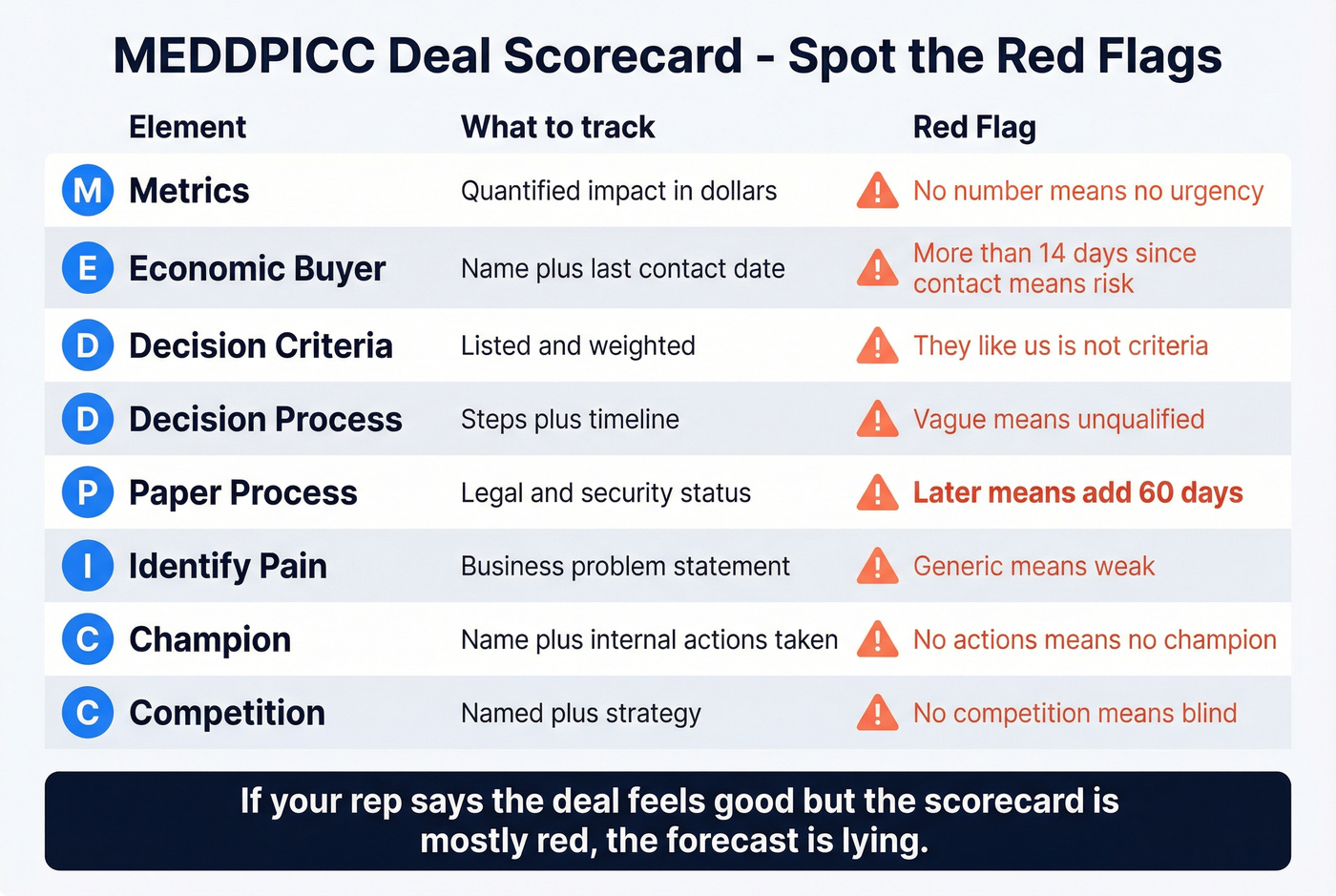
Here's a scenario we see constantly: $200K deal, AE says the economic buyer is "on board," you ask when she last spoke to them - silence. That deal isn't at 70% probability. It's at 30%, and the forecast is lying.
Add custom CRM fields for each MEDDPICC element and build a deal scorecard that turns subjective "this deal feels good" into objective "we're missing Economic Buyer confirmation and have no Paper Process timeline." If you need a starting point, borrow a set of MEDDIC discovery questions and map them to your fields.
| MEDDPICC Element | CRM Field | Red Flag |
|---|---|---|
| Metrics | Quantified impact ($) | No number = no urgency |
| Economic Buyer | Name + last contact date | >14 days = risk |
| Decision Criteria | Listed + weighted | "They like us" ≠ criteria |
| Decision Process | Steps + timeline | Vague = unqualified |
| Paper Process | Legal/security status | "Later" = +60 days |
| Identify Pain | Business problem statement | Generic = weak |
| Champion | Name + internal actions taken | No actions = no champion |
| Competition | Named + strategy | "No competition" = blind |
7 Mistakes That Kill Your Reviews
Mural's research on pipeline review failures identifies seven anti-patterns that turn deal reviews into wasted calendar blocks:
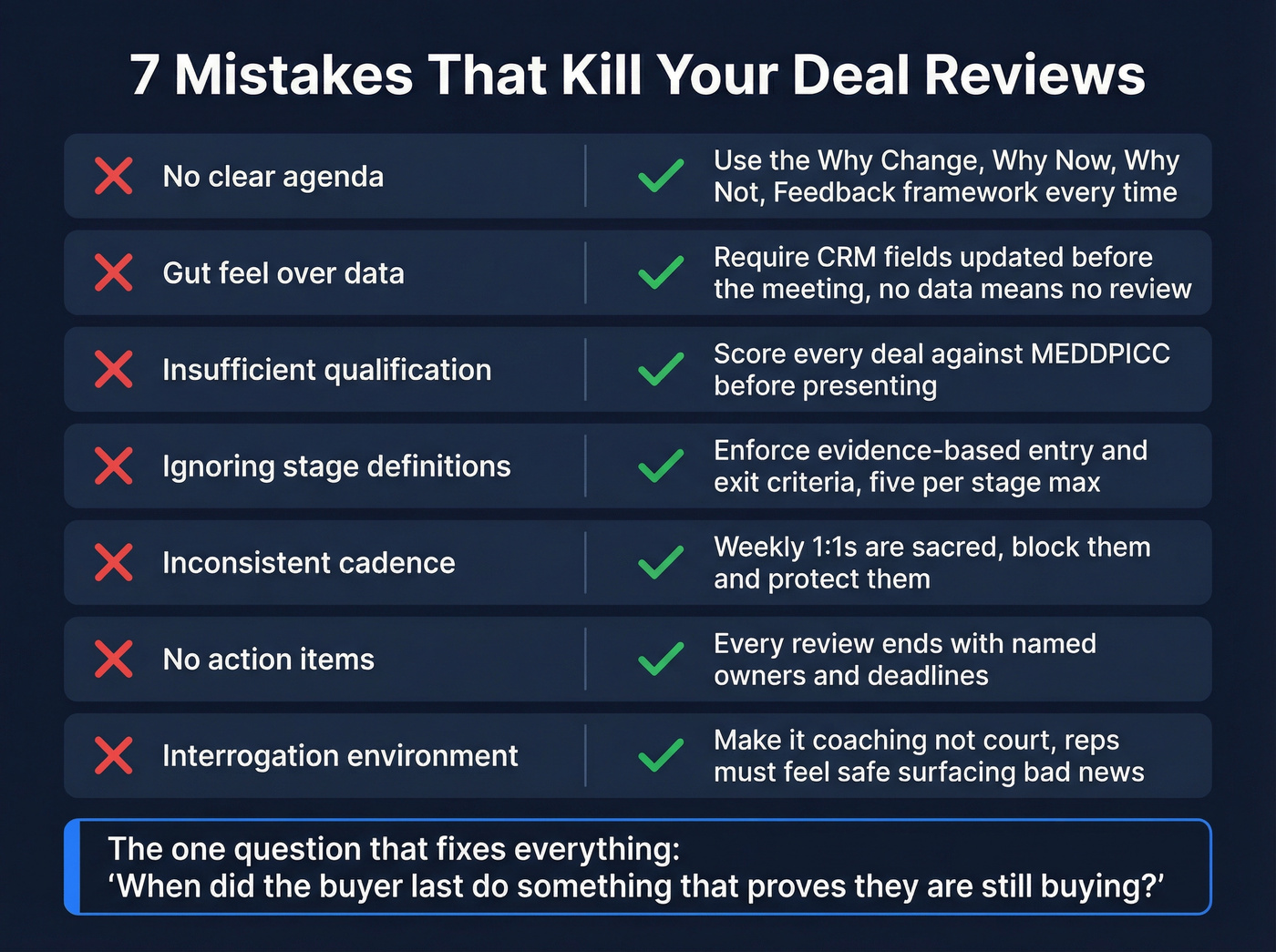
- No clear agenda. Use the four-part framework above. Every time.
- Gut feel over data. Require CRM fields updated before the meeting. No data, no review.
- Insufficient qualification. Score every deal against MEDDPICC before presenting it.
- Ignoring stage definitions. Enforce evidence-based entry/exit criteria - five per stage max.
- Inconsistent cadence. Weekly 1:1s are sacred. Block them. Protect them.
- No action items. Every review ends with named owners and deadlines. Period.
- Interrogation environment. If reps hide bad news because they fear the review, you've already lost. Make it coaching, not court.
MentorGroup adds a critical rule: every active deal must have a mutual, calendarized next step with a named buyer owner. No mutual next step plus no activity in 14 days? That's not a deal. Park it with re-entry triggers and move on.
Sales communities on Reddit flag the same failure mode constantly - reps presenting deals with no buyer contact in weeks, managers nodding along, and everyone acting surprised when the deal slips. The mutual-next-step rule kills these conversations before they start.
Look, most teams don't need a better CRM, a better methodology, or a better forecasting tool. They need a manager who will ask "when did the buyer last do something that proves they're still buying?" every single week. That one question, asked relentlessly, will improve your win rate more than any software purchase.
How to Streamline Deal Reviews
Your review is only as good as the data behind it. The right tools eliminate manual prep work and surface risks automatically.
CRM. Salesforce for enterprise teams, HubSpot Sales Hub for mid-market. The CRM is where MEDDPICC fields live, where stage criteria get enforced, and where the scorecard runs. If your CRM is a mess, your deal reviews are theater. If you're standardizing your stack, it helps to align on examples of a CRM and what each is best at.
Call intelligence. Gong is the clear #1 here. It records calls, surfaces keywords, and lets managers review actual buyer conversations instead of relying on rep summaries. Chorus (now part of ZoomInfo) is the runner-up. Either one transforms the "what did the buyer say?" question into "let's listen to what the buyer actually said."
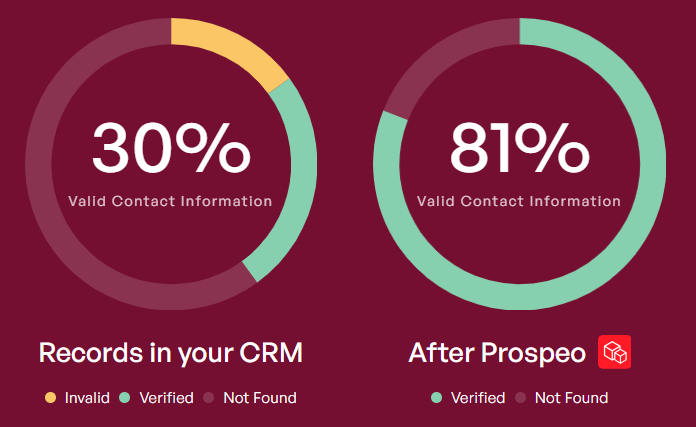
Data quality and CRM enrichment. When a champion changes jobs mid-deal and nobody notices, that's a data hygiene failure that tanks your review before it starts. We run our pipeline contacts through Prospeo's enrichment - it returns updated contact data for 83% of records with 98% email accuracy and refreshes every 7 days, so you're not reviewing deals against six-month-old information. Starts free; paid plans run about $0.01 per verified email. If you're comparing vendors, start with a shortlist of data enrichment services.
CPQ. DealHub handles configure-price-quote workflows that keep deal values accurate through the review process. When compression happens, it's often because pricing wasn't locked down early enough.
Skip the AI-powered "deal intelligence" tools unless you've already nailed the basics. We've seen teams buy fancy deal scoring software while their CRM had empty MEDDPICC fields and contacts from 2024. Fix the foundation first.
Deal Review Template
Copy this into your meeting doc and use it every session:
Pre-Meeting (AE completes before the review)
- CRM opportunity fields updated (MEDDPICC scorecard current)
- Pipeline contacts verified as current
- Written hypothesis: "The biggest risk on this deal is ___"
Part 1: Why Change (5 min) - Problem, quantified impact, cost of inaction.
Part 2: Why Now (5 min) - Compelling event, buyer priority ranking.
Part 3: Why Not (10 min) - Kill risks, Economic Buyer confirmation, Paper Process status, mutual calendarized next step.
Part 4: Feedback & Plan (10 min) - Consolidated feedback, action items with named owners and deadlines, MEDDPICC gaps to close.
Disqualification check: No mutual next step + no buyer activity in 14 days = park the deal. No exceptions.
If you want to operationalize the follow-through, pair the action items with a lightweight set of sales activities examples so reps know exactly what “good” looks like between reviews.
MEDDPICC scoring breaks down when your Economic Buyer field shows a person who left the company two months ago. Prospeo tracks job changes, verifies direct dials across 125M+ mobiles, and costs $0.01 per email - so every deal review starts with contacts that actually pick up.
Real deal inspection requires real data. Prospeo delivers both for a penny per lead.
FAQ
How often should you run deal reviews?
Weekly 1:1s between manager and rep (30-45 minutes) are the foundation - non-negotiable for teams with more than three reps. Layer in bi-weekly team sessions (60-90 minutes) for cross-team learning and monthly forecast reviews (90-120 minutes) for leadership accountability. The weekly cadence drives behavior change; skip it and you're back to status updates by month two.
What's the difference between a deal review and a pipeline review?
A deal review goes deep on 3-5 specific opportunities, inspecting qualification, risks, and next steps. A pipeline review goes wide, scanning the full portfolio for health, velocity, coverage ratios, and stage distribution. You need both on different cadences - weekly for deal-level inspection, bi-weekly or monthly for portfolio-level analysis.
How do you keep CRM data accurate for deal reviews?
Run CRM enrichment on a weekly cycle so contact records stay current. Set a rule: if a deal's primary contacts haven't been verified in the last 30 days, the AE refreshes them before the review. Stale data produces stale analysis, and a champion who quietly changed companies two months ago isn't going to push your deal through procurement.