

Stop Writing "Dear Sir or Madam" - Here's What to Say Instead
You're staring at a blank email, cursor blinking after the word "Dear," and you've been there for five minutes. "Dear sir or madam" feels safe but wrong. "Hey there" feels too casual. Here's the thing: the real problem isn't which greeting to pick. It's that you haven't spent those five minutes finding the actual person's name.
The Short Version
If you can find the person's name - and you usually can in under three minutes - use it. "Dear Sarah Chen" wins every time, in every context, no exceptions. If you genuinely can't find a name, "Dear Hiring Manager" works for jobs, "Hello" works for emails, and "To Whom It May Concern" works for formal complaints where no individual recipient exists.
"Dear sir or madam" is almost never the right call in 2026. It reads as lazy, outdated, and exclusionary.
What the Phrase Actually Means
The word "dear" traces back to Old English deoare in the 8th century, originally meaning precious or costly. By the 14th century it had migrated into personal letters as a term of affection, and by the 17th century it had calcified into the standard opening for polite communication - no longer an endearment, just furniture. Style authorities like Purdue OWL still recommend opening professional emails with a greeting plus the recipient's name or title, the same baseline advice that's held for decades.
Think of it like "sincerely" at the end of a letter. Nobody means they're being sincere in some deep emotional way. The problem isn't the word "dear." It's everything that comes after it.
Why You Should Stop Using It
It signals you didn't do your homework. When a hiring manager or prospect sees this generic salutation, the immediate read is: this person couldn't be bothered to spend two minutes finding my name. In a world where email previews are brutally short on mobile, you're wasting the only preview text that matters on a greeting that screams "mass mail."

It ignores how human brains work. People's attention spikes when they see their own name. A personalized greeting doesn't just feel polite - it makes the reader more engaged with whatever follows. A generic opener triggers the opposite: the mental filing cabinet labeled "junk."
It excludes people. "Sir or Madam" is binary. It assumes every recipient identifies as one or the other. As one Reddit user put it, the phrase is "terribly binary." In 2026, that's not just a style issue - it's a respect issue. Using someone's actual name sidesteps the problem entirely.
It triggers the "form letter" reflex. People who actively dislike receiving it aren't being precious. They're reacting to a signal that says "I sent this to 200 people and you're not special." Job seekers regularly ask whether "dear sir or madam" is too old-fashioned for cover letters. The answer is yes. Whether it's a cover letter or a cold email, personalization starts at the greeting.
When It's Still Acceptable
There are a handful of narrow cases where this greeting isn't terrible:
- Truly anonymous formal correspondence - government forms, legal notices, mass regulatory filings where no individual recipient exists
- Some international business contexts where English-language alternatives aren't established
- Formal letters to an institution where you genuinely can't identify a department or role
Segmented direct mail campaigns actually offer a better path: "Dear Homeowner," "Dear Fellow Engineer," or "Dear Book Lover" all outperform the generic version because they at least acknowledge something about the reader.
That's it. If you're writing to a human being whose name you could find, it's not acceptable. It's just easy.

You just read that "Dear Sir or Madam" kills response rates. The fix isn't a better generic greeting - it's finding the actual person's name. Prospeo's database of 300M+ professionals with 30+ filters lets you find the right contact in seconds, not minutes. Name, title, verified email - all at $0.01 per lead.
Never send another "Dear Sir or Madam" email again.
10 Better Alternatives (Ranked)
Here's what to use instead, from most to least personalized. A quick punctuation note: in US formal letters, a colon after the greeting is standard ("Dear Hiring Manager:"). In emails and UK letters, a comma is typical ("Dear Sarah Chen,"). Capitalize the key words in the salutation line.
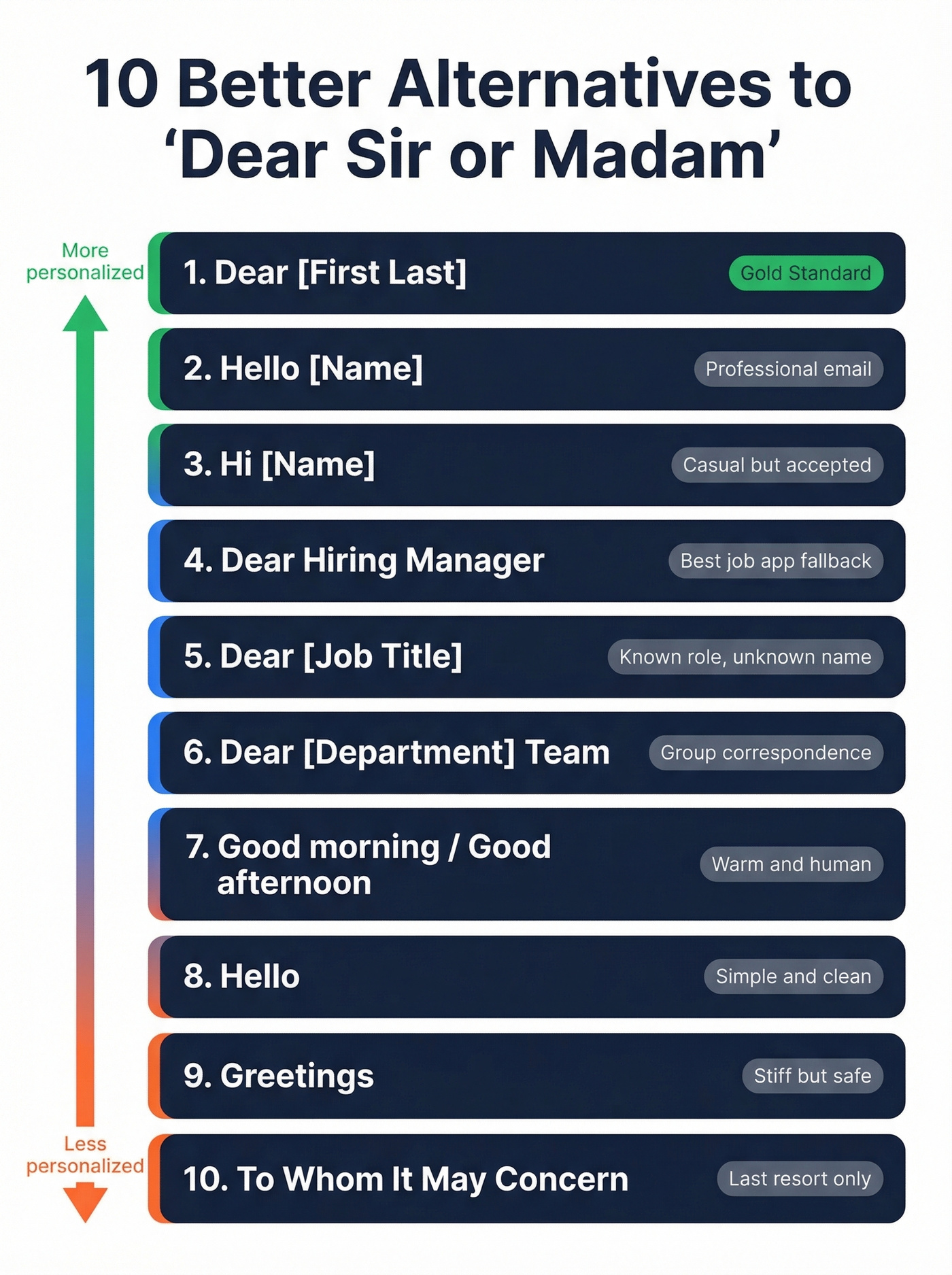
- Dear [First Last] - The gold standard. Always use this when you know the name.
- Hello [Name] - Slightly less formal, perfect for professional email.
- Hi [Name] - Casual but widely accepted. Not for printed letters.
- Dear Hiring Manager - The best fallback for job applications when you can't find a name. "Dear [Company] Recruiter" works too.
- Dear [Job Title] - "Dear Marketing Director" works when you know the role but not the person.
- Dear [Department] Team - "Dear Customer Support Team" for when you're writing to a group.
- Good morning / Good afternoon - Warm and human. Works well when you know the recipient's time zone.
- Hello - Simple, clean, no assumptions.
- Greetings - Stiff but gender-neutral and safe.
- To Whom It May Concern - Last resort. Better than "dear sir or madam" but still impersonal.
| Alternative | Formality | Best For |
|---|---|---|
| Dear [First Last] | High | Any context |
| Hello [Name] | Medium | Professional email |
| Hi [Name] | Low-medium | Casual email |
| Dear Hiring Manager | High | Job applications |
| Dear [Job Title] | High | Unknown name, known role |
| Dear [Dept] Team | Medium | Group correspondence |
| Good morning | Medium | Warm email openers |
| Hello | Medium | General email |
| Greetings | Medium-high | Formal, gender-neutral |
| To Whom It May Concern | High | Formal complaints |
Skip "Greetings" if you're writing anything remotely warm or relationship-driven. It reads like a robot wrote it. We've tested dozens of cold email openers across outreach campaigns, and "Hi [Name]" consistently outperforms anything impersonal - open rates, reply rates, the works.
"To Whom It May Concern" vs "Dear Sir or Madam"
Neither greeting is great, but they signal different things. "Dear sir or madam" implies you know you're writing to a specific person - you just don't know who. "To Whom It May Concern" implies you don't even know the department or role. It's the equivalent of throwing a letter into the void.
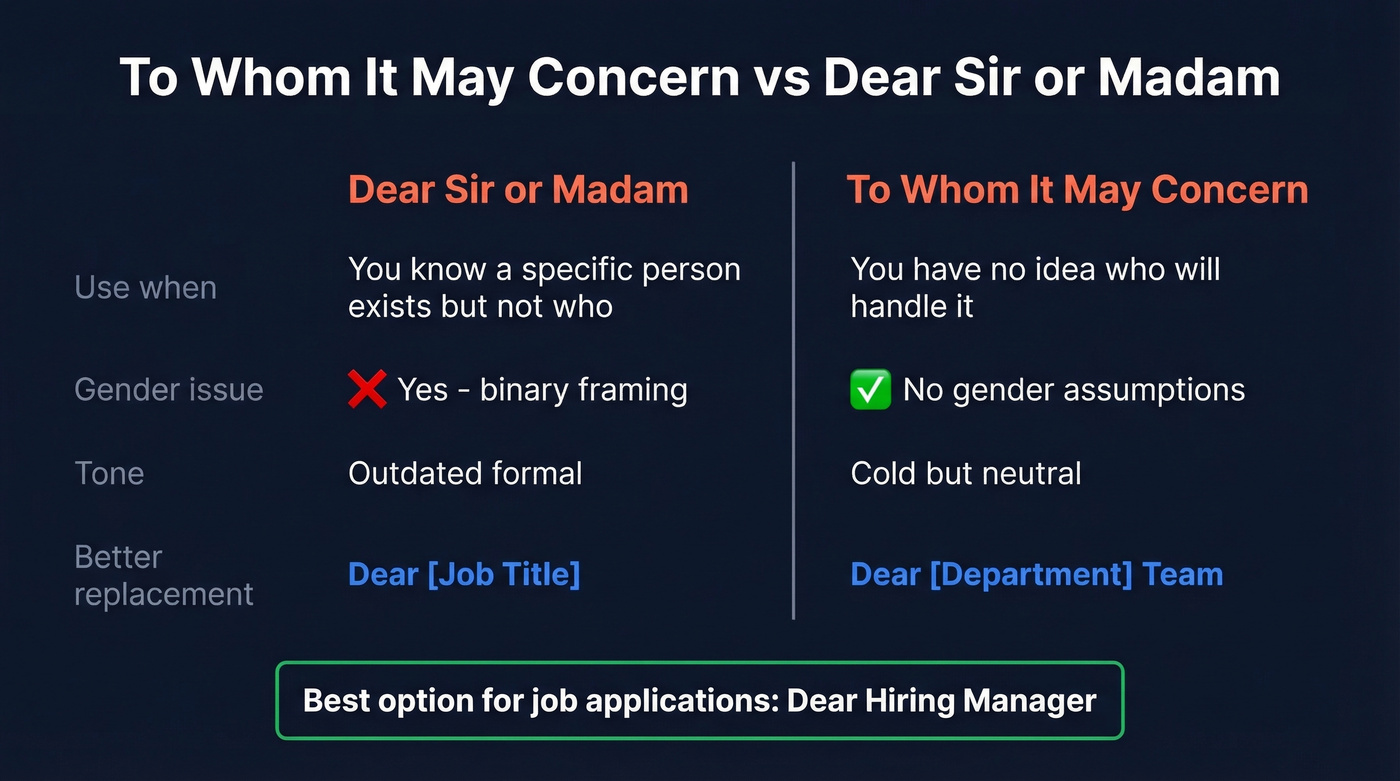
| Dear Sir or Madam | To Whom It May Concern | |
|---|---|---|
| Use when | You know a specific person exists | You don't know who'll handle it |
| Gender issue | Yes - binary framing | No |
| Tone | Outdated formal | Cold but neutral |
| Better option | Dear [Job Title] | Dear [Dept] Team |
For job applications, "Dear Hiring Manager" beats both. It's specific enough to show intent, generic enough to cover your bases.
How to Actually Find the Right Name
Every article about salutations says "just find the person's name." None of them show you how. Here's the actual playbook we use across hundreds of outreach campaigns.
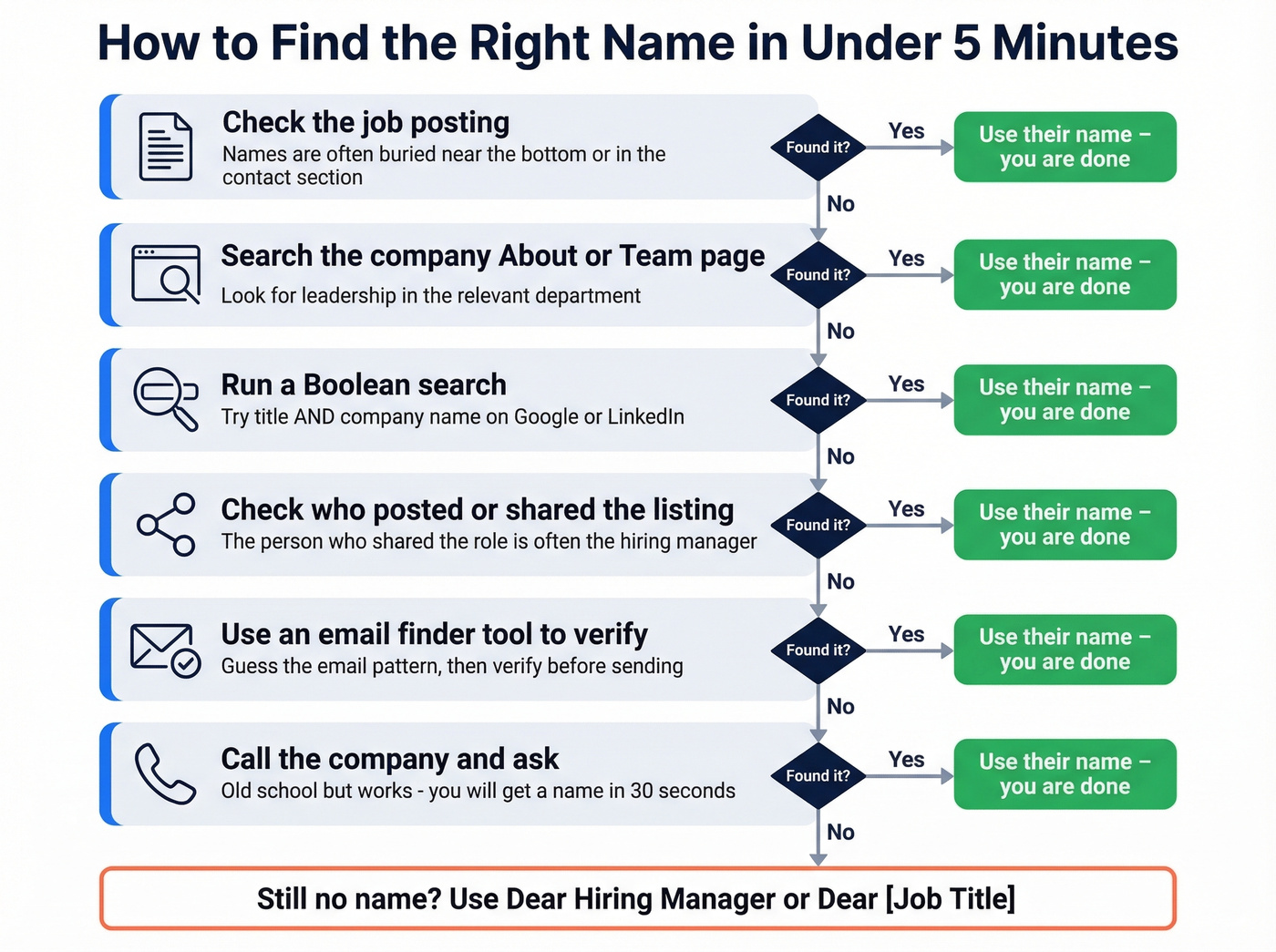
Check the job posting itself. Many listings include the hiring manager's name or the recruiter's. Read the whole thing - it's often buried near the bottom or in a "questions about this role" section.
Search the company's About or People page. Most companies list their leadership team. Applying to marketing? Look for the VP or Director of Marketing.
Run a Boolean search by company + title. Try something like "Engineering Manager" AND "Acme Corp" on Google or any professional network. Filter by current company and location to narrow results fast.
Check who posted or shared the job listing. The person who shared the role on social platforms is often the hiring manager or someone on the team. That's your lead.
Infer the email pattern and verify before sending. Most companies use predictable formats - firstname.lastname@company.com, flastname@company.com, and so on. Tools like Hunter.io can surface the domain pattern. But don't just guess and send - verify first. Prospeo's email finder verifies addresses with 98% accuracy, and the free tier gives you 75 emails per month, more than enough for a job search or targeted outreach campaign.

Call the company and ask. Old school, but it works. "Hi, I'm sending a letter to your marketing team - could you tell me who heads up that department?" You'll get a name in 30 seconds.
Let's be honest: if your letter is important enough to write, it's important enough to spend five minutes finding the recipient's name. The greeting isn't a formality - it's your first impression. Sending a generic salutation to someone whose name is on the company website is like showing up to a job interview and calling the interviewer "hey, you."
The best salutation is always the person's real name. Prospeo's Chrome extension - used by 40,000+ professionals - pulls verified names, titles, and emails from any company page or professional profile in one click. 98% email accuracy means your perfectly addressed email actually lands.
Find the name, nail the greeting, land in the inbox.
UK vs US Conventions
The greeting itself is largely the same on both sides of the Atlantic. The differences show up in punctuation and closings.
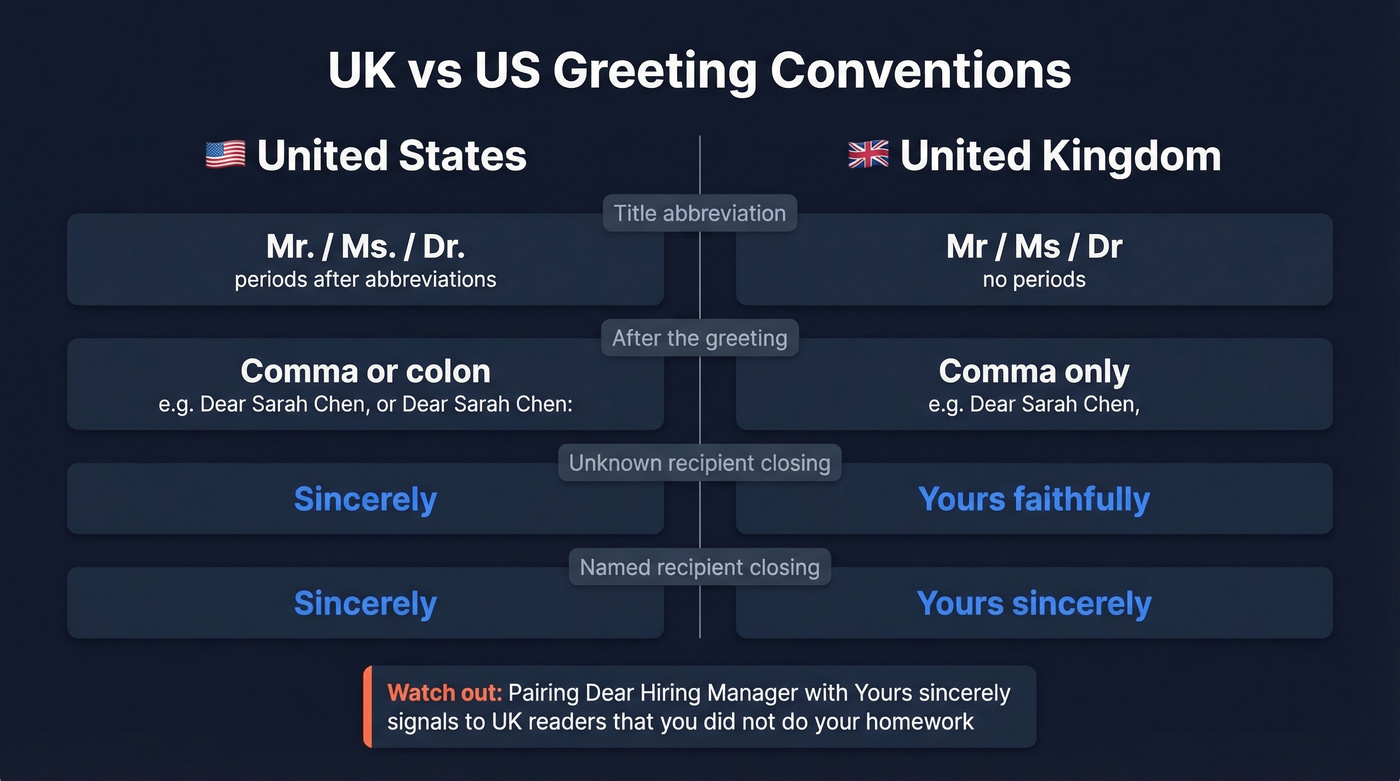
| Convention | US | UK |
|---|---|---|
| Title abbreviation | Mr. / Ms. / Dr. | Mr / Ms / Dr |
| After greeting | Comma or colon | Comma only |
| Unknown recipient close | "Sincerely" | "Yours faithfully" |
| Named recipient close | "Sincerely" | "Yours sincerely" |
In the UK, there's a long-taught rule that "Dear Sir or Madam" pairs with "Yours faithfully," while "Dear Ms. Chen" pairs with "Yours sincerely." Most Americans don't follow this distinction - "Sincerely" covers everything. I've seen otherwise strong cover letters undermined by pairing "Dear Hiring Manager" with "Yours sincerely" when writing to a British company. Small error, but it tells a UK reader you didn't do your homework. The Guardian's style guide is a good reference for British conventions if you're unsure.
Ready-to-Use Templates
Cover letter - name unknown:
Dear Hiring Manager,
I'm writing to apply for the [Job Title] role at [Company]. My background in [relevant skill] aligns closely with what you've described, and I'd welcome the chance to discuss how I can contribute.
Cover letter - name known:
Dear Sarah Chen,
I'm applying for the [Job Title] position at [Company]. Your team's work on [specific project] caught my attention, and my experience in [relevant area] makes this a strong fit.
Cold outreach email:
Hi Jordan,
I noticed [Company] just expanded its sales team - congrats. We help teams like yours [specific value prop] without [common pain point]. Worth a 15-minute call this week?
Formal complaint:
Dear Customer Service Team,
I'm writing regarding [issue] with my account ([account number]). I've attempted to resolve this through [previous channel] without success. I'd appreciate a written response within 10 business days.
FAQ
Is "Dear" too formal for email?
No. "Dear" has been a standard convention for centuries - it's not an endearment. It's appropriate in any professional context, from cover letters to client correspondence. Pair it with the recipient's name for the strongest impression.
Can I just write "Hi" in a formal letter?
For emails, absolutely - "Hi [Name]" is widely accepted in professional correspondence in 2026. For printed formal letters or legal documents, stick with "Dear [Name]" or "Dear [Title]" to match reader expectations.
What about "Dear Mx."?
"Mx." is a gender-neutral honorific gaining traction in both the US and UK. Use it when someone's pronouns are unknown and the context requires an honorific. When in doubt, skip the honorific entirely and use their full name - "Dear Alex Rivera" is always safe.
Is "To Whom It May Concern" better than "Dear Sir or Madam"?
Marginally. It avoids the gender binary problem but still broadcasts that you didn't research the recipient. "Dear Hiring Manager" or "Dear [Department] Team" are stronger choices for nearly every situation.
What's the fastest way to find a hiring manager's email?
Search professional profiles by company name plus the job title, then verify the address before sending. In our experience, this takes under five minutes and dramatically improves response rates compared to any generic greeting.