

Decision Making Unit (DMU): The 2026 Guide
Your champion loved the demo. The pilot went flawlessly. Then the deal went dark for three weeks - and when it resurfaced, someone from procurement you'd never spoken to had killed it. This isn't bad luck. 74% of B2B buyer teams demonstrate unhealthy conflict during the decision process. If you haven't mapped every stakeholder in the decision making unit, you're flying blind into that conflict.
The Short Version
Forrester puts the average buying group at 13 people, and 89% of purchases involve two or more departments. Map every one or watch the deal stall. Use the spend-times-strategic-importance matrix below to predict DMU complexity before you start discovery. And once you've mapped roles, enrich your stakeholder list with verified contact data so you can actually reach them. A beautiful org chart with no emails or direct dials is just a wall decoration.
What Is a B2B Decision Making Unit?
A decision making unit is the full group of people involved in a B2B purchase decision. Not just the person who signs the contract - everyone who influences, evaluates, blocks, or uses what you're selling.
The concept traces back to the late 1960s and early 1970s. Robinson, Farris, and Wind introduced the Buygrid model in 1967, and Webster & Wind formalized the "buying center" framework in 1972. The terms "buying center," "buying committee," and "DMU" all describe the same thing - DMU is the more common practitioner term, while buying center shows up more in academic literature.
Most sellers treat the DMU like a static org chart. It's not. It's a shifting mix of competing priorities, personal incentives, and political relationships that reconfigures as the deal progresses. The most common mapping failure we've seen: the champion says "I'm the decision maker," the rep takes it at face value, and procurement kills the deal three weeks later.
The 6 DMU Roles (Plus One)
The classic model defines six roles in any buying decision. In practice, you need a seventh.
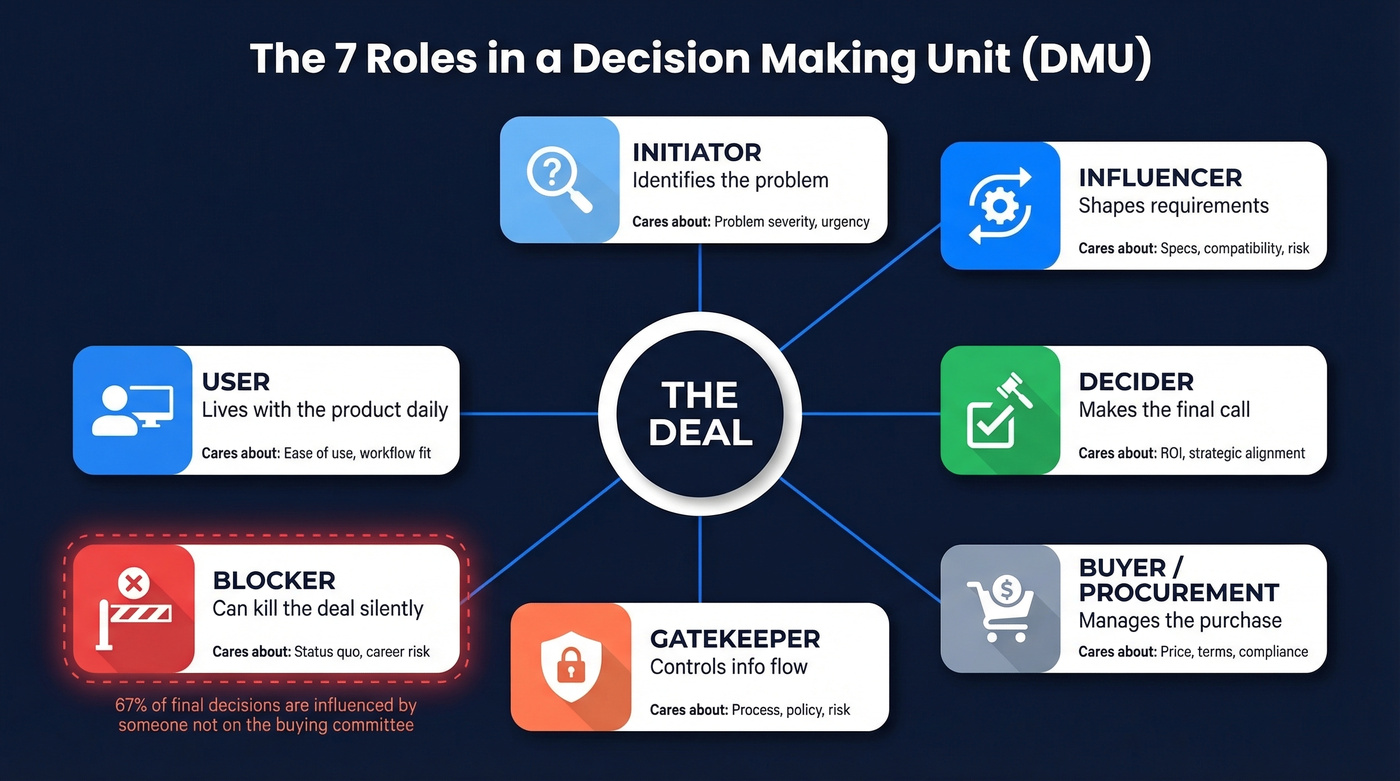
| Role | What They Do | How to Spot Them | What They Care About |
|---|---|---|---|
| Initiator | Identifies the problem | First person to raise the need internally | Problem severity, urgency |
| Influencer | Shapes requirements | Referenced by others; often technical | Specs, compatibility, risk |
| Decider | Makes the final call | Has budget authority | ROI, strategic alignment |
| Buyer (Procurement) | Manages the purchase | Appears late; owns contracts | Price, terms, compliance |
| Gatekeeper | Controls info flow | Assistants, IT security, legal | Process, policy, risk |
| User | Lives with the product | The team that'll use it daily | Ease of use, workflow fit |
| Blocker | Can kill the deal silently | Often invisible until late stage | Status quo, career risk |
That seventh role isn't in the textbook, but it's the one that kills deals. 67% of final purchase decisions are made or influenced by someone not on the buying committee. That "outside the committee" influence is where late-stage blockers and surprise influencers come from. In our experience, the blocker is often someone in IT security or legal - people with veto power and zero incentive to say yes.
A critical nuance from MIT's Disciplined Entrepreneurship framework: procurement is almost never the real decision maker. They're a veto gate. They can stop a deal, but they rarely champion one. Don't confuse their authority to say no with the authority to say yes.
Some frameworks use different labels - economic buyer, technical evaluator, champion - but the underlying roles map to the same categories. One person can fill multiple roles, too. Your champion might be both the initiator and an influencer. Build separate persona profiles per role even when one person wears two hats, because their priorities shift depending on which hat they're wearing.
How Big Is a DMU? It Depends on the Deal
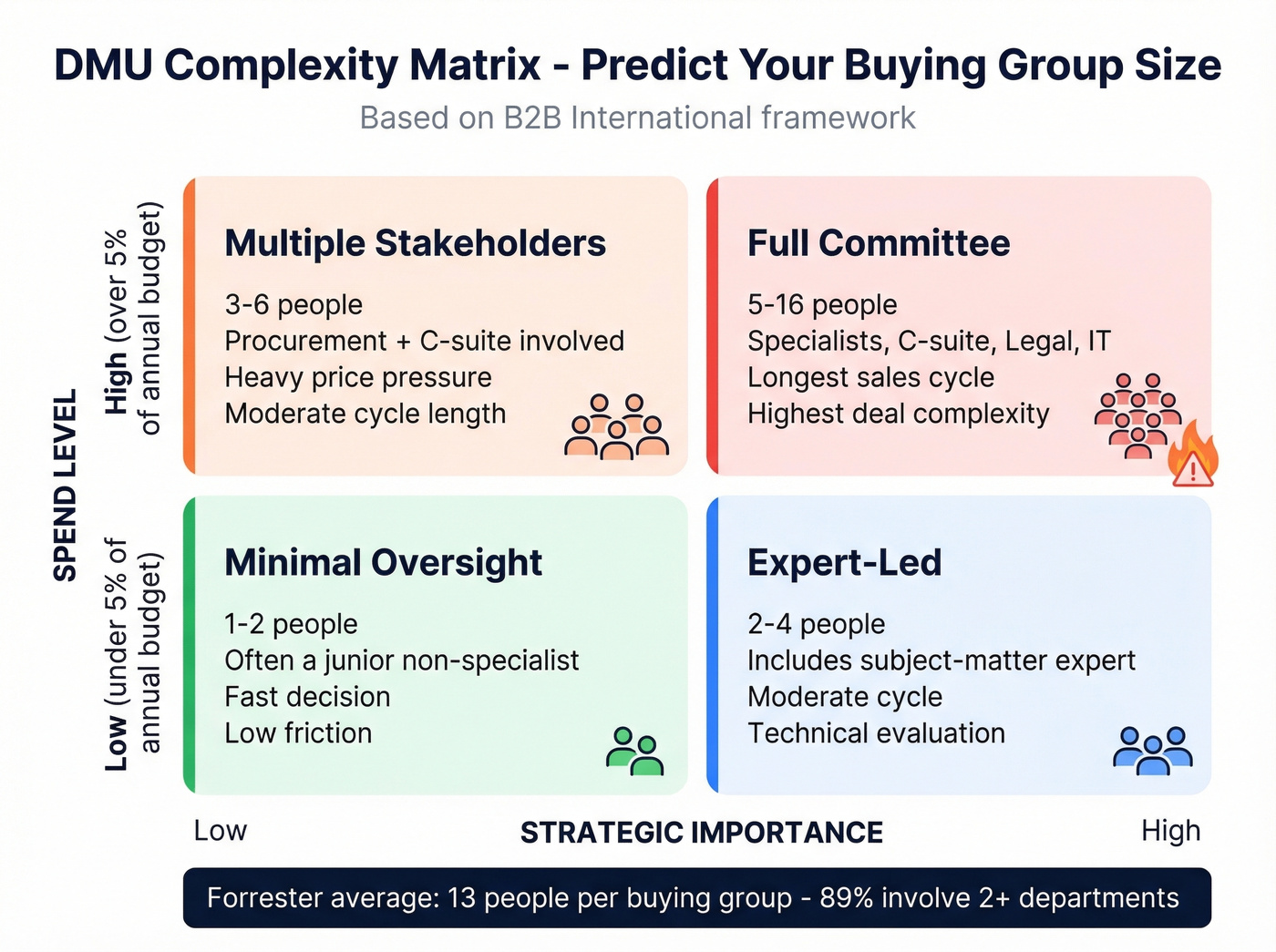
B2B International's framework maps buying group complexity across two dimensions: spend level and strategic importance.
| Low Strategic Importance | High Strategic Importance | |
|---|---|---|
| Low Spend (<5% of annual budget) | 1-2 people, often a junior non-specialist | 2-4 people, includes a subject-matter expert |
| High Spend (>5% of annual budget) | Multiple people incl. procurement + C-suite; heavy price pressure | 5+ people incl. specialists, C-suite, legal, IT; longest cycle |
This matrix is more useful than a single average because it tells you what to expect before discovery begins. A $5K/year tool purchase at a mid-market company won't involve the CFO. A $200K platform deal at an enterprise will involve people you haven't imagined yet.
Composition also shifts based on buying situation. A straight rebuy - renewing an existing vendor - involves very few people. A modified rebuy, switching from a competitor, pulls in more stakeholders. A completely new purchase category, where no budget line even exists yet, triggers the full committee. Each scenario changes your timeline and stakeholder count in ways you need to plan for.
The numbers back this up. Gartner reports buying groups range from 5 to 16 people across as many as 4 functions. Forrester puts the average at 13, with 89% of purchases involving two or more departments. For practical planning, many SaaS teams see mid-market deals involve 4-6 stakeholders, while enterprise deals run 8-12 participants, adding vendor management, compliance, and data governance roles.

86% of deals stall because you can't reach every stakeholder. Prospeo gives you verified emails (98% accuracy) and direct dials for all 13 people in the buying group - not just your champion. Use 30+ filters to find every decision maker, influencer, and blocker by job title, department, and seniority.
Stop losing deals to stakeholders you never contacted.
Why 86% of B2B Deals Stall
86% of B2B purchases stall during the buying process. Not 86% fail - 86% stall. They slow down, go dark, get deprioritized, or loop back to the beginning.
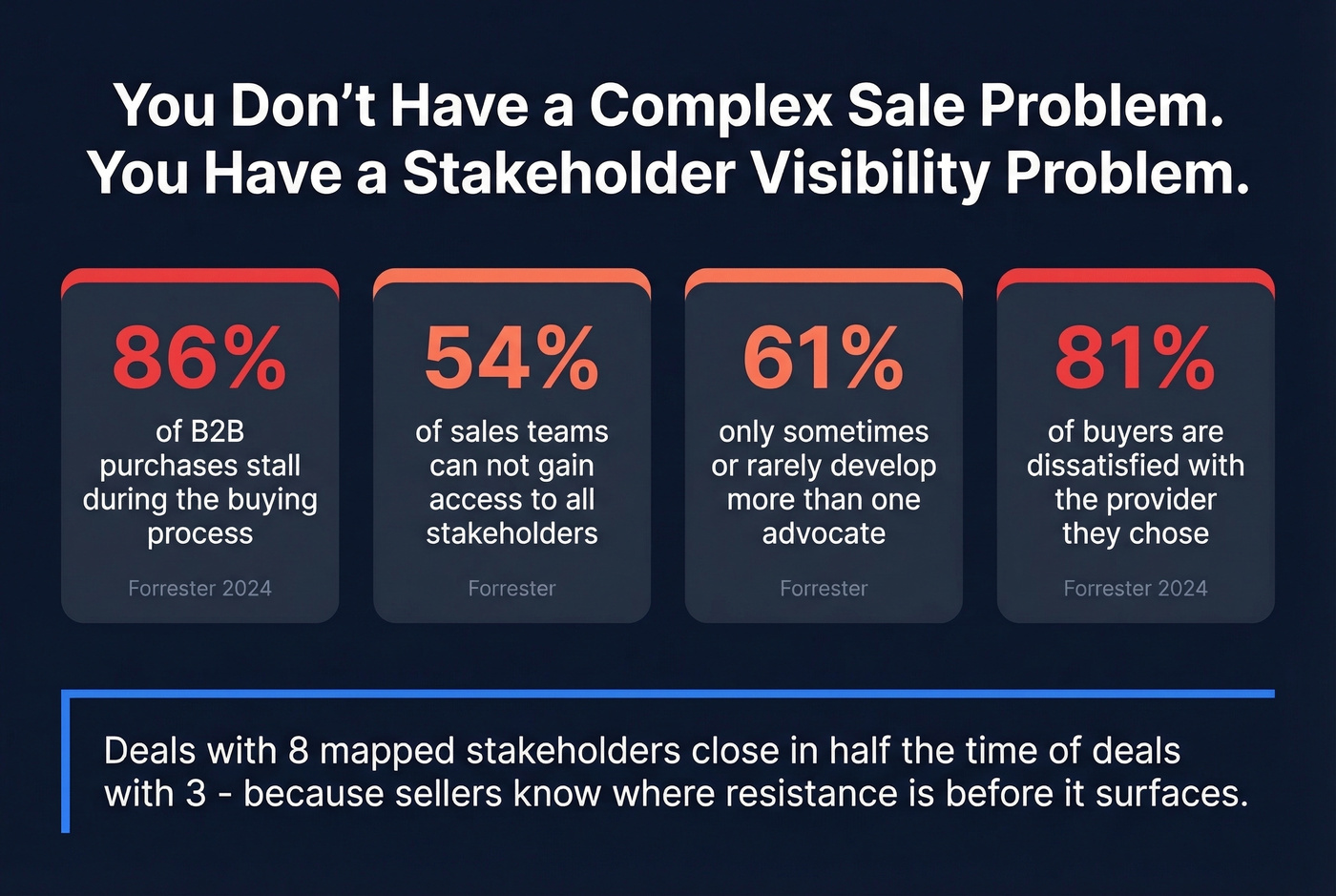
The root cause isn't product-market fit or pricing. It's stakeholder visibility. 54% of sales teams can't gain access to all stakeholders. 61% only sometimes or rarely develop more than one advocate inside the account. And even when deals do close, 81% of buyers are dissatisfied with the provider they chose - often because the wrong stakeholders drove the decision.
Here's the thing: you don't have a complex-sale problem. You have a stakeholder visibility problem. The deal isn't complicated because there are 13 people involved - it's complicated because you only know about 4 of them. We've seen deals with 8 mapped stakeholders close in half the time of deals with 3, simply because the seller knew where the resistance was before it surfaced.
How to Map Your DMU
Four concrete steps, from first conversation to complete stakeholder map.
Step 1: Start With Your Champion
Your champion is your entry point, not your entire map. The most important discovery questions are "Who else needs to be involved in this decision?" followed by "Who could slow this down or stop it?" and "What's the internal process for approving a vendor like us?"
Don't accept "I'm the decision maker" at face value. Even when it's technically true, there are influencers and blockers your champion won't think to mention.
Step 2: Build the Stakeholder Map
For every person you identify, capture these fields:
| Field | Example |
|---|---|
| Name | Sarah Chen |
| Title | VP Engineering |
| DMU Role | Decider |
| Influence Level | High |
| Sentiment | Supportive |
| Veto Power | Yes |
| Key Concerns | Integration with existing stack |
Most CRMs can accommodate custom fields for influence level, sentiment, and veto power. Add them if you haven't already.
Step 3: Find Hidden Stakeholders
Review the company's leadership page and org charts. Look at who's been promoted recently or hired into new roles - those people will insert themselves into buying decisions to make an early impact.
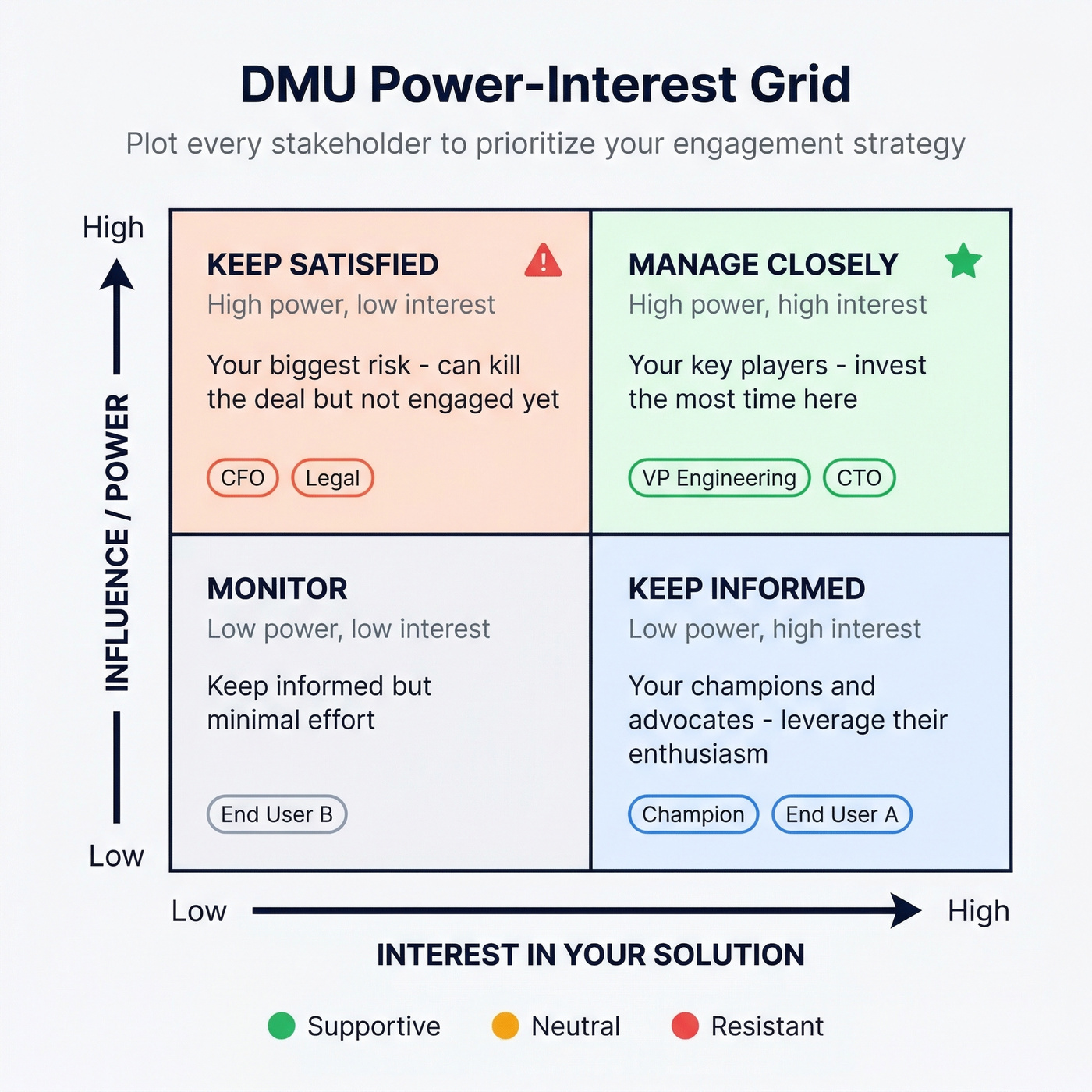
This is where most teams hit a wall: you've identified 8 stakeholders but have contact data for 3. Use a data enrichment platform like Prospeo to pull verified emails and mobile numbers for every person on the map - 98% email accuracy and an 83% enrichment match rate, integrated with Salesforce and HubSpot, no manual research required. A stakeholder map without contact data is just an exercise in frustration.
Step 4: Plot a Power-Interest Grid
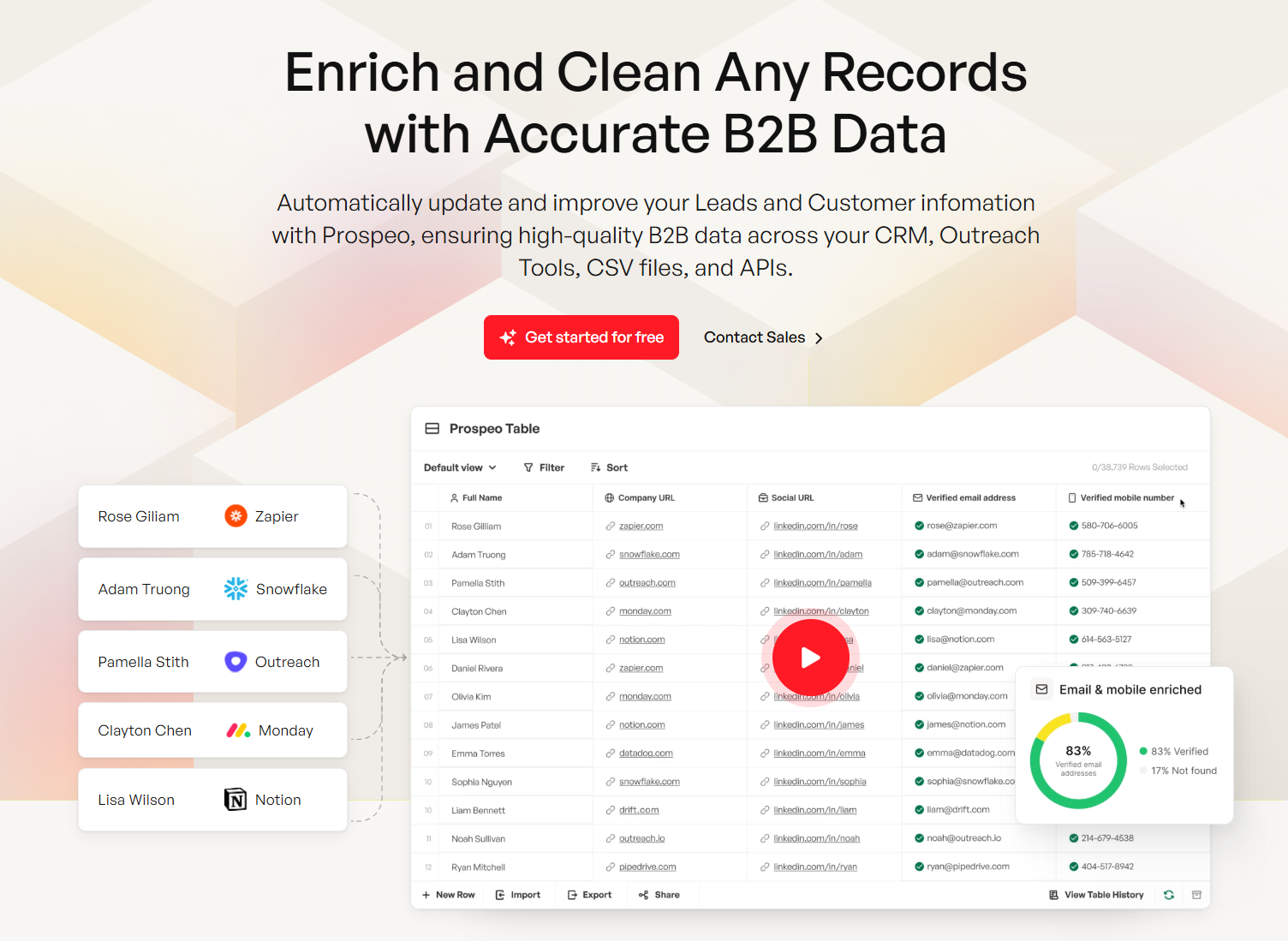
A flat list isn't enough. Plot stakeholders on a Power-Interest Grid with influence on one axis and interest on the other. Use color to represent sentiment - green for supportive, yellow for neutral, red for resistant. High-power, low-interest stakeholders are your biggest risk: they can kill the deal but aren't engaged enough to care about your value prop yet.
Engaging Every Stakeholder
Multi-Thread the Right Way
Multi-threading is the single most important skill in enterprise sales, and the easiest way to alienate your champion if done wrong. The key is trigger-based outreach, not cold ambushes.
When a new stakeholder enters the thread - say, a security review gets triggered - that's your opening. "I understand your team is evaluating our security posture. Here's our SOC 2 report and a summary of how we handle data residency." That's helpful, not threatening. Use discovery prompts like "Who else owns fixing that?" to surface new stakeholders organically during calls rather than going around your champion's back.
Build Consensus, Not Just Buy-In
Buying groups that reach consensus are 2.5x more likely to report a high-quality deal. But here's the counterintuitive part: individual-level personalization has a 59% negative impact on consensus. Tailoring your message to each stakeholder's personal priorities makes the group less aligned, not more. Buying-group-level relevance - messaging that helps the group align around a shared outcome - improves consensus by 20%.
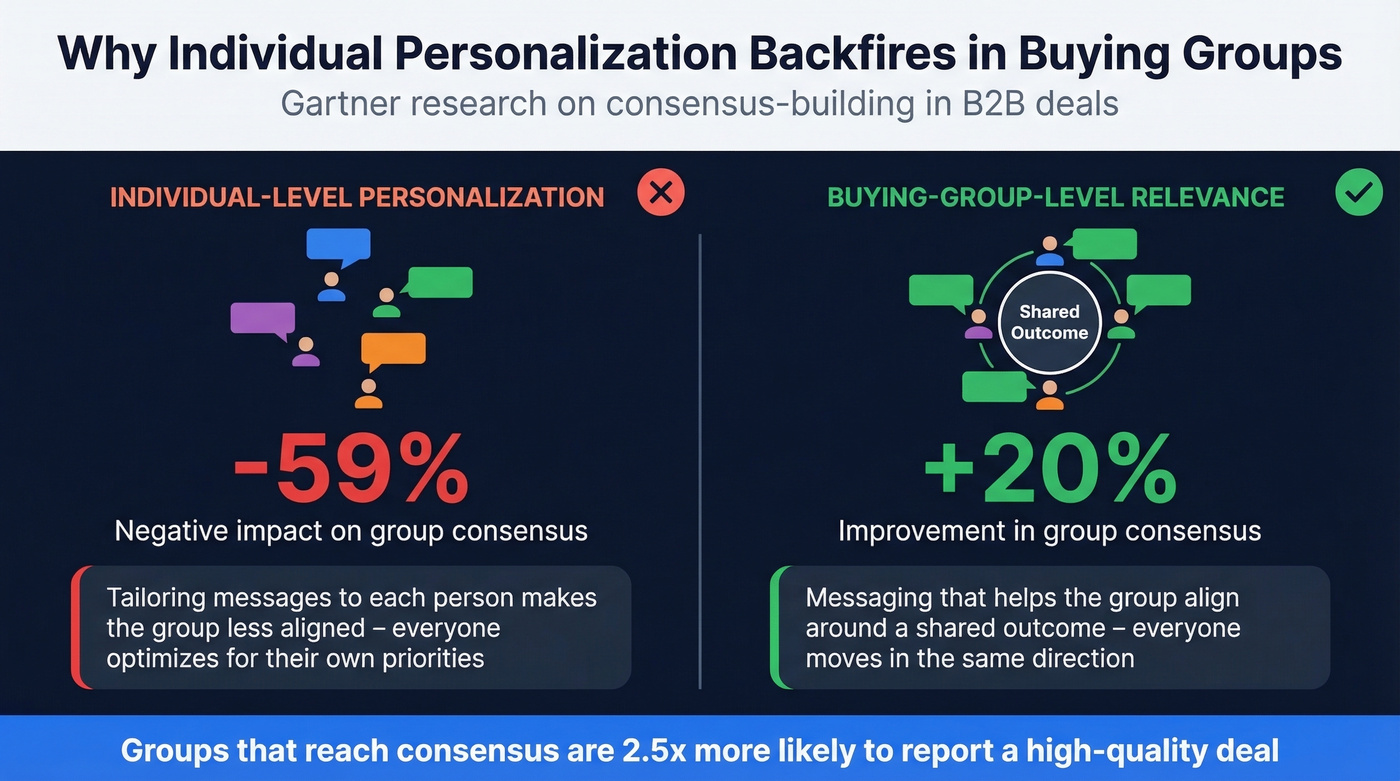
This means your content strategy should prioritize materials that help the group decide together. Business cases, ROI calculators, and implementation timelines beat personalized one-pagers every time.
Introduce a Mutual Action Plan early. Track every stakeholder, their timeline, and their blockers in a shared document. MAPs make the invisible visible and give your champion a tool to drive internal alignment without you having to push.
The Emotional Layer
B2B International's needs matrix maps motivations across rational vs. emotional and individual vs. company. All four quadrants matter. The CFO cares about ROI and career risk. The end user cares about workflow efficiency and feeling heard in the process. The CISO cares about compliance and not being the person who approved a breach.
Let's be honest: if you're only selling on rational/company benefits, you're addressing one quadrant out of four. The deals that close fastest are the ones where every stakeholder feels both logically and emotionally safe saying yes. I've watched reps lose six-figure deals because they nailed the business case but never addressed the VP's fear of championing a vendor that fails publicly. Understanding buyer motivation at this emotional level is what separates reps who close from reps who forecast.
What's Changing in 2026
DMUs are getting bigger, more informed, and harder to reach. Almost 95% of buyers anticipate using genAI to support their purchase decisions. Stakeholders are arriving to your calls pre-armed with AI-generated competitive analyses and feature comparisons. The buying process is shifting from seller-guided to buyer-led, and your stakeholder strategy needs to adapt.
Meanwhile, 90% of buyers say social proof heavily influences their shortlist decisions, and 83% alter their initial vendor lineup during the journey. Vendor engagements have dropped from 3.2 to 2.5 on average - buyers are talking to fewer vendors but doing more research independently.
In some industries, MIT's Disciplined Entrepreneurship framework notes the emergence of algorithmic "robo-decision makers" - automated procurement systems that evaluate vendors on predefined criteria before a human ever gets involved. For teams selling into financial services or regulated industries, this is already a reality.
If you're not one of the 2.5 vendors who gets a real conversation, you're one of the vendors who gets dropped. Map the full decision making unit or accept that outcome.
A mapped DMU without contact data is just a wall decoration. Prospeo's CRM enrichment returns 50+ data points per contact at a 92% match rate - so once you identify the procurement lead, the IT gatekeeper, and the silent blocker, you can actually reach them. At $0.01 per email, enriching a 13-person buying group costs less than a coffee.
Turn your stakeholder map into a contact list in seconds.
FAQ
What does DMU stand for?
DMU stands for Decision-Making Unit - the complete group of people involved in a B2B purchase decision, from end users to the executive who signs the check. It's also called a buying center or buying committee, with no functional difference between the terms.
How many people are in a typical DMU?
Gartner reports 5-16 people across up to 4 functions; Forrester puts the average at 13. Mid-market deals typically involve 4-6 stakeholders, while enterprise deals run 8-12 depending on deal size and strategic importance.
What are the main roles in a DMU?
The classic six are initiator, influencer, decider, buyer/procurement, gatekeeper, and user. Add "blocker" - the stakeholder who can kill the deal without being the official decision maker. One person can fill multiple roles simultaneously.
How do you find contact info for stakeholders you can't reach?
Use a B2B data enrichment tool like Prospeo, which returns verified emails and direct dials at 98% accuracy with an 83% match rate. Upload names and companies, get 50+ data points back per contact - enough to enrich a full stakeholder map in minutes.
How do you build consensus across a large buying group?
Focus on group-level messaging that aligns stakeholders around a shared outcome rather than hyper-personalized pitches. Gartner found individual-level personalization has a 59% negative impact on consensus. Use Mutual Action Plans and shared business cases to keep every participant aligned.