


Definitive Healthcare vs DiscoverOrg: What You Need to Know in 2026
An SDR pulls a ZoomInfo list targeting mid-market dental groups. Every contact maps to the health system name - not the specific clinic. There's no location count, no way to tell if it's a 3-office practice or a 30-office chain. Hours of manual sifting follow. That's the gap the Definitive Healthcare vs DiscoverOrg comparison is really about, and the answer in 2026 isn't what most people expect.
DiscoverOrg Is Gone
DiscoverOrg acquired ZoomInfo in February 2019 and rebranded the combined entity by September of that year. TrustRadius labels DiscoverOrg "discontinued." All of DiscoverOrg's capabilities - org charts, verified direct dials, buying scoops - now live inside ZoomInfo.
A TrustRadius Community Pulse review captured the split well: "For HR department information, DiscoverOrg definitely had the best content... but if you are looking for more healthcare based then Definitive might be the way to go." That distinction still holds. If you're searching for Definitive Healthcare vs DiscoverOrg in 2026, you're really comparing Definitive Healthcare vs ZoomInfo.
The 30-Second Verdict
Use Definitive Healthcare if you need healthcare org intelligence - facility-level data, provider affiliations, claims analytics, and specialty breakdowns. Nothing else goes this deep on the business side of healthcare.
Use ZoomInfo if you need broad B2B contact data with strong CRM integrations across all industries.
Skip both if your real problem is reaching the people you've already identified. Both platforms have contact accuracy issues, and teams can spend $40K+ across tools and still deal with bounces from stale data.
Feature Comparison at a Glance
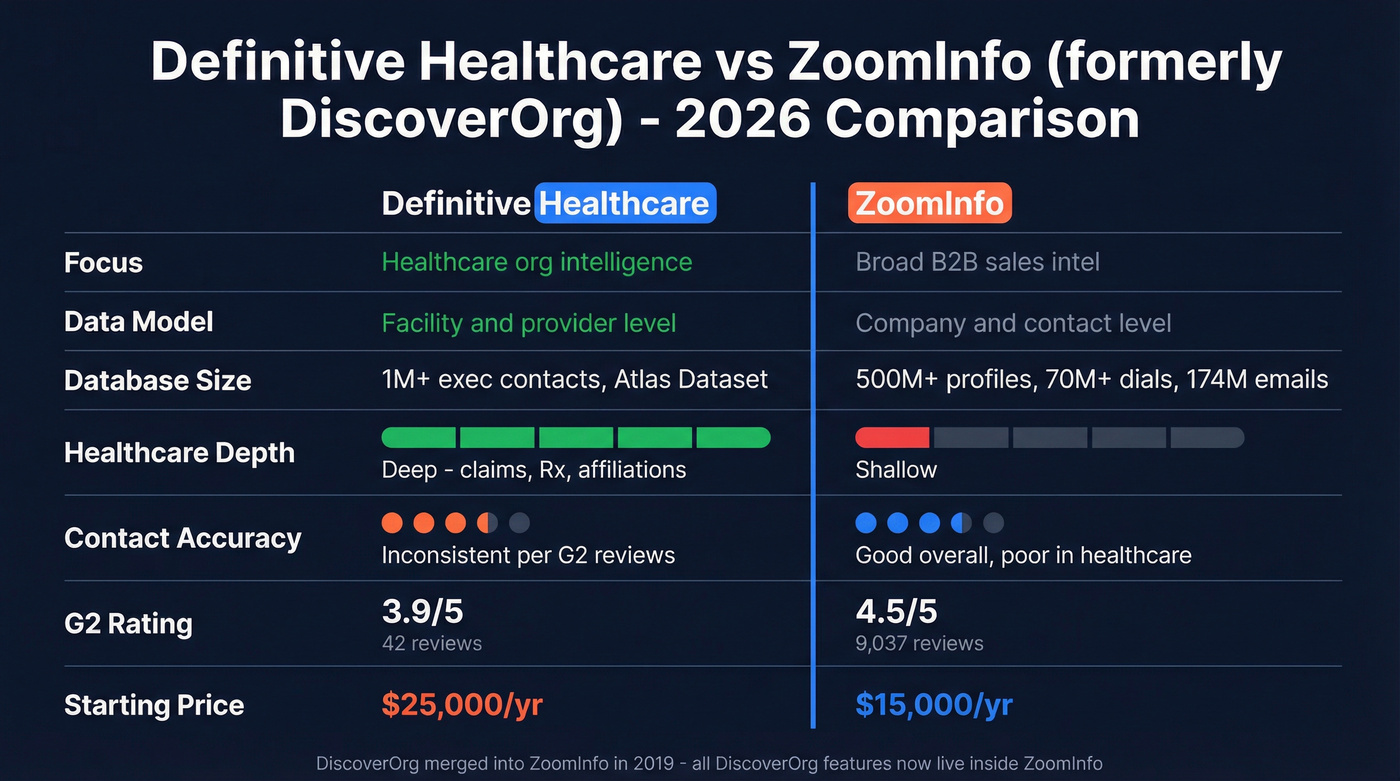
| Dimension | Definitive Healthcare | ZoomInfo |
|---|---|---|
| Focus | Healthcare org intel | Broad B2B sales intel |
| Data model | Facility / provider level | Company / contact level |
| Database | 1M+ exec contacts; Atlas Dataset | 500M+ profiles, 70M+ dials, 174M emails |
| Healthcare depth | Deep (claims, Rx, affiliations) | Shallow |
| Contact accuracy | Inconsistent per G2 reviews | Good overall; poor in healthcare |
| G2 rating | 3.9/5 (42 reviews) | 4.5/5 (9,037 reviews) |
| Starting price | ~$25,000/yr | ~$15,000/yr (Professional tier) |
| Contracts | Quote-based | Annual contracts |

Healthcare teams stack Definitive and ZoomInfo for $40K+/year - then still deal with bounced emails. Prospeo fills the contact accuracy gap with 143M+ verified emails refreshed every 7 days at 98% accuracy, plus 125M+ verified mobiles with a 30% pickup rate. Keep your targeting tool. Fix your outreach data for $0.01/email.
Stop paying enterprise prices for contacts that bounce.
Data Models: The Core Difference
Definitive Healthcare models data at the facility and provider level. You can see individual clinic locations, their specialties, affiliated physicians, claims volume, and technology installs. ZoomInfo models data at the company and contact level - the same way it handles every other industry.
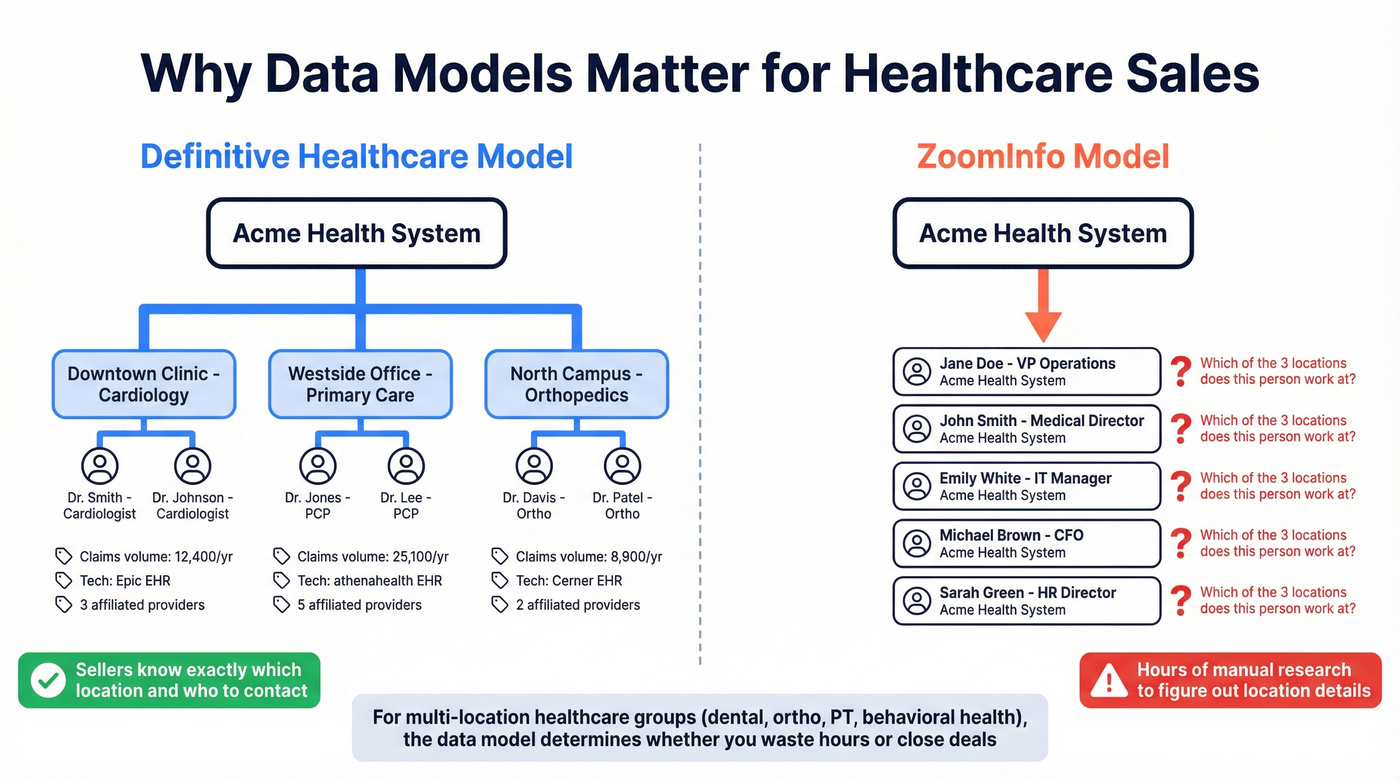
The practical impact is brutal for healthcare sellers. One TrustRadius user put it plainly: ZoomInfo "only gives you a local address but refers to each location as the health system name," making it "hard to define where particular people are from." On Reddit, an SDR targeting midmarket healthcare groups said ZoomInfo and DiscoverOrg are "useless because they don't have location counts" - causing hours of manual research just to figure out how many sites a practice operates.
If you're selling into multi-location groups like dental, ortho, PT, or behavioral health, this is the difference between a productive day and a wasted one. ABM practitioners often stack both tools together, and agencies like SmartBug have noted that enrichment accuracy varies across platforms, so internal validation of contact data matters regardless of which tool you pick.
Where Each Falls Short
Definitive Healthcare
The org intelligence is excellent. The contact data? Not so much.
G2 reviewers consistently flag accuracy problems - one wrote that "the phone numbers that are listed are often wrong or not direct." A Reddit user at a healthcare IT startup called the data "a little spotty" when trying to reach CIOs and IT directors. You're paying for targeting intelligence, not contact accuracy, and that's an important distinction when budgeting.
ZoomInfo
ZoomInfo's 4.5/5 G2 rating across 9,000+ reviews is earned for general B2B prospecting. But healthcare is a blind spot. It treats a 50-location orthopedic group the same way it treats a SaaS company with one office. The consensus on r/sales threads about ZoomInfo for healthcare is exactly that - great tool, wrong use case.
Pricing Breakdown
Here's the thing: neither platform is cheap.
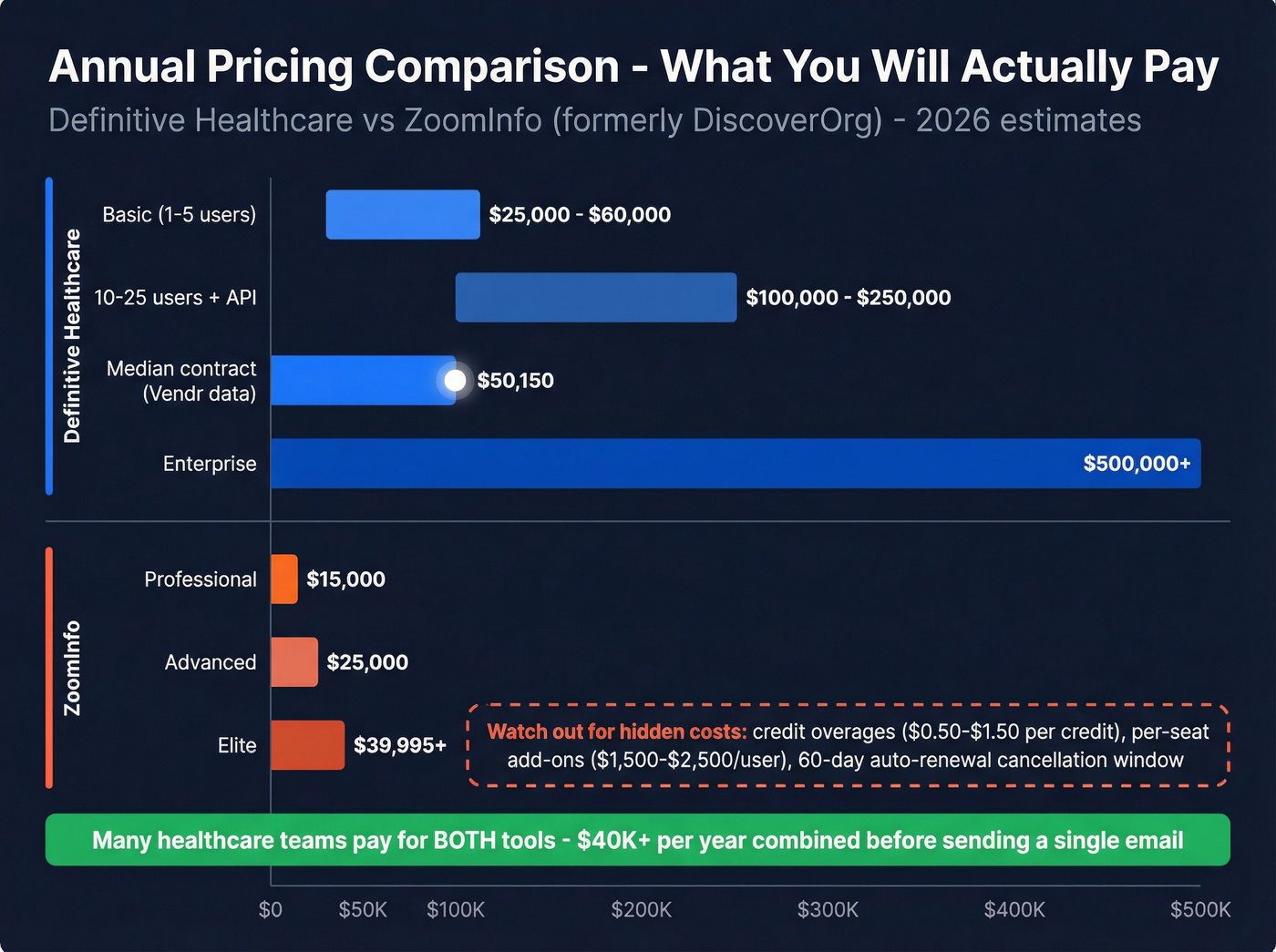
| Platform | Configuration | Annual Cost |
|---|---|---|
| Definitive Healthcare | 1-5 users, basic | $25,000-$60,000 |
| Definitive Healthcare | 10-25 users + API | $100,000-$250,000 |
| Definitive Healthcare | Median contract (Vendr) | $50,150 |
| Definitive Healthcare | Enterprise | $500,000+ |
| ZoomInfo | Professional | ~$15,000 |
| ZoomInfo | Advanced | ~$25,000 |
| ZoomInfo | Elite | $39,995+ |
| ZoomInfo | Per-seat add-on | $1,500-$2,500/user |
ZoomInfo is annual-contract only. Renewals typically increase 10-20%, and watch for hidden costs: credit overages run $0.50-$1.50 per credit, and there's a 60-day auto-renewal cancellation window that catches teams off guard. Definitive Healthcare's pricing is entirely quote-based - you won't see a number until you talk to sales.
Many healthcare sales teams end up paying for both, which means $40K+/year combined before you've sent a single email.
If your average deal size is under $15K, you almost certainly don't need both platforms. Pick the one that matches your biggest bottleneck - targeting or outreach - and fill the gap with a lighter tool like an SDR tool.
Verified Contacts Without a $25K Contract
Both Definitive Healthcare and ZoomInfo share the same weakness: you can identify the perfect target account, map the org chart, understand the claims data - and still deal with bounces because the contact data is stale. We've seen this pattern repeatedly with healthcare sales teams who come to us frustrated after spending five figures on data that doesn't connect them to anyone.
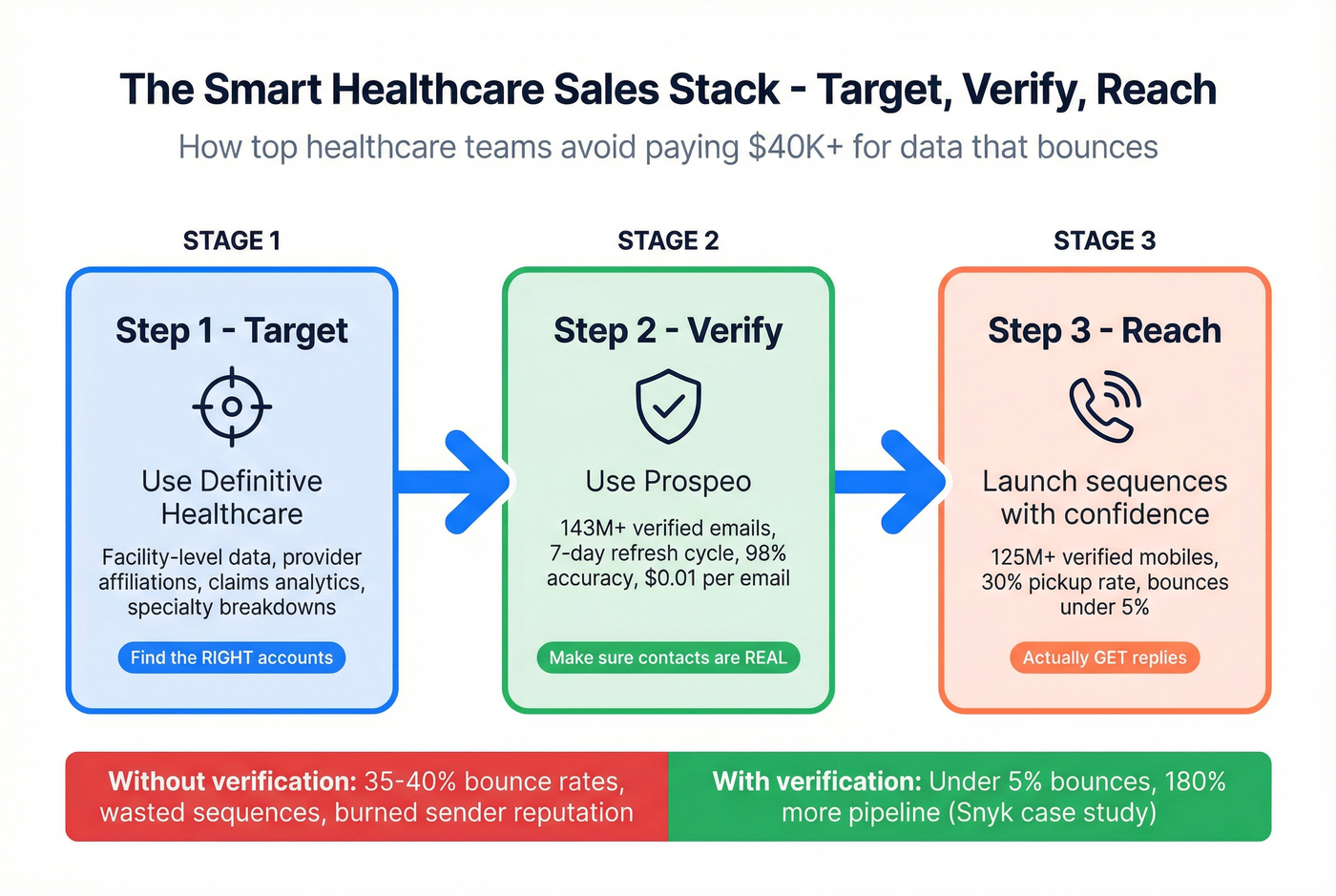
Prospeo addresses that gap with 143M+ verified emails refreshed on a 7-day cycle at 98% accuracy for roughly $0.01 per email, plus 125M+ verified mobile numbers with a 30% pickup rate - useful when healthcare decision-makers don't respond to cold email. The smart play for healthcare teams: use Definitive Healthcare for targeting intelligence, then verify your contact list through Prospeo before launching sequences.

Let's be honest about what this looks like in practice. One of our customers, Snyk, had 50 AEs dealing with 35-40% bounce rates before switching their verification workflow. After the switch, bounces dropped below 5% and AE-sourced pipeline jumped 180%. Healthcare teams running a similar stack - Definitive for targeting, Prospeo for verification - can expect comparable improvements without doubling their data spend. If bounce rates are your bottleneck, start with an email bounce rate audit and tighten your email deliverability basics before scaling volume.
Definitive Healthcare nails facility-level targeting. ZoomInfo covers broad B2B contacts. Neither solves stale phone numbers and bounced emails in healthcare. Prospeo's 7-day data refresh cycle and 5-step verification process give healthcare sellers the accurate contact layer both platforms are missing - no annual contract, no sales call required.
Verify your healthcare contact list before you hit send.
FAQ
Is DiscoverOrg still available?
No. DiscoverOrg merged into ZoomInfo in 2019 and is labeled discontinued on TrustRadius. All DiscoverOrg capabilities - org charts, buying scoops, verified dials - now live inside ZoomInfo's platform.
Can I use Definitive Healthcare and ZoomInfo together?
Yes, and many healthcare teams do. Definitive Healthcare handles facility-level targeting while ZoomInfo provides broader contact data and CRM integrations. Expect $40K+/year combined - powerful but expensive.
How does ZoomInfo handle multi-location healthcare groups?
Poorly. ZoomInfo maps contacts to the parent health system name rather than individual clinic locations. For multi-site practices in dental, ortho, or behavioral health, this means hours of manual research to determine which location a contact actually works at.