

Demand Gen Content: Strategy, Examples & KPIs (2026)
99% of your market isn't buying right now. Demand gen content is how you win the 1% that is - by shaping how the other 99% thinks about the problem before they ever talk to sales.
This isn't about Google's Demand Gen ad campaigns. It's about what to publish, where to push it, and how to turn engagement into pipeline.
The Three-Move Playbook
Awareness. Publish original, ungated content that reframes how your ICP thinks about their problem.
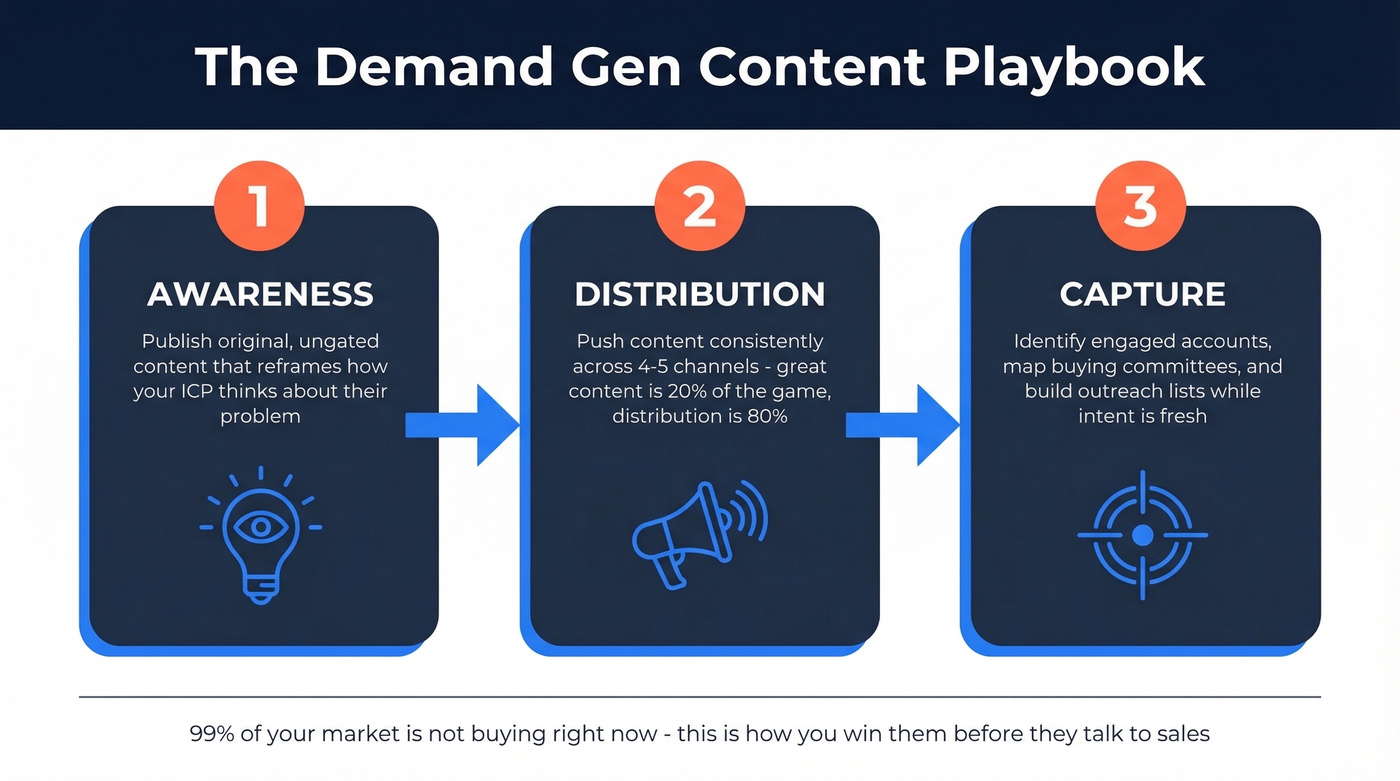
Distribution. Push it consistently - great content is 20% of the game; distribution is 80%.
Capture. When engagement signals appear, identify the accounts and build buying-committee lists for outreach.
Everything below is the how.
Demand Generation vs. Lead Gen
These aren't opposites - they're sequential.
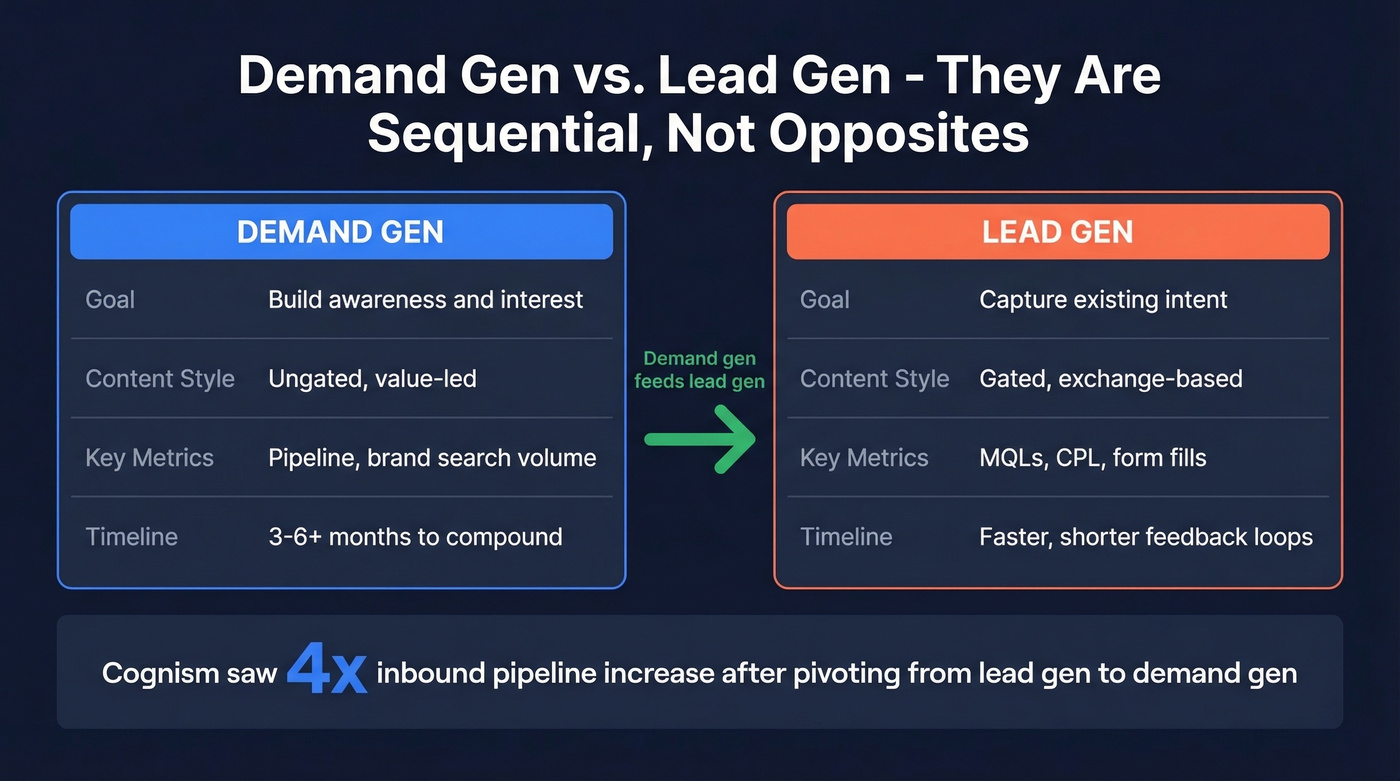
| Demand Gen | Lead Gen | |
|---|---|---|
| Goal | Build awareness + interest | Capture intent |
| Content | Ungated, value-led | Gated, exchange-based |
| Metrics | Pipeline, brand search | MQLs, CPL, form fills |
| Timeline | 3-6+ months to compound | Faster, shorter loops |
Cognism reported a 4x increase in inbound pipeline after pivoting from lead gen to demand gen, with higher win rates and shorter sales cycles. That tracks with what we've seen across dozens of B2B teams: when you educate the market first, the leads that come in are warmer and close faster. The content does the selling before a rep ever gets involved, which is why the relationship between demand gen content and pipeline health is so direct.
Examples That Cut Through
The research play - Typeform's "Get Real" campaign. They surveyed 1,300 influencers, marketers, and consumers, collected 146 video responses, and built an interactive, ungated hub around the findings. Every participant had a reason to share. That's demand generation architecture, not content production.
I've seen this pattern work at every scale. Original data is the single most defensible content moat in B2B. Gong Labs does it by analyzing massive volumes of sales calls. UserEvidence does it with their "The Long Game" series, building a recurring audience around customer evidence and insights. You don't need their budget - survey 50 customers and you already have something no competitor can replicate.

Original research drives demand - but who's actually engaging? Prospeo tracks 15,000 intent topics via Bombora so you can identify accounts consuming content about your category. Then pull verified buying-committee contacts with 98% email accuracy and 30+ filters to match persona and stage.
Turn content engagement into pipeline before your competitors even notice the signal.
Distribution Is the Real Job
Most demand gen programs die because nobody sees the content. One practitioner on r/marketing nailed it: great content is only 20% of success; 80% comes from distribution. The working benchmark is 18 touchpoints across 4-5 channels before conversion.
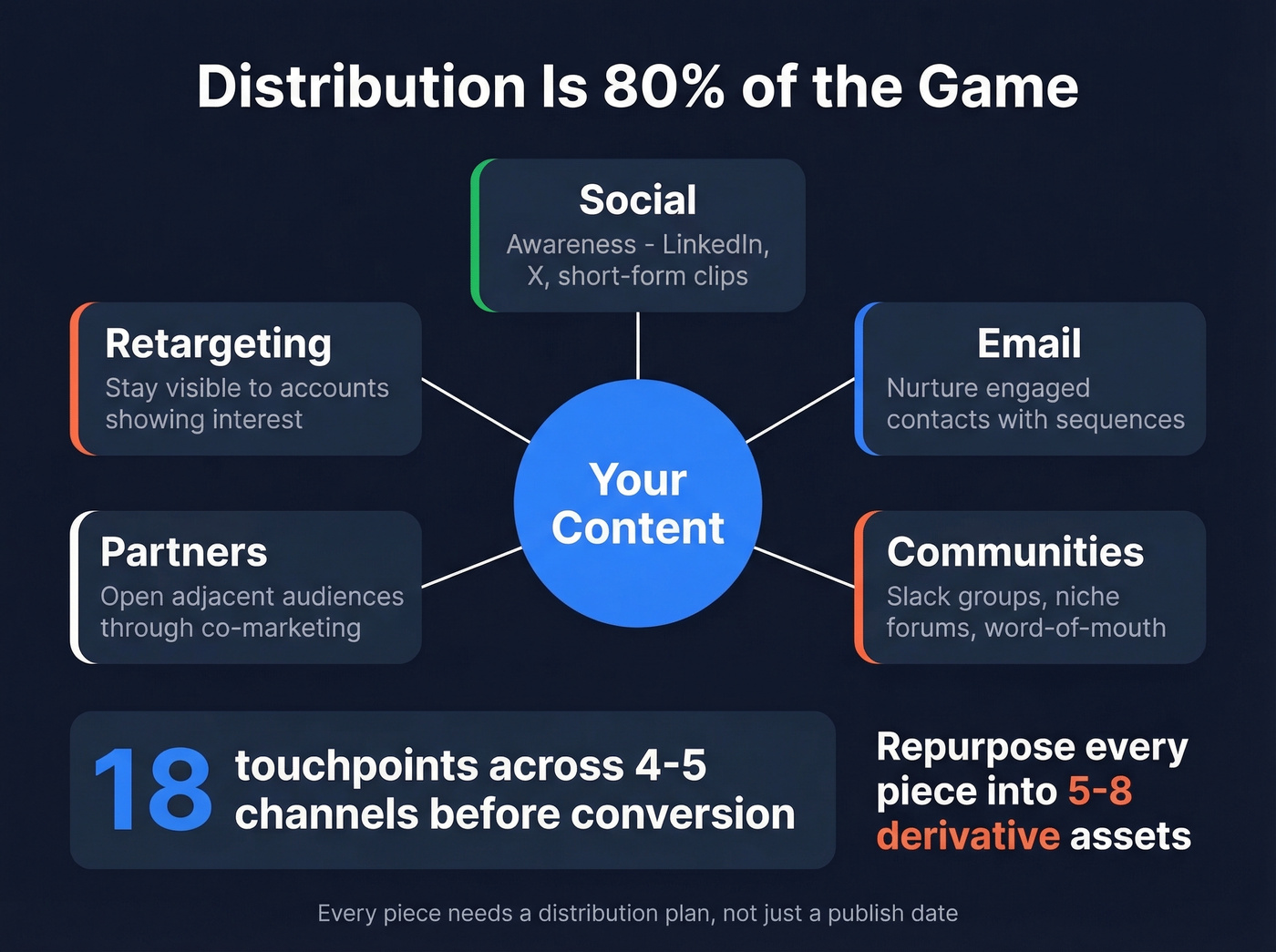
In our experience, the teams that win assign each channel a specific role. Social handles awareness. Email nurtures engaged contacts. Communities like Slack groups and niche forums drive word-of-mouth. Partners open adjacent audiences. Retargeting keeps you visible to accounts already showing interest. Every piece you publish needs a distribution plan, not just a publish date.
Here's the thing: the attribution mindset kills more demand gen programs than bad content ever will. A buyer sees your post on social, Googles you two weeks later, attends a webinar a month after that, then requests a demo. If you credit only the last touch, you'll cut the social budget that started the whole chain. Track directionally. Stop optimizing for attribution perfection.
Mistakes That Kill Pipeline
| Do This | Not This |
|---|---|
| Build decision-support content - comparisons, ROI ranges, 30/60/90 rollout plans | All thought leadership, no evaluation assets (78% of mid-funnel buyers want case studies) |
| Map content to both persona and buying stage | Write TOFU awareness content for a CISO when your buyer is a RevOps lead |
| Commit to 6+ months | Kill the program at month three because you can't attribute pipeline |
The third row is where we see the most carnage. Teams launch with enthusiasm, produce solid content for 8-10 weeks, then panic when the pipeline dashboard doesn't spike. Demand gen content compounds. If you aren't willing to commit for at least two quarters, save your budget and run paid lead gen instead - at least you'll get MQLs to show for it.
What to Measure
Prioritize in this order: marketing-sourced pipeline first, SQLs and close rate per channel second, CPL for efficiency context third, and content engagement as a leading indicator tied to account-level signals.
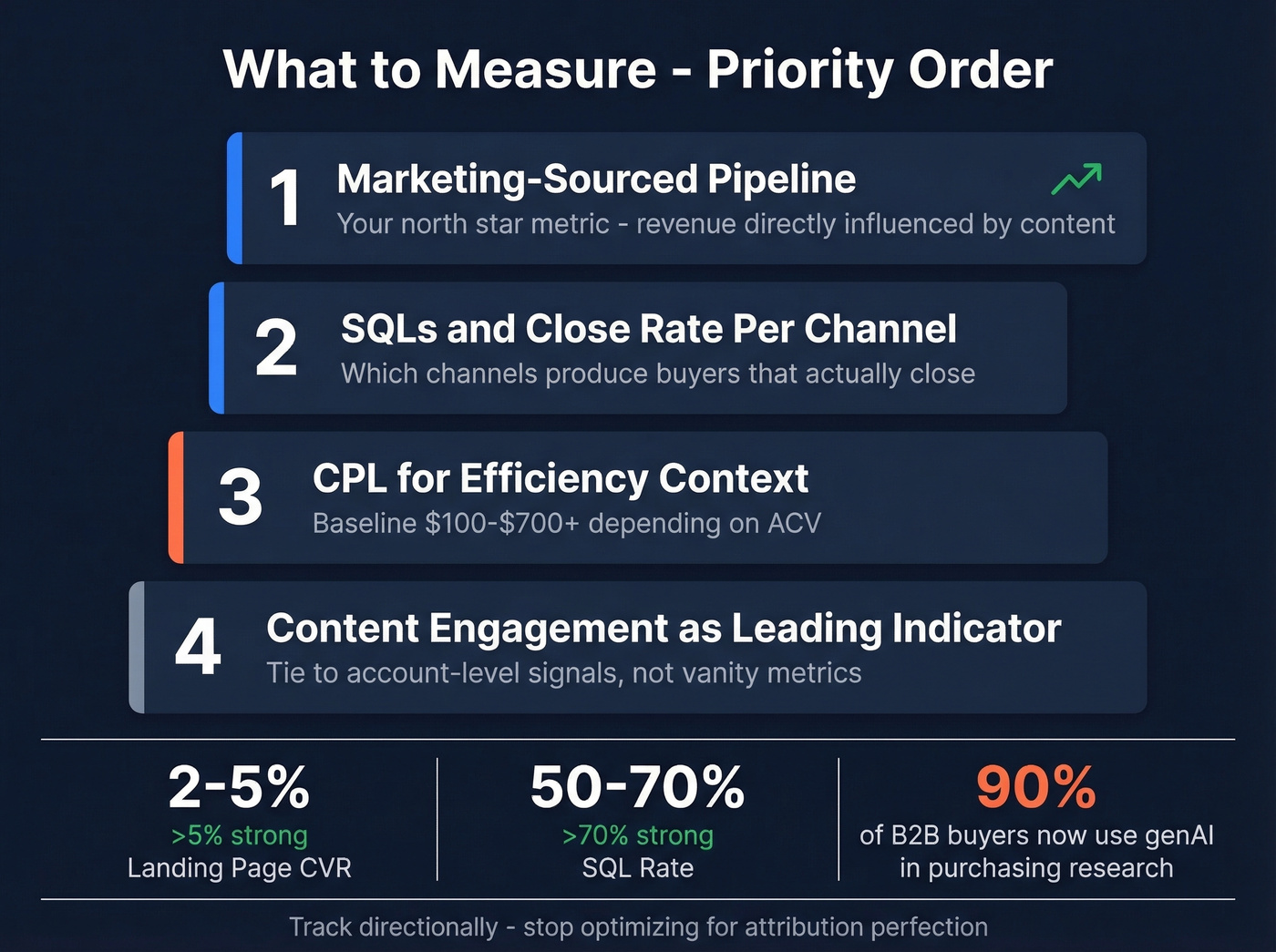
| Metric | Baseline | Strong |
|---|---|---|
| Landing page CVR | 2-5% | >5% |
| SQL rate | 50-70% | >70% |
| CPL | $100-$700+ | Varies by ACV |
Nearly 90% of buyers now use genAI in purchasing research, which means your content needs to be structured, specific, and data-rich enough to surface in AI-generated answers - not just traditional search. Forrester's 2026 B2B marketing predictions reinforce this shift: brands that don't adapt their content for AI consumption will lose visibility fast.
Your First 90 Days
Weeks 1-2 - Build three starter assets: one piece of original research, one recurring series for audience-building, and one comparison asset for buyers in decision mode.
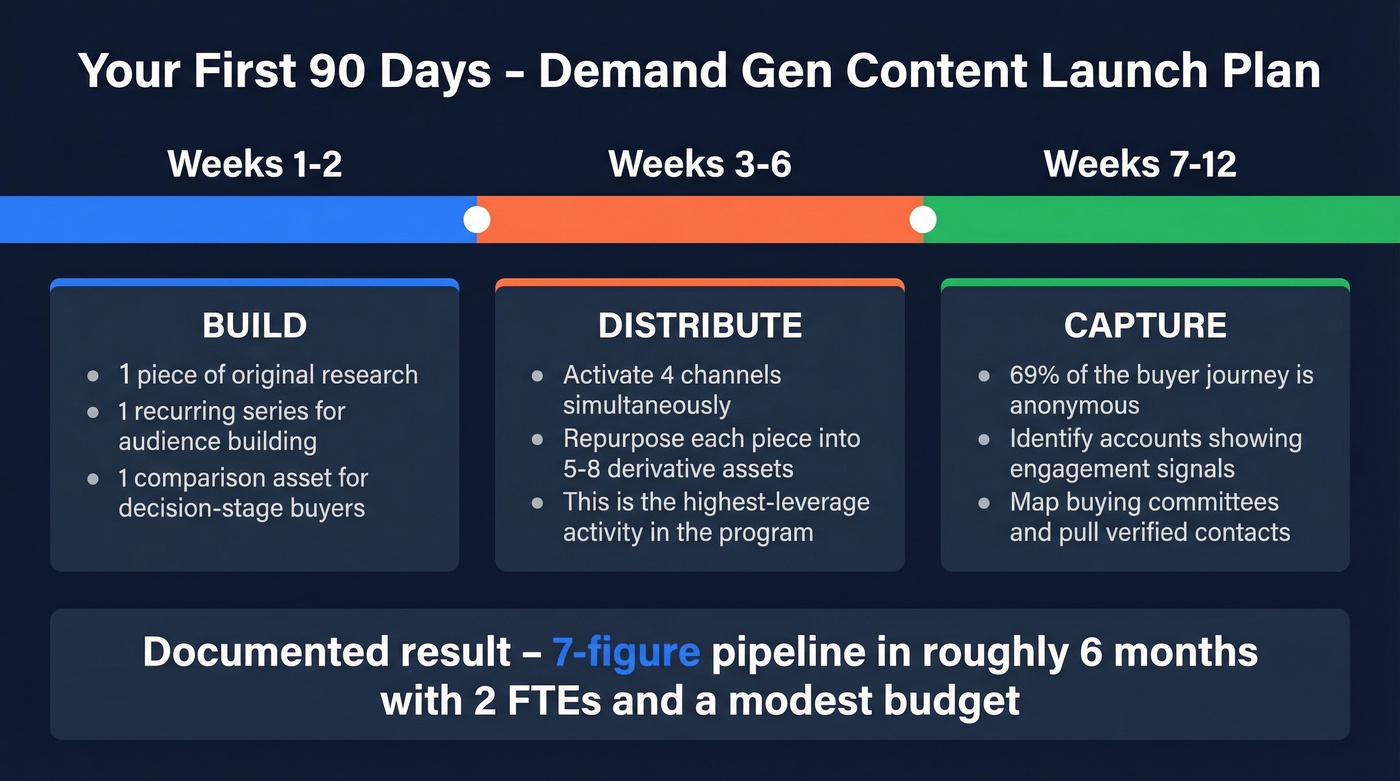
Weeks 3-6 - Turn on distribution across 4 channels. Repurpose every piece into 5-8 derivative assets: clips, quotes, threads, carousels, email snippets. This is where most teams under-invest, and it's the single highest-leverage activity in the entire program.
Weeks 7-12 - Start capturing demand. Buyers complete up to 69% of their journey anonymously, so don't wait for hand-raises. Identify accounts showing engagement signals, map the buying committee, and pull verified contact data through a tool like Prospeo to reach them while intent is fresh. Acting on signals within days rather than weeks is the difference between a warm conversation and a cold call.
One practitioner documented their results on Reddit: 7-figure pipeline in roughly 6 months with 2 FTEs and a modest budget. The compounding effect is real - but only if you don't quit early.
69% of the buyer journey happens anonymously. When accounts finally surface engagement signals, stale data kills your speed-to-lead. Prospeo refreshes every 7 days - not 6 weeks - so you reach buying committees with verified emails and direct dials while intent is still hot. At ~$0.01/email, scaling outreach to warm accounts won't break your budget.
Stop letting demand gen leads bounce - verify every contact before you hit send.
FAQ
Is demand gen content gated or ungated in 2026?
Mostly ungated. Gate assets only when they're genuinely high-value and the buyer is already evaluating - ROI calculators, implementation guides, pricing benchmarks. Everything else should be freely accessible to maximize reach and trust.
How long before it impacts pipeline?
Expect roughly 6 months before meaningful pipeline influence. Results usually lag, then accelerate sharply once content compounds and branded search volume rises.
How should I measure results with messy attribution?
Combine self-reported attribution on demo forms with directional signals like account-level engagement and branded search trends. Track marketing-sourced pipeline as the north star metric, not individual content-piece attribution.
How do I turn anonymous engagement into outreach lists?
Use intent data and visitor tracking to identify which accounts consume your content, then map the buying committee at those accounts. Prospeo tracks 15,000 intent topics via Bombora and pairs them with 30+ search filters, so you can match engagement signals to verified contacts and reach decision-makers within days.