

10 Demand Generation Examples With Real Companies and Real Numbers
Every "demand generation examples" article recycles the same vague advice: run webinars, gate your ebook, nurture with email. None of them name a company, share a number, or tell you what actually happened. That's not an example - it's a suggestion.
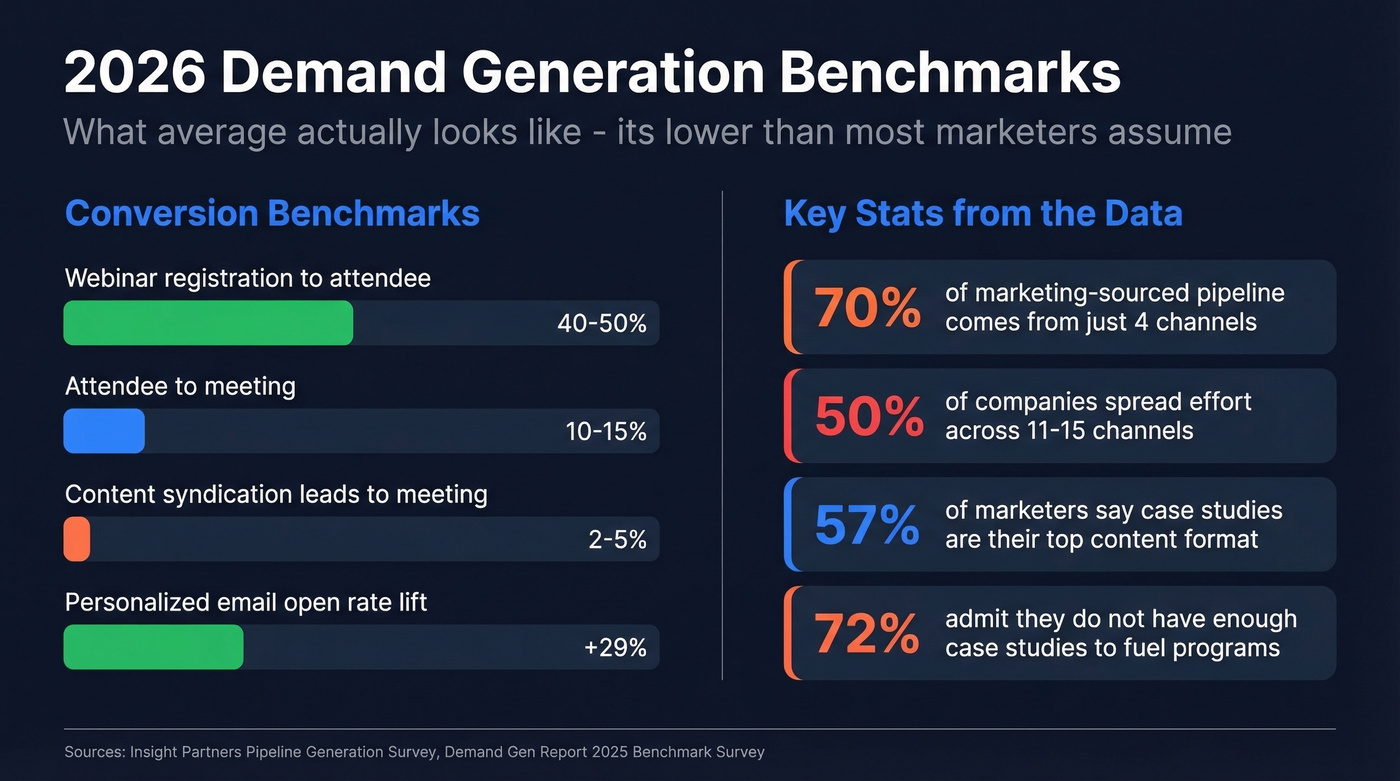
Here's what the data actually says. 70% of marketing-sourced pipeline comes from just four channels, yet 50% of companies spread effort across 11-15 channels. Meanwhile, 57% of marketers say case studies are their top content format, but 72% admit they don't have enough case studies to fuel their programs. Everyone wants proof. Almost nobody produces it.
If your average deal size is under $20K and you're running more than four demand gen channels, you're not doing demand gen - you're doing activity theater. Pick 3, execute with specificity, and measure pipeline, not MQLs. Below are 10 campaigns from companies that did exactly that, with real numbers attached.
Demand Gen vs. Demand Capture vs. Lead Gen
These three terms get used interchangeably, and the confusion wastes budget.
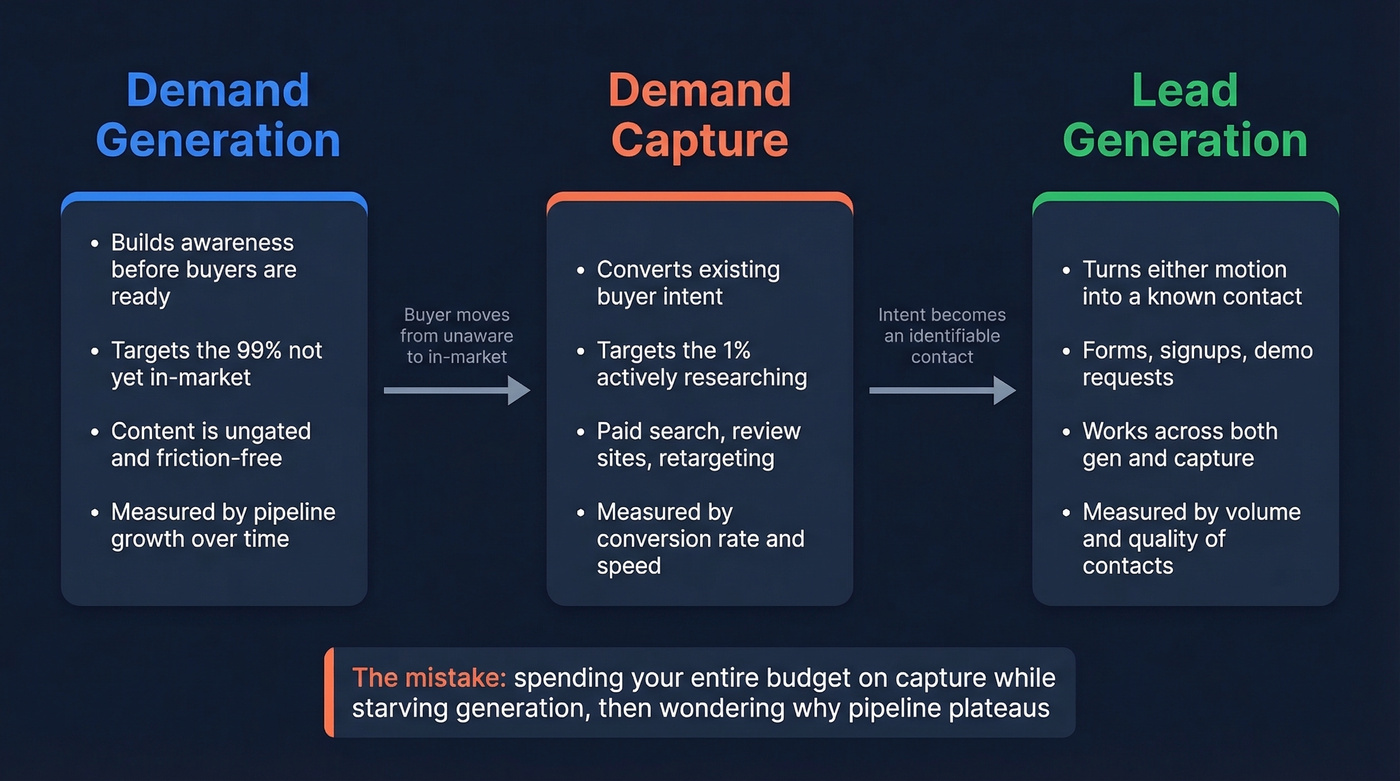
Demand generation builds awareness and preference before buyers are ready to purchase. Demand capture converts existing intent when buyers are already researching solutions - paid search, review sites, high-intent outbound, retargeting. Lead generation is the mechanism that turns either motion into an identifiable contact your team can work.
Cognism CMO Alice de Courcy frames the 99/1 split well: focus on converting the 1% in-market while generating demand among the 99% who aren't. Keep content friction-free and always-on. The mistake most teams make is spending their entire budget on capture while starving generation, then wondering why pipeline plateaus quarter after quarter.
10 Strategies That Actually Drove Pipeline
1. Ungated Content Pivot (Cognism)
What they did: Cognism ripped the gates off their content. No more forms in front of reports, guides, or templates. Everything became freely accessible.
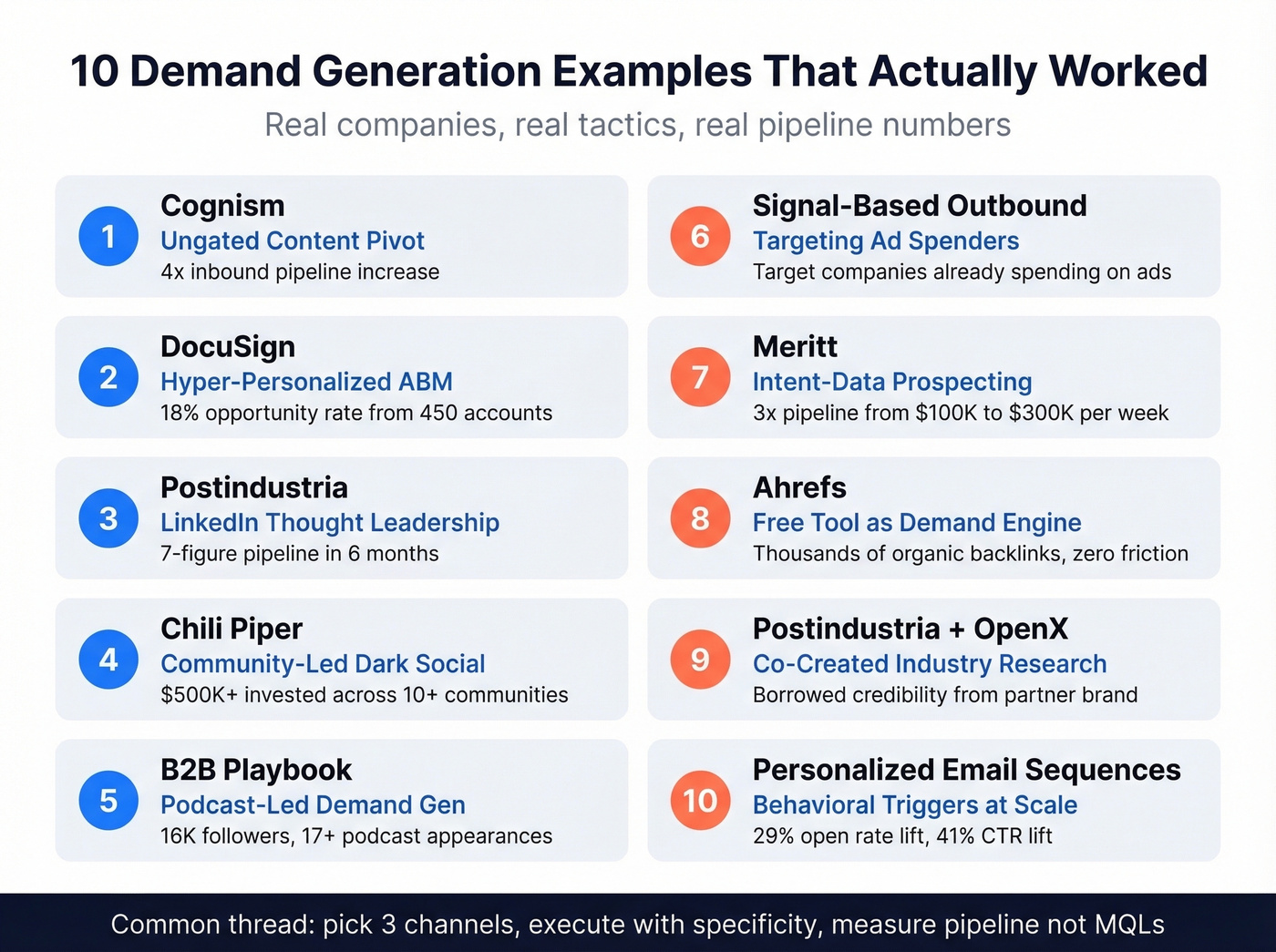
What happened: Inbound pipeline increased 4x. Win rates went up. Sales cycles got shorter. The counterintuitive part - removing the form that "captured leads" actually produced more pipeline, because the content reached far more people and built trust before the first sales conversation ever happened.
Gated content optimizes for MQLs. Ungated content optimizes for reach and trust. The 99% who aren't buying today still need to know you exist, and a PDF behind a form doesn't accomplish that - it just gives your BDR team a list of people who wanted the PDF, not your product. Skip this approach if your sales team can't stomach an MQL volume drop before pipeline rises. That patience is non-negotiable.
2. ABM With Hyper-Personalized Ads (DocuSign)
DocuSign ran one of the cleanest ABM campaigns in recent memory. They identified 450 enterprise target accounts, mapped six distinct buyer personas within each, and built unique ad creative and landing pages for every persona-account combination. That's not swapping a first name into a subject line - it's building distinct experiences for distinct buyers.
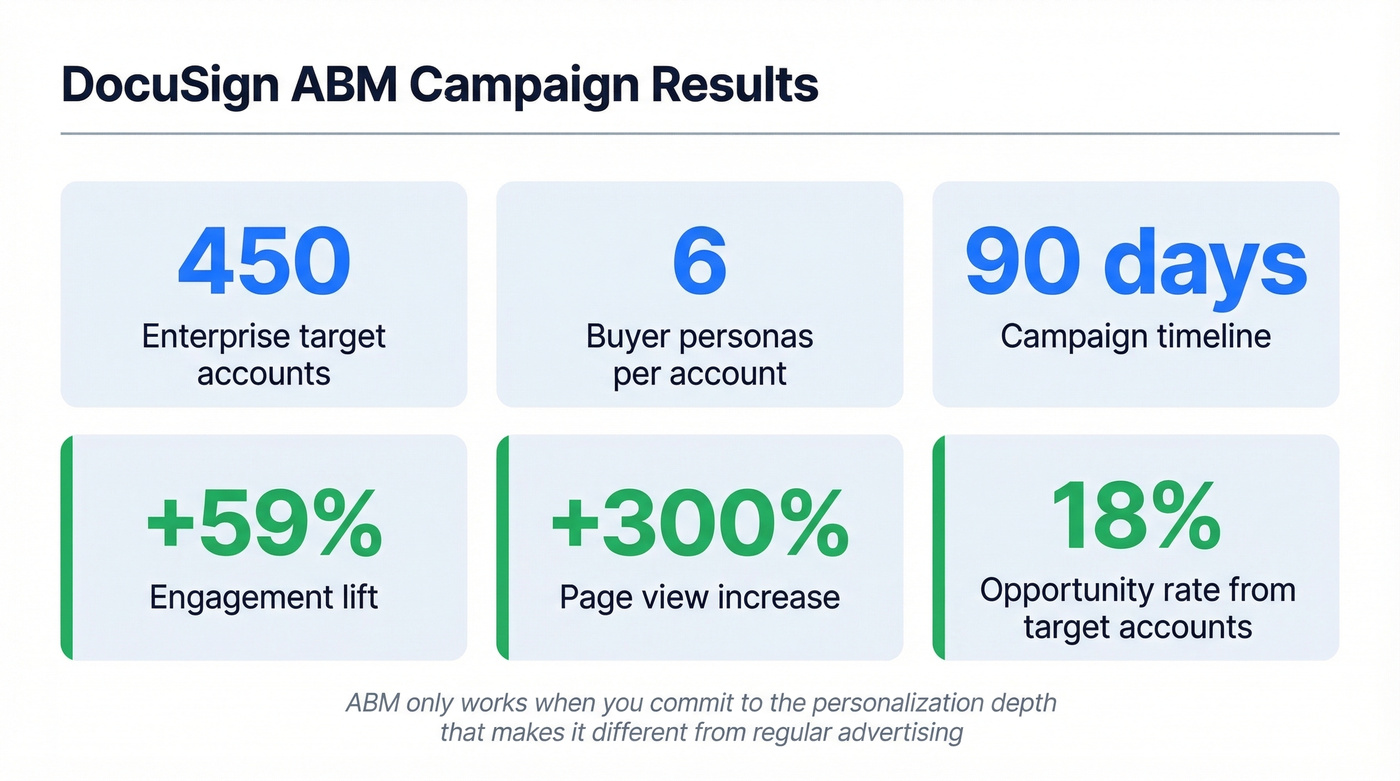
The numbers: 59% lift in engagement, 300% increase in page views across target accounts, and an 18% opportunity rate within three months. For enterprise deals with long sales cycles, converting nearly one in five target accounts to pipeline in 90 days is exceptional.
The lesson isn't "do ABM." ABM only works when you commit to the personalization depth that makes it different from regular advertising. Half-measures - running the same ad to a target account list - produce half-results.
3. LinkedIn Thought Leadership to 7-Figure Pipeline (Postindustria)
This one takes patience. Postindustria, a software development company, narrowed their positioning from generic dev services to AdTech, mobile bidding, and mobile SDK - a deliberate bet on specificity over breadth.
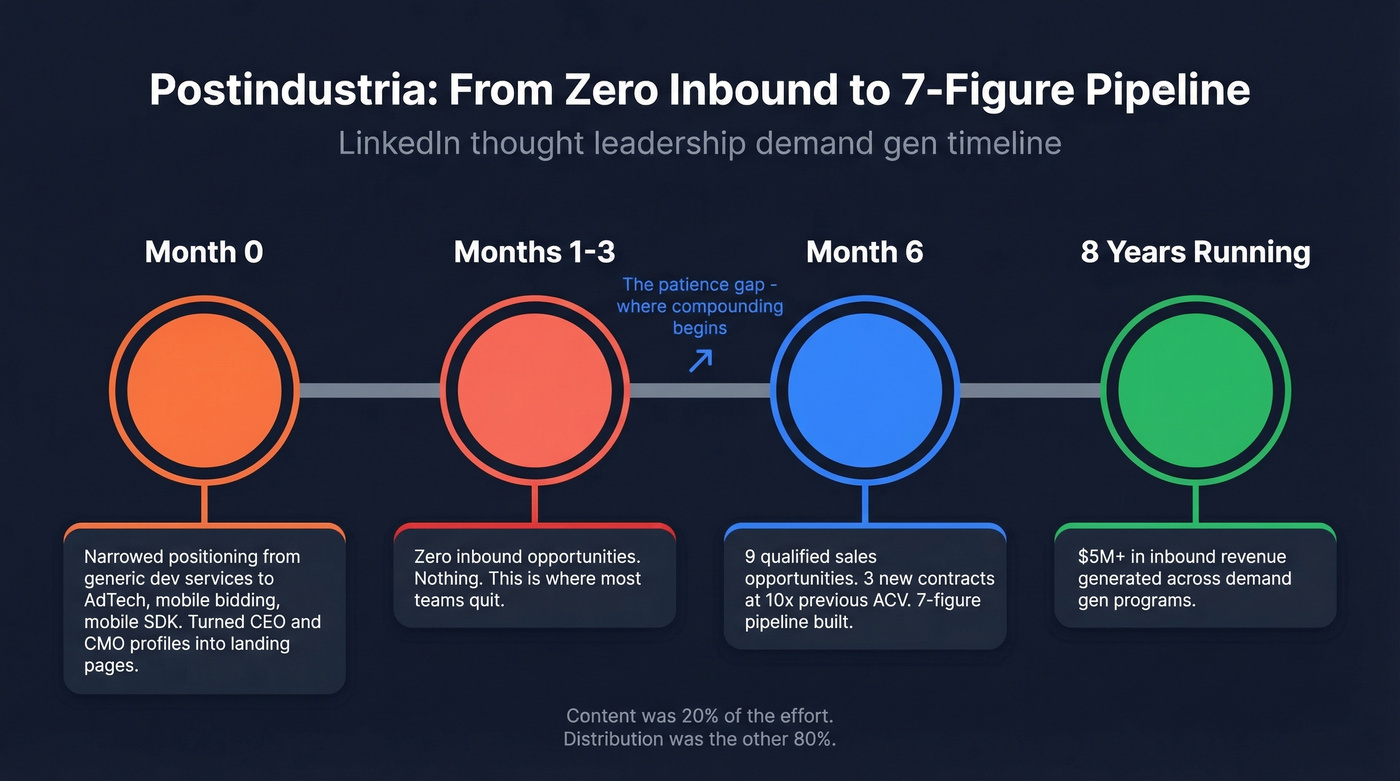
They turned their CEO and CMO profiles into landing pages, grew their networks across four audience segments, and committed to consistent distribution. The content itself was only 20% of the effort. Distribution - the relentless, daily work of getting it in front of the right people - was the other 80%.
Here's the timeline that makes this real. Zero inbound opportunities for the first three months. Nothing. Then by month six: 9 qualified sales opportunities, 3 new contracts at 10x their previous ACV, and a 7-figure pipeline. The practitioner behind this case reports generating $5M in inbound revenue across 8 years of running demand gen programs, and their stance is blunt: the attribution mindset kills B2B marketing programs, because higher-ticket journeys are multi-touch and non-linear.
4. Community-Led Dark Social (Chili Piper)
Chili Piper invested $500K+ across 10+ communities since 2020. That's not a sponsorship line item - it's a strategic commitment to showing up where their buyers already hang out.
The critical insight from their playbook is what doesn't work: the "sponsor, get attendee list, hand to SDRs, spam" motion. Practitioner communities consistently call out this pattern as a fast path to zero pipeline. Before investing in any community, Chili Piper evaluated engagement quality (responses per thread, unique logins, percentage of member-driven posts), ICP signals (mentions of competitors, relevant keyword mentions over the last 90-180 days), and owned distribution assets like newsletter open rates and event registration vs. show-up rates.
After events, they built content hubs to track repeat visits - turning a one-time interaction into an ongoing engagement signal. The playbook works because it treats communities as awareness channels, not lead lists. Among the demand generation examples in this list, Chili Piper's community investment stands out for its long time horizon and compounding returns.
5. Podcast-Led Demand Gen (B2B Playbook)
B2B Playbook grew from zero to 16K followers and 17+ podcast appearances. The mechanic is straightforward: each podcast episode creates a compounding content asset. Episode 1 reaches 50 people. Episode 100 reaches 50 people plus the long-tail audience discovering episodes 1-99.
The compounding effect is why podcast-led demand gen feels slow for the first 6 months and then accelerates. Same patience curve as the Postindustria case - you're building an audience asset, not running a campaign.
6. Signal-Based Outbound (Targeting Ad Spenders)
Here's a tactic you can copy this week. A web developer targeting SMBs doesn't blast every company with a website. Instead, they build a list of companies already spending on Google and Bing Ads - using tools like Clay to identify the signal.
The pitch angle writes itself: "You're spending $5K/month driving traffic to a site that doesn't convert." The signal proves budget exists and creates urgency that cold outbound to a random list never will. The consensus on r/LeadGeneration is simple: target "already spending" signals instead of boiling the ocean.
7. Intent-Data Prospecting (Meritt)
Demand gen creates interest. But when buyers signal they're ready, you need verified data to act on those signals fast.
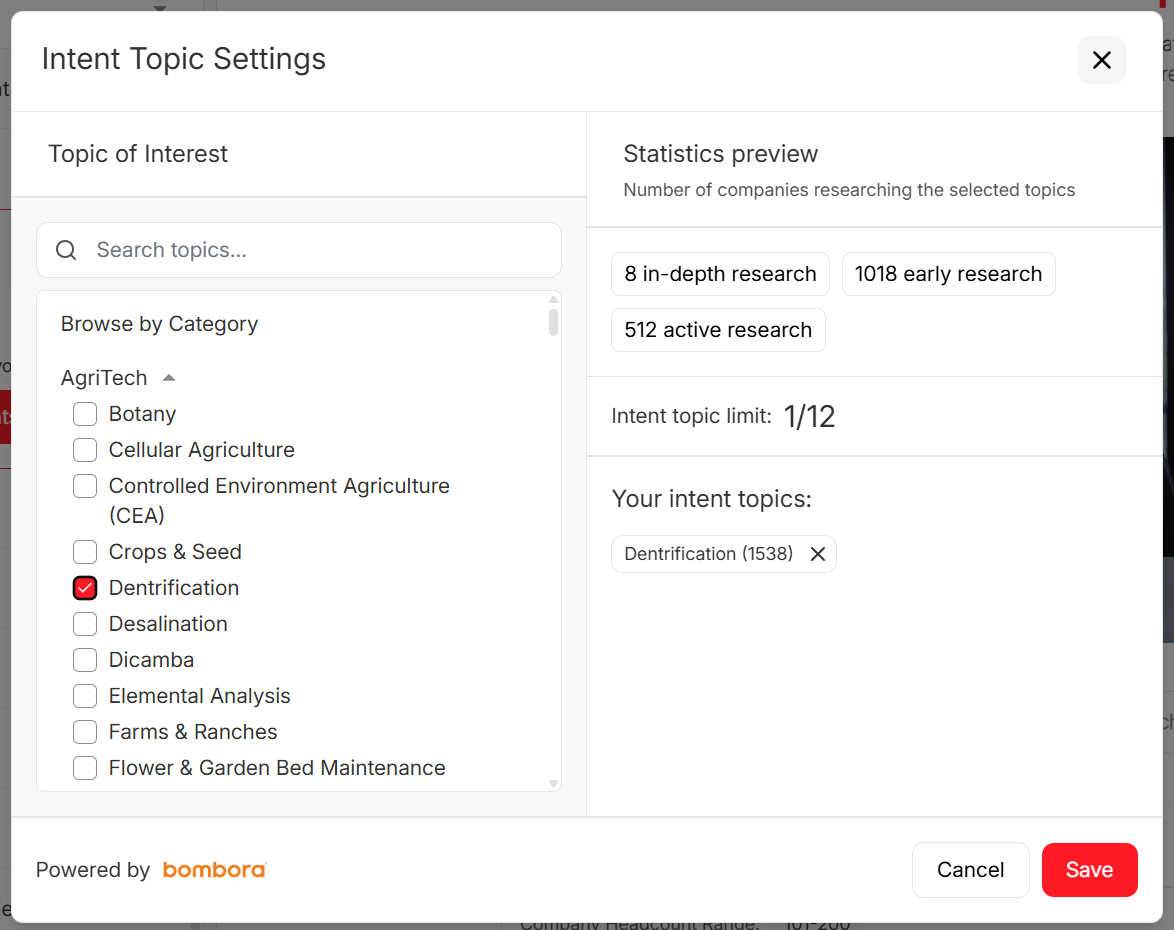
Meritt, a B2B services company, layered intent data into their outbound workflow and tripled pipeline from $100K to $300K per week. Prospeo's intent data tracks 15,000 Bombora topics, identifying accounts actively researching relevant subjects. When Meritt's demand gen content pushed a prospect into research mode, the intent signal flagged the account, and the sales team reached out with verified emails on a 7-day refresh cycle. Their bounce rate dropped from 35% to under 4%.
That's the connection most teams miss: brilliant demand gen campaigns are wasted if your outreach data is stale when buyers finally raise their hand.
8. Free Tool as a Demand Engine (Ahrefs)
Ahrefs' free keyword generator isn't a lead magnet - it's a demand generation engine. It solves a real problem without requiring a login, builds brand affinity with SEO practitioners who'll eventually need the full suite, and generates thousands of organic backlinks from people referencing the tool.
This is product-led demand gen at its cleanest. The free tool doesn't capture leads. It creates future customers by delivering genuine value with zero friction. Not every company can build a free tool, but every company can ask: "What's the smallest useful thing we could give away that demonstrates our core competency?"
9. Co-Created Industry Research (Postindustria + OpenX)
Postindustria didn't just publish their own research - they co-created an industry report with OpenX, a major player in their target market. They ran market research with niche AdTech associations and target accounts, positioning themselves as thought leaders rather than vendors.
Co-created research works because it borrows credibility from the partner brand while generating backlinks, press mentions, and speaking invitations. The key is choosing a partner your ICP already trusts. Postindustria's report positioned them alongside OpenX in the minds of AdTech buyers - a positioning no amount of cold outbound could achieve.
10. Personalized Email Sequences at Scale
Personalized emails see a 29% open rate lift and 41% CTR lift over generic sends - yet most B2B teams still batch-and-blast.
The demand gen angle here isn't cold outreach - it's nurture. When someone engages with your content, visits your pricing page, or attends your webinar, the follow-up sequence should reflect that behavior. Behavioral triggers ("you watched 80% of our webinar on X") consistently outperform time-based drips ("it's been 3 days since we emailed you"). This is where demand gen and demand capture meet.
As operating ranges: webinar registration-to-attendee rates often land around 40-50%, attendee-to-meeting conversion around 10-15%, and content syndication leads to meetings around 2-5%. Knowing these numbers prevents you from celebrating vanity metrics while pipeline stays flat.

Every demand gen example above has one thing in common: the pipeline died or thrived based on data quality. Prospeo gives you 300M+ profiles with 98% email accuracy, 30+ filters including buyer intent and technographics, and a 7-day data refresh - so your signal-based outbound actually connects.
Stop feeding campaigns with stale data. Start with contacts that convert.
2026 Demand Generation Benchmarks
Before you benchmark your demand gen program, you need to know what average looks like. Spoiler: it's lower than most marketers assume.
Ruler Analytics analyzed 100M+ data points across 14 industries:
| Metric | Average | B2B SaaS | IT/Managed Services | Legal |
|---|---|---|---|---|
| Qualified lead rate | 2.9% | 1.1% | 1.5% | 7.4% |
| Form conversion | 1.7% | - | - | - |
| Call conversion | 1.2% | - | - | - |
First Page Sage's dataset confirms the SaaS and IT numbers. Even Salesforce converts less than 5% of its traffic into qualified leads. If your B2B SaaS program is converting at 1.5%, you're actually above average.
On the budget side, 35% of demand gen leaders saw budget increases heading into 2026, and 28% project 11-20% total revenue growth. 87% are now using AI in at least one demand gen tactic, with 65% reporting positive impact. Paid social leads typically convert to qualified opportunities at 1-3%, while SEO-sourced leads convert at 2-4% - reinforcing why organic channels dominate the pipeline contribution data.
In our experience, teams that clean their contact data before launching campaigns see 2-3x better conversion rates than those who don't. These benchmarks assume your data is clean. Bad contact data is where programs silently leak pipeline.
Three Mistakes That Kill Demand Gen Programs
Optimizing for MQLs over revenue. Your MQL count is up 40% but pipeline is flat? Your measurement is broken. Align metrics to pipeline and revenue, not form fills. Tighten your MQL definition with direct sales feedback - if sales says 60% of MQLs are junk, your scoring model needs surgery, not more volume.
Static ICP without behavioral signals. A firmographic ICP ("Series B SaaS, 50-200 employees, US-based") is a starting point, not a strategy. Layer intent data and content engagement signals on top. An account that matches your firmographic profile AND is actively researching your category is 5-10x more likely to convert than one that just matches the profile.
Launching paid ads without buyer research. Look, we've seen teams spend $50K on LinkedIn ads using internal messaging that means nothing to buyers. The fix is unglamorous: interview 10 recent buyers, record the exact language they use to describe their problem, and put that language in your ad copy. Buyer words outperform marketer words every time. The best demand generation examples in this article share a common trait - they all started with deep buyer understanding before spending a dollar on distribution.
Running ABM like DocuSign or signal-based outbound like example #6? You need verified contact data for every persona in your target accounts. Prospeo enriches leads with 50+ data points at a 92% match rate - plus intent data across 15,000 topics to find the 1% already in-market.
Layer intent signals on verified contacts for $0.01 per email.
FAQ
What are the best demand generation examples for B2B?
Cognism's ungated content pivot drove a 4x pipeline increase. DocuSign's hyper-personalized ABM converted 18% of 450 target accounts. Postindustria's thought leadership built a 7-figure pipeline in 6 months. The common thread: each company picked a narrow strategy and executed deeply rather than spreading across a dozen channels.
How long does demand generation take to produce pipeline?
Expect 3-6 months before meaningful pipeline materializes. Postindustria saw zero inbound for 3 months, then 9 qualified opportunities by month 6. Programs that quit before the 90-day mark almost never get a fair read on whether the strategy works.
What's the best demand gen channel for B2B?
SEO, events, social media, and paid search drive 70% of marketing-sourced pipeline according to data from 100+ companies. Pick 2-3 and execute deeply rather than spreading across 15 channels. Concentration beats diversification.
How do you measure demand generation success?
Track pipeline generated, win rates, and CAC trends - not MQLs. Average qualified lead conversion is 2.9% across industries. If your MQL count is climbing but pipeline is flat, your scoring model needs tightening with direct sales input.
What tools help activate demand gen signals?
Layer intent data on top of your campaigns to catch buyers when they enter research mode. Prospeo tracks 15,000 Bombora topics and pairs intent signals with 98%-accurate contact data on a 7-day refresh cycle, so your sales team can act on demand gen signals before they go stale. Cognism, Demandbase, and 6sense also offer intent-based activation at higher price points.