

Best Demand Generation Tools for 2026 - Ranked by Teams That Use Them
A RevOps lead we know ran a stack audit last quarter and found her team was paying for 14 tools. Only five touched pipeline. The other nine generated dashboards, not demand.
That ratio is more common than anyone wants to admit.
Why Most Demand Gen Stacks Fail
The tools aren't the issue. The sequencing is.
92% of B2B buyers already have at least one vendor in mind when they start researching, and 41% have a preferred vendor before formal evaluation begins. Prospects are roughly 69% through the buying process before they ever talk to a seller - with APAC buyers even further along at 72.4%, compared to 68.2% in North America.
Your demand gen stack has one job: make sure you're on the shortlist before the buyer knows they're buying. The winning vendor lands on that Day One shortlist 95% of the time. If you're not there, your fancy ABM platform and your 47-step nurture sequence don't matter.
Most teams fail because they start with automation (Layer 3) and skip data quality (Layer 1). They blast emails to bad addresses, tank their domain reputation, and then wonder why "demand gen isn't working." The average B2B buying cycle runs 10.1 months. You can't afford to spend the first three of those fixing deliverability problems that shouldn't exist.
Our Picks at a Glance
Best for data foundation: Prospeo - 98% email accuracy, ~$0.01/email, free tier with 75 verified emails/month.
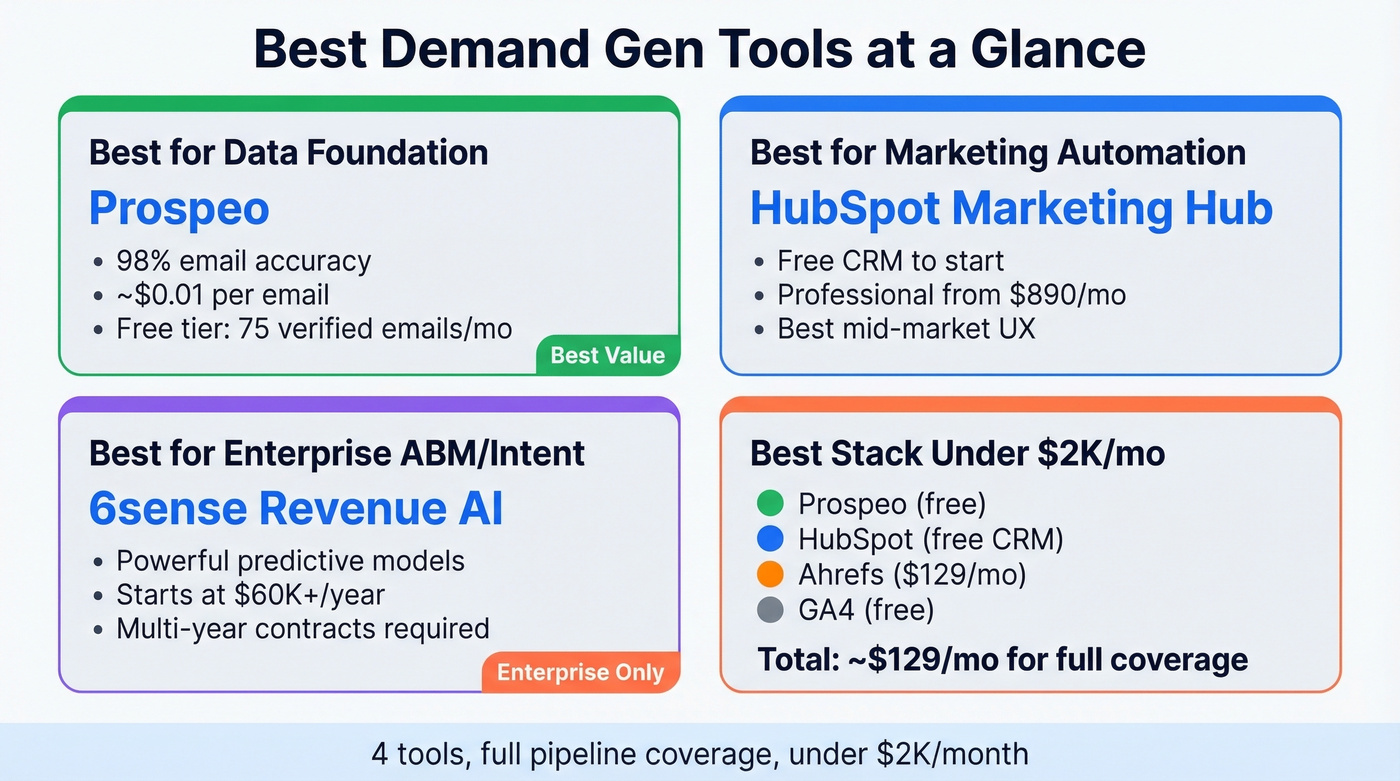
Best for marketing automation: HubSpot Marketing Hub - still the default for mid-market teams. Free CRM to start, Professional from $890/mo.
Best for enterprise ABM/intent: 6sense - powerful predictive models and intent signals, but you'll need $60K+/year and patience.
Best for teams under $2K/month: Prospeo (free) + HubSpot (free CRM) + Ahrefs ($129/mo) + GA4 (free). Four tools, full coverage.
Channel ROI Benchmarks for 2026
Before you pick tools, pick channels. The tool only matters if the channel it serves is worth investing in.
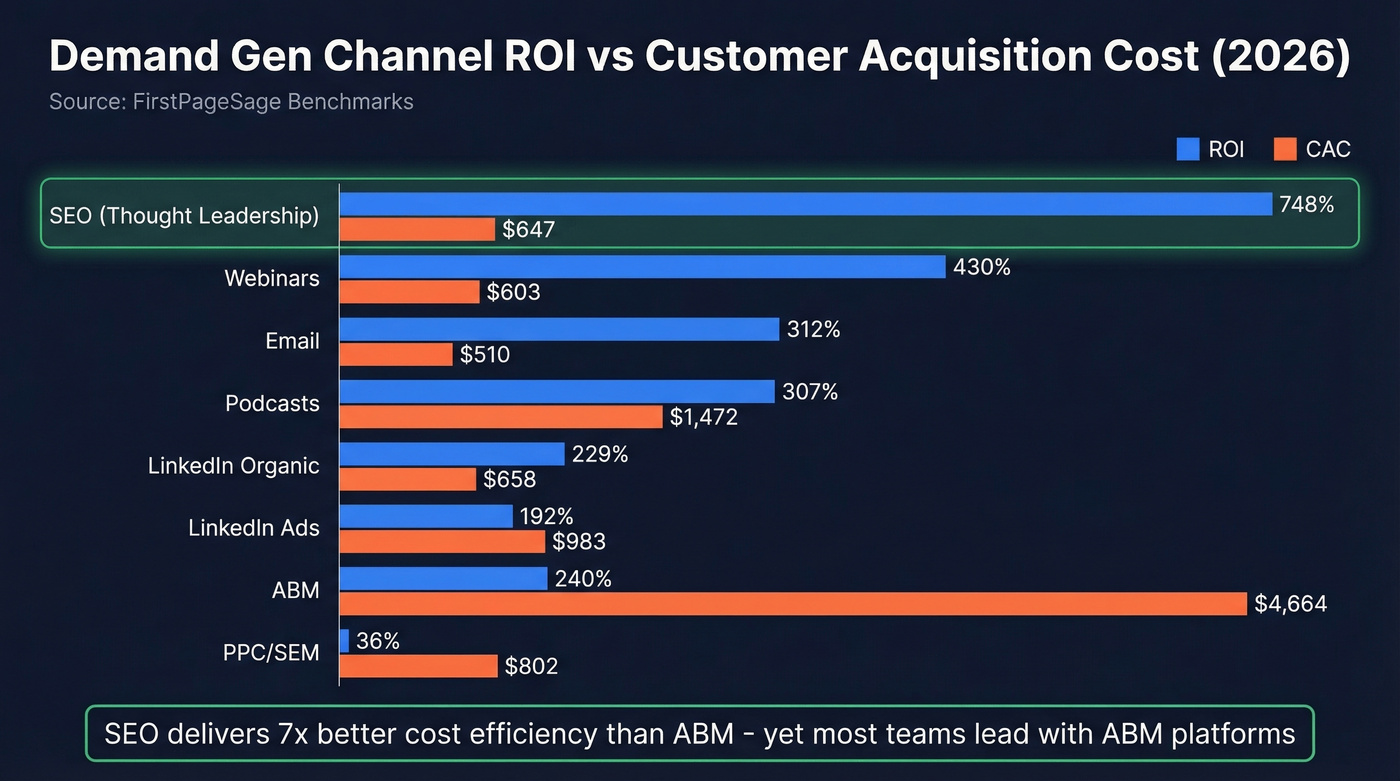
FirstPageSage's demand generation benchmarks lay this out clearly:
| Channel | Avg CAC | ROI | Time to Results |
|---|---|---|---|
| SEO (Thought Leadership) | $647 | 748% | 4-6 months |
| Webinars | $603 | 430% | 2-4 months |
| $510 | 312% | 3-6 months | |
| Podcasts | $1,472 | 307% | 12-18 months |
| LinkedIn Organic | $658 | 229% | 6-8 months |
| LinkedIn Ads | $983 | 192% | 3-4 months |
| ABM | $4,664 | 240% | 4-8 months |
| PPC/SEM | $802 | 36% | 1 month |
SEO delivers 748% ROI at a $647 CAC. ABM delivers 240% at $4,664. That's a 7x difference in acquisition cost. Yet most "demand gen" articles lead with ABM platforms that cost $60K-$200K/year.
Here's the thing: ABM absolutely works for enterprise teams selling six-figure deals. But if your average deal is in the four-figure range, SEO and email will outperform ABM every time on a cost-per-pipeline-dollar basis. The best demand generation tools are the ones matched to channels that actually move pipeline for your deal size.
The 5-Layer Demand Gen Stack
Every demand gen stack needs five layers:
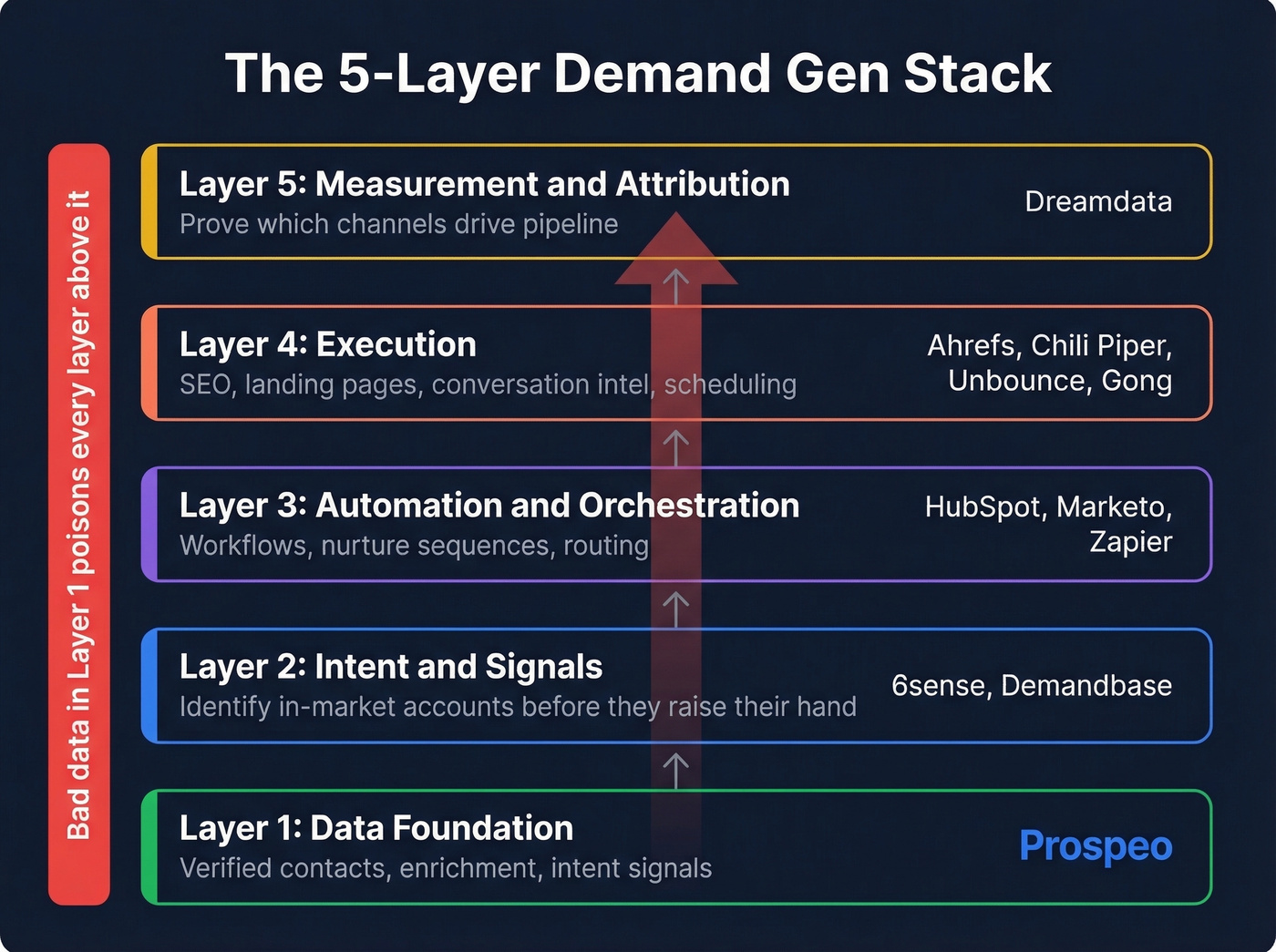
- Data Foundation - verified contacts, enrichment, intent signals
- Intent & Signals - identifying in-market accounts before they raise their hand
- Automation & Orchestration - workflows, nurture sequences, routing
- Execution - the channels themselves: SEO tools, landing pages, conversation intelligence, scheduling
- Measurement & Attribution - proving which channels drive pipeline, not just "influence"
With a 10.1-month average buying cycle, you can't skip layers. Bad data in Layer 1 poisons every layer above it. This is why B2B demand gen platforms that promise to "do everything" often underdeliver - they optimize for breadth instead of getting each layer right.

Bad data in Layer 1 poisons every layer above it. Prospeo gives you 300M+ profiles with 98% email accuracy, 125M+ verified mobiles, and a 7-day refresh cycle - so your demand gen stack runs on contacts that actually connect. Snyk's 50 AEs cut bounce rates from 35% to under 5% and grew AE-sourced pipeline 180%.
Stop generating demand for inboxes that don't exist.
The 12 Best Demand Generation Tools
Prospeo (Layer 1: Data Foundation)
Use this if you need a clean data foundation without a six-figure contract. Prospeo's B2B database covers 300M+ professional profiles with 98% email accuracy and 125M+ verified mobile numbers that deliver a 30% pickup rate. The 7-day data refresh cycle is the real differentiator - the industry average is six weeks, which means most databases serve you stale contacts by default.
The platform includes Bombora intent data across 15,000 topics, 30+ search filters (buyer intent, technographics, job changes, headcount growth, funding), and integrations with Salesforce, HubSpot, Clay, Zapier, Lemlist, Instantly, Smartlead, and Make.
Real results: Snyk's 50 AEs were running 35-40% bounce rates before switching. After the switch, bounces dropped under 5%, and AE-sourced pipeline jumped 180%. That's not a marginal improvement - it's a fundamentally different outbound motion.
Pricing is transparent and self-serve. Free tier gives you 75 verified emails/month plus 100 Chrome extension credits. Paid plans run ~$0.01/email with no contracts.

Pair with Salesloft or Outreach if you need a built-in dialer or full sales engagement suite.
HubSpot Marketing Hub (Layer 3: Automation)
HubSpot is the demand generation software most mid-market teams should start with for automation. The UX is genuinely good, the ecosystem is massive, and the free CRM means you can start without budget approval.
Marketing Hub Professional runs $890/mo for 2,000 marketing contacts and climbs to $3,600/mo for Enterprise. The catch: costs scale with your contact database. We've seen mid-market teams hit $2,500-$4,000/mo faster than they expected once they pass 10K contacts. Budget for that growth curve or you'll get an unpleasant surprise six months in.
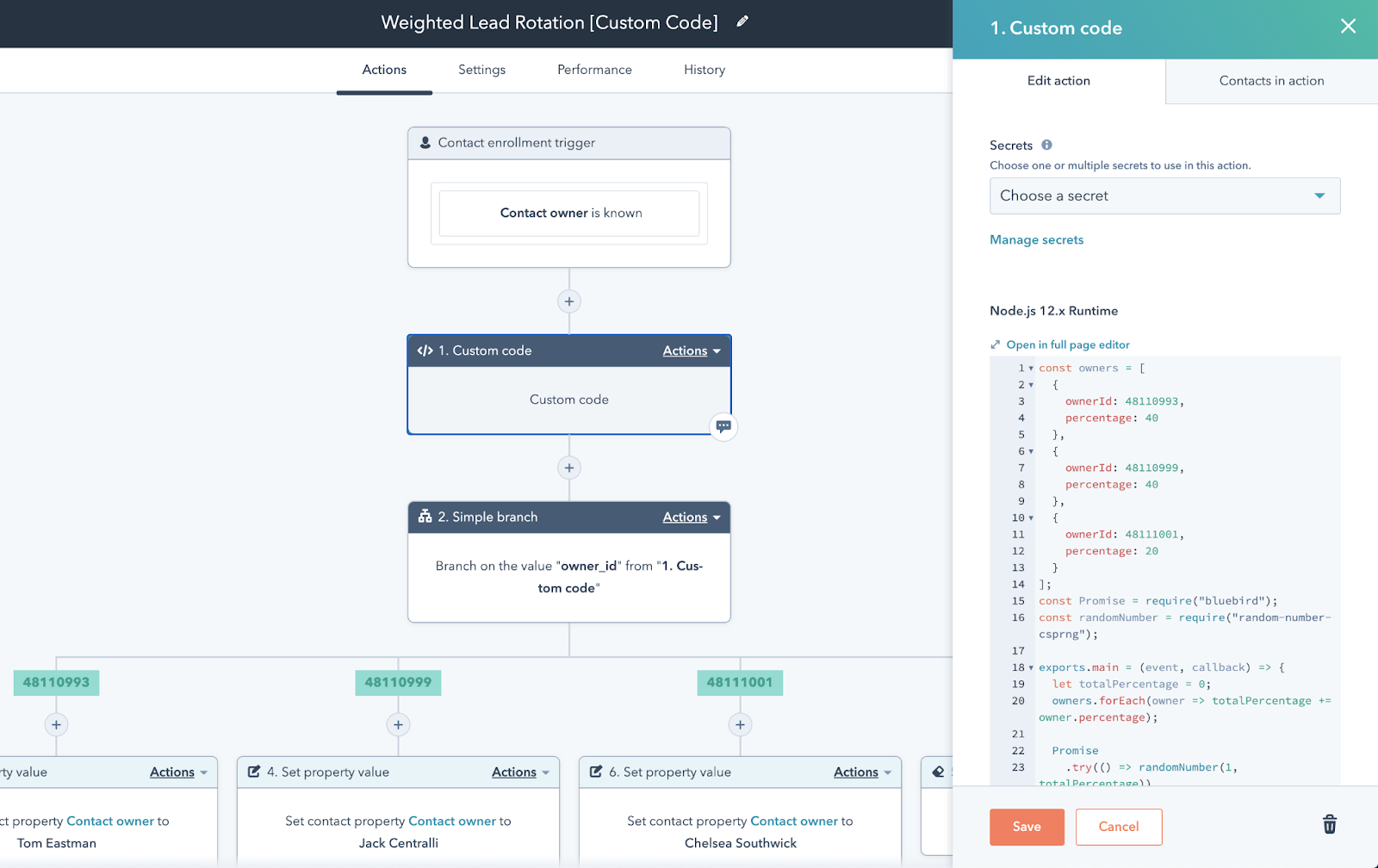
Skip this if you're an enterprise team already in the Adobe/Marketo ecosystem, or if you need sophisticated multi-touch attribution - HubSpot's native attribution is decent, not great.
6sense Revenue AI (Layer 2: Intent & Signals)
6sense is the most powerful intent platform on the market - and the most expensive one most teams can't justify.
The free tier (50 credits/month) is genuinely useful for small teams dipping into intent data. But the real product starts at $60K-$100K/year and can run up to $200K+ depending on modules, with mandatory multi-year contracts. Credits unlock emails and phone numbers but don't roll over between billing cycles. The predictive AI models and Sales Copilot are impressive - the platform identifies which accounts are in-market before they fill out a form, and the consensus on r/sales is that the intent signals are among the most accurate available, if you can stomach the price.
Use this if you're selling enterprise deals and have $60K+/year to invest. Skip this if you're a 20-person company. The ROI math simply doesn't work at that scale.
Demandbase (Layer 2: Intent & Signals)
Demandbase is enterprise ABM with enterprise complexity. Pricing ranges from ~$24K/year for basic packages to $300K+/year, with a median contract around $65K/year. The most concrete public reference: a $215,000/12-month contract on AWS Marketplace. Budget for a ~$29K onboarding fee on top of that. Implementation takes roughly two months, and the median time to ROI is 13 months per G2 data.
One technical gotcha worth flagging: Demandbase can't sync to or from Salesforce custom objects. If your CRM is heavily customized, that's a real limitation. Best for enterprise teams with dedicated ops resources who can absorb a long ramp-up period.
Ahrefs (Layer 4: Execution - SEO)
SEO delivers 748% ROI at $647 CAC - the highest of any demand gen channel. Ahrefs is the best tool for capturing that value. Plans start at $129/mo and run up to $14,990/mo for enterprise. The site audit and content gap analysis features are where it earns its keep for demand gen teams specifically - you'll find the content opportunities your competitors are ranking for and you're not. We've used it to identify entire topic clusters that competitors had locked down while our clients had zero coverage.
Chili Piper (Layer 4: Execution - Conversion)
Chili Piper solves one problem brilliantly: the gap between "lead fills out form" and "lead talks to a rep." Plans run $25-$35/user/month plus a platform fee.
If your average form-to-meeting time is measured in days, Chili Piper cuts it to seconds with instant routing and scheduling. Slow follow-up kills more pipeline than bad messaging - we've seen this pattern across dozens of teams, and it's frustrating how many companies spend six figures on demand gen only to let leads sit in a queue for 48 hours.
Marketo Engage (Layer 3: Automation)
Adobe's marketing automation platform for teams that need sophisticated multi-touch nurture campaigns and don't mind a steep learning curve. Typically $1,000-$3,000/mo. Requires a dedicated admin. Best for enterprise teams already in the Adobe ecosystem - if you're not, the switching costs and ramp time aren't worth it.
Unbounce (Layer 4: Execution - CRO)
AI-powered landing page builder, starts at $99/mo. If you're spending on ads, your landing pages matter more than your ad copy. Full stop.
Zapier (Layer 3: Orchestration)
Free basic tier, paid from $19.99/mo. The glue that makes your stack talk to itself. Essential, unsexy, non-negotiable.
Dreamdata (Layer 5: Attribution)
Free tier available, paid typically $1,000-$3,000/mo. B2B revenue attribution that tells you which channels actually drive pipeline - not just "influenced" pipeline. For teams running multi-channel demand gen, this is where you find out what's really working versus what just looks good in a slide deck.
Gong (Layer 4: Execution - Conversation Intelligence)
Typically $100-$150/user/month. Records and analyzes sales calls. The demand gen angle: feed call insights back into content strategy. A workflow we've seen work well - use Gong transcripts plus AI tools to turn sales objections into blog topics and ad copy. Your best content ideas are hiding in your sales calls.
Semrush (Layer 4: Execution - SEO)
From $129.95/mo. Broader than Ahrefs - includes PPC research and other marketing toolkits alongside organic search. Best for teams that want one platform across organic and paid.
What It Actually Costs
| Tool | Starting Price | Mid-Market Cost | Contract |
|---|---|---|---|
| Prospeo | Free (75 emails/mo) | ~$99-$299/mo | None |
| HubSpot Marketing | Free CRM | $890-$3,600/mo | Annual |
| 6sense | Free (50 credits/mo) | $60K-$200K/yr | Multi-year |
| Demandbase | ~$24K/yr | ~$65K/yr median | Annual |
| Ahrefs | $129/mo | $249-$449/mo | Monthly |
| Chili Piper | $25/user/mo | $150-$500/mo | Annual |
| Marketo | ~$1,000/mo | $1,500-$3,000/mo | Annual |
| Unbounce | $99/mo | $99-$159/mo | Monthly |
| Zapier | Free | $19.99-$69/mo | Monthly |
| Dreamdata | Free | $1,000-$3,000/mo | Annual |
| Gong | ~$100/user/mo | $500-$1,500/mo | Annual |
| Semrush | $129.95/mo | $249.95/mo | Monthly |
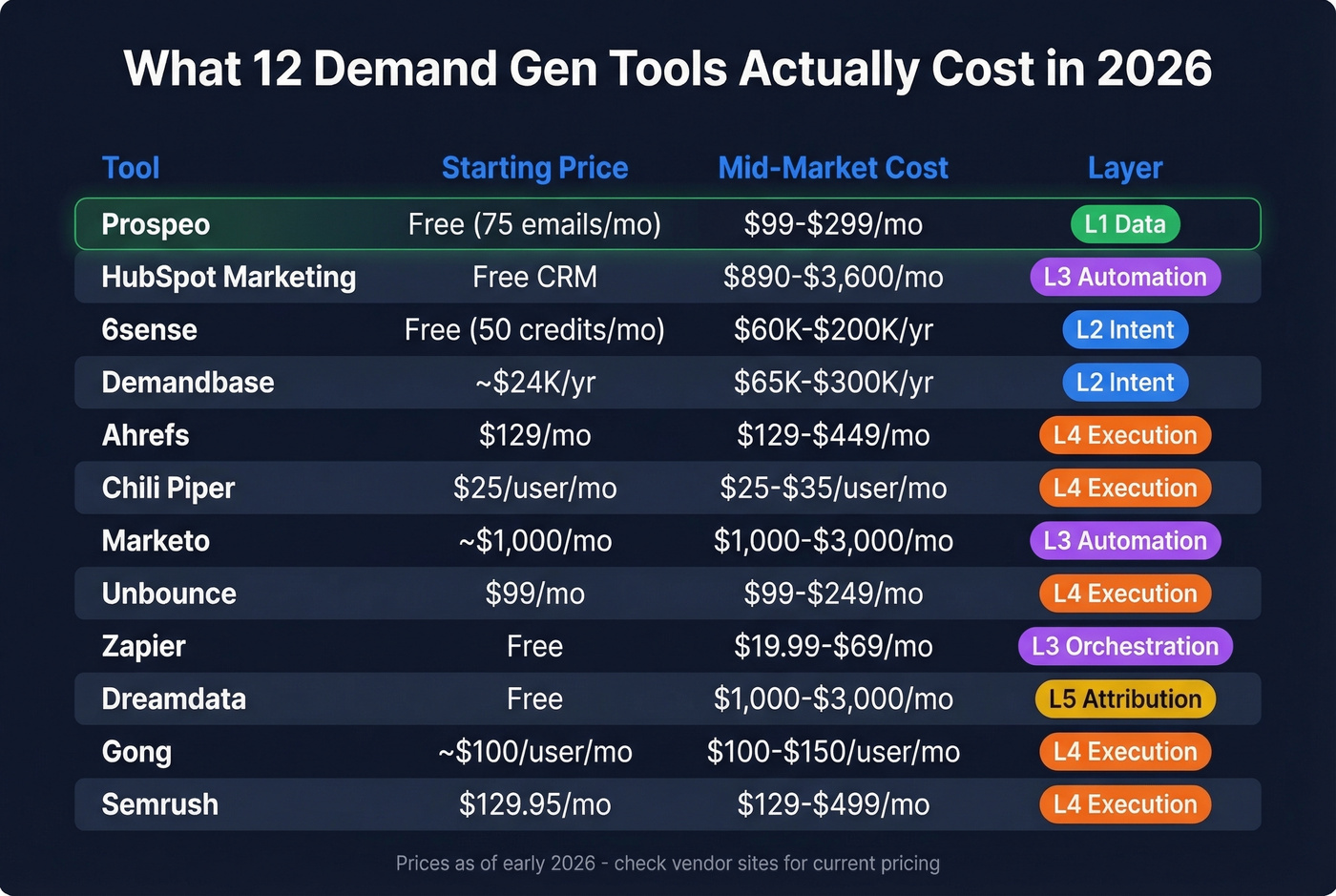
The fact that 6sense, Demandbase, and ZoomInfo still won't publish straightforward pricing tells you everything about how they view their buyers.
Build Your Stack Without Overspending
You need 4-6 tools, not 18. Here's how to layer them by budget.
SMB ($500-$2K/month): Start with Prospeo's free tier for verified contact data, HubSpot's free CRM for automation basics, Ahrefs for SEO, and GA4 for measurement. Total cost: under $200/month. This stack covers Layers 1, 3, 4, and 5 - and it's the same foundation we'd recommend to any demand generation agency building client campaigns from scratch.
Mid-market ($5-$15K/month): Add paid data plans for your foundation and intent signals, HubSpot Marketing Hub Professional, Ahrefs, Chili Piper for conversion, and Dreamdata for attribution. All five layers covered without a six-figure commitment.
Enterprise ($20K+/month): Layer in 6sense or Demandbase for intent, Marketo for automation, Gong for conversation intelligence, and HockeyStack or Dreamdata for attribution. Even at this scale, you still need a clean data layer underneath - bad data at scale just means bad results at scale.
The content multiplier trick: One workflow we've seen work exceptionally well - a team spends 5 hours per week recording a 40-minute podcast episode, then uses Descript and AI tools to repurpose it into 12 LinkedIn posts, a newsletter edition, and 12 short-form video clips. That's an entire week of multi-channel demand gen content from one recording session. Your tools should serve a system like this, not replace it.
Let's be honest about the biggest waste in demand gen: it's not buying the wrong tools. It's buying the right tools in the wrong order. Start with Layer 1. Get your data clean. Then build up.
Plays That Drive Revenue in 2026
The tools above are only as effective as the plays you run with them.
Conversational email sequences that respond to intent signals in real time. When a target account spikes on a relevant Bombora topic, trigger a personalized email within 24 hours - not a generic nurture drip. This turns passive intent data into active pipeline.
SEO-led thought leadership paired with retargeting. Publish the content that answers the questions your buyers ask at month one of a 10-month cycle, then retarget visitors with mid-funnel offers. The compounding effect here is real: that content keeps working for you long after the ad budget runs out.
Signal-based outbound using job change and funding triggers. A new VP of Marketing at a target account is a warmer lead than any MQL score. These plays work because they align with actual buyer behavior - meeting prospects where they are in the cycle instead of where your nurture sequence assumes they are.
The AI Shift and the Cookie Problem
Google's AI Overviews are accelerating zero-click behavior. You're no longer just optimizing for clicks - you're optimizing to be cited.
The teams winning in 2026 run a two-track content approach: LLM-parsable content (structured, data-backed, Q&A-formatted) that gets picked up by AI summaries, plus distinctive human-written content that builds brand affinity AI can't replicate. You need both.
Meanwhile, the deprecation of third-party cookies in B2B is reshaping how teams identify anonymous website visitors. Alternatives - first-party intent data, reverse IP lookup, enriched matched audiences - aren't optional anymore. They're the new baseline.
On the paid side, better data drives measurable gains. Cognism reported that using enriched matched audiences on paid social lifted their CTR from 0.54% to 1.04% without changing creatives, copy, or CTAs. That's a near-2x improvement from data quality alone.
Hot take: Most teams don't have a demand gen problem. They have a data hygiene problem dressed up as a demand gen problem. Fix your bounce rates before you buy another platform.
You just saw the numbers: email delivers 312% ROI at a $510 CAC - but only if your emails land. Prospeo's proprietary 5-step verification, spam-trap removal, and 7-day data refresh keep your domain reputation clean and your sequences hitting real buyers. At ~$0.01/email with no contracts, it costs less than one bad bounce cascade.
Protect your domain and your pipeline - start with clean data.
FAQ
What's the difference between demand generation and lead generation?
Demand generation creates awareness before the buying cycle begins - it puts you on the shortlist. Lead generation captures existing intent at the conversion point. Demand gen fills the top of the funnel; lead gen converts it into pipeline. You need both, but the order matters.
How much should you budget for demand generation tools?
SMB teams should plan for $500-$2K/month, mid-market $5-$15K/month, and enterprise $20K+/month. Most teams overspend on automation and underspend on data quality - flip that ratio and start with Layer 1.
What's the best free option for small teams?
Prospeo's free tier (75 verified emails/month) paired with HubSpot's free CRM and GA4 covers data, automation, and measurement for under $200/month once you add an SEO tool like Ahrefs at $129/month.
Do you need an ABM platform for demand generation?
Only if you're targeting enterprise accounts with $60K+/year to invest. Most mid-market teams get better ROI from SEO ($647 CAC, 748% ROI) than ABM ($4,664 CAC, 240% ROI) - a 7x difference in acquisition cost.
How do you measure demand generation ROI?
Track pipeline sourced by channel, not MQLs. Use attribution tools like Dreamdata or HockeyStack to tie spend directly to revenue. If you can't connect a channel to closed-won deals, you can't justify the budget.