

Demand Generation vs Demand Capture: The Data-Backed Guide for 2026
Your pipeline dropped 30% last quarter. Marketing says awareness is up. Sales says leads are garbage. Both are right - and the disconnect lives in the gap between demand generation and demand capture.
Only about 5% of B2B buyers are in-market at any given time. Meanwhile, buyers are roughly 69% through the purchasing process before they ever talk to a seller - and that figure climbs to 72.4% in APAC markets. If you're only running capture plays, you're fighting over a sliver of the market and losing to brands that planted seeds months ago.
The Short Version
- Demand capture alone structurally caps your pipeline. You can only capture what already exists, and that's about 5% of your total addressable market.
- Demand generation builds the other 95% into future buyers. It's the reason they shortlist you before they ever fill out a form.
- You need both, but the ratio matters. The framework and channel benchmarks below give you the execution steps every other guide skips.
Definitions That Actually Matter
Demand generation creates awareness and preference among buyers who aren't shopping yet. Demand capture converts buyers who are already looking for a solution. The mistake most teams make is treating them as interchangeable - they're not. They operate on different timelines, use different channels, and require different KPIs.
| Demand Generation | Demand Capture | |
|---|---|---|
| Goal | Build awareness + preference | Convert active buyers |
| Funnel stage | Top / mid | Bottom + post-sale expansion |
| Time horizon | 6-18 months | 1-3 months |
| Example channels | Podcasts, content, social | SEO, PPC, review sites, G2 |
| Primary KPI | Brand recall, engagement | Pipeline, revenue |
Some marketers frame gen and capture as a single flywheel - one continuous loop where every touchpoint feeds the next. That sounds elegant, but it obscures the operational reality. Generation and capture run on different timelines, need different budgets, and break in different ways. Treating them as one loop is exactly how teams end up with a 70/30 capture-heavy split and a pipeline that plateaus.
Here's the number that makes this concrete: 84.6% of North American buyers already have a preferred vendor when they first contact sales. If you're not in that consideration set before the buyer enters the market, capture tactics won't save you.
The Three Levels of Buyer Demand
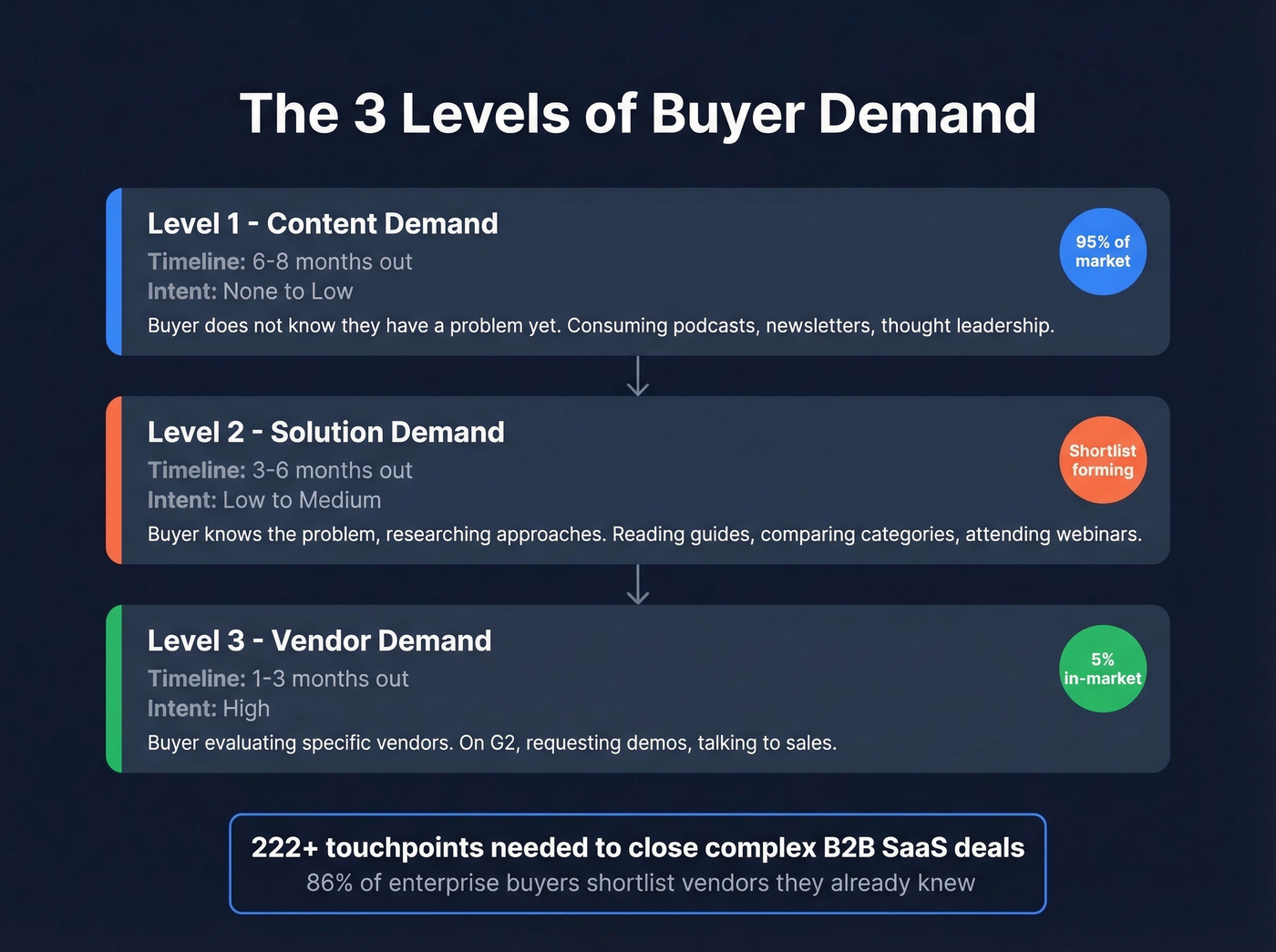
Not all demand is created equal. A useful framework from FullFunnel's B2B playbook breaks buyer demand into three levels, each requiring a different approach.
Level 1 - Content Demand
Six to eight months out, no or low intent. The buyer doesn't know they have a problem yet. They're consuming podcasts, reading newsletters, scrolling thought leadership. Your job here is to be useful and memorable - not to pitch.
Level 2 - Solution Demand
Three to six months out, low to medium intent. The buyer knows they have a problem and is researching approaches - comparing categories, reading guides like this one, attending webinars. You need to be in the conversation here or you won't make the shortlist.
Level 3 - Vendor Demand
One to three months out, high intent. The buyer is evaluating specific vendors. They're on G2, requesting demos, talking to sales. This is where demand harvesting lives - converting the interest you built at earlier levels into pipeline.
It takes 222+ touchpoints to close complex B2B SaaS deals, based on analysis of 1.5M+ contacts across 50+ companies. And per TrustRadius and Pavilion research, 86% of enterprise buyers shortlist vendors they'd already heard of before starting research. If you're invisible at Levels 1 and 2, you're structurally locked out of Level 3.

222+ touchpoints to close a deal means you need accurate data at every level of demand. Prospeo's 300M+ profiles with 98% email accuracy and intent data tracking 15,000 topics let you reach the 95% who aren't in-market yet - and capture the 5% who are.
Stop fishing in the 5% pond. Build pipeline across the full market.
What Actually Converts - Channel Benchmarks
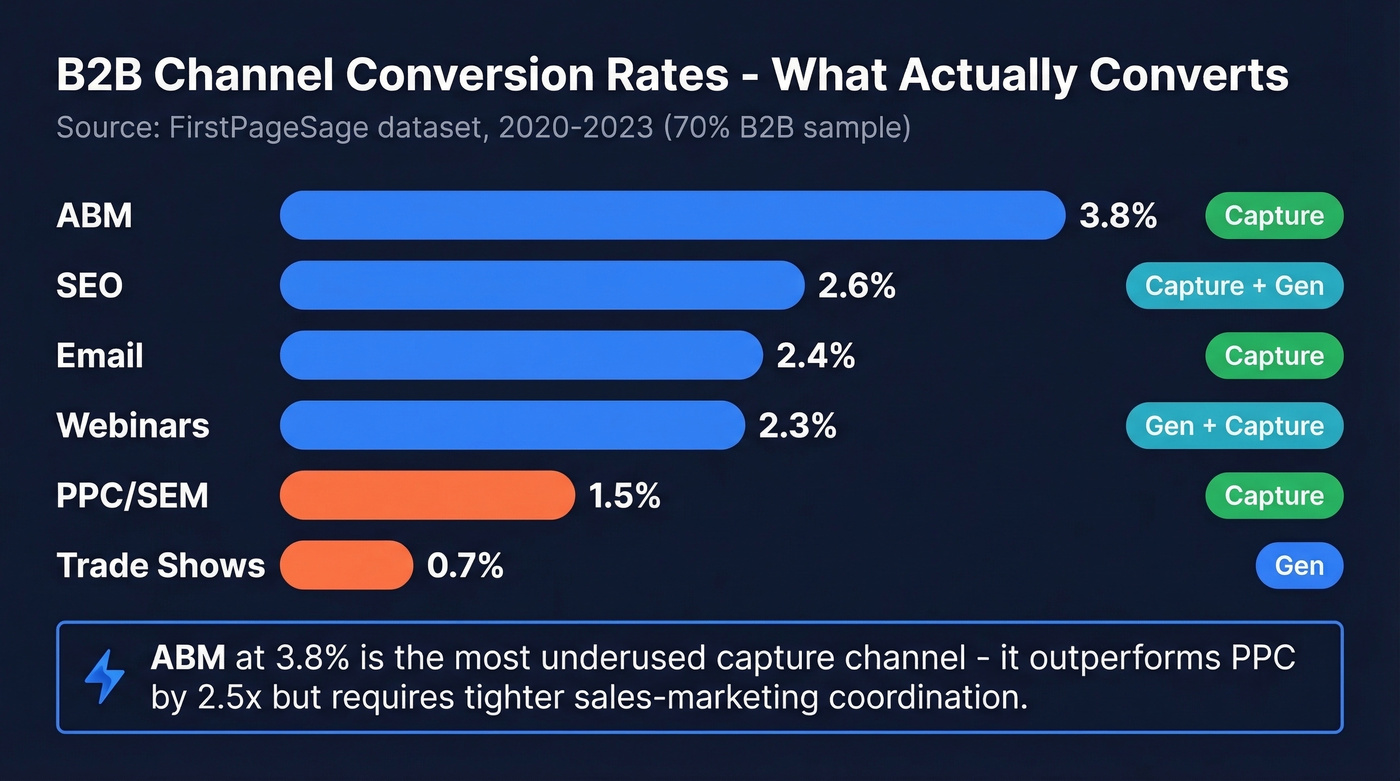
Let's put numbers on this. Conversion rates by channel from a FirstPageSage dataset covering 2020-2023 (70% B2B):
| Channel | Avg Conversion Rate | Primary Role |
|---|---|---|
| ABM | 3.8% | Capture |
| SEO | 2.6% | Capture + Gen |
| 2.4% | Capture | |
| Webinars | 2.3% | Gen + Capture |
| PPC/SEM | 1.5% | Capture |
| Trade shows | 0.7% | Gen |
ABM at 3.8% is the most underused capture channel we see. Most teams default to PPC because it's easier to spin up, but ABM consistently outperforms when you have clear ICP definition and decent data. The tradeoff is operational complexity - ABM requires tight marketing-sales coordination that PPC doesn't.
Review sites like G2 and Capterra aren't in this dataset, but they function as high-intent capture channels where buyers are actively comparing vendors, putting them closer to ABM conversion rates than PPC.
On the paid side, expect an average search CPC around $5.26 (WordStream cross-industry data), B2B SaaS CTR around 4%, and a cost per lead in business services of roughly $104. If your capture spend is high and conversion is low, the problem is almost always upstream - you're trying to harvest interest that doesn't exist yet.
How to Split Your Budget
A 2026 survey of 400 senior marketing leaders found brand awareness commands about 15-17% of total marketing spend, with lead generation at roughly 13-15%. That's directional, but it doesn't tell you how to allocate between generation and capture.
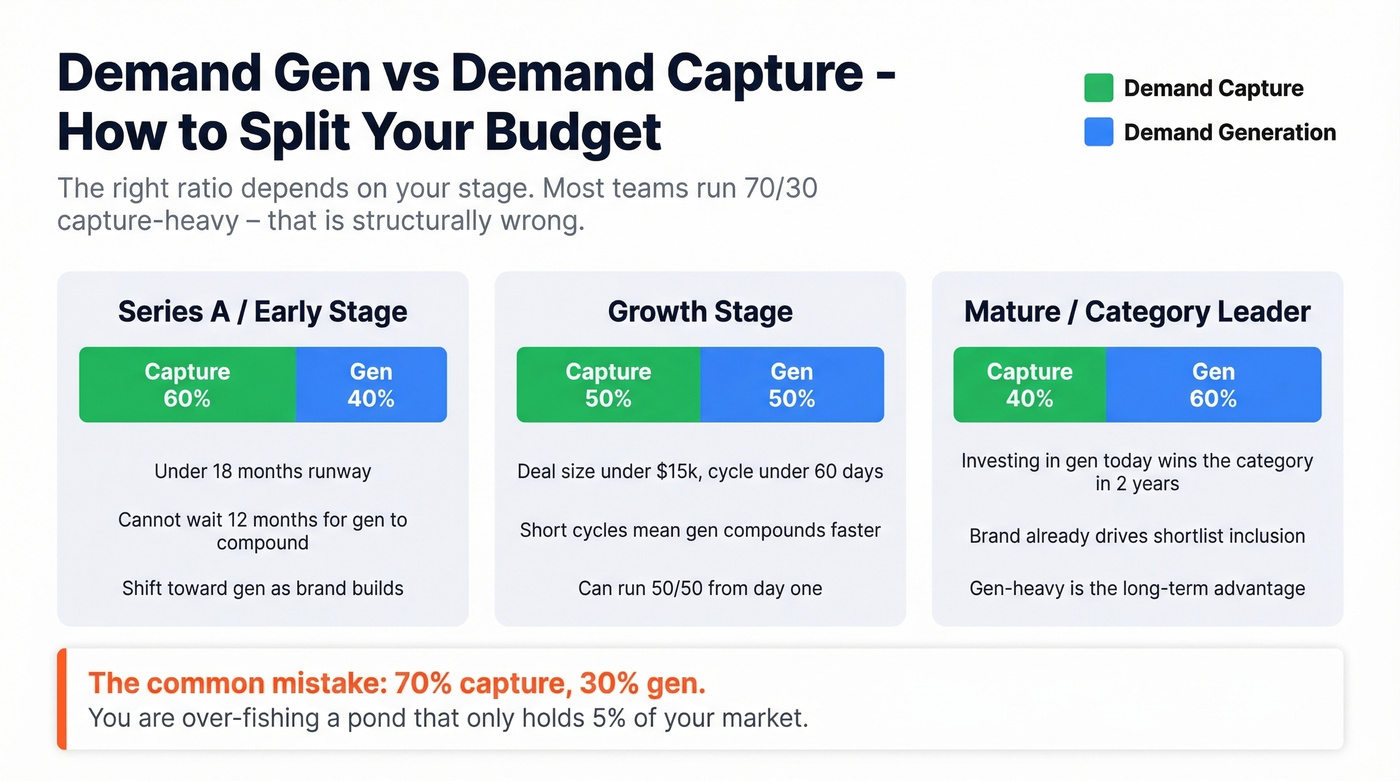
Most teams run a 70/30 capture-heavy split. That's structurally wrong for long-term growth. You're over-fishing a pond that only holds 5% of your market.
The right ratio depends on stage. A Series A company with 18 months of runway can't wait 12 months for demand gen to compound - run 60/40 capture-to-gen, then shift as your brand builds. Mature companies should be at 50/50 or even 40/60 gen-heavy. The companies that dominate categories in 2026 invested in gen two years ago.
Here's a take we'll stand behind: if your average deal size is under $15k and your sales cycle is under 60 days, you can run 50/50 from day one. Short cycles mean your gen investments compound faster - you don't need the 12-month runway that enterprise sellers do.
The #1 Mistake: Demand Gen Theater
We've seen this pattern dozens of times. A marketing team generates 2,000 MQLs in a quarter. Sales accepts 180. Leadership asks what happened, and marketing defends the volume. That's not demand generation - it's lead gen with a rebrand.
The symptoms are predictable: everything is gated, every webinar ends with a demo CTA, and marketing's primary metric is MQL count. The structural problem is that these tactics only work on buyers already in motion. You're not generating demand. You're capturing it badly and calling it something else.
And even when teams do run real demand gen, bad data on the capture side undermines the whole effort. If your bounce rate is above 5%, your data provider is the issue before your strategy is. Snyk's team of 50 AEs dropped bounce rates from 35-40% to under 5% after switching to Prospeo's 5-step verification on a 7-day refresh cycle - and AE-sourced pipeline jumped 180%. You can't fix demand gen theater with better messaging alone; you need data that actually reaches people.
How to Execute Demand Capture
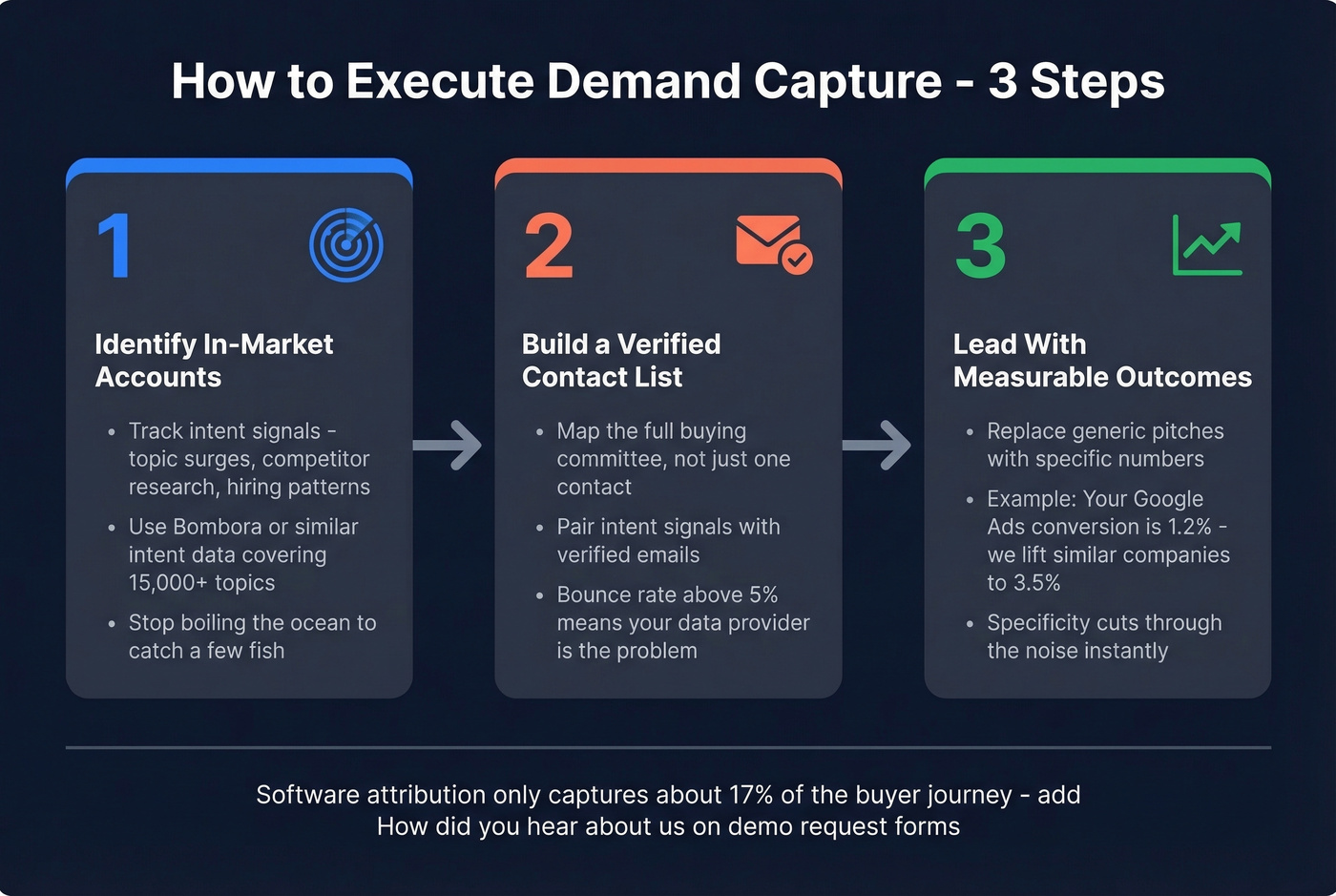
Once you've built awareness through content, brand, and community, you need to capture it efficiently. Demand harvesting at this stage is about precision, not volume. Three operational steps separate teams who convert from teams who waste budget.
1. Identify In-Market Accounts
Don't guess. Intent signals - topic surges, competitor research, hiring patterns - tell you which accounts are actively evaluating solutions. Without this, you're doing what one Reddit practitioner called "boiling the ocean to catch a few fish."
2. Build a Verified Contact List
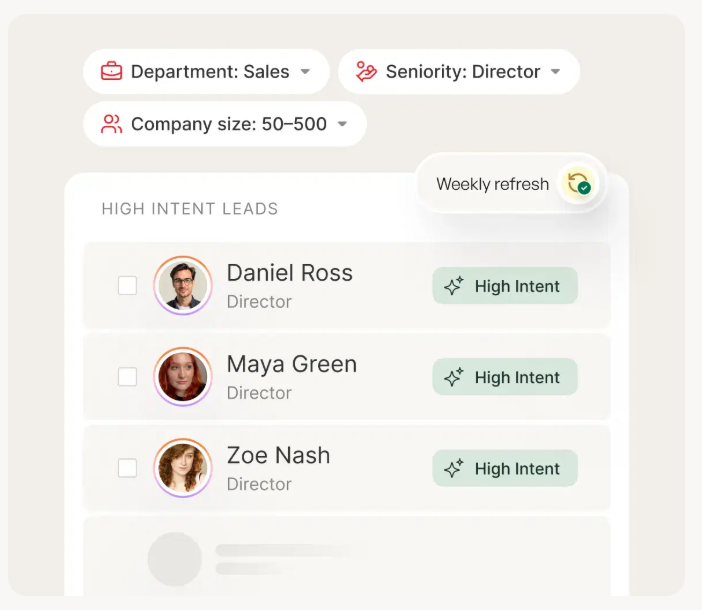
Knowing an account is in-market is useless if you can't reach the buying committee. This is where your data provider matters most - intent signals paired with verified contacts, or you're stuck knowing an account is ready but unable to reach anyone. Prospeo handles both sides: 15,000 Bombora intent topics mapped to 300M+ professional profiles, with 98% email accuracy.
3. Lead With Measurable Outcomes
The same Reddit thread nailed this: instead of "let us build you a website," try "your Google Ads spend is generating a 1.2% conversion rate - we've lifted similar companies to 3.5%." Another commenter added that leading with specific numbers "cuts through the noise instantly." Specificity converts. Generic pitches get ignored.
On measurement: software attribution only captures about 17% of the buyer journey. For everything else, add a "How did you hear about us?" field on high-intent forms like demo requests. For teams with budget, incrementality testing - running controlled holdout groups - is the gold standard for measuring gen's true lift, but it requires scale most mid-market teams don't have.
If you're tightening the capture motion, it also helps to standardize your lead scoring so sales prioritizes the same signals marketing is paying for.
Running ABM at 3.8% conversion requires tight ICP targeting and clean data. Prospeo gives you 30+ filters - buyer intent, technographics, headcount growth, funding - so your capture campaigns only hit accounts your gen efforts already warmed up. At $0.01 per email, scaling both motions doesn't break the budget.
Fuel both demand gen and demand capture from one platform.
FAQ
Is demand generation the same as lead generation?
No. Lead gen collects contact info from people who may not care about your product - gated ebooks and form fills. Demand gen builds genuine interest so buyers seek you out when they're ready. The distinction changes what you measure: brand recall and engagement vs. MQL volume.
How do you measure demand generation ROI?
Add a "How did you hear about us?" field on high-intent forms like demo requests, not ebook downloads. This self-reported attribution captures dark-funnel sources - podcasts, word-of-mouth, community mentions - that analytics software misses, covering the roughly 83% of the buyer journey that happens off your owned properties.
What tools do you need for a demand capture strategy?
At minimum: intent data to identify in-market buyers, a verified contact database, and a CRM that tracks conversion by source. Layer in a sequencing tool like Instantly or Smartlead for outreach, and you've got a full capture stack.
What's the difference between demand creation and demand capture?
Demand creation educates and influences buyers who don't yet know they need a solution - building the market before you sell into it. Demand capture targets buyers who already have intent and are actively evaluating vendors. Most pipeline problems stem from over-investing in capture while neglecting creation, which shrinks the pool of future buyers you can convert.