

Demand Generation vs Lead Generation: The Practitioner's Guide
"Marketing sent us 500 leads last month and we booked 3 meetings." If that Slack message sounds familiar, you're living the MQL quality crisis. The demand generation vs lead generation debate isn't new, but the stakes keep climbing. A Marketing Week survey of 450 B2B marketers found that 37.7% are under pressure to deliver MQLs regardless of quality. Barney O'Kelly at AlixPartners put it bluntly: most of what passes for lead generation is "data processing, not marketing."
This isn't a glossary. It's an operational guide for teams that need to stop confusing activity with strategy.
The Short Version
Demand gen creates desire before buyers are in-market. Lead gen captures it once they are. You need both - but most teams over-index on lead gen because it's easier to measure.
If 37.7% of your peers are pressured to deliver MQLs regardless of quality, you're not alone - and the fix isn't more gating. Below: a side-by-side comparison, channel benchmarks with actual CPL numbers, a named case study, and a decision framework.
Definitions That Actually Matter
Demand generation is the work you do to build awareness, trust, and intent before a buyer is actively shopping. Podcasts, ungated guides, brand campaigns, community presence - anything that makes your name the one they already know when a need surfaces.
Lead generation captures contact information from buyers who are already showing intent. Gated content, demo forms, webinar registrations, outbound sequences - anything that converts anonymous interest into a name and email you can work.
The cleanest way to think about it: demand gen creates demand, lead gen captures it. Gartner reports that more than 60% of software buyers choose the brand they had in mind at the start of their search. If you're not on that mental shortlist, your lead gen is fighting uphill from the first touchpoint.
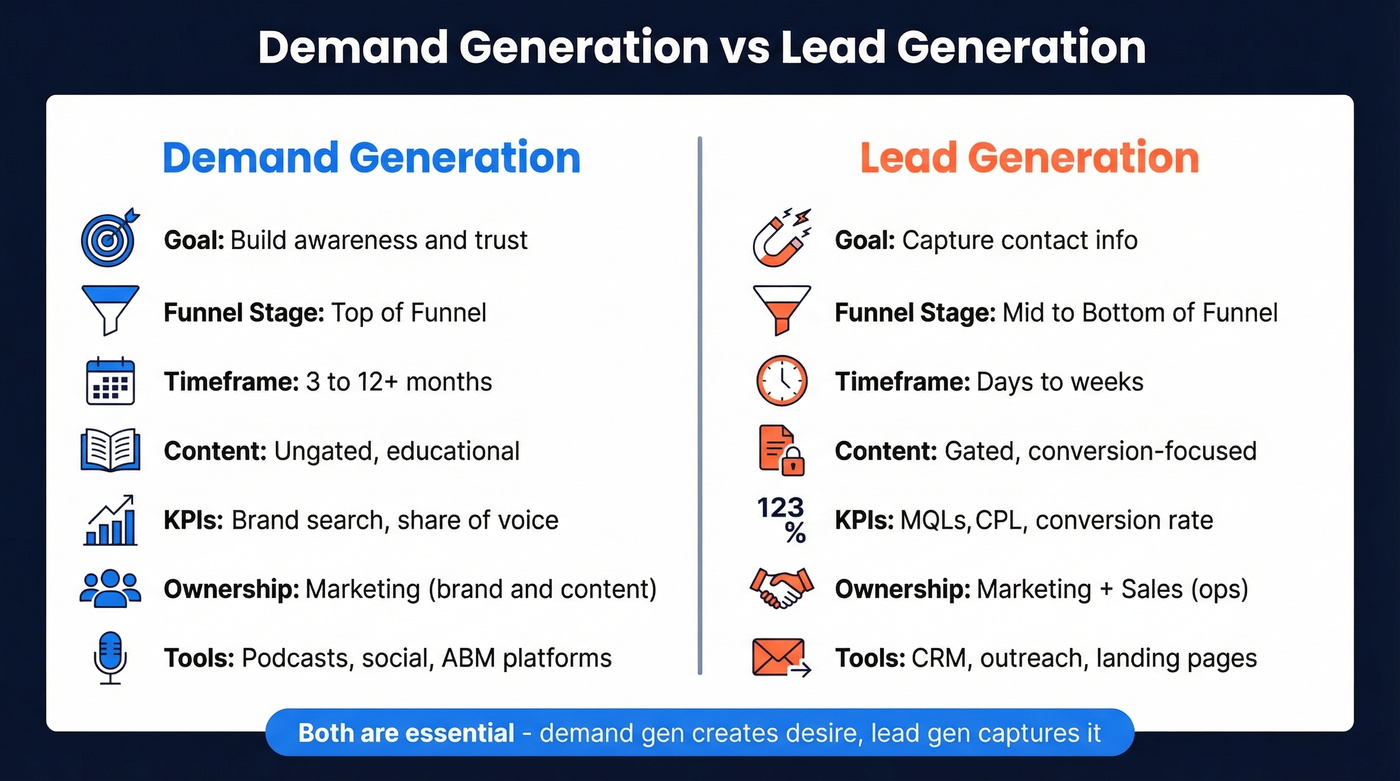
Side-by-Side Comparison
| Dimension | Demand Gen | Lead Gen |
|---|---|---|
| Goal | Build awareness + trust | Capture contact info |
| Funnel Stage | TOFU | MOFU-BOFU |
| Timeframe | 3-12+ months | Days-weeks |
| Content | Ungated, educational | Gated, conversion-focused |
| KPIs | Brand search, share of voice | MQLs, CPL, conversion rate |
| Ownership | Marketing (brand/content) | Marketing + Sales (ops) |
| Example Tools | Podcasts, social, ABM | CRM, outreach, landing pages |
Why Demand Gen Matters More Than Ever
Picture the board meeting: the CEO asks why marketing spend is up 20% but pipeline is flat. The answer, almost always, is that the team has been optimizing lead capture while the market's attention has shifted upstream.
Buyers don't behave the way our funnels assume. They self-research across 10+ channels before talking to a single rep. Buying committees run 6-10 decision-makers deep. And 98% of software buyers say reading reviews is important before making a purchase decision. Shortlists form before forms get filled out.
Paige O'Neill, CMO at Culture Amp, captured the shift well: "The things we used to do to generate leads... don't work as effectively anymore." The LinkedIn 2026 B2B Marketing Benchmark reinforces this - 94% of senior marketers agree trust is the key to B2B success, and 42% say increasing brand awareness among decision-makers is their top priority. Brands using video and influencer partnerships are 2.2x more likely to be trusted.
Here's the thing: 49% of marketing leaders report declining traditional search traffic due to AI-generated answers. The organic traffic firehose that powered content-led lead gen for a decade is narrowing. If your entire pipeline depends on someone searching for a problem, finding your gated PDF, and filling out a form, you're building on a shrinking foundation.
Demand gen isn't optional anymore. It's the cost of entry.
When Lead Gen Is Your Entire Strategy
That same Marketing Week survey found that 26.7% of B2B marketers say delivering leads is their only metric of success. Not pipeline. Not revenue. Leads.
This confusion plays out daily in B2B marketing communities - practitioners on r/sales and r/marketing routinely debate whether demand gen is "replacing" lead gen, when the real problem is that most teams never did demand gen in the first place. The Sirocco Group describes this pattern well: instead of addressing demand creation, teams double down on demand capture, squeezing harder on a funnel that's already dry at the top.
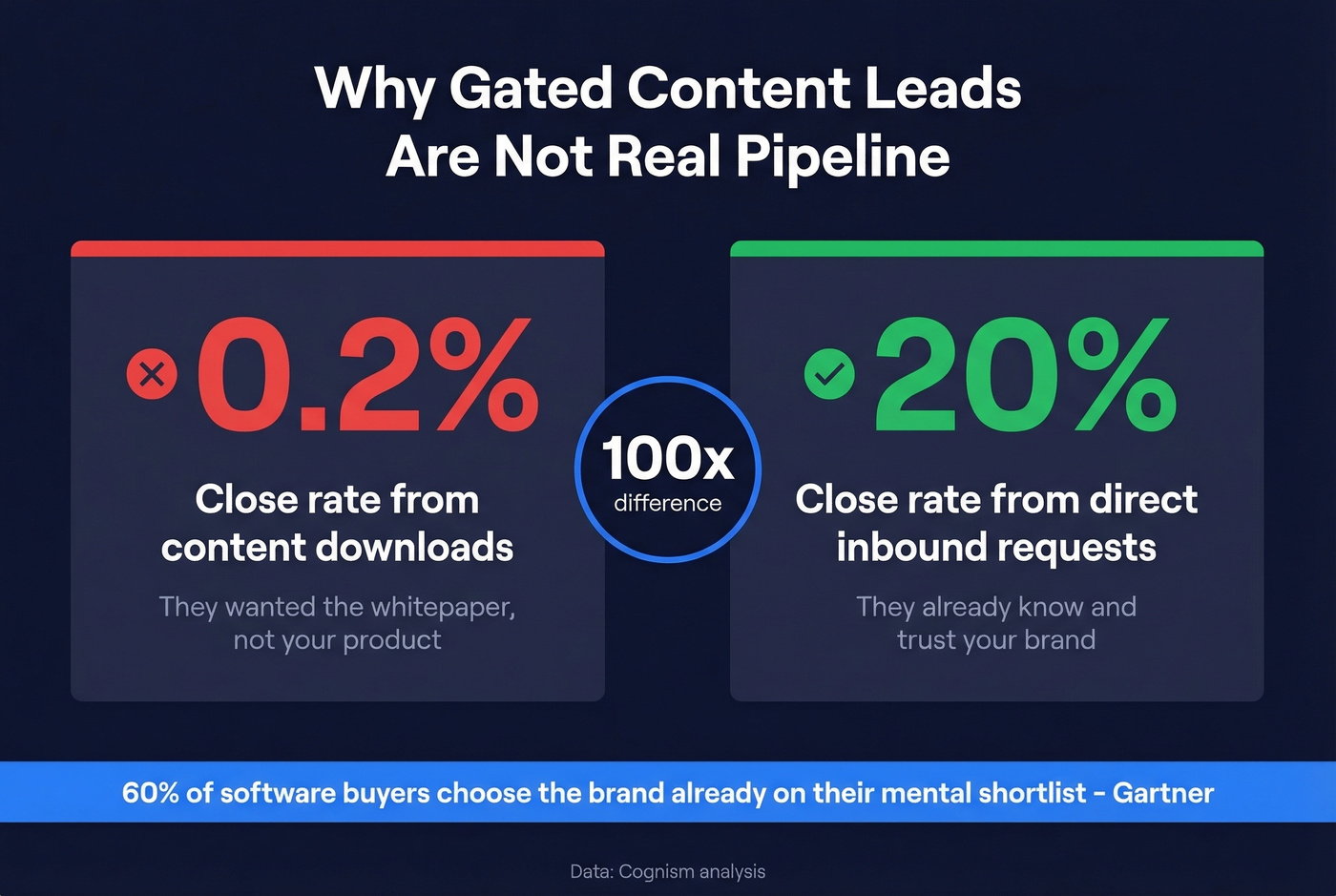
The results are predictable. Cognism's analysis showed a 0.2% close rate from content leads versus 20% from direct inbound requests. That's a 100x difference. When someone downloads your whitepaper because they want the whitepaper - not because they want your product - calling them an MQL is a polite fiction.
Now for the hot take: if your average deal size is under $15K, you probably don't need a sophisticated demand gen engine. A strong founder brand, a few ungated guides, and a tight outbound motion will carry you further than a six-figure ABM platform. But the moment you're selling to buying committees with 6+ stakeholders and 90-day sales cycles, demand gen stops being a nice-to-have and becomes the entire game.

Your demand gen creates the shortlist. Your lead gen captures it. But both fall apart when 35% of your emails bounce. Prospeo's 98% email accuracy and 125M+ verified mobiles mean the prospects you worked so hard to warm actually receive your outreach - no burned domains, no wasted pipeline.
Stop losing demand you already created to bad contact data.
How Both Strategies Work Together
Let's map this to HubSpot's three-stage buyer journey - Awareness, Consideration, Decision - with actual activities at each stage.
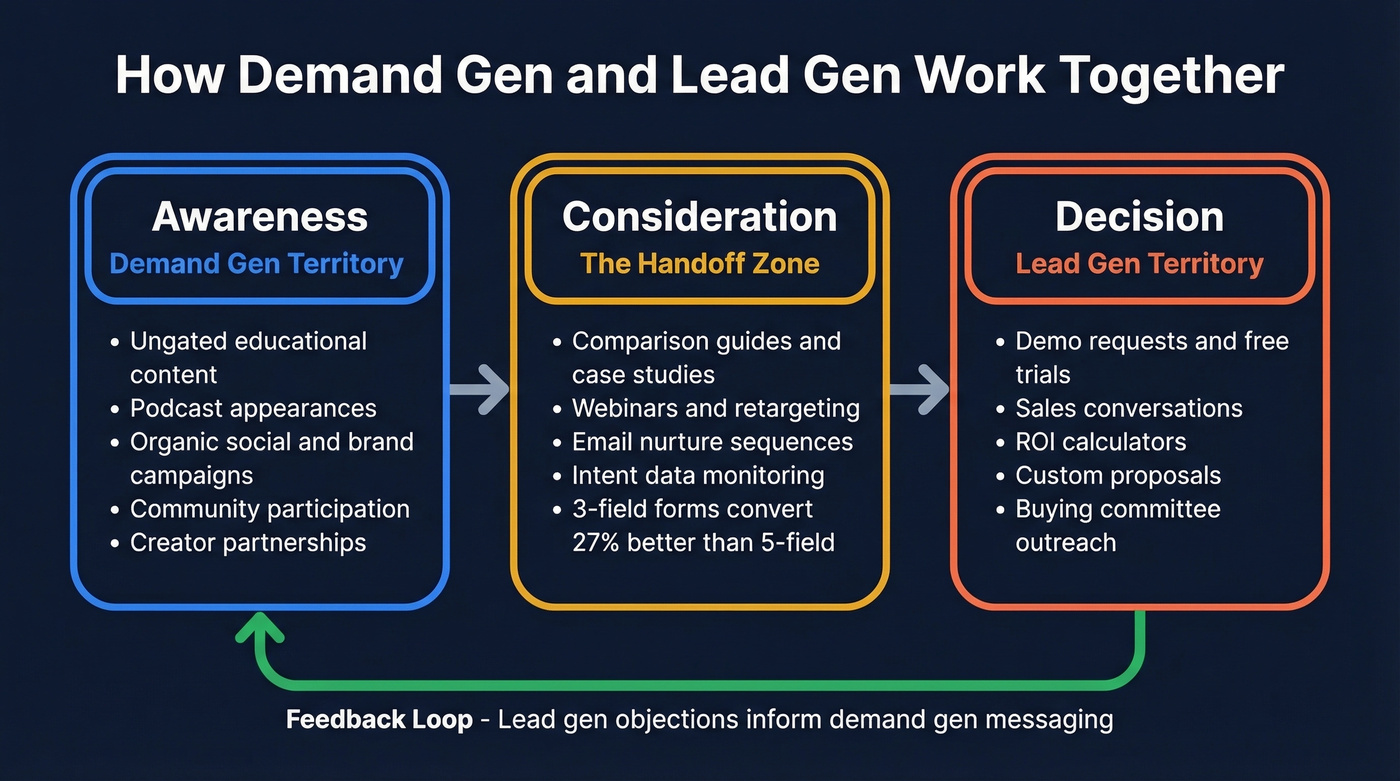
Awareness stage (demand gen territory): Ungated educational content, podcast appearances, organic social, brand campaigns, thought leadership, community participation, and creator partnerships. The goal is to get on the shortlist before the buyer knows they're building one.
Consideration stage (the handoff): Comparison guides, case studies, webinars, retargeting campaigns, email nurture sequences, and intent data monitoring. This is where 3-field forms convert 27% better than 5-field forms - reduce friction at the exact moment interest peaks.
Decision stage (lead gen territory): Demo requests, free trials, sales conversations, ROI calculators, custom proposals, and direct outreach to buying committee members. Capture and convert hand-raisers.
The critical piece most teams miss is the feedback loop. Lead gen data should inform demand gen messaging - if your SDRs hear the same objection in every discovery call, that objection belongs in your ungated content. And demand gen should warm prospects so lead gen conversion rates climb over time.
We've seen ungating content reduce form-fill volume by 50-70% but increase lead-to-opportunity conversion 2-3x across multiple teams we've worked with. The math works out in favor of ungating, especially when you factor in the buying committee reality. You're not selling to one person who fills out a form - you're selling to 6-10 people who all need to trust you before a deal closes.
Benchmarks Worth Tracking
Channel Benchmarks (2026 Directional)
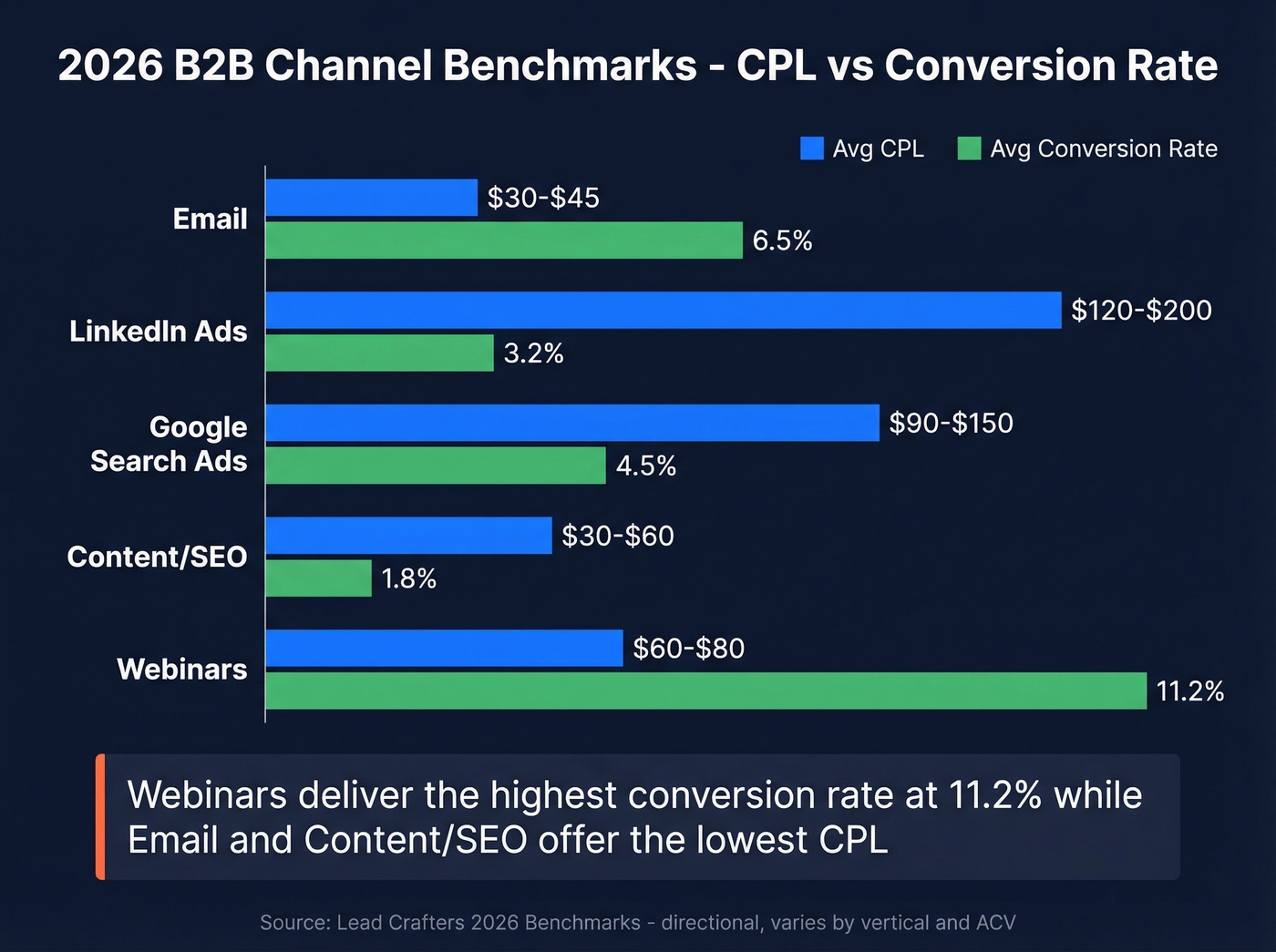
| Channel | Avg CPL | Avg Conversion |
|---|---|---|
| $30-$45 | 6.5% | |
| LinkedIn Ads | $120-$200 | 3.2% |
| Google Search Ads | $90-$150 | 4.5% |
| Content/SEO | $30-$60 | 1.8% |
| Webinars | $60-$80 | 11.2% |
Source: Lead Crafters 2026 benchmarks. Your vertical and ACV will shift these significantly.
Funnel Conversion Benchmarks
| Stage | Great | Average |
|---|---|---|
| Visitor to Lead | >5% | 2-5% |
| MQL to SQL | >60% | 40-60% |
| Lead to Customer | >20% | 10-20% |
Demand gen ROI doesn't show up in first-touch attribution. Expect early signals - brand search volume, direct traffic, inbound demo requests - within 3-6 months. Compounding pipeline impact takes 6-12 months. In our experience, demand gen programs influence 40-60% of pipeline, but first-touch models only capture 10-20% of that credit. If your attribution model only credits the last form fill, demand gen will always look like it's underperforming.
None of these conversion rates matter if the contact data is bad. One real example: Snyk's team of 50 AEs cut bounce rates from 35-40% to under 5% after switching data providers, and AE-sourced pipeline jumped 180%. Bad data is the silent killer of every funnel metric in both tables above.
JupiterOne's Year-Long Transition
JupiterOne, a Series C cybersecurity startup, spent a full year transitioning from a lead-gen engine to a demand gen motion. The operational change was deceptively simple: they redefined MQL from "ICP + email address" to "ICP + purchase intent behavior." Sales would only receive leads that appeared genuinely in-market.
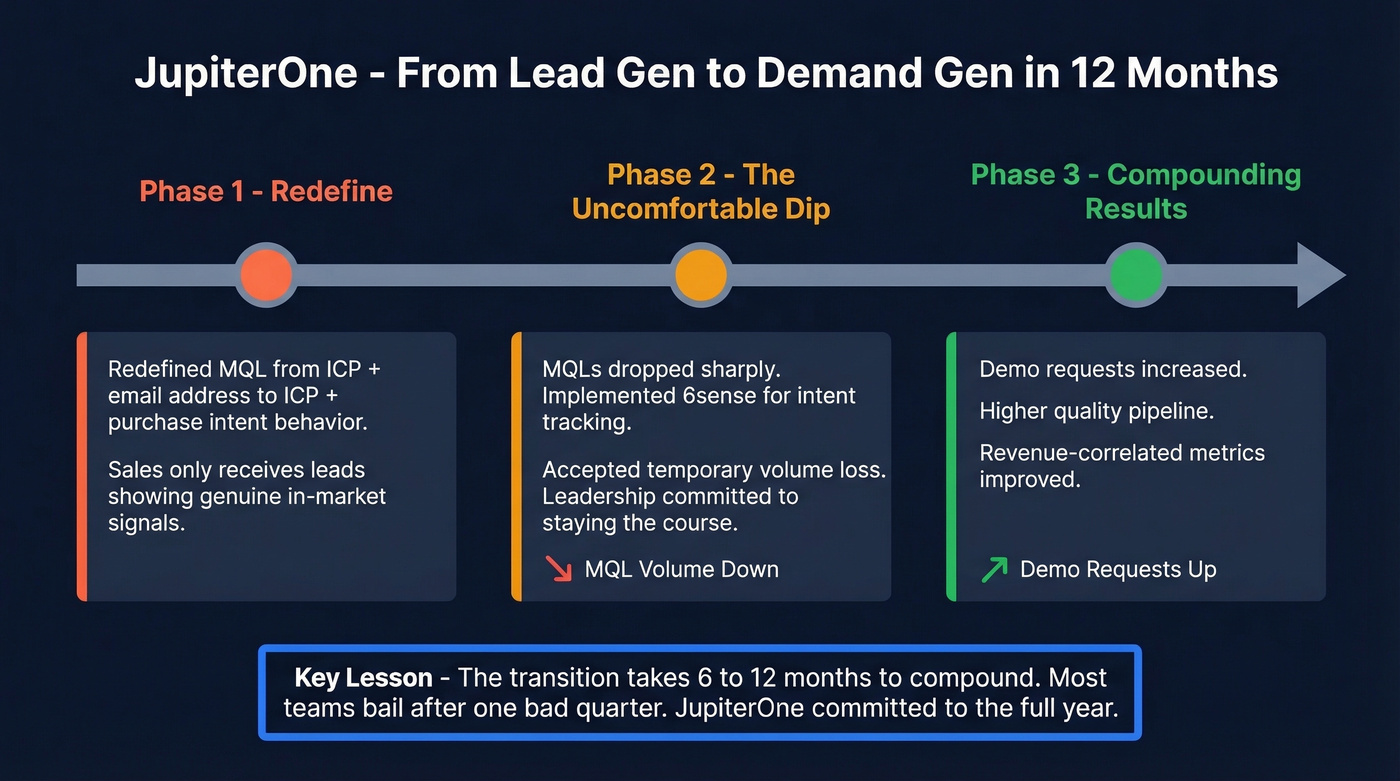
The short-term result was uncomfortable. MQLs dropped sharply. But demo requests - the metric that actually correlates with revenue - increased. The team implemented 6sense to track intent signals, though they noted real limitations: cookies and reverse IP don't work well when your buyers are cybersecurity professionals who block tracking by default.
The lesson isn't "buy 6sense." It's that the transition requires redefining what counts as a lead, accepting a temporary volume drop, and giving the program 6-12 months to compound. JupiterOne's leadership committed to the full year. Most teams bail after one bad quarter.
Tools That Power Each Strategy
The lead gen software market runs $7.4B and is projected to hit $16.2B by 2034 at a 9.1% CAGR. Here's how the stacks break down.
Demand gen stack:
- Content platforms - WordPress, Webflow, podcast hosting (free-$50/mo)
- Social and community - organic social, Slack communities, Reddit (free + time)
- ABM and intent - 6sense (~$30-100K+/yr), Bombora (~$25-50K/yr), Demandbase (~$30-100K+/yr)
- Video and events - webinar platforms, YouTube, short-form video ($0-$500/mo)
Lead gen stack:
- CRM - HubSpot (free-$150/mo/user), Salesforce ($25-$550/user/mo)
- Outreach automation - Outreach (~$100-150/user/mo), Salesloft (~$100-150/user/mo), Instantly (~$30-97/mo), Lemlist (~$39-129/mo)
- Landing pages and CRO - Unbounce (~$74-$187/mo), Leadpages (~$37-$74/mo)
The bridge between the two stacks is data quality. Your demand gen program builds awareness over months. Your lead gen captures that interest. But if the contact data is stale when an SDR picks up the phone, the entire investment leaks at the handoff. Prospeo refreshes its 300M+ professional profiles every 7 days - the industry average is 6 weeks - with 98% email accuracy. That freshness gap is the difference between a connected call and a bounced email.
Where to Start
You're a startup with no brand recognition. Demand gen first. Lead gen without brand awareness is cold outreach into a void. Invest in ungated content, community presence, and thought leadership. Run a small outbound motion in parallel to learn your messaging, but don't expect it to carry pipeline alone.
You have traffic but no pipeline. Fix the conversion layer. Your demand gen is working - people know you exist. Now improve CTAs, clarify demo paths, speed up lead routing, and verify your contact data so SDRs aren't chasing dead emails.
You have both but low win rates. Redefine your MQL around intent behavior, not form fills. Look at what JupiterOne did. Stop counting whitepaper downloads as pipeline and start tracking demo requests, pricing page visits, and multi-stakeholder engagement.
Skip the expensive ABM platforms if you're pre-Series A. They're built for teams with established brand presence and the budget to run multi-channel campaigns across large account lists. For early-stage companies, a founder's personal brand and a clean contact database will outperform any $50K/yr intent tool.
The demand generation vs lead generation decision isn't binary - it's about sequencing the right investment at the right stage of your company's growth. If you're starting from zero, demand gen first. Always. Everything else is a rounding error until people know your name.
Selling to 6-10 person buying committees means you need every stakeholder's direct contact. Prospeo's 300M+ profiles with 30+ filters - including buyer intent, job changes, and department headcount - let you map entire committees and reach them with verified emails and direct dials.
Reach the full buying committee, not just the one person who filled out your form.
FAQ
What's the difference between lead generation and demand generation?
Demand gen builds awareness and trust before buyers are shopping. Lead gen captures contact information once they show intent. You need both - the question is sequencing. Most teams over-index on lead gen because it's measurable, then wonder why conversion rates stay below 5%.
Is demand generation replacing lead generation?
No. Demand gen creates the conditions that make lead gen effective. Without it, lead gen is cold outreach into indifference. Without lead gen, demand gen is brand awareness with no conversion mechanism. The ratio shifts based on brand maturity and average deal size.
How long before demand gen shows ROI?
Expect early signals - brand search volume, inbound inquiries, direct traffic - within 3-6 months. Compounding pipeline impact takes 6-12 months. Run lead gen in parallel to cover short-term revenue targets while demand gen builds.
What tools bridge demand gen and lead gen?
Intent data platforms like Bombora and 6sense identify in-market accounts before they fill out a form. CRMs track the full journey. Data quality tools like Prospeo ensure contact information is valid at handoff - so reps reach prospects instead of bouncing off stale records.
How should I split budget between the two?
Early-stage companies should weight 60-70% toward demand gen and 30-40% toward lead gen. As brand awareness matures and inbound volume grows, shift closer to 50/50. Watch lead-to-opportunity conversion rate - if it's climbing, your demand gen is working and you can invest more in capture.