

Direct Mail Prospecting: A Data-Driven Guide (2026)
Your SDR team sent 12,000 cold emails last month. Open rates looked decent. Reply rates were brutal. Now someone on the leadership team is asking about direct mail prospecting, and you're wondering if it's a real channel or a nostalgia play.
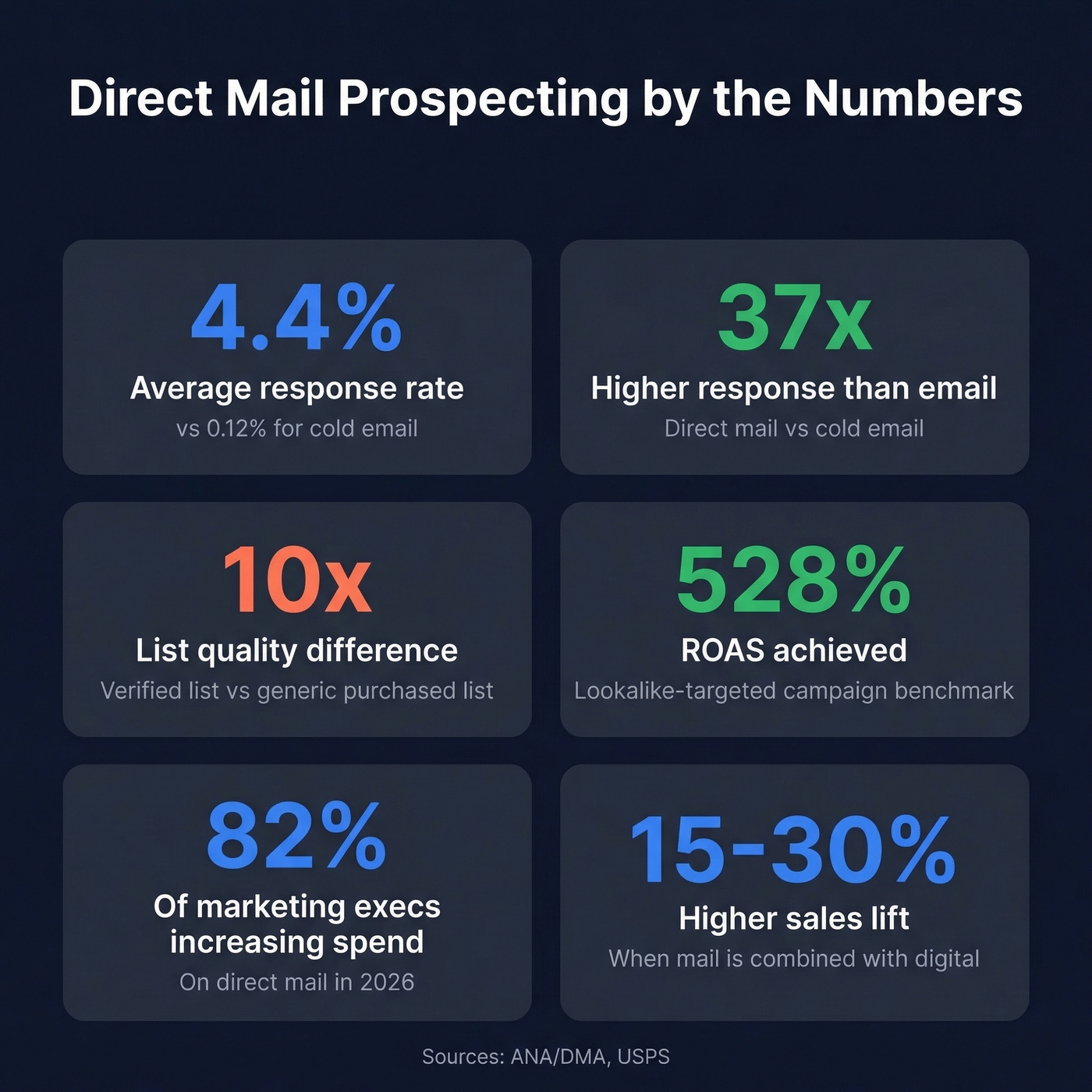
It's real. Direct mail averages a 4.4% response rate vs. email's 0.12%. With more companies pushing return-to-office policies, decision-makers are back at desks opening mail. People spend 45% longer with physical mail than digital ads - 1.6 minutes vs. 1.1 minutes. This channel is having a moment in B2B sales, and the gap between campaigns that print money and campaigns that burn it comes down to your data.
Here's the thing: direct mail is a data problem first and a creative problem second. Every other guide focuses on creative. This one focuses on data, because that's where 60%+ of your results come from.
What It Actually Costs in 2026
"Direct mail" covers everything from a $0.35 EDDM postcard to a $25 dimensional box with a branded gift inside. The format determines your budget more than anything else.
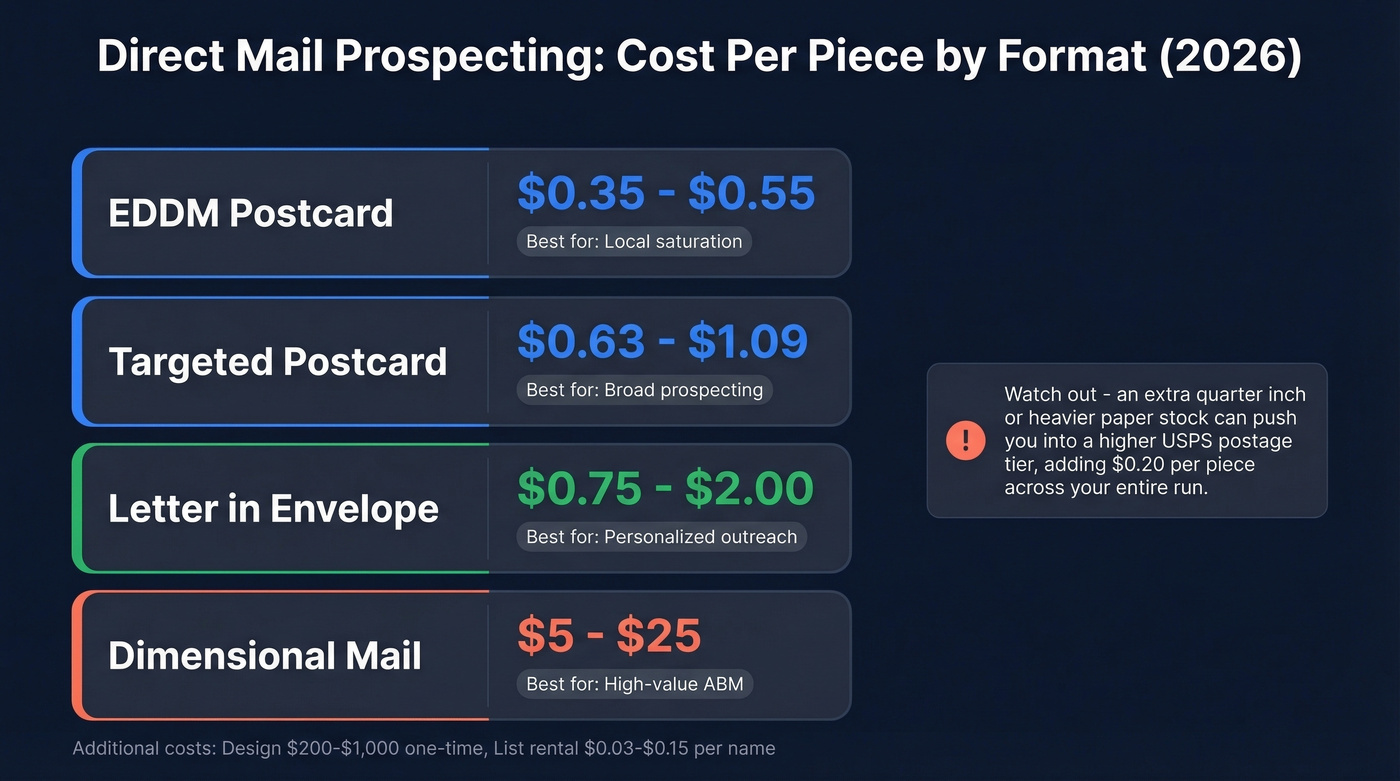
| Format | All-In Cost/Piece | Best For |
|---|---|---|
| EDDM postcard | $0.35-$0.55 | Local saturation |
| Targeted postcard | $0.63-$1.09 | Broad prospecting |
| Letter in envelope | $0.75-$2.00 | Personalized outreach |
| Dimensional mail | $5-$25 | High-value ABM |
Beyond postage and printing, budget for design ($200-$1,000 one-time) and list acquisition ($0.03-$0.15 per name if renting). One pitfall we see constantly: small format changes - an extra quarter-inch, a heavier stock - push you into a higher USPS postage tier and add $0.20/piece across the entire run. Spec your mailer to the postage class, not the other way around.
Response Rates by Format
Most guides say start with postcards because they're cheap. That's wrong for prospecting. In one head-to-head test, a letter package beat a double postcard 3-to-1. If your deal size justifies $1-$3/piece, start with letters.
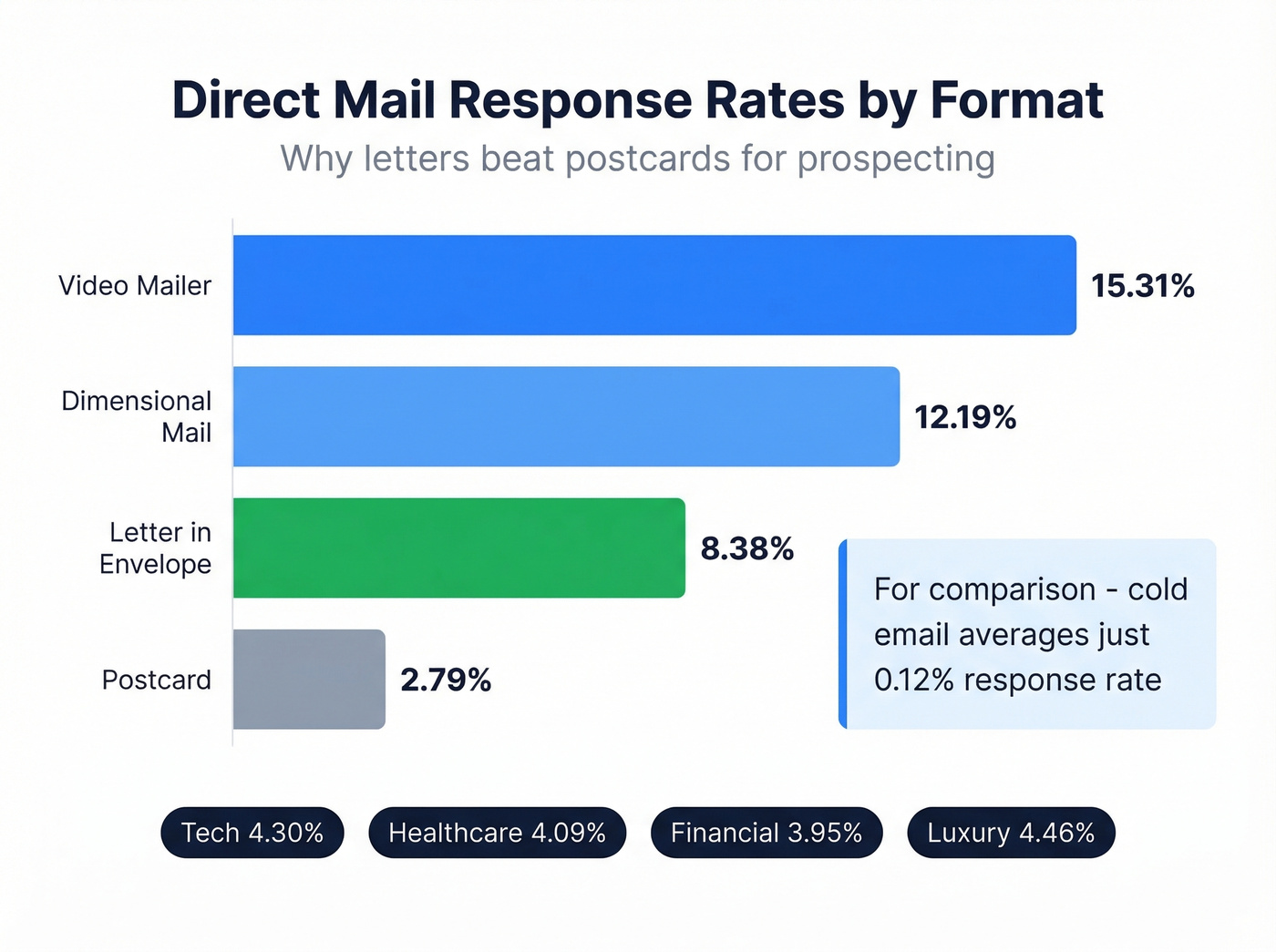
| Format | Avg Response Rate |
|---|---|
| Postcard | 2.79% |
| Letter in envelope | 8.38% |
| Dimensional | 12.19% |
| Video mailer | 15.31% |
Industry averages vary - technology 4.30%, healthcare 4.09%, financial services 3.95%, luxury goods 4.46%. For proof the channel delivers real ROI: a luxury clothing brand ran a lookalike-targeted campaign and hit 528% ROAS at a $43 CPA. That's consistent with broader trends. 82% of marketing executives are increasing direct mail investment, and 79% rank it among their top-performing channels.
If your average deal is under $10k, you probably don't need dimensional mail. A well-targeted letter with a strong offer will outperform a $25 box sent to a mediocre list every single time.
How to Run a Campaign
Build and Verify Your List
List quality drives everything. A verified, targeted list can pull 4%+ response rates. A generic purchased list? Around 0.4%-1%. That's a 10x difference for the identical mailer.
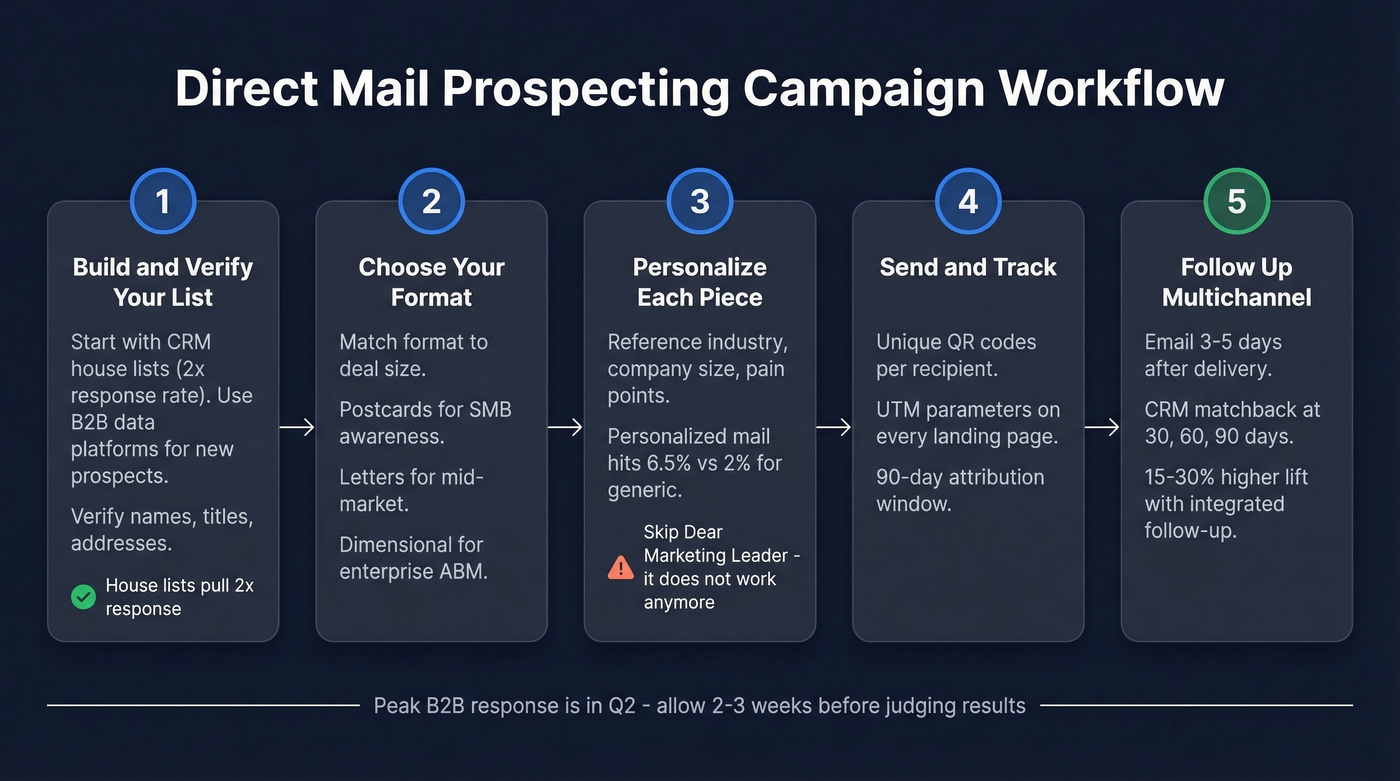
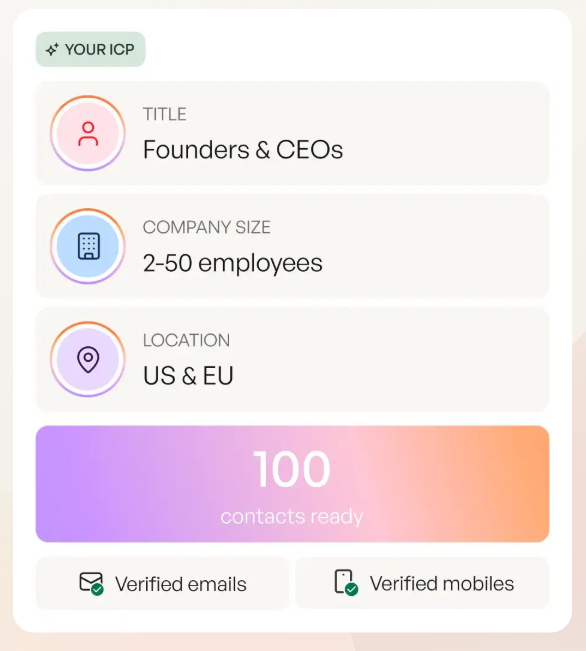
Start with your CRM - house lists pull double the response of outside lists. For new prospects, use a B2B data platform like Prospeo to build a list with verified names, titles, and company data filtered by industry, headcount, and role. With a 7-day data refresh cycle versus the 6-week industry average, you're not mailing people who changed jobs two months ago - a common and expensive source of wasted spend in physical mail campaigns where you can't just "resend" to the right person for free.
Choose Your Format
Match format to deal size. Postcards for broad awareness and light offers. Letters for mid-market where you need to explain a value prop. Dimensional mail for enterprise ABM targeting named accounts where $25/piece makes sense against six-figure deals.
Skip dimensional mail if you're testing the channel for the first time. Start with letters, prove the economics, then scale up.
Personalize Beyond "Dear First Name"
Reference the prospect's industry, company size, or a specific pain point. Personalized mail drives response rates up to 6.5% vs. 2% for generic pieces, yet only 50% of business marketers even capture and use prospect names for mailing. That's your edge - and it's a wide one.
We've found that the best-performing letters reference something specific about the company: a recent funding round, a job posting that signals a pain point, or a technology they're using. Generic "Dear Marketing Leader" letters don't cut it anymore.
Send, Track, and Follow Up
B2B response peaks in Q2 (averaging 4.12%). Allow 2-3 weeks for delivery and initial response before judging results.
If you can't track it, don't send it. Assign unique QR codes per recipient - QR usage has grown +433% since 2020, and 80% of smartphone users have scanned one in the past year. Add UTM parameters to every landing page. Set your attribution window to 90 days, because most conversions happen at the 30-60 day mark. That's longer than digital, but normal for physical mail.
For multichannel follow-up, send a personalized email 3-5 days after estimated delivery. Integrated campaigns drive 15%-30% higher sales lift vs. mail alone, and 97% of marketers confirm that combining mail with digital improves results. Run a CRM matchback at 30, 60, and 90 days to capture conversions that didn't come through a tracked URL.

Your direct mail list decays every day. People change jobs, move offices, get promoted. Prospeo refreshes 300M+ profiles every 7 days - not every 6 weeks like other providers. Filter by industry, headcount, role, and 30+ criteria to build a mail-ready list that doesn't waste $1-$25 per piece on outdated contacts.
Stop mailing people who left the company two months ago.
Mistakes That Kill Campaigns
Test multiple list sources. When you test four providers, one list is usually ~25% better or worse than average. Run merge-purge to eliminate duplicates and prevent sending acquisition mail to existing customers. We learned this the hard way on a client project where 12% of the "new prospect" list turned out to be current customers - awkward and expensive.
Don't skip A/B testing. Test offers, formats, and CTAs. The offer matters more than the design. A mediocre-looking letter with a compelling reason to respond beats a beautiful postcard with a generic CTA.
Don't design before checking specs. "Unproducible creative" - a mailer that doesn't meet USPS requirements - is the most expensive mistake in direct mail. Confirm dimensions and weight before you touch design software.
Building a Repeatable Program
Starting a mail-based sales program without a repeatable framework is how budgets evaporate. Map your mail touches to your sales development cadence: first touch introduces the problem, second touch (sent 10-14 days later) reinforces the offer, and an optional third touch creates urgency. This sequenced approach mirrors the multi-touch logic your SDRs already use in email and phone, but with the higher engagement rates physical mail delivers.
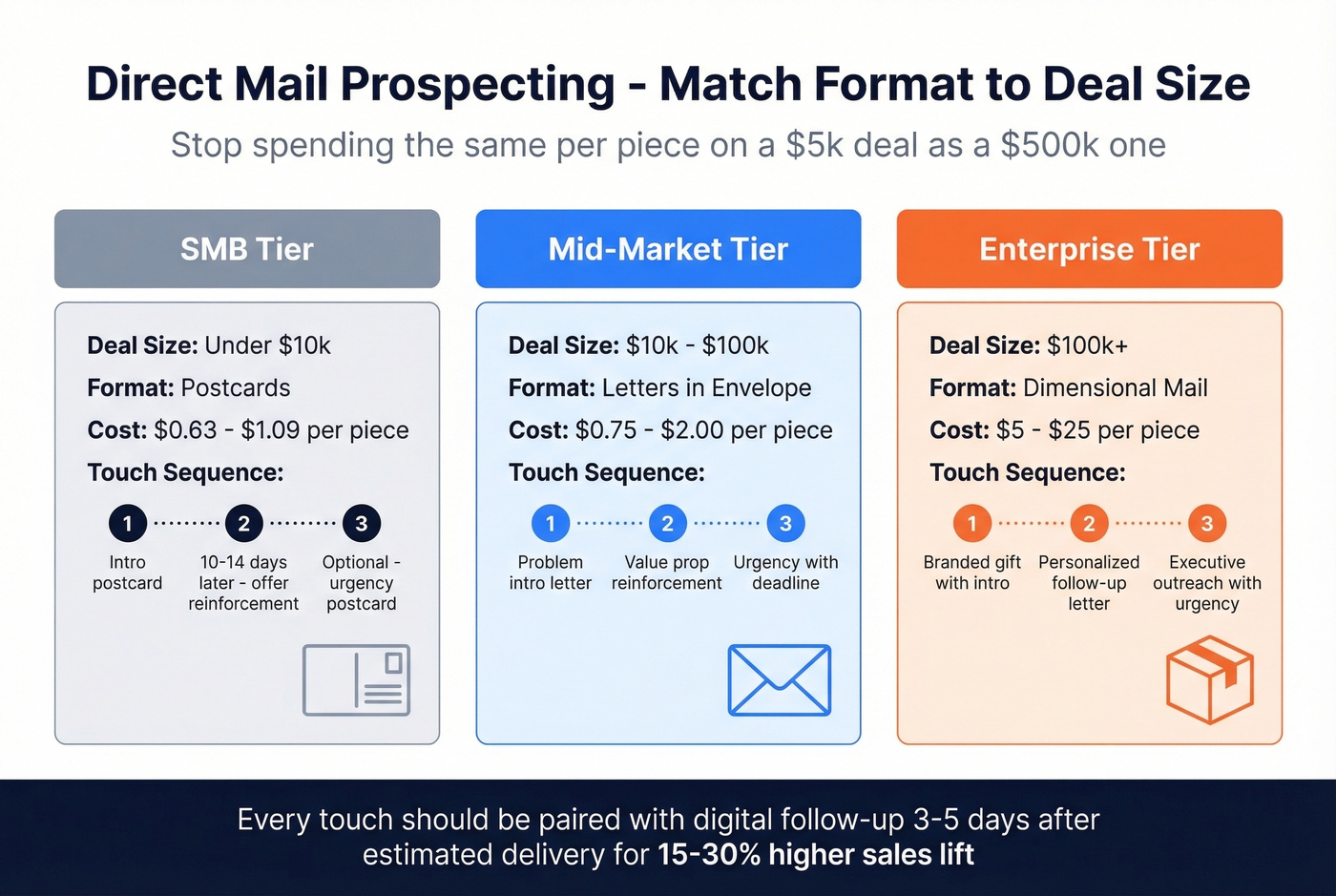
The next lever is segmentation. Split your list by deal size tier and assign a format to each - postcards for SMB, letters for mid-market, dimensional for enterprise. This prevents the most common budget mistake: spending the same per piece on a $5k opportunity as a $500k one. Let's be honest, most teams we talk to are running one format across their entire list and wondering why ROI is inconsistent.
Tools Worth Evaluating
Starting out? Stannp (pay-as-you-go) or Postalytics (automation plus CRM/MAP integrations). Enterprise ABM? Lob (API-first, address verification built in) or PFL (deep MAP integrations). Gifting plays? Sendoso. Budget multi-channel? ClickSend. API-driven workflows? PostGrid with usage-based pricing.
For the data layer underneath any of these platforms, Prospeo handles prospect identification and verification - 300M+ profiles with 30+ search filters including buyer intent, technographics, and headcount growth - so you're feeding clean, current records into your mail vendor rather than renting stale lists.
Expect $500-$2,000/mo for SMB plans on the mail platform side. Enterprise contracts run higher with dedicated support and custom integrations.
Integrated campaigns drive 15-30% higher sales lift. After your mailer lands, follow up with a verified email 3-5 days later. Prospeo gives you 98%-accurate emails and 125M+ direct dials for every contact on your mail list - so your multichannel follow-up actually reaches the same person who opened your envelope.
Turn every mailer into a multichannel sequence with verified contact data.
FAQ
What response rate should I expect?
The overall average for direct mail prospecting is 4.4% across formats per ANA/DMA benchmarks. Postcards average 2.79%, letters 8.38%, and dimensional mail 12.19%. A verified, targeted list can pull 10x more response than a generic purchased one, so list quality matters more than format choice.
How much does a campaign cost?
A typical small business campaign runs $2,000-$5,000 for 5,000 pieces. All-in costs range from $0.35/piece for EDDM postcards to $25/piece for dimensional mail. Budget an additional $200-$1,000 for design and $0.03-$0.15 per name for list rental.
How do I build a prospect list for direct mail?
Start with your CRM - house lists pull double the response of purchased lists. For new prospects, use a B2B data platform to build a verified list filtered by title, industry, and company size, then append mailing addresses through your mail vendor or a data enrichment service.
Is physical mail still effective in a digital-first world?
Yes - and arguably more effective than five years ago. Inbox saturation has driven email response rates below 0.2% for cold outreach, while physical mail faces less competition. Decision-makers receive fewer pieces of mail than ever, which means each one gets more attention. When paired with digital follow-up, mail consistently outperforms single-channel campaigns by 15%-30%.