

How to Build an SDR Cadence That Books Meetings
Deals closed within 50 days carry a 47% win rate. After 50 days, that number craters to roughly 20%. Your SDR cadence isn't just a sequence of emails and calls - it's a countdown clock. And most cadences fail not because the copy is bad, but because the data underneath is rotten.
What You Need (Quick Version)
- 7-10 touches, multi-channel, over 2-3 weeks. Multi-touch cadences convert at 4-7% - about 2-3x higher than single-channel.
- Connect rate below 5%? Fix your data before touching your copy. A healthy connect rate sits at 8-12%. Below that, the problem isn't your script - it's stale contacts.
- Every touch needs a job. If a step says "just checking in," delete it.
What Is an SDR Cadence?
An SDR cadence is a structured, multi-channel sequence of outreach touches - email, phone, social, video - designed to earn a meeting with a prospect. The best-performing sequences run 8-12 touches across multiple channels over two to three weeks.
Only 23% of buyers want to talk to a sales rep early in their buying process. Your cadence has to earn that conversation by showing up in the right places with the right message at the right time. That's why a deliberate sales cadence for SDRs matters more than raw activity volume.
Day-by-Day Cadence Template
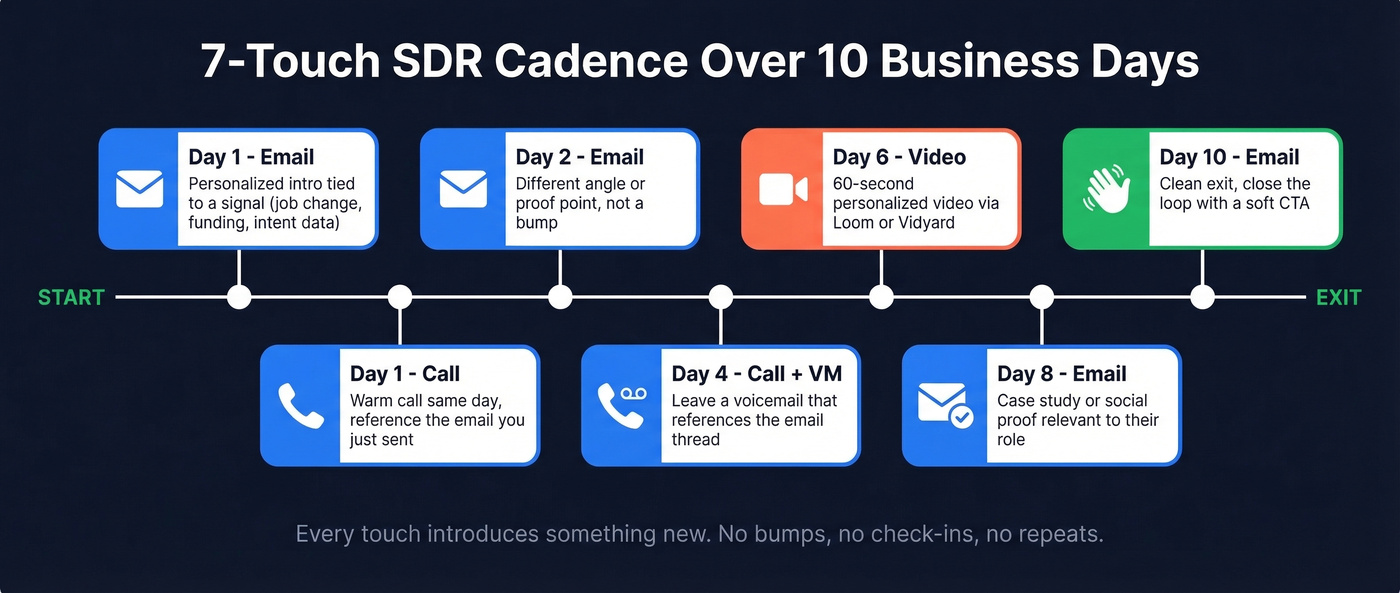
This is a 7-touch baseline over 10 business days. We've seen it work most consistently for outbound teams selling mid-market and up. Day 1 counts as two touches - the email and the call are separate actions with separate goals.
| Day | Channel | The Job |
|---|---|---|
| 1 | Personalized intro referencing a signal (job change, funding, intent) | |
| 1 | Call | Warm call same day - reference the email |
| 2 | Different angle or proof point | |
| 4 | Call + VM | Voicemail referencing the email thread |
| 6 | Video | 60-second personalized video (Loom, Vidyard) |
| 8 | Case study or social proof relevant to their role | |
| 10 | Clean exit - "closing the loop" with a soft CTA |
Every touch introduces something new. Day 2 isn't a "bump" - it's a different angle. Day 6 isn't a repeat of Day 1 in video form - it's a proof point or question that only works on camera.
One stat that should change how you think about Day 1: responding to an inbound signal within 5 minutes increases conversion by 400%, yet only 7% of teams actually hit that window. If your cadence starts with an intent signal or inbound trigger, speed matters more than polish.
Regional note: DACH and broader EMEA/APAC prospects tend to find aggressive Day-1 multi-touches intrusive. Space your first three touches over five days instead of two, and lead with email before calling.
SDR Cadence Benchmarks for 2026
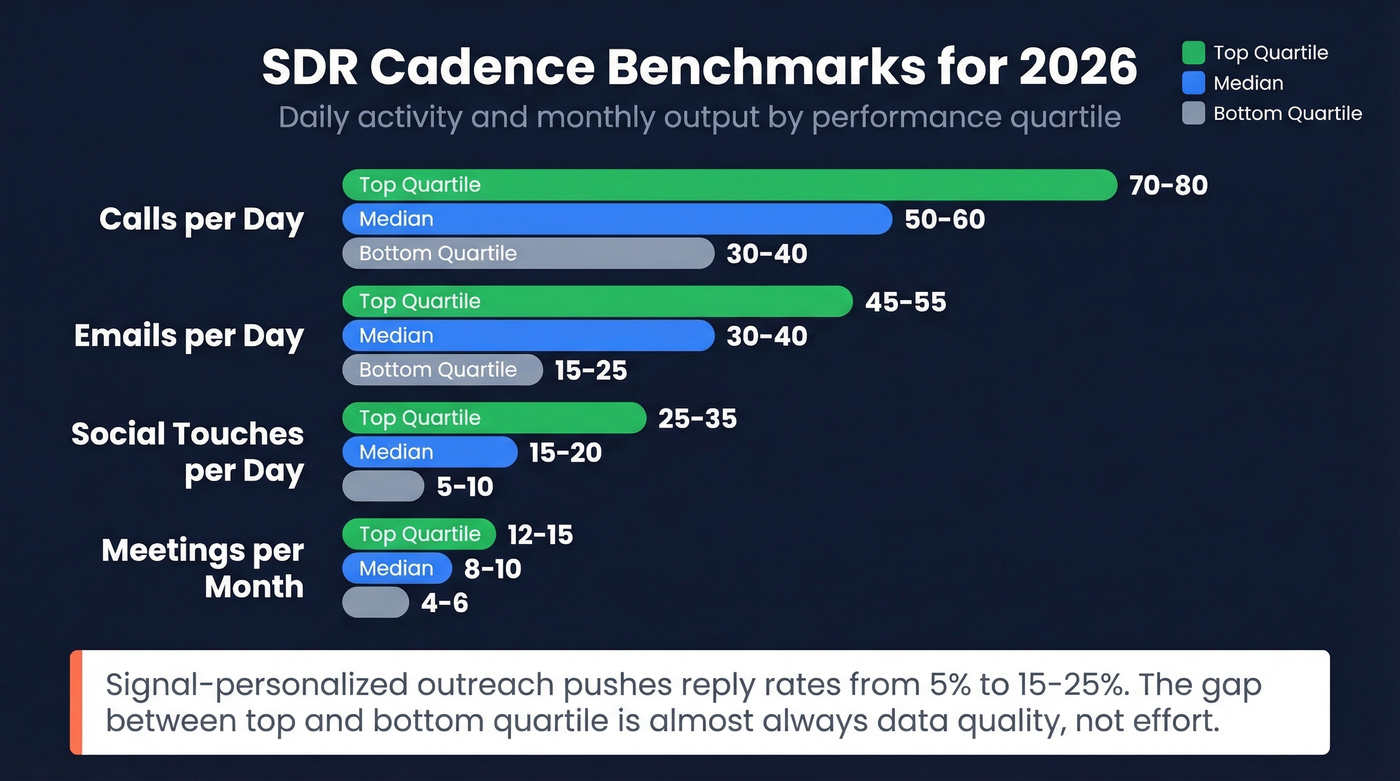
Here's what "good" looks like this year.
| Metric | Top Quartile | Median | Bottom Quartile |
|---|---|---|---|
| Calls/day | 70-80 | 50-60 | 30-40 |
| Emails/day | 45-55 | 30-40 | 15-25 |
| Social/day | 25-35 | 15-20 | 5-10 |
| Meetings/month | 12-15 | 8-10 | 4-6 |
The average cold email response rate is 5.1%, with most campaigns falling between 1% and 5%. Signal-personalized outreach - referencing a job change, funding round, or intent data - pushes reply rates to 15-25%. And 81% of emails are opened on mobile, so walls of text get swiped away before the second sentence.
One r/sales thread puts it bluntly: most reps book by the first call connect or by the third email (intro + value + bump). For cold outbound to new accounts, the benchmarks consistently point to 7-12 touches winning over shorter sequences.

Signal-personalized outreach pushes reply rates to 15-25%, but only if your emails actually land. Prospeo's 98% email accuracy and 7-day data refresh mean every touch in your cadence reaches a real inbox - not a bounce log that torches your domain.
Stop rewriting your cadence. Start fixing the data underneath it.
Mistakes That Kill Reply Rates
1. Email-only outreach. Over 90% of sales emails get ignored. If email is your only channel, you're playing a losing game.
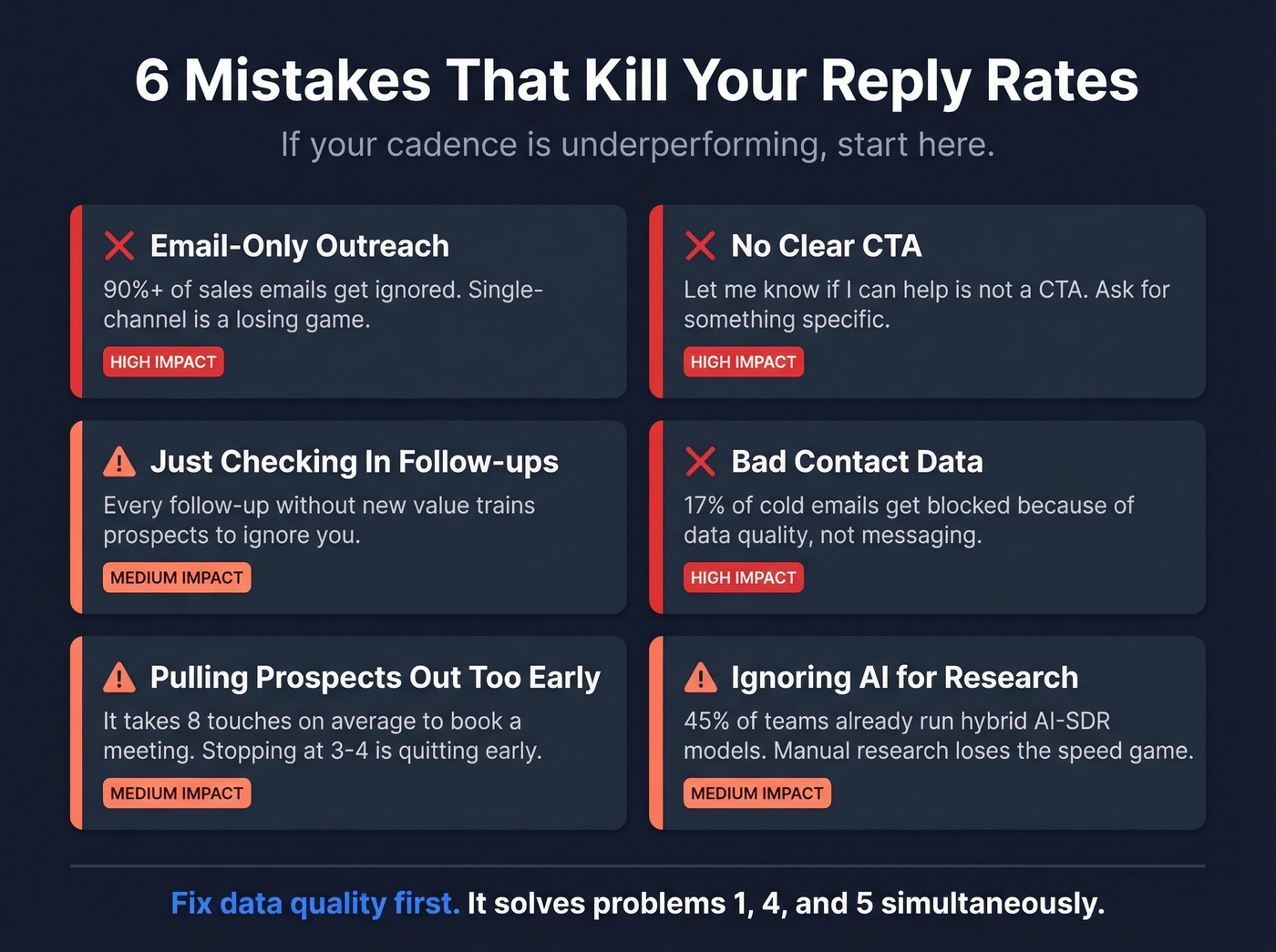
2. No clear CTA. "Let me know if I can help" isn't a call to action. It's a polite way to get archived. Ask for something specific: a 15-minute call, a yes/no on relevance, a referral. (If you need examples, steal from these sales follow-up templates.)
3. "Just checking in" follow-ups. Every follow-up without new value trains your prospect to ignore you. Bring a case study, a relevant stat, a new angle - anything that justifies the interruption. If you must use a bump, use a better version than "checking in" (see: how to say just checking in professionally).
4. Bad data. 17% of cold emails get blocked because of data quality, not messaging. You can write the best email in the world. If it bounces or lands in spam, nobody reads it.
5. Pulling prospects out too early. It takes an average of 8 touches to get a meeting. If your cadence stops at 3-4 touches, you're quitting before the game starts.
6. Ignoring AI for the grunt work. 81% of sales teams are experimenting with AI, and 45% already run hybrid AI-SDR models for research, personalization, and follow-up timing. If you're still manually researching every prospect before Day 1, you're losing the speed game to teams that aren't. (More ideas: AI sales follow-up.)
Fix Your Data First
Here's the thing: if your connect rate is below 5%, your cadence isn't the problem - your contact data is. Almost 20% of cold emails get flagged as spam, and a bounce rate above 5% actively destroys your sender reputation. You can't sequence your way out of bad data. Start with the basics of email deliverability and sender reputation.
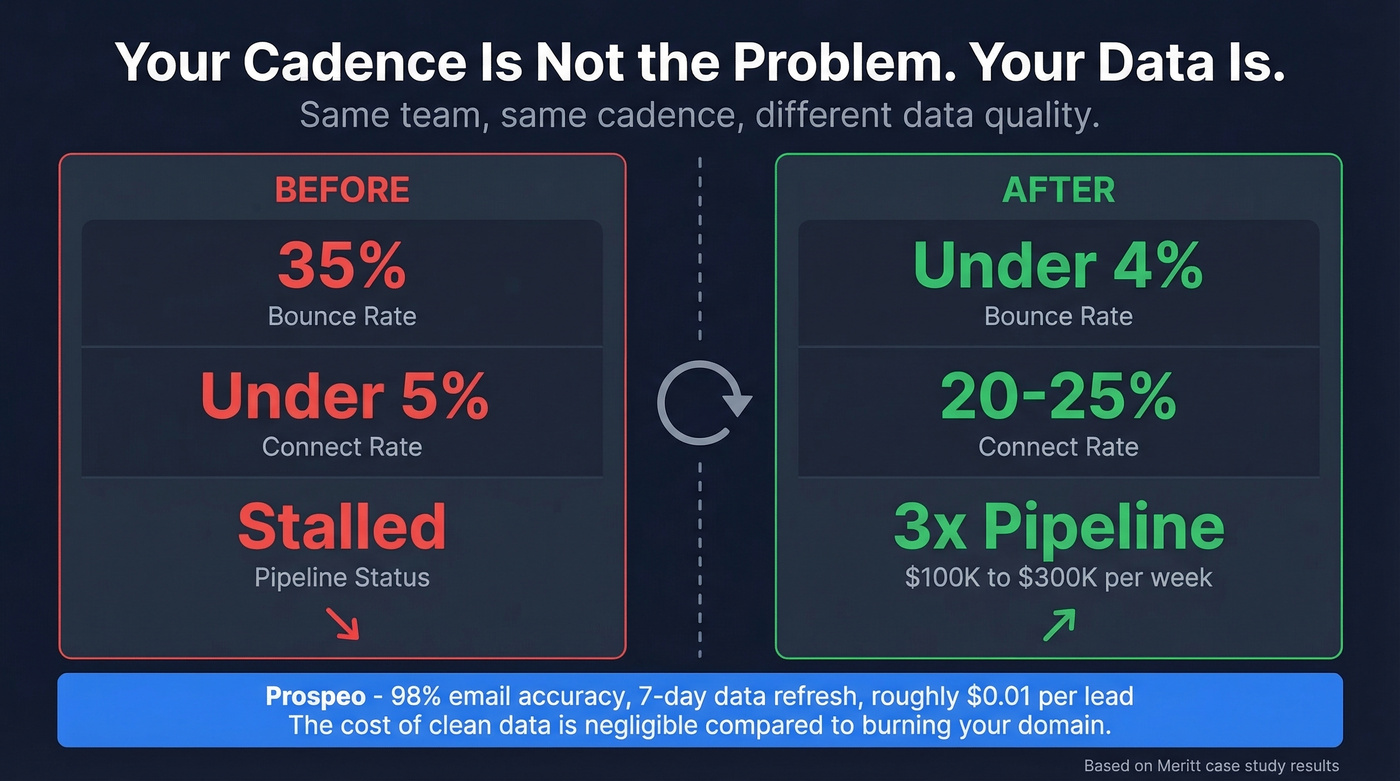
We've seen this pattern play out dozens of times. Meritt was running bounce rates at 35% with pipeline stalled. After switching to Prospeo for email verification, bounces dropped under 4% and connect rates tripled to 20-25%. With 98% email accuracy, a 7-day data refresh cycle versus the 6-week industry average, and verification at roughly $0.01 per lead, the cost of clean data is negligible compared to the cost of burning your domain. If you're cleaning lists at scale, pair verification with data enrichment services.
Let's be honest: most SDR teams don't have a cadence problem. They have a data problem wearing a cadence costume. If you've rewritten your sequence more than twice without improving reply rates, stop editing copy and start auditing your contact list.

Meritt ran a 35% bounce rate before switching to Prospeo. After? Under 4% bounces, connect rates tripled, and pipeline jumped from $100K to $300K/week - same team, same cadence. At ~$0.01/email with no contracts, clean data costs less than a single wasted touch.
Your 7-touch cadence deserves 7 real inboxes. Verify before you send.
Cadence Tools Worth Knowing
The sequencer runs your cadence. The data layer feeds it. Don't confuse the two.
| Tool | Best For | Price | Key Strength |
|---|---|---|---|
| Prospeo | Data accuracy layer | Free (75/mo) - ~$0.01/lead | 98% email accuracy, 7-day refresh |
| Salesloft | Sequencing + coaching | ~$75-200/user/mo | Best-in-class cadence analytics |
| Outreach | Enterprise sequencing | ~$50-150/user/mo | Deep workflow customization |
| HubSpot Sales Hub | Mid-market CRM-native | ~$20-150/user/mo | Zero-friction if already in HubSpot |
| Apollo | Budget all-in-one | Free - ~$99/user/mo | Best free tier for bootstrapped teams |
Salesloft and Clari merged in 2026, and Salesloft remains a strong pure sequencing platform for teams that want coaching analytics alongside cadence execution. Skip it if you're under 5 reps - the value kicks in at scale. Outreach is the enterprise pick with a steep learning curve, rated 4.3/5 on G2 across 3,500+ reviews.
HubSpot works if you're already in the ecosystem and don't want another login. Apollo's free tier makes it the obvious starting point for bootstrapped teams, though in our experience data quality drops off once you're past a few hundred contacts a month. The sequencer matters less than the data feeding it - that's the lesson most teams learn the hard way. If you're evaluating your stack, start with a shortlist of SDR tools and then map what should live in your CRM.
Adapting Your Cadence for New Hires
A new hire's outreach cadence should look different from what a tenured rep runs. New SDRs don't yet have the pattern recognition to improvise, so give them a tighter, more prescriptive sequence: fewer optional steps, clearer talk tracks for calls, and pre-written email templates they can personalize with one or two variables like company name and a recent trigger event. As reps ramp and hit consistent meeting numbers, loosen the structure and let them experiment with timing and messaging. I've watched reps go from zero meetings to consistently hitting quota in four weeks when the cadence removes decision fatigue from their first month. If you're formalizing ramp, use a 30-60-90 day plan.
FAQ
How many touchpoints should an SDR cadence have?
Seven to twelve touches across two to three weeks, spread across email, phone, and social. Multi-touch cadences convert at 4-7% - two to three times higher than single-channel sequences. Below seven touches, you're quitting before most prospects engage.
What's a good reply rate for cold email?
The average cold email reply rate is 5.1%. Signal-personalized outreach hits 15-25%. Below 1%, check your data quality and deliverability before rewriting copy - a verification tool that catches bounces before they torch your domain is worth more than any subject line tweak.
How do I know if my contact data is good enough?
Check your connect rate. Healthy is 8-12%. Below 5% means stale data is the bottleneck, not your messaging. A bounce rate above 5% is actively burning your sender reputation - run your list through a verification tool before launching any sequence.
What improves reply rates fastest?
Start with data hygiene - verified emails and direct dials. Then layer in signal-based personalization like job changes, funding events, and intent data, plus multi-channel touches. These three changes typically move reply rates from the 3-5% range into 15-25% before you rewrite a single subject line.