

Direct Sales vs Indirect Sales: A Data-Backed Guide to Choosing Your GTM Model
Referral and partner-sourced leads cost about $150 in B2B SaaS. Outbound sales leads cost $1,980. That's a 13x gap - and it explains why your CEO is asking hard questions about channel strategy. The choice between direct sales and indirect sales isn't academic; it reshapes your economics, your org chart, and your growth ceiling.
Whether you're a SaaS startup selling $12K ACV deals to SMBs, an enterprise vendor running six-figure consultative sales, or a hardware company deciding between direct-to-consumer and retail distribution, this guide gives you the numbers, the framework, and the operational playbook to make the call.
Quick Verdict
- Go direct when ACV exceeds $100K, the sale is consultative, and you're still validating product-market fit.
- Go indirect when the product is standardized, you need geographic scale, and you want variable costs instead of fixed headcount.
- Go hybrid when you want both - and budget the operational overhead to manage channel conflict, because it's coming.
Here's the thing: many B2B companies under $10M ARR default to direct because it feels safer. It is safer - and slower, and more expensive. If your product doesn't require a 45-minute demo to sell, you're probably leaving money on the table by not building a partner channel earlier.
What Each Model Actually Means
Think of it like the auto industry. Tesla sells through its own showrooms - that's a direct sales channel. Ford sells through a network of independent dealerships - that's an indirect sales channel. Both move cars, but the economics, customer relationships, and control dynamics are completely different.
In B2B, direct sales means you sell products or services to the end customer without intermediaries. Your reps run demos, negotiate contracts, and close deals. A SaaS company's outbound AE team running enterprise deals is direct. Indirect sales means a third party - reseller, distributor, VAR, systems integrator, or referral partner - sells on your behalf. Microsoft reports that partners influence over 95% of its commercial revenue, meaning partners are involved in the majority of deals even when Microsoft co-sells directly.
The distinction matters because each model carries fundamentally different cost structures and scaling curves. A $12K ACV SaaS product sold through a reseller network has completely different unit economics than the same product sold by an in-house SDR-to-AE motion. In regulated industries like healthcare, compliance and procurement complexity often push teams toward more direct control. Context determines the right answer.
Terminology note: In consumer contexts, "direct sales" often refers to MLM/network marketing - which is actually indirect, since it inserts distributors between the company and the buyer. As one Reddit thread pointed out, a farmer selling soap at a market is truly direct; an MLM rep is an intermediary. This article covers B2B sales models, not MLM.
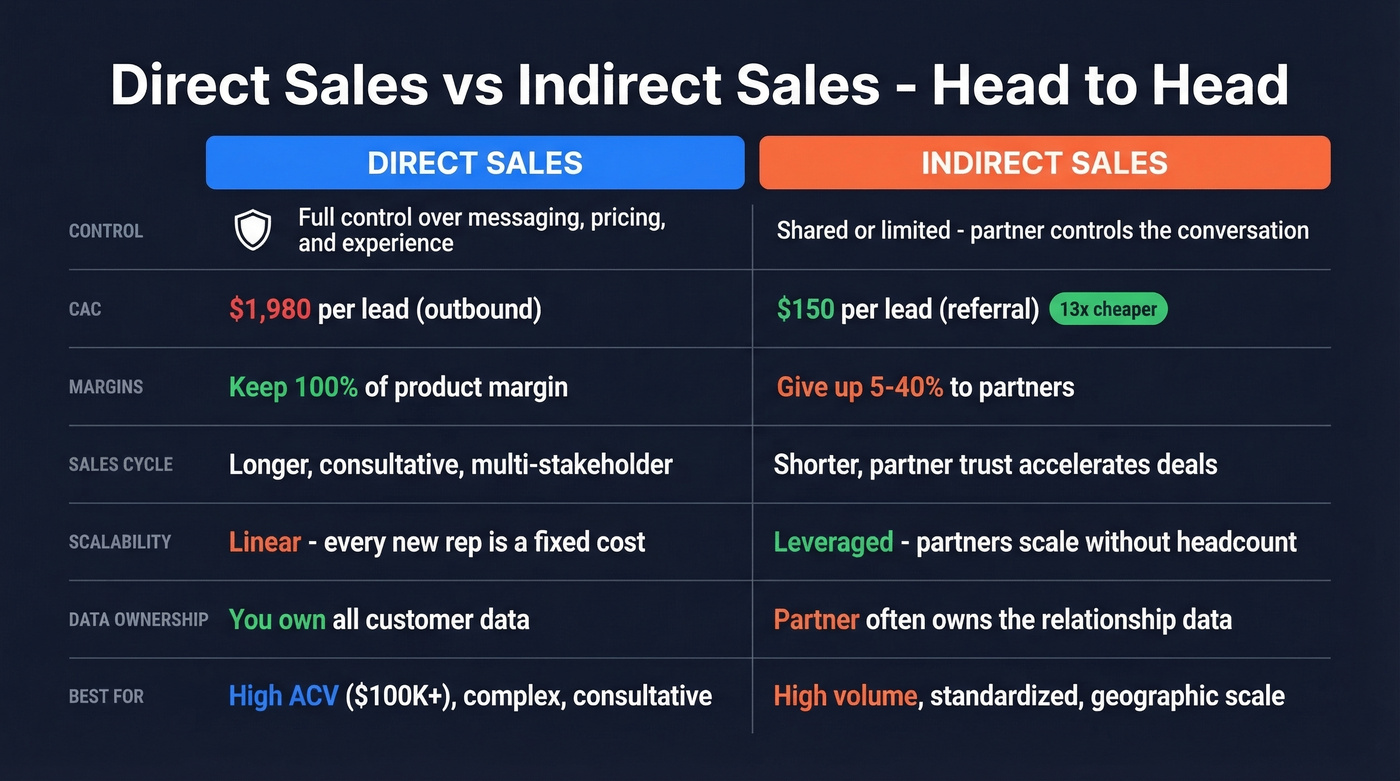
Side-by-Side Comparison
| Dimension | Direct Sales | Indirect Sales | Winner |
|---|---|---|---|
| Control | Full | Shared/limited | Direct |
| CAC | ~$1,980 (outbound) | ~$150 (referral) | Indirect (by 13x) |
| Gross margin | Higher (no split) | Lower after payout | Direct |
| Partner payout | N/A | Referral 5-15%; reseller 20-40% | - |
| Sales cycle | Longer, consultative | Shorter via partner trust | Indirect |
| Scalability | Linear | Leveraged | Indirect |
| Customer relationship | Owned end-to-end | Shared; partner-led | Direct |
| Data ownership | You own it | Partner often owns it | Direct |
| Best for | High ACV, complex | High volume, standardized | Depends on product |
CAC and Margin Economics
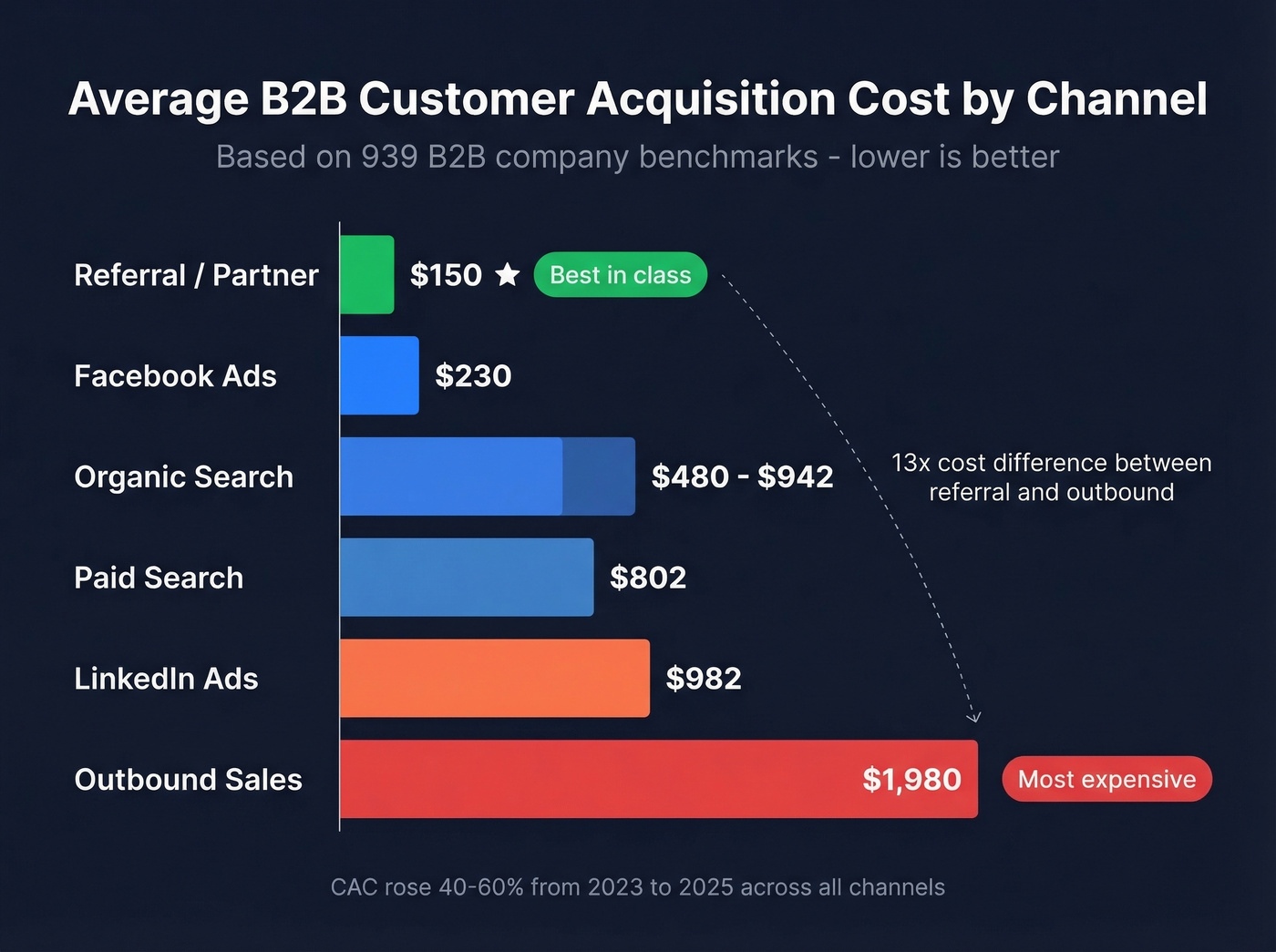
Here's where the strategic conversation actually starts. CAC by channel, based on a benchmark analysis covering 939 B2B companies:
| Channel | Avg B2B CAC |
|---|---|
| Referral/partner | $150 |
| Facebook ads | $230 |
| Organic search | $480-$942 |
| Paid search | $802 |
| LinkedIn ads | $982 |
| Outbound sales | $1,980 |
These are blended CAC benchmarks, not CPL, and they'll vary by ACV and sales motion. CAC across all channels rose 40-60% from 2023 to 2025, driven by privacy regulations, competition, and attribution complexity.
Partner-sourced leads cost 13x less than outbound. That's not a rounding error - it's a different business model.
The Microsoft case study makes this concrete at enterprise scale. IDC's 2024 analysis found Microsoft's partner ecosystem generates $10.04 in partner revenue for every $1 of Microsoft revenue - a $1.2T ecosystem. That's what mature indirect looks like.
But margin tells the other half of the story. Direct sales avoids partner revenue share, so you keep the full product gross margin before sales and marketing costs. Indirect gives typically 5-15% to referral partners and 20-40% to resellers. If your product has thin margins, that partner cut can destroy unit economics. If your product has 80%+ gross margins, the math often works because you're trading margin for dramatically lower CAC and faster geographic reach.

Direct sales teams live or die by data quality. Every bad email burns your domain reputation and inflates that $1,980 outbound CAC even further. Prospeo delivers 98% verified emails and 125M+ mobile numbers with a 30% pickup rate - so your AEs spend time closing, not bouncing.
Cut your outbound CAC by connecting with real buyers on the first attempt.
When to Use Each Model
Go Direct When
Your sale is consultative and high-touch. If ACV runs $100K+ and buyers need custom demos, security reviews, and multi-stakeholder alignment, you need your own reps in the room.
Direct is also non-negotiable when you're still validating product-market fit. You can't outsource learning what your customers actually want. The feedback loop from direct customer conversations is irreplaceable. Budget accordingly - plan on ~$200K-$350K/year fully loaded for an AE once you factor salary, benefits, tools, and overhead. That's a fixed cost whether they close or not.
Use direct if:
- ACV exceeds $50K and requires multi-threading
- Compliance requirements demand a controlled sales process
- You're pre-Series B and still iterating on ICP and messaging
- The product requires significant customization or implementation support
Skip direct if your product sells itself with a free trial, you're trying to cover 10+ geographies with a 5-person sales team, or deal sizes don't justify the fully-loaded cost of an AE.
Go Indirect When
The product is standardized enough that a partner can sell it without your team on every call. Geographic expansion, bundling opportunities, and the need for variable cost structure all point toward indirect. You're converting fixed headcount into performance-based commissions.
Indirect also shines for implementation-heavy products where systems integrators add genuine value. If your product needs 200 hours of configuration, an SI partner isn't just a channel - they're a delivery mechanism.
Use indirect if:
- The product is standardized with clear pricing and packaging
- You need geographic reach faster than you can hire
- Partners add real value through bundling, implementation, or local expertise
- Your ACV is under $25K and can't support direct sales economics
Skip indirect if you haven't nailed product-market fit yet, your product requires deep technical selling that partners can't replicate, or you can't invest in partner enablement. It's not free - more on that below.
Decision Framework
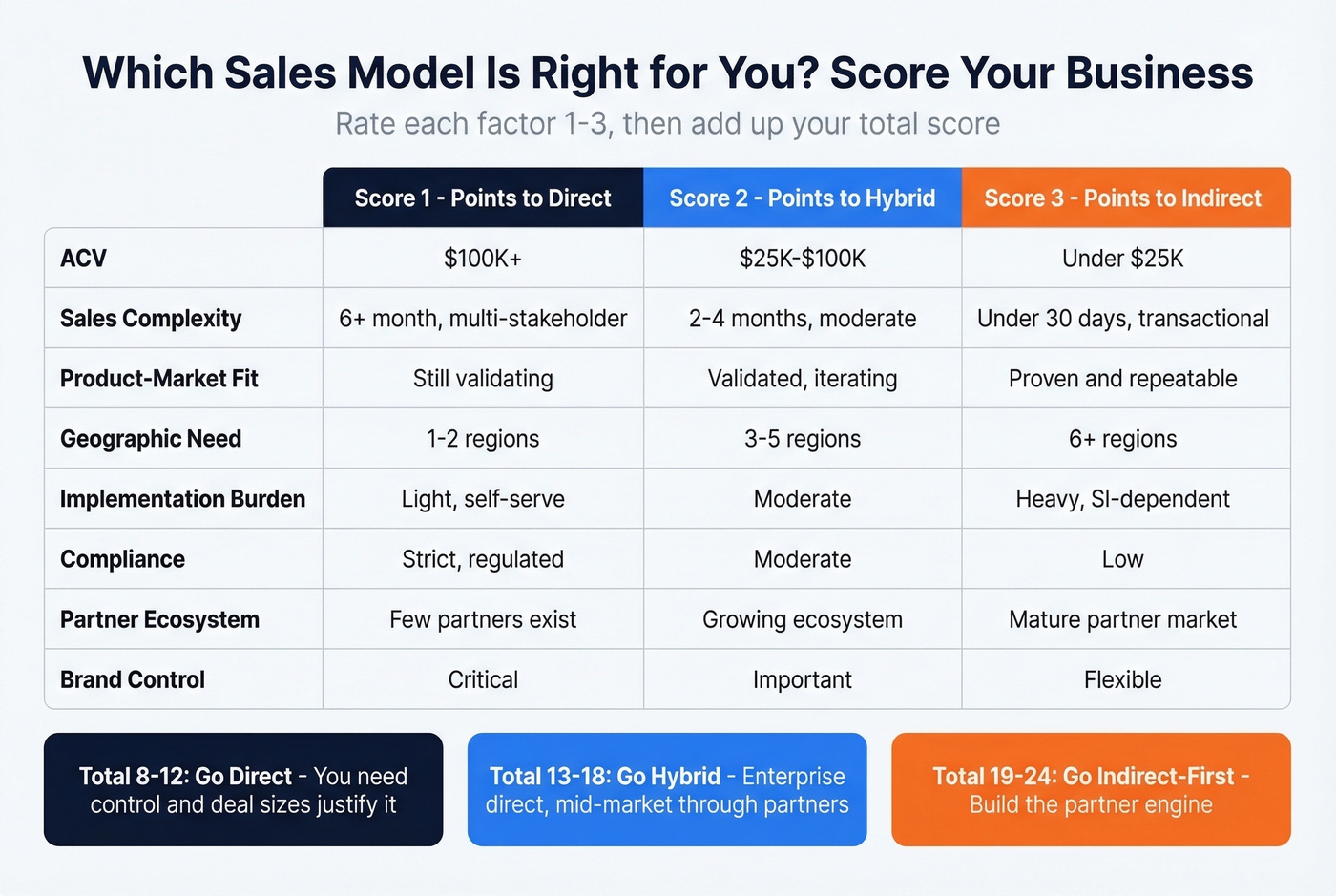
Score each factor 1-3 based on your current situation, then follow the recommendation.
| Factor | Score 1 (Direct) | Score 2 (Hybrid) | Score 3 (Indirect) |
|---|---|---|---|
| ACV | $100K+ | $25K-$100K | Under $25K |
| Sales complexity | Multi-stakeholder, 6+ month cycle | Moderate, 2-4 month cycle | Transactional, under 30 days |
| Product-market fit | Still validating | Validated, iterating | Proven and repeatable |
| Geographic need | 1-2 regions | 3-5 regions | 6+ regions |
| Implementation burden | Light (self-serve) | Moderate | Heavy (SI-dependent) |
| Compliance requirements | Strict (regulated industry) | Moderate | Low |
| Partner ecosystem density | Few relevant partners exist | Growing ecosystem | Mature partner market |
| Brand control priority | Critical | Important | Flexible |
Scoring:
- 8-12 total: Go direct. You need control and the deal sizes justify it.
- 13-18 total: Go hybrid. Segment by deal size - enterprise direct, mid-market and SMB through partners.
- 19-24 total: Go indirect-first. Build the partner engine and keep a small direct team for strategic accounts.
By company stage: Seed and Series A? Direct. Period. Learn from your customers. Series B-C? Hybrid - keep enterprise direct, start building partner channels for mid-market. Growth or public? Indirect-heavy with direct for strategic accounts. That's the Microsoft model.
Why Hybrid Models Are Winning
Buyers Use Every Channel
Buyers use 10 interaction channels on average - up from 5 in 2016. Gartner reports 80% of B2B sales interactions now happen in digital channels. A third of buyers prefer a seller-free experience entirely, and that number climbs to 44% among millennials.
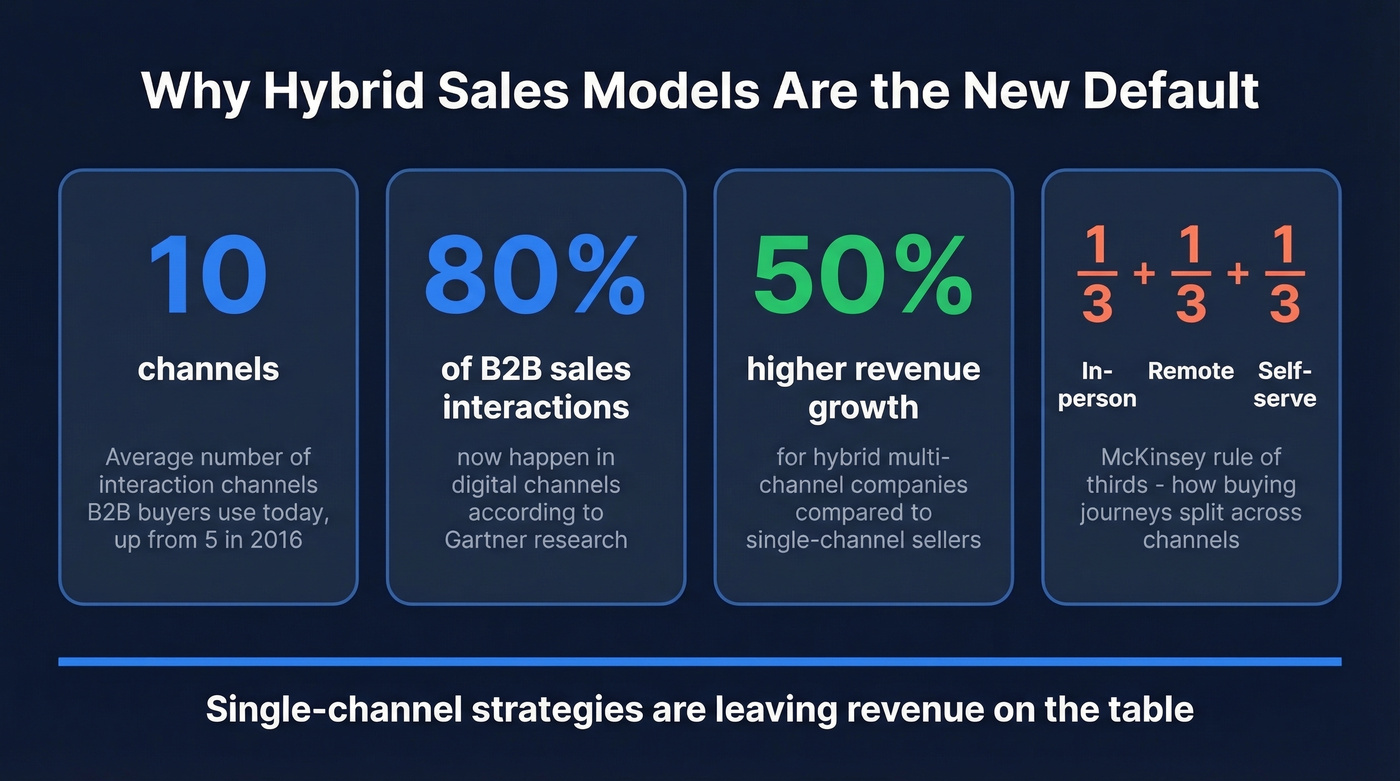
McKinsey's "rule of thirds" captures the new reality: at any stage of the buying journey, roughly one-third happens in-person, one-third remote, and one-third digital self-serve. Hybrid approaches drive up to 50% higher revenue growth than single-channel companies. The hybrid model isn't a trend. It's the default.
The "Two Value Propositions" Problem
Going indirect introduces a third-party business model into yours. That's the part most teams underestimate. You suddenly need two value propositions: one for your customers and one for your partners. Partners aren't your customers - they're your channel. But they have their own P&L, their own priorities, and their own customers competing for their attention.
This operational shift is why so many partner programs stall. We've seen teams launch a "partner program" that's really just a referral link and a PDF. That's not a channel strategy - it's a hope strategy.
Why Indirect Fails (and How to Fix It)
Partner Churn Is the Default
Eighty percent of new partners leave vendor programs without ever selling anything. Partner portal adoption sits at a dismal 17% industry-wide. Thirty-six percent of partners disengage because rewards aren't compelling; 31% leave because the rules are confusing.
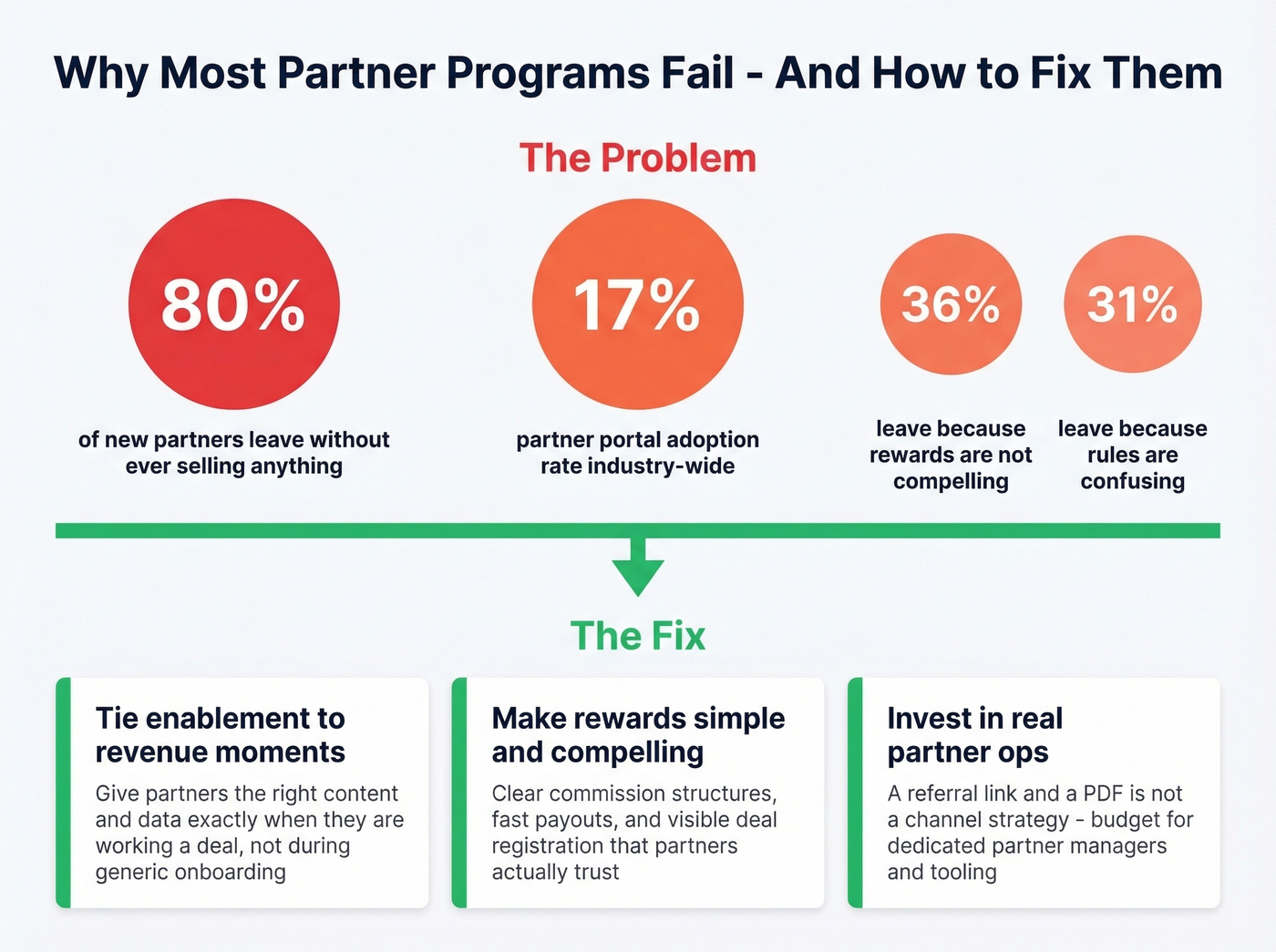
The fix isn't more onboarding decks. It's targeted enablement tied to revenue moments - giving partners the right content, the right data, and the right support exactly when they're working a deal. Generic "welcome to the partner portal" emails don't move pipeline.
Channel Conflict Is Inevitable
Over 70% of enterprise tech purchases involve a partner. When your direct team and your partners compete for the same deal, conflict isn't a risk - it's a certainty.
Channeltivity's taxonomy breaks this into three types worth planning for. Vertical conflict happens when your direct team undercuts a partner on pricing. Horizontal conflict erupts when two partners fight over the same territory. Ecosystem conflict emerges from overlapping roles in complex multi-partner deals. The stakes are real: 60% of solution providers will de-emphasize a vendor over persistent conflict, and roughly a third will drop the relationship entirely.
Prevention comes down to clear territory rules, published deal registration processes, standardized onboarding, and not oversaturating your partner roster in any single region or vertical.
What You Must Staff For
Building a partner channel isn't free - it just shifts costs from variable sales comp to operational infrastructure. Here's the minimum org investment for a serious indirect motion:
A channel manager owns partner recruitment, activation, and quota. A partner marketing lead builds co-marketing campaigns, joint webinars, and partner-facing content. Solutions engineering coverage ensures partners can get technical support during active deals without waiting three days for a response. A deal desk with published rules handles deal registration, conflict resolution, and discount approvals. Someone owns the PRM/portal - whether that's Channeltivity, PartnerStack, or Crossbeam - and keeps it updated. And you need a partner enablement cadence: monthly pipeline reviews, quarterly business reviews, and real-time Slack channels for deal support.
Skip any of these and you'll join the majority of companies whose partner programs produce impressive logos on a slide deck and zero pipeline.
Data Quality Matters More Than Your Model
Let's be honest about something: most companies don't have a sales model problem. They have a data problem.
Direct teams with bad contact data waste a huge chunk of rep capacity on dead-end outreach - calling disconnected numbers, emailing bounced addresses, chasing prospects who left the company six months ago. Partner programs with no prospect data enablement create the same outcome: 80% of new partners leave without ever closing a deal because they can't reach anyone. Whether you're running a direct motion or enabling resellers, verified data is the execution layer underneath everything.
In our experience, the teams that see the biggest lift from switching models are the ones that fix their data first. Meritt tripled their pipeline from $100K to $300K per week after switching to Prospeo's B2B database, with bounce rates dropping from 35% to under 4%. At roughly $0.01 per verified email across 143M+ verified addresses and 125M+ verified mobile numbers on a 7-day refresh cycle, the math works for both direct teams and partner enablement programs.
If you're tightening your outbound motion, pair this with a real cost to acquire customer model and track pipeline health weekly - not quarterly.
Building a hybrid GTM motion? Whether your AEs run enterprise deals directly or partners source referrals, you need clean contact data across every channel. Prospeo's 300M+ profiles with 30+ filters - including buyer intent, technographics, and headcount growth - let you build targeted lists for direct outreach and arm partners with qualified leads.
Stop paying $1,980 per lead when better data starts at $0.01.
What's the biggest risk of switching from direct to indirect?
Channel conflict and partner churn. Sixty percent of partners de-emphasize vendors over persistent conflict, and 80% of new partners never close a deal. Establish territory rules and deal registration processes before recruiting your first partner.
Can a startup use indirect sales from day one?
Not recommended. You need the direct feedback loop to validate product-market fit first. Most companies add partners after Series B, once ICP, messaging, and pricing are proven and repeatable.
How do I decide between hybrid and pure indirect?
Use the scoring framework above. If your ACV spans a wide range - say $15K SMB deals alongside $200K enterprise contracts - hybrid is almost always the answer. Run enterprise direct and route mid-market and SMB through partners.
What tools help enable both models?
Your partner channel needs the same data foundation as your direct reps. Pair a verified prospect data source with a PRM like PartnerStack or Crossbeam for deal registration and pipeline visibility.