

Discovery Questions for Phone Sales: A Rep's Playbook
Most reps talk too much on discovery and listen too little. Flip that dynamic so the buyer does more of the talking, and results usually follow.
Gong's research backs it up: longer buyer responses correlate with higher deal success. On the phone - where you can't read body language, can't point at a slide, and can't rely on a shared screen to carry the conversation - getting prospects to open up takes sharper discovery questions for phone sales, not more of them.
The right questions aren't about quantity. They're about depth. A lot of sellers admit discovery is a weak spot, and buyers often do their homework before they ever take your call. So if you rattle off a checklist, it doesn't feel consultative. It feels like an interrogation.
What You Need (Quick Version)
Stop memorizing 20 questions. On the phone, you need five great questions and three follow-up probes that keep them talking.
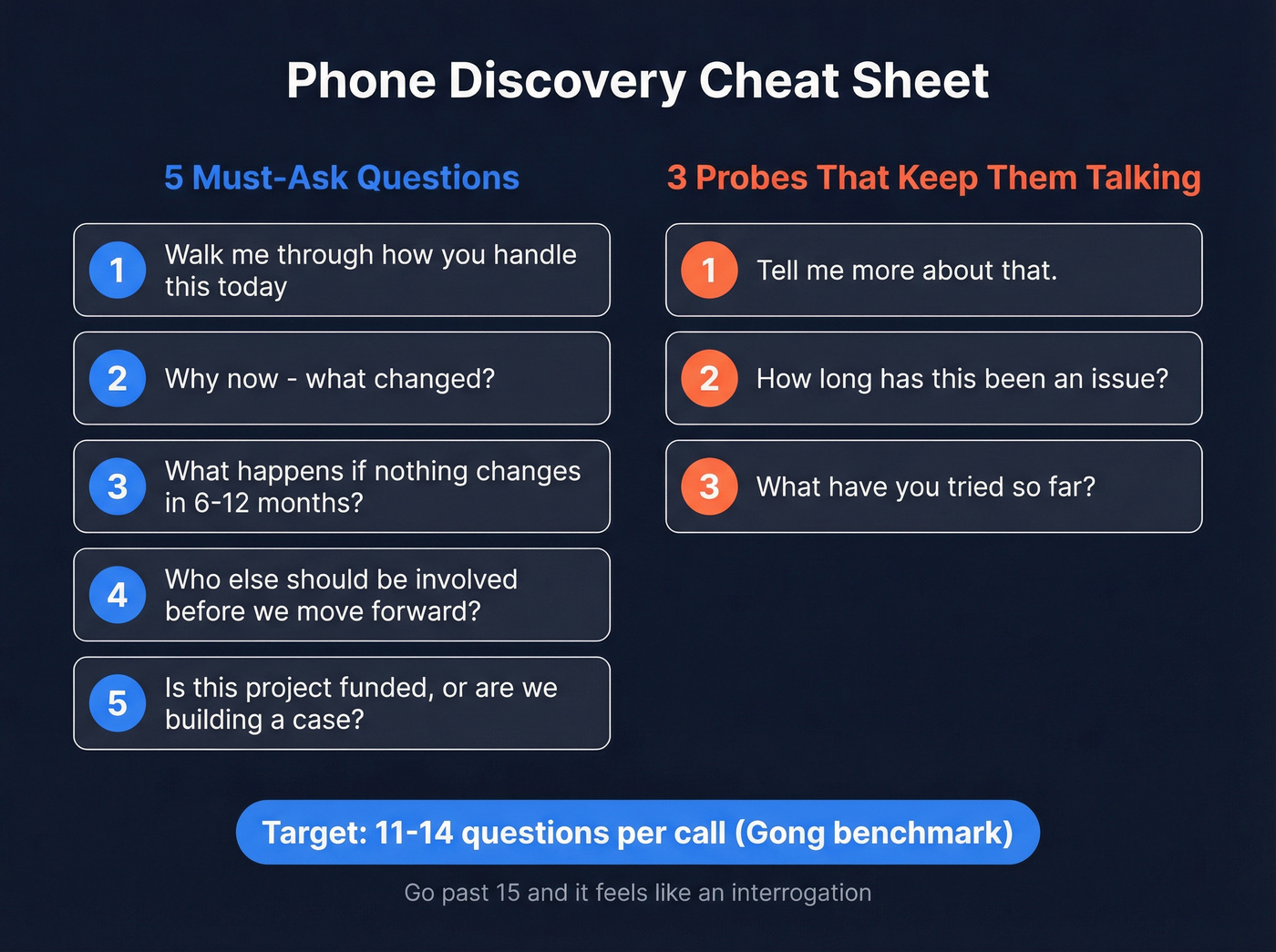
Five must-asks:
- "Walk me through how you're handling this today."
- "Why now - what changed?"
- "What happens if nothing changes in the next 6-12 months?"
- "Who else should be involved before we move forward?"
- "Is this project funded, or are we building a case?"
Three probes that keep them talking:
- "Tell me more about that."
- "How long has this been an issue?"
- "What have you tried so far?"
Gong's benchmark is 11-14 targeted questions per discovery call. Go past 15 and it starts to feel like an interrogation. On the phone, aim for the lower end and let probes do the heavy lifting. https://www.gong.io/blog/sales-discovery-questions
Why Phone Discovery Hits Different
Most discovery advice assumes a scheduled video meeting with slides and a screen share. Phone calls don't work that way. No visual cues. No chat. And silence feels twice as long when neither person can see the other's face.
Here's the thing: that's also an advantage.
Without a shared screen, the prospect tends to stay present. You're competing for one sense - hearing - and that forces better listening on both sides. One simple tactic we picked up from HubSpot and still use: close your eyes for a few seconds while they speak. It sounds goofy, but it helps you catch the real pain points, objections, and urgency in how they say things, not just what they say. https://blog.hubspot.com/sales/discovery-call-mistakes
Questions You Actually Need on the Phone
Opening the Call
Your first question sets the tone. Don't waste it on "So, tell me about your company." You should already know the basics.
The best opener we've used is:
"What's going on in your world that made you decide to talk to me?"
It hands them the mic and surfaces intent fast.
Want something shorter? Try:
"Why now?"
Two words. Big signal. If they can't explain urgency, you're probably dealing with a tire-kicker or a "curious but not committed" stakeholder.
And if you want to get to the truth quickly, this one is a little spicy but incredibly useful:
"Why hasn't this been fixed before today?"
It pulls out past failed attempts, internal politics, and competing priorities in one shot.
Pain and Impact
This is where deals are won or lost. Surface-level pain gets surface-level commitment, and phone calls are full of polite, vague answers unless you push (tastefully).
Use questions that force specificity:
- "What happens if nothing changes?"
- "If you don't solve this in 6-12 months, what's the impact on the team?"
- "How does this affect you personally?"
- "What's the cost of this problem per month?"
That "personally" question is the one most reps skip. Don't. People buy for personal reasons (time, stress, credibility, promotion risk) and justify it with business logic later.
If a prospect tightens up, use a permission frame:
"Can I ask you a difficult question?"
It lowers defenses, signals respect, and usually gets a yes. Then ask the hard one.
Qualifying: A Decision Tree
Instead of running through a checklist, treat qualifying like a branching path. One answer tells you which direction to go next.
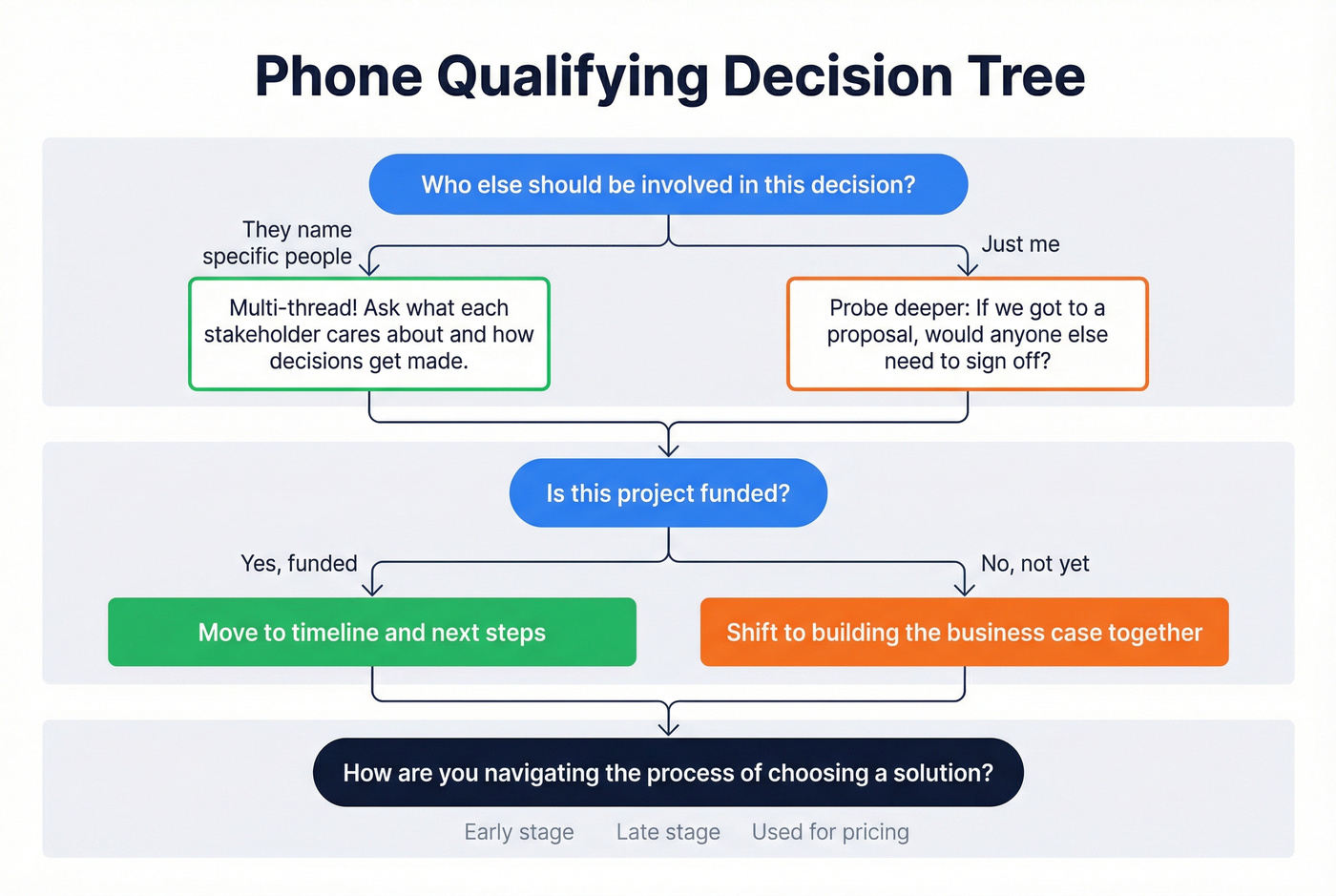
Start here:
"Who else should be involved in this decision?"
If they name specific people, great - now you can multi-thread. Ask what each stakeholder cares about and how decisions usually get made.
If they say "just me," don't accept it at face value. Follow with:
"If we got to a proposal stage, would anyone else need to sign off?"
Then go direct on budget:
"Is this project funded?"
Look, dancing around budget for 30 minutes is one of the most frustrating habits in sales. You're not being "consultative." You're wasting everyone's time.
Finally, ask about process without making it feel like procurement theater:
"How are you navigating the process of choosing a solution?"
You'll learn whether you're early, late, or being used for pricing.
Closing and Next Steps
Never end a call without a concrete next step. "Let's circle back" is where deals go to die.
Two closers that work:
- "Are there any reasons not to move forward?" (surfaces hidden objections)
- "If we set up a 30-minute demo with you and [stakeholder] on Thursday, does 2 PM work?" (assumptive, but still respectful)
Notice the "we" framing. It creates partnership. "If you want to schedule a demo" keeps you on opposite sides of the table.
Probes That Trigger Longer Responses
The questions above are your skeleton. Probes are the muscle.
Gong Labs found a strong link between longer buyer responses and closed deals, and probes are how you earn those longer responses without turning the call into a survey. https://www.gong.io/blog/sales-discovery-questions
A few that consistently work:
- "Tell me more about that." (it's basically a cheat code)
- "How long has this been an issue?" (adds urgency context)
- "What have you tried so far?" (uncovers failed attempts and bias)
And then there's mirroring: repeat the last two or three words they said with a slight upward inflection.
Prospect: "We've tried a few tools, but adoption's been rough."
You: "Adoption's been rough?"
They keep talking. You learn more. You say less. Everybody wins.

Great discovery questions are useless if you're calling the wrong person. Prospeo gives you 125M+ verified mobile numbers with a 30% pickup rate - so your perfectly crafted openers actually reach decision-makers, not gatekeepers.
Stop perfecting questions for people who never pick up.
A 20-Minute Phone Call Structure
This framework compresses a classic SPIN-style flow into something that fits phone reality. Record calls with permission. You'll catch things on replay that you missed in the moment, and you'll also notice where you started talking because you got nervous.
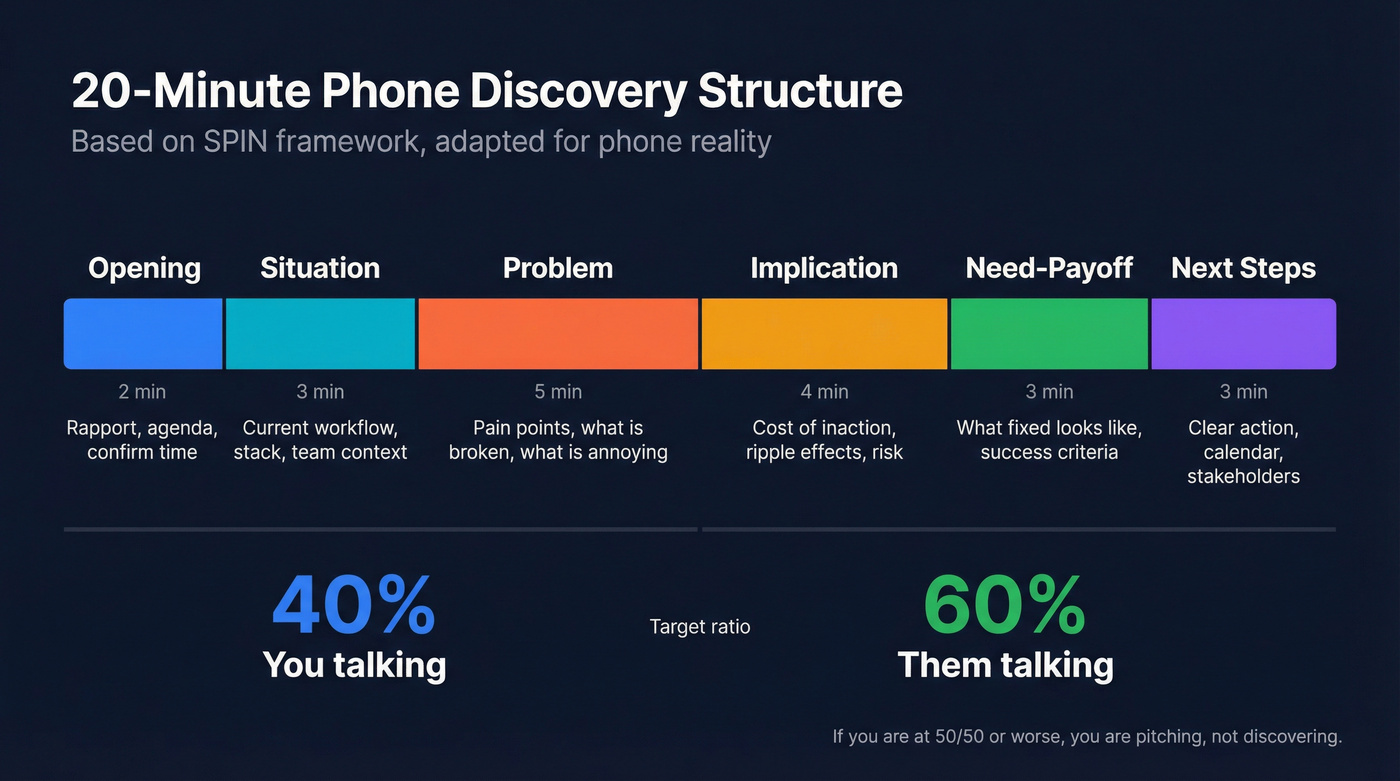
| Phase | Minutes | What You're Doing |
|---|---|---|
| Opening | 2 | Rapport, agenda, confirm time |
| Situation | 3 | Current workflow, stack, team context |
| Problem | 5 | Pain points, what's broken, what's annoying |
| Implication | 4 | Cost of inaction, ripple effects, risk |
| Need-Payoff | 3 | What "fixed" looks like, success criteria |
| Next Steps | 3 | Clear action, calendar, stakeholders |
Your talk/listen target: 40/60. You talk 40%, they talk 60%.
If you're at 50/50 (or worse), you're pitching, not discovering.
Cold-Call Micro-Discovery
You don't get 20 minutes on a cold call. You get 30-90 seconds to earn the right to ask a real question.
A Zendesk-style approach that works well is time-boxing up front: "In three minutes, I can share how we help [specific outcome]." Then pivot immediately into one micro-discovery question:
"Can I ask how you're managing [pain point] today?"
One question. That's it. If they engage, you've got a conversation. If they don't, move on.
And voicemail? Keep it to 15 seconds. Reference one specific pain point and a reason you're calling. Skip the product pitch.
Hot take: if your average deal size is under $10k, you probably don't need a 20-minute discovery framework at all. You need a tight cold-call pivot and a fast demo. Don't over-engineer a process the deal can't afford.
Pre-Call Prep Determines Everything
Salesforce puts it plainly: buyers expect reps to act like trusted advisors. You can't do that if your first question is "So, what does your company do?" https://www.salesforce.com/blog/what-is-a-discovery-call/
The best discovery question is the one you don't have to ask because you already researched the answer. In our experience, even five minutes of prep changes the whole call: you sound calmer, you ask better follow-ups, and you don't burn credibility on basics.
Here's a real scenario we see all the time. You're about to dial a VP. The calendar invite says "Revenue Ops," but their title changed last month, the company just opened a new region, and the person who used to own the project left. If you walk into that call blind, your "discovery" turns into a clumsy fact-finding mission, and the prospect starts wondering why they took the meeting.
Our team pulls verified emails, direct dials, and current job titles from Prospeo before calls so the first minute isn't spent confirming basics. Prospeo has 300M+ professional profiles, 143M+ verified emails, and 125M+ verified mobile numbers, refreshed every 7 days. That freshness matters on phone outreach because stale numbers don't just waste time - they wreck your team's momentum.
You just mapped out a 20-minute discovery structure. Now fill your pipeline with prospects worth discovering. Prospeo's 30+ filters - buyer intent, job changes, headcount growth - let you target contacts already showing buying signals, so every phone call starts with real urgency.
Reach in-market buyers before they talk to your competitor.
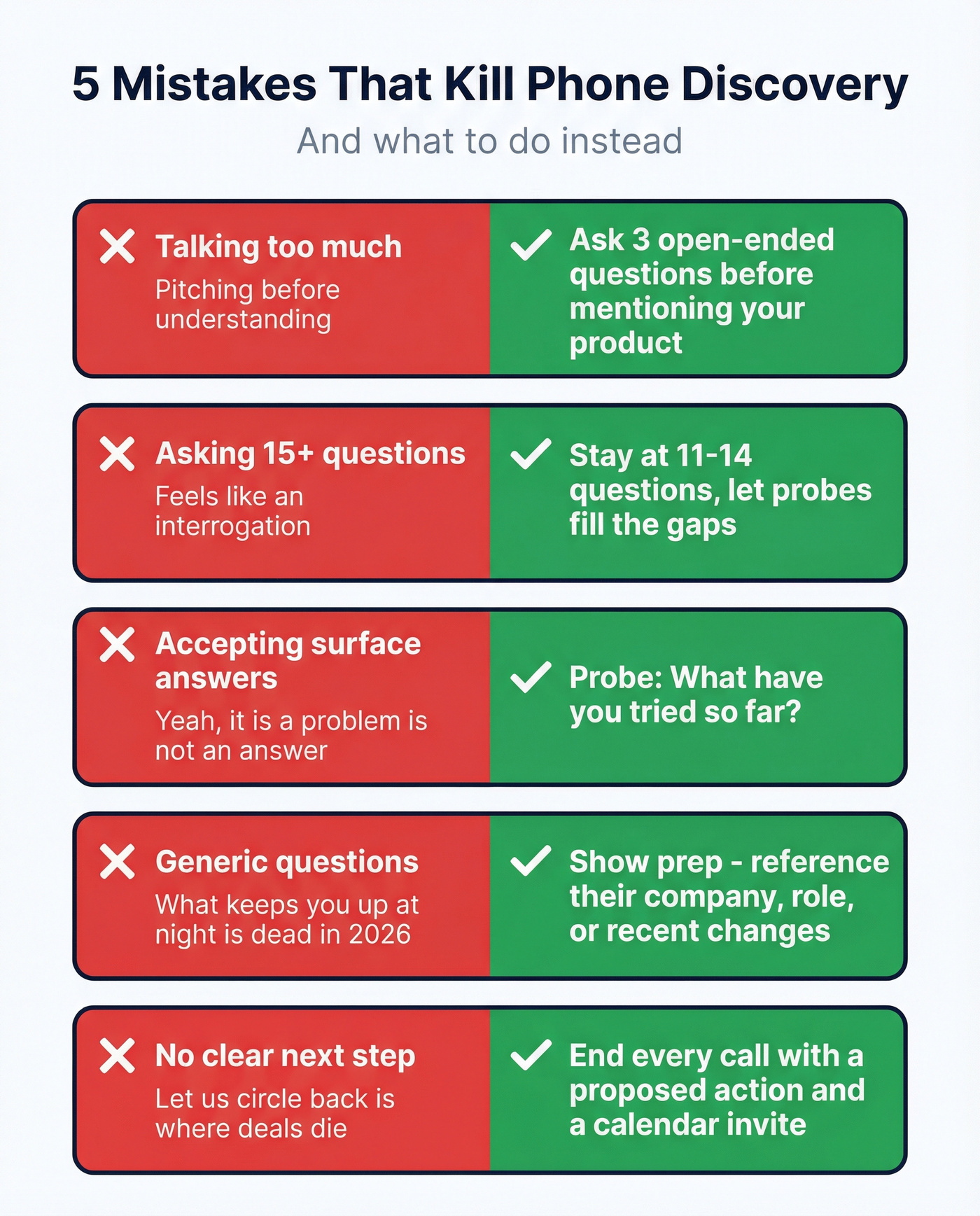
Five Mistakes That Kill Phone Discovery
- Talking too much. Ask three open-ended questions before you mention your product. If you can't, you're pitching. https://blog.hubspot.com/sales/discovery-call-mistakes
- Asking 15+ questions. Stay in the 11-14 range and let probes fill gaps.
- Accepting surface answers. "Yeah, it's a problem" isn't an answer. Probe: "What have you tried so far?"
- Asking "What keeps you up at night?" in 2026. Generic questions signal zero prep.
- No clear next step. Every call ends with a proposed action, or it ends with nothing.
Pick a Framework and Start Calling
SPIN, Sandler, Gap Selling, NEPQ - they're all useful, and they're all easy to overthink. Let's be honest: methodology debates are mostly procrastination dressed up as professionalism.
A practitioner on r/sales put it best: all sales methodologies boil down to the same four things - need, budget, stakeholders, timeline. The framework is just scaffolding. https://www.reddit.com/r/sales/comments/1miaa3n/all_sales_methodologies_are_basically_the_same/
If you only learn one, make it SPIN. It's widely taught, it maps cleanly to phone discovery, and it's easy to internalize without a two-day workshop. If you want a plug-and-play template, grab a discovery call script.
Then stop reading about frameworks and start making calls. The best discovery questions for phone sales are the ones you actually ask, in real conversations, with real follow-ups - not the ones sitting in a doc you bookmarked and forgot.
FAQ
How many questions should I ask on a phone discovery call?
Aim for 11-14 targeted questions per call, based on Gong's analysis of recorded conversations. Past 15, win rates drop because the call starts feeling like an interrogation. Use probes like "Tell me more" to extend answers without adding to your question count.
What's the ideal talk-to-listen ratio for phone sales?
Target 40% rep talk time and 60% prospect talk time. If you're at 50/50 or higher, you're pitching instead of discovering. Track it with call recording tools - most reps overestimate how much they listen.
How do I handle prospects who give short answers on the phone?
Use a permission frame ("Can I ask you a difficult question?") and follow with a pain or impact question. Mirroring also works: repeat their last few words as a question and let the silence do its job.
How do I prep for phone discovery without wasting time?
Pull verified contact data, job titles, and company context before dialing so you skip basic fact-finding. Tools like Prospeo surface contact details quickly, and that prep time pays back fast once you're doing real volume.