

The Double Funnel: A Practical Guide for B2B Marketing Teams
Your CMO just came back from a conference and wants to run ABM alongside demand gen. Your team of four is already stretched thin. Now what?
That's the double funnel - and it's simpler in theory than in practice. If you just scrolled past seven beer bong listings to get here, welcome. This is the B2B marketing version: running two parallel go-to-market motions without losing your mind or your budget.
What You Need (Quick Version)
The double funnel means running demand gen (MQLs) and ABM (MQAs) as parallel motions feeding the same pipeline. It works for B2B companies with $5M+ ARR, sales cycles over 60 days, and enough headcount to staff both motions. Below that threshold, master one funnel first. Both funnels share one non-negotiable dependency: accurate contact data. If your email bounce rate is above 5%, fix data quality before adding strategic complexity.
What Is a Double Funnel?
If you're new to B2B funnels, the core idea is straightforward: a funnel maps the journey from first touch to closed deal. The double funnel runs two of those journeys in parallel. The term carries two established meanings in B2B, and which one your CMO means determines everything about execution.
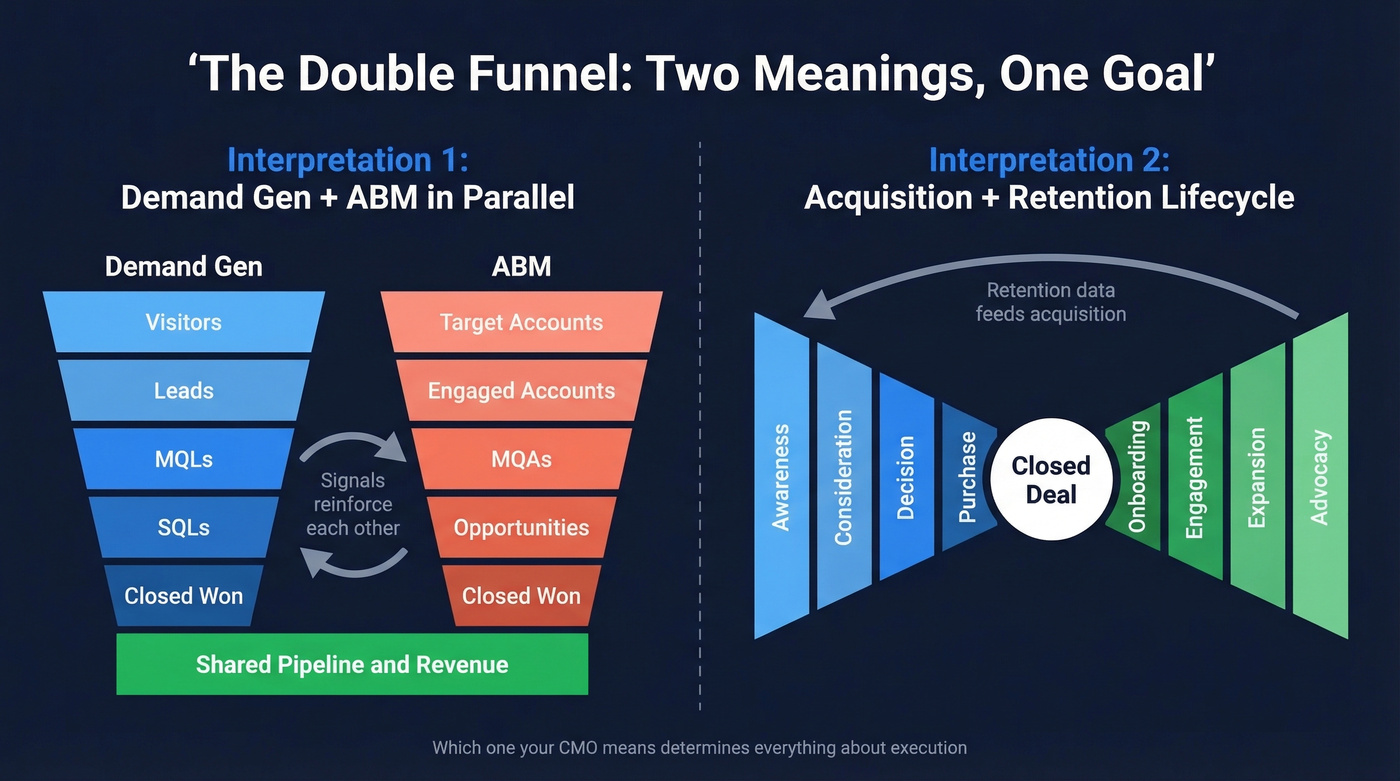
Demand Gen + ABM in Parallel
Demandbase defines the double funnel as tracking both lead-based metrics from traditional demand gen (MQLs) and account-based metrics (MQAs) side by side - a "both/and" approach where MQLs and MQAs reinforce each other rather than competing. Two distinct motions feeding a shared revenue engine.
The best operational example comes from Coupa. Their marketing org splits into segment-aligned teams - enterprise ABM vs. SMB demand gen - and runs three tiers of ABM: one-to-one, one-to-few, and one-to-many. The sourcing mix targets roughly 30-35% inbound and 65% "allbound", with sales, marketing, and ADRs going after target accounts together.
What made Coupa's model work was removing the sourcing conflict. ADRs get comped regardless of whether a deal originated from inbound or outbound. That alignment detail matters more than the framework itself. Most implementations fail not because the strategy is wrong, but because incentives still pit demand gen against ABM. We've seen this pattern repeatedly: the framework is fine, the comp plan is the problem.
On Reddit, searches for "double funnel" often surface non-marketing results (like Gundam "double fin funnel"), so most marketing-specific coverage lives in vendor and agency content. That makes the Coupa case study carry outsized weight as a real-world proof point.
Acquisition + Retention Lifecycle
The second interpretation, popularized by Elevated Third, treats the model as two interconnected stages: an acquisition funnel flowing into a retention funnel (Onboarding -> Engagement -> Advocacy). Instead of ending at the closed deal, it flips and maps the post-sale journey with equal rigor. The feedback loop is what matters here - retention data flows back into acquisition to refine targeting and messaging. If your company has meaningful expansion revenue or net-revenue-retention targets, this is the interpretation that should get your attention.
Why the Traditional Funnel Broke
The linear customer funnel assumed buyers move in a straight line from awareness to purchase. That hasn't been true for years.
75% of B2B buyers now prefer a rep-free research experience. 80% of B2B interactions are digital. Buyers engage with 10+ channels before making a purchase decision, and roughly 64% use social media as their first contact point to learn about new products.
Layer on GDPR, cookie deprecation, and rising acquisition costs, and the single-funnel model starts looking like a relic. You can't track a buyer's journey through one neat pipeline when they're bouncing between webinars, peer communities, review sites, and dark social before ever filling out a form. Running parallel motions isn't a trendy framework - it's a structural response to how buying actually works now. The cycle measures time, the pipeline tracks deals in motion, and the funnel maps conversion stages. A single model can't capture all three dimensions across both inbound and outbound motions.
Double Funnel vs. Bow-Tie Funnel
Let's be honest: the bow-tie funnel is the double funnel with better branding.
The bow-tie model traces back to 2009 in the travel industry and was later adopted by Winning by Design for B2B. It maps the traditional acquisition funnel on the left and gives retention/expansion equal representation on the right - the same structure as the acquisition + retention version, just visualized differently.
What the bow-tie framework adds is emphasis on buying groups. Gartner's data shows buying committees now range from 6-10 members, roughly double what they were a decade ago. Influ2's internal data goes further: committees of 21+ people where sales engages 11+ stakeholders simultaneously produce the highest conversion rates. That complexity is exactly why a single linear funnel can't capture the full picture.

Both funnels in a double funnel strategy share one dependency: contact data that actually connects. Prospeo delivers 98% email accuracy with a 7-day refresh cycle - so your demand gen doesn't bounce and your ABM plays reach the right buying committee members.
Stop feeding two funnels with stale data. Start with contacts that convert.
When It Works (and When It Doesn't)
When to Run Parallel Funnels
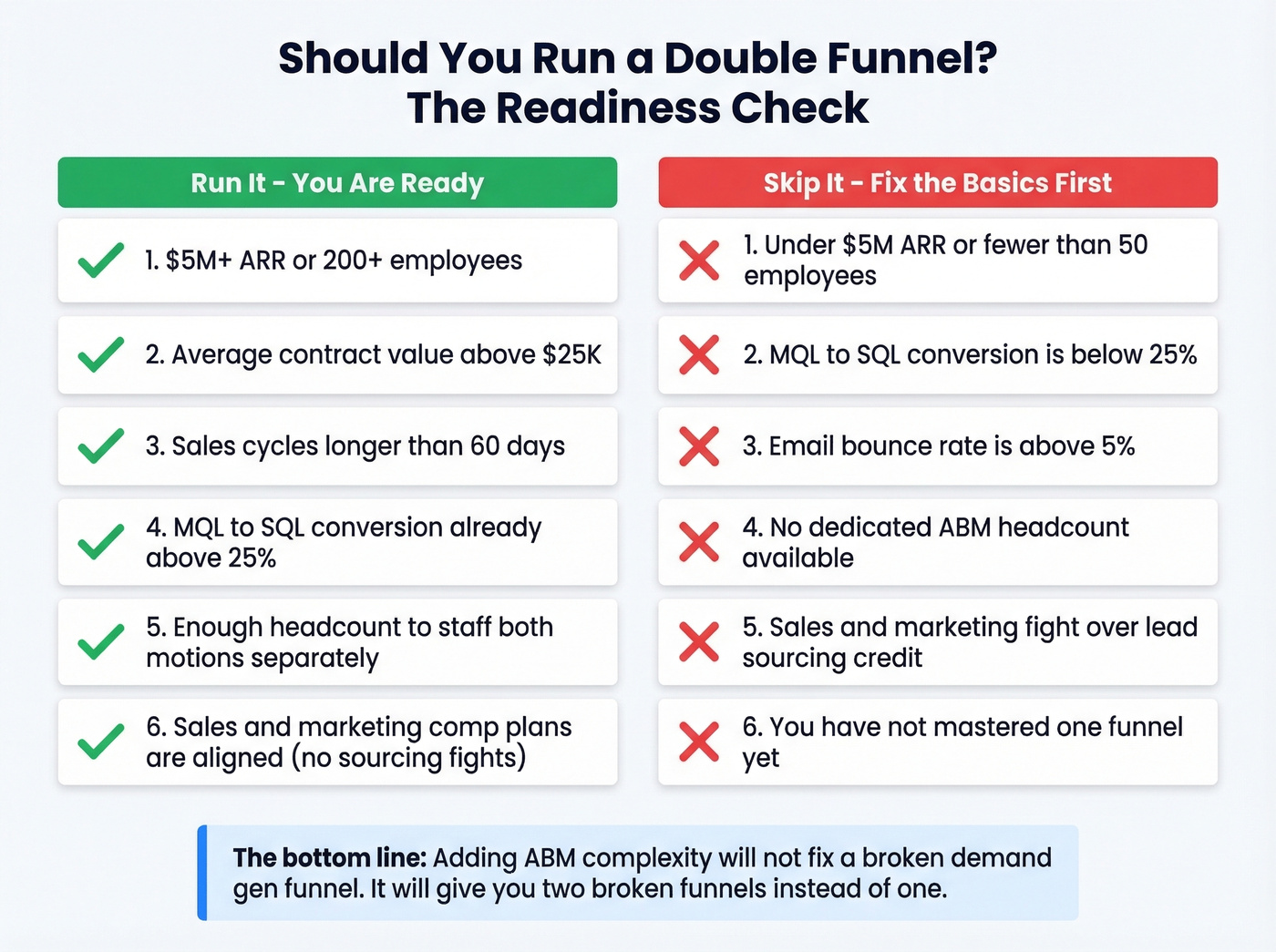
The double funnel makes sense when your organization has the scale and complexity to justify two parallel motions - 200+ employees or $5M+ ARR, average contract values above $25K, and sales cycles running 60+ days. Your goals should be clearly defined for each motion before you launch.
The ROI case is strong when you can staff it properly. 76% of marketers say ABM delivers the highest ROI of any strategy. Companies with aligned sales and marketing teams achieve 19% faster growth and 67% improved win rates. The sweet spot is a mid-market or enterprise B2B company where demand gen handles volume and ABM focuses resources on the 50-200 accounts that actually move the revenue needle.
When It Fails
BOL Agency's take is worth hearing: ABM works better as a full organizational commitment than as a side project running alongside demand gen. Their argument is that "dipping into two pools at the same time" stretches resources thin and causes missed opportunities in both.
They're not wrong. I've watched teams burn six months trying to run both before admitting they needed to pick one. The demand gen campaigns get half the budget they need, the ABM plays are too thin to be truly personalized, and attribution becomes a political fight between the two camps.
Skip this if your MQL-to-SQL conversion is below 25%. Adding ABM complexity won't solve the underlying problem - it'll give you two broken funnels instead of one. Fix the one you have, then expand.
Metrics and Benchmarks to Track
You can't manage two funnels without clear benchmarks. Here's what the data shows across 40+ benchmark studies.
Conversion Rates by Stage
| Stage | B2B SaaS | Cybersecurity | eCommerce |
|---|---|---|---|
| Lead -> MQL | 39% | 24% | 23% |
| MQL -> SQL | 38% | 40% | 58% |
| SQL -> Opp | 42% | 43% | 66% |
| SQL -> Closed | 37% | 46% | 60% |
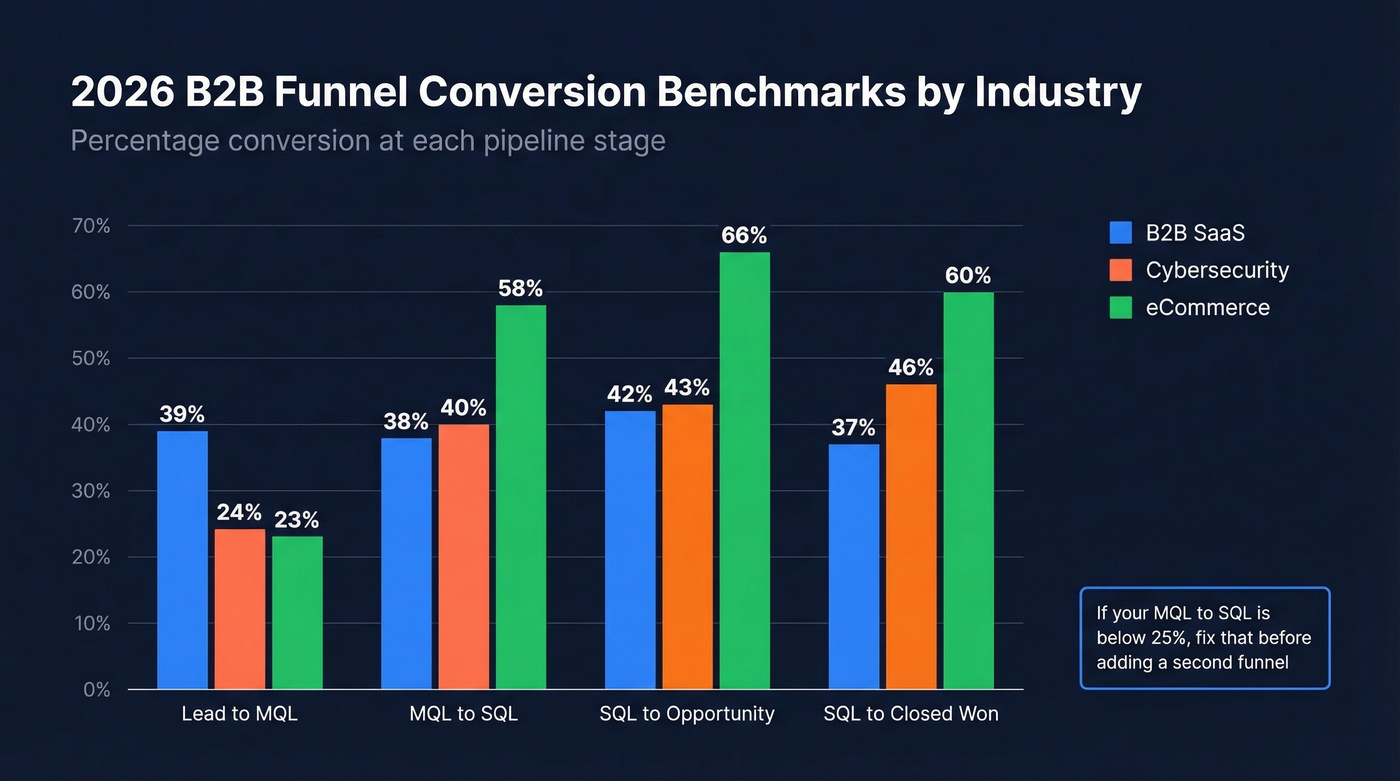
For SMB/mid-market SaaS ($10M-$100M ARR), the 2026 SaaS averages run: Visitor -> Lead at 1.4%, Lead -> MQL at 41%, and an overall lead-to-customer conversion of roughly 2.7%. These stages are consistent across most B2B models, though conversion rates vary significantly by industry and ACV.
Channel Performance
| Channel | Visitor -> Lead | MQL -> SQL | Opp -> Close |
|---|---|---|---|
| SEO | 2.1% | 51% | 38% |
| PPC | 0.7% | 26% | 35% |
| Events | - | - | 40% |
SEO leads convert to SQL at nearly double the rate of PPC leads. Events close at the highest rate. These channel differences matter when you're allocating budget - ABM events and dinners close well, while demand gen SEO content fills the top of funnel efficiently.
Track pipeline velocity across both funnels: (Opportunities x Avg Deal Value x Win Rate) / Sales Cycle Length. SaaS & Technology companies average around $1,847/day in pipeline velocity. Teams using predictive analytics catch resource misallocation months earlier than those relying on stage-level reporting alone. Reverse funnel analysis - working backward from closed-won deals to identify which early-stage signals predicted success - is especially useful for tuning the ABM side.
The Data Layer That Makes or Breaks It
Every ABM vendor will tell you their platform is the orchestrator. What they won't tell you is that orchestration means nothing when 30% of your contact records are outdated.
Both funnels share one dependency: accurate, fresh contact data. Your demand gen campaigns bounce when emails go stale. Your ABM outreach fails when you're targeting a VP who changed jobs three months ago. Intent signals are worthless if you can't reach the people showing intent - you need qualified contacts in each motion, not just names on a list. This is the unsexy infrastructure layer that determines whether your double funnel actually produces pipeline or just produces dashboards.
Behavioral triggers like job changes, funding rounds, and technology purchases are only actionable when the underlying contact data is accurate enough to reach the right person at the right time. In our experience, teams that fix data quality first see conversion lifts across both motions before they change anything else about their strategy.

Minimum Viable Tech Stack
You don't need a $100K platform to run a double funnel. You need three things.
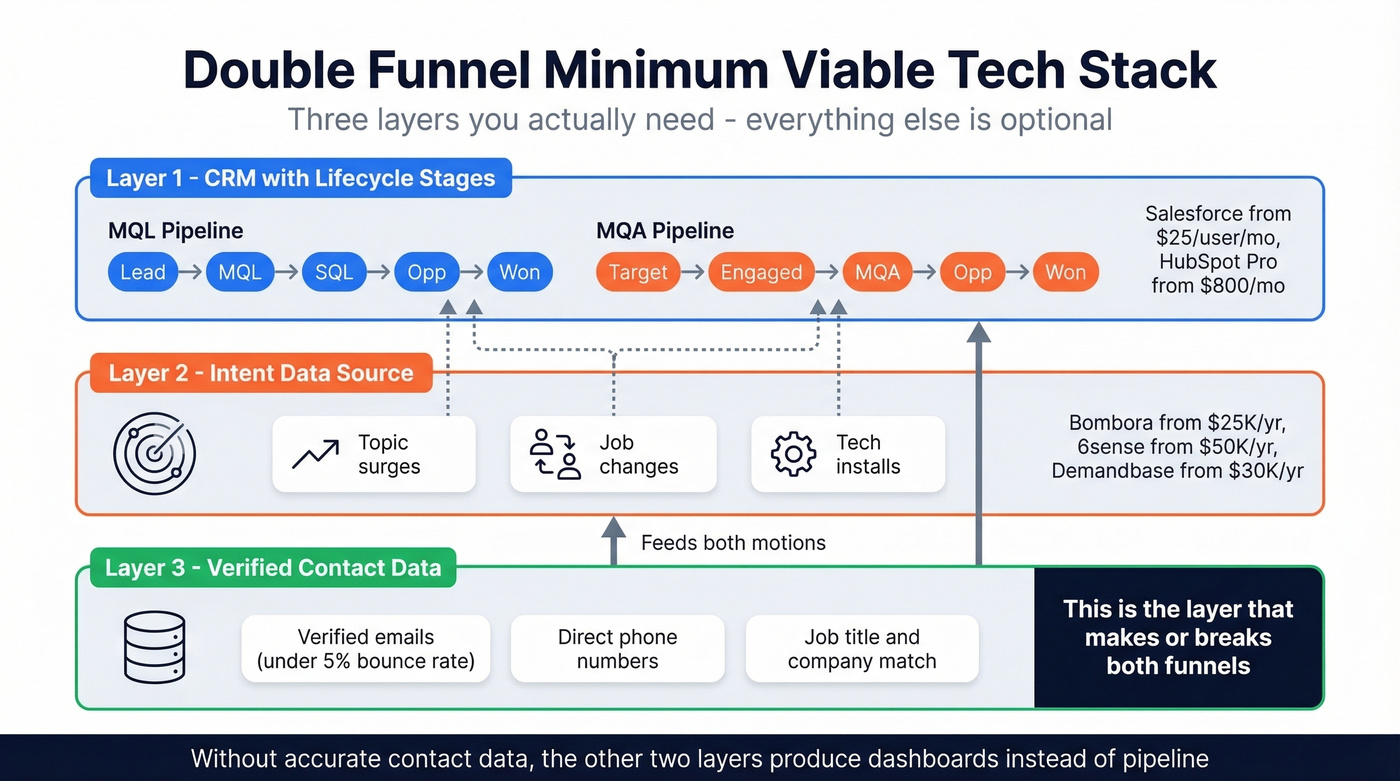
CRM with lifecycle stages. Salesforce starts around $25/user/month for entry tiers, with most B2B teams paying more once they add Sales Cloud features and automation. HubSpot Marketing Hub Professional starts around $800-$1,000/month before add-ons. The CRM needs to track MQLs and MQAs separately with clear stage definitions - this is what separates a pipeline view from a lead-funnel view and lets you report on each motion independently. Without this, you can't measure either funnel. If you need a quick reference list, see examples of a CRM.
Intent data source. Bombora standalone runs $25K-$50K+/year. Bundled through platforms like 6sense ($50K-$120K+/year) or Demandbase ($30K-$100K+/year depending on modules and seats), it gets expensive fast. Intent data tells you which accounts are actively researching your category - it's what makes ABM targeted rather than random. For a practical implementation, use intent based segmentation.
Verified contact database. This is where budget-conscious teams have options. Prospeo's CRM enrichment returns 50+ data points per contact at an 83% match rate, with native integrations for Salesforce, HubSpot, Smartlead, Instantly, and Lemlist. Pricing starts at a free tier - 75 verified emails/month plus 100 Chrome extension credits/month, no contracts - at roughly $0.01 per email. That's a fraction of what enterprise-only alternatives charge, which matters when you're building out both motions and don't want the data layer alone to blow your budget. If you're comparing vendors, start with data enrichment services and best B2B company data providers.

Running ABM alongside demand gen means your team needs verified emails and direct dials for 6-10 person buying committees - fast. Prospeo gives you 300M+ profiles, 125M+ verified mobiles, and 30+ filters including buyer intent and headcount growth to power both motions from one platform.
One data platform for both funnels. No contracts, no sales calls required.
FAQ
What does "double funnel" mean in B2B?
It means running demand generation and account-based marketing as parallel motions feeding the same pipeline, or connecting an acquisition funnel with a retention funnel into one lifecycle model. Either way, you're operating two structured conversion paths simultaneously instead of one.
Is a double funnel the same as a bow-tie funnel?
Yes, functionally. The bow-tie funnel maps pre-sale acquisition on the left and post-sale retention on the right - identical mechanics to the acquisition + retention double funnel, just with a different visual metaphor and better branding.
What size company needs a double funnel?
B2B companies with $5M+ ARR, sales cycles over 60 days, and at least 3-4 dedicated marketing headcount to staff both motions. Below that, master one go-to-market funnel first - layering complexity on a broken foundation just doubles the problems.
What's a good MQL-to-SQL conversion rate?
B2B SaaS benchmarks show 38-39% MQL-to-SQL conversion. Below 25% signals a qualification problem, not a strategy problem. Tightening discovery questions and enriching lead records with verified data can lift SQL quality significantly.
What tools do you need to run a double funnel?
Three non-negotiables: a CRM with lifecycle stages (Salesforce or HubSpot), an intent data source for account prioritization (Bombora, 6sense, or Demandbase), and a verified contact database for accurate emails and direct dials feeding both motions.