

Dropcontact vs Hunter: Data, Pricing & Verdict (2026)
Run the same 1,000-lead dataset through both tools and you'll see the tradeoff immediately: Lobstr's API benchmark found Hunter returned 281 emails while Dropcontact returned 383. But Clay's dataset scored Dropcontact's data quality 9.33 points lower than Hunter's.
More emails, worse quality. Fewer emails, better quality. That's the entire Dropcontact vs Hunter debate in two sentences.
30-Second Verdict
Hunter wins on: email quality (89.56% in Clay's testing) and ease of use (G2: 9.4/10).
Dropcontact wins on: coverage (75.95% per Clay) and GDPR compliance - it backs this up with a CNIL closure letter.
Skip both if you need verified mobile numbers, a leads database, or intent data. Neither tool does any of that.
The Core Difference
Hunter is database-driven. It stores email formats it's already discovered and matches against them - 102M+ stored addresses at last count. Dropcontact takes the opposite route: no contact database at all, purely algorithmic enrichment, generating and verifying emails in real time from name + company inputs.
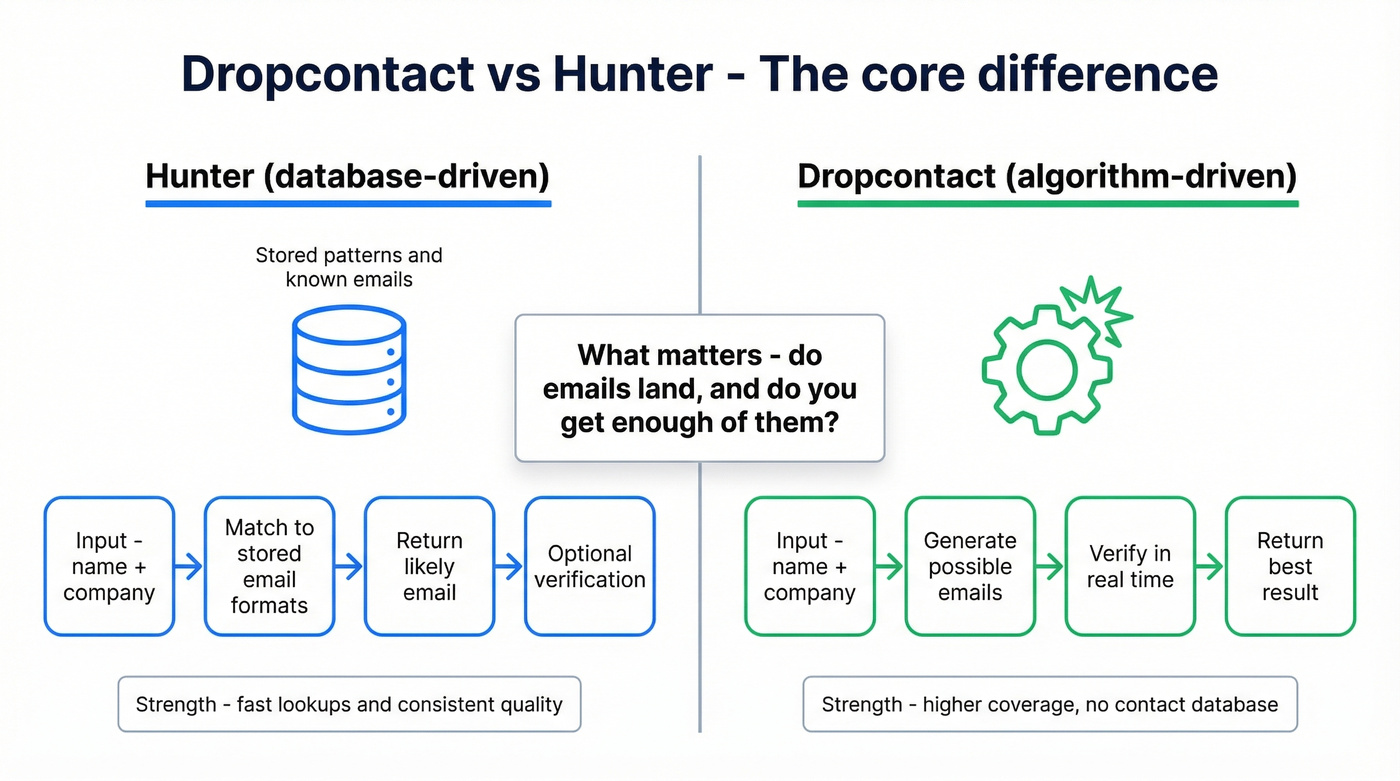
Here's the thing: the database vs. algorithm debate is a distraction. What actually matters is whether the emails land and whether the tool finds enough of them. Let's look at the numbers.
Accuracy & Coverage Benchmarks
Two third-party tests plus Dropcontact's own benchmark paint a consistent picture:
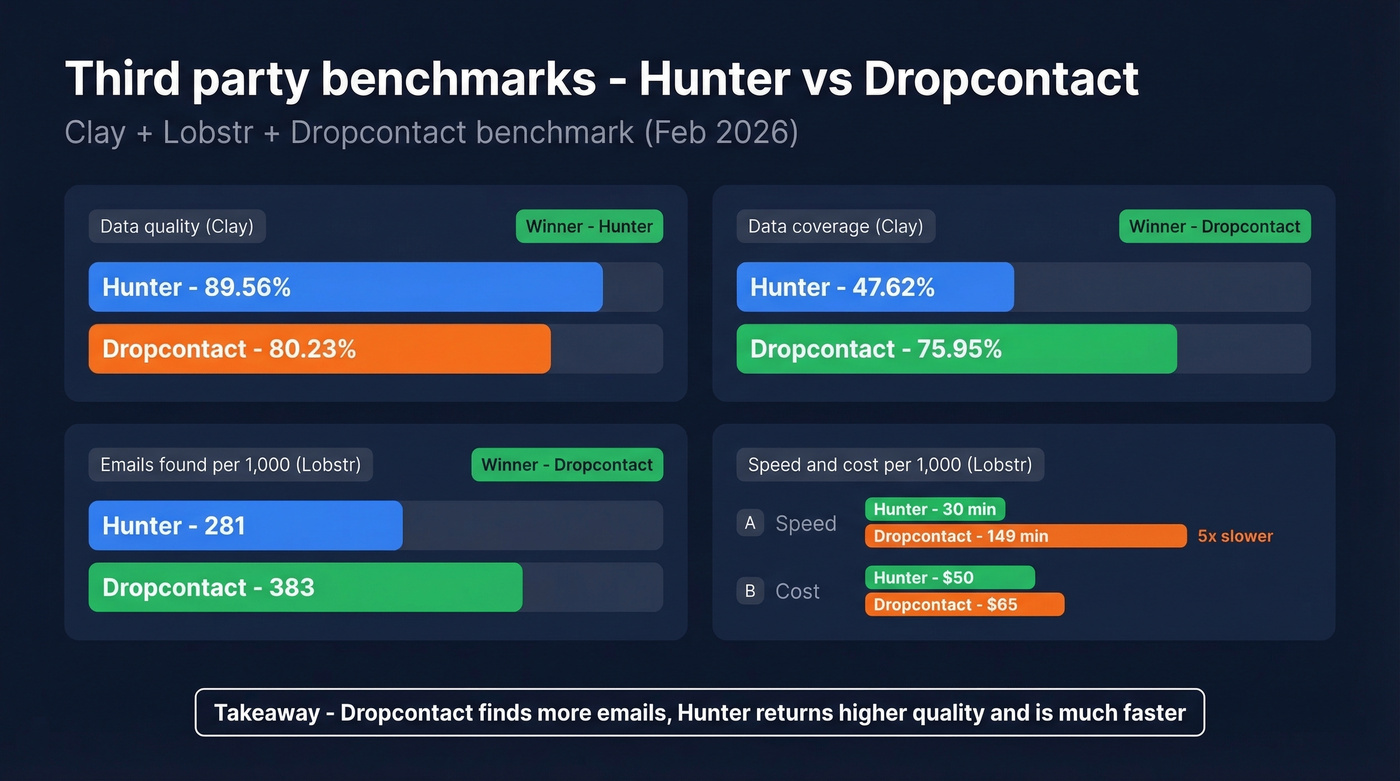
- Clay scored both tools on data quality and data coverage across a shared dataset.
- Lobstr ran 1,000 leads through each API and measured emails found, speed, and cost per lookup.
- Dropcontact's benchmark tested 15 tools on 20,000 real contacts (updated February 2026) and reported 54.9% effective enrichment with 0.9% hard bounces.
| Metric | Hunter | Dropcontact | Winner |
|---|---|---|---|
| Data quality | 89.56% | 80.23% | Hunter |
| Data coverage | 47.62% | 75.95% | Dropcontact |
| Emails found / 1k | 281 | 383 | Dropcontact |
| Speed / 1k requests | 30 min | 149 min | Hunter |
| Cost / 1k lookups | $50 | $65 | Hunter |
Most comparisons skip speed, which is a mistake. In Lobstr's benchmark, Hunter processed 1,000 lookups in 30 minutes vs. Dropcontact's 149 minutes. If you're enriching lists in real time or feeding a Clay workflow, that 5x gap matters a lot.

One more thing: Dropcontact advertises 99% validity for its V2 engine, while Clay's dataset scored Dropcontact's data quality at 80.23%. We've seen similar gaps between vendor claims and independent tests across the industry, so always trust the third-party numbers over marketing pages.

Why choose between Hunter's quality and Dropcontact's coverage? Prospeo delivers 98% email accuracy across 300M+ profiles - no tradeoff required. At ~$0.01/email with a 7-day data refresh, you get fresher contacts than either tool can match.
Stop compromising. Get coverage and accuracy in one platform.
Pricing Breakdown
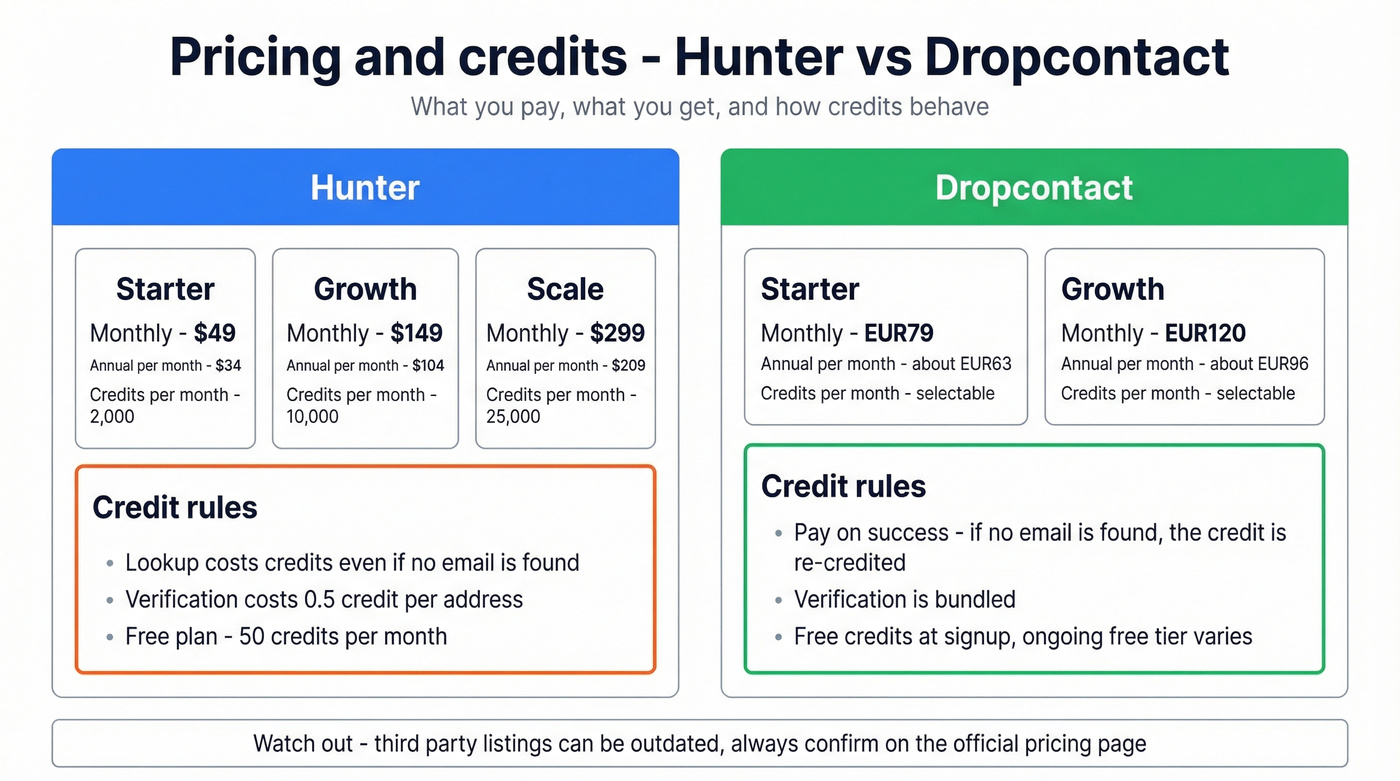
Hunter's pricing is straightforward. Dropcontact's is harder to parse because third-party listings don't always match the official pricing page - G2 lists Dropcontact at EUR24/mo for 1,000 credits, but the actual site shows EUR79/mo for Starter and EUR120/mo for Growth.
| Hunter Starter | Hunter Growth | Hunter Scale | Dropcontact Starter | Dropcontact Growth | |
|---|---|---|---|---|---|
| Monthly | $49 | $149 | $299 | EUR79 | EUR120 |
| Annual (per mo) | $34 | $104 | $209 | ~EUR63 | ~EUR96 |
| Credits/month | 2,000 | 10,000 | 25,000 | Selectable | Selectable |
| Verification | 0.5 credits | 0.5 credits | 0.5 credits | Bundled | Bundled |
Dropcontact's pay-on-success model is genuinely nice: if an email isn't found, the credit gets re-credited. Hunter charges credits for lookups regardless, and verification costs an additional 0.5 credit per address. (If you’re comparing verifiers, see our email verification options.)
Hunter also offers a free plan with 50 credits/month. Dropcontact provides free credits at signup, though the ongoing free tier varies.
Features & Integrations
Use Hunter if you want built-in email sequences, broad CRM integrations (HubSpot, Salesforce, Pipedrive, Zoho), automation via Zapier/Make/Clay, and an MCP server for LLM integrations. It's the more polished product for teams that just want to plug something in and go. (If you’re building a full outbound stack, start with the best SDR tools.)
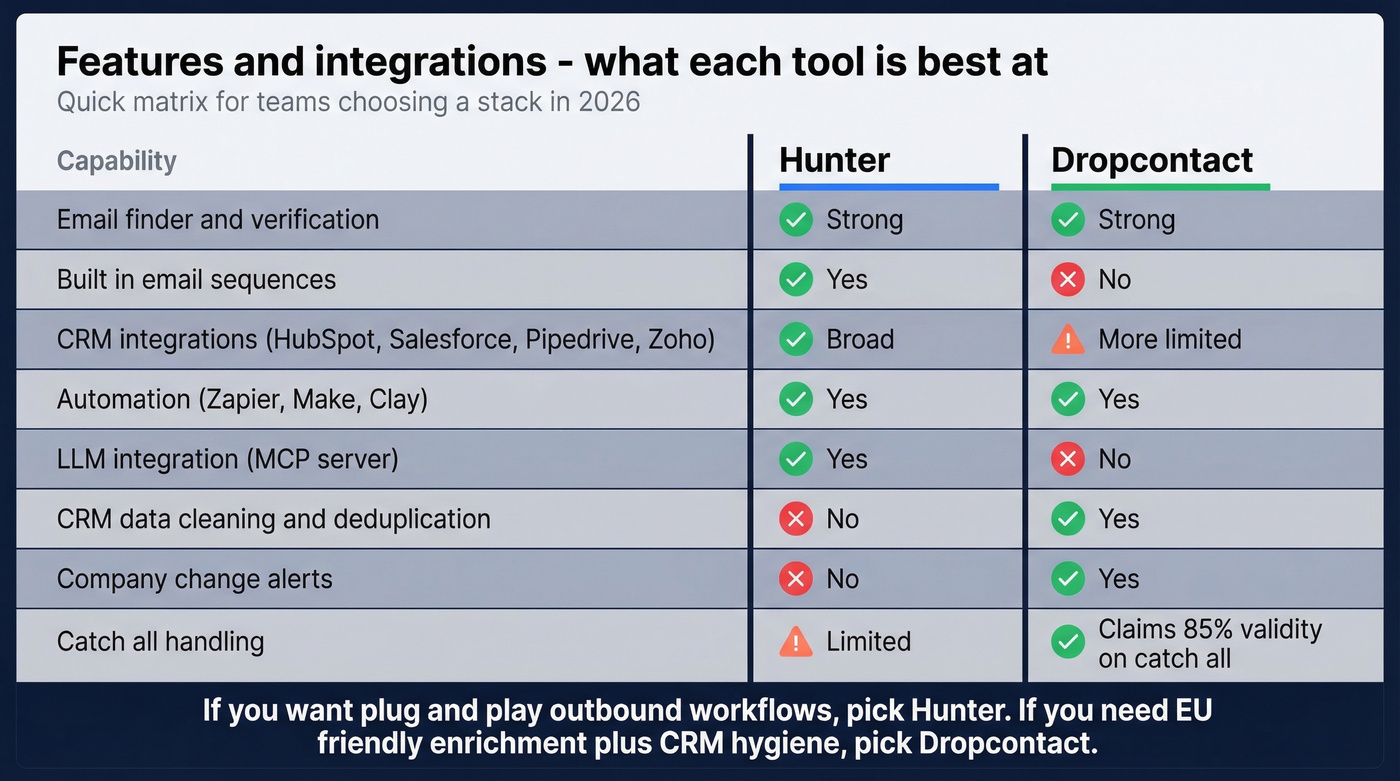
Use Dropcontact if you need CRM data cleaning, duplicate detection, company change alerts, or catch-all verification - Dropcontact publishes 98% validity overall and 85% validity on catch-all domains. The Growth plan adds URL enrichment without login and credit carryover. One caveat: CRM enrichment requires a separate subscription, which catches people off guard.
What Users Say
Dropcontact scores 4.6/5 on G2 (48 reviews) and 4.7/5 on Capterra. Hunter sits at 4.4/5 on G2 with 634 reviews - a much larger sample size. Hunter wins on ease of use (9.4 vs 9.0); Dropcontact wins on support quality (9.2 vs 8.7).
Complaint themes are predictable. Hunter users say credits burn fast - one Reddit practitioner called it "better as a verification layer than a primary source." Dropcontact users flag missing contacts and a forced Google/Microsoft auth flow on signup that feels unnecessarily heavy-handed. On the flip side, a Capterra reviewer called Dropcontact the "best email finder for Europe" after testing seven tools, which tracks with our experience testing EU-focused enrichment.
When to Pick Each
Pick Hunter if you prioritize email quality over volume, want the easiest setup, or need built-in sequences with broad CRM integrations. For teams sending under 2,000 emails per month, Hunter's free + Starter tier is the smarter bet - you'll spend less time cleaning bad data. (For more options, see our Hunter alternatives.)
Pick Dropcontact if you're EU-based and GDPR compliance is non-negotiable, you need higher coverage rates, or you value pay-on-success economics. Above 2,000 emails/month, Dropcontact's coverage advantage starts earning its keep. Just budget for a separate verification pass.
Skip both for outbound at scale. Both are point solutions - they find emails from inputs you already have. Neither offers a leads database, verified mobiles, or buyer intent signals. Prospeo fills those gaps with 300M+ profiles, 98% email accuracy, 125M+ verified mobiles, and intent data across 15,000 topics, all on a 7-day refresh cycle. If you're comparing Dropcontact vs Hunter, it's worth asking whether an email-only tool is enough for your outbound stack in 2026. (If you need list-building from scratch, compare sales prospecting databases and outbound lead generation tools.)
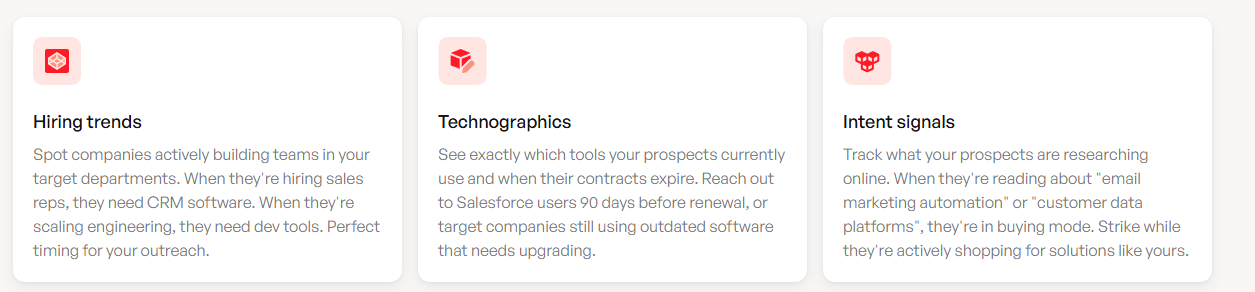
Neither Dropcontact nor Hunter offers a leads database, verified mobiles, or intent data. Prospeo gives you all three - 125M+ verified mobile numbers, buyer intent across 15,000 topics, and 30+ search filters to build lists from scratch instead of enriching ones you already have.
Email-only tools aren't enough for outbound in 2026.
FAQ
Is Dropcontact more accurate than Hunter?
It depends on what you mean by "accurate." Hunter delivers higher-quality emails - 89.56% vs 80.23% in Clay's dataset. Dropcontact finds more of them, with 75.95% coverage vs 47.62%. Pick Hunter if you'd rather have fewer valid emails; pick Dropcontact if volume matters more and you'll run a separate verification pass.
Is Dropcontact GDPR compliant?
Yes. Dropcontact cites a CNIL closure letter dated November 2020 confirming compliance, and it processes data algorithmically without storing a contact database. That makes it a strong pick for EU-based teams with strict data-processing requirements.
What's a good alternative to both?
Prospeo is the strongest option if you need more than email finding - it combines 300M+ profiles, 125M+ verified mobiles, and intent data in one self-serve platform with a free tier of 75 emails/month. Apollo and Snov.io also work for teams wanting more than a standalone email finder, though we've found their email accuracy doesn't match what Prospeo delivers at 98%.