

Easy Email Verification vs SalesIntel: Which One Do You Actually Need?
Your last cold email campaign bounced 15% of its list. The sequences stalled, your domain reputation took a hit, and now you're shopping for a fix.
Here's the thing about comparing Easy Email Verification vs SalesIntel: you're looking at two tools that don't do the same job. A database gives you who to contact. A verification tool tells you whether the address still works. Picking the wrong category wastes more time than picking the wrong tool within that category, and we've watched teams burn entire quarters figuring that out the hard way.
30-Second Verdict
- Easy Email Verification: You already have a list and need to scrub it before sending. Cheap, does one job.
- SalesIntel: You need to build a verified contact database with intent signals and firmographics - and you've got an estimated $18K+/year budget for a contract-style plan.
- Skip both if: You want verified contact data AND real-time email verification in one workflow without an enterprise contract.
What Each Tool Does
Easy Email Verification
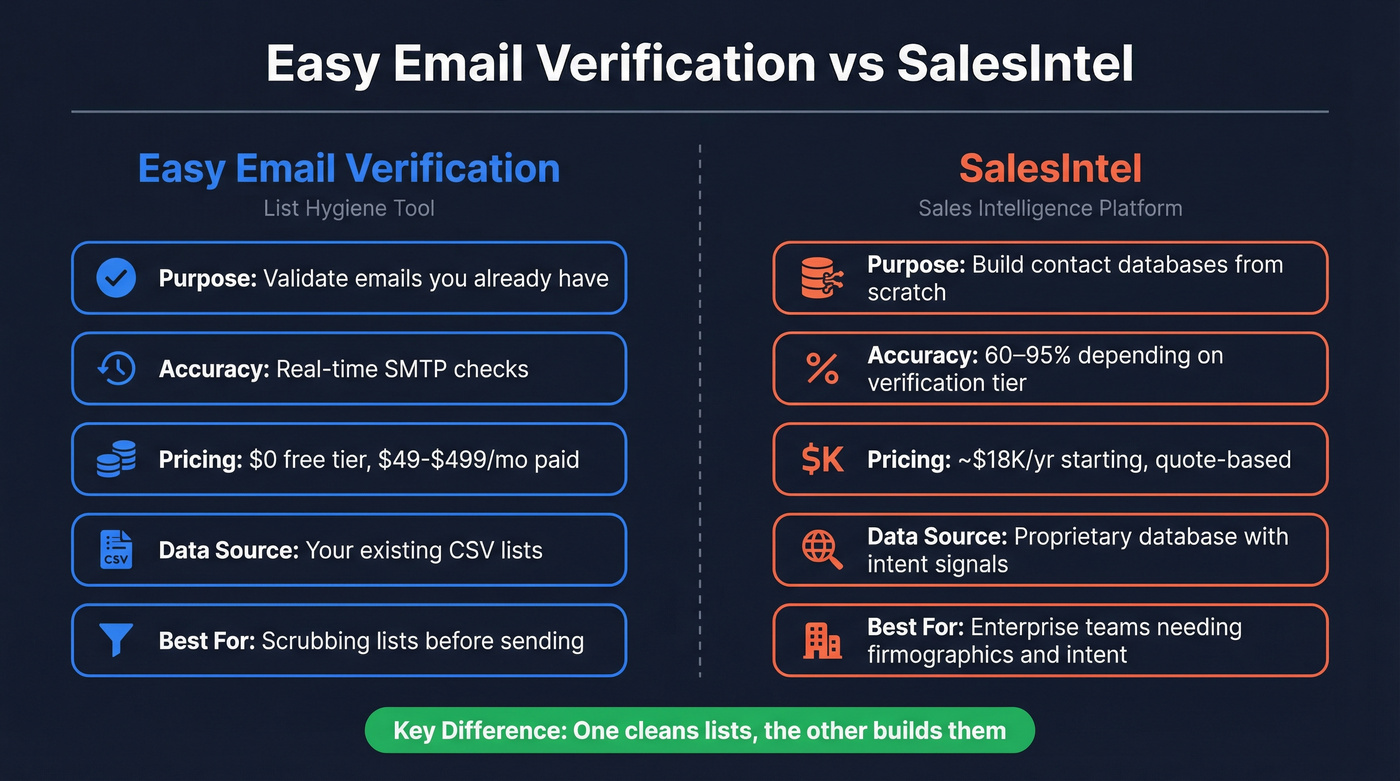
Easy Email Verification is a dedicated list-hygiene tool. It runs syntax, MX, and SMTP checks, flags disposable and role-based addresses, scores email/domain health, and offers an API for developers. Upload a CSV, get results. That's the entire workflow. It validates against current mailbox behavior in real time rather than relying on a database snapshot, which is a meaningful distinction when you're dealing with high-turnover contact lists.
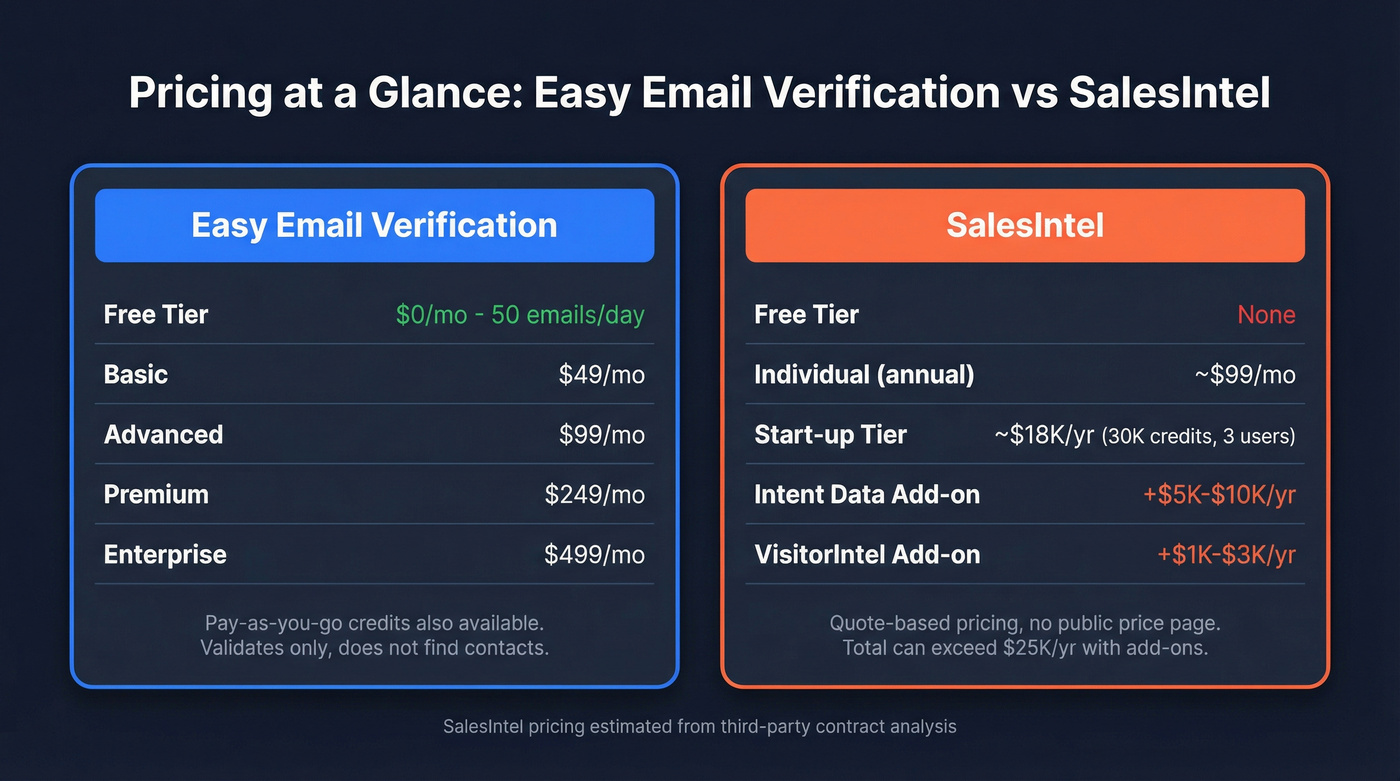
Pricing is transparent: there's a free tier at $0/month with 50 emails/day, then monthly plans for deliverability tools - Basic at $49/month, Advanced at $99/month, Premium at $249/month, and Enterprise at $499/month. Pay-as-you-go credit options are also available.
If you want a deeper breakdown of plans and tradeoffs, see our Easy Email Verification review.
SalesIntel
SalesIntel is a full sales intelligence platform - contact database, firmographics, technographics, intent data, and integrations with Salesforce, HubSpot, and Outreach. It carries a 4.3/5 on G2 with 538 reviews. Users praise ease of use and contact data access, but the top complaints center on outdated and inaccurate data.
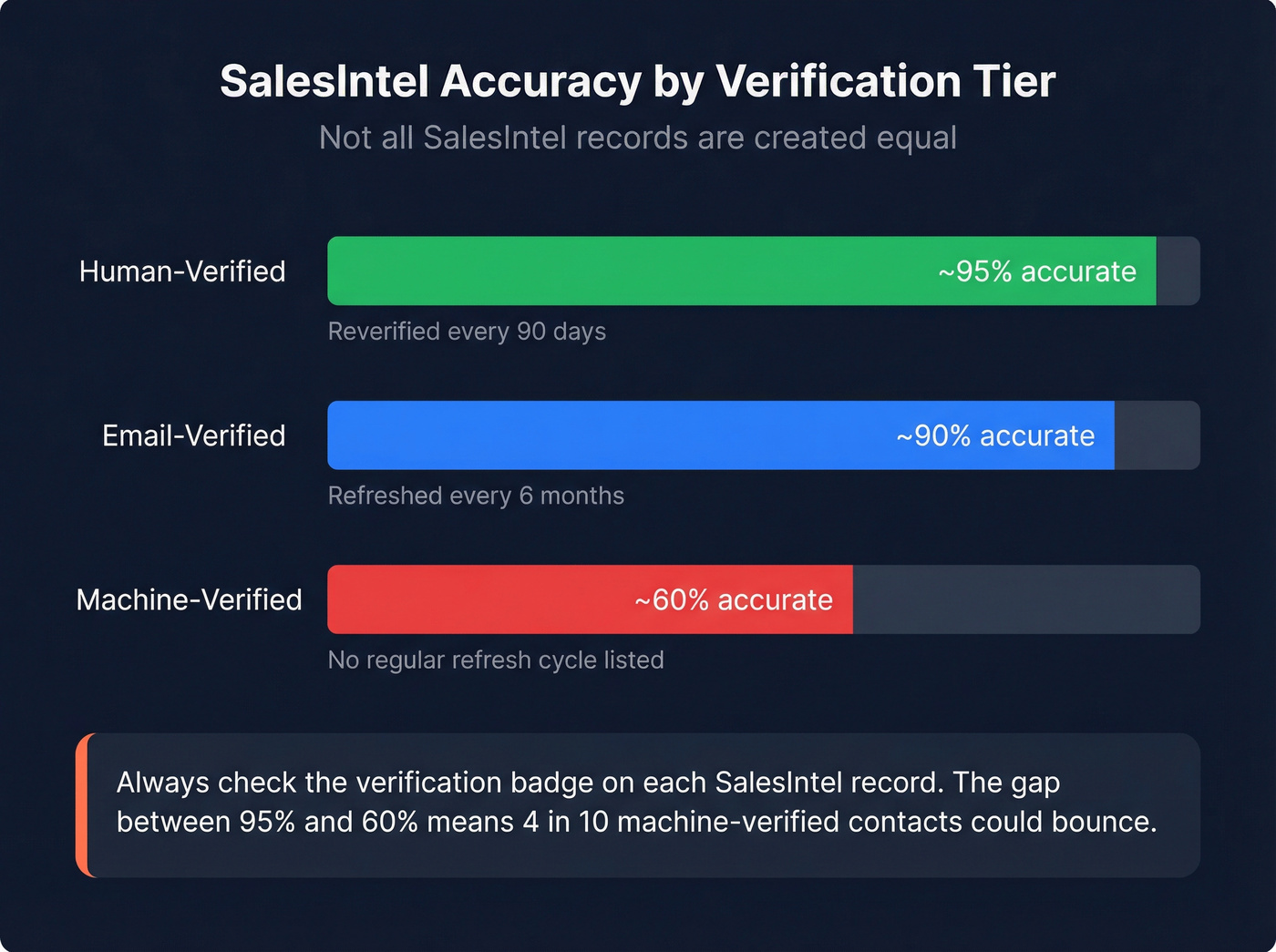
The verification model is tiered, and this matters a lot. Human-verified records hit ~95% accuracy and get reverified every 90 days. Email-verified records drop to ~90%, refreshed every six months. Machine-verified? Roughly 60% accurate. The structural problem: SalesIntel's database decays between verification cycles, so a record that was accurate in January might bounce by March. Always check the verification badge on each record before trusting it.

SalesIntel's machine-verified records hit 60% accuracy. Easy Email Verification only cleans lists you already have. Prospeo combines 300M+ profiles with 98% email accuracy and a 7-day refresh cycle - so every contact you pull is already verified. No separate verifier needed.
Get verified contacts and skip the cleanup step entirely.
Pricing Comparison
SalesIntel doesn't publish pricing - you'll talk to sales. Third-party contract analysis gives us workable estimates.
| Tool | Free Tier | Paid Start | Enterprise | Model |
|---|---|---|---|---|
| Easy Email Verification | 50 emails/day | $49/mo | $499/mo | Subscription + pay-as-you-go credits |
| SalesIntel | None | ~$99/mo (individual, annual) | ~$48K/yr | Quote-based |
SalesIntel's Start-up tier runs around $18K/year for 30,000 credits and up to 3 users. Their current packaging positions itself as "unlimited" exports and enrichment per user per month, while older contract breakdowns show credit-based tiers - ask your rep which model applies. Add intent data at $5K-$10K/year or VisitorIntel at $1K-$3K/year and you're looking at $25K+ before you've onboarded.
Easy Email Verification is dramatically cheaper but doesn't find contacts. It only validates ones you already have.
Which Tool Fits Your Workflow?
The 2% bounce threshold is the standard benchmark - top performers keep hard bounces under 1%. What separates email verifiers beyond basic checks is catch-all handling, honeypot detection, and refresh cadence. (If you want the deeper mechanics, see our guide to email bounce rate.)
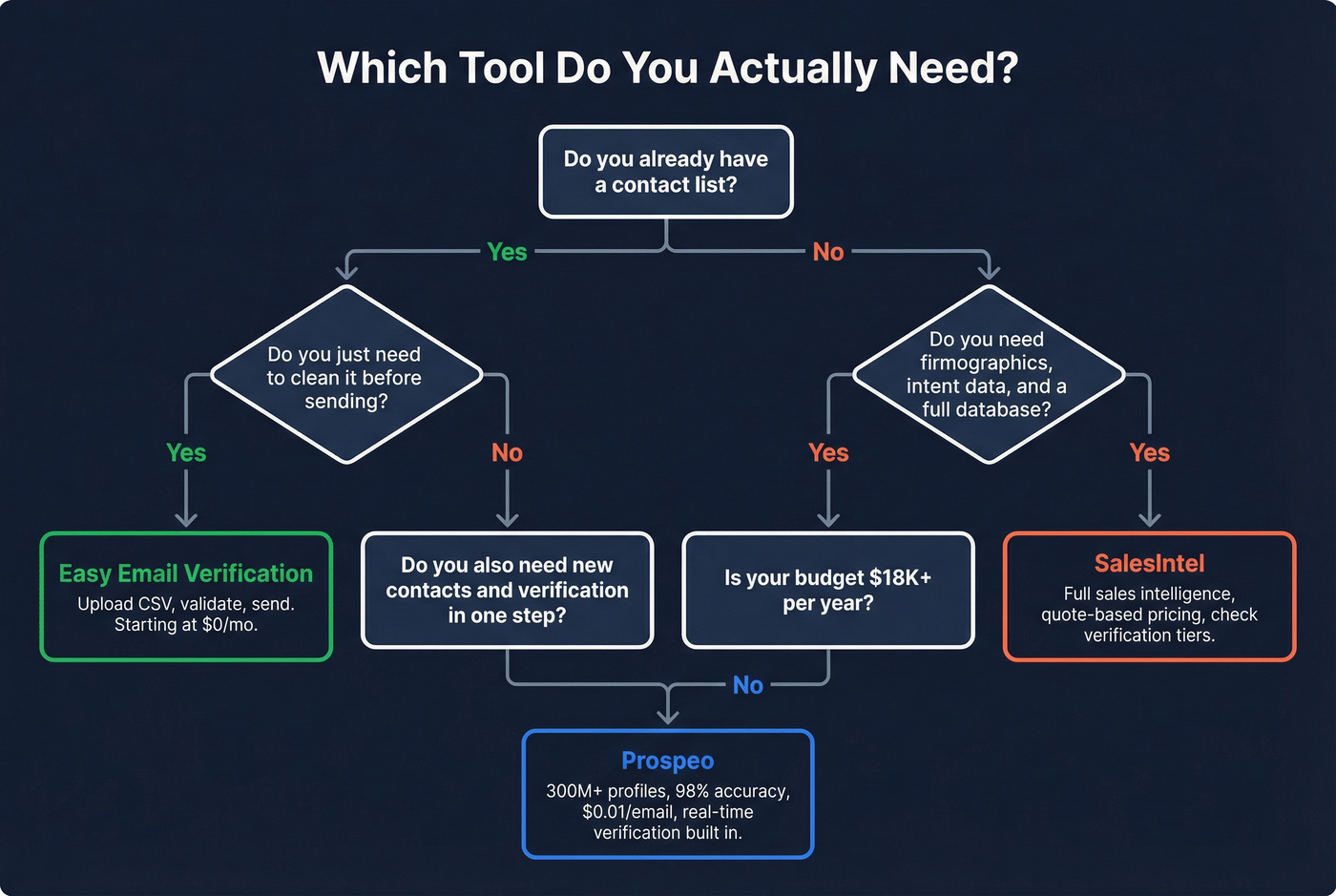
We've seen teams waste months paying for both a standalone verifier and a separate contact database when one tool covers both. Let's break down the decision:
You have a list and need to clean it - Easy Email Verification. Upload, validate, send.
You need to build a list from scratch with intent signals and firmographic filters - SalesIntel, if you've got the budget and patience for quote-based pricing. (For more options, compare sales prospecting databases.)
You need both verified contacts and verification in one workflow - Prospeo gives you 300M+ professional profiles with 98% email accuracy, a 7-day data refresh cycle, and real-time verification built into every search. Free tier starts at 75 emails/month with no contracts.
Here's our honest take: most teams with deal sizes under $15K don't need a full sales intelligence platform. They need accurate contacts that don't bounce, and they need them fast. An ~$18K/year database where machine-verified records sit at 60% accuracy costs more per usable contact than a tool charging $0.01/lead at 98% accuracy. The math isn't close.

At ~$18K/year, SalesIntel's cost per usable contact balloons when machine-verified records bounce. Prospeo delivers verified emails at $0.01 each with 98% accuracy - plus intent data, 30+ filters, and real-time verification baked into every search. No sales calls, no annual lock-in.
Pay $0.01/email instead of $18K/year for data that decays.
FAQ
Is Easy Email Verification the same as Easy Email Finder?
No. Easy Email Finder locates email addresses from names and domains. Easy Email Verification validates emails you already have. They're different tools from the same brand - make sure you're buying the right one.
How accurate is SalesIntel's data really?
The headline "95% accuracy" applies only to human-verified records, reverified every 90 days. Email-verified records drop to ~90%, and machine-verified records sit around 60%. The gap between tiers is wider than the marketing suggests, so always check the verification badge before trusting a record.