

Ecosystem-Led Growth: What It Actually Is, Whether It's Hype, and How to Do It
Your CEO came back from SaaStr with a new favorite phrase: "ecosystem-led growth." Now there's a Slack thread, a half-baked deck from a Crossbeam sales rep, and a vague mandate to "figure out our ELG strategy by Q3."
Here's the short version. Ecosystem-led growth is the strategy of using your partner ecosystem to source, close, and expand deals across the entire funnel. It's real, but overhyped by the vendors selling ELG platforms. To start, map your partner overlaps, run one co-sell pilot, and make sure your contact data is accurate enough to act on partner intel.
What Is Ecosystem-Led Growth?
ELG is a go-to-market motion that treats your partner network as the primary lever for attracting, converting, and growing customers. Bob Moore, co-founder and CEO of Crossbeam, popularized the term and wrote the book on it. His argument: the old playbooks - hire more reps, optimize your freemium funnel - are hitting diminishing returns. The next growth vector is your ecosystem of technology, service, and integration partners whose customers overlap with yours.
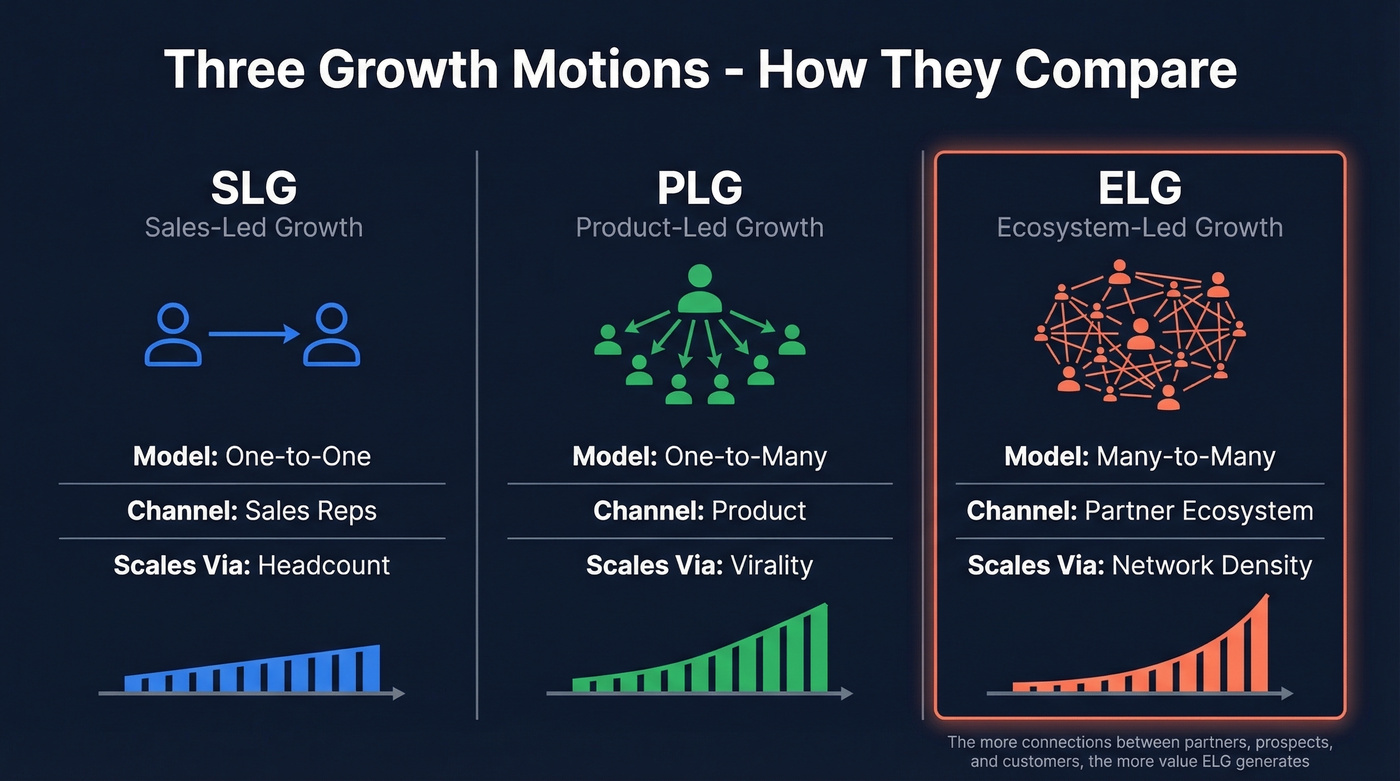
The simplest way to understand ELG is to compare it to the two motions it sits alongside:
| Motion | Model | Primary Channel | Scales Via |
|---|---|---|---|
| SLG | One-to-one | Sales reps | Headcount |
| PLG | One-to-many | Product | Virality |
| ELG | Many-to-many | Partner ecosystem | Network density |
Sales-led growth scales by adding reps. Product-led growth scales through virality and self-serve adoption. ELG scales through the density of your partner network - the more connections between partners, prospects, and customers, the more value the ecosystem generates.
Crossbeam's framework breaks ELG into a full-funnel model: Target, Engage, Differentiate, Acquire, Retain, Expand. Partner data doesn't just help you find new logos. It informs every stage, from identifying which accounts to prioritize through reducing churn and driving expansion revenue.
Real Strategy or Rebranded Partner Marketing?
Let's be honest: a lot of ELG sounds like partner marketing with better tooling.
The cleanest framing is the one Total Product Marketing put forward: "yes, kind of, but with a caveat." Partner marketing focuses on co-branded campaigns and joint demand gen. ELG is broader - it uses partner ecosystem data to inform the entire GTM strategy, including product development, sales enablement, and customer success. Partner marketing is one tactic within ELG, not a synonym for it.
And most ELG content is written by companies selling ELG platforms. Crossbeam popularized the term. Reveal popularized "Nearbound." The two merged in 2024, bringing 25,000+ companies onto a unified network under the Crossbeam brand. That merger signals real demand, but the loudest voices defining the category have a financial interest in making it sound revolutionary.
The differentiation is real, though. Traditional partner programs ran on spreadsheets and quarterly business reviews. ELG runs on modern account mapping and a partner data layer that tells your sales team which prospects already trust one of your partners. That operational layer is genuinely new.
Why ELG, Why Now
The forcing function isn't a clever marketing framework. It's buyer behavior.
Buying decisions happen in what practitioners call the "dark funnel": private Slack communities, peer conversations, vendor review threads, and informal advisor networks. 6sense research suggests that 84% of deals are effectively decided before sellers even engage. If the buyer already has a shortlist before your SDR sends the first cold email, the question becomes: how do you get on that shortlist?
Through the people buyers already trust - your partners.
Forrester data shows 67% of organizations expect partner-generated revenue to grow by 30%+ year over year. McKinsey analysts estimate the integrated network economy could represent a $100T value pool by 2030. Those are big numbers, and they track with what we're seeing in outbound: cold outreach alone is getting harder, and warm introductions through shared networks consistently outperform.
Here's our hot take: if your average deal size is under $15k and your sales cycle is under 30 days, you probably don't need a formal ELG program. A strong PLG motion with a few strategic integration partnerships will get you 80% of the value. ELG's ROI kicks in when deals are complex enough that trust and multi-threading actually move the needle. Skip this if you're a seed-stage startup selling $99/month plans - you've got bigger fish to fry.
How ELG Actually Works
Strip away the buzzwords and ELG runs on a simple mechanism: account mapping at scale.
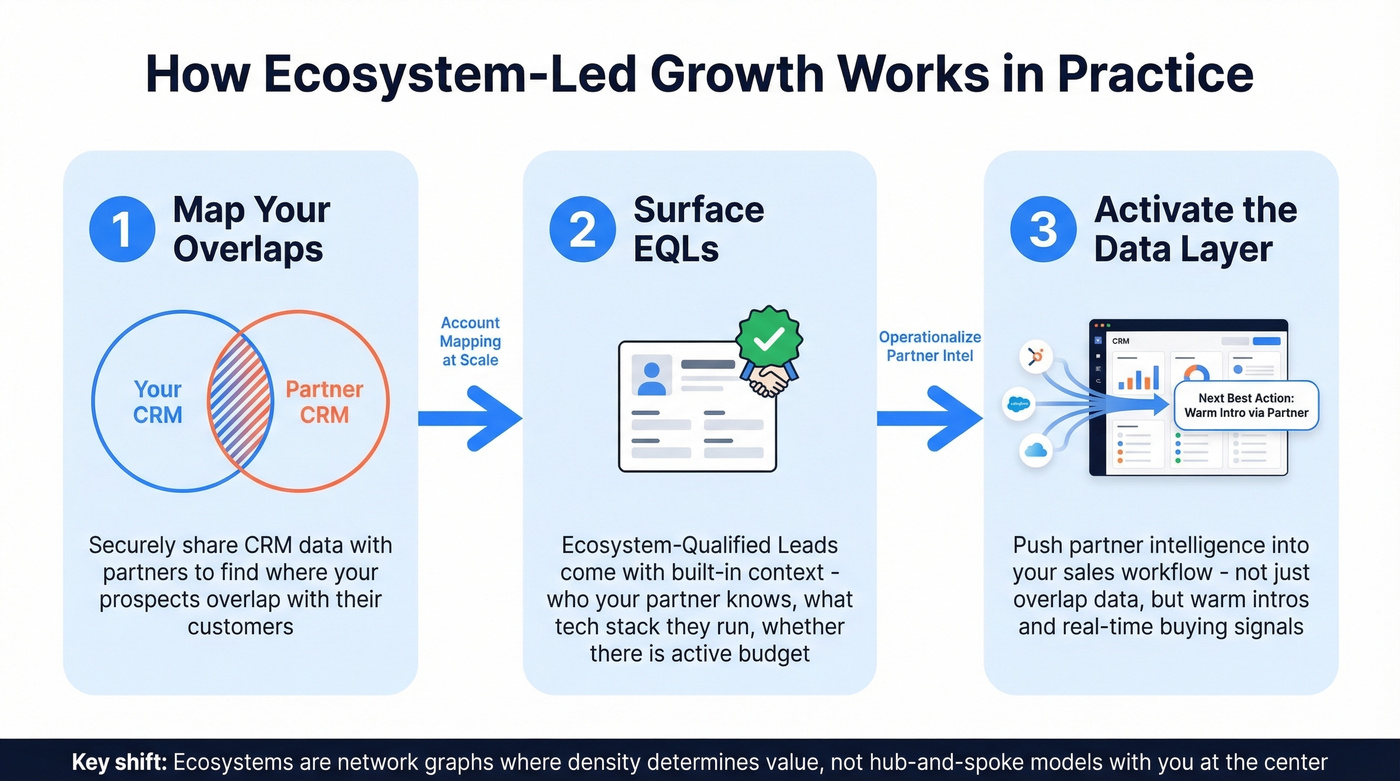
1. Map your overlaps. Using a platform like Crossbeam, you securely share CRM data with partners to identify where your prospect lists overlap with their customer bases. This is automated, real-time, and privacy-controlled - not the old "compare spreadsheets on a quarterly call" approach.
2. Surface ecosystem-qualified leads. An EQL is a prospect where a partner already has a trusted relationship with the target account. These aren't cold leads. They come with built-in context: which stakeholders your partner knows, what tech stack the account runs, and whether there's active budget.
3. Activate the partner data layer. This is where ELG gets operational. The data layer provides intelligence and next-best-actions - not just "this account overlaps," but "your partner's CSM has a warm relationship with the VP of Ops, and they're evaluating tools in your category right now."
The key conceptual shift: ecosystems aren't hub-and-spoke networks with you at the center. They're network graphs where density - the number of connections between nodes - determines value.
Crossbeam highlighted a LeanData example where 85-90% of inbound demo requests came in because a partner mentioned them. In another case, partner-influenced revenue jumped from 3% to 80% of new business in a single year. Those numbers sound extreme, but they illustrate what happens when you operationalize partner data instead of leaving it in a spreadsheet nobody opens.

Partner data tells you which accounts to target. But ecosystem-qualified leads are worthless without verified contact data to activate them. Prospeo delivers 98% accurate emails and 125M+ verified mobile numbers - refreshed every 7 days - so when your partner flags a warm account, you reach the right person instantly.
Turn partner intel into booked meetings at $0.01 per verified email.
What the Data Shows
Crossbeam's most-cited ELG benchmarks come from its analysis of a cohort of 300 customers:
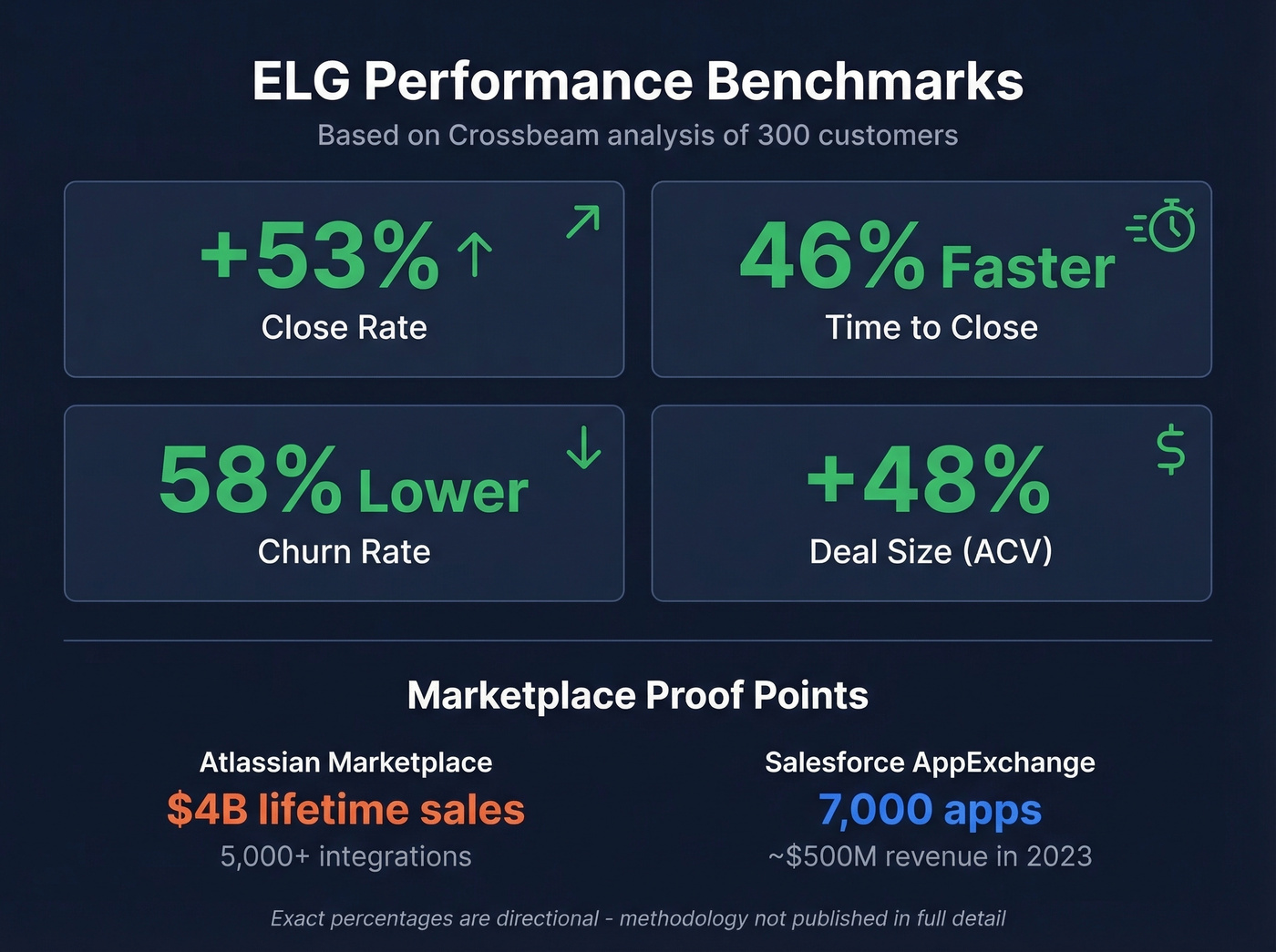
| ELG Metric | Improvement |
|---|---|
| Close rate | +53% |
| Time to close | 46% faster |
| Churn rate | 58% lower |
| Deal size (ACV) | +48% |
The methodology isn't published in detail, so take the exact percentages directionally. The trend, though, is consistent with what we've seen across partner-influenced deals in our own pipeline.
The marketplace proof points are harder to argue with because they're tied to public ecosystem distribution. Atlassian's marketplace has pushed roughly $4B in lifetime sales across 5,000+ integrations. Salesforce AppExchange runs 7,000 apps from approximately 4,500 partners and contributed roughly $500M to company revenues in 2023.
Broader partner benchmarks reinforce the trend: 72% of companies report lower CAC from partner channels, and mature partnership programs generate 28% of total revenue on average versus 18% for less developed programs.
Building a Partnership Ecosystem Strategy
Don't try to build a full ELG program in one quarter. JourneyBee's framework gets this right: Map, Pilot, Enable Sales.
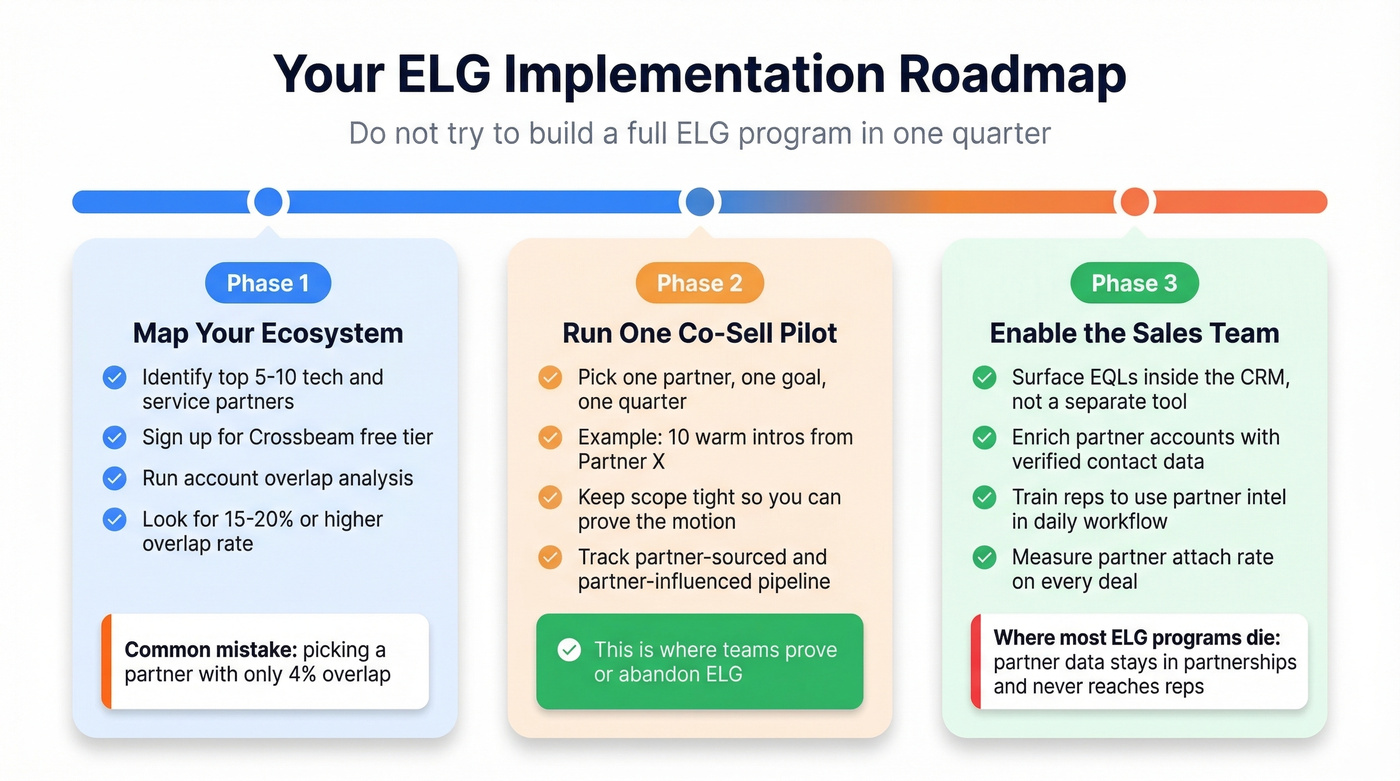
Map Your Current Ecosystem
Identify your top 5-10 technology and service partners. Get on Crossbeam's free tier and run account overlaps. You're looking for partners whose customer base has meaningful overlap with your ICP. Even a 15-20% overlap rate with one strong partner is enough to start.
Run One Co-Sell Pilot
Pick one partner, one goal, one quarter. Maybe it's "generate 10 warm introductions to accounts where Partner X has an active champion." Keep the scope tight. In our experience, the co-sell pilot is where teams either prove the motion or abandon it - so set it up to win. One frustrated partnerships lead told us their pilot died because they picked a partner with only 4% account overlap. Don't make that mistake. Check the overlap numbers before you commit.
Enable the Sales Team
This is where most ELG programs die.
The partnerships team maps overlaps, identifies warm accounts, and then nothing happens because reps don't know about it or don't trust the data. The motion fails if it stays in partnerships. Sales must use partner data in their daily workflow - surface EQLs in the CRM, not in a separate dashboard nobody checks.
The practical gap we see repeatedly: a partner surfaces a warm account, your rep pulls it up in Salesforce, and the contact data is from 2021. The intro dies before it starts. Prospeo plugs that gap - lead enrichment for partner-surfaced accounts with verified emails and direct dials pushed into Salesforce or HubSpot so reps act without leaving their CRM.
How to Measure ELG
Most teams overcomplicate this. Start with two metrics.
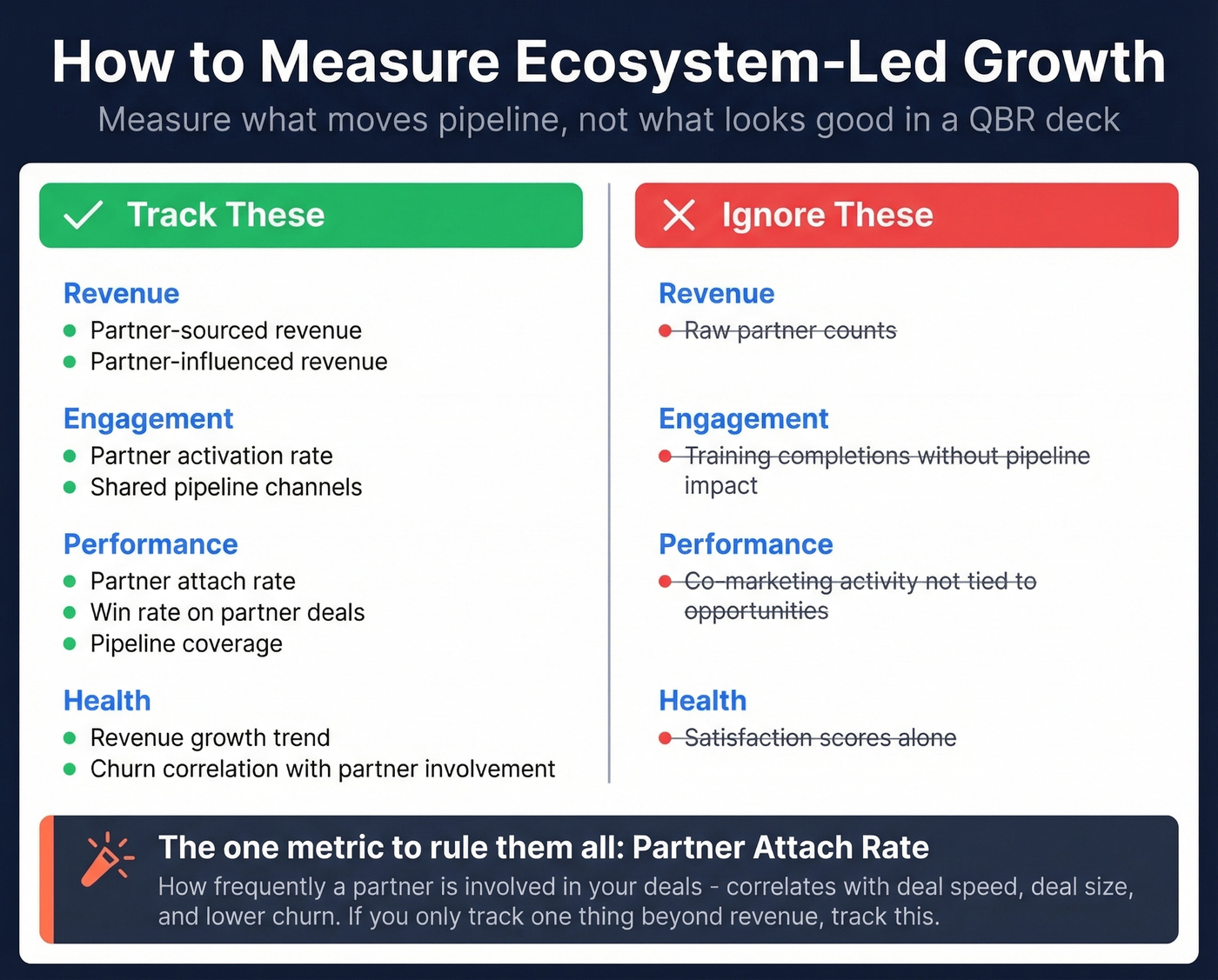
Matthew Gray at Postman tracks partner-sourced revenue and partner-influenced revenue as core KPIs, plus win rate and pipeline coverage as leading indicators. He explicitly ignores raw partner counts, training completions without pipeline impact, and co-marketing activity not tied to opportunities. That's the right instinct - measure what moves pipeline, not what looks good in a QBR deck.
monday.com takes a similar approach, splitting results into Direct and Influenced ARR, with a post-sale metric they call Partner Identified Expansions - tracking when partners surface upsell opportunities within existing accounts.
| Category | Key Metrics | What to Ignore |
|---|---|---|
| Revenue | Partner-sourced, influenced | Raw partner counts |
| Engagement | Activation rate, shared channels | Training completions alone |
| Performance | Attach rate, win rate, pipeline | Co-marketing without opps |
| Health | Revenue growth, churn correlation | Satisfaction scores alone |
Partner attach rate - how frequently a partner is involved in your deals - is the leading indicator most teams miss. It correlates with deal speed, deal size, and churn. If you're only tracking one thing beyond revenue, track attach rate.
The ELG Tech Stack
ELG runs on four layers: account mapping, data quality, attribution, and partner management.
| Category | Tool | Starting Price | Best For |
|---|---|---|---|
| Account Mapping | Crossbeam | Free; paid ~$4,800/mo | Every ELG program |
| Data Quality | Prospeo | Free (75 verified emails/mo) | Enriching partner-surfaced accounts |
| Prospecting | Apollo | Free; paid ~$49/user/mo | Teams wanting prospecting + sequencing |
| GTM Workflows | Clay | From ~$134/mo | Multi-step enrichment automation |
| Attribution | Dreamdata | From ~$750/mo | Proving ELG ROI to the board |
| PRM | PartnerStack | Custom (~$1,000+/mo) | Managing partner payouts |
Crossbeam is the account mapping layer - it's where ELG operationally begins. The free tier handles basic overlap analysis. Paid plans unlock unlimited offline partners and deeper analytics. It's expensive, but if this is a real strategic bet, it's the infrastructure.
Prospeo is the data quality layer. Account mapping tells you which accounts to pursue; Prospeo ensures you reach the right person with a verified email and verified mobile number. The database covers 300M+ professional profiles with 98% email accuracy and a 7-day refresh cycle. Starts free at 75 verified emails per month, with paid plans at roughly $0.01 per email. Native Salesforce and HubSpot integrations mean enriched contacts flow directly into rep workflows - no CSV exports, no manual uploads.

The remaining tools fill specific gaps as your program matures. Apollo works as a broader prospecting layer with built-in sequencing. Clay handles GTM orchestration - connecting account mapping data to enrichment and outreach sequences. Dreamdata solves attribution once you need to prove revenue impact. PartnerStack manages partner operations: onboarding and payouts.
For your first ELG pilot, start with Crossbeam free plus a data quality tool. Add attribution and PRM once you have enough deal flow to justify the spend.
If you’re building outbound sequences around partner signals, keep your sales follow-up tight and consistent.
ELG works when your sales team can act fast on partner signals. Stale data kills that speed. Prospeo's 7-day refresh cycle and 92% enrichment match rate mean your CRM stays current - so when a partner surfaces an overlap account, your reps already have verified emails, direct dials, and 50+ data points ready to go.
Stop letting bad data waste your best partner introductions.
FAQ
What's the difference between ELG and partner marketing?
Partner marketing focuses on co-branded campaigns and joint demand gen - it's one tactic. ELG uses partner ecosystem data to inform the entire go-to-market motion including product development, sales enablement, and customer success. Think of partner marketing as a single component within a broader partnership ecosystem strategy.
What is an ecosystem-qualified lead?
An EQL is a prospect identified through partner data where a partner already has a trusted relationship with the target account. EQLs convert at roughly 53% higher rates than cold leads because they carry built-in trust and context - your partner knows the stakeholders, tech stack, and buying timeline.