

Best Email Address Verifiers Online in 2026
Every invalid email you send costs roughly $12.50 per year in domain reputation damage, ISP throttling, and wasted sequence slots. B2B email lists decay by about 22.5% annually, so the "clean" list you built last quarter is already rotting. Picking the right email address verifier online isn't a nice-to-have - it's the difference between sequences that land and sequences that get your domain flagged.
We've tested most of the tools on this list across real outbound campaigns. Here's what actually performs.
Our Top Picks
Prospeo - Best for finding AND verifying emails in one workflow. 98% accuracy, 7-day data refresh, and a 5-step verification pipeline that handles catch-all domains. If you're building prospect lists from scratch, this eliminates an entire tool from your stack.
ZeroBounce - Best for enterprise compliance. SOC 2 Type 2, ISO 27001, and HIPAA certifications, 98.8% observed accuracy in independent testing, and 100 free monthly verifications.
NeverBounce - Best for straightforward bulk list cleaning. 98.6% observed accuracy, $8 per 1,000 credits, and a clean UI that marketing teams love.
How Email Verification Works
Most people treat email verification as a black box - upload a list, get results. Understanding the pipeline helps you evaluate why tools produce different results on the same list.
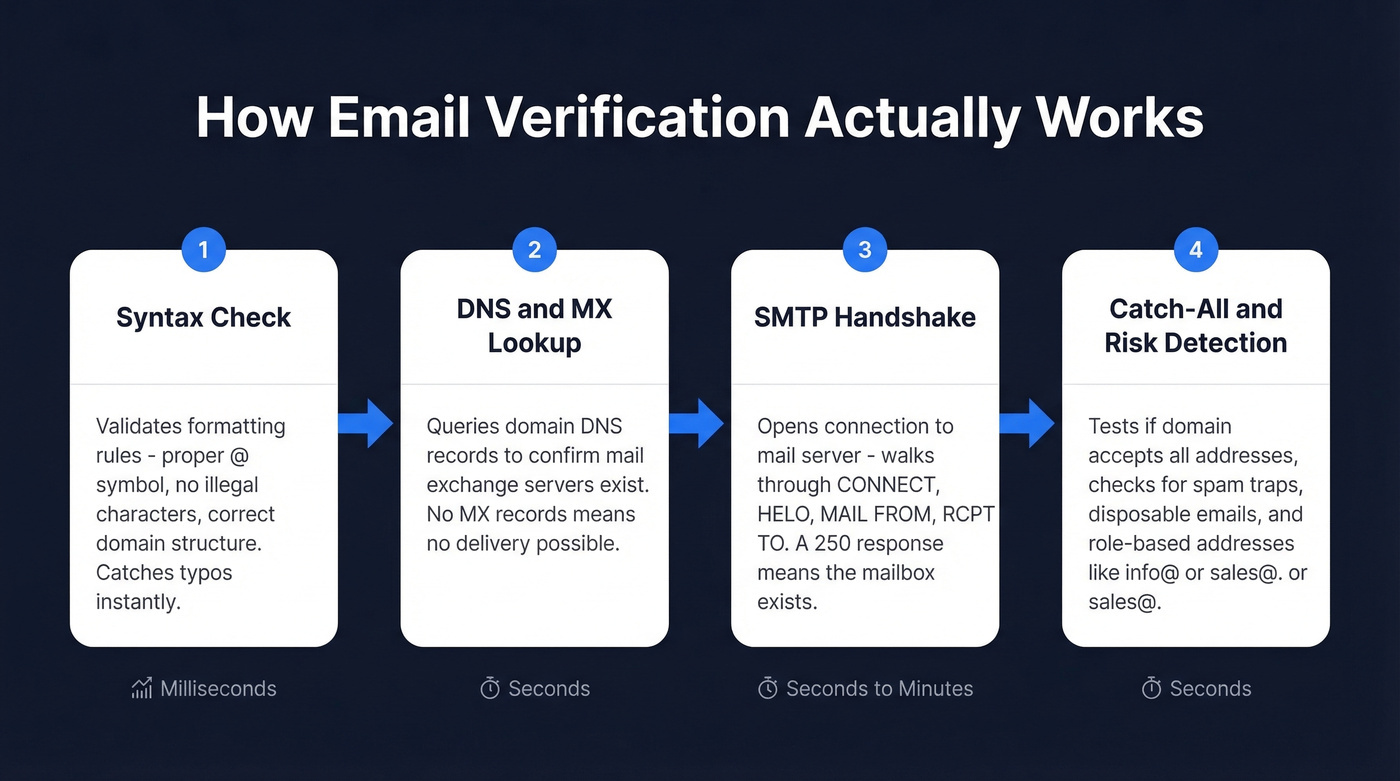
Every online email validator follows four stages:
Syntax check. The tool confirms the address follows valid formatting rules - proper use of @, no illegal characters, correct domain structure. This catches typos like "john@@company..com" and takes milliseconds.
DNS and MX lookup. The tool queries the domain's DNS records to confirm mail exchange servers exist. No MX records means nowhere to deliver mail.
SMTP handshake. The verifier opens a connection to the mail server and walks through the SMTP protocol - connect, HELO, MAIL FROM, then RCPT TO with the target address. A 250 response means the mailbox exists; a 550 or 553 means permanent rejection. This is where the real work happens, and where cheap tools cut corners by skipping retry logic and IP rotation.
Catch-all and risk detection. The verifier tests whether the domain accepts all addresses regardless of whether the mailbox exists, then checks for spam traps, disposable email services, and role-based addresses like info@ or sales@.
At scale, the bottleneck isn't computation - it's managing connections, avoiding rate limits, and maintaining IP reputation with mail servers.
Accuracy Benchmarks
A Warmup Inbox bake-off tested 15 tools against the same 10,000-email mixed-quality list. These results are the closest thing to an independent accuracy benchmark in the email verification category.
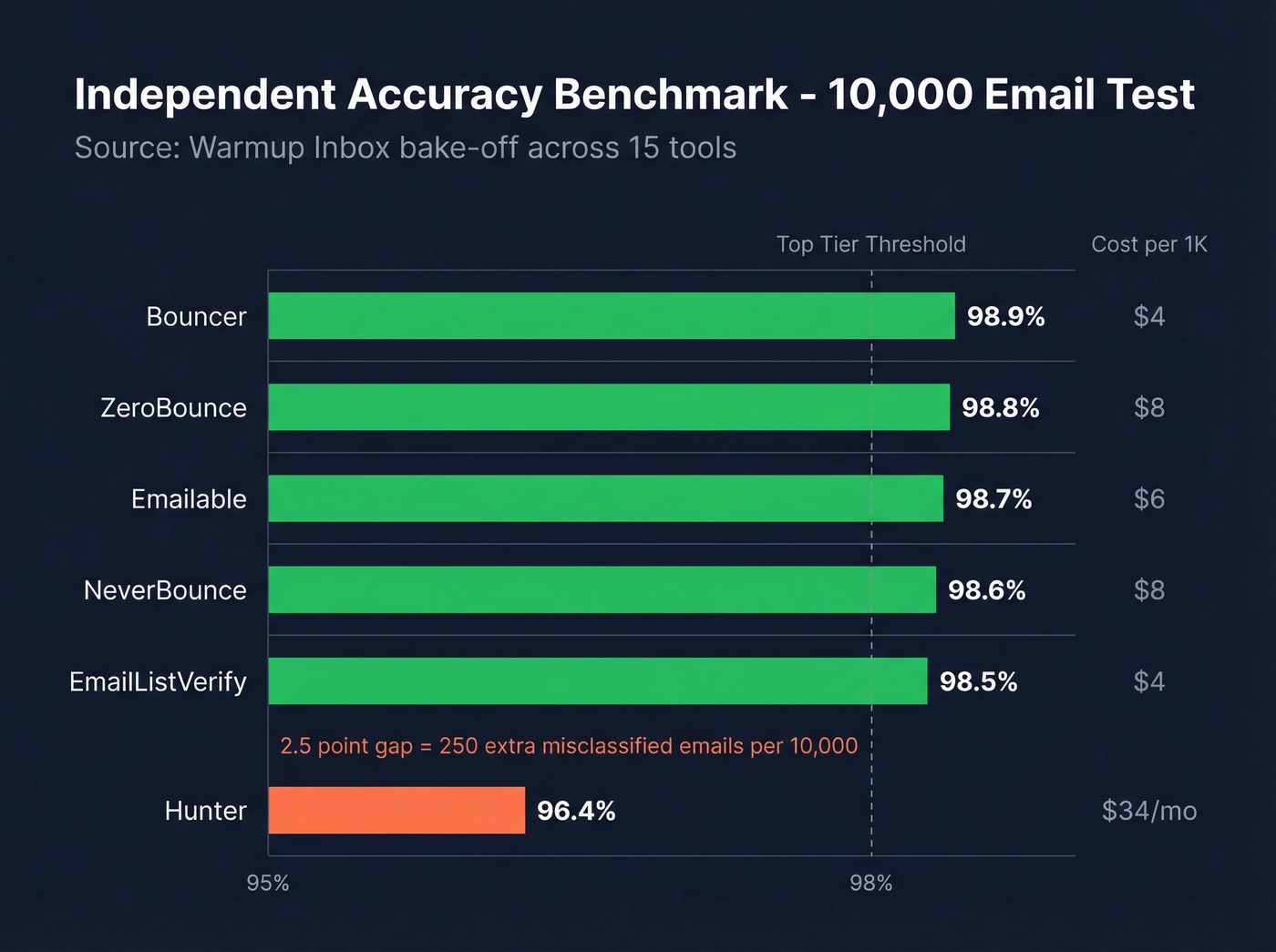
| Tool | Observed Accuracy | Speed (10k) | Free Credits | Entry PAYG |
|---|---|---|---|---|
| Bouncer | 98.9% | ~7 min | 100 | $7/1,000 |
| ZeroBounce | 98.8% | ~10 min | 100/mo | ~$8/1,000 |
| Emailable | 98.7% | ~3 min | 250 | ~$6/1,000 |
| NeverBounce | 98.6% | ~3 min | 10 | $8/1,000 |
| EmailListVerify | 98.5% | ~12 min | 100 | $4/1,000 |
| Hunter | 96.4% | ~11 min | 50 | ~$34/mo |
The top five tools cluster within 0.4 percentage points. At that level, the difference between 98.5% and 98.9% is roughly 40 emails out of 10,000 - meaningful at scale, but not a dealbreaker for most teams.
The real outlier is Hunter at 96.4%. That 2.5-point gap translates to 250 additional misclassified emails per 10,000. If accuracy is your primary criterion, that gap matters.
Let's be honest: most teams agonize over the difference between 98.5% and 98.9% accuracy when they should be worrying about verification frequency. A 98.5%-accurate tool run monthly beats a 98.9%-accurate tool run quarterly every single time.

You just read that lists decay 22.5% per year. Prospeo refreshes its 143M+ verified emails every 7 days - not every 6 weeks like most providers. Finding and verification happen in one pipeline, so you never upload a stale list into a separate tool.
Get 75 free verified emails and see 98% accuracy yourself.
Best Email Verification Tools in 2026
Prospeo
Prospeo finds and verifies emails in a single workflow. Most verifiers assume you already have a list - Prospeo builds it, then runs every address through a 5-step verification pipeline with catch-all handling, spam-trap removal, and honeypot filtering.
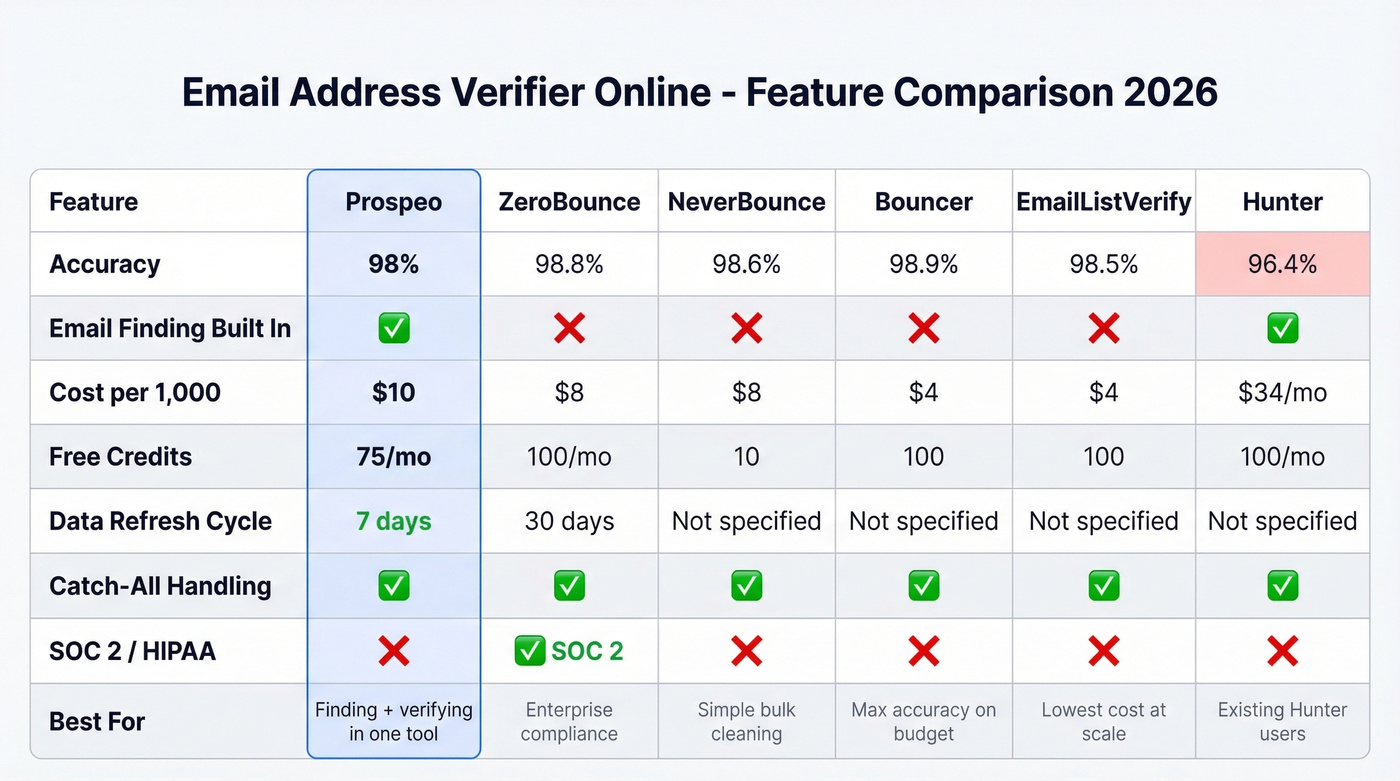
The database covers 143M+ verified emails across 300M+ professional profiles, refreshed on a 7-day cycle versus the industry average of roughly six weeks. That freshness gap is where bounce rates quietly creep up with other tools. The 98% accuracy rate holds across the full database, not just a curated subset.
Pricing runs about $0.01 per email. The free tier gives you 75 emails per month plus 100 Chrome extension credits. No contracts, no annual lock-in. Native integrations with Salesforce, HubSpot, Smartlead, Instantly, Lemlist, and Zapier mean verified contacts flow straight into your sequences without manual CSV juggling. One of our agency partners, Stack Optimize, built to $1M ARR while maintaining 94%+ deliverability and sub-3% bounce rates across all their clients - that's the kind of result you get when finding and verification happen in the same pipeline.
Best for: Teams building prospect lists from scratch who need finding and verification in one platform. If you're also building lists end-to-end, pair this with a tighter sales prospecting workflow so verification happens before outreach.
ZeroBounce
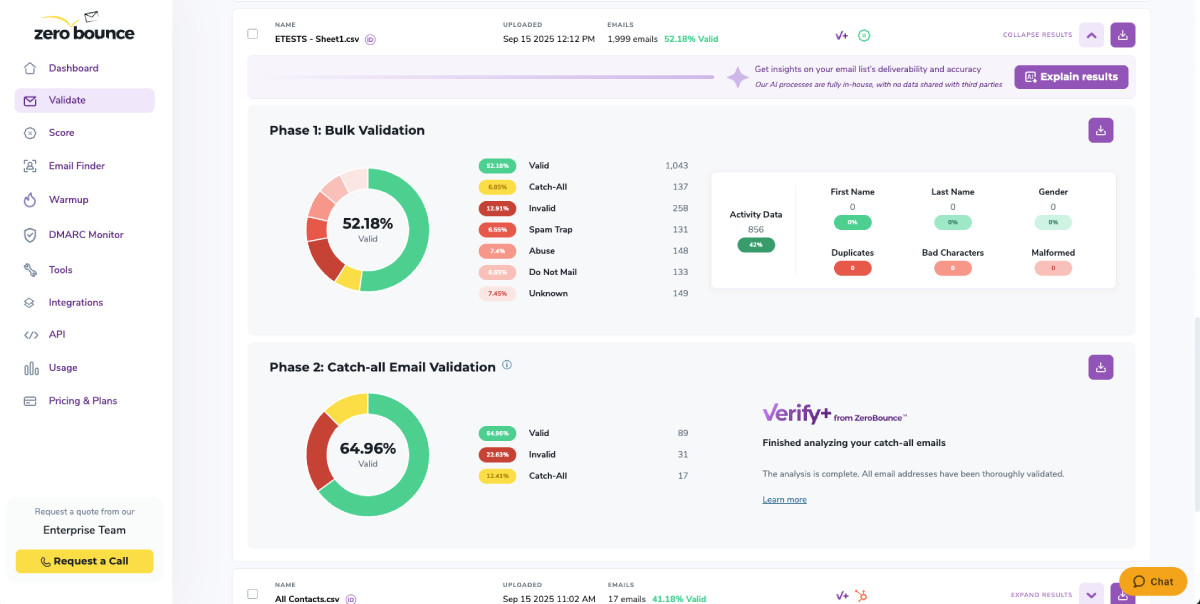
ZeroBounce is the enterprise compliance pick. SOC 2 Type II and HIPAA certifications aren't marketing checkboxes - they're requirements for healthcare, financial services, and any org with a security review process that touches email data.
The 98.8% observed accuracy in independent testing is strong. ZeroBounce claims 99.6% on their own site, but the independent 98.8% is still excellent and more trustworthy as a benchmark. You get 100 free monthly verifications with a business domain signup. PAYG starts at $15-16 for 2,000 credits (about $7.50-8 per 1,000), with subscription plans from $99/mo. Verification results expire after 30 days, which is worth noting if you're building lists ahead of campaigns.
Best for: Enterprise teams that need compliance certifications alongside high accuracy. If your security team needs SOC 2 documentation before approving a vendor, ZeroBounce is the obvious choice - but you'll pay a premium for those certifications.
NeverBounce
NeverBounce doesn't try to be clever. Upload a list, get it cleaned, move on.
That simplicity is exactly why it's one of the most recommended verifiers in practitioner communities. One Reddit thread ranking verification tools placed it alongside Instantly.ai and MillionVerifier as the top three picks among sales practitioners. The 98.6% observed accuracy is solidly top tier, processing speed is fast at roughly 3 minutes for 10,000 emails, and pricing is transparent: $8 per 1,000 on PAYG, or $49/mo on the Growth plan for up to 10,000 verifications with auto-sync. Duplicates are free on the Growth plan, which is a nice touch for teams re-verifying overlapping lists. Credits expire after 12 months.
Best for: Marketing teams cleaning existing lists before campaigns. Fair pricing, solid accuracy, no surprises. If bounces are already hurting you, start by tracking your email bounce rate before and after cleaning.
Bouncer
Use this if you're accuracy-obsessed and budget-conscious. Bouncer posted the highest observed accuracy in the bake-off at 98.9%. Entry PAYG is $20 for 5,000 verifications (about $4 per 1,000), and the 100 free credits let you test before committing.
Skip this if you need an all-in-one platform. Bouncer is purely a verification tool - no email finding or enrichment. You'll need to pair it with a separate prospecting tool for the full pipeline, like an email ID finder.
EmailListVerify
The budget king. At $4 per 1,000 emails, EmailListVerify is the cheapest credible option in the category. The 98.5% observed accuracy is only 0.4 points below the leader - roughly 40 emails per 10,000 list. Processing is slower at ~12 minutes for 10k, so plan accordingly for large batches. 100 free credits to start.
For teams processing large volumes where cost matters more than squeezing out the last fraction of accuracy, it's hard to beat. Skip it if speed is critical or you need real-time API verification for signup forms.
Hunter
Hunter has 6M+ users and a proprietary catch-all solution for major email providers. The problem is the 96.4% observed accuracy - noticeably below every other tool in the benchmark. That 2.5-point gap adds up fast on large lists.
Here's the thing: Hunter's verification is bundled with email finding, domain search, and outreach tools. You're paying ~$34/mo for shared credits across everything, not just verification. 100 free verifications per month. If you're already deep in the Hunter ecosystem, the verification is a convenient add-on. If accuracy is your priority, look elsewhere. (If you're comparing options, see our Hunter alternatives.)
Verifalia
Verifalia ranks well in search results largely because of its free single-email verification widget - paste an address, get a real-time result. For one-off spot checks, it's handy. For bulk work, the pricing and feature set don't compete with the tools above.
Emailable
Fast and accurate. Emailable processed 10,000 emails in roughly 3 minutes with 98.7% observed accuracy - the second-highest in the Warmup Inbox benchmark. 250 free credits, and $30 for 5,000 verifications (about $6 per 1,000). A solid mid-tier option that deserves more attention than it gets.
MillionVerifier
A Reddit favorite for budget-conscious sales teams. Pricing runs ~$2.50-4 per 1,000 emails, making it one of the cheapest options available. Popular with practitioners who stack multiple verifiers - run a list through MillionVerifier first, then a second tool to catch edge cases. If you need a straightforward email checker free of complicated pricing tiers, MillionVerifier's model is appealing.
Email Hippo
A long-running verification service checking 74 data points per address. Offers 100 free daily verifications and multiple product tiers. Solid but not differentiated enough to be a primary pick over the tools above.
Most verifiers on this list assume you already have a list. Prospeo builds it and verifies it in one workflow - 5-step verification with catch-all handling, spam-trap removal, and honeypot filtering at $0.01 per email. Stack Optimize ran this pipeline across every client and held sub-3% bounce rates to $1M ARR.
Ditch the two-tool stack. Find and verify emails in one click.
Pricing Compared
The spread between the cheapest and most expensive tool here is roughly 4x on a per-email basis.
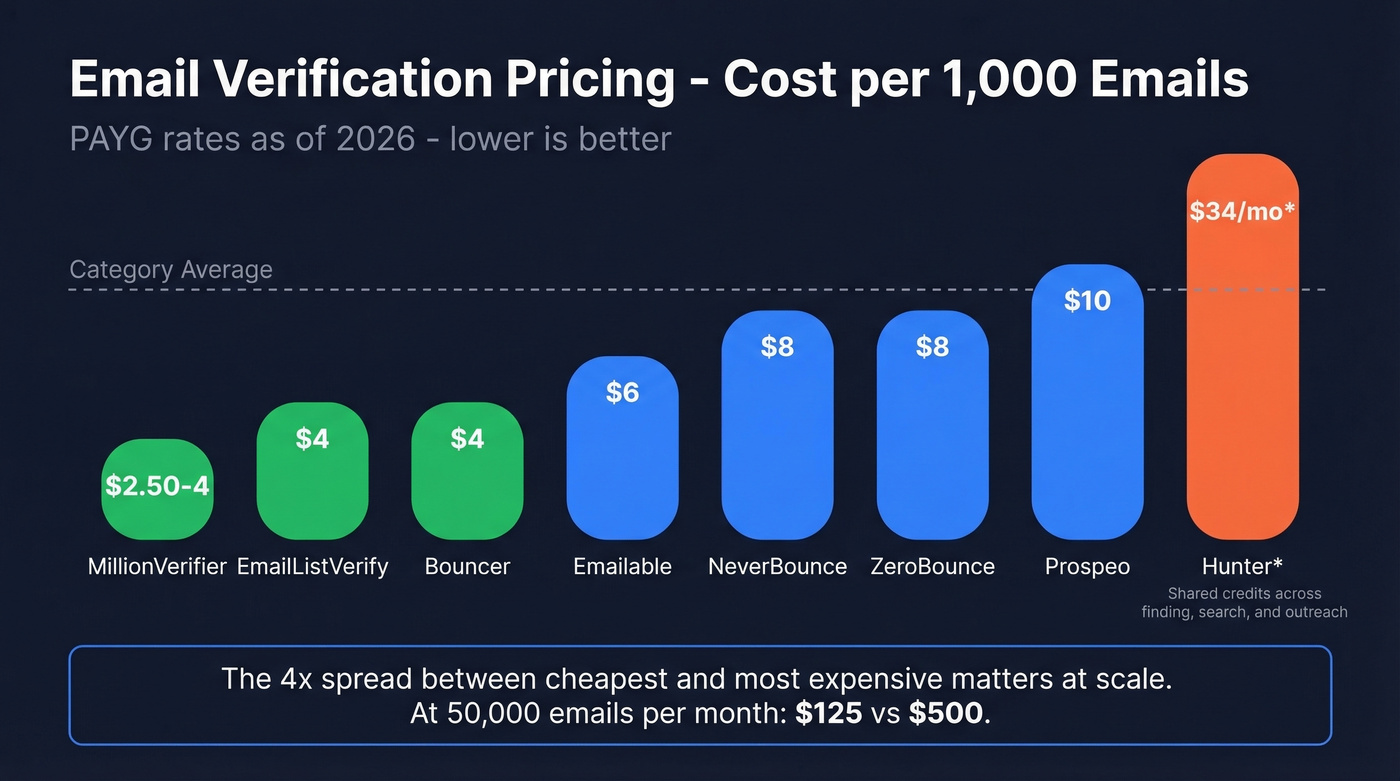
| Tool | PAYG per 1,000 | Free Credits | Credits Expire? |
|---|---|---|---|
| MillionVerifier | ~$2.50-4 | Limited | Plan-based |
| EmailListVerify | $4 | 100 | Plan-based |
| Bouncer | ~$4 | 100 | Plan-based |
| Emailable | $6 | 250 | Plan-based |
| NeverBounce | $8 | 10 | 12 months |
| ZeroBounce | ~$7.50-8 | 100/mo | Results expire after 30 days |
| BriteVerify | $10 | None | Plan-based |
| Prospeo | ~$10 | 75/mo | No expiration |
| Hunter | ~$34/mo shared | 100/mo | Monthly reset |
| Verifalia | Plan-based | Free widget | Plan-based |
Prospeo's credits don't expire, which matters more than most people realize. If you're verifying in bursts - heavy prospecting one month, quiet the next - expiring credits mean you're paying for verification you never use.
Why Catch-All Domains Break Verification
Catch-all domains are the single biggest source of "unknown" or "risky" results in any verification tool.
A catch-all domain accepts email for any address at that domain, regardless of whether the mailbox actually exists. Send an email to literally-anything@catchall-domain.com, and the server returns a 250 OK response - the same code it returns for a real mailbox. Standard SMTP verification can't tell the difference.
The basic detection method is straightforward: send a RCPT TO for a randomly generated, obviously fake address at the domain. If the server accepts it, the domain is catch-all. But organizations use catch-all configurations for legitimate reasons - capturing typos, routing during migrations, or privacy - so the verifier still needs to assess individual address likelihood.
In our testing, catch-all domains typically account for 10-20% of any B2B list. Most free verifiers flag the entire domain as "unknown" and leave you guessing. Better tools separate likely-valid addresses from probable dead ends even on catch-all domains, which is where the accuracy gap between cheap and premium verifiers really shows up.
Mistakes That Kill Deliverability
We see five errors repeatedly across the teams we work with:
Treating verification as a one-time event. B2B lists degrade 20-30% per year. A list verified six months ago has already lost 10-15% of its valid addresses. Verify monthly at minimum if you're actively sending.
Ignoring catch-all results. Marking all "unknown" addresses as safe to send is a fast path to bounces. Segment catch-all results separately and send to them cautiously - lower volume, warmed-up domains only.
Skipping role-based addresses. Addresses like info@, sales@, and admin@ often route to shared inboxes or distribution lists. They generate more spam complaints and convert at lower rates. Filter them out of cold outbound sequences.
Using syntax-only tools. A tool that only checks formatting and DNS records misses the SMTP handshake that confirms the mailbox exists. If your verifier doesn't do SMTP-level checks, it isn't really verifying anything. Any credible email validation tool performs full SMTP-level verification, not just pattern matching.
Not verifying at the point of capture. Real-time API verification on signup forms, webinar registrations, and lead magnets catches bad addresses before they enter your database. Cleaning a dirty list is always harder than keeping it clean. Bounce rates above 2% trigger ISP scrutiny - prevention beats remediation every time. If you're tightening your stack, start with an email deliverability guide and a dedicated email reputation tools checklist.
FAQ
Is online email verification legal?
Yes. Verification checks whether an address exists by querying the mail server - no email is sent, no personal content is accessed. It's widely used in GDPR-aligned workflows when you're verifying legitimately collected data.
How often should I verify my email lists?
Monthly at minimum for active senders. B2B lists decay 20-30% per year, so a six-month-old list has already lost roughly 10-15% of valid addresses. Teams sending 1,000+ emails per week should verify weekly.
Free vs. paid - is it worth paying?
Free tiers offering 50-100 checks are demos, not solutions. Paid PAYG plans starting at $4 per 1,000 are worth every penny - the cost of a bounced email far exceeds $0.004 per verification.
What does an "unknown" result mean?
Usually a catch-all domain. The server accepts all addresses, so the verifier can't confirm whether the specific mailbox exists. Treat "unknown" results as risky - send to them sparingly or not at all.
What's a good free email address verifier online to start with?
Prospeo offers 75 free verifications per month with full 5-step verification including catch-all handling. ZeroBounce gives 100 free monthly checks, and Emailable provides 250 free credits upfront - all three run real SMTP-level checks, not just syntax validation.