

Email Campaign ROI: The Formula Is Easy - Getting the Inputs Right Is Hard
Every marketing intern can recite the formula: (Revenue - Cost) / Cost x 100. The problem is that most teams plug in the wrong numbers on both sides of the equation, then wonder why the industry "36:1 ROI" benchmark doesn't match what finance sees.
In our experience, email campaign ROI falls apart at the cost denominator. Your "$200/mo email program" is actually a $10K+ annual investment once you count human hours. And on the revenue side, last-click attribution systematically undercounts email's contribution to pipeline. Let's fix both sides.
The ROI Formula (With Honest Math)
Email Campaign ROI = (Revenue - Cost) / Cost x 100
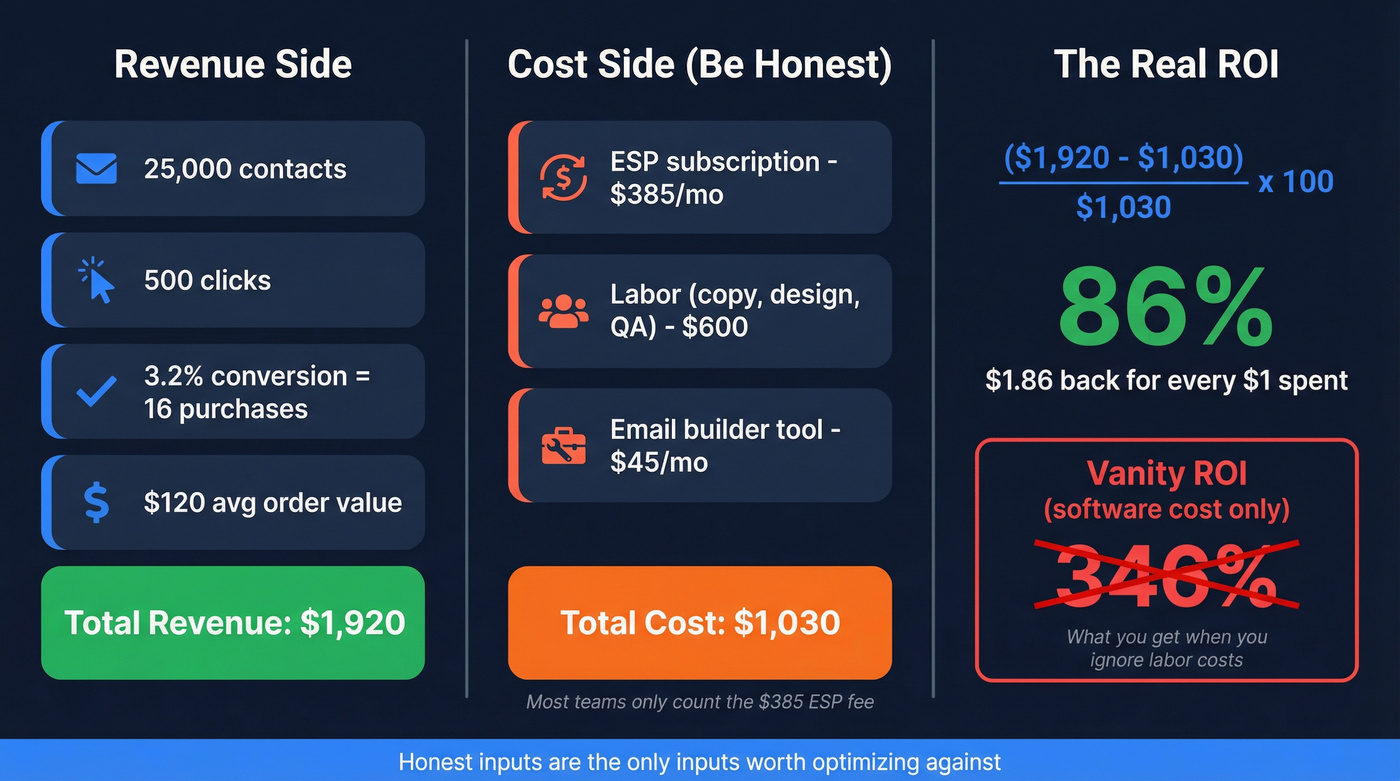
Worked example: 25,000-contact list, one promotional campaign driving 500 clicks. At a 3.2% conversion rate, that's 16 purchases at $120 average order value - $1,920 in revenue.
Now the costs, and this is where teams lie to themselves. ESP at $385/mo, $600 in labor for copy, design, and QA, $45/mo for your email builder. Honest total: $1,030.
ROI = ($1,920 - $1,030) / $1,030 x 100 = 86%.
That also means you got $1.86 back for every $1 spent on that send. Not the 346% you'd get if you only counted the software. Scale that across a full month of campaigns and the ratio climbs - but only if you keep the denominator honest.
What "Good" ROI Looks Like
The cross-industry average is $36 back for every $1 spent. That number hides enormous variance:
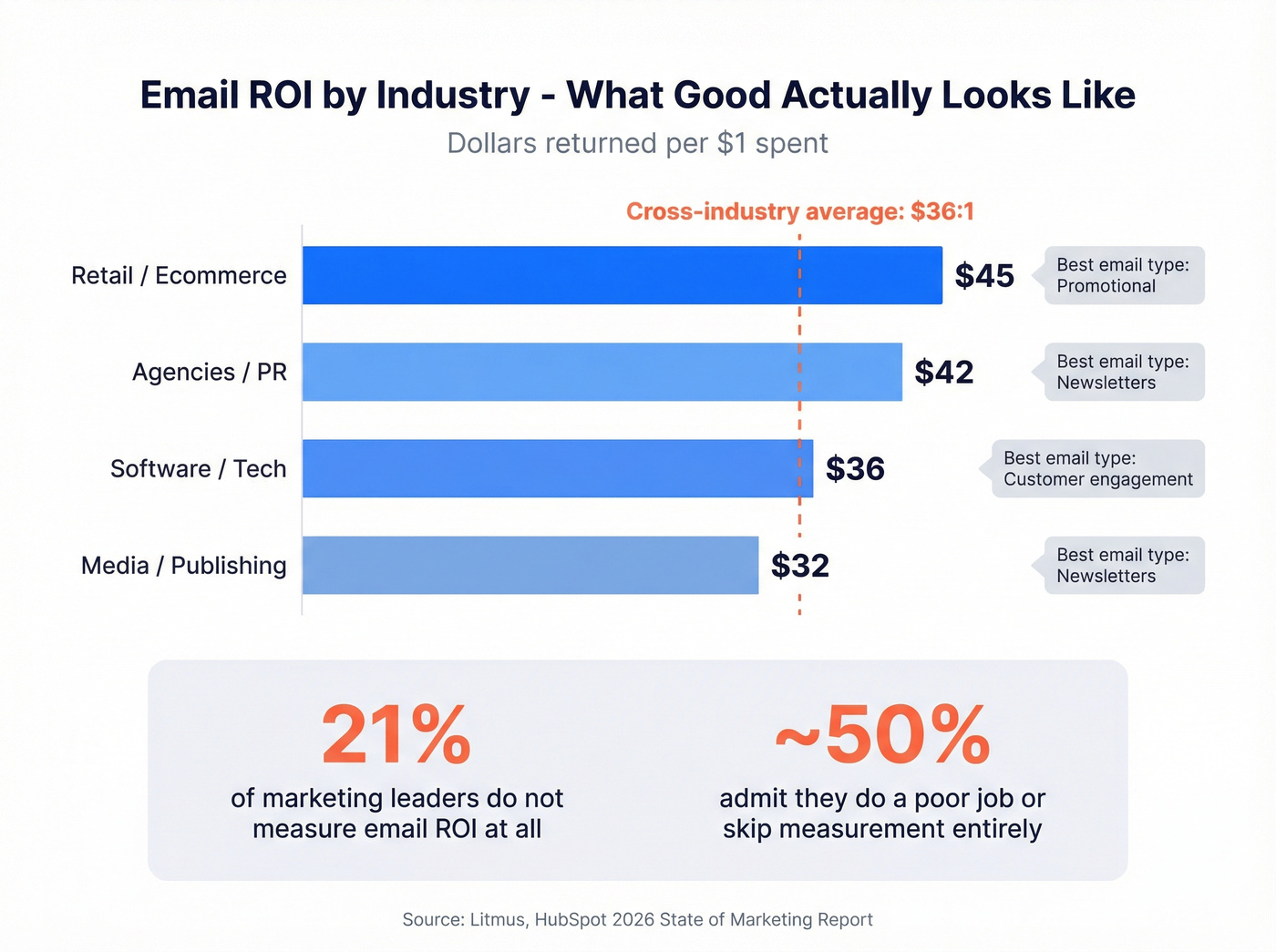
| Industry | ROI Ratio | Highest-ROI Email Type |
|---|---|---|
| Retail / Ecommerce | 45:1 | Promotional |
| Agencies / PR | 42:1 | Newsletters |
| Software / Tech | 36:1 | Customer engagement |
| Media / Publishing | 32:1 | Newsletters |
B2C brands see email as the #1 ROI channel per HubSpot's 2026 State of Marketing Report. For B2B, website/blog/SEO leads, with email landing behind the top tier - still outperforming most paid channels.
Here's the uncomfortable part: 21% of marketing leaders don't measure email ROI at all. Fewer than 13% say they measure it well, and roughly half admit they do a poor job or skip measurement entirely. If you're reading this article, you're already ahead of most teams.
The True Cost of Email
This is where most return-on-investment calculations collapse. Teams divide revenue by their ESP subscription and call it a day.
At 50,000 contacts, your ESP alone runs around $385/mo on Mailchimp, $609/mo on ActiveCampaign, or $720/mo on Klaviyo. Add a design tool at $20-$95/mo, a deliverability monitor, and the 8-15 hours/week someone spends writing, building, testing, and analyzing campaigns. Many businesses allocate 6-10% of their total marketing budget to email.
That doesn't make the ROI bad. It makes it accurate. And an accurate number is the only one worth optimizing against.
If your ROI calculation doesn't include labor, you don't have a real number. You have a vanity metric dressed up in a spreadsheet.

You just read that honest cost accounting changes everything. Here's what changes on the revenue side: Prospeo's 5-step email verification dropped Snyk's bounce rate from 35-40% to under 5%, unlocking 180% more pipeline. At $0.01/email with 98% accuracy, your cost denominator stays low and your revenue numerator climbs.
Stop inflating ROI with bad data - start earning it with verified contacts.
Why Your Number Is Probably Wrong
Four pitfalls, in order of how much damage they do:
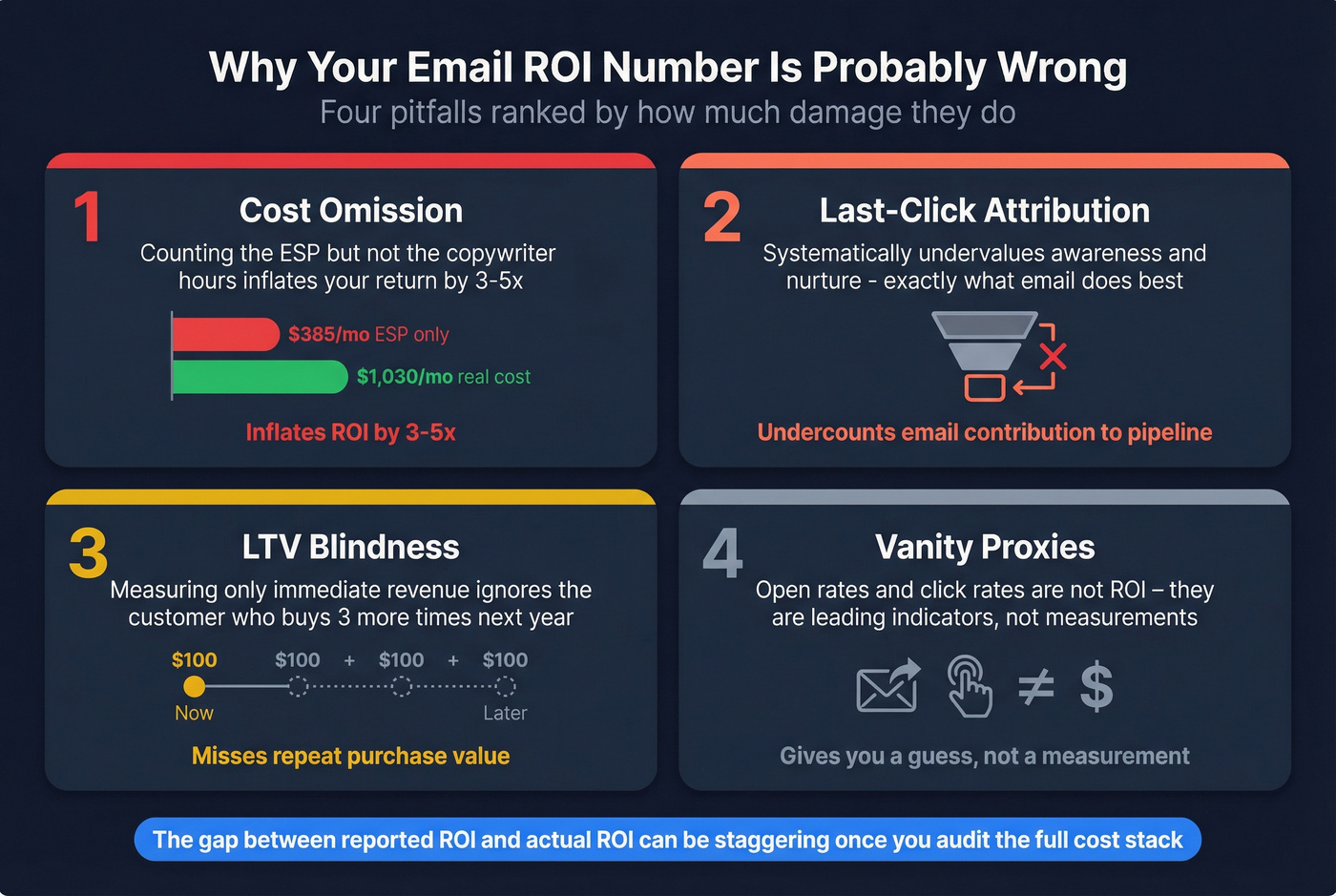
- Cost omission. Counting the ESP but not the copywriter's hours inflates your return figure by 3-5x.
- Last-click attribution. As CACM's analysis shows, last-touch systematically undervalues awareness and nurture - exactly what email does best.
- LTV blindness. Measuring only immediate revenue ignores the customer who buys three more times over the next year.
- Vanity proxies. Open rates and click rates aren't ROI. They're leading indicators. If your reporting stops at engagement, you have a guess, not a measurement.
The consensus on r/b2bmarketing is blunt: practitioners openly admit their ROI spreadsheets "lie" because of compounding drop-offs at each funnel stage - deliverability, replies, meetings, close rates. They're right. We've seen the same thing in our own campaigns, and the gap between reported ROI and actual ROI can be staggering once you audit the full cost stack.
How to Track Revenue Accurately
Tag every link with UTMs. Use utm_source=newsletter, utm_medium=email, and utm_campaign=june_promo at minimum. Without these, GA4 often lumps email traffic into Direct.
Find your data in GA4. Go to Reports, then Acquisition, then Traffic acquisition, and change the primary dimension to "Session source/medium." That's where your email revenue lives.
Validate with DebugView. Use GA4's DebugView before launch to confirm UTMs fire correctly. One broken parameter zeros out an entire campaign's attribution - we've watched a $40K product launch get credited to "Direct" because someone forgot the utm_medium tag on the hero CTA.
How to Improve Email Campaign ROI
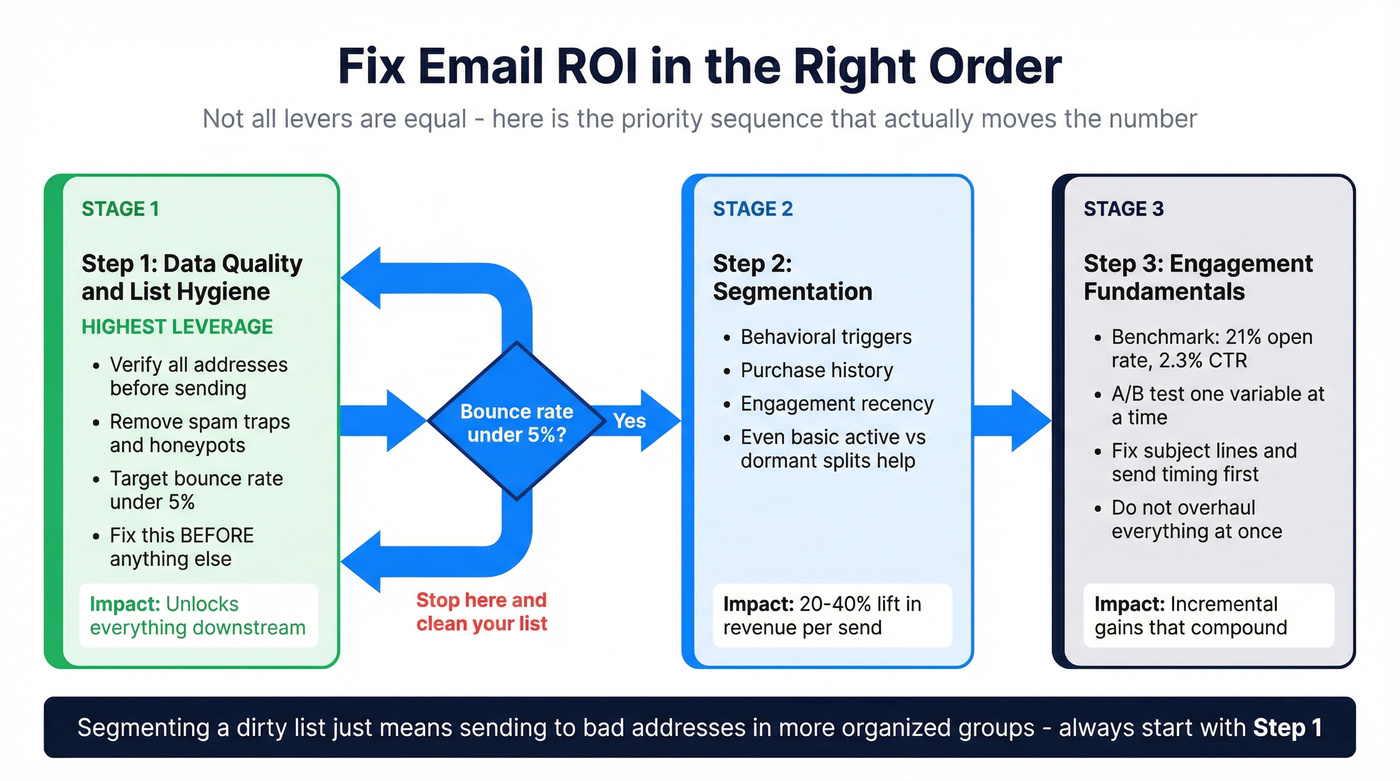
Not all levers are equal. Here's the priority order that actually moves the number.
Data Quality and List Hygiene
This is the most underrated ROI lever in email, and it isn't close. Bad addresses lead to bounces, which damage sender reputation, which tanks inbox placement, which craters revenue per send. The chain is direct and unforgiving.
If your bounce rate is over 5%, fix deliverability before you touch anything else. No subject line optimization or segmentation strategy will overcome emails that never reach the inbox. Prospeo's 5-step verification catches invalid addresses, spam traps, and honeypots that ESPs miss - Snyk's team saw bounce rates drop from 35-40% to under 5% after switching, and AE-sourced pipeline jumped 180%.

Segmentation
Once your list is clean, segment it. Behavioral triggers, purchase history, engagement recency - any segmentation beats batch-and-blast. Even basic recency-based segments splitting active from dormant subscribers can lift revenue per send by 20-40%. Skip this if you haven't fixed list hygiene first, though. Segmenting a dirty list just means you're sending to bad addresses in more organized groups.
Fix Engagement Fundamentals
Campaign Monitor's benchmarks sit at 21% open rate and 2.3% CTR. If you're below those, fix subject lines and send timing before touching design. A/B test one variable at a time. Most teams try to overhaul everything at once and end up learning nothing.
List hygiene is the highest-leverage ROI fix in this article, and it's the cheapest to implement. Prospeo catches spam traps, honeypots, and invalid addresses your ESP misses - on a 7-day refresh cycle, not the 6-week industry average. Stack Optimize built a $1M agency on sub-3% bounce rates using this data.
75 free verified emails per month. Enough to see the ROI difference yourself.
FAQ
What is a good email marketing ROI?
Most teams earn $10-$36 per $1 spent. The cross-industry average is 36:1, with retail hitting 45:1 and media closer to 32:1. Above 20:1 with honest cost accounting - including labor and tooling - means you're performing well.
How do you calculate email campaign ROI?
Use (Revenue - Total costs) / Total costs x 100. Include ESP fees, labor hours, design tools, and list acquisition costs. Omitting labor is the most common mistake and inflates results by 3-5x.
Why is my email ROI lower than benchmarks?
Three likely reasons: you're counting all costs (many benchmarks don't), you're using last-click attribution, or poor list quality is dragging down deliverability. Fix list hygiene first - verify addresses and remove spam traps before they damage sender reputation.
Is email still the highest-ROI marketing channel in 2026?
For B2C, yes - HubSpot's 2026 State of Marketing Report ranks it #1. For B2B, website/blog/SEO leads, but email outperforms most paid channels and consistently delivers strong returns at scale when list quality and attribution are handled correctly.