

Every Email Deliverability Change Since 2024 (and What Matters Now)
You set up SPF, DKIM, and DMARC. You kept your complaint rate low. Your inbox placement still dropped from 55-60% to roughly 35%.
We've watched dozens of outbound teams go through this exact pattern since the email deliverability changes 2024 introduced. Emails aren't bouncing - they're just invisible. Deliverability has become its own full-time job, and one bad batch of sends can undo weeks of reputation building.
The Short Version
Authentication is the floor. SPF and DKIM must pass, and DMARC should be in place with alignment. If you're still on p=none, you're in monitoring mode - move to p=quarantine or p=reject when you're ready to enforce.
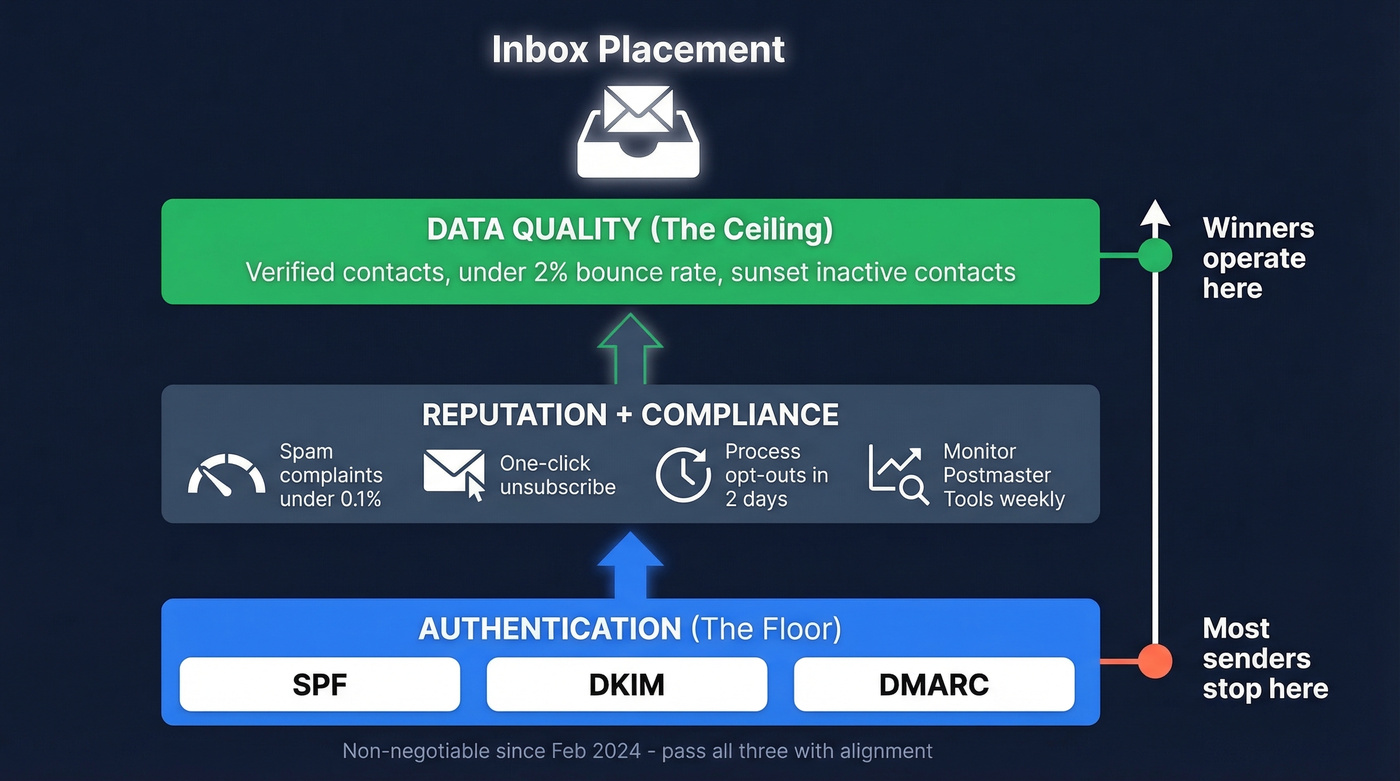
Data quality is the ceiling. Bad addresses create the bounce and complaint signals that tank sender reputation under AI-driven inboxes.
Monitor and verify. Google Postmaster Tools and Microsoft SNDS are free. Use them weekly. Verify your lists before every send - a single bad batch compounds fast.
What Changed in February 2024
Gmail and Yahoo drew a line. The new bulk sender rules meant any domain sending 5,000+ emails per day became subject to non-negotiable requirements:
- SPF + DKIM + DMARC - all three, properly aligned (DMARC alignment)
- One-click unsubscribe via the List-Unsubscribe header (RFC 8058), processed within 2 days
- Spam complaint rate below 0.3%, with Google recommending under 0.1%
- Strong technical hygiene - TLS, valid rDNS/HELO, non-deceptive headers - became far less optional for consistent inbox placement
DMARC adoption surged. Domains with valid records jumped from 523,921 in 2023 to 937,931 by early 2026. But only 411,935 actually enforce their policy with quarantine or reject. The rest sit on p=none, which is monitoring mode - not protection. That gap tells you everything about where most senders still are.
The Enforcement Escalation
Google Gets Strict (November 2025)
February 2024 was the warning shot. Starting November 2025, Gmail began ramping up enforcement on non-compliant traffic, including temporary and permanent rejections. That's the shift from soft deferrals (4xx errors) to hard rejections (5xx failures). Your emails don't just land in spam - they don't land at all.
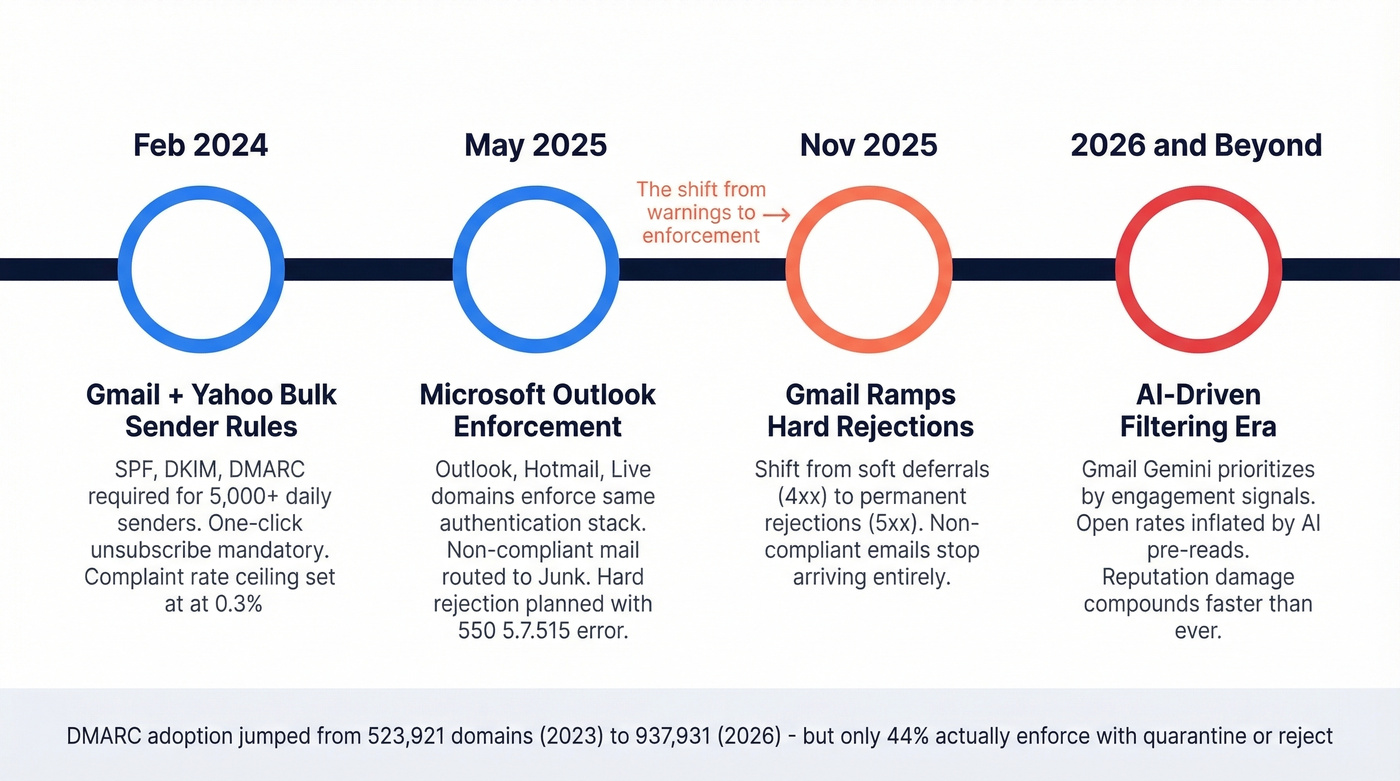
Looking ahead, Gmail's sending policy in 2026 is expected to tighten further, with AI-driven filtering making engagement signals even more decisive.
The sentiment on r/coldemail tracks with this: since late 2024, cold outbound produces "no results" and causes reputation damage quickly, even with verified addresses.
Microsoft Outlook Requirements (May 2025)
Microsoft followed with bulk sender requirements for Outlook.com consumer domains. Same general threshold of 5,000+ daily messages, same authentication stack. SPF, DKIM, and DMARC alignment are all mandatory for high-volume senders targeting Outlook, Hotmail, and Live domains.
Starting May 5, 2025, non-compliant messages route to Junk. Full rejection is planned - Microsoft's published SMTP error code is 550; 5.7.515 Access denied, sending domain does not meet the required authentication level.

Every bounce chips away at your sender reputation - and in 2026, AI-driven inboxes remember. Prospeo's 5-step verification catches invalid addresses, spam traps, and catch-all domains before they reach your sending queue. 98% email accuracy. Data refreshed every 7 days, not 6 weeks.
Stop feeding bad data to increasingly intelligent inboxes.
Gmail Gemini Changes the Game
Here's the thing: this isn't just a spam filter upgrade. Gmail's 3 billion users are getting an AI inbox powered by Gemini that prioritizes, summarizes, and decides what's worth surfacing based on engagement patterns, contact relationships, and content signals.
Industry benchmarks from 2026 deliverability analysis put open rates around 45.6% - likely inflated because AI auto-opens messages to generate summaries before deciding whether to surface them. Meanwhile, click-through rates dropped from 4.35% to 3.93%. Visibility isn't "inbox vs spam" anymore. It's a gradient inside the inbox itself, and the system learns from every bounce, complaint, and ignored message.
Open rate is a dead metric. Stop tracking it. Track replies and clicks instead.
What the Numbers Show
Here's what the data looks like across practitioners who shared their numbers publicly:
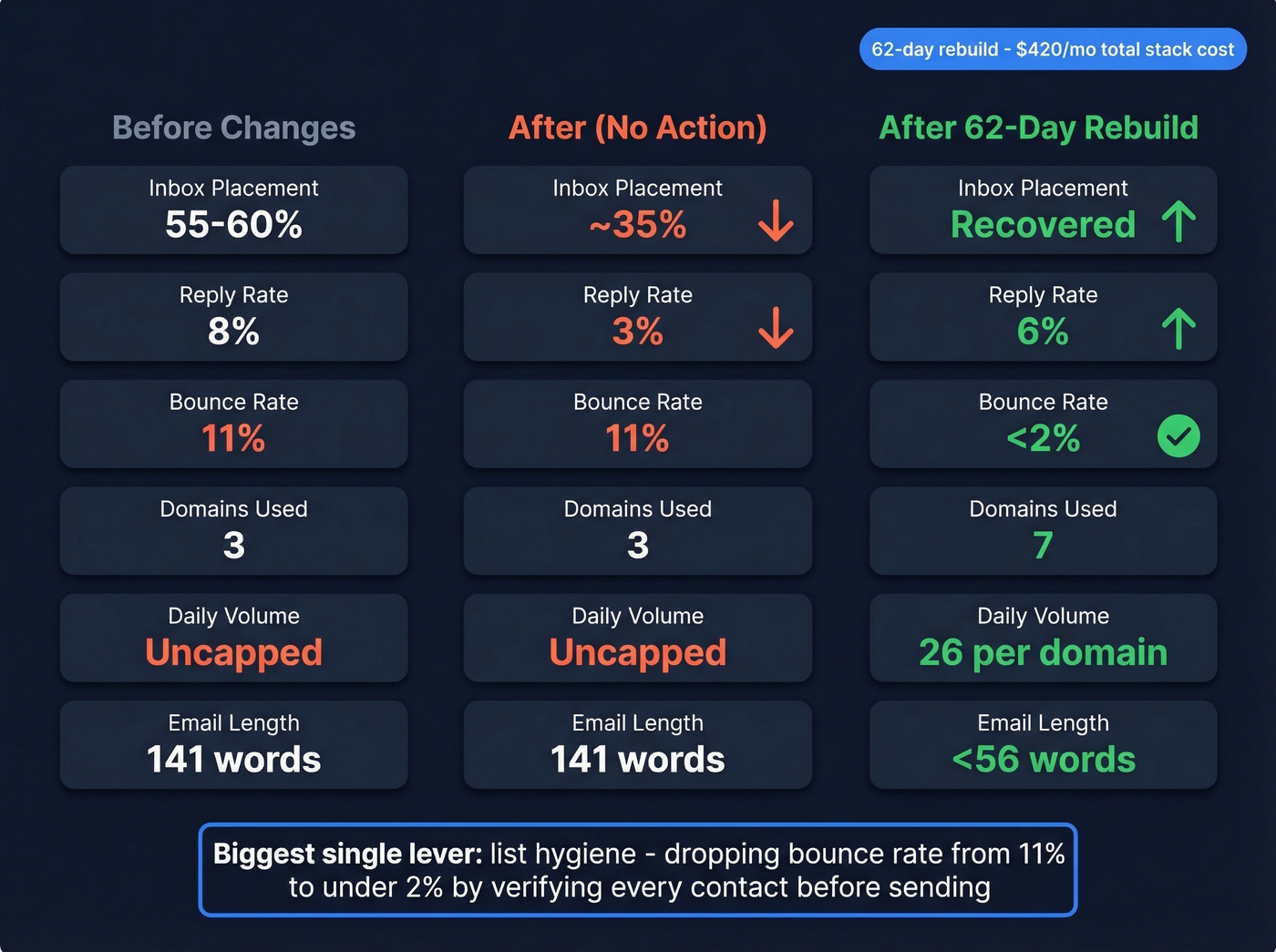
| Metric | Before Changes | After (No Action) | After Rebuild |
|---|---|---|---|
| Inbox placement | 55-60% | ~35% | Recovered |
| Reply rate | 8% | 3% | 6% (62 days) |
| Bounce rate | 11% | 11% | <2% |
| Domains used | 3 | 3 | 7 |
| Daily volume | Uncapped | Uncapped | 26/domain |
| Email length | 141 words | 141 words | <56 words |
The rebuild took 62 days. The biggest single lever was list hygiene - dropping bounce rates from 11% to under 2% by verifying every contact before sending.
Other tactical shifts that worked: sending Tuesday through Thursday between 8-11am, keeping emails under 56 words, and capping volume at 26 emails per domain per day. Total stack cost for the rebuild ran roughly $420/month across tools and infrastructure. Not cheap, but the alternative was watching reply rates stay at 3%.
Your 2026 Compliance Checklist
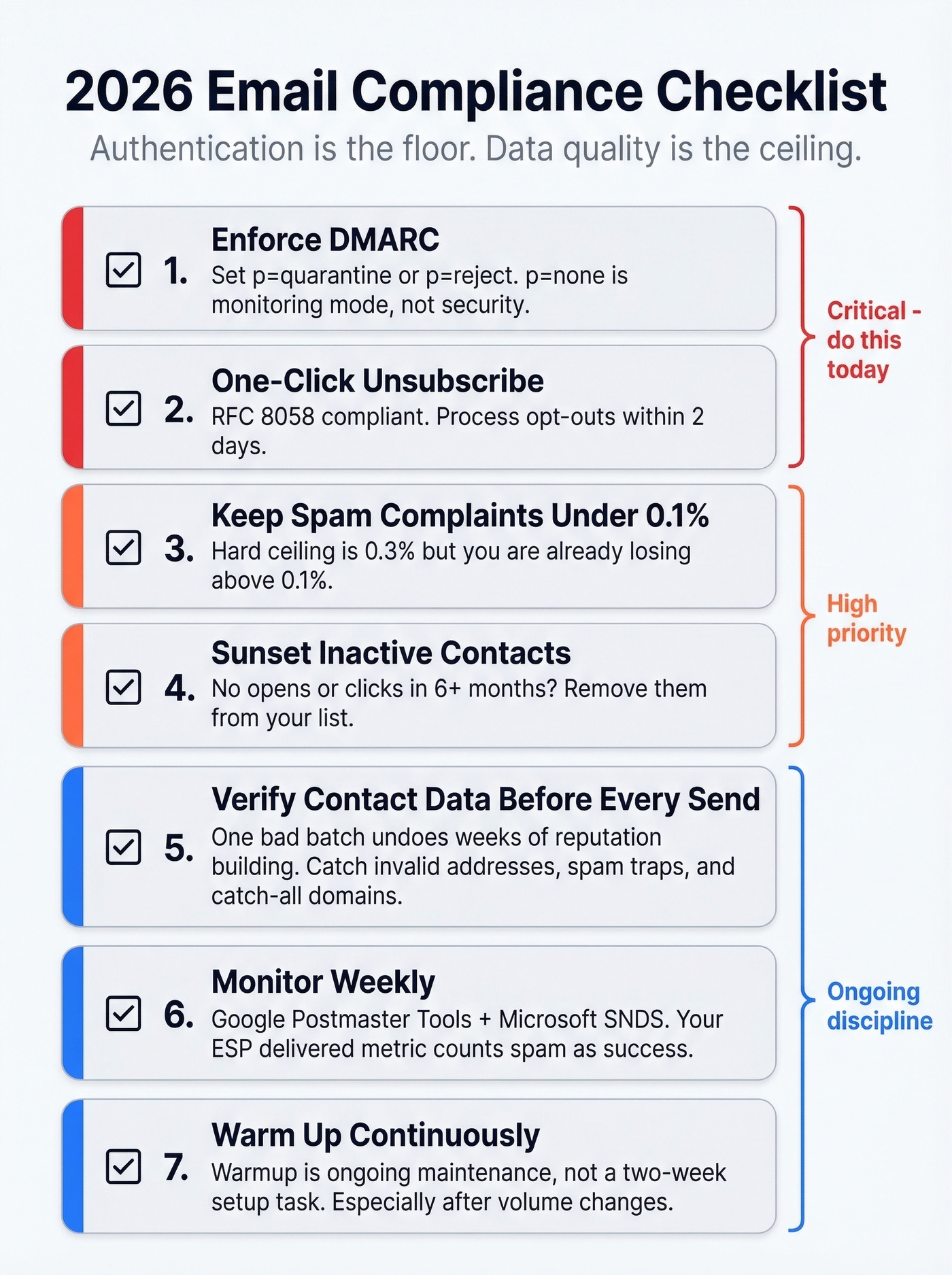
- Enforce DMARC. Set p=quarantine or p=reject. p=none is monitoring mode, not security.
- One-click unsubscribe. RFC 8058 compliant. Process opt-outs within 2 days.
- Spam complaints under 0.1%. The hard ceiling is 0.3%, but you're already losing above 0.1%.
- Sunset inactive contacts. No opens or clicks in 6+ months? Remove them.
- Verify contact data before every send. One bad batch undoes weeks of reputation building. Prospeo's 5-step verification catches invalid addresses, spam traps, and catch-all domains at 98% accuracy - and there's a free tier with 75 verifications/month, so there's no excuse to skip this.
- Monitor weekly. Google Postmaster Tools and Microsoft SNDS. Don't rely on your ESP's "delivered" metric - delivered to spam still counts as delivered.
- Warm up continuously. Warmup isn't a two-week setup task. It's ongoing maintenance, especially after any volume change or domain rotation (email warmup).
Why Bad Data Is the Real Problem
Let's be honest: authentication is table stakes now. Every serious sender has SPF, DKIM, and DMARC configured. The teams still struggling with deliverability in 2026 have a data quality problem, not an authentication problem.
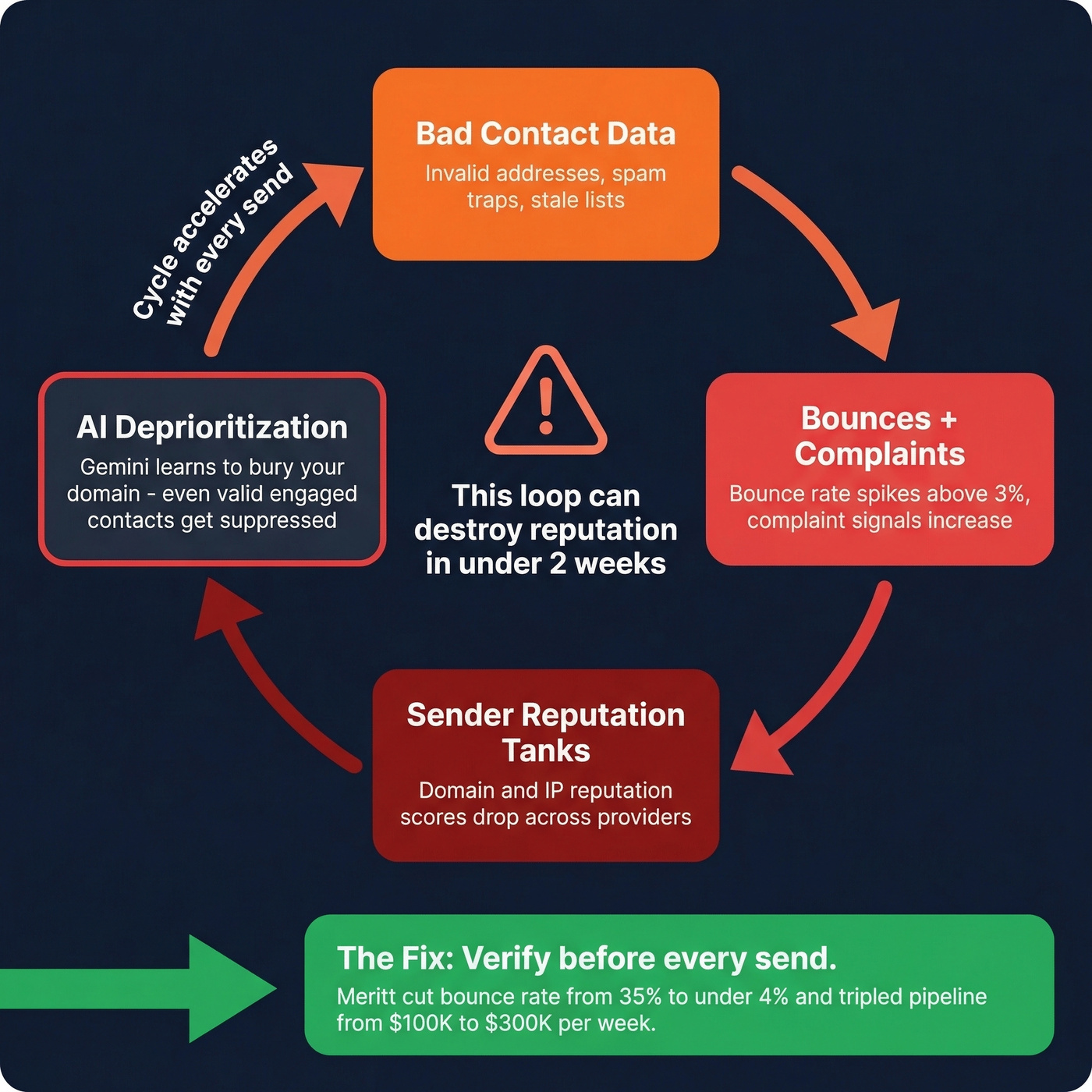
We've seen this loop destroy sender reputation in under two weeks. Bad contact data creates bounces and complaints. Bounces damage sender reputation. Damaged reputation triggers AI deprioritization. And once Gemini learns to deprioritize your domain, every future email - even to valid, engaged contacts - gets buried.
Meritt saw their bounce rate drop from 35% to under 4% after switching to verified data, and their pipeline tripled from $100K to $300K/week. That's what happens when you stop feeding garbage into increasingly intelligent inboxes.
Skip the "we'll clean the list later" approach. If your bounce rate is above 3%, stop sending and fix the data first (email bounce rate). Everything else is rearranging deck chairs.
Meritt cut their bounce rate from 35% to under 4% and tripled pipeline to $300K/week. The difference wasn't authentication - it was switching to verified contact data. Prospeo gives you 143M+ verified emails at 98% accuracy, with 75 free verifications per month to start.
Fix your data before Gmail fixes your reputation for you.
FAQ
What counts as a "bulk sender" under the 2024 rules?
Any domain sending 5,000+ emails per day to Gmail or Yahoo consumer addresses qualifies. Microsoft applies the same threshold for Outlook.com, Hotmail, and Live domains. Once you cross that line, full authentication and one-click unsubscribe aren't optional - they're mandatory.
My authentication is set up but deliverability still dropped. Why?
Authentication gets you through the door, not into the inbox. Placement depends on sender reputation, complaint rates, and engagement signals. Bad contact data is the most common hidden cause - the email deliverability changes 2024 set in motion made these signals far more consequential. Verify every list before sending.
How do I check if my emails are landing in spam?
Google Postmaster Tools shows inbox placement and spam rate for Gmail. Microsoft SNDS covers Outlook. Monitor both weekly - your ESP's "delivered" metric counts spam delivery as success, which masks the real problem entirely.