

The Best Free Email Finder Online - 9 Tools Tested and Compared
Every free email finder online claims 97%+ accuracy. But when Dropcontact [tested 15 tools on 20,000 real contacts](https://support.dropcontact.com/article/253-how-is-dropcontact-different-from-existing-solutions) on 20,000 real contacts - actually sending emails, not just running SMTP pings - real enrichment rates landed between 30% and 55%. That gap between promise and inbox reality is where most prospecting budgets go to die.
"Free email finder" means wildly different things depending on the tool. Fifty credits here, 100 there, some expiring in a week, others rolling over indefinitely. We tested these tools against real prospect lists across multiple ICPs to see what actually held up.
Our Picks (TL;DR)
| Tool | Free Tier | Best For | Paid From |
|---|---|---|---|
| Prospeo | 75 emails/mo | Highest accuracy, freshest data | $49/mo |
| Hunter | 50 credits/mo | Verification + brand trust | $49/mo |
| Skrapp | 100 credits/mo | Most generous free tier | $30/mo |
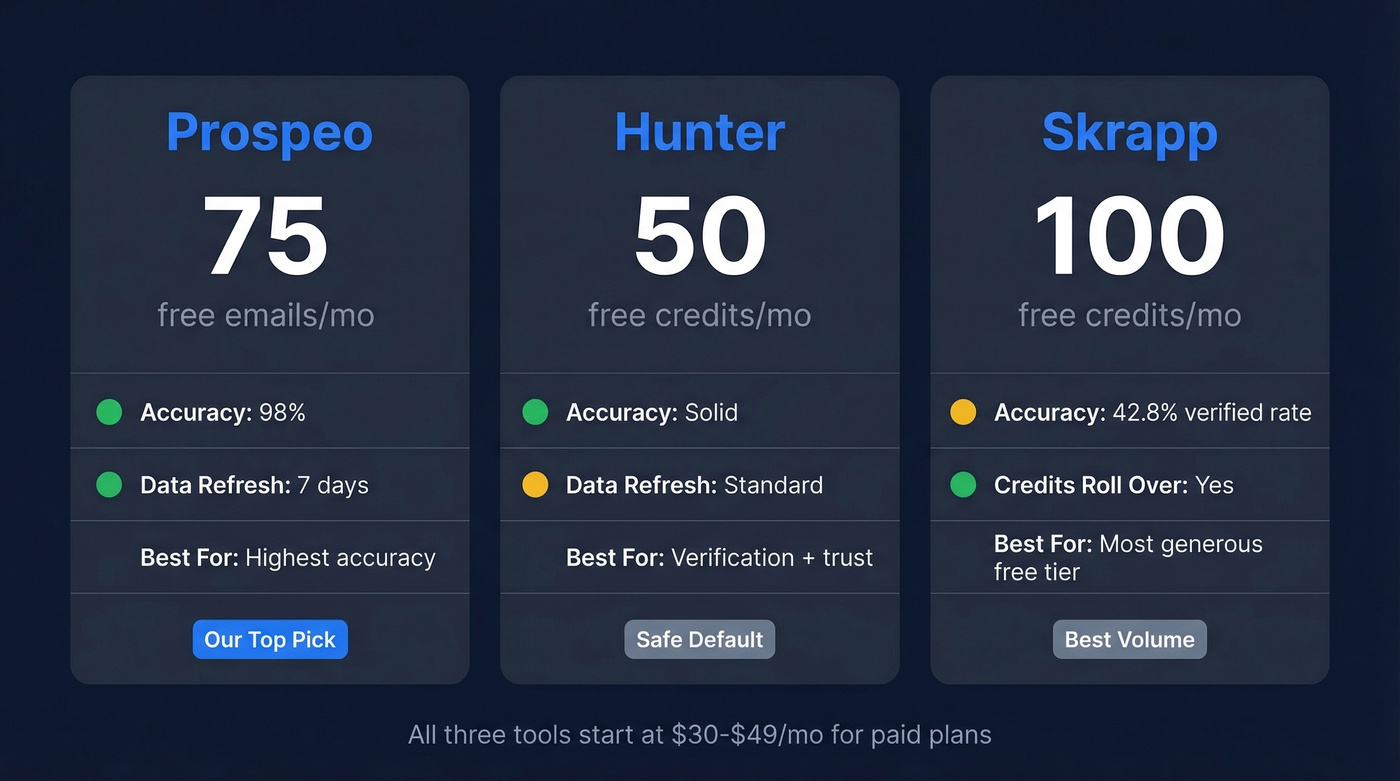
If accuracy matters more than volume, start with Prospeo. If you want the most free credits to burn through, Skrapp's your move. Hunter is the safe default most people already know.
Best Free Email Finder Online Tools in 2026
Prospeo
Use this if you're running outbound at any real volume and can't afford bounces killing your sender reputation. Prospeo gives you 75 free verified emails per month plus 100 Chrome extension credits - enough to test data quality against your ideal customer profile before spending a dollar.

That 98% email accuracy comes from a 5-step proprietary verification process that includes catch-all handling, spam-trap removal, and honeypot filtering. It's not just SMTP pinging - it's actual deliverability testing. Meritt dropped their bounce rate from 35% to under 4% after switching, which tells you more than any marketing page ever could.
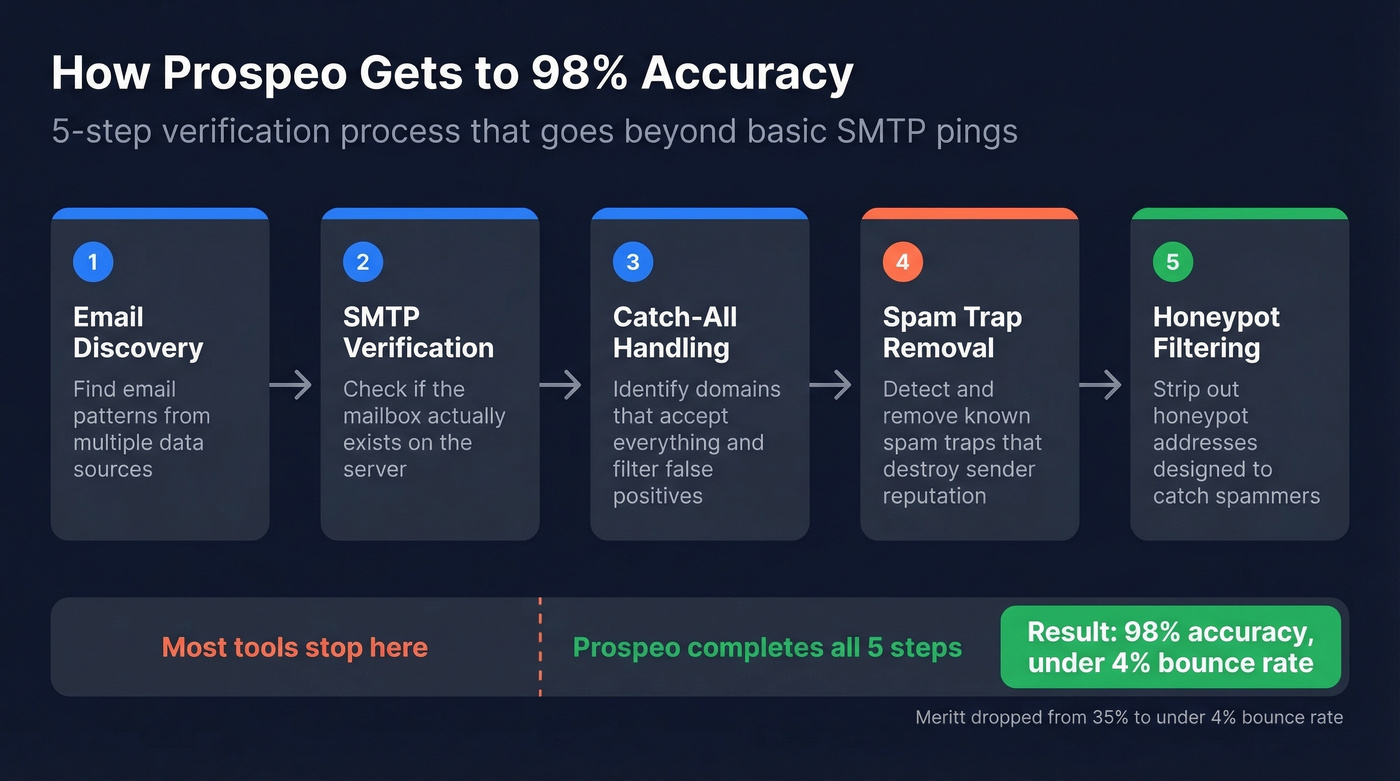
The 7-day data refresh cycle is what separates Prospeo from the pack. Most tools refresh around every six weeks, which means you're emailing people who changed jobs a month ago. Weekly refresh catches those changes before they become bounces. The Chrome extension has 40,000+ users and works across company websites and professional profiles. Paid plans start at $49/mo for 2,000 credits, and you only pay for valid addresses.
Skip this if you need one email address once a year and don't care about verification depth.
Hunter
Hunter is the tool everyone's heard of, and the verification engine deserves that reputation. You get 50 free credits per month, with verification costing just 0.5 credits each. The free plan includes API access, a Chrome extension, a Google Sheets add-on, and unlimited team members - that last one is rare for a free tier.

Hunter's database includes more than 100 million professional email addresses, but it can still feel smaller than the biggest data providers. The consensus on r/agency calls the verification "solid" but flags the database as "pretty small." It works better as a verification layer than a primary prospecting source. The free plan also excludes link tracking, reporting, and premium Discover filters. Paid plans jump to $49/mo for 2,000 credits, $149/mo for 10,000.
Here's the thing: Hunter is the best free verification tool, but it's a mediocre free finder. If you already have email addresses and need to clean them, Hunter is excellent. Building lists from scratch? You'll hit the database ceiling fast. (If you're comparing options, see our breakdown of Hunter alternatives.)
Skrapp
Skrapp quietly offers the most generous recurring free tier in this category: 100 email credits per month, with credits that roll over if you don't use them all.
The credit system is fair. You get charged 1 credit when the finder returns a "valid" or "catch-all" result. Invalid and unknown results? Free. Duplicates? Also free. And here's the detail most comparison articles miss: if you cancel your subscription, you keep your remaining credits. That's a small thing, but it signals a company that isn't trying to trap you.
Paid plans start at just $30/mo for 1,000 credits with 2 user seats, making Skrapp the cheapest path from free to paid in this roundup. In one benchmark, Skrapp's verified rate hit 42.8% - solid but not top-tier. For teams who need volume over precision, or who are stacking multiple tools in a waterfall, it delivers.
Snov.io
Use this if you're prospecting internationally and want automation baked into the same platform as your email lookup tool. Snov.io gives you 50 credits per month to spend across actions like email finding, domain searches, and verification. The free plan also lets you contact up to 100 campaign recipients per month - enough to test sequences without upgrading.
Skip this if you need deep US-first coverage. Snov.io's strength is breadth across geographies, not depth in any single market. Paid plans start at $39/mo (Starter) and $99/mo (Pro).
GetProspect
GetProspect's catch-all handling is the standout feature. Most free tools either skip catch-all domains entirely or mark everything as "risky." GetProspect runs proprietary verification on them, giving you more usable results from the same prospect list.
You get 50 valid emails plus 100 verifications free per month, with credits rolling over up to one month's allowance. No charge for duplicates. One warning: they strictly enforce one free account per person - create a second and they'll disable both. Verified rate benchmarks around 62%, which is decent. Paid plans start at $49/mo for 1,000 valid emails.
Anymail Finder
Anymail Finder takes a different approach: you get 100 free credits, but they expire after 7 days. That's aggressive. It's really a trial, not a free tier.
But the mechanics are clever enough to justify the tight window. Searches that don't return valid emails cost nothing. Name and profile URL lookups cost 1 credit per valid email found, while a company domain lookup costs 1 credit per search and can return up to 20 valid emails. Verification costs just 0.2 credits. And if you can prove more than 3% of their results bounced, they'll refund you - a confidence signal you rarely see. Paid plans start at $9/mo billed annually, making this the cheapest entry point for anyone who outgrows the trial.
Lemlist
Use this if you already use Lemlist for outreach and want email finding built into the same workflow. Their free email finder uses waterfall enrichment across seven providers, checking each source sequentially until it finds a valid address. That approach typically yields higher match rates than any single-provider tool.
Skip this if you need bulk lookups without creating an account. The free tool handles single lookups only; bulk processing requires a free Lemlist account and a CSV upload. Paid outreach plans start around $59/mo.
Mailmeteor
Completely free, no signup required - Mailmeteor's email finder handles one-off lookups in the browser. Need to find an email address online free without creating an account anywhere? This works. Don't expect it to scale.
EXPERTE.com
Another free, no-signup option for quick single lookups. It generates common email permutations and validates them by connecting to the recipient mail server without actually sending an email. Some results show as "Unknown" on catch-all domains. Fine for the occasional one-off check, but it's not a prospecting tool by any definition.

You just read that real enrichment rates land between 30% and 55%. Prospeo's 5-step verification delivers 98% email accuracy - with catch-all handling, spam-trap removal, and honeypot filtering built in. 75 free emails/month, no credit card required.
Stop guessing which free email finder actually works. Test Prospeo's accuracy yourself.
Free Email Search: Tool-by-Tool Comparison
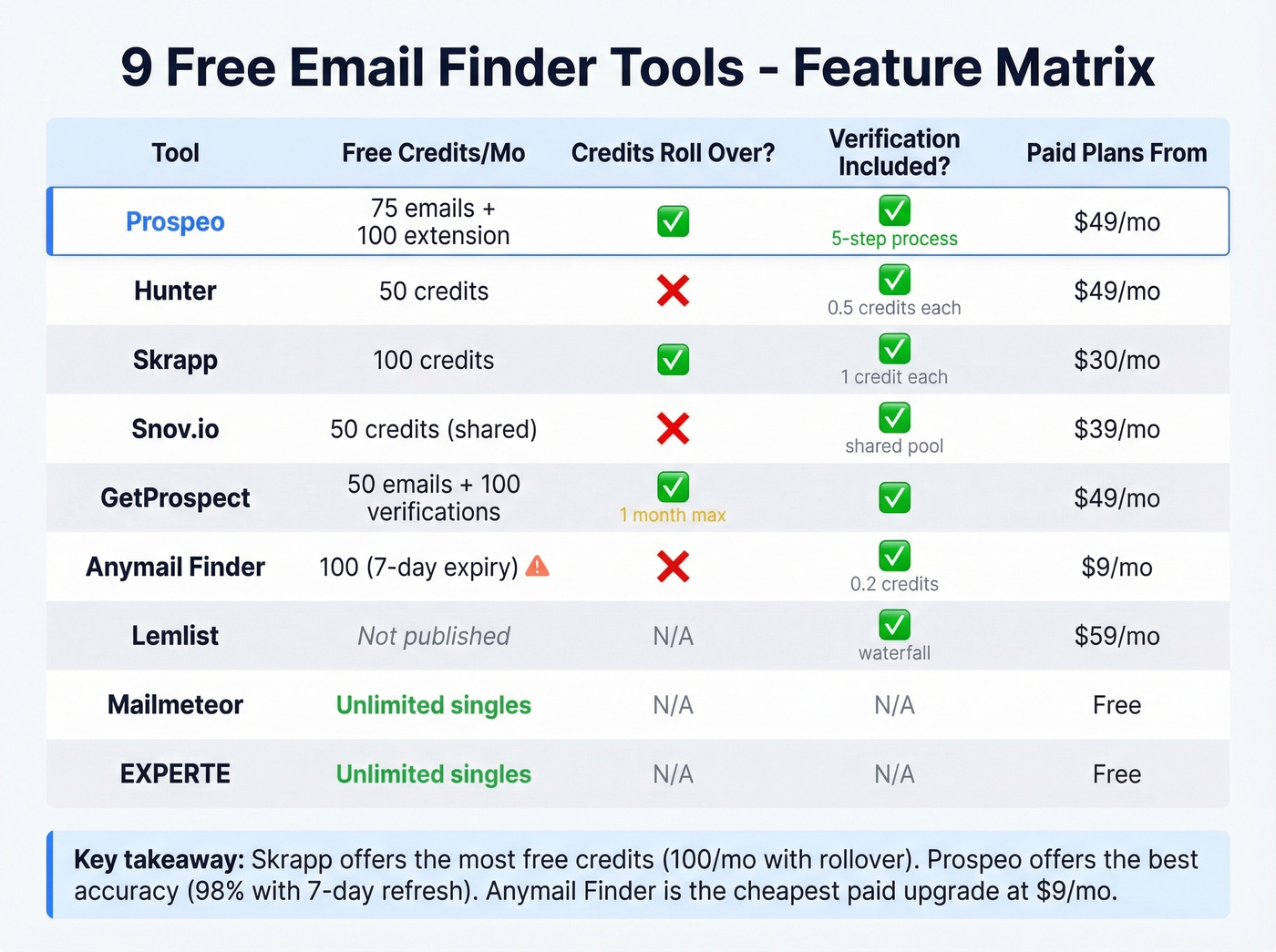
The details matter - "50 free credits" means very different things depending on how credits are consumed.
| Tool | Free Credits/Mo | Rollover | Verification Incl. | Paid From |
|---|---|---|---|---|
| Hunter | 50 credits | No | Yes (0.5 cr) | $49/mo |
| Skrapp | 100 credits | Yes | Yes (1 cr) | $30/mo |
| Snov.io | 50 credits | No | Yes (shared) | $39/mo |
| GetProspect | 50 emails + 100 ver. | Yes (1 mo) | Yes | $49/mo |
| Anymail | 100 (7-day exp.) | No | Yes (0.2 cr) | $9/mo |
| Lemlist | Not published | N/A | Yes (waterfall) | ~$59/mo |
| Mailmeteor | Unlimited singles | N/A | N/A | Free |
| EXPERTE | Unlimited singles | N/A | N/A | Free |
Stacking free tiers across multiple tools? Prospeo refreshes every 7 days - not 6 weeks like the rest. That means fewer bounces from job changers and stale records destroying your sender reputation. Meritt cut their bounce rate from 35% to under 4%.
Fresh data kills bounces. Start with 75 free verified emails at $0.01 each after that.
What "97% Accuracy" Actually Means
Let's be honest - every email finder tool markets accuracy numbers north of 95%. Those numbers aren't lies exactly. They're measuring something different from what you care about.
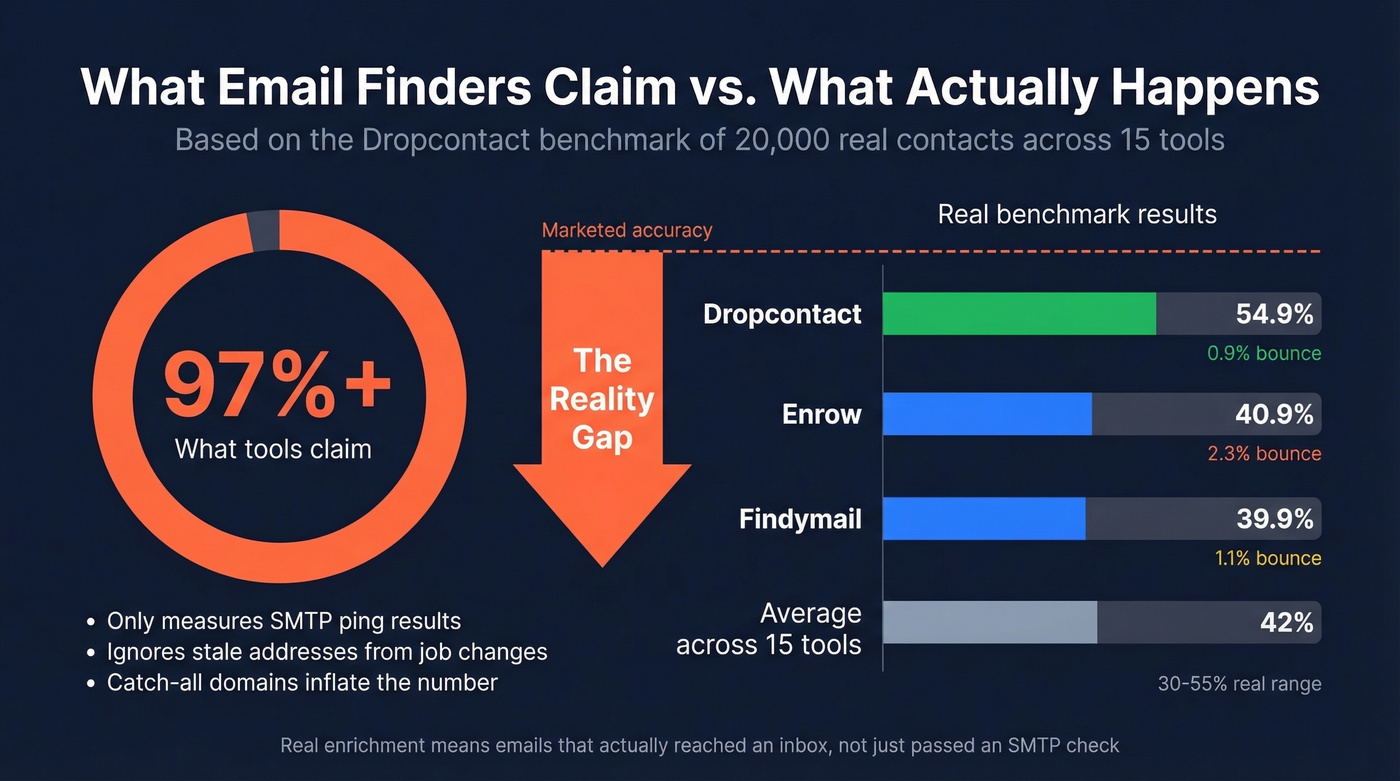
Most accuracy claims measure the percentage of returned results that don't hard-bounce on an SMTP check. That's a low bar. It doesn't account for wrong-domain matches, stale addresses from people who changed jobs, or catch-all domains that accept everything regardless of whether the mailbox exists.
The Dropcontact benchmark, updated February 2026, is the most rigorous public test we've seen. They fed 20,000 real contacts into 15 tools, then actually sent emails to every result. Dropcontact hit 54.9% real enrichment with a 0.9% hard bounce rate. Findymail landed at 39.9% with 1.1% bounces. Enrow managed 40.9% but with 2.3% bounces. Worth noting: Dropcontact ran this benchmark themselves, so take their own top ranking with appropriate context. But the methodology - live sending plus manual domain audits - is genuinely more rigorous than anything else published.
A separate Anymail Finder benchmark on 5,000 contacts sourced from professional profiles showed verified rates ranging from 20% to 77% across eight tools. No single tool dominates across all datasets. If your average deal size is modest, you probably don't need the most expensive data provider. But you absolutely need accurate data, because every bounce chips away at the sender reputation that makes your entire outbound program work. (More on this in our email deliverability guide.)
Mistakes That Kill Your Results

Verifying too far from send time. Email addresses go stale fast - people change jobs, companies restructure domains. In our experience, verifying within a month of sending is the bare minimum. A week is better.
Ignoring catch-all risk. Catch-all domains accept every email sent to them, so SMTP verification can't confirm the specific address exists. Expect roughly 70% deliverability on catch-all results versus 90%+ on fully verified addresses. Treat them as a separate segment with its own sending domain.
Sending risky emails from your primary domain can torch your reputation in a single bad batch. Use a separate sending domain and IP for catch-all or unverified addresses. We've seen teams learn this the hard way - one agency we spoke with burned through three domains in two months before setting up proper infrastructure.
Double-verifying through a second tool sounds smart but often backfires. Different tools have different catch-all policies, and what one marks "valid" another marks "risky." Running found emails through an additional verifier can reduce your valid list by up to 20%. Pick one verification source and trust it.
Ignoring data freshness is the silent killer. A tool that refreshes data weekly will consistently outperform one that refreshes monthly - even if the slower tool has a larger database. Fresh data beats big data for deliverability every time.
When to Upgrade From Free
Free tiers exist for one reason: to let you test which tool's data actually works for your specific ICP. The contacts a tool finds for enterprise SaaS buyers in the US will be completely different in quality from what it finds for SMB owners in Germany. You can't know which tool fits until you run your actual targets through it.
The upgrade triggers are predictable. If you're sending more than 500 emails per day, free credits won't last past breakfast. If you need bulk upload or API access for enrichment workflows, some free plans exclude or throttle those features. And if multiple people are prospecting, you'll need team seats that free plans rarely support - Hunter being the notable exception. (If you're building a full stack, start with our list of SDR tools.)
Tools like Apollo and Cognism come up frequently in Reddit discussions, but their free tiers are too limited for this roundup. Apollo in particular draws complaints about per-seat pricing at scale.
The good news: $30-49/mo gets you 1,000-2,000 credits at most tools on this list. That's enough for a solo SDR or a small agency running targeted campaigns. If your outbound program can't justify $30/mo for verified contact data, the problem isn't the tool cost.
FAQ
Is there a free email finder online that actually works?
Yes - every tool on this list delivers results for some slice of the market. The catch is that accuracy depends on your ICP. A tool that finds 80% of US tech contacts might find 30% of European manufacturing leads. Test 2-3 free tiers on your actual prospect list before committing to any single provider.
How accurate are free email finders really?
Marketing claims say 97%+. Independent benchmarks show real enrichment rates around 30-55% when you account for hard bounces, wrong-domain matches, and stale data. The gap comes from tools measuring SMTP validity rather than actual deliverability. Always verify on your own list before trusting published numbers.
What's a catch-all email domain?
A catch-all domain accepts all emails regardless of whether the specific mailbox exists. SMTP verification can't confirm the address is real, so deliverability on catch-all results runs around 70% versus 90%+ on fully verified addresses. Prospeo and GetProspect flag these separately; other tools lump them in with "valid."
Can I stack multiple free email finder tools together?
Yes - and you should. No single tool covers every contact. Running the same list through 2-3 tools in a waterfall approach (try tool A first, send misses to tool B) significantly increases your overall match rate. Lemlist automates this across seven providers; you can also build manual waterfalls using Prospeo, Hunter, and Skrapp's free tiers.
What's the most accurate free email finder online?
Prospeo delivers 98% email accuracy through a 5-step verification process with a 7-day data refresh cycle - the fastest in the industry. But accuracy varies by geography, industry, and seniority level. Test 2-3 tools on your actual prospects; what works for US tech contacts may underperform for European manufacturing leads.