

How to Respond to an Email Introduction Without Overthinking It
Your former colleague just emailed you and a VP of Product at a Series B company. The intro is sitting in your inbox right now. You've got about 24 hours before the window starts closing.
Here's the thing: your email introduction response doesn't need to be perfect. It needs to be fast, specific, and respectful of the person who stuck their neck out for you. Most people overthink the wording, underthink the mechanics, and end up either ghosting or sending something so generic it kills the momentum. We've watched promising warm introductions die because someone spent three days wordsmithing a reply. Let's fix that.
The 30-Second Reply Formula
If you're scanning this on your phone before firing off a reply, here's everything you need:
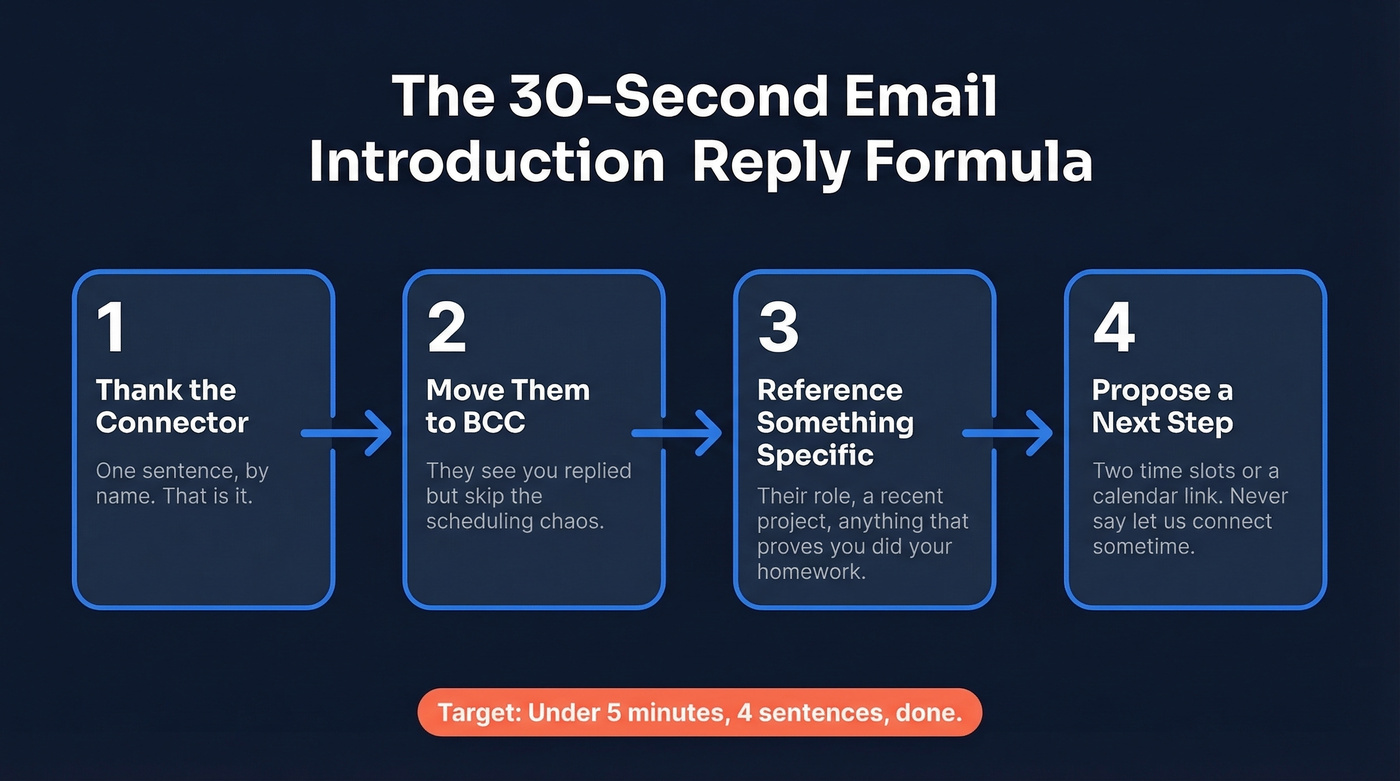
- Thank the connector by name - one sentence.
- Move the connector to BCC - so they see you replied but don't get dragged into scheduling.
- Reference something specific about the new contact - their role, a recent project, anything that proves you looked them up.
- Propose a concrete next step - two time slots or a calendar link. Not "let's connect sometime."
Four sentences, done in under five minutes. The rest of this article is about doing it well.
Reply-All vs. BCC vs. New Thread
This is where most people freeze. The decision tree is simpler than you think.
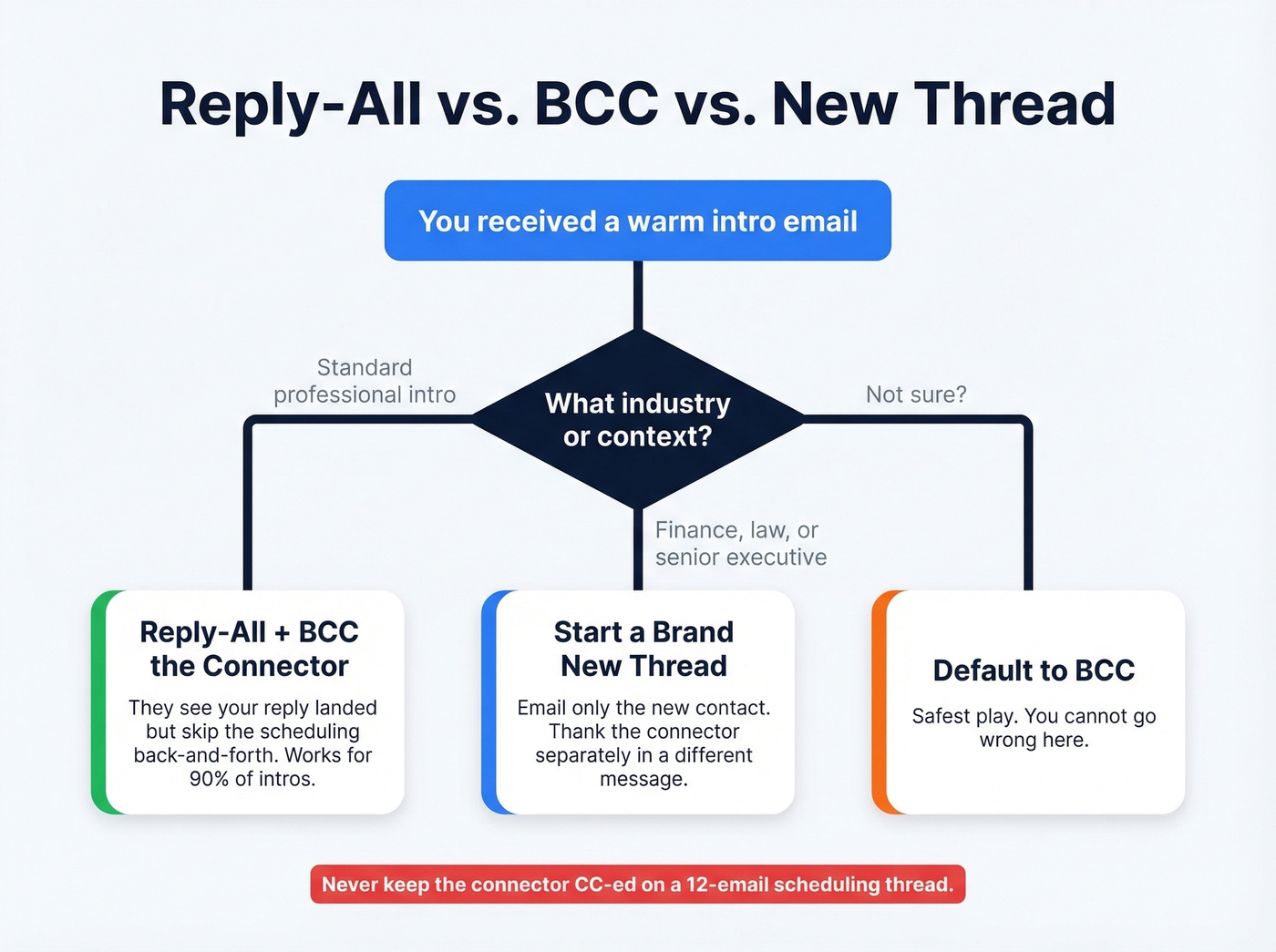
Standard professional intro: Reply-all on the original thread, but move the connector to BCC. They'll see your response landed, and they won't get pinged on every scheduling back-and-forth. This is the consensus approach in modern email etiquette, and it works in the vast majority of intros.
Formal industries like finance, law, or senior executive intros: Start a brand-new thread with just the introduced contact. Thank the connector in a separate email. The Wall Street Oasis consensus is clear - the referrer "most likely doesn't need the extra emails in their inbox."
You're unsure? Default to BCC. It's the safest play.
Pro tip: If you're replying to both parties in one email, use address blocks to make it scannable - "==> Sarah, thanks for the intro" and "==> James, great to connect" - so each person immediately sees what's directed at them. Small formatting move, big signal of professional fluency.
If you reply-all and keep the connector copied on a 12-email scheduling thread, you've told them to never introduce you again. Respect their inbox the way you'd want yours respected.
How to Structure Your Reply
Knowing how to respond to an introduction email well comes down to five steps, in order. Don't skip the research step - it's the difference between a reply that gets a meeting and one that gets archived.
Step 1: Thank the connector by name. "Thanks for connecting us, Sarah" is enough. One line. Don't write a paragraph about how grateful you are.
Step 2: Move the connector to BCC. Do this before you hit send. Most email clients make it quick.
Step 4: One sentence on why you're excited to connect. Tie it to mutual value, not just what you want. "I think there's a lot of overlap between what your team is building and the work we're doing on developer onboarding" beats "I'd love to pick your brain."
Step 5: Propose a specific next step. Two or three time slots, or a calendar link. "Would Tuesday at 2pm ET or Thursday morning work for a quick 20-minute call?" removes friction. Vague "let's find time" emails die in inboxes. If you want more options, use proven email wording to schedule a meeting.

Step 3 of your reply is research - and that's where most people wing it. Prospeo's Chrome extension gives you 40+ data points on any contact in one click, so you can reference their role, company size, and tech stack before you hit send.
Turn every warm intro into a booked meeting with real contact intelligence.
Templates by Scenario
Networking / General Professional Intro
Hi [Name], thanks for the intro, [Connector]! [Moving them to BCC.]
Great to e-meet you - I've been following [Company]'s work on [specific thing]. Would you have 20 minutes this week to swap notes? Here are a couple slots: [times] or grab one here: [calendar link].
Job Opportunity Intro
The biggest mistake we see in job-related warm introductions: attaching a CV in the first email. Don't do it. If they want it, they'll ask. Your goal is to land a conversation, not dump a document.
Hi [Name], thank you [Connector] for making this connection. [Moving to BCC.]
I'm very interested in the [Role] at [Company]. I graduated [honors] from [School] and have been focused on [relevant experience]. Would you have time for a brief call this week?
If your GPA isn't a selling point, skip it entirely - mentioning a mediocre GPA does more harm than leaving it out. In finance and consulting, formality scales with seniority. The more senior the recipient, the tighter your note should be.
Sales / Business Development Intro
Most sales intro replies fail because they lead with a pitch instead of curiosity. If you need a stronger opener, borrow from these emails that get responses.
Hi [Name], [Connector] speaks highly of what you're building at [Company] - moving them to BCC.
We help [type of company] solve [specific problem], and it sounds like there's a fit. Would a quick 15-minute call make sense? [calendar link]
VC / Investor Intro
Investors read hundreds of these. Lead with traction, not vision.
Hi [Name], thanks [Connector] - BCC'ing them here.
We're [Company], [one-line traction proof: ARR, growth rate, or key metric]. We're raising [round] to [one-sentence use of funds]. Does [day] or [day] work for 20 minutes?
Partnership / Collaboration Intro
Hi [Name], appreciate the connection, [Connector]. [BCC'ing them.]
I've been looking at how [their company] and [your company] could complement each other around [mutual value area]. Would love to explore over a quick call: [slots].
Intro From a Senior Executive or VIP
Look, most people write too much in these emails. The more senior the person, the shorter your message should be. Here's the right version next to the wrong one:
❌ "I'm so honored to connect. I've been following your career for years and would love to learn from your experience across multiple industries..."
✅ "Dear [Name], thank you, [Connector], for this introduction. [Moving to BCC.] I've admired [specific work]. I'd welcome any time you might have for a brief conversation at your convenience."
Higher formality, fewer words, more deference. Let them set the pace.
Mistakes That Kill Your Reply
Keeping the connector on the thread forever. BCC them on your first reply. Full stop. They don't need to witness your scheduling dance.
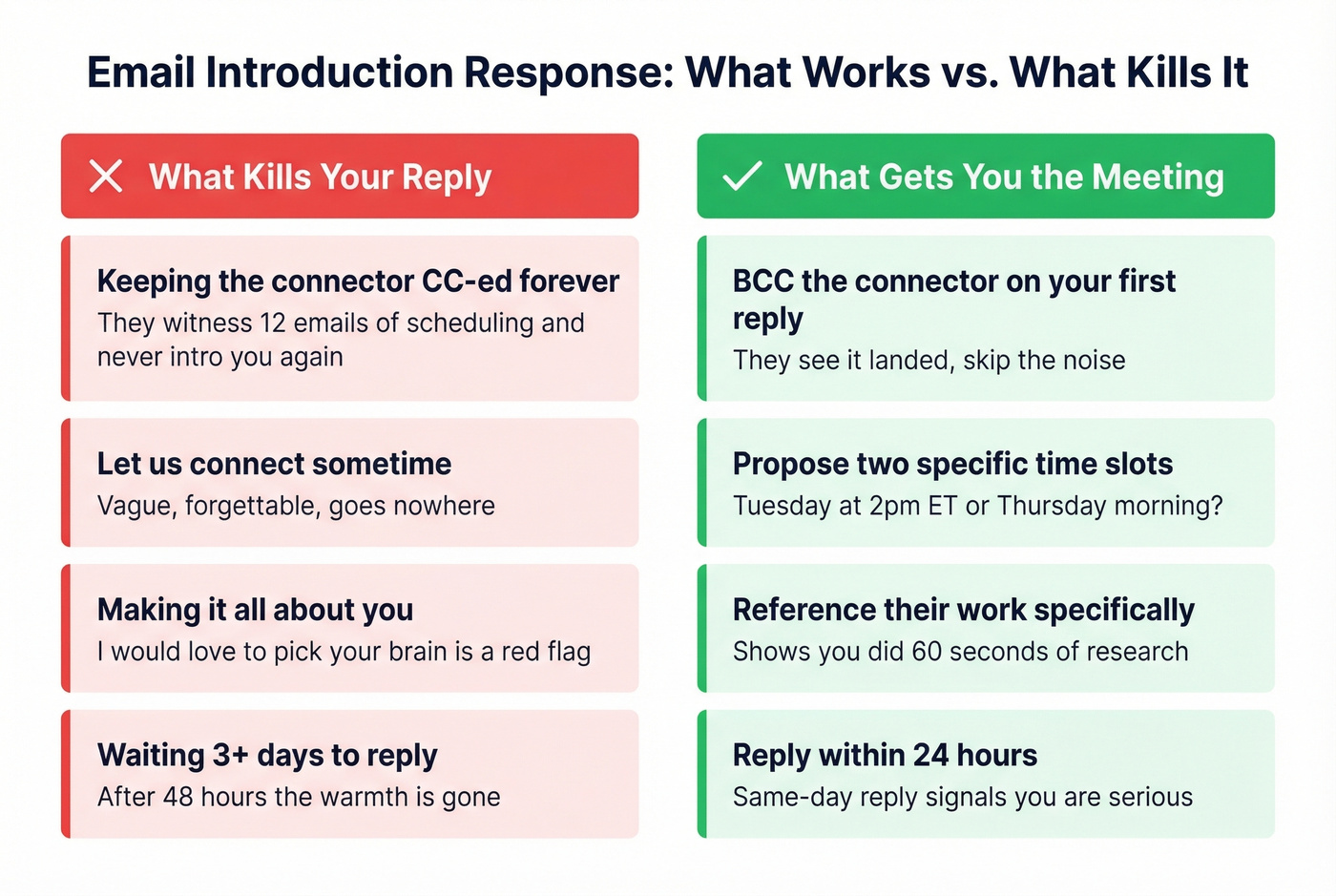
"Let's connect sometime." This is the email equivalent of "we should grab coffee." It means nothing and leads nowhere. Propose a specific day and time.
Making it all about you. The connector is risking their reputation by vouching for you. Your reply should make them look good, not make you sound desperate.
Waiting more than 48 hours. The intro has a half-life. Reply within 24 hours if you can - 48 at the absolute maximum. After that, the warmth is gone and you're basically cold-emailing someone who expected to hear from you days ago.
When They Don't Reply
Don't panic. People are busy, not uninterested.
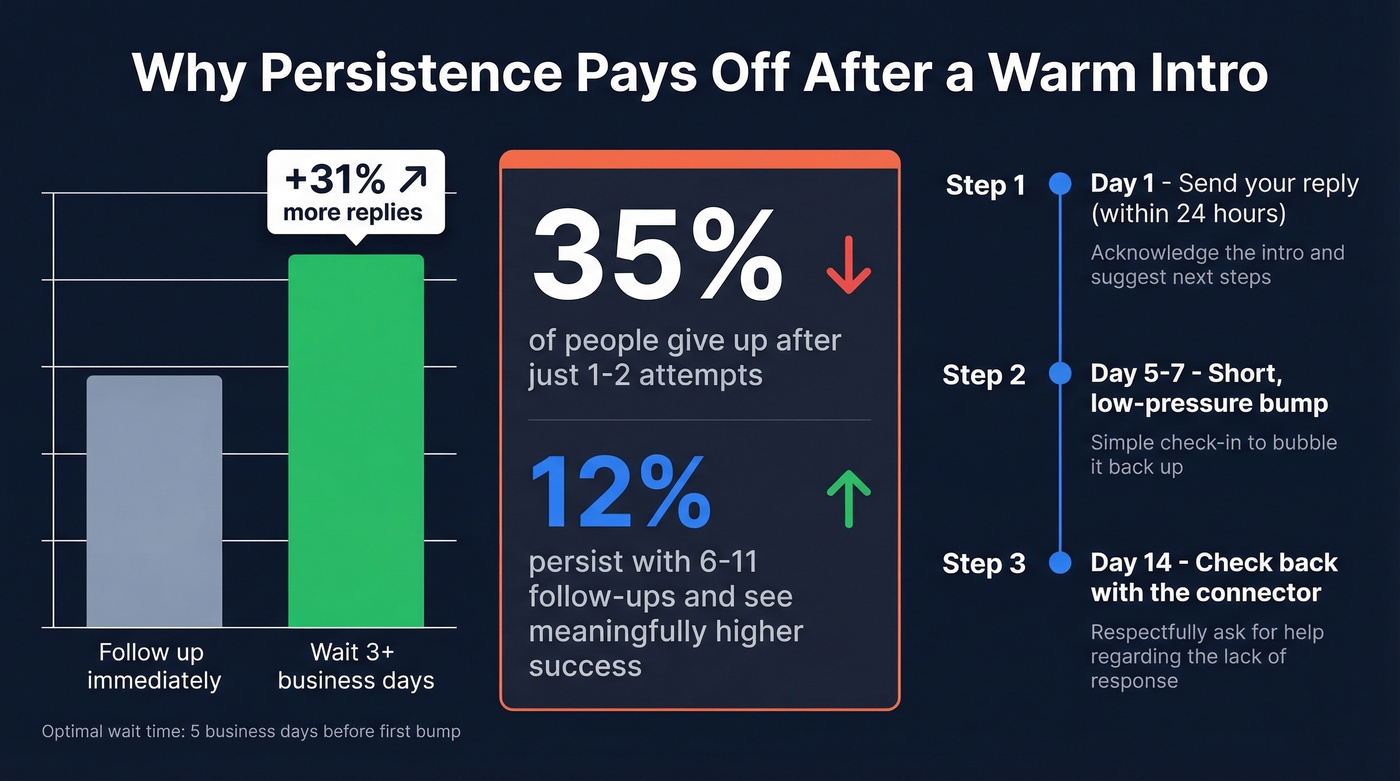
Wait 5 business days before following up with a short, low-pressure bump: "Hi [Name], just bumping this up - would love to find a time if you're open to it." Sales follow-up data shows that waiting at least 3 business days yields a 31% increase in replies compared to following up immediately. Short video follow-ups can boost click-through rates by 65%, though that's more common in sales contexts than networking.
Here's what most people get wrong: 35% give up after just one or two attempts. The 12% who persist with 6-11 follow-ups see meaningfully higher success rates. Those numbers come from outbound sales, but the principle holds for warm intros too - inboxes are chaotic, and a gentle nudge often does the trick. If you want plug-and-play language, use these sales follow-up templates.
If another week passes with no response, check back with the original connector. A quick "Hey Sarah, have you heard from [Name]? Just want to make sure the timing works" keeps the loop closed without being pushy. For timing rules, see When Should You Follow Up on an Email?
Warm intros open doors. Bad data slams them shut. When your intro leads to a call and you need to loop in more stakeholders, Prospeo gives you 98% accurate emails and 125M+ verified mobile numbers - so you never lose momentum after the first reply.
Stop guessing contact details. Start closing from the first introduction.
How to Decline a Connection Request Gracefully
Sometimes someone asks you to make an intro you don't feel comfortable making. Maybe you can't vouch for the person, or the ask doesn't make sense for your contact.
The playbook, originally outlined in HBR, comes down to three moves. Be transparent about why - "I don't think the fit is right for [Contact] right now" is honest and respectful. Offer something in return: alternative referrals, advice, or even a template they can use. One author declined to introduce someone to their literary agent but shared their own successful intro email as a model instead. And keep the door open: "Let's revisit this when you've got [specific milestone]."
There's also the "soft no." Message your network contact privately, let them decide whether they want to engage, and relay the outcome. This is really just a private pre-check so your contact can opt in or opt out without anyone getting put on the spot. If someone skipped that step and dropped you into an awkward three-way email, manage it behind the scenes - a quick private note to the connector explaining the situation goes a long way.
FAQ
Should I reply-all or just email the new contact?
BCC the connector on your first reply so they see you responded promptly without getting dragged into scheduling. In formal industries like finance or law, start a completely new thread with just the introduced contact and thank the connector separately.
How quickly should I respond to an intro email?
Reply within 24 hours - 48 hours at the absolute maximum. Warm introductions lose momentum fast, and a same-day reply signals professionalism and respect for the connector's effort.
What's the fastest way to research the new contact before replying?
Pull up their profile using a tool like Prospeo to see their current role, company, and verified contact details. Reference something specific about their work in your reply. That one detail separates your message from every generic "great to connect" note they've received this week.
The best email introduction response is the one you send within 24 hours. Everything else is polish.