

How to Write the Perfect Email After Introduction
Someone just introduced you over email. You've read the message twice, and now you're staring at the reply button wondering exactly what to say, who to include, and whether you're about to commit an etiquette crime. Meanwhile, the person on the other end - who receives 120+ emails a day - is already moving on. Your email after introduction needs to land fast, and it needs to land right.
The BCC Rule Everyone Gets Wrong
Reply all on your first response, thank the introducer by name, then move them to BCC. The phrasing is simple: "Moving [Name] to BCC to spare their inbox - thanks for the intro!" This closes the loop so the introducer sees you responded, without dragging them into a scheduling thread they don't care about.
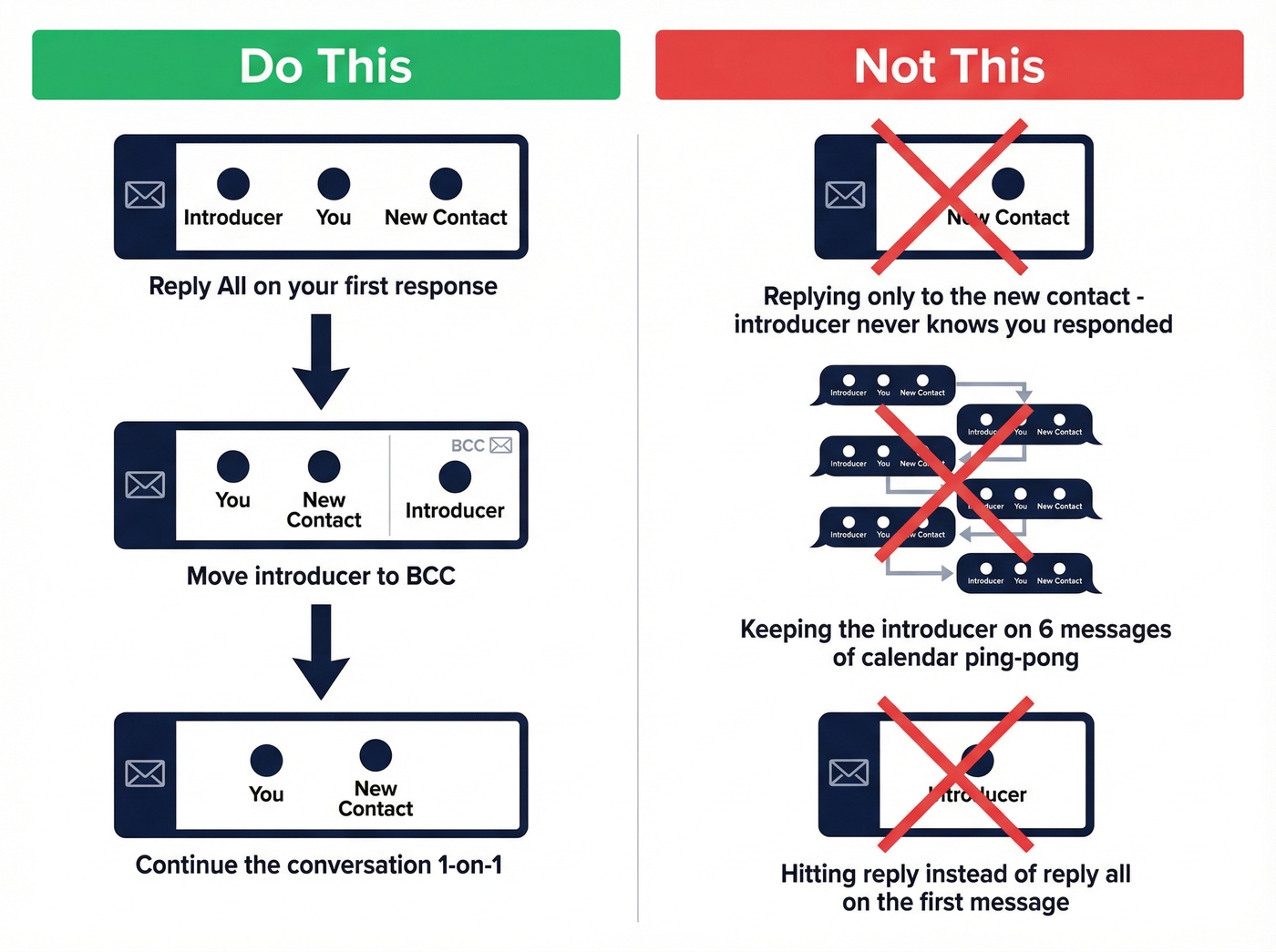
What you shouldn't do: keep the introducer copied on every subsequent message. Don't reply only to the new contact without acknowledging the connector. And don't hit "reply" instead of "reply all" on that first message - the introducer deserves to know their effort landed.
This is one of the most common etiquette debates people run into after an intro, and the cleanest approach is straightforward: reply all once, thank the connector, then BCC them going forward. We've watched promising connections stall because someone kept the introducer looped in for six messages of calendar ping-pong. Don't be that person.
One more norm worth knowing: the less senior person replies first. If a VP introduced you to a C-suite exec, you're the one who should be hitting send within one business day.
How to Reply, Step by Step
Five steps. Don't overthink it.
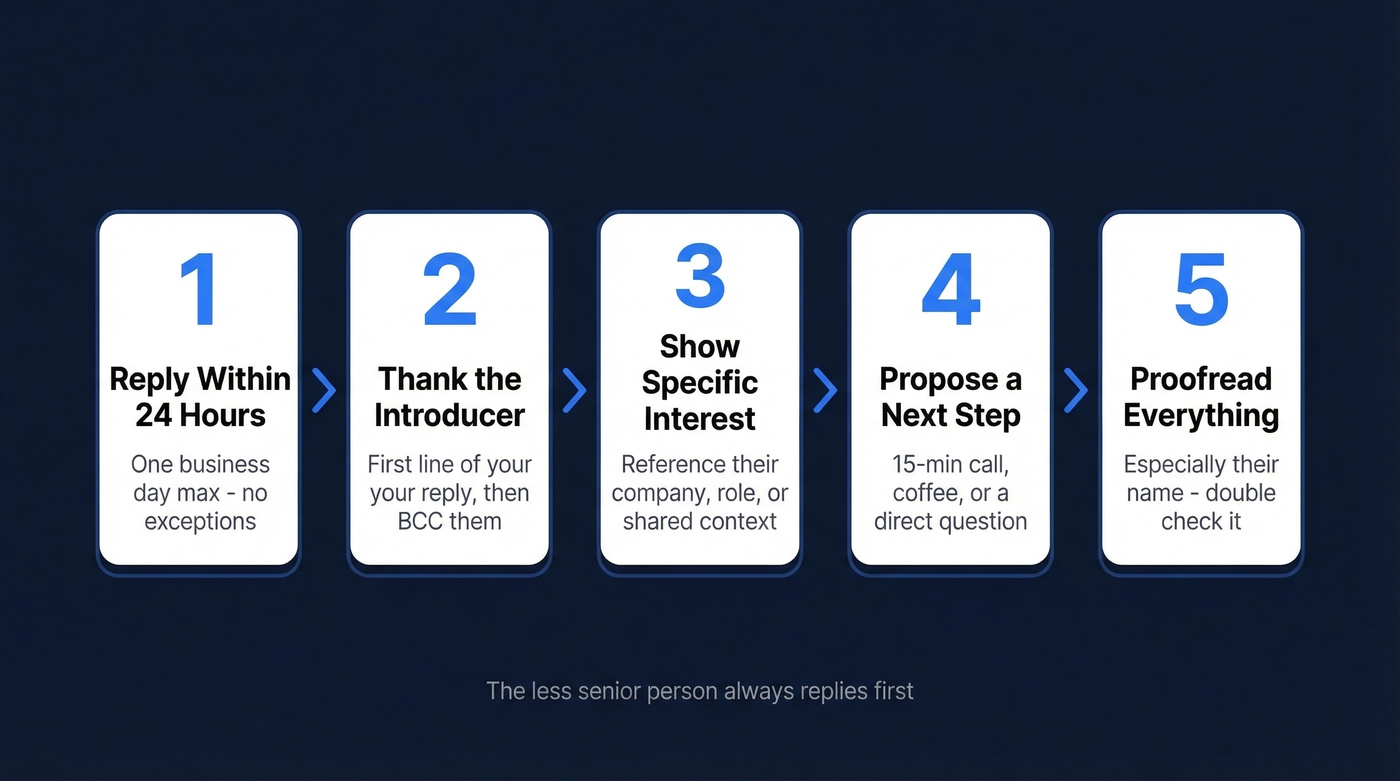
Respond within 24 hours. Not "promptly." Not "when you get a chance." Within one business day. This is the baseline expectation, and missing it signals you don't value the connector's effort.
Thank the introducer. First line of your reply. One sentence. Then BCC them.
Express specific interest. Don't just say "nice to meet you." Reference something concrete - their company, a shared interest, the reason you were introduced. A strong follow-up goes beyond pleasantries and shows you've actually looked into who they are. (If you want more examples, borrow structure from these emails that get responses.)
Propose a next step. A 15-minute call, a coffee, a specific question. Give them something to say yes to. If you're trying to land a meeting, use proven email wording to schedule a meeting.
Proofread. Misspelling the new contact's name in an introduction reply is a uniquely painful mistake.
For subject lines: if the original subject is clear (like "Intro: Sarah <> James"), keep it. If it's vague, rewrite it. Aim for ~50 characters or fewer using the "Intro: Name <> Name" format. For more options, swipe from these email subject line examples.
Templates That Actually Work
Networking Introduction
Hi [Name],
Moving [Introducer] to BCC - [Introducer], thanks so much for connecting us!
[Name], great to e-meet you. I've been following [Company/Project] and would love to hear more about [specific thing]. Would you be open to a 15-minute call next week? I'm flexible Tuesday or Thursday afternoon.
Best, [Your Name]
This should feel warm but purposeful. Specificity is what earns the reply.
Job Opportunity Introduction
Slightly more formal here - you're being evaluated from the first sentence.
Hi [Name],
Thanks for the introduction, [Introducer] - moving you to BCC to keep your inbox clean.
[Name], I really appreciate you taking the time. I've looked into the [Role Title] position and I'm excited about [specific aspect of the role or company]. I'd love to learn more about the team and what you're looking for. Would a brief call this week work on your end?
Thank you, [Your Name]
Business or Partnership Introduction
Keep this one short. Decision-makers scan.
[Name],
[Introducer], thanks for making this happen - BCCing you from here.
I think there's a natural overlap between what we're doing in [specific area] and [their company]'s work in [specific domain]. Happy to share more context - does 20 minutes sometime this week work?
Cheers, [Your Name]

A great introduction email means nothing if it bounces. Prospeo's 5-step email verification catches invalid addresses, spam traps, and catch-all domains before you hit send - so your follow-up actually lands. 98% accuracy. 75 free verifications per month.
Don't let a dead email address kill a warm introduction.
What to Do When They Don't Respond
You sent a solid reply. Three days pass. Nothing.
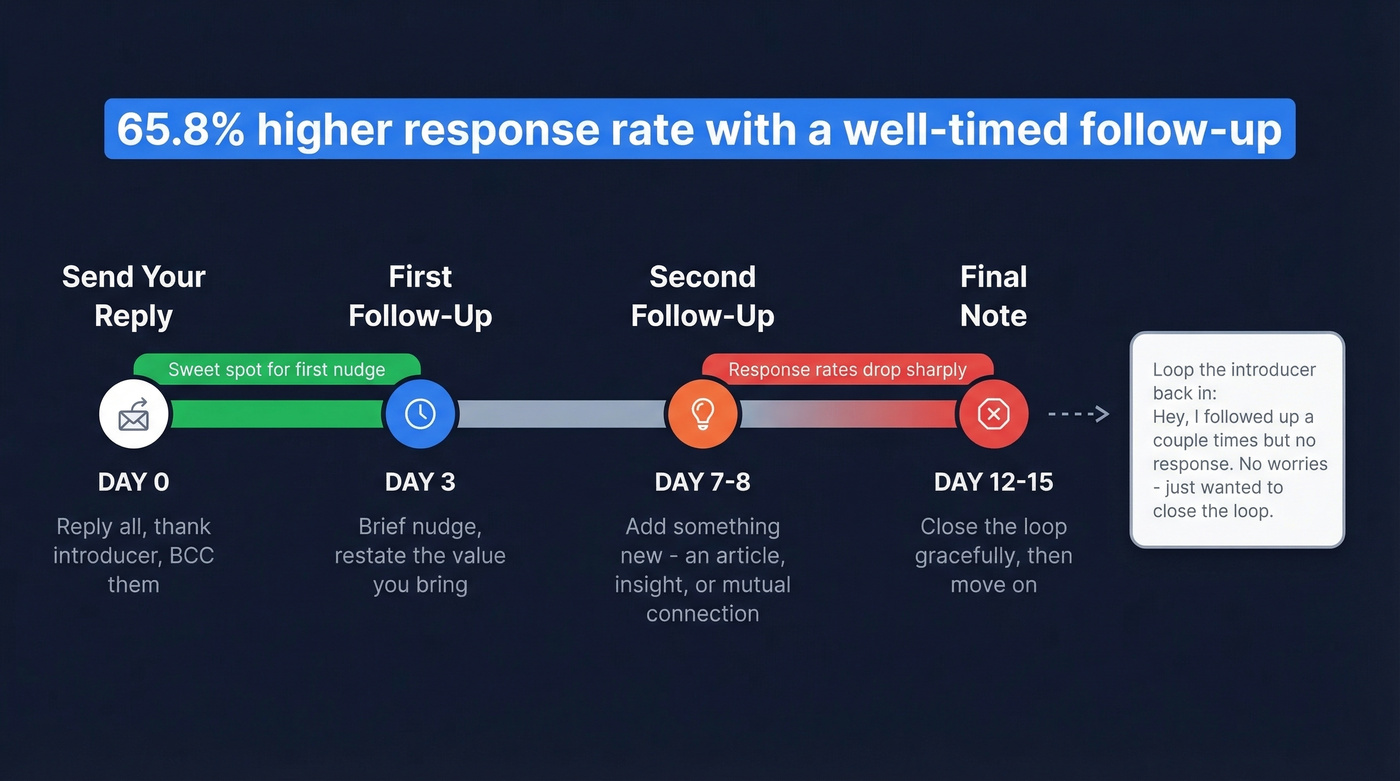
Here's the thing: a well-timed follow-up increases your response rate by 65.8%. But timing matters more than persistence. Response rates drop after five days, so your first follow-up should land around day three. (If you want a deeper timing breakdown, see when should i follow up on an email.)
| Touchpoint | Timing | What to Say |
|---|---|---|
| First follow-up | Day 3 | Brief nudge, restate value |
| Second follow-up | Day 7-8 | Add new context or insight |
| Final note | Day 12-15 | Close the loop gracefully |
Your Day 3 nudge:
Hi [Name], just wanted to bump this in case it got buried. I'd still love to connect about [topic] - happy to work around your schedule.
Your Day 7-8 follow-up should add something new - a relevant article, a mutual connection you discovered, a specific insight about their business. Don't just repeat yourself. Contribute value, not just another ask for time. If you need copy you can adapt, use these sales follow-up templates.
After three touches with no response, loop the original connector back in: "Hey [Introducer], I followed up a couple times but haven't heard back. No worries - just wanted to close the loop." Then move on.
Before sending that follow-up, make sure the address is still valid. I've seen solid introductions die because the follow-up bounced - the introducer thinks you ghosted, the contact never saw a thing. Prospeo checks emails in real time with 98% accuracy, and the free tier covers 75 verifications per month. Takes seconds and keeps you from wasting follow-ups on dead addresses. If you're troubleshooting deliverability, start with email bounce rate and the email deliverability guide.

The Double Opt-In Introduction
A double opt-in introduction means both parties have agreed to be connected before anyone hits send. Fred Wilson popularized the concept, and it's become the gold standard in professional networking - especially in VC and startup circles.
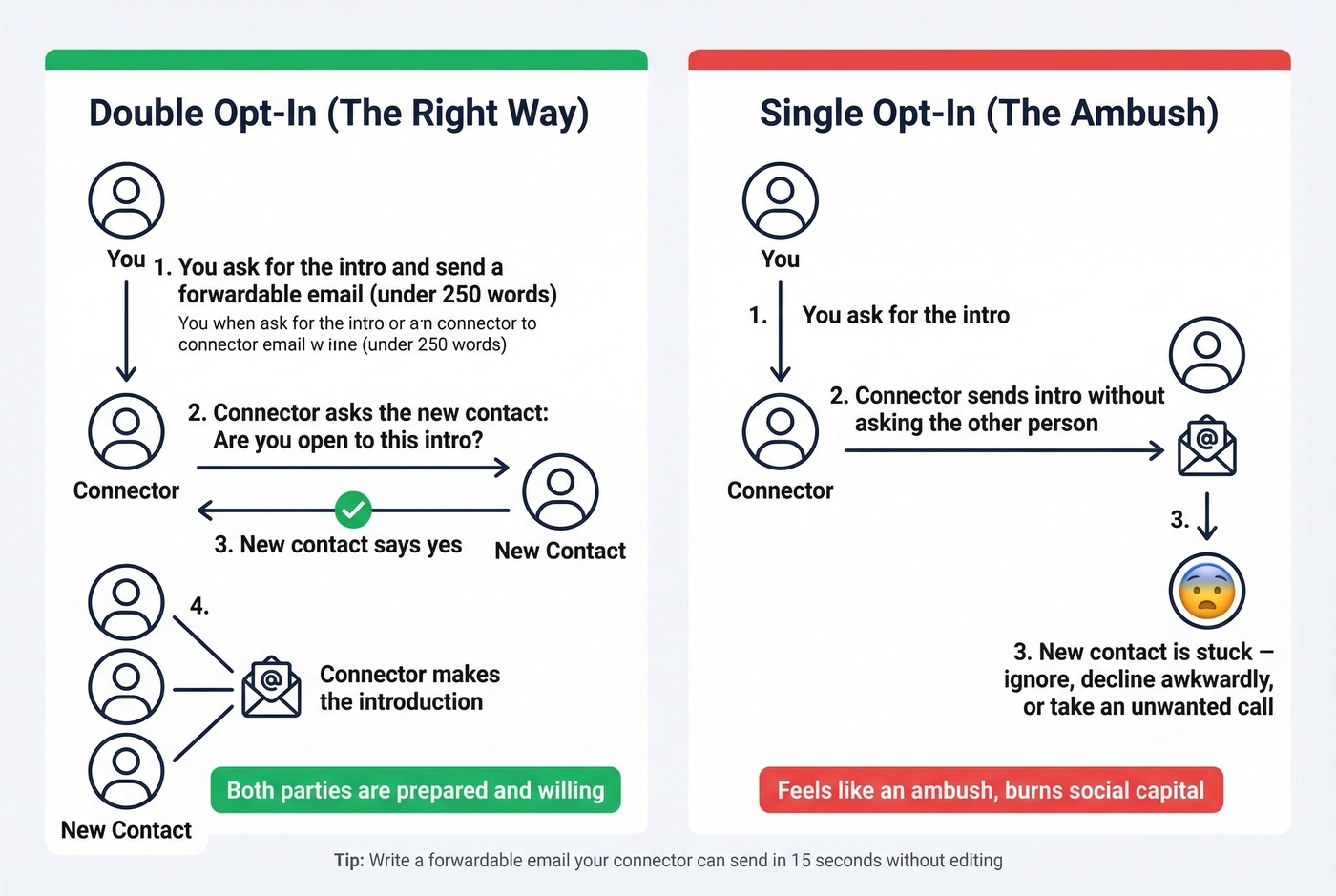
A single opt-in intro is an ambush. You land in someone's inbox without warning, and now they're stuck choosing between ignoring the email, declining awkwardly, or taking a call they never asked for.
If you're requesting an intro, make it easy. Write a forwardable email - under 250 words, with clear context on why the connection makes sense for both sides. In VC circles, this is standard: include traction numbers, what you're looking for, and why this specific person matters. Your connector should be able to forward it in 15 seconds without editing a word. (For more intro formats, see company introduction email example.)
Let's be honest: most people treat introductions like a numbers game - "Can you intro me to 10 people?" That's a fast way to burn social capital. Start with one. Make it count. The best networkers we know send fewer intro requests, not more.
Edge Cases Most Guides Skip
Declining an introduction gracefully. Sometimes you get introduced to someone and it's not the right fit. Making an introduction is implicitly vouching for someone - your reputation is on the line. If you're unsure about someone asking you to connect them, suggest a 3-way coffee first before committing to a formal intro. If the timing is wrong but the person is solid, suggest revisiting in a month.
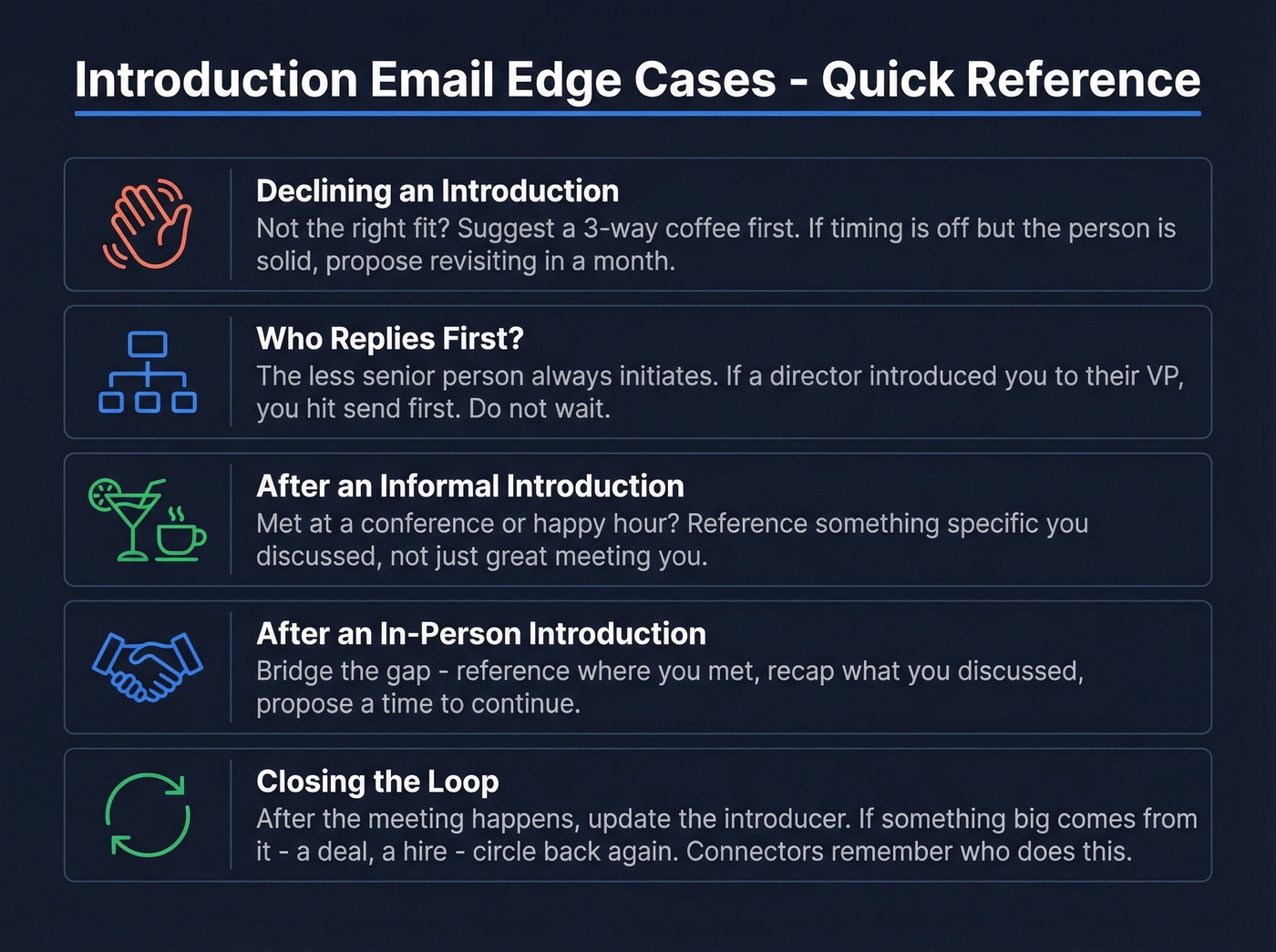
Who replies first? The less senior person initiates. Always. If a director introduced you to their VP, you send the first reply. Don't wait for the more senior person to make the move - they won't.
Following up after an informal introduction. Met someone at a conference happy hour or a casual coffee? Same principles apply. Your follow-up should reference something specific you discussed - not just "great meeting you." Mention the topic that sparked the conversation and propose a concrete next step.
Sending an email after an in-person introduction. Sometimes the intro happens face-to-face and the email comes later. Your message should bridge the gap between the in-person conversation and a formal next step: reference the event or context where you met, recap what you discussed, and propose a time to continue the conversation.
Closing the loop after the meeting. This is separate from the initial BCC, and it's the step almost everyone forgets. After your meeting happens, send the introducer a quick update: "Had a great call with [Name] - thanks again for connecting us." This shows gratitude and keeps you top of mind for future introductions. And if something meaningful comes from it - a deal, a hire, a partnership - circle back again. In our experience, connectors remember who closes the loop, and they'll introduce you again.
Building real relationships starts with reaching real inboxes. Prospeo gives you verified contact data for 300M+ professionals - emails, direct dials, and 50+ data points per contact - so every introduction leads somewhere.
Find verified emails for the people you actually want to meet.
The reply is the easy part. Everything after - the BCC, the follow-up, the loop-closing - is what separates people who network from people who actually build relationships.