

Best Email List Cleaners in 2026: Pricing, Accuracy & Honest Picks
You've got a 250,000-email list, a campaign launch next Tuesday, and a nagging suspicion that a quarter of those addresses are dead. You're right to worry. Email lists decay by roughly 28% every year, and global inbox placement sits around 84% - but that average hides ugly variation. Gmail places about 87% of emails in the inbox while Microsoft manages only 76%. If your list skews toward Outlook domains, dirty data will wreck you faster than you think.
Here's the hot take most vendors won't give you: the best email list cleaner is the one you never need. If your source data is already verified at the point of collection, cleaning becomes a formality. But most teams aren't there yet, so here are 12 cleaners worth evaluating, with real pricing, honest limitations, and clear recommendations.
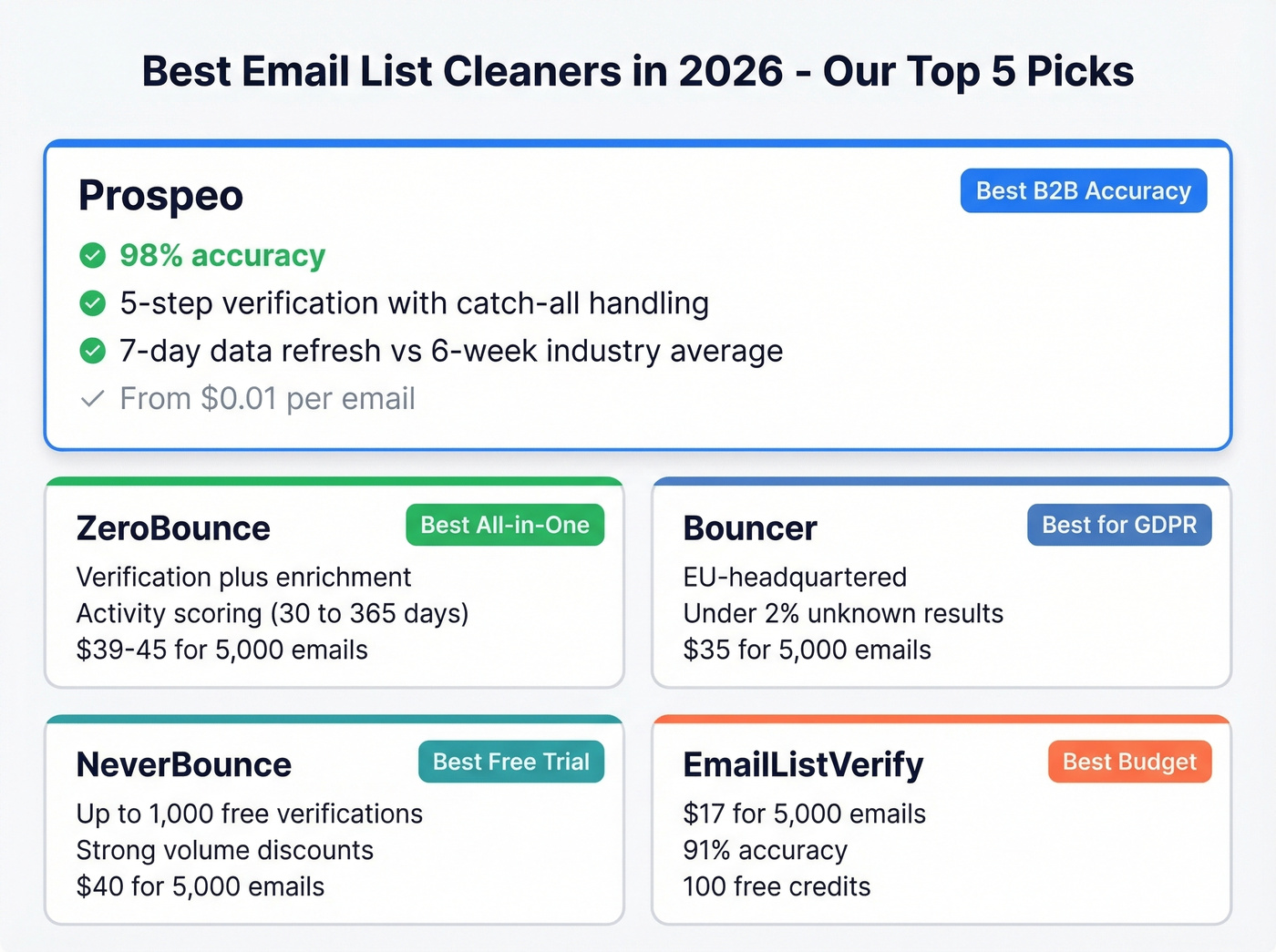
Our Picks (TL;DR)
| Use Case | Pick | Why |
|---|---|---|
| Best B2B accuracy & freshness | Prospeo | 98% email accuracy, 5-step verification with catch-all handling, 7-day data refresh |
| Best all-in-one verify + enrich | ZeroBounce | Verification plus enrichment fields and activity scoring in one platform |
| Best for EU / GDPR-first teams | Bouncer | EU-headquartered, under 2% unknown results, strong catch-all resolution |
| Best free trial | NeverBounce | Well-known, reliable verifier with strong volume discounts |
| Best budget option | EmailListVerify | $17 for 5,000 emails - hard to beat on pure cost |
What Email List Cleaning Actually Does
Every cleaner runs the same basic pipeline. The differences are in how many steps they actually complete:
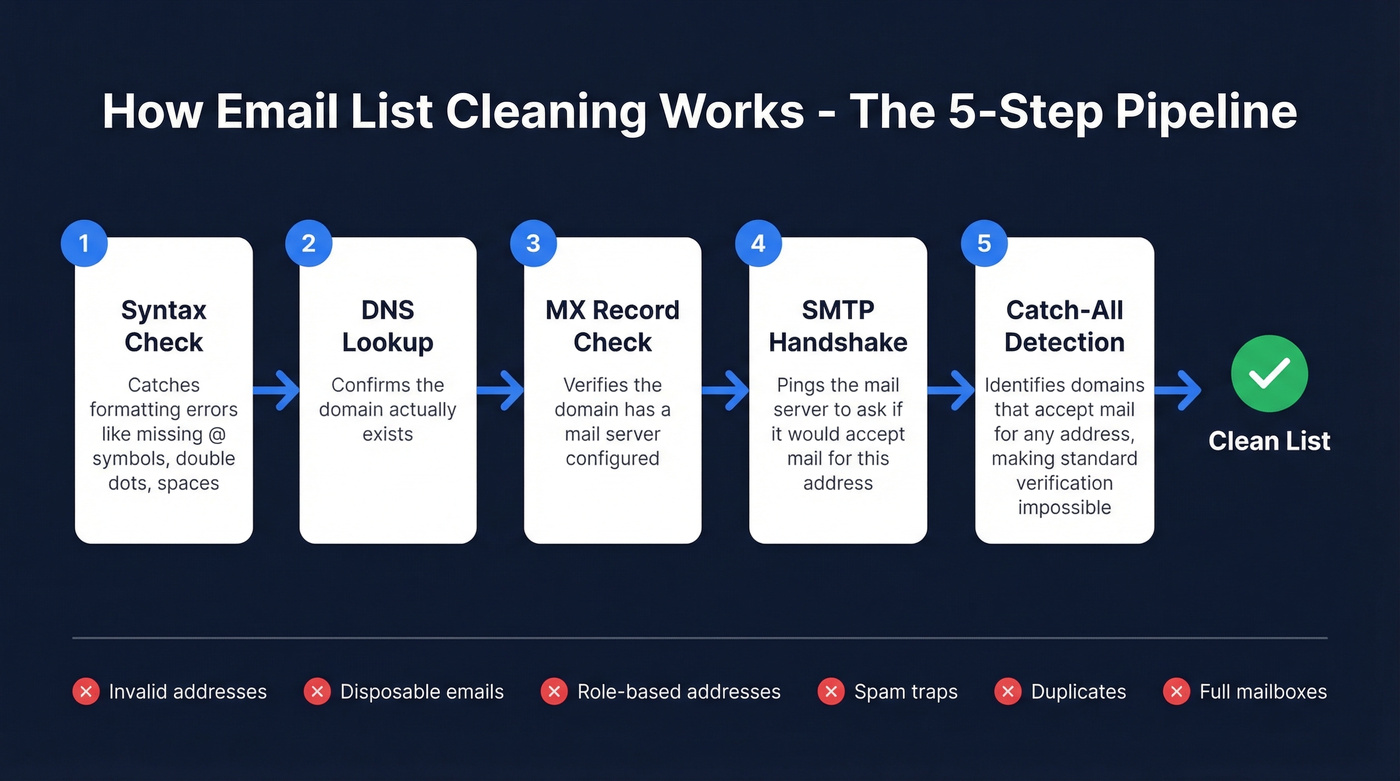
- Syntax check - catches formatting errors like missing @ symbols, double dots, and spaces
- DNS lookup - confirms the domain exists
- MX record check - verifies the domain has a mail server configured
- SMTP handshake - pings the mail server to ask "would you accept mail for this address?" without sending anything
- Catch-all detection - identifies domains that accept mail for any address, making individual verification impossible through standard methods
A good list cleaning tool flags and removes invalid or non-existent addresses, disposable emails from services like Guerrilla Mail and Mailinator, role-based addresses (info@, support@, sales@), known spam traps and honeypots, duplicate entries, and full-mailbox addresses that will hard bounce.
Hard bounces are permanent - the address doesn't exist and never will. Soft bounces (full mailbox, server temporarily down) may resolve on their own. Every cleaner should distinguish between the two, but not all do it well.
One quick note on terminology: "verification" flags each address with a status, while "cleaning" (sometimes called email scrubbing) is the broader workflow of removing bad addresses, deduplicating, and sometimes enriching what's left. Most tools do both. Don't overthink the semantics.
The 12 Best Email List Cleaning Tools
Prospeo
Most cleaning tools verify after the fact - you build a list somewhere else, export a CSV, upload it, and hope for the best. Prospeo flips that model. Its 5-step verification runs at the source, meaning emails are verified before they ever hit your CRM or sequencer. The database covers 143M+ verified emails with 98% accuracy, and data refreshes every 7 days versus the 6-week industry average.
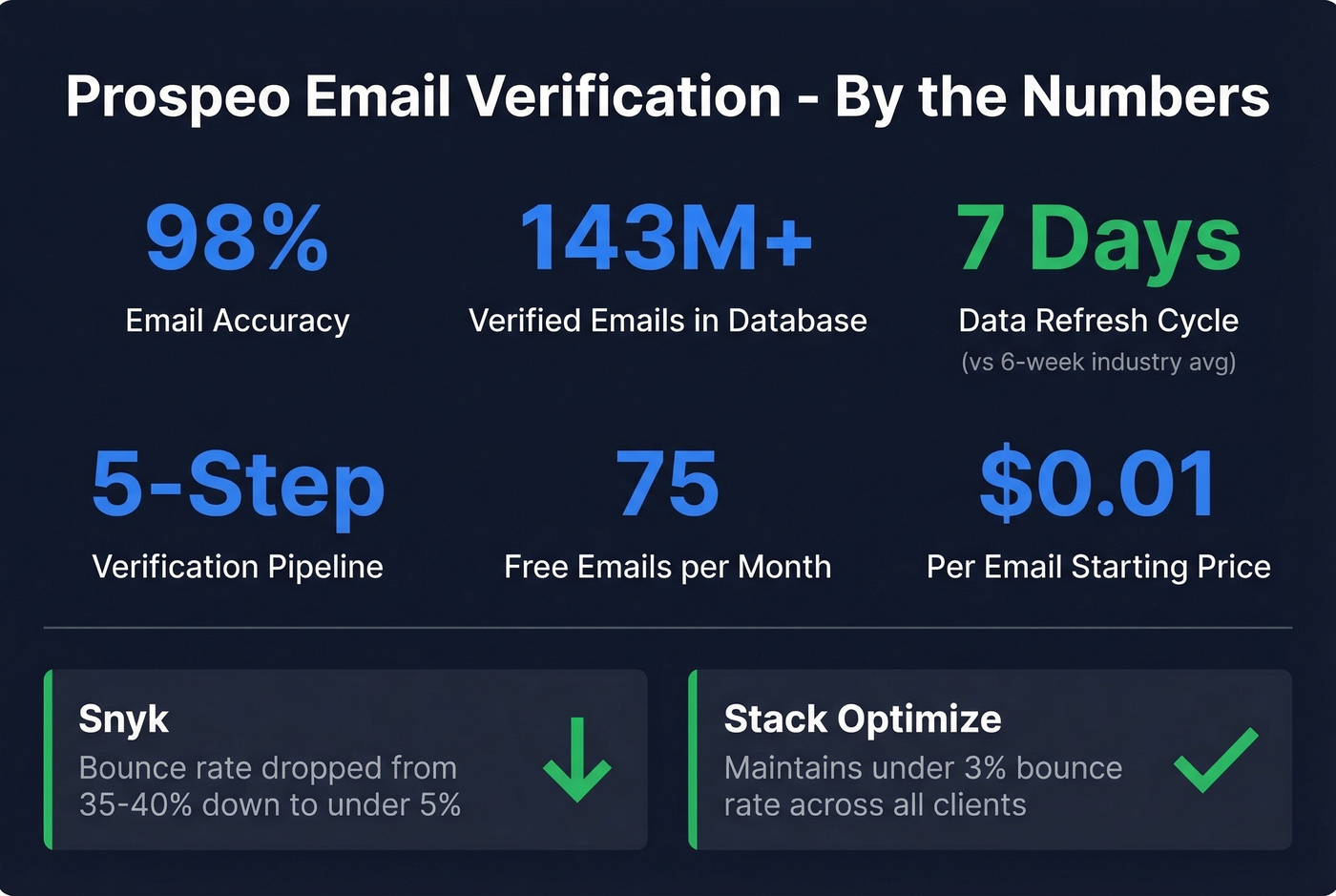
Catch-all handling is built into the verification pipeline, along with spam-trap removal and honeypot filtering. That matters because catch-all domains are where most cleaners give up and return "unknown" - Prospeo actually resolves them. The results back this up: Snyk cut bounce rates from 35-40% down to under 5%, and Stack Optimize maintains under 3% bounce across all clients.
Integrations cover the major outbound stack - HubSpot, Salesforce, Lemlist, Instantly, Smartlead, Clay, and Zapier. Pricing runs ~$50 for 5,000 emails and ~$1,000 for 100,000, with a free tier of 75 verified emails per month.
Use it if: You're a B2B team that wants clean data from the start, not a band-aid after the fact.
Skip it if: You only need a one-time bulk CSV scrub of a legacy marketing list - pair it with a budget bulk cleaner like EmailListVerify for that.
ZeroBounce
ZeroBounce is the Swiss Army knife of this category. Beyond standard verification, it bundles enrichment fields like name, gender, and location, plus activity scoring with configurable windows - 30, 60, 90, 180, or 365 days. That activity data helps you prioritize addresses that are more likely to be actively used.
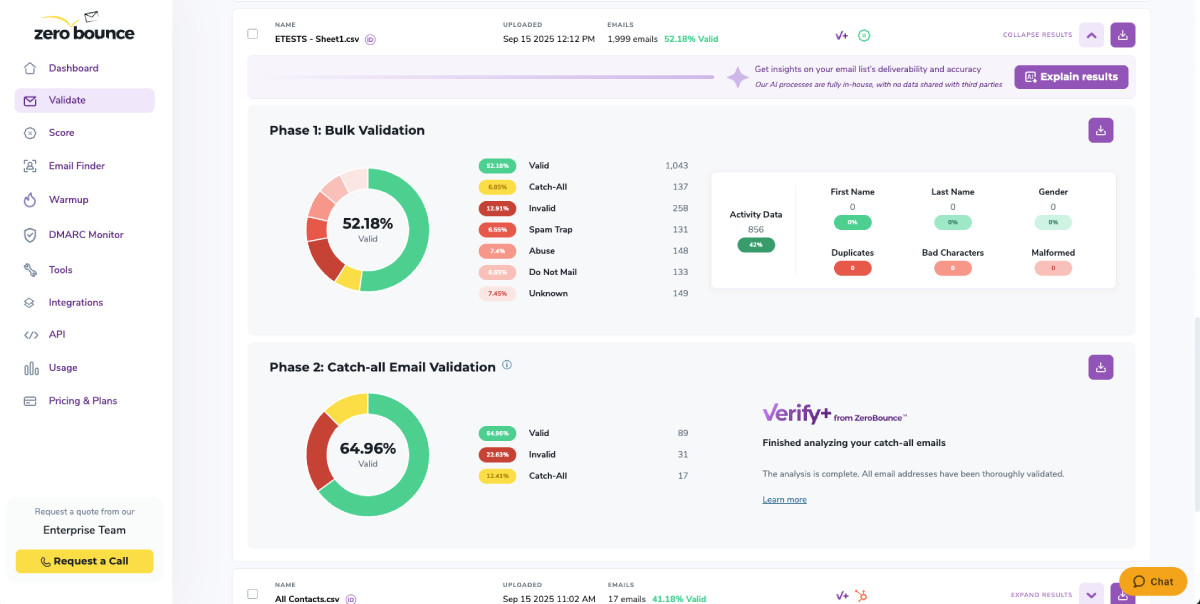
Spam trap detection is strong, and the platform handles catch-all domains reasonably well. Pricing runs $39-45 for 5,000 emails and $390 for 100,000, with 100 free verifications per month.
Use it if: You want verification plus enrichment in one tool and you'll actually use the activity scoring data.
Skip it if: You only need basic list cleaning - a budget tool does the core job at a fraction of the cost.
NeverBounce
NeverBounce is the name most people know first, partly because it's been around forever and partly because ZoomInfo acquired it. It claims 99.9% accuracy - a number we'll interrogate later - but the reliability is genuinely solid. We've rarely seen surprises with NeverBounce results.
Volume pricing drops to ~$0.003/email at scale. Standard pricing lands around $40 for 5,000 and $400 for 100,000.
Skip it if: Catch-all domains are a huge part of your list and you want the lowest possible "unknown" rate.
Use it if: You need a reliable, well-known cleaner with good volume discounts.
Bouncer
Bouncer is the pick for teams selling into Europe. EU-headquartered, GDPR-first by design, and the lowest unknown rate in the category - under 2%. That last point matters more than it sounds. When a cleaner returns 15-20% "unknown" results, you're left guessing on a huge chunk of your list. Bouncer's catch-all handling actually resolves most of those into usable verdicts.
The platform has verified 4B+ emails, claims 99.5% accuracy, and offers 100 free credits to start. Pricing is $35 for 5,000 and $400 for 100,000 - slightly above budget tools but competitive with the premium tier.
Use it if: GDPR compliance is non-negotiable and you want the fewest "unknown" results possible.
Skip it if: You're optimizing purely on cost. DeBounce and EmailListVerify are significantly cheaper for basic cleaning.
Kickbox
Kickbox is the only tool in this space that puts a deliverability guarantee in writing - if more than 5% of addresses marked "deliverable" bounce, you get credits back. They also don't charge for emails that come back as "unknown," which is a nice touch when catch-all domains inflate your unresolvable count.
The proprietary "Sendex Score" gives each email a quality signal beyond binary valid/invalid. Pricing runs $40 for 5,000 and $80 for 10,000, but scales steeply - $800 for 100,000 versus $400 at NeverBounce or Bouncer. That's a real gap at volume.
Use it if: Deliverability guarantees matter to your compliance or procurement team, and your lists are under 50k.
Skip it if: You're cleaning large lists regularly. At 100k+, Kickbox costs roughly double the competition.
Clearout
Clearout runs $21 for 3,000 credits and includes a catch-all resolver. Integrations cover major ESPs and CRMs. Kickbox's own comparison page lists Clearout at 94% accuracy - notably lower than the 99% claim on Clearout's site.
Emailable
Emailable's standout is its API - sub-300ms response times and SDKs for multiple languages make it a strong choice for developers building real-time verification into signup forms or transactional flows. List-based cleaning runs $50 for 5,000 emails with 250 free credits.
EmailListVerify
The budget pick, full stop. $17 for 5,000 emails. Accuracy sits around 91% per third-party comparisons - decent for the price, but don't expect premium-tier catch-all resolution or enrichment. The 100 free credits let you test before committing. This is a workhorse for teams that need basic hygiene without the extras.
DeBounce
DeBounce is the cheapest option on this list at $10 for 5,000 emails. Ideal for one-time bulk cleans of legacy lists where you need to strip out obvious invalids before a re-engagement campaign. Catch-all handling is basic. For recurring cleaning needs, you'll want something stronger.
MillionVerifier
MillionVerifier requires a 10,000-email minimum purchase at $37, which makes it awkward for small lists but reasonably priced for mid-volume work. Upload, process, download. No frills, no enrichment, no real-time API.
Mailfloss
Connects directly to your ESP and runs automated daily cleaning. If you're on Mailchimp, ActiveCampaign, or ConvertKit and want set-and-forget list maintenance, Mailfloss handles it without manual CSV uploads. Starts at $29/month.
ListClean
Ultra-budget at $5 for 10,000 emails - roughly $40 for 100,000. Minimal features, minimal interface. Don't expect catch-all resolution or integrations.
Proofy
Proofy runs $16 for 5,000 emails with basic verification. Functional for simple one-off cleans but doesn't differentiate enough to recommend over EmailListVerify or DeBounce.

Why clean a list when you can build a clean one? Prospeo's 5-step verification catches invalid addresses, spam traps, and honeypots before they ever reach your CRM. 143M+ emails at 98% accuracy, refreshed every 7 days.
Skip the scrub. Start with data that doesn't need cleaning.
Pricing Compared
Here's what you'll actually pay across all 12 tools at standard volume tiers:
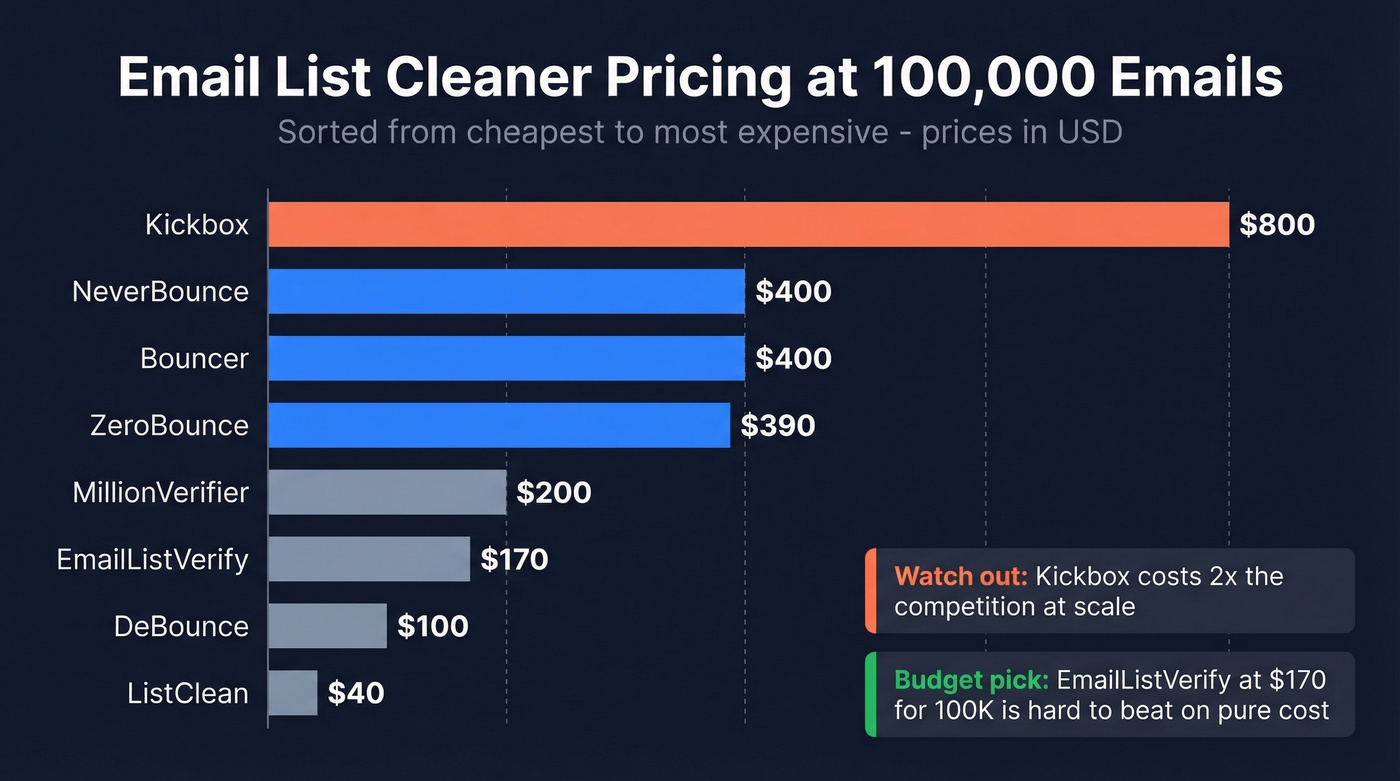
| Tool | 5,000 | 10,000 | 100,000 | Free Tier |
|---|---|---|---|---|
| ZeroBounce | $39-45 | $65 | $390 | 100/mo |
| NeverBounce | $40 | $50 | $400 | Up to 1,000 |
| Bouncer | $35 | $60 | $400 | 100 |
| Kickbox | $40 | $80 | $800 | 100 |
| Clearout | ~$35 | ~$60 | Not public | 100 |
| Emailable | $50 | ~$90 | Not public | 250 |
| EmailListVerify | $17 | ~$30 | ~$170 | 100 |
| DeBounce | $10 | ~$20 | ~$100 | 100 |
| MillionVerifier | - | $37 | ~$200 | - |
| ListClean | ~$2.50 | $5 | ~$40 | 25 |
| Proofy | $16 | ~$30 | Not public | - |
The average cost across the category runs $0.003-$0.01 per email. Cleaning a 250,000-email list costs roughly $750-$875 with NeverBounce or ZeroBounce. For context, BriteVerify charges a flat $0.01/email - the same per-email rate as Prospeo, which includes upstream data sourcing and a 7-day refresh cycle.
The biggest pricing trap is Kickbox at scale. It's competitive at 5,000 emails but doubles the cost of NeverBounce and Bouncer at 100,000. If you're cleaning large lists regularly, that gap compounds fast.
Snyk cut bounce rates from 35-40% to under 5%. Stack Optimize holds under 3% across every client. The difference? Catch-all handling, honeypot filtering, and a 7-day refresh cycle that kills list decay before it starts.
Drop your bounce rate below 5% - starting at $0.01 per email.
The Catch-All Problem
Let's be honest about something most marketing pages won't explain: catch-all domains are the single biggest source of "unknown" results, and they're everywhere in B2B.
A catch-all domain is configured to accept email for any address - sales@, jsmith@, literally-anything@. When a verification tool pings the mail server, it gets a "yes, I'll accept that" response regardless of whether the specific mailbox exists. Standard SMTP verification can't distinguish a real inbox from a black hole.

This is why some tools return 15-20% "unknown" results on B2B lists. You paid to verify emails and got back a shrug for a fifth of them. The Allegrow research team frames this well: what matters is whether a tool gives you an "actionable verdict" you can actually use to make send/don't-send decisions.
The tools that genuinely resolve catch-all addresses - Bouncer, ZeroBounce, and Clearout - use additional signals beyond the SMTP handshake. Budget tools like DeBounce, EmailListVerify, and ListClean punt on catch-all entirely. If your list is heavy on corporate domains, this distinction alone should drive your tool choice.
Nobody Can Prove 99% Accuracy
Every accuracy number you see is self-reported. Bouncer claims 99.5%. NeverBounce claims 99.9%. ZeroBounce says 96-98%. There's no independent lab running controlled head-to-head tests across these tools.
The frustration on Reddit about this is real - users on r/Emailmarketing can't find data-based comparative tests and view most listicles as incomplete. One thread put it bluntly: nobody has published a proper side-by-side benchmark. Kickbox's own comparison page lists Clearout at 94% and EmailListVerify at 91%, notably lower than the 99%+ claims on those tools' own websites. Even competitors can't agree on the numbers.
So what should you actually look for instead of a vendor's accuracy claim? A low unknown rate means the tool is doing more work on catch-all domains. A deliverability guarantee - Kickbox is the only one offering this - puts money behind the promise. Ask specifically how a tool resolves accept-all domains, and look for customer case studies with before/after bounce rates, which are harder to fake than a blanket "99% accurate" claim.
We've seen tools that claim 99% accuracy still produce 8-10% bounce rates on B2B lists heavy with catch-all domains. The accuracy number on the marketing page is decoration. The bounce rate in your ESP is the truth.
How to Choose the Right Tool
Six criteria matter more than marketing claims.
Verification methodology. How many steps does the tool run? Syntax + DNS + MX is table stakes. SMTP handshake is standard. Catch-all resolution and spam-trap detection separate the premium tools from the basics.
Catch-all handling. Does the tool return a binary valid/invalid verdict, or does it punt with "unknown"? For B2B lists, this is the single most important differentiator. A tool that returns 20% unknowns is leaving money on the table.
Integrations. Does it connect to your ESP, CRM, or sequencing tool? Manual CSV upload works for one-off cleans, but ongoing email hygiene requires native connections. Check for your specific stack - HubSpot, Salesforce, Mailchimp, Outreach, whatever you're running.
Pricing model. Pay-as-you-go credits, monthly subscriptions, or volume tiers? PAYG works for occasional cleaning. Subscriptions make sense for ongoing hygiene. Make sure you understand what counts as a "credit" - some tools charge per verification attempt, others only for results.
Data handling and privacy. Does the tool upload your list to their servers, or process locally? Some tools offer browser-based processing where data never leaves your machine. For teams handling sensitive contact data under GDPR, Bouncer's EU hosting is a real advantage.
Deliverability guarantee. Does the vendor back their results financially? Kickbox's 95% guarantee is the only formal one in the space. Everyone else asks you to trust their sender reputation claims.
How Often to Clean Your List
Twilio recommends keeping bounce rates under 0.5% and suggests cleaning every six months as a baseline. That's too conservative for most teams. Lists decay 28% annually - quarterly cleaning is the real minimum, and monthly is better for lists over 100,000.
Gmail flags senders with spam complaint rates above 0.3%. Microsoft is even stricter with its inbox placement, letting only about 76% of emails through compared to Gmail's 87%. Your sender reputation degrades silently, then collapses all at once.
For transactional or real-time sends like signup confirmations, API-based verification at the point of entry is the only approach that makes sense. Automated daily cleaning through tools like Mailfloss works for marketing lists that grow continuously. Some teams are also exploring AI-powered scrubbing tools that use machine learning to predict which addresses are likely to go stale before they actually bounce, though the category is still maturing.
The contrarian angle worth considering: if your source data is already 98% accurate with a weekly refresh cycle, cleaning becomes a formality rather than a rescue mission. The best strategy isn't better cleaning software - it's better data upstream.
FAQ
What's the difference between email verification and email list cleaning?
Verification checks whether a specific email address is deliverable. Cleaning is the broader process: removing invalids, deduplicating, stripping role-based addresses, flagging spam traps, and purging disposable emails. Most tools handle both, and the terms are used interchangeably in practice.
Can I clean my email list for free?
Most tools offer small free tiers - 75 to 1,000 credits depending on the provider. NeverBounce offers up to 1,000 free credits, while Prospeo provides 75 verified emails per month and EmailListVerify gives 100 free credits. For lists under 1,000 contacts, a free tier works fine. Anything larger costs $0.003-$0.01 per email.
How long does bulk cleaning take?
Most tools process 10,000-50,000 emails in under 30 minutes. Lists over 100,000 can take 1-2 hours. Real-time API verification runs in milliseconds per email, making it suitable for point-of-entry validation on signup forms.
What's a good bounce rate after cleaning?
Under 0.5% is the target. If you're currently above 2%, clean your list before sending another campaign - your sender reputation is actively degrading. Tools with strong catch-all resolution typically get you closer to that 0.5% threshold.
Why did my cleaner return so many "unknown" results?
Almost certainly catch-all domains. These accept email for any address, so standard SMTP checks can't confirm whether a specific mailbox exists. Tools with advanced catch-all resolution - like Bouncer, ZeroBounce, and Prospeo - return significantly fewer unknowns by using additional verification signals beyond the basic handshake.