

Email List Verification Free: What Actually Works in 2026
You exported 3,000 contacts from your last event, loaded them into your sequencer, and watched 8% bounce. Your ESP sent a warning. One more campaign like that and you're staring at a throttled sending domain - or a blacklist.
The rule is simple: keep total bounces under 2%, hard bounces below 1%. Email lists decay 25%+ per year thanks to job changes, domain closures, and abandoned inboxes. Free verification tools can help, but most free tiers are smaller than you'd expect, and the accuracy gap between tools is wider than any of them admit on their marketing pages.
Quick Recommendations
Cleaning a small list right now? Bouncer gives you 1,000 free credits - one of the most generous one-time free tiers. Upload your CSV, get results in minutes, move on.
Need ongoing monthly hygiene? ZeroBounce offers 100 free verifications per month on a recurring basis. Good for regulated industries that need a paper trail.
Building prospect lists from scratch? Prospeo finds and verifies emails in one step - 98% accuracy, 75 free emails per month. You skip the two-tool workflow entirely.
How Email Verification Actually Works
Every tool markets "30+ verification checks," but the core process is the same five steps. Understanding them helps you spot which tools are doing something genuinely different versus repackaging the basics.
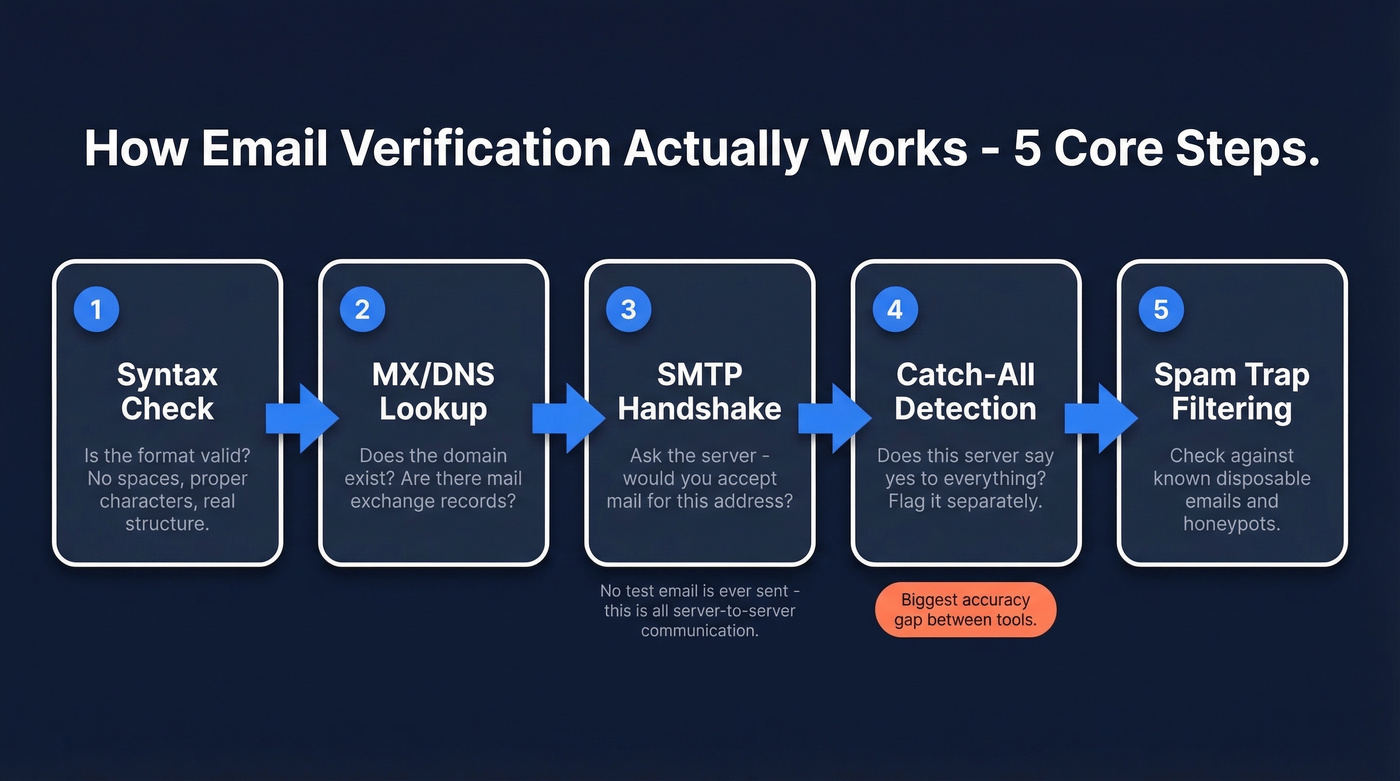
Step 1: Syntax check. Is the email formatted correctly? No spaces, valid characters, proper domain structure. This catches typos and garbage entries.
Step 2: MX/DNS lookup. Does the domain exist? Does it have mail exchange records pointing to a real mail server? Dead domain means dead email.
Step 3: SMTP handshake. The tool connects to the mail server and asks "would you accept a message for this address?" without actually sending one. The server's response determines the verdict.
Step 4: Catch-all detection. Some domains accept mail for any address, real or fake. These "catch-all" servers make verification unreliable because they say "yes" to everything. Good tools flag these separately instead of marking them valid.
Step 5: Disposable and spam-trap filtering. The tool checks against databases of known throwaway email services and suspected spam traps. Sending to either tanks your reputation fast.
No test email is ever sent during this process. The entire verification happens through server-to-server communication. The real difference between tools comes down to how well they handle step 4 and how current their spam-trap databases are.
Best Free Email Verification Tools (2026)
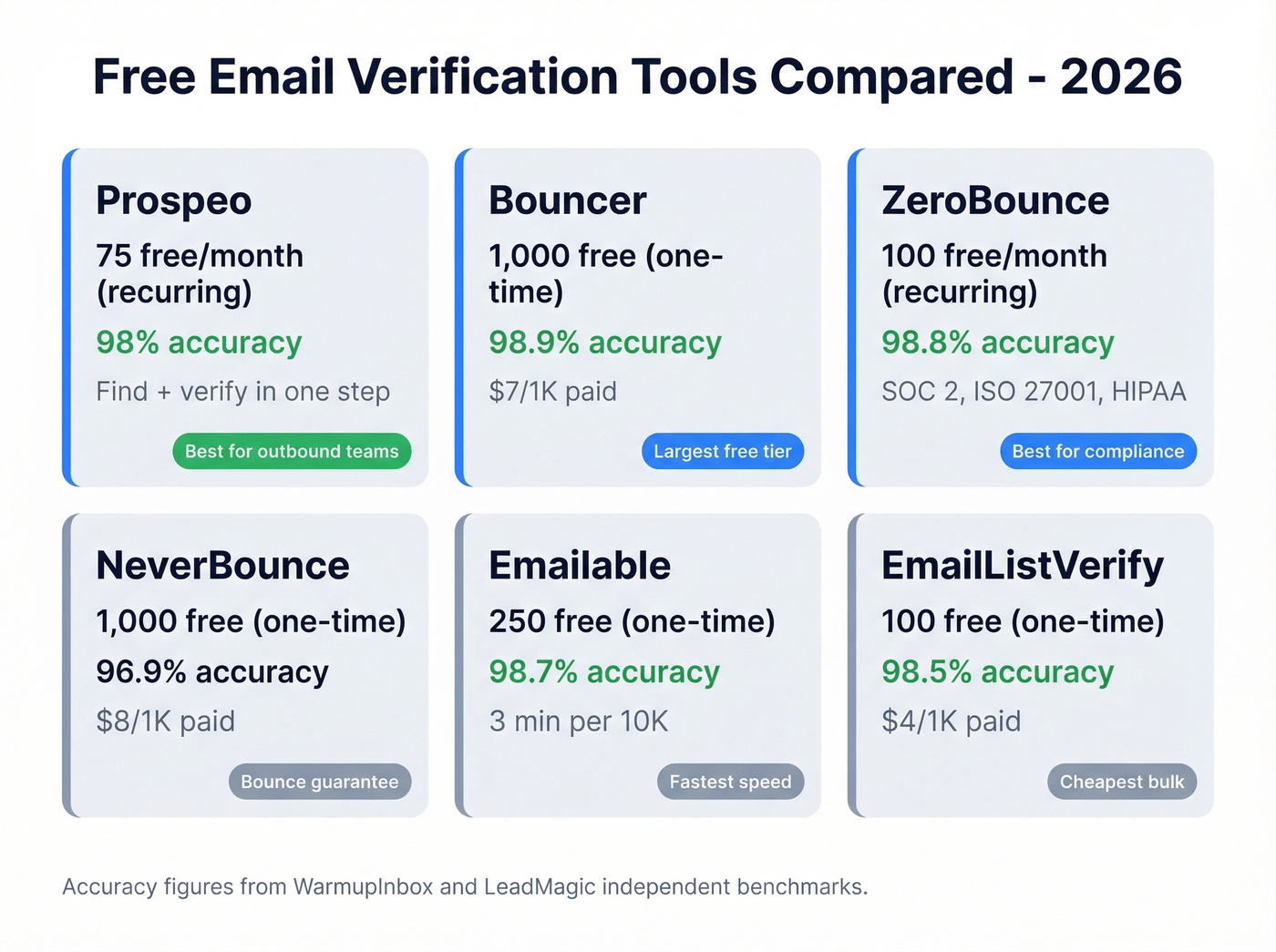
| Tool | Free Credits | Cost/1K (Paid) | Speed (10K) | Accuracy | Best For |
|---|---|---|---|---|---|
| Prospeo | 75/mo | ~$0.01/email | - | 98% | Find + verify in one step |
| Bouncer | 1,000 (once) | $7 | ~7 min | 98.9% | Largest one-time free tier |
| ZeroBounce | 100/mo | ~$9-10 | ~10 min | 98.8% | Compliance teams |
| NeverBounce | 1,000 (once) | $8 | ~18 min | 96.9% | Bounce guarantee |
| Emailable | 250 | ~$6 | ~3 min | 98.7% | Fastest processing |
| EmailListVerify | 100 | ~$4 | ~12 min | 98.5% | Budget bulk |
| Hunter | 100/mo | ~$24.50 | ~11 min | 96.4% | B2B prospecting |
| Verifalia | ~25/day | ~$7.90 | N/A | N/A | Daily drip |
| MillionVerifier | No free tier | ~$0.30 | ~35 min | 95.8% | Cheapest bulk |
| Mailmeteor | 50/mo | N/A | N/A | N/A | Google Sheets |
Prospeo - Find and Verify in One Step
Most free verification tools assume you already have a list. Prospeo takes a different approach: it finds emails and verifies them simultaneously using a proprietary 5-step verification pipeline that includes catch-all handling, spam-trap removal, and honeypot filtering. The 75 free emails per month come pre-verified at 98% accuracy, and you don't pay for invalid results, which eliminates the two-tool workflow where you find emails with one service and clean them with another.
Real-world results back this up. Snyk cut bounce rates from 35-40% to under 5% after switching, and Stack Optimize maintains 94%+ deliverability across all clients with bounce rates under 3%. For outbound teams where every bounced email risks domain reputation, starting with pre-verified data beats cleaning bad data after the fact.
Bouncer - Largest Free Tier
Bouncer's 1,000 free credits make it the obvious starting point if you've never verified a list before. Upload a CSV, get results in about 7 minutes for 10K contacts based on WarmupInbox's benchmark testing, and move on.
On accuracy, benchmarks vary depending on how they treat "unknown" results. WarmupInbox shows 98.9% observed accuracy. In LeadMagic's 10,000-email test, Bouncer resolved 15% of catch-all results - solid but not perfect.
Paid tier runs $7 per 1,000 emails. The catch: those 1,000 credits are a one-time starter pool. Once they're gone, you're on paid. But for a first-pass clean of a small list before a campaign launch, Bouncer is hard to beat.
ZeroBounce - Recurring Free Credits
ZeroBounce's free tier is smaller at 100/month, but it recurs - fresh credits every month without paying. For teams verifying a trickle of new contacts on an ongoing basis, that recurring model matters more than a one-time dump.
The compliance story is where ZeroBounce separates itself: SOC 2 Type 2, ISO 27001, HIPAA, GDPR/CCPA. Uploaded data can't be viewed by the ZeroBounce team, and results expire after 30 days. If you need a free email checker that meets enterprise security requirements, ZeroBounce is the clear choice. Paid plans start at $18 for 2,000 credits monthly. In LeadMagic's 10,000-email test, ZeroBounce hit 97.8% accuracy with 0.9% false positives and 1.3% false negatives.
NeverBounce - Financial Guarantee
NeverBounce gives you 1,000 free credits to start and a unique selling point: if your bounce rate exceeds 3% on a paid plan, they refund the difference. That's a real financial backstop that no other tool on this list offers.
Paid pricing sits at $8/1K on pay-as-you-go, or $49/month for up to 10,000 verifications on the Growth plan. Credits expire 12 months after purchase. In LeadMagic's benchmark, NeverBounce scored 96.9% accuracy with 8% catch-all resolution and processed 10K contacts in about 18 minutes.
Emailable - Fastest Processing
If speed matters more than anything else, Emailable processes 10K contacts in roughly 3 minutes. You get 250 free credits, 98.7% observed accuracy, and paid plans at ~$6/1K. It does one thing well and doesn't overcomplicate it.
EmailListVerify - Budget Bulk
The budget option. 100 free credits, ~$4 per 1,000 on paid plans - one of the cheapest in the market. Observed accuracy of 98.5% and about 12 minutes for a 10K list. If you're cleaning a massive list and cost matters more than speed, EmailListVerify earns its spot.
Hunter, Verifalia, MillionVerifier, Mailmeteor
Hunter gives you 100 verifications per month free, and single checks don't require signup. Accuracy scored 96.4% in WarmupInbox's test. At ~$24.50 effective cost per 1K verifications on unified credits, it's expensive for pure verification - better as a B2B prospecting suite where verification is a side feature.
Verifalia offers about 25 free credits per day that don't roll over. Good for teams verifying a handful of emails daily, but impractical for batch cleaning.
MillionVerifier is the cheapest bulk option at ~$0.30 per 1,000 emails, though there's no free tier. The tradeoff: 95.8% accuracy, only 5% catch-all resolution, and roughly 35 minutes for 10K contacts. For a 100K-contact marketing list where you can tolerate slightly higher bounce rates, the math works. For outbound sales where every bounce hurts your domain, spend more per verification.
Mailmeteor offers 50 free verifications per month through a Google Sheets add-on. Convenient for spot-checking individual emails, not built for bulk work.
What the Benchmarks Actually Show
Here's the thing the product pages won't tell you: every verification tool claims 97-99% accuracy, and under strict testing conditions, none of them hit those numbers. The self-reported figures are marketing, not data.
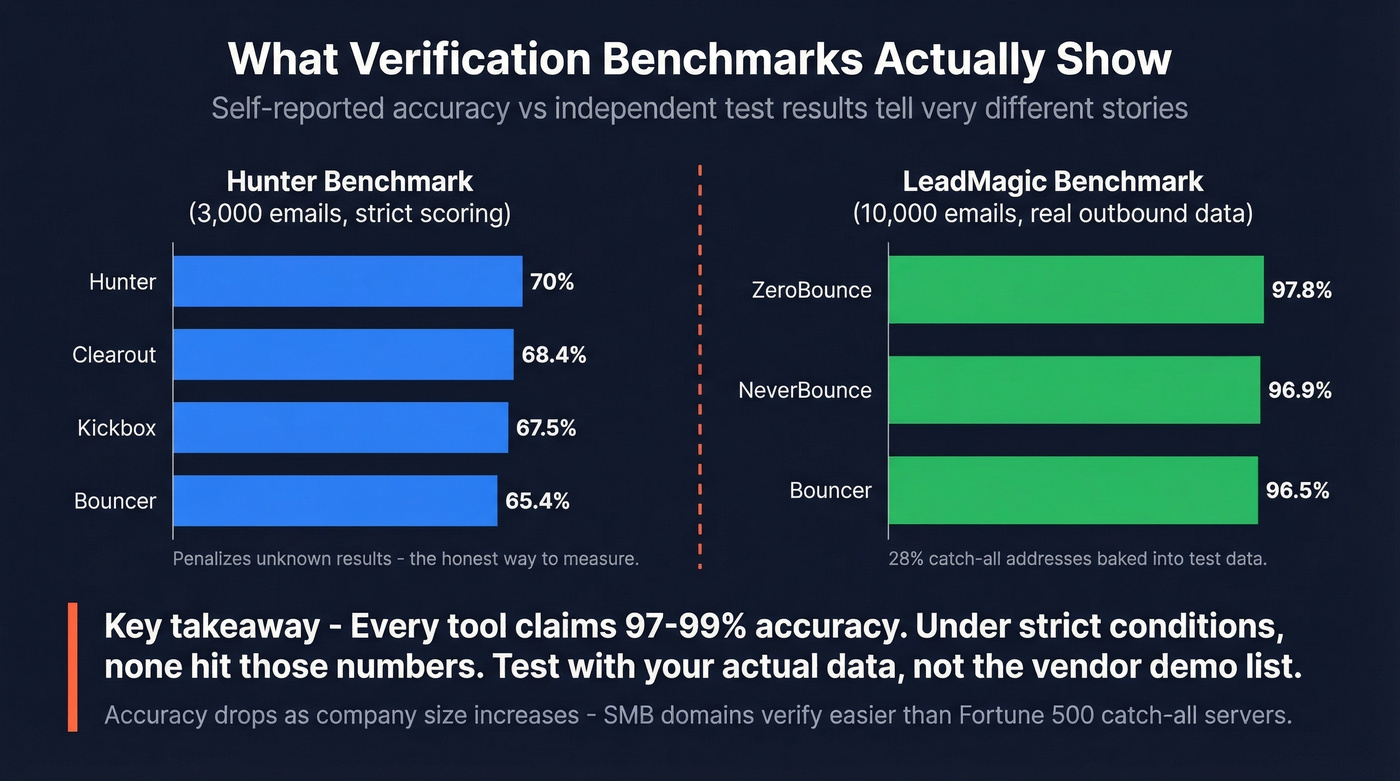
Hunter's 2026 benchmark ran 15 verifiers against 3,000 real business emails segmented by company size, using Clay to standardize conditions. The top scores? 65-70% overall accuracy. Hunter scored 70%, Clearout 68.4%, Kickbox 67.5%, Bouncer 65.4%. These numbers look low because they penalize "unknown" results - which is actually the honest way to measure. When a tool says "I don't know," that's not a failure, but it's not a success either.
LeadMagic's 10,000-email test used real outbound B2B data with 28% catch-all addresses baked in. ZeroBounce hit 97.8%, NeverBounce 96.9%, Bouncer 96.5%. The gap between tools widens on mid-market and enterprise domains where server configurations are stricter and catch-all rates climb.
In our experience running outbound campaigns, accuracy drops as company size increases. A tool that nails verification on SMB domains will struggle with Fortune 500 catch-all servers. Test with your actual data, not the vendor's demo list.

Why verify a list you built with bad data? Prospeo's proprietary 5-step verification - catch-all handling, spam-trap removal, honeypot filtering - is baked into every email it finds. 98% accuracy at $0.01/email. 75 free emails per month, no credit card required.
Skip the two-tool workflow. Find and verify in one step.
The Catch-All Problem
Roughly 28-30% of a typical B2B email list returns "catch-all" status. These are domains configured to accept all incoming email regardless of whether the specific mailbox exists. Your verification tool can't tell if john.smith@company.com is real or if the server just says "sure, send it" to everything.
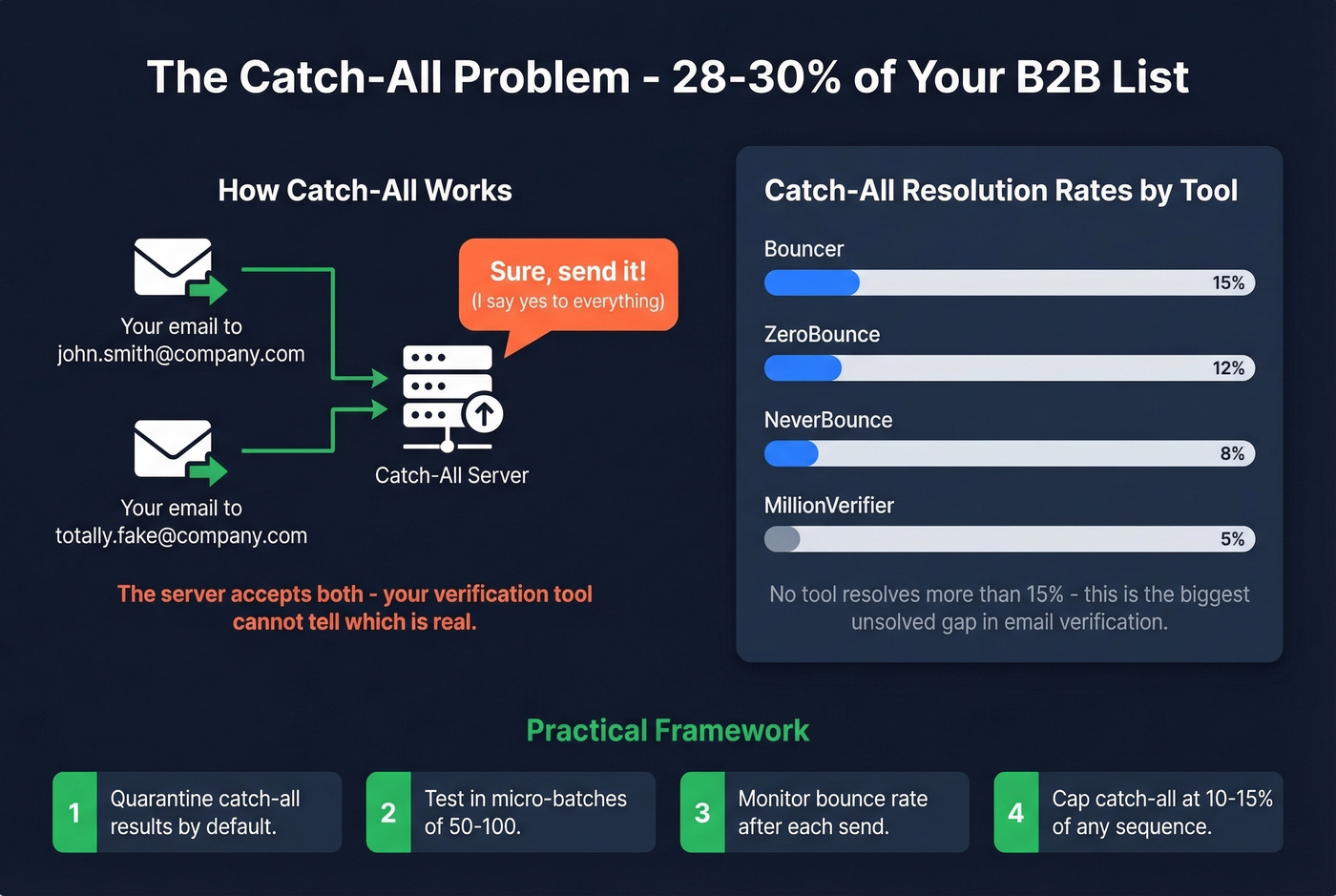
This is the single biggest gap in email validation, and no tool has fully solved it. ZeroBounce resolves about 12% of catch-alls, Bouncer 15%, NeverBounce 8%, MillionVerifier just 5%.
Here's the practical framework we use. Quarantine catch-all results by default. Don't send to them in bulk. Test in micro-batches of 50-100, monitor your email bounce rate after each send, and cap catch-all addresses at 10-15% of any sending sequence. If bounces spike, pull the rest immediately.
Five Mistakes That Waste Credits
1. Treating verification as a one-time event. Lists decay 25%+ per year. Average professional job turnover runs around 41%. That "clean" list from January is already degrading by April.
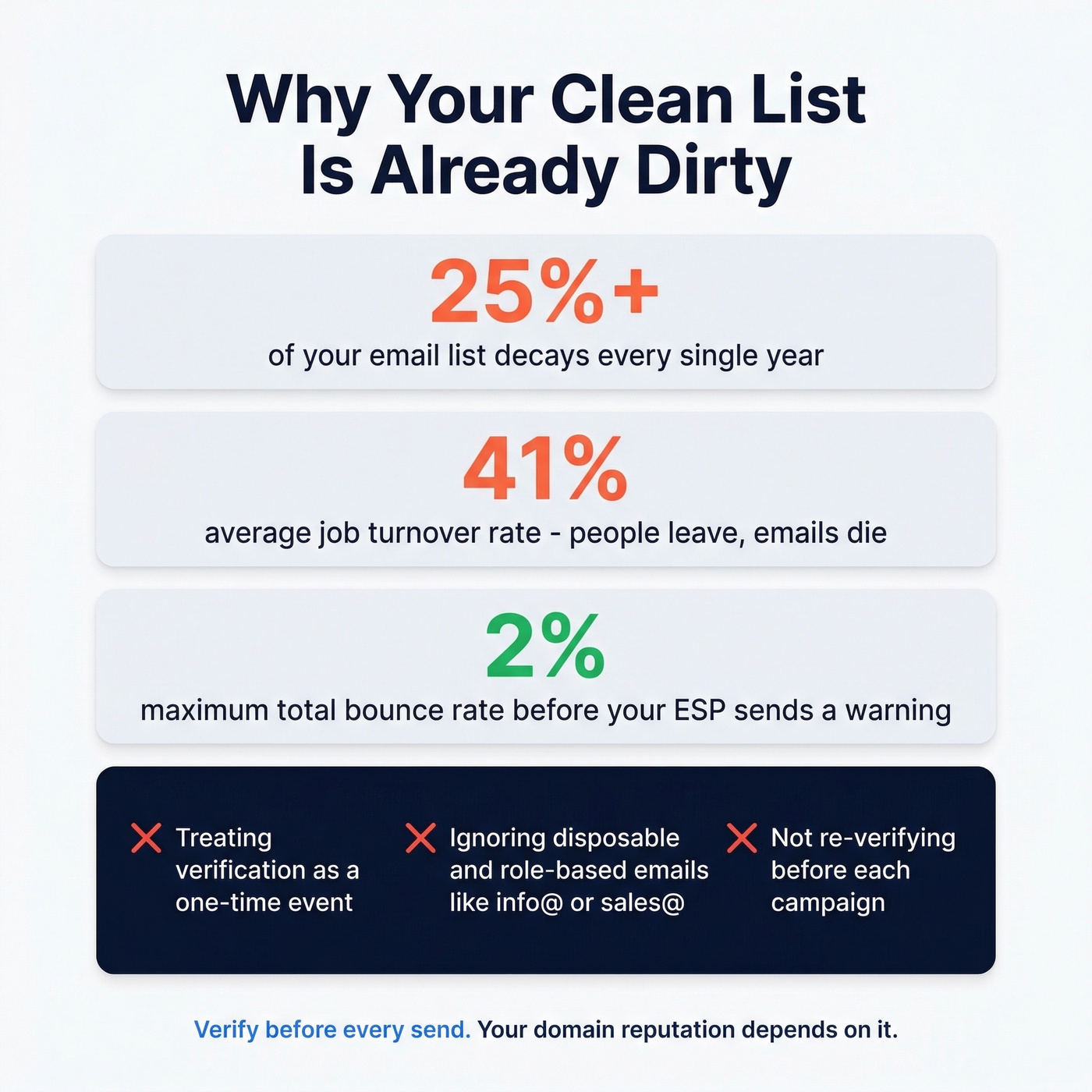
2. Ignoring disposable and role-based emails. Addresses like info@, sales@, and anything from Mailinator or Guerrilla Mail will either bounce or land in a black hole. Filter them out before they eat your credits.
3. Not re-verifying before each campaign. An email that was valid three months ago isn't necessarily valid today. Re-verify any list that's been sitting idle, especially if it's older than 90 days.
4. Skipping real-time validation at capture points. Your web forms, event registrations, and lead magnets should validate emails on entry - not after they've already polluted your database. Most verification tools offer real-time API validation for this.
5. Verifying bad source data instead of starting with quality data. We've seen teams burn through their entire free tier on garbage data from purchased lists, only to confirm what they already suspected: half the emails are junk. If your source data is bad, no amount of verification fixes the underlying problem - you need better data to begin with.
Snyk dropped bounce rates from 35-40% to under 5%. Stack Optimize holds 94%+ deliverability across every client. The difference? Starting with pre-verified data instead of cleaning dirty lists after the fact. Prospeo refreshes all records every 7 days - not the 6-week industry average.
Your domain reputation is too valuable for stale data. Start with clean contacts.
Bounce-Rate Targets by Industry
Not every industry has the same baseline. Here's what "good" looks like according to ActiveCampaign's benchmark data:
| Industry | Avg. Bounce Rate |
|---|---|
| Beauty & Personal Care | 0.33% |
| Agriculture & Food Services | 0.50% |
| Business & Finance | 0.55% |
| Consulting | 0.79% |
| Creative Services | 0.93% |
| Construction | 1.28% |
If you're above your industry average, verification isn't optional - it's urgent. If you're below it, keep verifying anyway. Lists don't stay clean on their own.
How to Verify an Email List Free (Step by Step)
Let's walk through the workflow that maximizes your free credits:
- Export your list as a CSV with a single column of email addresses.
- Remove obvious duplicates and role-based addresses (info@, support@) before uploading - don't waste credits on emails you'd filter out anyway.
- Upload to a free email verifier like Bouncer (1,000 credits) or ZeroBounce (100/month).
- Download results and segment into three buckets: valid, invalid, and catch-all/unknown.
- Delete invalid addresses immediately. Quarantine catch-alls for micro-batch testing.
This process takes under 15 minutes for most lists and costs nothing. Skip it if your list is under 50 contacts - at that scale, just eyeball the domains and remove anything obviously dead.
FAQ
Is free email list verification accurate enough?
For small batches, yes - top tools score in the mid-to-high 90s on standard test lists. Under stricter scoring that penalizes "unknown" results, overall accuracy lands closer to 65-70%. The limitation is volume, not quality: most free tiers cap at 25-250 credits per day, which won't cover serious outbound operations.
How often should I verify my email list?
Re-verify every 90 days at minimum. Lists decay 25%+ annually due to job changes and domain closures. Add real-time API validation at every capture point - forms, imports, event registrations - so invalid addresses never enter your database in the first place.
What should I do with catch-all results?
Quarantine them. Never send to catch-all emails in bulk. Test in micro-batches of 50-100, monitor bounces after each send, and cap catch-all addresses at 10-15% of any sequence. If bounces climb past 2%, pull the remaining catch-alls immediately.
Can I verify a large list for free?
Not realistically. The most generous one-time free tier is Bouncer's 1,000 credits. For lists over 1,000, you'll need a paid plan - or use a find-and-verify approach that delivers pre-verified emails from the start, eliminating the separate verification step entirely.
What's the difference between email finding and email verification?
Email finding discovers addresses for a person or company. Verification checks whether an existing address is deliverable. Most tools do one or the other. A few platforms combine both - finding and verifying in a single step - so outbound teams don't need a separate cleaning tool.