

Best Email Locator Tools in 2026: Ranked by What Actually Matters
Last quarter, a RevOps lead we know uploaded 2,000 contacts from a "verified" database into a cold email sequence. Bounce rate hit 4.2% by day three. The sending domain took reputation damage that took weeks to repair, and the email locator that sourced those contacts was one of the big names everyone recommends.
Most "best email finder" lists rank 15 tools alphabetically and call it a day. No opinions, no accuracy data, no pricing math. We ranked the top tools by the three things that actually determine whether they'll help or hurt your outbound: accuracy verified by real sending data, pricing transparency, and data freshness.
Our Top Picks
| Pick | Tool | Why | Starting Price | Free Tier |
|---|---|---|---|---|
| Best overall | Prospeo | 98% email accuracy, 7-day refresh, ~$0.01/email | ~$39/mo | 75 emails/mo |
| Best for international | Snov.io | Strong non-US coverage, built-in sequences | $29.25/mo | Trial credits |
| Best for verification | Hunter | Industry-standard verify layer, clean UI | $49/mo ($34 annual) | 50 credits/mo |
| Best free tier | Prospeo / Skrapp | Prospeo: 75 emails/mo; Skrapp: 100 credits/mo | Free / $30/mo | Yes / Yes |
Prospeo takes the top spot because 98% email accuracy at a penny per email is hard to argue with - especially when the data refreshes every seven days instead of the six-week industry norm.
What the Accuracy Data Shows
Every email address finder claims 95%+ accuracy. The Dropcontact benchmark is one of the few tests that cuts through the marketing. They tested 15 tools on 20,000 real contacts - 9,800 US, 9,700 Europe, and 500 from the rest of the world - and measured results by actually sending emails, not running simulated checks. Inputs were only first name, last name, and company name.
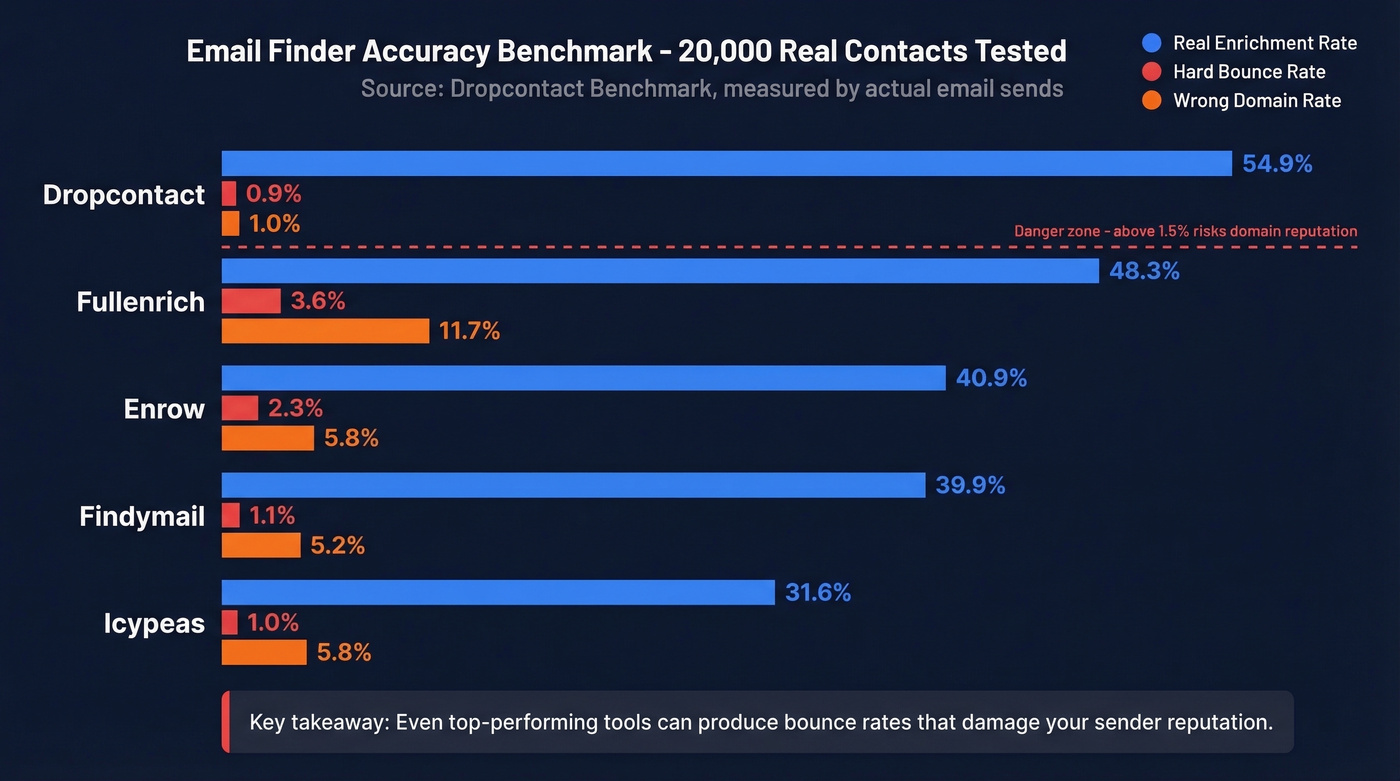
The results are sobering:
| Tool | Real Enrichment Rate | Hard Bounce Rate | Wrong Domain Rate |
|---|---|---|---|
| Dropcontact | 54.9% | 0.9% | 1.0% |
| Fullenrich | 48.3% | 3.6% | 11.7% |
| Enrow | 40.9% | 2.3% | 5.8% |
| Findymail | 39.9% | 1.1% | 5.2% |
| Icypeas | 31.6% | 1.0% | 5.8% |
A "top-performing" tool like Fullenrich still produced a 3.6% hard bounce rate. Practitioner consensus on r/coldemail treats anything above 1.5% as a red flag - and that benchmark used real sending methodology, not the synthetic checks most vendors use to inflate their numbers.
Prospeo wasn't included in this specific benchmark, but production results tell the story. Meritt dropped bounce rates from 35% to under 4%. Stack Optimize runs under 3% across all clients. Snyk cut bounce rates from 35-40% to under 5%. That's what a proprietary 5-step verification pipeline delivers versus tools relying on third-party email providers.
Here's the thing: the gap between "claimed accuracy" and "actual bounce rate in production" is where domain reputations go to die.
Hot take: If your average deal size is under $10K, you probably don't need a $15K/year data platform. A focused email locator with high accuracy and a $39/month price tag will outperform an enterprise suite you'll use 20% of.
How Email Locators Work
An email locator takes a name and a company and returns a verified work email address. Whether you're looking up addresses for a 50-person target account list or enriching thousands of leads for an outbound campaign, the execution ranges from single-step verified results to unverified guesses that torch your sender reputation.

The distinction between finding and verifying matters more than most people realize. A finder discovers the address. A verifier confirms it's deliverable. These are two different jobs, and many tools only do one well.
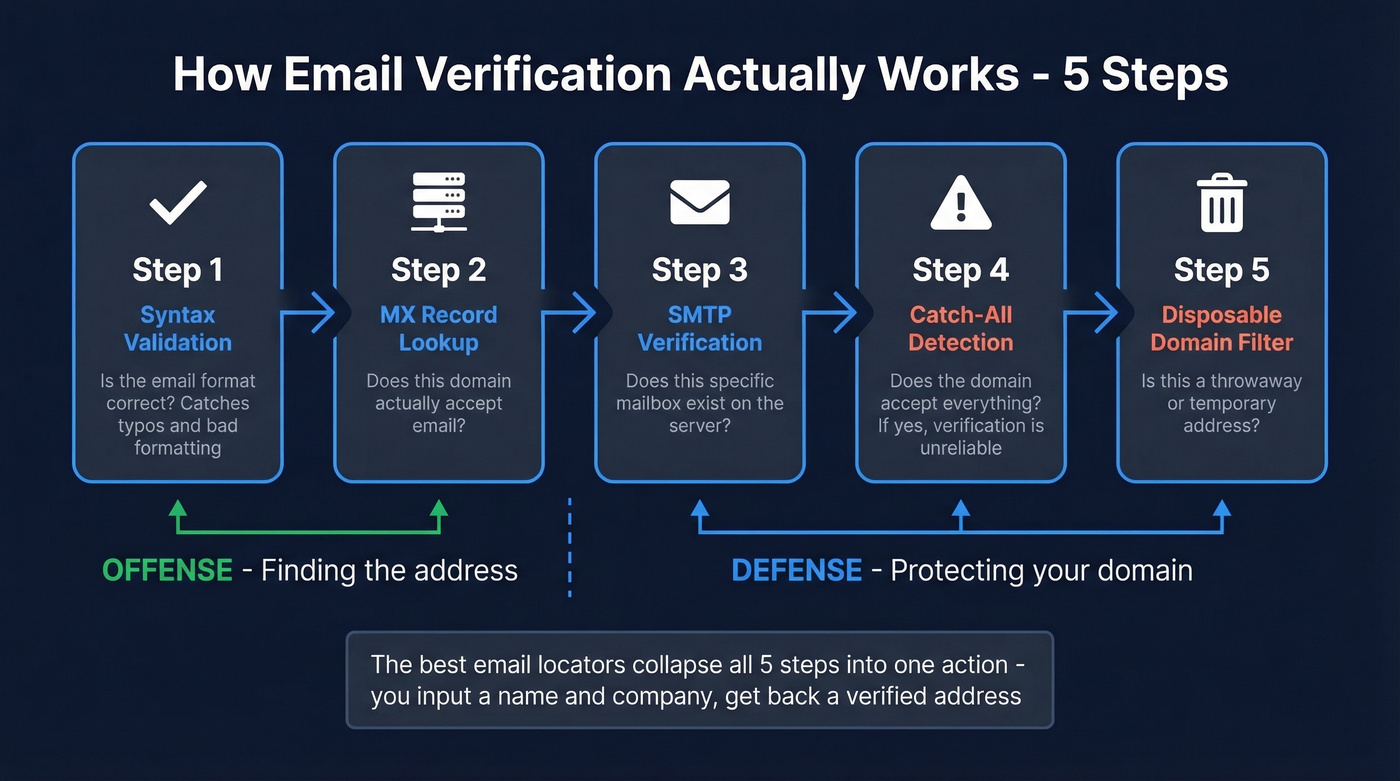
Verification runs five checks:
- Syntax validation - is the format correct?
- MX record lookup - does the domain accept email?
- SMTP verification - does the mailbox exist?
- Catch-all detection - does the domain accept everything, making verification unreliable?
- Disposable domain filtering - is this a throwaway address?
Think of the finder as offense - it gets you the address. The verifier is defense - it keeps your domain reputation intact. The best tools collapse both into a single step: you input a name and company, get back an address that's already been verified through the full pipeline. That's what you should optimize for, because running a separate verification tool on every list adds cost, time, and friction that compounds fast at scale.
Top Email Locator Tools, Ranked
Prospeo - Best Overall
Use this if you care about data quality above everything else and want finding plus verification in one step. The 7-day data refresh cycle means you're not emailing people who changed jobs six weeks ago. 300M+ profiles, 143M+ verified emails, and 125M+ verified mobiles - all running through a proprietary 5-step verification pipeline that handles spam traps, and honeypots.

The Chrome extension has 40,000+ users and works on company websites and professional profiles. Search filters go 30+ deep, including buyer intent signals powered by Bombora across 15,000 topics, technographics, job changes, and headcount growth. The API returns a 92% match rate, which is exactly what you want for enrichment workflows.
Pricing is the real differentiator: roughly $0.01 per email, with a free tier of 75 emails and 100 Chrome extension credits per month. No contracts, no sales calls, self-serve onboarding. Teams like Meritt report bounce rates dropping from 35% to under 4%, with pipeline tripling from $100K to $300K per week.
Skip this if you need a full-stack sending platform with built-in sequences - pair with Instantly or Smartlead for that.
Snov.io - Best for International
Use this if you're prospecting outside the US and want email finding, verification, and outreach sequences in one platform. The Reddit consensus is clear: Snov.io is "good for international leads" with "affordable credits" and "automation built in."
Starter runs $29.25/mo billed annually with 1,000 credits and 5,000 recipients. Pro jumps to $74.25/mo for 5,000 credits and 25,000 recipients. Credits and recipients are different billing units - credits get spent on searches and verification, while recipients get charged once on first contact. Follow-ups in the same billing period are free. The LinkedIn automation add-on costs $69/mo per slot, which adds up fast for multi-channel sequences. Unlimited team seats on all plans is a nice touch.
Skip this if you need the deepest US-only database or the credits-vs-recipients distinction sounds like it'll create billing surprises.
Hunter - Best for Verification
Hunter's brand trust is earned - it's been the go-to domain search tool for years. But it's better as a verification layer than a primary discovery tool for building prospect lists. Reddit's take mirrors our experience: "solid verification accuracy but database is pretty small."

The free tier gives you 50 credits/mo, enough to test. Starter is $49/mo ($34/mo annual) for 2,000 credits, Growth is $149/mo for 10,000 credits, and Scale hits $299/mo for 25,000 credits. All plans include unlimited users.
Skip this if you need a large discovery database. Hunter excels at verification and domain search, not building prospect lists from scratch.
Skrapp - Fair Credits, Honest Data
Most tools charge you whether the result is valid or not. Skrapp's Fair Credit Policy flips that: no charge for invalid or unknown results, no duplicate charges, and credits roll over even after cancellation. You only pay when Skrapp returns a valid or catch-all email.
Free tier gives you 100 credits/mo. Professional is $30/mo for 1,000 credits. Enterprise scales to $262/mo for 50,000 credits with API access and a dedicated account manager. The database isn't massive, but the credit mechanics are the most consumer-friendly in the space.
GetProspect - 95% Accuracy Guarantee
GetProspect leads with a guarantee most competitors won't touch: 95% accuracy with credit refunds when they miss the mark. That safety net matters if you've been burned by bad data before.
Free tier starts at 50 emails/mo, paid plans from $49/mo for 1,000 valid emails. The Chrome extension works well for prospecting on professional profiles, and the interface is clean enough for solo SDRs who don't want a learning curve. The database is smaller than the top-tier platforms, which limits high-volume campaigns, but the refund guarantee adds confidence you won't find elsewhere.
Apollo - Big Database, Stale Data
"Big database... data feels bad sometimes... lots of bounces on older contacts." - r/agency
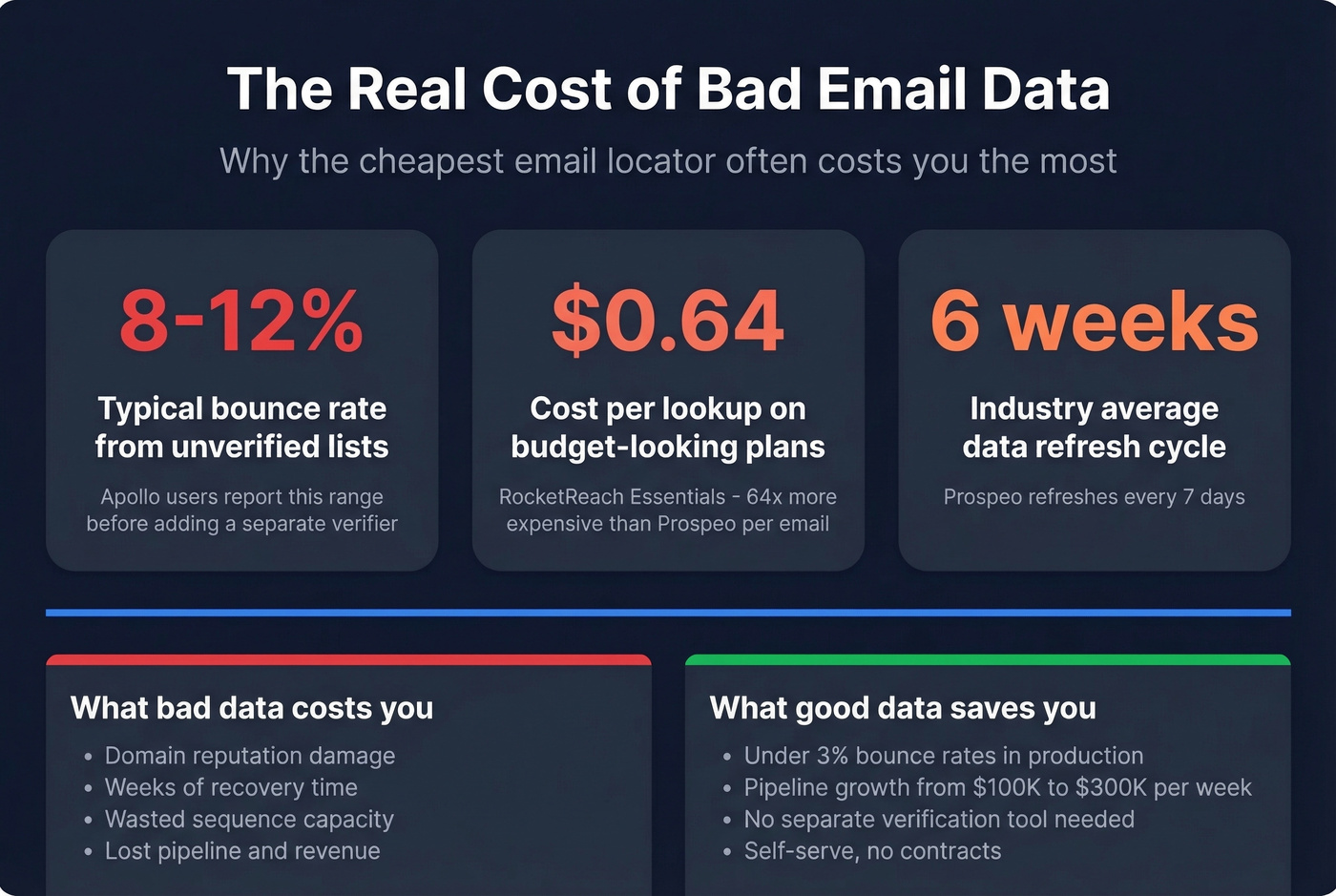
That Reddit quote captures Apollo perfectly. The 250M+ contact database is massive, and the free tier is genuinely useful for getting started. Paid plans run ~$49-$99/mo per user. But we've seen teams pull Apollo lists and hit 8-12% bounce rates before running them through a separate verifier. Per-seat pricing compounds fast - a 5-person team is looking at $250-$500/mo before paying for verification on top.
Skip this if you don't want to bolt on a separate verification step for every list you pull.
RocketReach
Individual plans run $80-$300/user/mo, with extra lookups at $0.30-$0.45 each. On the $80 Essentials plan with 125 lookups, that's $0.64 per lookup - 64x more expensive than the cheapest options per email. User complaints about unclear cancellation and billing policies are a recurring theme in reviews.
ContactOut
Free tier covers 100 contacts/mo. Sales plan is $79/mo, Recruiter starts at $199/mo. Pricing isn't clearly published on their site, which is a transparency red flag. Strong for recruiting use cases, but overpriced and over-engineered for sales prospecting.
Anymail Finder
Plans start at $14/mo, with 100 free credits to test. Only charges for emails marked Valid, which is a fair model. The database is small - this works for low-volume, targeted lookups, not scaled outbound.
Voila Norbert
From $39/mo for 1,000 searches, with 50 free searches to start. Clean interface, reliable for small-batch lookups. Not built for teams sending 500+ emails a day.
Notable mentions: Cognism is strong for EU/UK data but priced at enterprise level (~$15K-$30K/year). Instantly's Lead Finder uses waterfall enrichment across a 450M+ database but is newer and less proven as a standalone email locator.

The gap between claimed accuracy and actual bounce rates is where domains get burned. Prospeo's proprietary 5-step verification pipeline delivers 98% email accuracy with a 7-day data refresh - so you're never emailing stale contacts. Production results: under 4% bounce rates, not marketing claims.
Stop gambling your domain reputation on unverified email locators.
Pricing Comparison
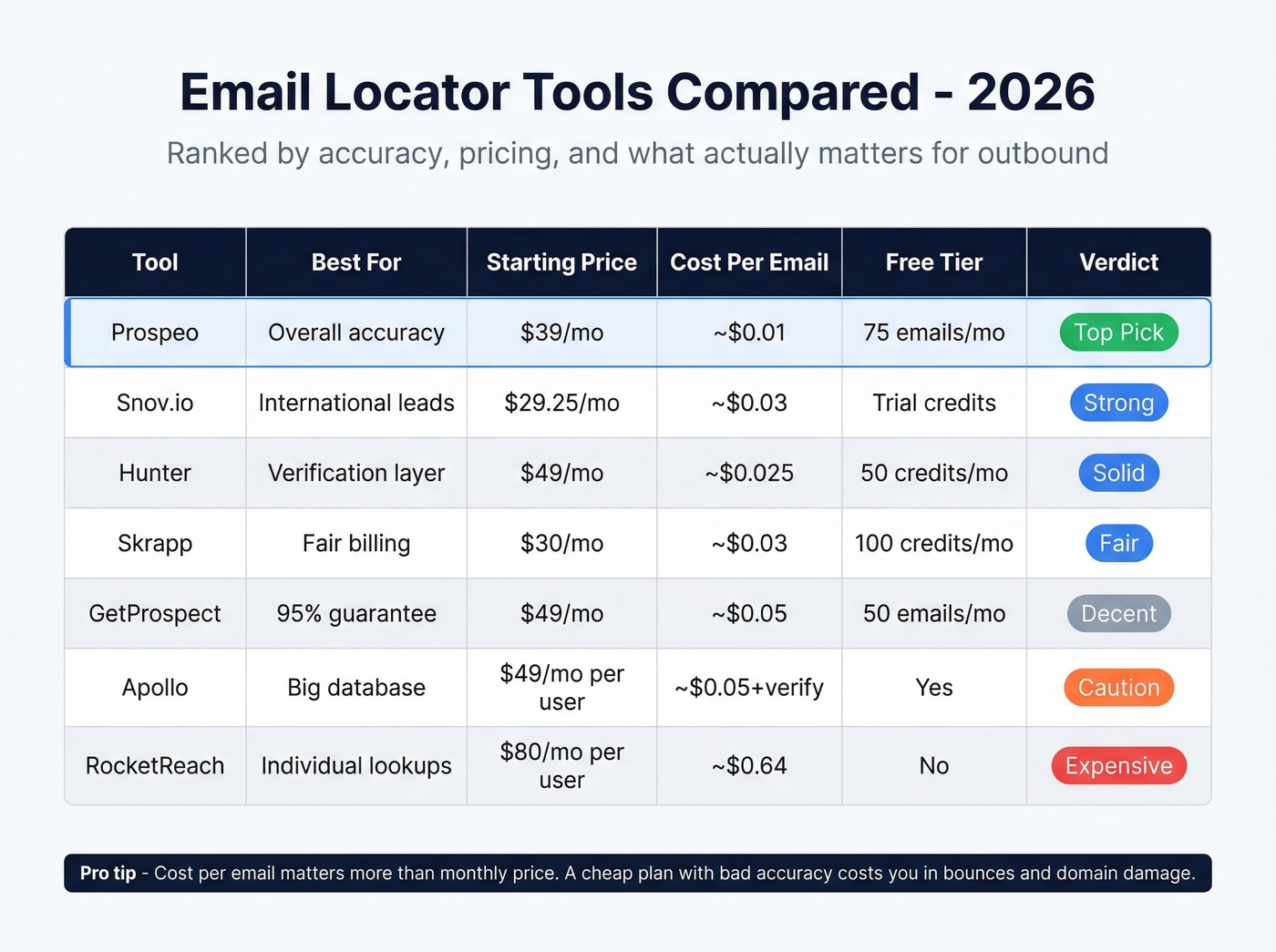
Cost per email is the metric that matters most - it's where the real disparities show up when you're trying to locate addresses at scale.
| Tool | Starting Price | Free Tier | ~Cost/Email | Key Differentiator |
|---|---|---|---|---|
| Prospeo | ~$39/mo | 75 emails/mo | ~$0.01 | 98% accuracy, 7-day refresh |
| Snov.io | $29.25/mo | Trial credits | ~$0.03 | Built-in sequences |
| Hunter | $49/mo | 50 credits/mo | ~$0.025 | Strong verification, unlimited users |
| Skrapp | $30/mo | 100 credits/mo | ~$0.03 | Fair credit policy |
| GetProspect | $49/mo | 50 emails/mo | ~$0.05 | 95% guarantee with refunds |
| Apollo | ~$49/mo/user | Yes | ~$0.05 | 250M+ contacts |
| RocketReach | $80/mo/user | No | ~$0.64 | Phone + email |
| ContactOut | $79/mo | 100 contacts/mo | ~$0.16 | Recruiter focus |
| Anymail Finder | $14/mo | 100 credits | ~$0.38 | Pay for verified only |
| Voila Norbert | $39/mo | 50 searches | ~$0.04 | Simple UI |
The cost-per-email gap is staggering. RocketReach at $0.64 versus Prospeo at $0.01 means you're paying 64x more per contact for a tool that doesn't demonstrably deliver better data.
At ~$0.01 per verified email, Prospeo gives you finding and verification in one step - no separate tools, no extra costs. 143M+ verified emails, 30+ search filters, and 75 free emails per month to prove it works before you spend a cent.
Get 75 free verified emails and see the accuracy difference yourself.
Where They Fit in Your Stack
A cold email operation has five layers: data sourcing, enrichment, verification, inbox infrastructure, and sending. Most email lookup tools handle layers one and two - they find the contact and enrich it with a job title or company info. You still need verification unless your tool includes it, and you definitely still need inbox infrastructure and a sending platform.
The practical implication: if your tool doesn't verify, you need a separate service like Million Verifier or NeverBounce before anything hits an inbox. That's added cost and workflow friction. Tools with built-in 5-step verification collapse layers one through three into a single step - you search, find, and verify in one action, eliminating the standalone verifier entirely.
Let's be honest about the math. At 10,000 contacts with a 2% bounce rate, that's 200 hard bounces - enough to trigger spam filters and damage your sending domain for weeks. The 1.5% threshold isn't arbitrary.
Can You Legally Use One?
Yes, but the rules matter. GDPR treats email addresses as personal data - no exceptions. Enforcement has hit EUR 5.88B through 2025, with 2,245 fines issued since 2018. Penalties run up to EUR 20M or 4% of global revenue, whichever is higher. TIM got hit with a EUR 27.8M fine for aggressive email campaigns, which should make any outbound team pay attention.
For B2B outreach, "legitimate interests" is a valid legal basis under GDPR, but it requires documentation. You can't just claim it - you need to demonstrate that your outreach is relevant, proportionate, and that you've considered the recipient's reasonable expectations. Tools routing data through US servers also face FISA 702 and Cloud Act exposure, so verify your provider's data residency.
When evaluating any email locator, check for EU data residency, a Data Processing Agreement available on request, audit logs for data access, and suppression list support for opt-outs. Every email you send should include an easy unsubscribe mechanism. Self-serve tools with GDPR compliance built in - including EU data processing, global opt-out enforcement, and available DPAs - reduce risk significantly compared to tools that route data through non-EU servers without clear residency commitments.
How to Choose the Right Tool
These five criteria matter most, in order of impact on your results.
1. Accuracy - verified by real sending. Marketing claims mean nothing. Ask for bounce rate data from real campaigns, or test on 100 contacts yourself before committing.
2. Data freshness. A 98% accurate email from three months ago might belong to someone who changed jobs. Ask about refresh cycles. Seven days is best-in-class. Six weeks is the industry average. Anything longer is a liability.
3. Pricing transparency. If a tool won't show you pricing on their website, that's a signal. You'll end up on a sales call negotiating against yourself. Favor tools with published, self-serve pricing.
4. Credit mechanics. Do you pay for bounces? For duplicates? For catch-all results? Skrapp's fair credit policy is the gold standard - you should only pay for deliverable results.
5. Integration fit. Does it connect to your CRM and sending tool without a Zapier workaround? Native integrations with Salesforce, HubSpot, Instantly, or Lemlist save hours of manual export-import cycles.
If you optimize for these five things, you'll end up with a short list of two or three tools. Test them on the same 100 contacts and compare bounce rates. That 30-minute test will tell you more than any feature comparison matrix ever will.
FAQ
What's the difference between an email finder and an email verifier?
A finder discovers email addresses from a name and company. A verifier checks whether an existing address is deliverable. They solve different problems - discovery versus deliverability defense. The best tools combine both into a single step, returning verified results without a separate check.
Are email locator tools legal under GDPR?
Yes, if you have a lawful basis - typically "legitimate interests" for B2B outreach. You need to document your rationale, honor opt-outs promptly, and use a GDPR-compliant provider with EU data residency. Consent isn't strictly required for B2B, but your documentation needs to be solid.
What's a good bounce rate for cold email?
Under 1.5% is the target for healthy sender reputation. Above 2% and your sending domain starts taking damage that compounds over time. If you're consistently above 3%, your data source is the problem - not your sending infrastructure.
What's a good free email locator for small teams?
Prospeo offers 75 free verified emails per month with full enrichment. Skrapp gives 100 free credits with its fair credit policy. Hunter provides 50 free credits. For teams running real campaigns on a budget, Prospeo's free tier delivers the most usable results because verification is included - no separate tool needed.
The Bottom Line
The email locator market is full of tools that look similar on feature pages but diverge sharply on accuracy and cost. Whether you need to locate an address for a single decision-maker or you're enriching a 10,000-contact campaign, the same rule applies: test before you commit. A hundred contacts, real sends, measure bounces. That 30-minute experiment will save you months of domain reputation damage and thousands in wasted spend.