

Best Email Lookup Tools in 2026: Accuracy Data, Real Pricing, No Fluff
You send 500 cold emails. 47 bounce. Your ESP flags your domain, and suddenly even warm follow-ups land in spam. That's not a messaging problem - it's a data problem, and it starts with whichever email lookup tool you picked.
The average cold email response rate sits around 7-10%, and strong campaigns push past 20%. None of that matters if your bounce rate crosses 5% and your domain reputation tanks.
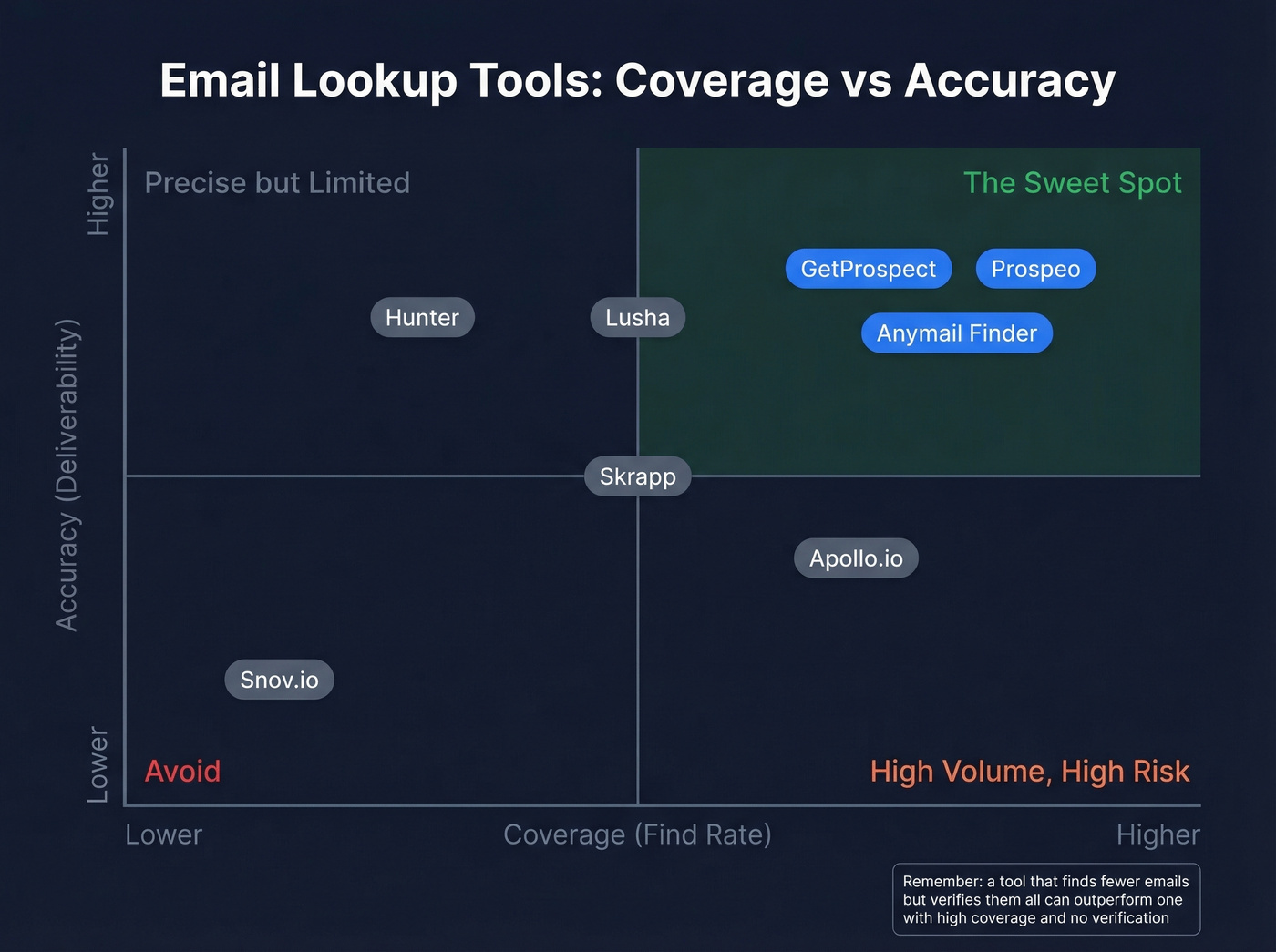
Here's the distinction most people miss: "found" and "deliverable" aren't the same thing. A tool can return an email for 80% of your list, but if 15% of those bounce, you're worse off than a tool that finds fewer emails but verifies every one. Coverage rate versus accuracy rate - that's the single most important thing to understand before you pick a tool.
Our Top Picks
| Use Case | Pick | Why |
|---|---|---|
| Best for email accuracy | Prospeo | 98% verified email accuracy, 7-day data refresh, ~$0.01/email |
| Best free tier | Apollo.io | 100 free credits/month, 275M+ database |
| Best for international leads | Snov.io | Affordable credits, strong global coverage, built-in automation |
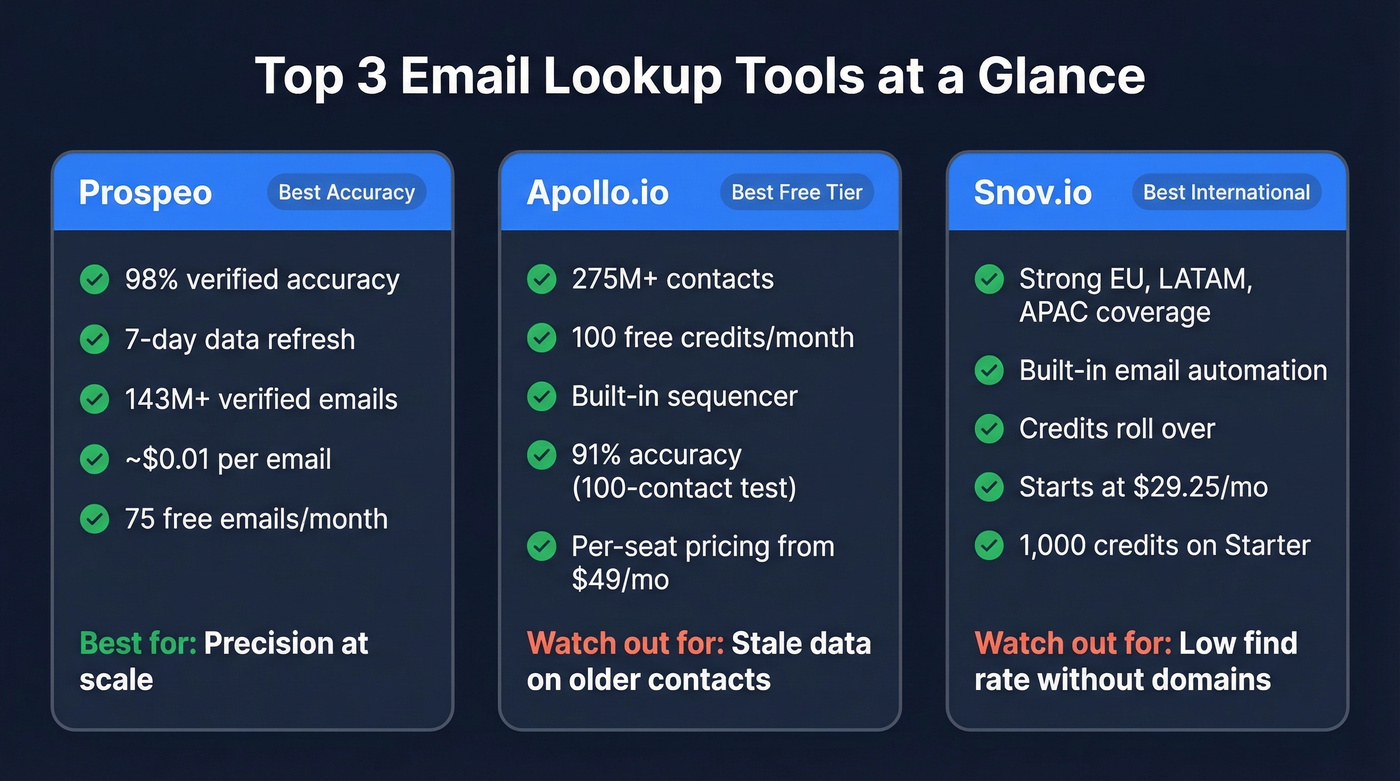
If you had to trial just two: Prospeo for precision, Apollo for breadth. Together they cover the spectrum.
Accuracy Benchmarks Compared
Two published benchmarks give us real numbers. The first, published on Anymail Finder's blog, tested 5,000 fresh contacts exported from Sales Navigator across the US, UK, France, Germany, and Saudi Arabia. The second, published by Tomba in early 2026, ran 5,000 identical searches per tool - split evenly between domain-based and company-name-only lookups.
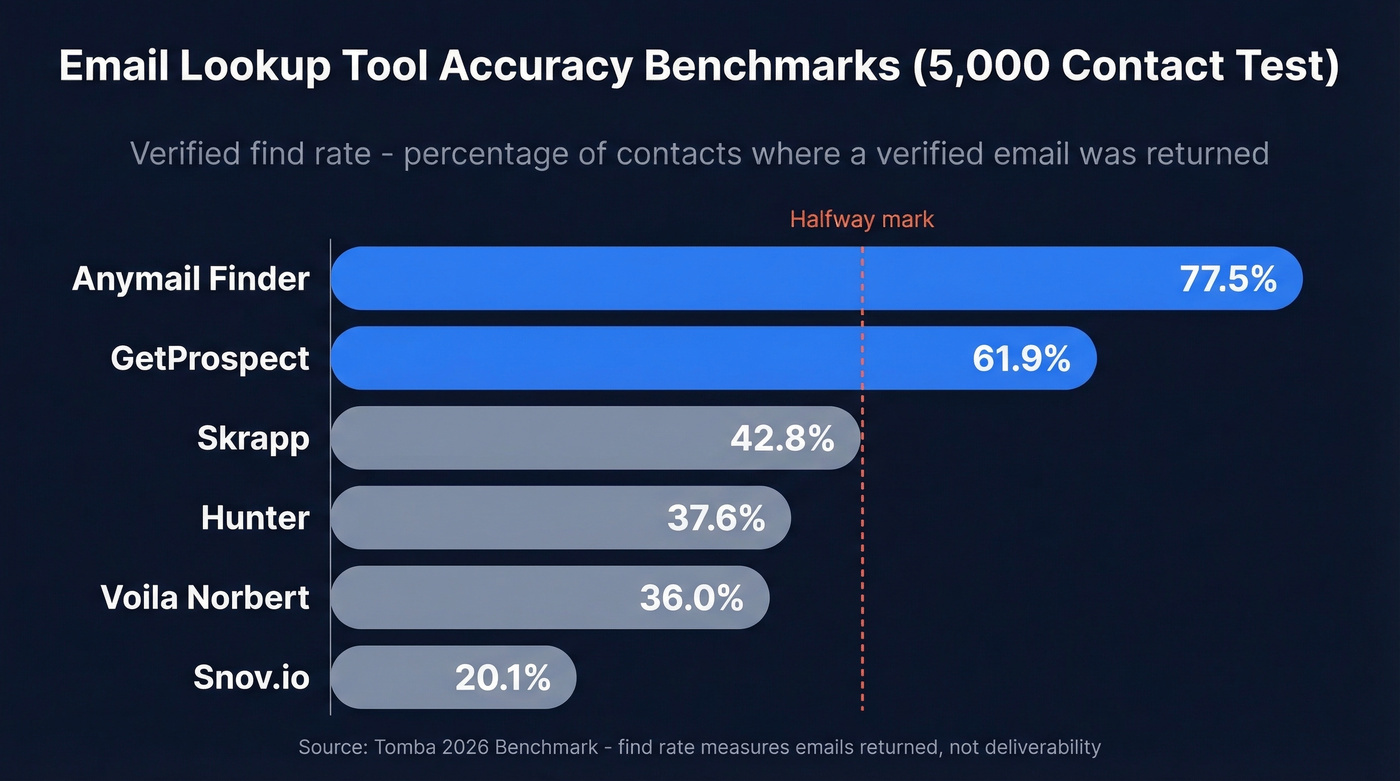
Both are vendor-authored, so take the absolute rankings with a grain of salt. But the methodology reveals clear patterns.
Combined Find Rates (Tomba Benchmark, 5,000 Searches)
| Tool | Verified Rate |
|---|---|
| Anymail Finder | 77.5% |
| GetProspect | 61.9% |
| Skrapp | 42.8% |
| Hunter | 37.6% |
| Voila Norbert | 36.0% |
| Snov.io | 20.1% |
These benchmarks measure find rate - how many emails a tool returns - not deliverability. A tool with a lower find rate but built-in verification can outperform one with higher coverage but no verification layer.
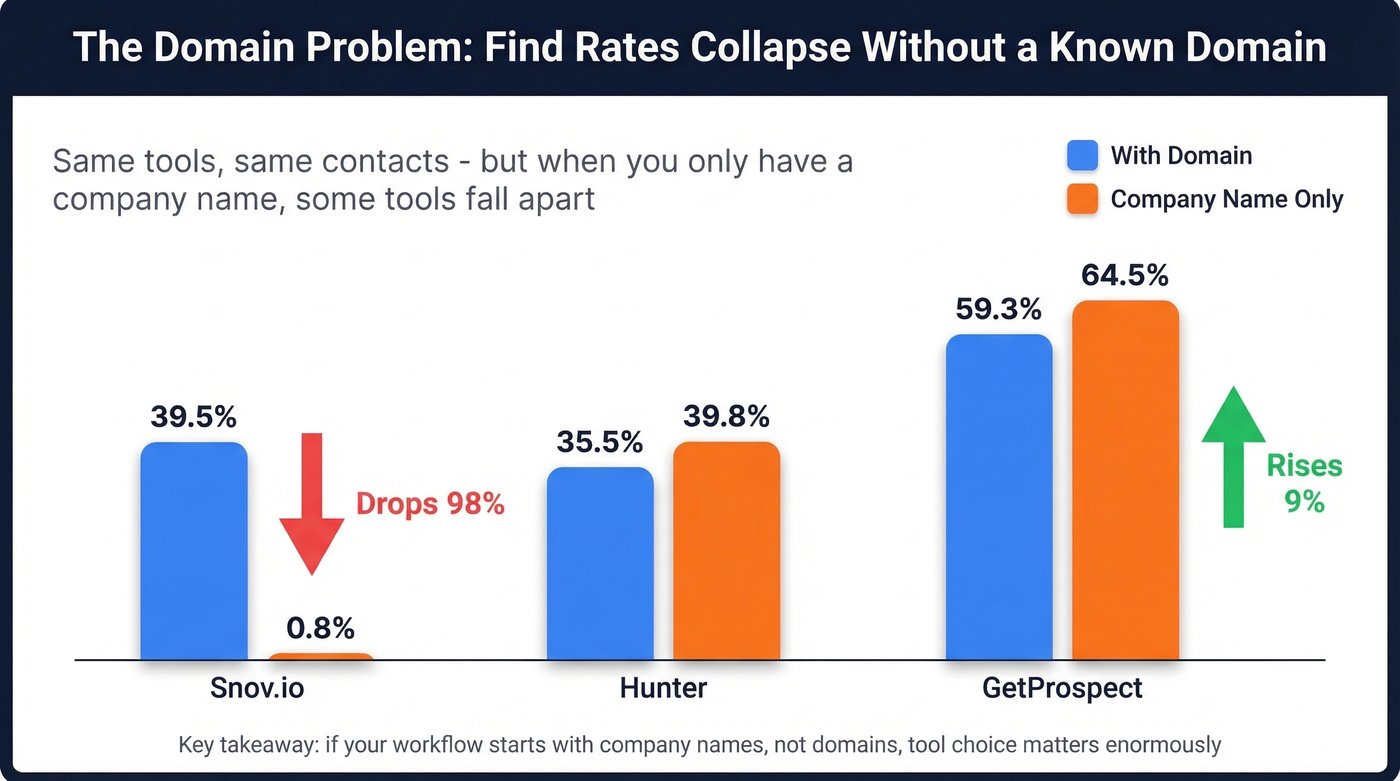
The Tomba benchmark reveals something most roundups miss: when you split searches into domain-known versus company-name-only, some tools collapse entirely. Snov.io dropped from 39.5% on domain searches to 0.8% on company-name searches. Hunter held relatively stable, rising from 35.5% to 39.8%. GetProspect actually improved without domains, jumping from 59.3% to 64.5%.
If your workflow starts with a company name and a job title - no domain in hand - you need a tool that handles that. Many can't.
A separate 100-contact practitioner test ran verified business contacts through multiple tools. GetProspect hit 95% accuracy, Lusha 93%, Apollo 91%, and Hunter 90%. Smaller sample, but it confirms that coverage and accuracy are different metrics entirely.
The 10 Best Email Lookup Tools
1. Prospeo
Prospeo covers 300M+ professional profiles with 143M+ verified emails and 125M+ verified mobile numbers. Every email runs through a 5-step verification process - catch-all handling, spam-trap removal, honeypot filtering - delivering 98% email accuracy.
Data refreshes every 7 days. The industry average is 6 weeks. That gap matters for outbound teams sending sequences over 2-3 weeks, where stale data means bounces compound as your campaign runs.

The 30+ search filters include buyer intent powered by Bombora, technographics, job changes, headcount growth, and funding signals. The Chrome extension (40,000+ users) works across company websites and professional profiles. CRM and CSV enrichment returns 50+ data points per contact with a 92% API match rate, with native integrations for Salesforce, HubSpot, Smartlead, Instantly, and Lemlist.
We've seen the real-world impact firsthand: Meritt went from a 35% bounce rate to under 4% after switching, tripling their pipeline from $100K to $300K per week.
Use this if: You're running outbound at scale and can't afford bounces. Agencies managing multiple client domains. Anyone burned by stale data from other providers.
Pricing: ~$0.01 per email. Free tier gives you 75 emails + 100 Chrome extension credits/month. No contracts, no per-seat pricing, cancel anytime.

You just saw the benchmarks - most email lookup tools trade coverage for accuracy. Prospeo delivers 98% verified email accuracy across 143M+ emails, with a 7-day refresh cycle that keeps your data fresh while competitors serve 6-week-old records. That's the difference between a 4% bounce rate and a flagged domain.
Stop paying for emails that bounce. Start with 75 free lookups.
2. Hunter
Hunter is the email finder everyone's heard of. The brand is strong, the Chrome extension is genuinely useful for quick one-off lookups, and it's been around long enough to earn default status on many teams. Hunter's database covers 100M+ professional email addresses, but it can feel smaller than database-first platforms in day-to-day prospecting.
In the 5,000-contact benchmark, Hunter found verified emails for just 37.6% of contacts. The 100-contact practitioner test was kinder - 90% accuracy - but that's accuracy on emails it found, not coverage of the full list.

In our experience, agency workflows often treat Hunter as a verification layer more than a primary discovery tool. If you already have email addresses and need to verify them, Hunter's solid. Building lists from scratch? You'll hit coverage gaps.
Use this if: You need a reliable verification layer on top of another database, or you want unlimited users on paid plans.
Skip this if: You're building prospect lists from scratch and need high coverage rates.
Pricing: Free (50 credits/month), Starter $34/mo annual, Growth $104/mo, Scale $209/mo. Unlimited users on paid plans.
3. Apollo.io
Apollo is the obvious starting point for teams that want a big database without a big budget. The free tier gives you 100 credits per month, the database covers 275M+ contacts, and the built-in sequencer means one less tool to buy. For a Series A company running its first outbound motion, it's hard to beat that entry point.
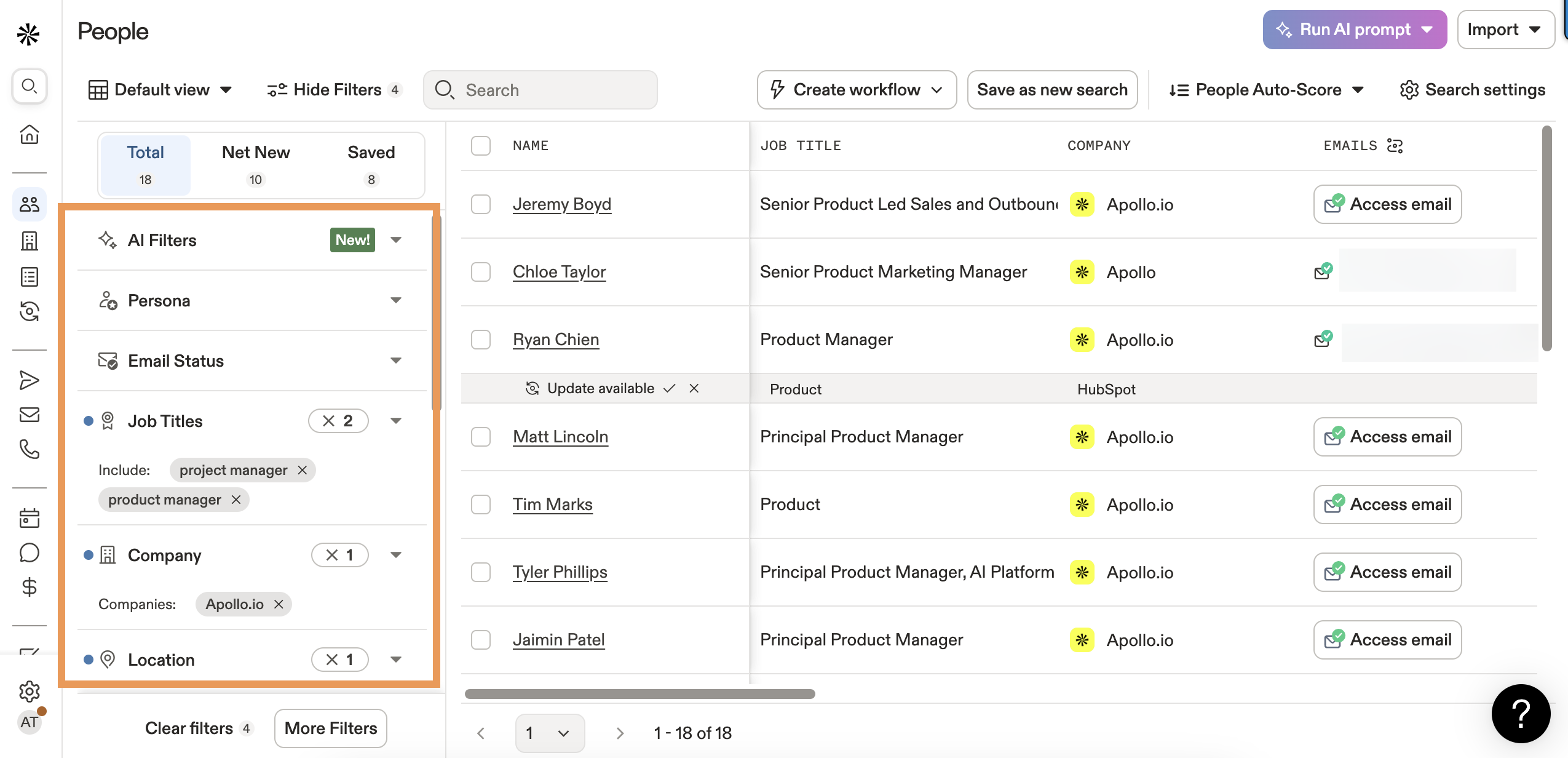
But "big database" doesn't mean "fresh database." The #1 complaint about Apollo in agency discussions is bounces on older contacts. One agency operator put it bluntly: "data feels bad sometimes... lots of bounces on older contacts." The consensus on r/sales threads tends to echo this - Apollo's great for volume, less reliable for precision.
The practitioner test showed 91% accuracy on 100 contacts, which is decent. At scale, stale records accumulate. Email credits are technically "unlimited" but subject to fair-use caps. The real cost driver is per-seat pricing: Basic runs $49/mo annual per user, Professional $79/mo, and Organization $119/mo with a 3-user minimum. You also can't reduce seats mid-term - once locked in, you're paying for every seat until renewal. A 5-person team on Pro is $4,740/year before mobile credit costs.
Use this if: You're early-stage, need volume, and can tolerate some data quality variance.
Skip this if: You're sending 500+ emails daily and can't afford bounce rates above 3%.
4. Snov.io - Best for International Leads
Snov.io is the pick for teams prospecting outside North America. Strong coverage in Europe, LATAM, and APAC, plus built-in email automation and a browser-based social automation add-on ($69/mo per slot). The benchmark find rate was low at 20.1%, but that test skewed toward a specific contact profile - in agency workflows, Snov is a common pick for international leads where other tools fall short.
Pricing is reasonable: Starter at $29.25/mo annual with 1,000 credits and 5,000 recipients, Pro at $74.25/mo with 5,000 credits. Unused credits roll over. But read the fine print: credits and recipients are separate quotas. You can burn through credits on searches while your recipient cap stays untouched, or vice versa.
Use this if: Your ICP includes non-US companies and you want automation baked in.
Skip this if: You need high find rates on US-only prospects.
5. GetProspect
Quietly one of the best performers in published benchmarks. GetProspect hit 61.9% in the 5,000-contact test and 95% accuracy in the 100-contact practitioner test - the highest accuracy score in that batch. They offer a 95% accuracy guarantee with credits back if they miss the mark.
Let's be honest: GetProspect is the most underrated option on this list. It outperformed tools with 5x the brand recognition in every benchmark we reviewed, and the accuracy guarantee shows real confidence in their data. Free tier gives you 50 emails per month. Paid plans start at $49/mo for 1,000 valid emails. No sequencer, no frills - just solid email finding with a confidence guarantee most competitors won't match.
6. Anymail Finder
Anymail Finder flips the pricing model: you only pay for fully verified results. If the tool can't verify an email, you don't burn a credit. That eliminates the frustration of spending credits on "risky" or "catch-all" addresses that never deliver.
Their benchmark showed a 77.5% find rate - the highest in the Tomba test. Pricing starts at $19/mo for 50 searches and $39/mo for 1,000 searches. Unused credits roll over. For teams that care more about precision than volume, the pay-per-verified model is genuinely compelling.
7. Lusha
Lusha scored 93% accuracy in the practitioner test and stands out for bundling direct-dial phone numbers alongside email. If your outbound motion includes cold calling, Lusha pulls double duty. Free tier offers 40 credits per month.
The catch is per-user pricing - paid plans run ~$36-59/user/mo, which adds up fast for teams of five or more. Compared to credit-based tools where you pay for data rather than seats, Lusha gets expensive quickly. Solid accuracy, but watch the math.
8. ContactOut
Mostly accurate data for personal emails and mobile numbers, but credit practices are a problem. G2 reviewers flag deceptive credit practices, with "unlimited" capped at 2,000 emails under fair use. Sales plan runs $79/user/month for 6,000 emails per year. We'd recommend reading the fine print carefully before committing.
9. Skrapp
Mid-tier performer: 42.8% find rate in the 5,000-contact benchmark, 93% accuracy in the 100-contact practitioner test. Free tier available, credit-based pricing at ~$29/mo. A reasonable option if you're already in the ecosystem, but hard to recommend over GetProspect or Anymail Finder at similar price points.
10. Voila Norbert
Simple, focused email finder with a 36.0% benchmark find rate. Starts at $39/mo for 1,000 searches, with 50 free searches to get started. Does one thing adequately, but the find rate puts it behind several competitors at the same price.
Also worth considering: Cognism (90% accuracy in the practitioner test, strong European data, enterprise pricing around $15,000-25,000/year), Reply.io (email finder bundled with sales engagement), and AeroLeads (budget-friendly prospecting from ~$19/mo).
Every email lookup tool on this list charges you credits whether the address is deliverable or not. Prospeo's 5-step verification - catch-all handling, spam-trap removal, honeypot filtering - means you pay ~$0.01 only for emails that actually land. Meritt cut their bounce rate from 35% to under 4% and tripled their pipeline.
Test it against your current tool. 75 free emails, no credit card required.
Pricing Comparison
| Tool | Free Tier | Starter (Annual) | Credits Included | Per-Email Cost |
|---|---|---|---|---|
| Hunter | 50 credits/mo | $34/mo | 2,000/mo | ~$0.017 |
| Apollo.io | 100 credits/mo | $49/user/mo | "Unlimited" (capped) | Per-seat |
| Snov.io | 50 credits/mo | $29.25/mo | 1,000 credits | ~$0.029 |
| GetProspect | 50 emails/mo | $49/mo | 1,000 valid | ~$0.049 |
| Anymail Finder | Trial available | $19/mo | 50 searches | ~$0.38 |
| Lusha | 40 credits/mo | ~$36/user/mo | Per-seat allotment | Per-seat |
| ContactOut | 40 emails/yr | $79/user/mo | 6,000 emails/yr | ~$0.16 |
| Skrapp | 100/mo | ~$29/mo | 1,000 credits | ~$0.029 |
| Voila Norbert | 50 (one-time) | $39/mo | 1,000 searches | ~$0.039 |
Per-user pricing (Apollo, Lusha, ContactOut) scales linearly with headcount - a 10-person team on Apollo Pro is $9,480/year. Credit-based tools don't penalize you for adding reps.
On a pure per-email basis, Prospeo's ~$0.01 is the lowest unit cost in the group, and that includes verification in the price. Anymail Finder's $0.38 per search looks expensive, but you only pay for verified results - the effective cost depends on your find rate.

Free Tier Breakdown
Every tool offers some kind of free tier, but the limits vary wildly. Here's what each service actually gives you:
| Tool | Free Credits/Month | Limitations |
|---|---|---|
| Skrapp | 100/mo | Basic features |
| Apollo.io | 100/mo | Fair-use caps apply |
| Hunter | 50/mo | Full features |
| Snov.io | 50/mo | 100 recipients, 1 warm-up |
| GetProspect | 50/mo | Standard features |
| Lusha | 40/mo | Basic access |
| ContactOut | 40/year | Standard profiles only |
| Voila Norbert | 50 (one-time) | Not monthly |
| Anymail Finder | Trial available | Pay-per-verified model |
ContactOut's "free tier" is 40 emails per year - essentially a product demo, not a usable plan. Voila Norbert's 50 searches are one-time, not recurring. For genuine ongoing free usage, Apollo and Prospeo offer the most generous allowances.
Protect Your Domain Reputation
Finding emails is the easy part. Keeping your domain healthy while sending to them - that's where teams get burned.
Verify close to send time. Email addresses decay as people change jobs, companies restructure, and domains expire. Verify your list within a month of sending. Anything older is a gamble. Tools with built-in verification on export eliminate this step entirely. (If you want a deeper breakdown of bounce thresholds and fixes, see our guide to bounce rate.)
Know "verified" from "risky." Verified emails deliver at 90%+ rates. "Risky" emails - often catch-all domains - hover around 70%. That 20-point gap compounds fast. If you're sending 1,000 emails and 300 are "risky," expect 90+ bounces from that segment alone.
Understand catch-all domains. A catch-all domain accepts every email sent to it, even fake addresses. Most basic SMTP verification marks these as "valid" because the server accepts the connection. That doesn't mean a real person reads that inbox. Use a tool with catch-all verification to keep your bounce rate honest. (More on verification workflows in our email deliverability guide.)
Stay under 2% bounce rate. Above 5% and you're risking domain reputation damage - ESPs start throttling or blocking your sends. Since roughly 60% of replies come after the first follow-up, protecting your domain for those follow-up touches is critical. For sending limits and pacing, see email velocity.
Use a secondary domain for risky sends. If you must email unverified or catch-all addresses, route them through a secondary sending domain. This quarantines reputation damage away from your primary domain. Tools with native CRM integrations make it easier to segment verified versus risky contacts before they hit your sequences. (If you're building a full outbound stack, start with our list of outbound lead generation tools.)
FAQ
Are email lookup tools legal?
Yes, for legitimate B2B outreach. GDPR-compliant tools source data from public professional profiles and enforce opt-out requests globally. You're responsible for having a lawful basis - legitimate interest is the standard for B2B cold outreach in most jurisdictions - but reputable providers operate within established legal frameworks.
How accurate are email finders really?
Independent benchmarks show find rates from 20% to 80% depending on the tool and dataset. Accuracy on returned results ranges from 90% to 98%. Always confirm whether the tool verifies emails before returning them - a 60% find rate with built-in verification outperforms an 80% find rate with no verification every time.
Free vs. paid - worth upgrading?
Free tiers work for testing or low-volume prospecting under 50 emails per month. Once you're past 500+ monthly sends, paid plans with verification and catch-all handling prevent bounces that damage your domain. Domain recovery costs far exceed $30-50/month for a proper tool.
What's a catch-all domain?
A catch-all domain accepts all incoming emails, including messages sent to nonexistent addresses. Basic SMTP checks mark these as "valid" when they'll never reach a real inbox. Tools like Prospeo and Anymail Finder include catch-all verification to filter these out before you send.
What's the best email lookup tool in 2026?
For verified accuracy and data freshness, Prospeo's 98% accuracy rate and 7-day refresh cycle make it the safest choice for outbound teams. For maximum free-tier volume, Apollo's 275M+ database with 100 monthly credits is unmatched. For international prospecting, Snov.io's non-US coverage and built-in automation stand out. Most teams get the best results pairing a high-accuracy finder with a broad database.