

Email Outros: How to End Emails That Get Replies
You've written the whole email - clear subject line, tight body, solid ask - and now you're frozen on the last two lines. "Best"? "Thanks"? "Warm regards"? Here's the thing: your closing sentence matters far more than your closing word.
Eye-tracking research on email skimming points to an F-pattern, and the left-aligned sign-off area tends to be one of the last things people actually read in the body. Most guides on email closing lines get this completely backwards, obsessing over the sign-off word while ignoring the line that drives replies.
The Short Answer
Gratitude-based closings ("thanks," "thank you") outperform everything else - 63% response rate vs. 47.5% baseline. Your closing sentence is the conversion lever; the sign-off word is just the bow on top. Pick two or three sign-offs that fit your actual situations and stop overthinking it.
What the Data Says About Email Sign-Offs
In 2017, Boomerang analyzed over 350,000 email threads and compared response rates by sign-off. The results aren't subtle.
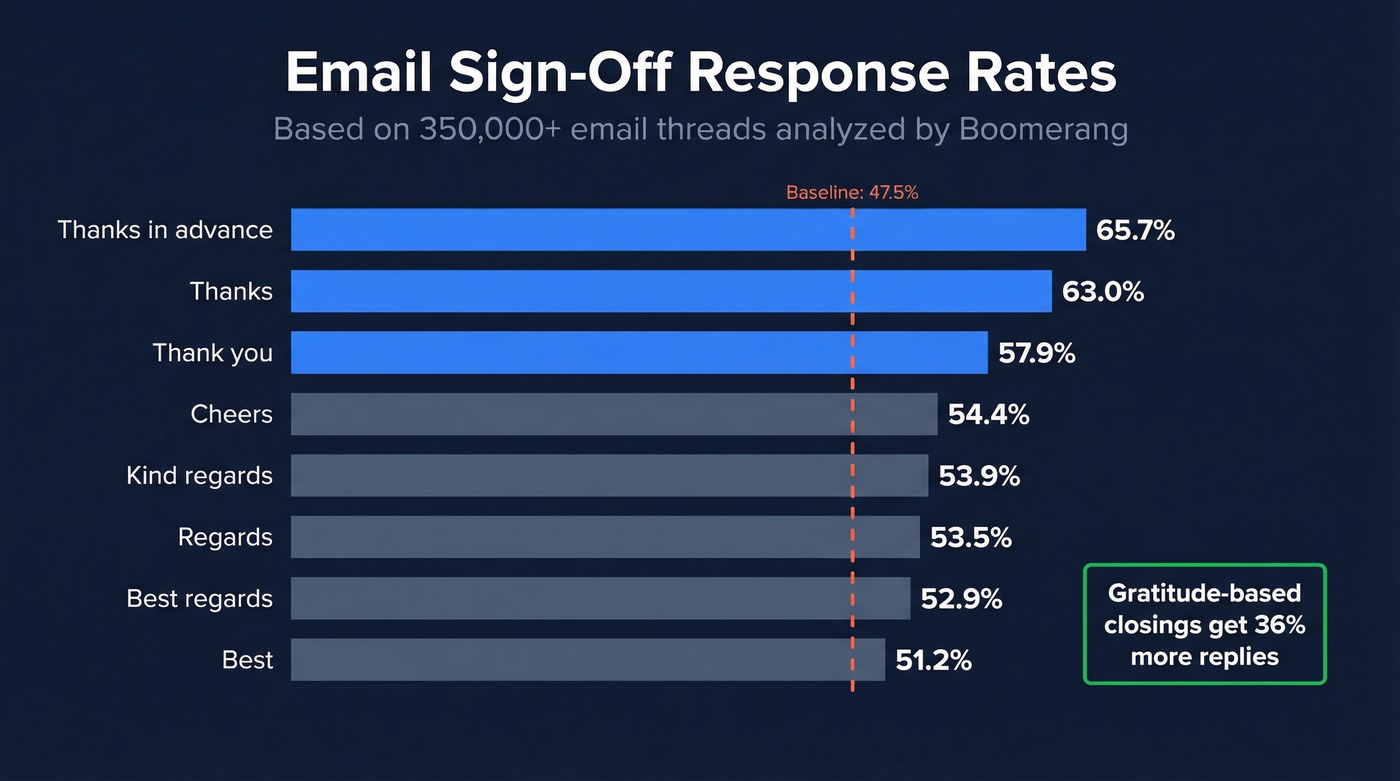
| Sign-Off | Response Rate |
|---|---|
| Thanks in advance | 65.7% |
| Thanks | 63.0% |
| Thank you | 57.9% |
| Cheers | 54.4% |
| Kind regards | 53.9% |
| Regards | 53.5% |
| Best regards | 52.9% |
| Best | 51.2% |
Baseline response rate across all emails: 47.5%
Closings containing "thank" pulled a 62% response rate vs. 46% without - a 36% relative lift. A separate experiment by Grant & Gino with 69 participants found that adding "Thank you so much!" to a request got recipients to help 66% of the time vs. 32% without it. Gratitude isn't just polite. It's persuasive.
Closing Lines by Scenario
Don't memorize a list of 70 options. Match the sign-off to the situation.
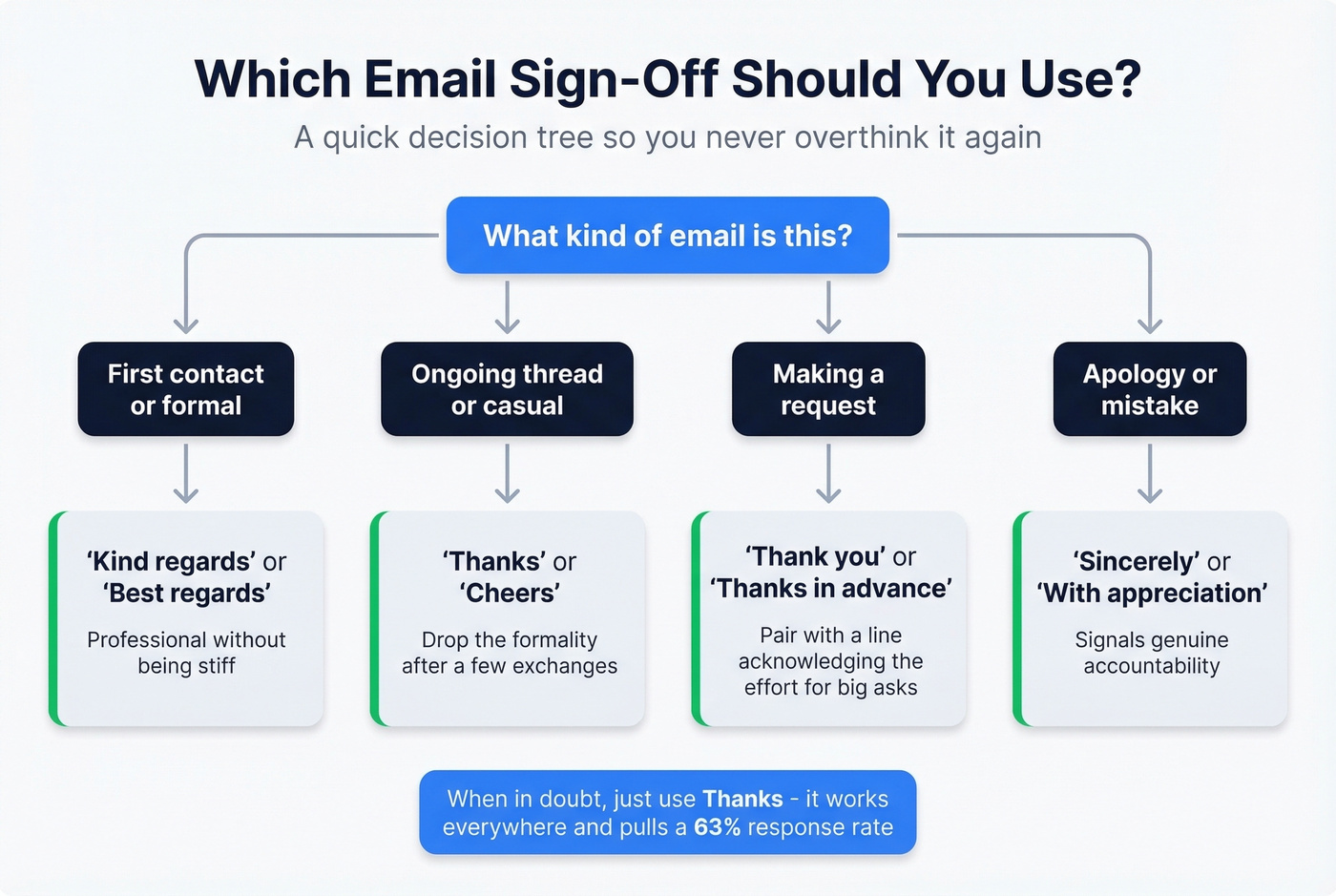
First contact or formal emails. "Kind regards" and "Best regards" signal professionalism without sounding stiff. Use these when emailing someone senior, external, or unfamiliar. "Respectfully" works for government or legal contexts but reads as overly formal everywhere else.
Ongoing threads and casual emails. Once you've exchanged a few messages, drop the formality. "Thanks," "Cheers," or just your name. In threads on r/workingmoms and r/ExecutiveAssistants, people explicitly call out "Best" as feeling insincere and gravitate toward "Thanks" instead. Emoji-only sign-offs exist in the wild, but save those for Slack.
Requests and asks. "Thank you" or "Thanks in advance" - but read the room. "Thanks in advance" has the highest response rate in the data, yet it can feel presumptuous for big asks. Pair it with a sentence that acknowledges the effort: "I know this is a lot - thanks in advance for looking into it."
Apologies and mistakes. When you've dropped the ball, "Sincerely" or "With appreciation" carry the right weight. They signal genuine accountability without the performative warmth of "Thanks!" after you just missed a deadline.

You just learned that gratitude-based closings lift reply rates by 36%. But a 15% bounce rate kills that lift before anyone reads your outro. Prospeo's 5-step email verification catches spam traps, honeypots, and catch-all domains - 98% accuracy, $0.01 per email.
Fix your list before you fix your sign-off.
Lines and Sign-Offs to Avoid
The sign-off word is mostly harmless. The closing sentence is where you accidentally sound passive-aggressive. Melody Wilding broke down five common offenders for CNBC:
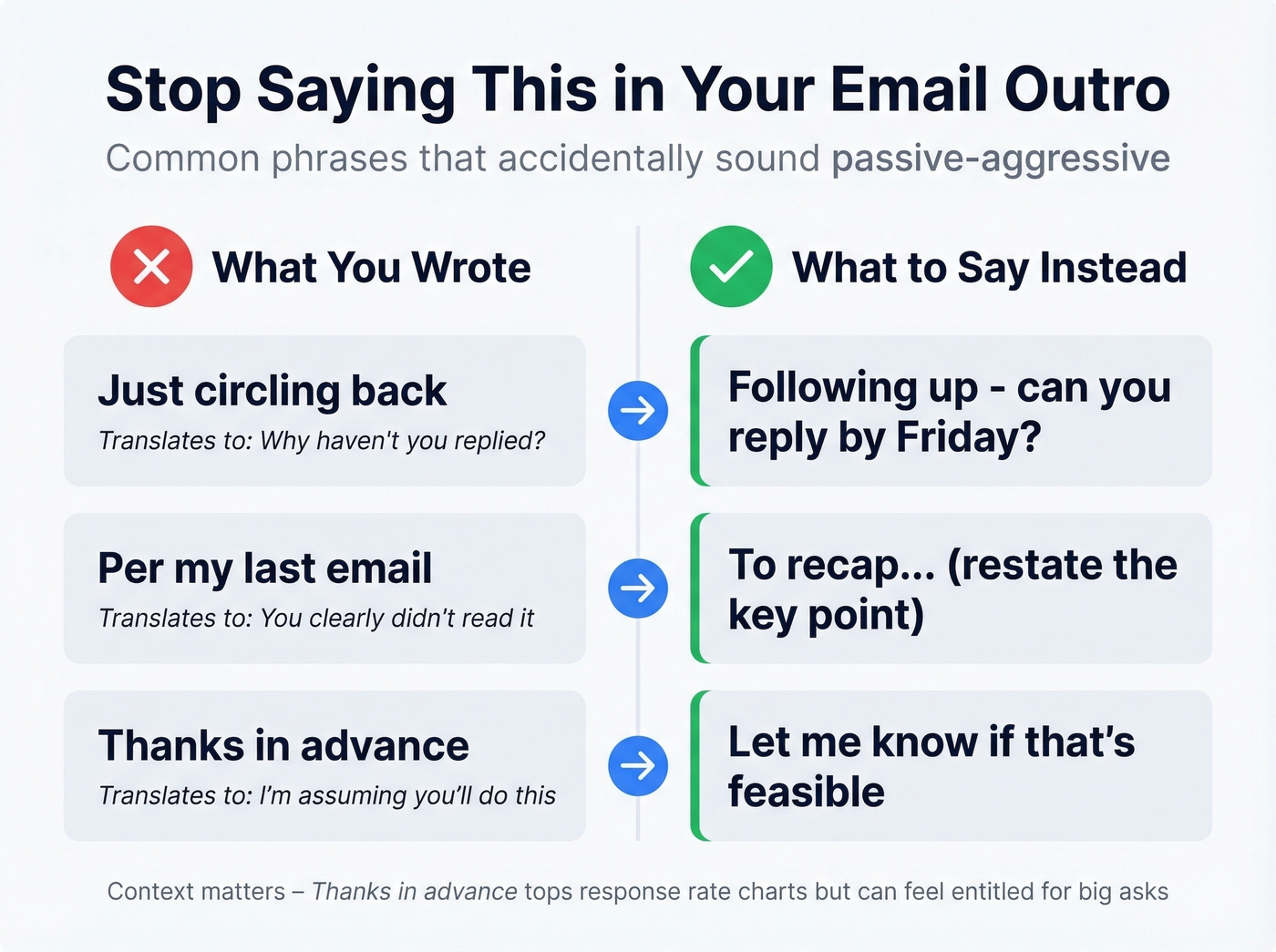
| Phrase | What It Implies | Better Alternative |
|---|---|---|
| Just circling back | Why haven't you replied? | "Following up - can you reply by Friday?" |
| Per my last email | You didn't read it | "To recap..." + restate the key point |
| Thanks in advance | I'm assuming you'll do this | "Let me know if that's feasible" |
The irony with "thanks in advance" is real: it tops the response-rate chart and the passive-aggressive list. In a casual request to a peer, it's fine. In the wrong context, it reads as entitled. Learning how to craft a closing line that's assertive without being presumptuous - that's the real skill.
Beyond phrases, certain sign-off words don't belong in professional email: "Love," "XOXO," "Thx," "God bless" (unless you're in ministry), and "Sent from my iPhone" - which isn't a sign-off, it's a confession that you didn't care enough to delete the default.
Email Outros for Sales
In outbound email, your outro is the CTA. "Looking forward to hearing from you" is the sales equivalent of a shrug - it asks for nothing specific and gets nothing back.
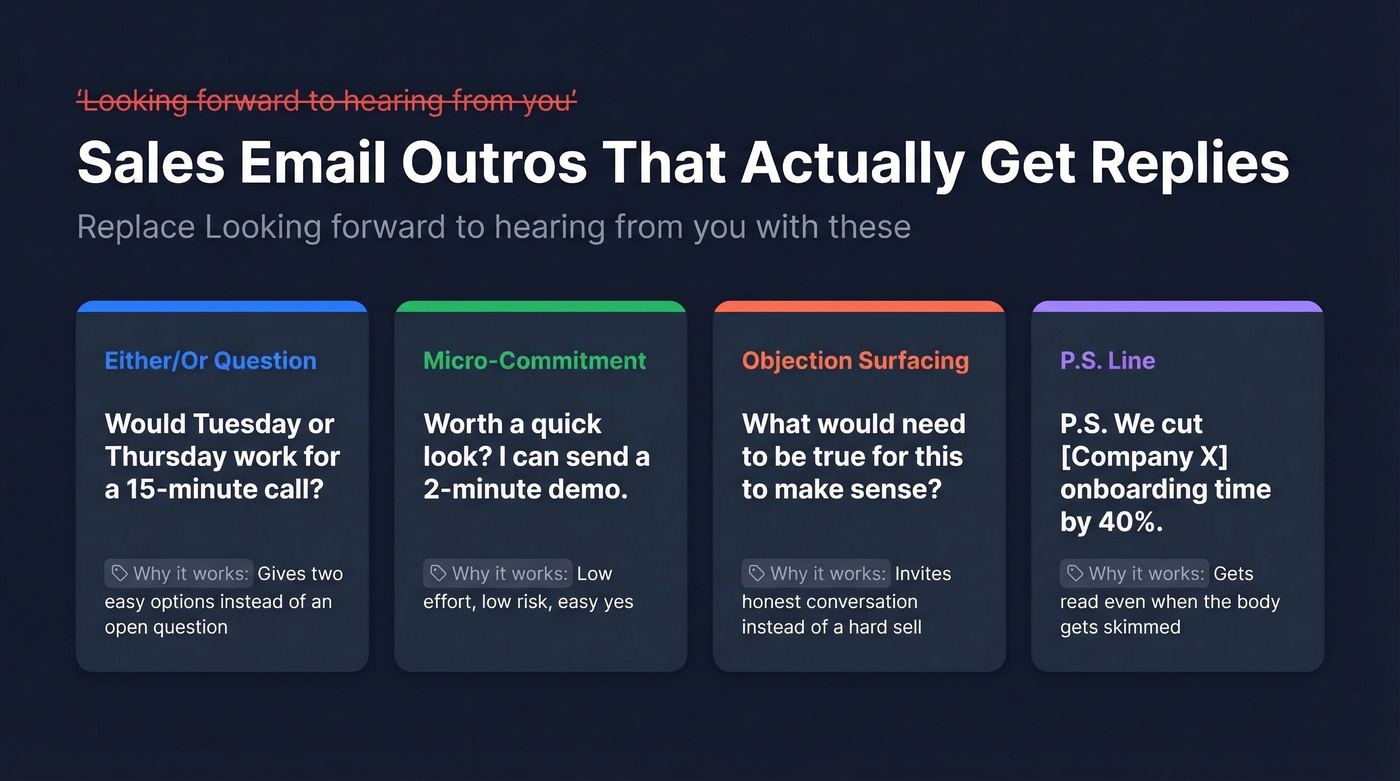
- Either/or question: "Would Tuesday or Thursday work for a 15-minute call?"
- Micro-commitment: "Worth a quick look? I can send a 2-minute demo."
- Objection surfacing: "What would need to be true for this to make sense?"
- P.S. line: Reiterate your core value prop after the sign-off - it gets read.
Every one of these gives the recipient an easy, low-friction reason to hit reply.
Look, here's the part most outreach guides skip: your closing line doesn't matter if you're emailing a dead address. We've seen teams agonize over CTA phrasing while sending to lists with 15%+ bounce rates. Before you optimize the outro, verify the list. Prospeo runs real-time email verification with 98% accuracy and a 5-step process that catches spam traps, honeypots, and catch-all domains. If your bounce rate is above 5%, the best CTA in the world won't save your domain reputation.

Sales outros like 'Would Tuesday or Thursday work?' only convert when they reach a real decision-maker. Prospeo gives you 143M+ verified emails refreshed every 7 days - so your carefully crafted CTA lands in a live inbox, not a dead end.
Stop perfecting CTAs for addresses that don't exist.
Gen Z and Email Endings
A ZeroBounce survey of ~1,400 Gen Z workers found 57% aren't sure how formal to be in email, 53% default to "Thanks," and 14% skip the sign-off entirely. Meanwhile, 36% of Gen Z have 1,000+ unread emails in their inbox.
Your outro is competing with chaos. Keep it short and make the ask obvious. If you're unsure how to write an ending that feels professional but not stuffy, "Thanks" is the safest default for any generation.
Accessible Sign-Offs
The WHO estimates 2.2 billion people have some form of vision impairment. Your email signature is part of your outro - add alt text to images, use readable fonts at 14pt+ with sufficient contrast, and make sure links are underlined and clearly labeled. Test with a screen reader before you set it and forget it.
FAQ
Is "Best" a bad email sign-off?
Not bad, just the lowest-performing popular option at 51.2%. "Thanks" pulls 63%. For anything where you want a reply, switch to a gratitude-based closing. For confirming a meeting time? "Best" is perfectly fine.
How do I end an email that actually gets replies?
Write a closing line with a specific ask, use a gratitude-based sign-off like "Thanks" or "Thank you," and verify your contact list so the email actually reaches a real inbox. If you're running outbound at any scale, tools like Prospeo catch invalid addresses before they tank your deliverability.
Does "Thanks in advance" sound passive-aggressive?
It depends on context. In casual peer requests, it's the highest-performing sign-off at 65.7% response rate. For big asks to senior stakeholders, it can feel presumptuous - pair it with a line acknowledging the effort, or swap to "Let me know if that's feasible."
Let's be honest: most people agonize over "Best" vs. "Regards" when the real problem is the sentence above the sign-off says nothing. Nail the closing line, pick a gratitude-based email outro, and the sign-off word barely matters.