

The Data-Backed Email Sequence for Sales Funnels That Actually Converts
You've built the funnel, written the emails, hit send - and nothing. Your email sequence for sales funnels looks right on paper, but conversions sit near zero. The problem isn't your copy. It's your structure, your timing, and almost certainly your list quality.
Email marketing still returns $36 for every $1 spent on average, with top performers hitting $68. Automated flows convert 19x higher than one-off campaign blasts. But most funnel sequence guides hand you a vague template and wish you luck. This one won't.
What's a Sales Funnel Email Sequence?
A sales funnel email sequence is a pre-planned series of automated emails that move a contact from first touch to purchase and beyond. Each email maps to a funnel stage:
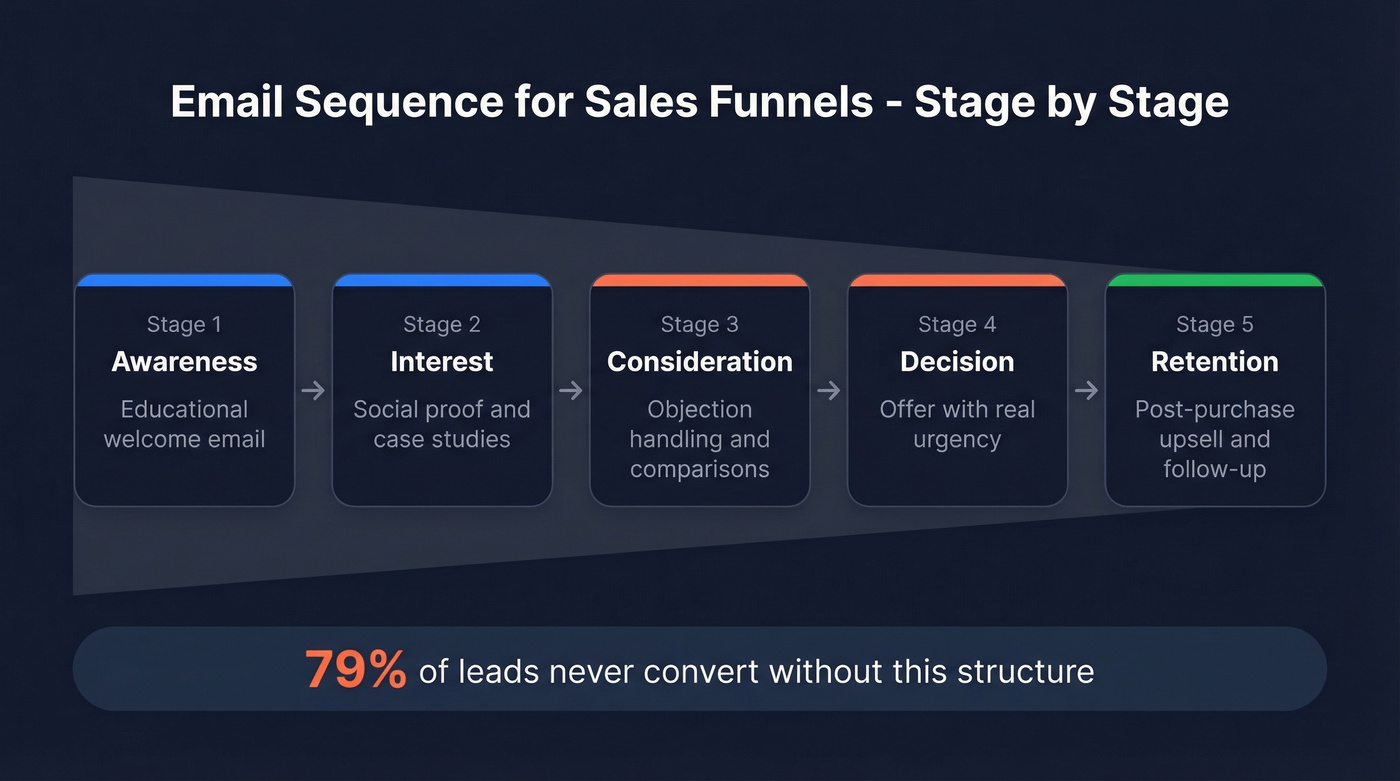
- Awareness - educational welcome
- Interest - social proof, case studies
- Consideration - objection handling, comparisons
- Decision - offer, urgency
- Retention - post-purchase follow-up, upsell
Without this structure, 79% of leads never convert. They enter the funnel, get a generic blast or two, and vanish. The key isn't better writing - it's aligning each message to the specific stage your prospect occupies instead of blasting the same pitch to everyone.
The monetization gap between campaigns and flows is massive. In one Feb 2026 portfolio benchmark, campaigns generated $0.04 per recipient while automated flows generated $0.94. That's a 23x difference, and it comes entirely from structure and timing.
The 6-Email Buyer Journey Sequence (Day by Day)
This cadence follows the "start hot, then cool down" principle - front-load touches when intent is highest, then space out as you build familiarity. Here's a widely used 23-day framework:
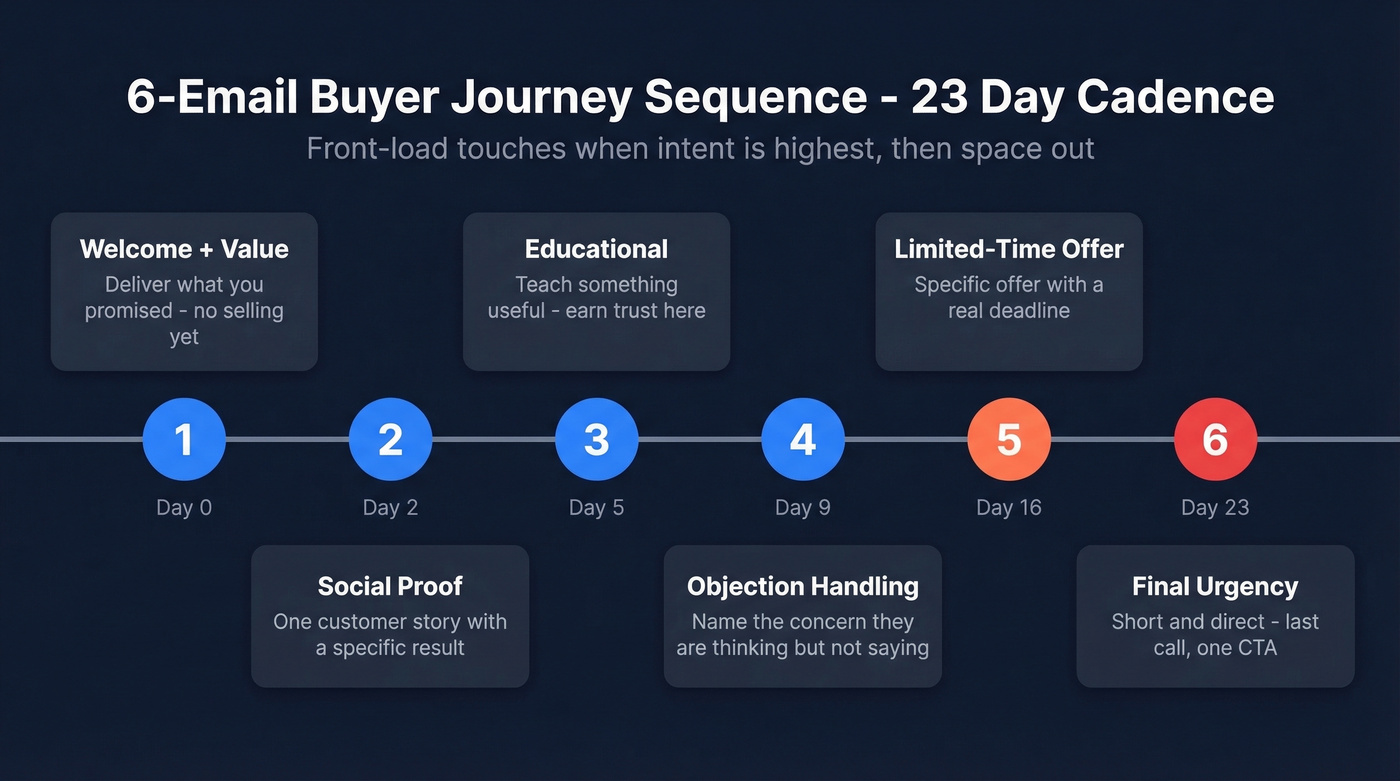
| Email # | Day | Purpose | Subject Line Pattern | CTA Type |
|---|---|---|---|---|
| 1 | 0 | Welcome + value | "Here's what you asked for" | Download / access |
| 2 | 2 | Social proof | "How [Company] grew X%" | Read case study |
| 3 | 5 | Educational | "The #1 mistake in [topic]" | Learn more |
| 4 | 9 | Objection handling | "Worried about [concern]?" | Watch / compare |
| 5 | 16 | Limited-time offer | "[X]% off - ends Friday" | Claim offer |
| 6 | 23 | Final urgency | "Last chance: [offer]" | Buy / book now |
What each email should say
Email 1 (Day 0): Deliver whatever you promised at signup - the ebook, the checklist, the discount code. No selling yet. Just prove you're worth opening again.
Email 2 (Day 2): Show, don't tell. One customer story with a specific result. "Meritt tripled their pipeline from $100K to $300K per week" beats "our customers love us" every time.
Email 3 (Day 5): Teach something genuinely useful. Address the biggest misconception in your space. This is where you earn trust - and where most sequences lose people by pitching too early.
Email 4 (Day 9): Name the objection your buyers are thinking but not saying. Price too high? Implementation too complex? Tackle it head-on with proof.
Email 5 (Day 16): Make the offer. Be specific about what they get, what it costs, and when the deal expires. Vague urgency like "limited time!" doesn't work anymore. Real deadlines do.
Email 6 (Day 23): Last call. Short, direct, no new information. Restate the offer, remind them of the deadline, and make the CTA impossible to miss.
A quick scenario: Say a SaaS company gets a trial signup on Monday. Email 1 delivers the login link within seconds. By Wednesday, Email 2 shares how a similar company cut onboarding time by 60%. By the following Monday, Email 3 teaches a workflow trick most users miss. The prospect is now engaged, educated, and primed for the conversion emails that follow. That's the rhythm - a buyer journey sequence that mirrors how people actually make decisions.
An alternative spacing model worth testing: Fibonacci cadence - Day 0, 1, 2, 3, 5, 8, 13. More aggressive early on, which works well for trial-based SaaS funnels where the activation window is tight. We've seen teams A/B test both and land somewhere in between.
Keep subject lines under 30 characters for mobile. Every email gets one CTA - not two, not three. One.
Benchmarks - What Good Looks Like
Most teams miscalibrate here. They compare flow performance to campaign averages and think they're crushing it. Here's the real bar, using Klaviyo's 2026 data across 183,000+ brands:
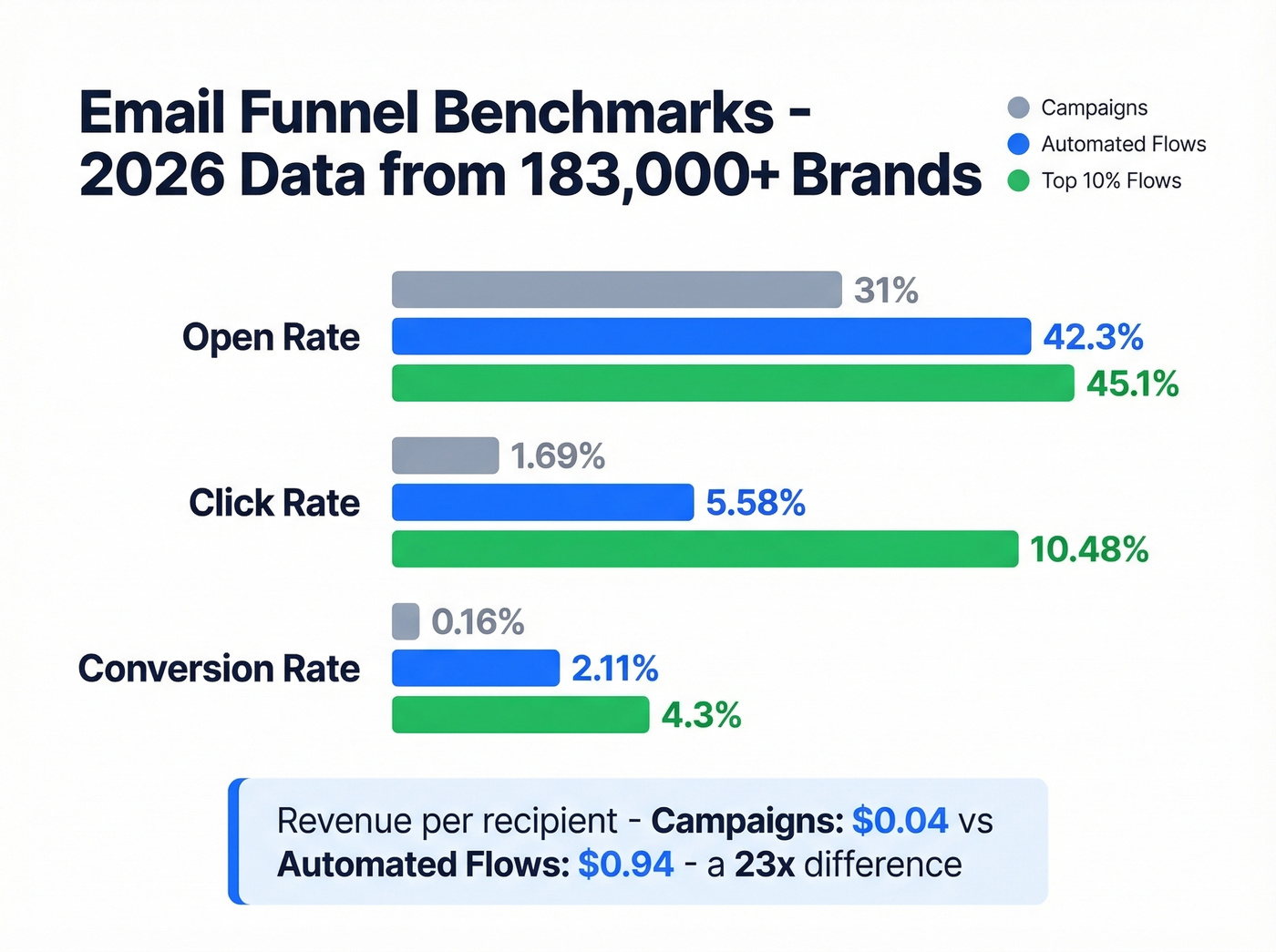
| Metric | Campaigns | Automated Flows | Top 10% Flows |
|---|---|---|---|
| Open rate | 31% | 42.3% | 45.1% |
| Click rate | 1.69% | 5.58% | 10.48% |
| Conversion | 0.16% | 2.11% | 4.3% |
| Revenue/recipient | $0.04 | $0.94 | - |
For specific sequence types, welcome series average around 3% conversion, abandoned cart flows recover 10-15% of lost purchases, and post-purchase follow-ups average 6.8%.
Here's the thing: if your flows are converting below 1%, don't rewrite your copy. Don't redesign your templates. Check deliverability. Nine times out of ten, that's where the problem lives - and it's the fix nobody wants to hear because it's less fun than wordsmithing subject lines.

A 6-email sequence means nothing if half your list bounces. Prospeo's 5-step verification keeps bounce rates under 2% - the threshold that separates inbox placement from spam folders. At $0.01 per verified email, cleaning your funnel list costs less than one lost conversion.
Stop optimizing copy for emails that never reach the inbox.
Triggers Beat Timers
Time-based drips are fine as a starting point, but behavioral triggers dramatically outperform them. Customized transactional emails yield 6x higher revenue than generic sends. Here's the timing cheat sheet:
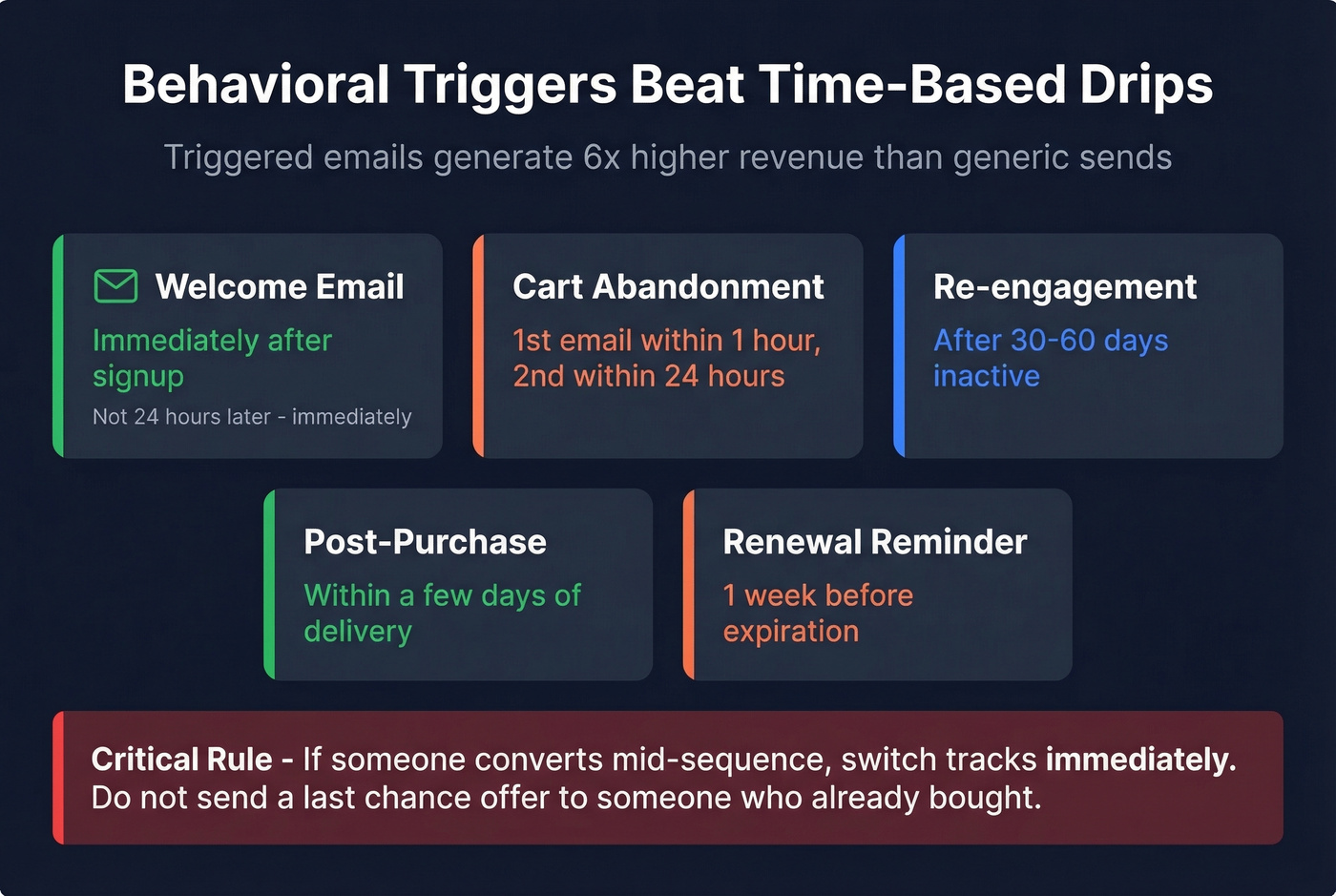
- Welcome email - immediately after signup (not 24 hours later - immediately)
- Cart abandonment - first email within 1 hour, second within 24 hours
- Re-engagement - after 30-60 days of inactivity
- Post-purchase - within a few days of delivery
- Renewal reminder - 1 week before expiration
The critical rule: if someone converts mid-sequence, switch tracks. Don't send a "last chance" offer to someone who already bought. Build branching logic that moves converters into a thank-you or onboarding flow automatically. This sounds obvious, but the consensus on r/emailmarketing is that most teams skip this step and wonder why unsubscribe rates spike at Email 5.
Deliverability - The Silent Funnel Killer
Your sequence is invisible if it lands in spam. And deliverability has gotten brutal in 2026.
Office365 inbox placement dropped to 50.70% - down nearly 27 percentage points year over year. Outlook and Hotmail sit at 26.77%. Only 7.6% of domains enforce DMARC, yet authenticated senders are 2.7x more likely to reach inboxes. The math is simple: authenticate with SPF, DKIM, and enforced DMARC, or accept that half your sequence never gets seen. Google's sender guidelines and Microsoft's anti-spam policies both spell this out clearly.
Your bounce rate needs to stay below 2%, and spam complaints below 0.1%. Healthy portfolios run bounce rates around 0.35% and spam rates at 0.009%. The gap between those numbers and yours? That's unverified contacts poisoning your sender reputation.
Before launching any funnel sequence, run your contacts through real-time verification. In our experience, this single step fixes more broken funnels than any amount of copywriting. Prospeo's 5-step verification process catches invalid addresses, catch-all domains, and spam traps with 98% email accuracy on a 7-day data refresh cycle. One customer saw bounce rates drop from 35% to under 4% - that's the difference between a sequence that converts and one that destroys your domain.
Skip this step if you're only emailing confirmed double opt-in subscribers from your own forms. But for any purchased list, scraped contacts, or enriched CRM data? Verification isn't optional.

Behavioral triggers only fire when you're reaching real people at real addresses. Prospeo delivers 98% email accuracy with a 7-day data refresh - so your welcome emails, cart recovery, and urgency sends hit verified inboxes, not dead ends.
Every funnel stage converts higher when the data underneath is clean.
Five Mistakes That Kill Funnel Sequences
These come up in nearly every audit we run. Each one is fixable in an afternoon.
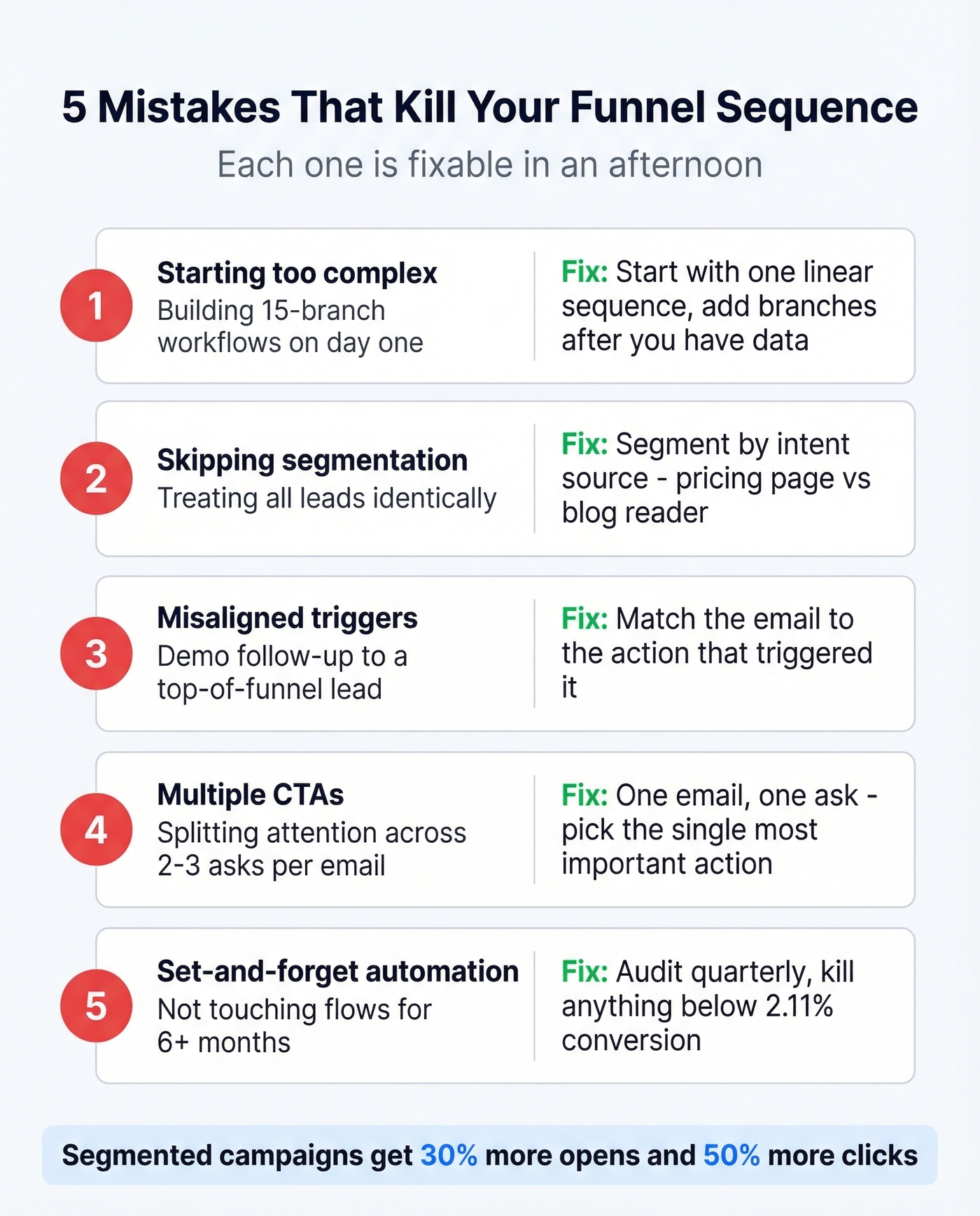
Starting too complex. Resist the urge to build a 15-branch workflow on day one. Start with one linear sequence. Add branches only after you have baseline data telling you where people drop off.
Skipping segmentation. Segmented campaigns generate 30% more opens and 50% more clicks than unsegmented ones. At minimum, segment by intent source - someone who downloaded a pricing guide isn't the same as someone who read a blog post, and treating them identically tanks your conversion rate across every stage of the funnel. If you need a practical framework, start with intent source and build from there.
Misaligned triggers. Sending a demo follow-up to someone who downloaded a top-of-funnel ebook is a conversion killer. Match the email to the action that triggered it, not to where you wish the prospect was.
Multiple CTAs. One email, one ask. Every additional CTA splits attention and tanks click rates. Pick the single most important action and make it obvious (see CTA rules).
Set-and-forget automation. Sequences go stale. Audit your core flows quarterly and kill anything converting below the 2.11% automated flow benchmark. If you haven't touched your welcome series in six months, it's probably underperforming.
Let's be honest: most broken funnels aren't a copy problem. They're a plumbing problem - wrong triggers, wrong timing, wrong data. Fix the plumbing first. If you want a stage-by-stage model to sanity-check your flow, use an AIDA funnel as a quick diagnostic.
FAQ
How many emails should a sales funnel sequence have?
Five to six emails over two to four weeks hits the sweet spot for most funnels. Front-load when intent is highest, then space out to avoid fatigue. The 23-day, 6-email structure outlined above is a solid default - adjust spacing based on your sales cycle length.
What's a good conversion rate for an automated email sequence?
Automated flows average 2.11% conversion across 183,000+ brands in 2026. Welcome series average around 3%, abandoned cart flows recover 10-15%, and post-purchase follow-ups hit roughly 6.8%. Below 1%? Check deliverability and list quality before rewriting copy - bad data is the most common culprit.