

Email Sequencing: What Works, What Doesn't, and What the Data Says in 2026
Automated email sequences convert at 13x the rate of one-off campaigns. That's not a typo - it's what Klaviyo found across 183,000+ brands. Yet most teams still treat email sequencing like a glorified mail merge: blast a list, hope for replies, wonder why deliverability tanks. The gap between teams that sequence well and teams that sequence badly is enormous, and it's mostly about infrastructure, not copywriting.
What Is Email Sequencing?
An email sequence is a series of pre-written emails sent automatically based on a trigger - a signup, a cart abandonment, a cold outreach campaign launch. The recipient enters the sequence, and emails fire on a schedule or in response to behavior.
The term gets conflated with "drip campaign." They're close but not identical. A sequence follows a fixed path where everyone gets the same emails in the same order. A drip campaign branches based on behavior and routes people down different paths. Most modern tools blur the line, but the distinction matters when you're choosing software.
There are two fundamentally different categories, and they require different tools, different strategies, and different compliance frameworks:
| Marketing Sequences | Cold Outreach Sequences | |
|---|---|---|
| Audience | Opted-in subscribers | Cold prospects, no prior contact |
| Goal | Nurture, convert, retain | Start a conversation |
| Format | Designed templates, visual | Plain-text, conversational |
| Typical length | 4-7 emails | 2-4 emails |
| Tooling | ESPs (Klaviyo, ActiveCampaign) | Cold outreach tools (Instantly, Lemlist) |
Everything that follows applies to both worlds, but we'll call out where the advice diverges.
Key Takeaways
- 13x conversion gap. Automated flows hit a 2.11% placed-order rate vs. 0.16% for one-off campaigns.
- Shorter beats longer for cold outreach. Two-step sequences outperformed five-step by roughly 50% across 12 tested campaigns.
- Deliverability is the prerequisite. SPF, DKIM, DMARC, warmup ramps, bounce thresholds - get these wrong and your sequences never reach an inbox.
- Verify before you send. A 15% bounce rate can kill a domain in 30 days.
2026 Benchmarks: Why Sequences Win
The case for automated sequences over one-off campaigns isn't theoretical anymore. Klaviyo's 2026 benchmarks analyzed data from 183,000+ brands:
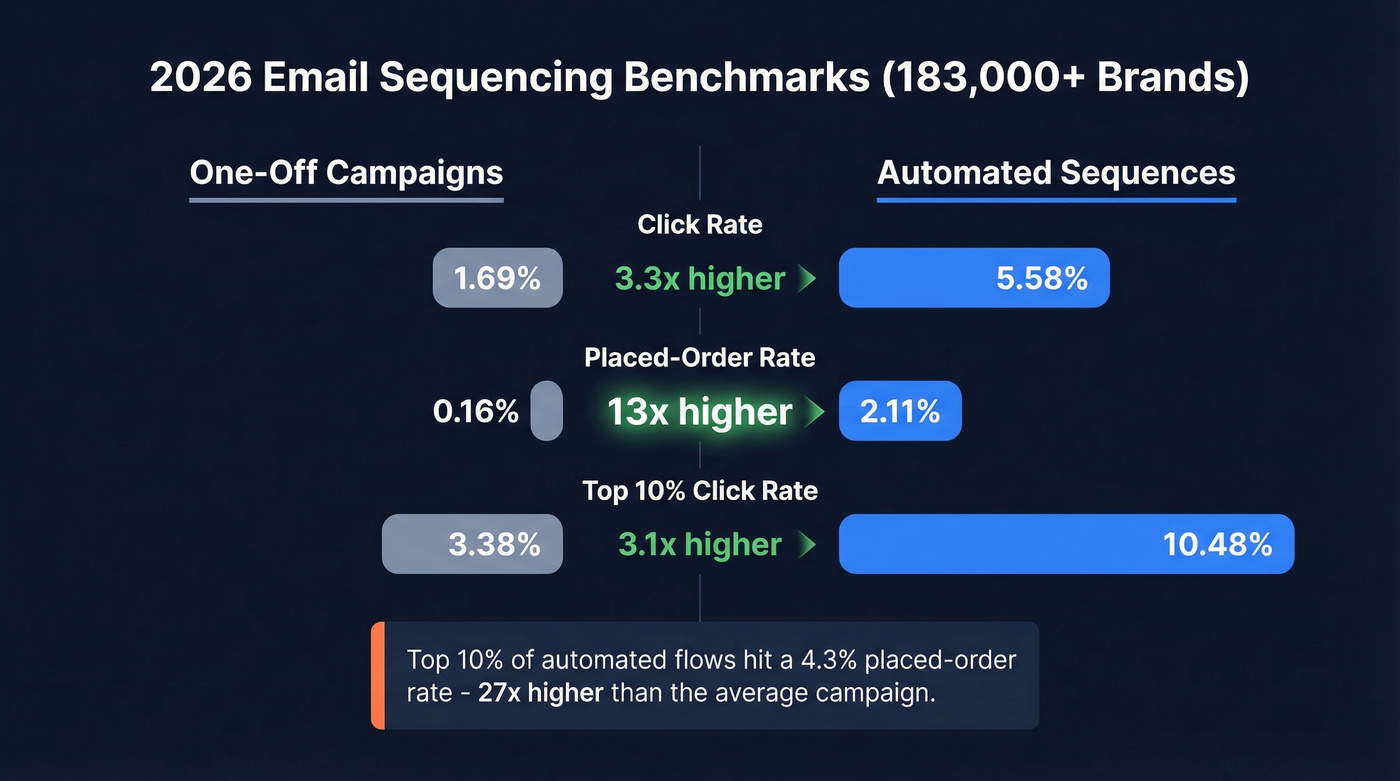
| Metric | One-Off Campaigns | Automated Flows |
|---|---|---|
| Click rate | 1.69% | 5.58% |
| Placed-order rate | 0.16% | 2.11% |
| Top 10% click rate | 3.38% | 10.48% |
That's a 3.3x gap on clicks and a 13x gap on conversions. The top 10% of automated flows hit a 4.3% placed-order rate - 27x higher than the average campaign.
ActiveCampaign's benchmarks tell a similar story from a different angle: 39.26% average open rate and 6.21% click rate across their customer base. The industry-standard stat - $36 ROI per $1 spent on email - still holds, and sequences are where most of that ROI concentrates.
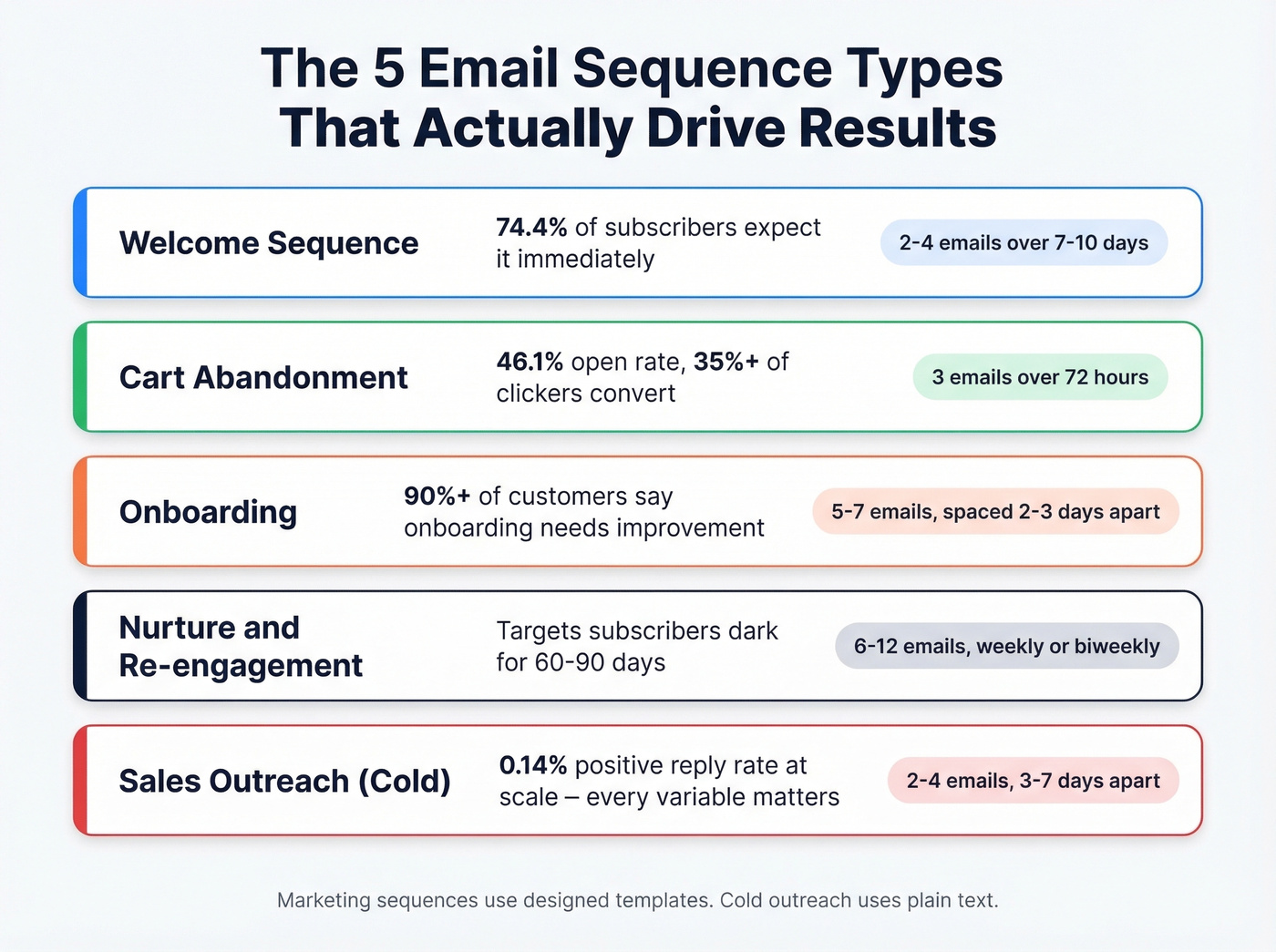
Cart abandonment is the clearest example. 75.5% of shopping carts get abandoned, but 46.1% of people open cart abandonment emails, 13.3% click, and 35%+ of those clickers complete the purchase. That's revenue sitting on the table, recovered by a simple three-email sequence.
Sequence Types That Drive Results
Welcome Sequences
74.4% of subscribers expect a welcome email immediately after signing up. A welcome sequence of 2-4 emails over 7-10 days sets expectations, delivers your lead magnet, and drives the first conversion while engagement is highest. Skip this and you're wasting your best window.
Cart Abandonment
The highest-ROI sequence in ecommerce. Three emails - one soon after abandonment, one the next day, one 48-72 hours later - is the standard cadence, and these emails can hit that 46.1% open rate. If you're running any kind of online store without this automated, you're leaving the easiest money on the table.
Onboarding Sequences
Over 90% of customers think the onboarding process needs improvement. A 5-7 email onboarding sequence that walks new users through key features, shares quick wins, and addresses common friction points reduces churn more reliably than any other retention tactic. Space them 2-3 days apart.
Nurture and Re-engagement
Nurture sequences run over weeks or months, delivering case studies, guides, and industry insights to prospects who aren't ready to buy. Typical length is 6-12 emails, spaced weekly or biweekly. The goal isn't conversion - it's staying top of mind until timing aligns.
Re-engagement sequences target subscribers who've gone dark for 60-90 days. A 2-3 email "still interested?" series either reactivates them or gives you permission to clean your list. Either outcome improves deliverability.
Sales Outreach Sequences
Different beast entirely. A sales outreach sequence is plain-text, personalized, and sent to prospects who've never heard of you. The data here contradicts most of what you've read.

A 15% bounce rate kills your domain in 30 days - and your sequences with it. Prospeo's 5-step verification delivers 98% email accuracy, so your carefully crafted sequences actually reach inboxes instead of spam folders.
Stop sequencing into the void. Start with emails that land.
Cold Email Sequence Blueprint
Most cold email advice is written by people selling cold email tools. The actual practitioner data tells a different story. One poster on r/coldemail ran 500K+ emails over three months and tracked every result: 694 positive replies, 85 clients signed directly. That's a 0.14% positive reply rate at massive scale - which reinforces why every variable in your sequence needs to earn its place.
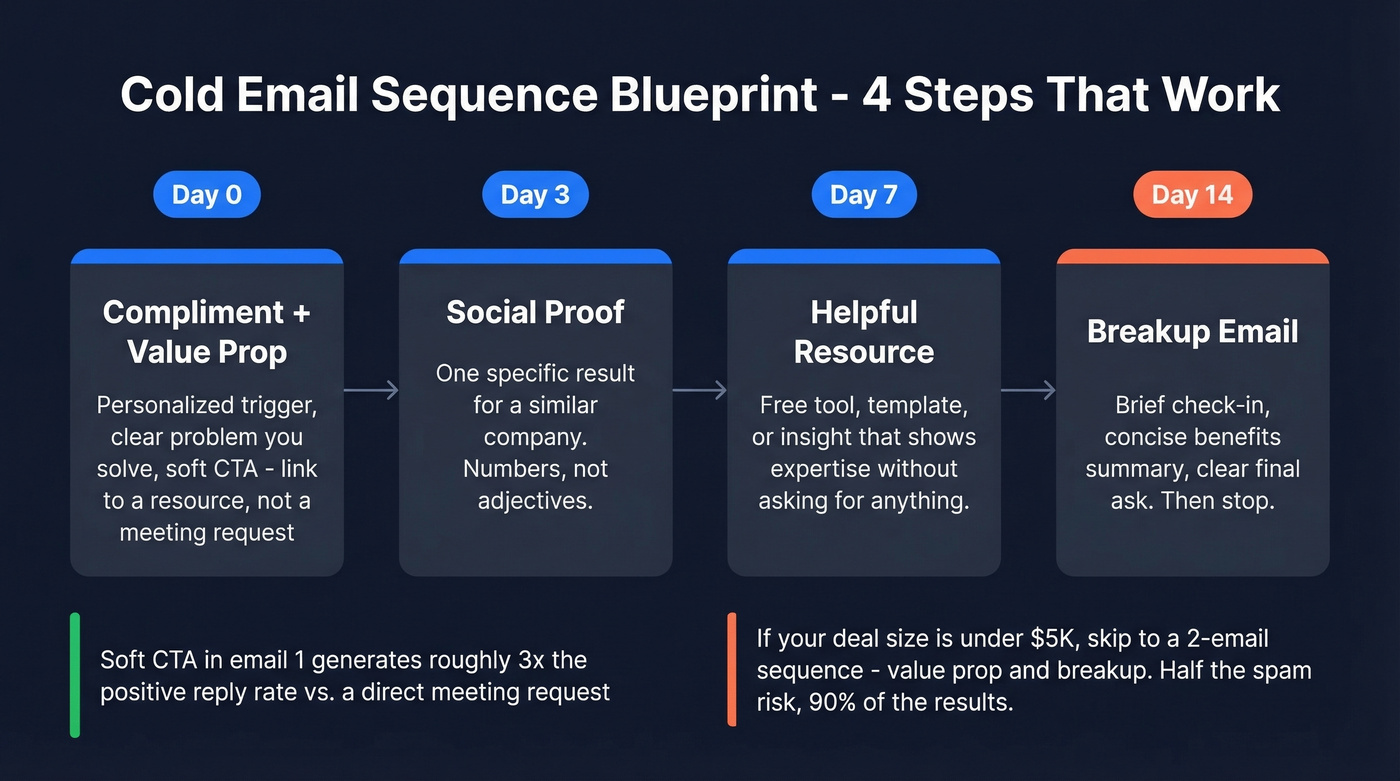
Here's a proven four-email structure, adapted from Cognism's B2B sequence framework:
- Day 0 - Compliment + value prop. Personalized trigger plus a clear statement of what you solve. Soft CTA - link to a resource or case study, not a meeting request.
- Day 3 - Social proof. One specific result you've driven for a similar company. Numbers, not adjectives.
- Day 7 - Helpful resource. A free tool, template, or insight that demonstrates expertise.
- Day 14 - Breakup. Brief check-in, concise summary of benefits, clear final ask.
That soft CTA in email one matters enormously. Across 15-20 tested campaigns, a resource or case study CTA generated roughly 3x the positive reply rate compared to a direct meeting request. People don't want to commit 30 minutes to a stranger. Give them something valuable first.
For multichannel, the data favors sequential over parallel. Email first, then engage on professional networks only after someone shows interest, then phone for high-intent signals. Practitioners report a 30% higher positive reply rate with this sequential approach than hitting every channel simultaneously.
Here's the thing: if your deal size is under $5K, you probably don't need a four-step sequence at all. Two emails - value prop and breakup - will get you 90% of the results at half the spam risk. We've watched teams burn domains running five-step sequences for products that sell for $2K/year. The math never works.
Timing and Cadence
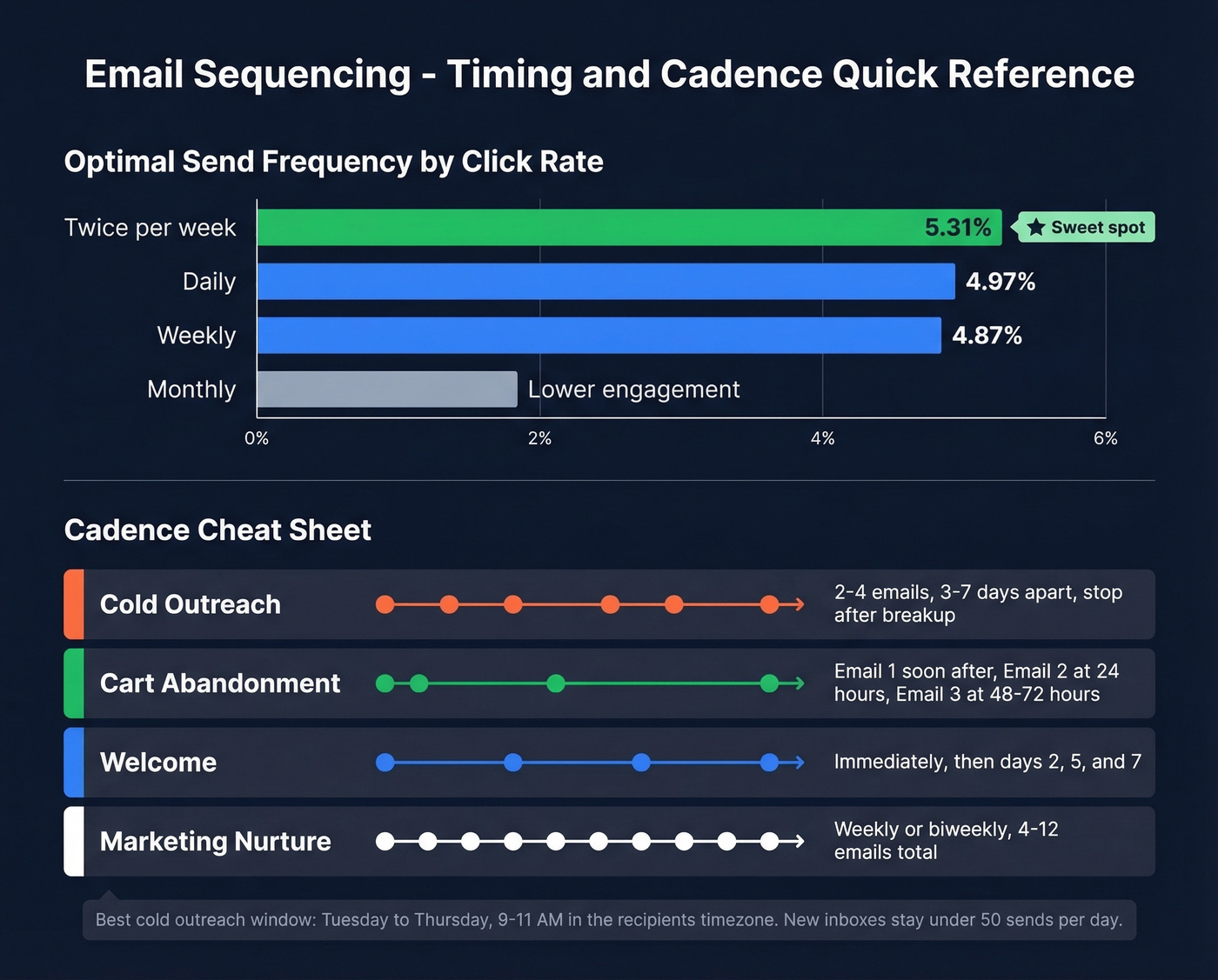
For cold outreach, the consensus is clear: Tuesday through Thursday, 9-11 AM in the recipient's timezone, with 3-7 day intervals between touches. New inboxes should stay under 50 sends per day until properly warmed.
For marketing sequences, the picture is more nuanced. Here's how businesses actually send, per MailerLite-derived data:
- 36.3% send 1-3 emails per month
- 29.5% send weekly
- 12.2% send twice per week
- 10.8% send daily
The sweet spot for click rates is twice per week at 5.31% - slightly above daily at 4.97% and notably above weekly at 4.87%. But frequency tolerance depends entirely on your audience and content quality.
Quick cadence reference:
- Cold outreach: 2-4 emails, 3-7 days apart, stop after the breakup
- Marketing nurture: weekly or biweekly, 4-12 emails total
- Cart abandonment: soon after abandonment, then ~24 hours, then 48-72 hours
- Welcome: immediately, then days 2, 5, and 7
A/B test your send times and intervals within sequences. AI-powered send-time optimization tools promise to find the perfect window per recipient, but segmentation and list quality move the needle far more than send-time tweaks.
If your unsubscribe rate spikes above ~0.3%, you're either sending too frequently or to the wrong segment. Fix the targeting before you fix the copy.
Deliverability - The Prerequisite
None of your sequences matter if they land in spam. And in 2026, the rules are stricter than ever.
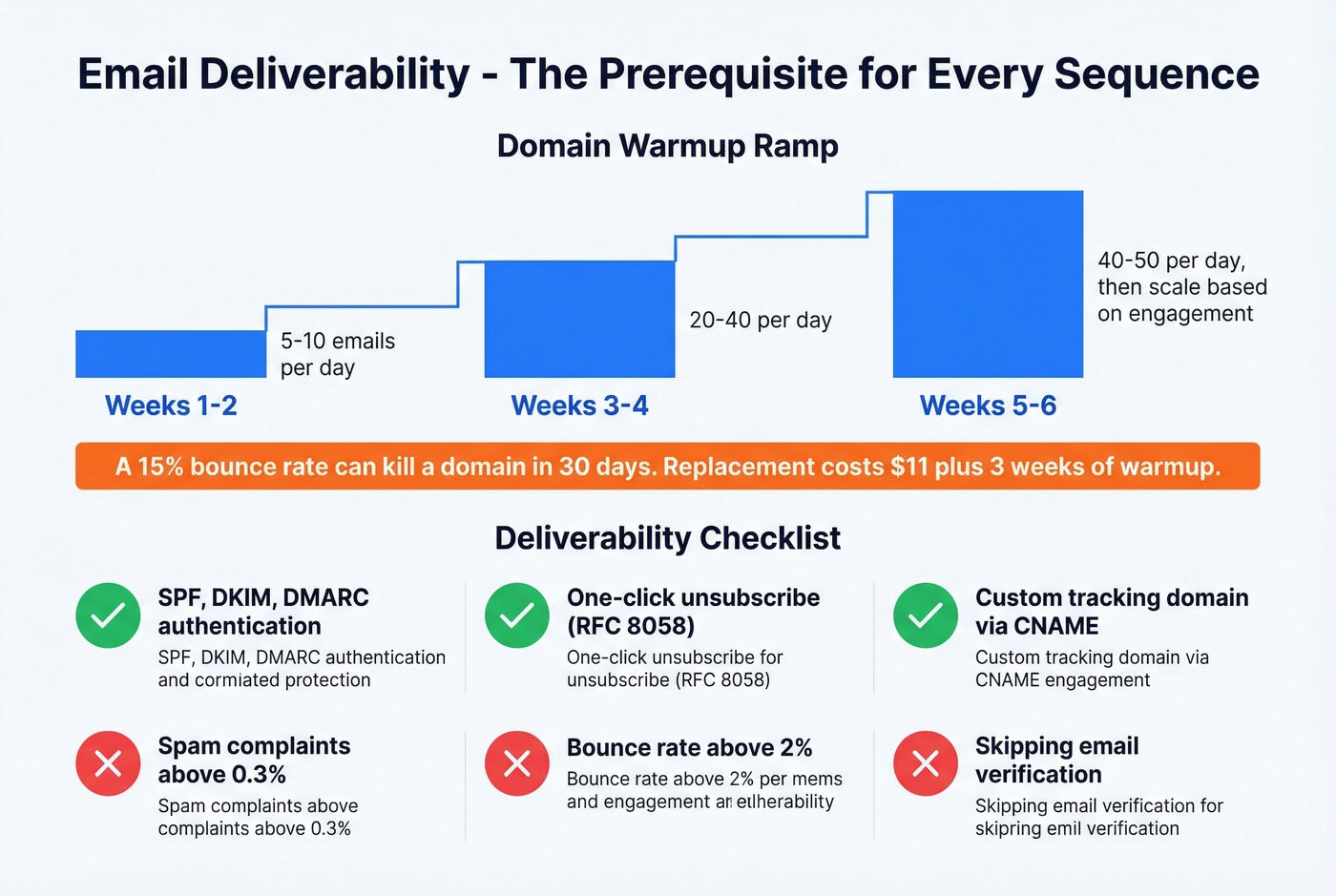
Bulk sender requirements now mandate SPF, DKIM, and DMARC authentication. One-click unsubscribe per RFC 8058 is required for marketing emails. Spam complaints must stay under 0.3%. Bounces must stay under 2%. Violate these thresholds and inbox providers throttle you - sometimes permanently.
For cold outreach specifically, CAN-SPAM requires accurate sender information, a physical mailing address, and a functioning unsubscribe mechanism. GDPR adds legitimate interest requirements for EU prospects. Ignoring these isn't just risky - it's expensive.
New domain warmup ramp:
- Weeks 1-2: 5-10 emails per day
- Weeks 3-4: 20-40 per day
- Weeks 5-6: 40-50 per day, then scale based on engagement
Set up a custom tracking domain via CNAME to isolate your tracking reputation from shared infrastructure. It's a 10-minute setup that most teams skip and later regret.
Let's be honest about open rates: they're a vanity metric now. Apple Mail Privacy Protection pre-fetches tracking pixels, inflating open rates to 85%+ while actual human engagement sits below 1%. We've seen campaigns that looked incredible on opens but had near-zero replies. Track reply rates for cold outreach and click rates for marketing sequences. Everything else is noise.
Before launching any sequence, verify your list. A 15% bounce rate can kill a domain within 30 days, and replacement domains cost ~$11 each plus three weeks of warmup. The math is simple: verify first, send second. Prospeo's 5-step verification process with catch-all handling and spam-trap removal integrates natively with Instantly, Lemlist, Saleshandy, and Smartlead, so verified contacts flow directly into your sequencing tool.
"Best Practices" That Actually Hurt
The consensus on r/coldemail is that several widely-taught tactics actively damage results at scale. Here are five from practitioner data across 500K+ emails, plus two marketing-specific mistakes most guides ignore.
1. Long sequences. Two-step sequences outperformed five-step by ~50% across 12 campaigns. Steps 3-5 almost never converted and increased spam complaints. After two touches, you're training inbox providers to flag you.
2. Meeting-request CTAs in the first email. The lowest-converting CTA type across 15-20 campaigns. A soft ask - a case study link, a relevant resource - generated roughly 3x the positive reply rate.
3. Buying pre-built lists. Pre-built lists consistently showed 8-15% bounce rates. At 15%, you're looking at domain damage within a month. Fresh scraping plus verification costs ~$0.15 per lead all-in, versus $0.50-$1.00 from database providers. (If you're unsure where the line is legally, read our guide on buying email lists.)
4. Heavy AI personalization. Heavy AI personalization produced a 1.9% reply rate versus 1.8% for simple relevance-based personalization. That's a 0.1 percentage point lift for 3x the cost. Mentioning the prospect's industry, a recent company event, or their tech stack works just as well.
5. Optimizing for open rates. Apple MPP inflates open rates to 85%+ with less than 1% actual human engagement. If you're A/B testing subject lines based on opens, you're optimizing for a metric that doesn't reflect reality. Use proven cold email subject line examples and measure replies/clicks instead.
6. Ignoring mobile rendering. Over 60% of emails are opened on mobile devices. Marketing sequences built with desktop-first templates lose clicks to broken layouts and tiny CTAs. Test every email on a phone screen before it enters your sequence.
7. Skipping segmentation. Segmented campaigns drive up to 5x higher open rates than unsegmented blasts. Sending the same nurture sequence to your entire list is the marketing equivalent of the "long sequence" mistake - more volume, worse results.
Best Email Sequence Software in 2026
| Tool | Best For | Starting Price | Category |
|---|---|---|---|
| Prospeo | List verification | Free (75 emails/mo) | Data Quality |
| ActiveCampaign | Marketing automation | ~$19/mo (1K contacts) | Marketing |
| Klaviyo | Ecommerce sequences | ~$20/mo (500 contacts) | Marketing |
| Brevo | Budget marketing | Free (300 emails/day) | Marketing |
| Saleshandy | Cold outreach | ~$25/mo (annual) | Cold Outreach |
| Instantly | High-volume cold | ~$30/mo (annual) | Cold Outreach |
| Lemlist | Multichannel cold | ~$55/mo (annual) | Cold Outreach |
ActiveCampaign
~$19/mo for 1K contacts. On r/MarketingAutomation, ActiveCampaign consistently gets praised for the deepest automation capabilities in its class - behavioral triggers, conditional branching, lead scoring, CRM built in. The 39.26% average open rate across their customer base speaks to deliverability. The learning curve is real, and pricing scales aggressively past 10K contacts. But for sophisticated nurture sequences, it's the standard most teams measure against.
Klaviyo
The ecommerce default. If you're on Shopify or WooCommerce, start here - the integrations and pre-built flow templates for cart abandonment, browse abandonment, and post-purchase work out of the box. ~$20/mo for 500 contacts. Where it falls short is anything outside ecommerce; the B2B use case feels bolted on rather than native.
Brevo
Skip this if you need advanced automation or deep behavioral triggers. Choose this if you need a generous free tier and simple sequences without complexity. 300 emails/day free, paid plans from ~$25/mo. Best for small marketing teams running straightforward welcome and nurture flows.
Saleshandy
Cold outreach focused with unified inbox management and A/B testing. ~$25/mo annually. Good for moderate-volume outbound without the learning curve of larger platforms.
Instantly vs. Lemlist
Two cold outreach heavyweights, and the choice comes down to channel strategy. Instantly (~$30/mo) is built for high-volume email with inbox rotation and warmup tools included. Lemlist (~$55/mo) adds multichannel orchestration - email, social touches, and manual tasks in one workflow. If you're running the sequential approach that produces 30% higher reply rates, multichannel orchestration can justify the premium. Email-only? Instantly wins on value.
Cold outreach sequences live or die on data quality. Prospeo gives you 300M+ verified contacts with 30+ filters - buyer intent, technographics, job changes - so every sequence targets the right person at the right moment. At $0.01 per email, bad data is no longer an excuse.
Build sequences worth sending. Start with contacts worth reaching.
FAQ
What is email sequencing?
Email sequencing is the practice of sending a series of pre-written emails automatically based on a trigger like a signup, cart abandonment, or outreach campaign launch. Recipients enter the sequence and receive emails on a set schedule or in response to behavior. Marketing sequences typically run 4-7 emails; cold outreach performs best at 2-4.
What's a good open rate for sequences?
A 30-40% open rate is a solid baseline - benchmark data shows 31% for campaigns and 39%+ for well-optimized automated flows. That said, Apple Mail Privacy Protection inflates open rates significantly. Prioritize click rates for marketing and reply rates for cold outreach as more reliable performance indicators.
How do sequences differ from drip campaigns?
Sequences follow a fixed series where every recipient gets the same emails in the same order. Drip campaigns branch based on behavior - clicks, opens, purchases - routing people down different paths. Most modern tools blend both approaches, and the terms are often used interchangeably in practice.
How do I keep sequences out of spam?
Authenticate your domain with SPF, DKIM, and DMARC. Keep bounces under 2% and spam complaints under 0.3%. Warm up new domains over 4-6 weeks. Verify your list before sending - catch invalid addresses, spam traps, and catch-all domains before they damage your sender reputation.
What's the best send time for sequence emails?
Tuesday through Thursday, 9-11 AM in the recipient's timezone, with 3-7 day intervals for cold outreach. For marketing sequences, twice-weekly sending hits the click-rate sweet spot at 5.31%. A/B test within your audience - segmentation matters more than send-time optimization.