

Best Email Validation Tools in 2026: Honest Picks
You just sent 10,000 cold emails. By morning, 1,600 of them never reached an inbox. Your bounce rate spiked, your sender reputation took a hit, and your sequencing tool flagged your domain. The global inbox placement rate sits around 83.5% - meaning roughly 1 in 6 emails vanish before anyone sees them. Every email validation tool on the market claims 98-99% accuracy. The real test isn't syntax checking - it's what happens when your list is full of catch-all domains, role-based addresses, and contacts who changed jobs three months ago.
Our Top Picks (TL;DR)
| Use Case | Pick | Why |
|---|---|---|
| Outbound teams | Prospeo | Finds and verifies in one step. 98% accuracy with catch-all handling. |
| Budget verifier | Bouncer | $8/1K to start. Credits never expire. No charge for unknowns or duplicates. |
| Speed at scale | Emailable | 2M emails/hour. Nothing else comes close on throughput. |
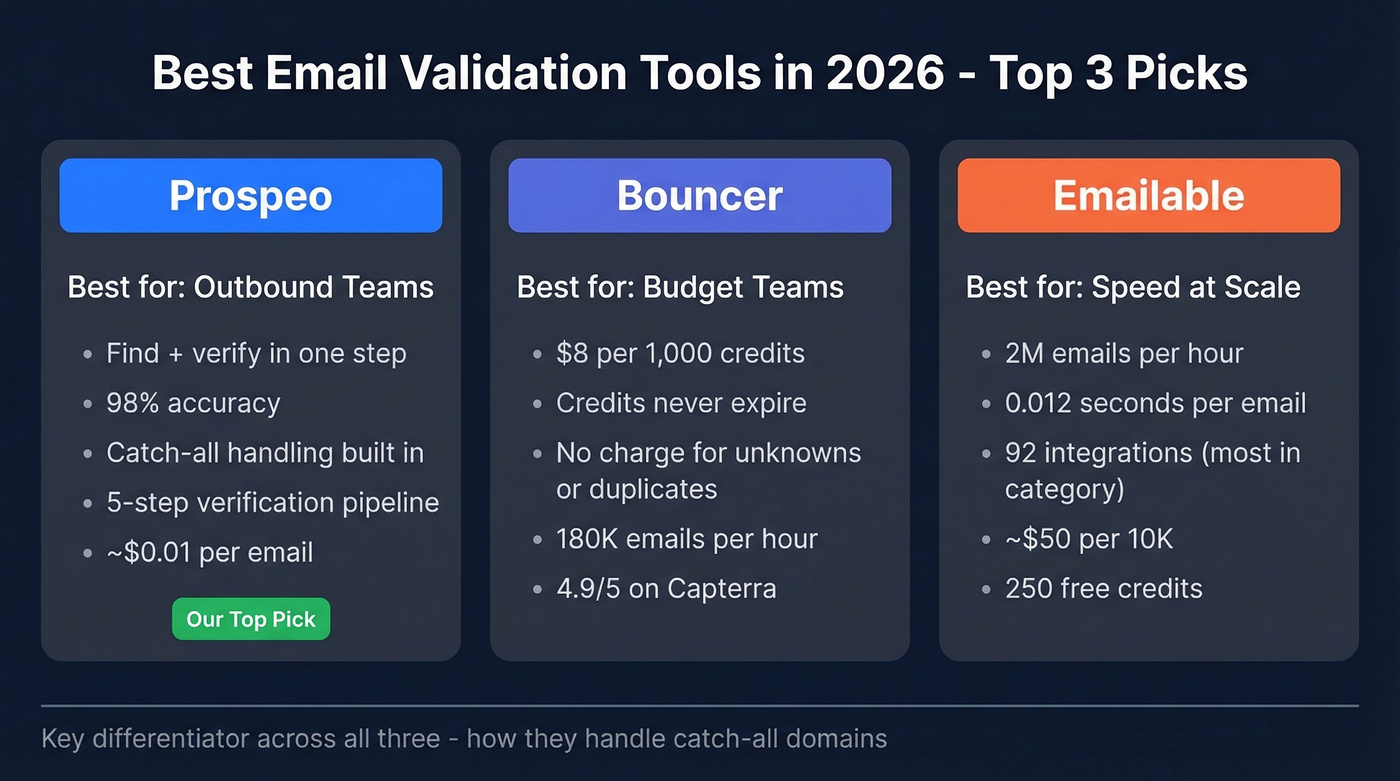
Prospeo is our pick for outbound and prospecting teams because it kills the two-tool workflow. Instead of finding emails in one platform and verifying them in another, Prospeo's 5-step verification pipeline handles catch-all detection, spam-trap removal, and honeypot filtering in a single pass - across 143M+ verified addresses. We've seen the results firsthand: Meritt dropped their bounce rate from 35% to under 4%, and Snyk's 50-person AE team cut bounces from 35-40% to under 5% while generating 200+ new opportunities per month.
Bouncer is the no-brainer for teams that just need a standalone verifier without committing to a subscription. Pay-as-you-go pricing starts at $8 for 1,000 credits, and they don't charge you for duplicates or unknowns - that's rare in this category.
Emailable wins on raw speed. Two million emails per hour makes it the fastest bulk verifier available. If you're cleaning a 500K-record marketing database overnight, this is the tool.
The key differentiator across all three? How they handle catch-all domains. That's where most "verified" lists still bounce.
Validation vs. Verification
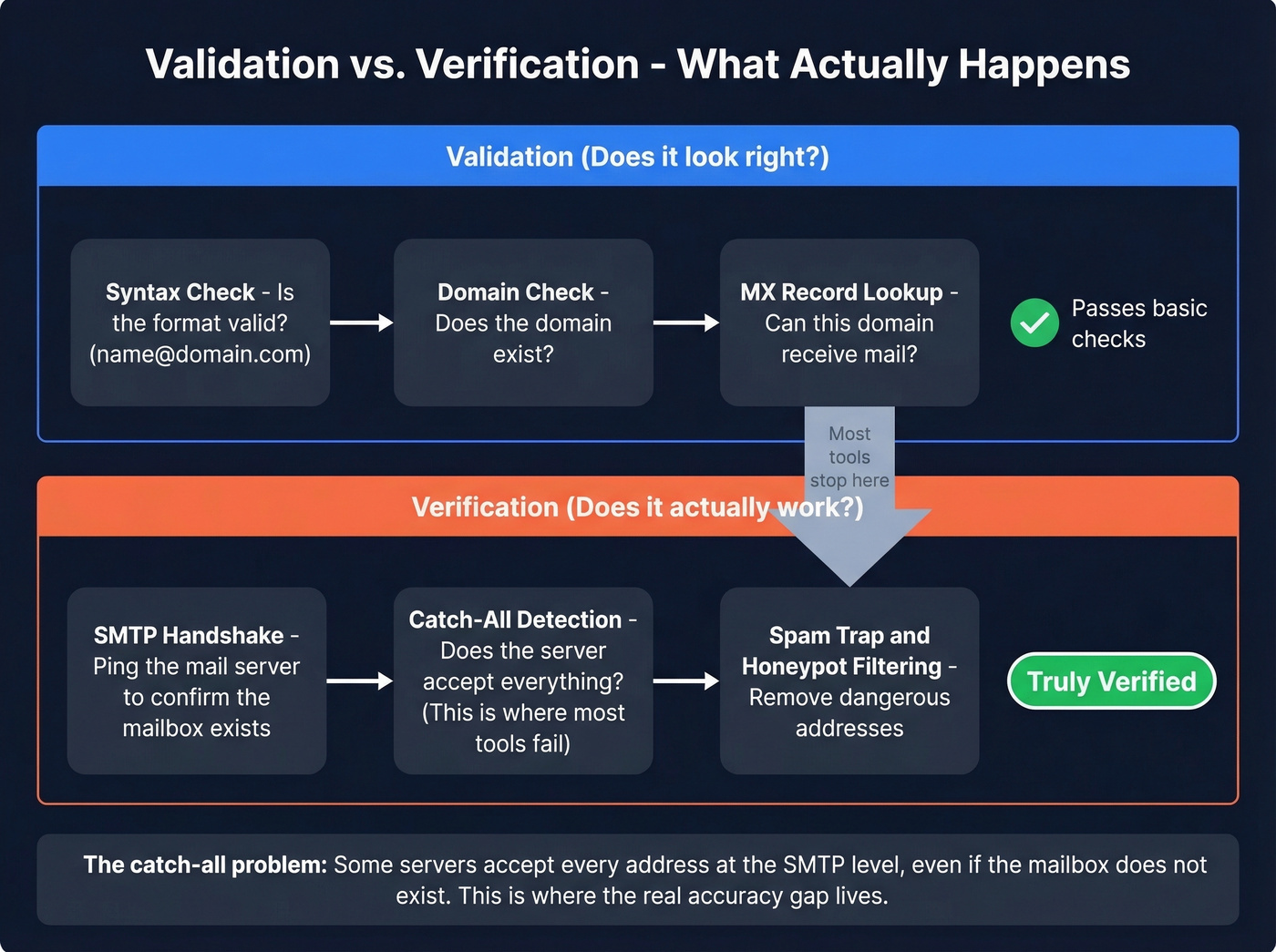
These terms get used interchangeably, but they're different steps. Validation checks whether an email address could exist - proper format, valid syntax, real domain. Verification goes further: it pings the mail server via MX and SMTP lookups to confirm the mailbox actually receives mail. Most tools in this list do both, so the distinction is mostly academic. The one nuance that matters is accept-all (catch-all) domains - servers that accept every address at the SMTP level, even if the specific mailbox doesn't exist. That's where the real accuracy gap lives.
Why Validation Matters for Deliverability
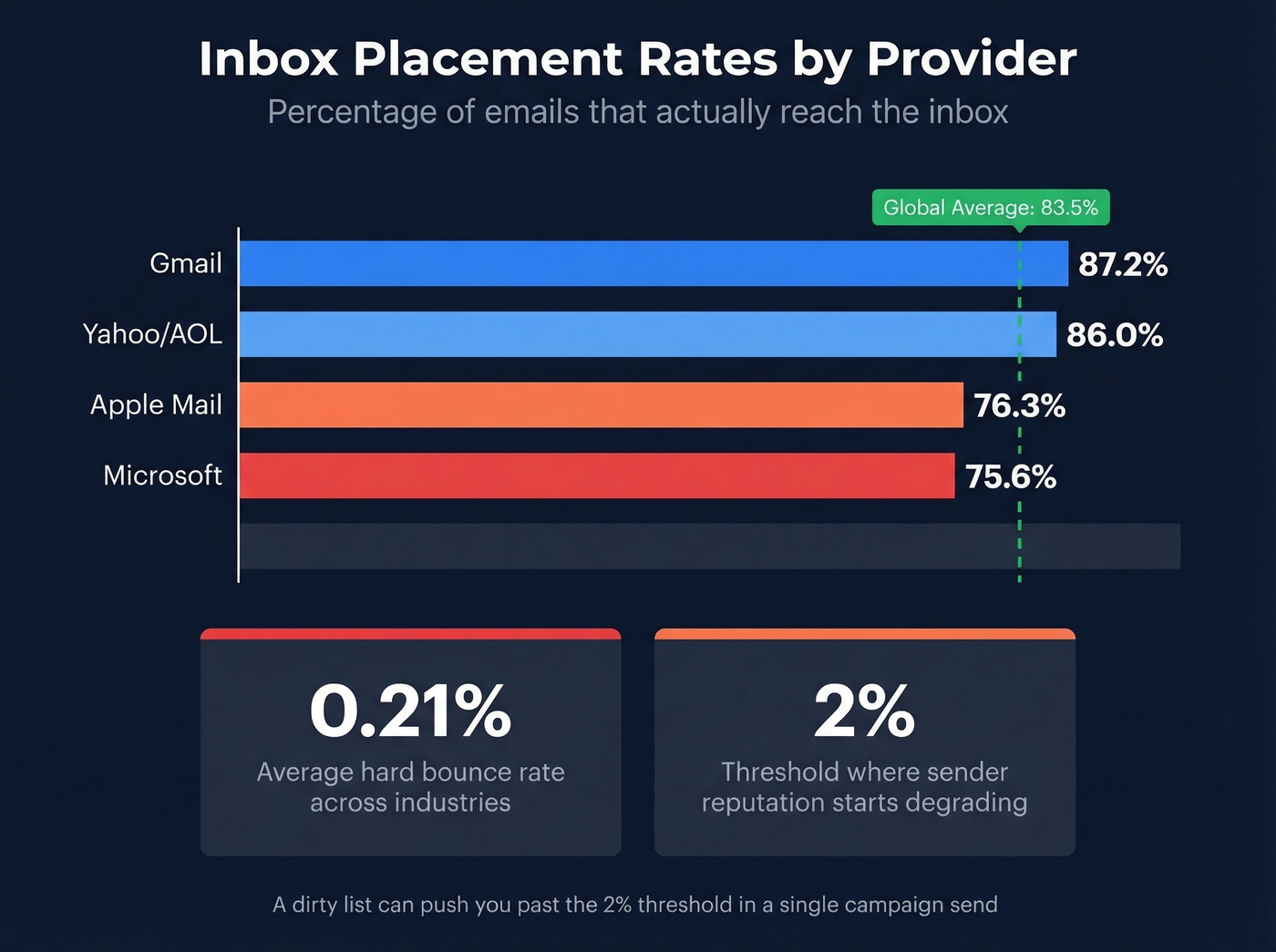
Gmail delivers to the inbox 87.2% of the time. Microsoft? Just 75.6%. Yahoo and AOL hover around 86%. Apple Mail sits at 76.3%. These are averages - if your list is dirty, you'll perform well below them.

The average hard bounce rate across industries is 0.21%. That sounds low until you realize that anything above 2% starts actively degrading your sender reputation. One bad campaign on an unverified list can push you past that threshold in a single send.
Here's the thing: most teams don't need a better verifier - they need to stop treating validation as a one-time event. Email lists decay fast. Average professional turnover runs around 41% annually, which means roughly 4 in 10 contacts on a year-old list have changed jobs, roles, or companies. If you aren't re-verifying every four months at minimum, you're sending to ghosts. The cost isn't just bounces - it's the compounding damage to your domain reputation that makes even your good emails land in spam.
The Best Email Validation Tools
Prospeo
Prospeo collapses the find-and-verify workflow into a single platform. Most outbound teams run one tool to build lists and a second tool to clean them. Prospeo's 5-step verification pipeline - catch-all handling, spam-trap removal, honeypot filtering, syntax validation, and SMTP verification - runs automatically on every email it finds across its 300M+ profile database. The Chrome extension, used by 40,000+ teams, lets you verify contacts on the fly while browsing professional profiles or company websites.
The 7-day data refresh cycle, compared to the 6-week industry average, means you're working with fresher data than almost any competitor. At ~$0.01/email with a free tier of 75 verified emails per month plus 100 Chrome extension credits/month, there's no sales call required to get started. Pricing is credit-based with no contracts and cancel-anytime flexibility. GDPR compliant with DPAs available. For teams running outbound campaigns at scale, Prospeo eliminates the gap between prospecting and list hygiene entirely.
If you're building a full outbound stack, pair verification with sales prospecting techniques that keep reply rates high.
Bouncer
Bouncer has the cleanest billing model in the category. You buy credits, they never expire, and you don't get charged for duplicates or unknown results. That last point matters more than it sounds - other tools burn credits on unresolvable addresses, which quietly inflates your cost per verified email.

Pay-as-you-go pricing starts at $8 for 1,000 verifications and scales to $2,000 for 1M. At the 10K tier, you're paying $60. Speed runs at 180K emails/hour - capable, though not category-leading. The integration count is limited to 16 platforms, which is fine for most workflows but could be a bottleneck if your stack is complex. Bouncer doesn't do email finding, so pair it with a prospecting tool if you need both.
If you're comparing options, see our breakdown of Bouncer alternatives.
Bouncer carries a 4.9/5 on Capterra (233 reviews) and 4.8/5 on G2 (232 reviews). Those are the highest ratings in this list, and they're earned.
ZeroBounce
Use this if: You want a mature, well-integrated verifier with a generous free tier. ZeroBounce offers 100 free monthly verifications (business/premium domain required), credits that never expire, and no charge for unknown results. With 45+ integrations, it's near the top for teams with complex marketing stacks. Plans start at $15/mo.
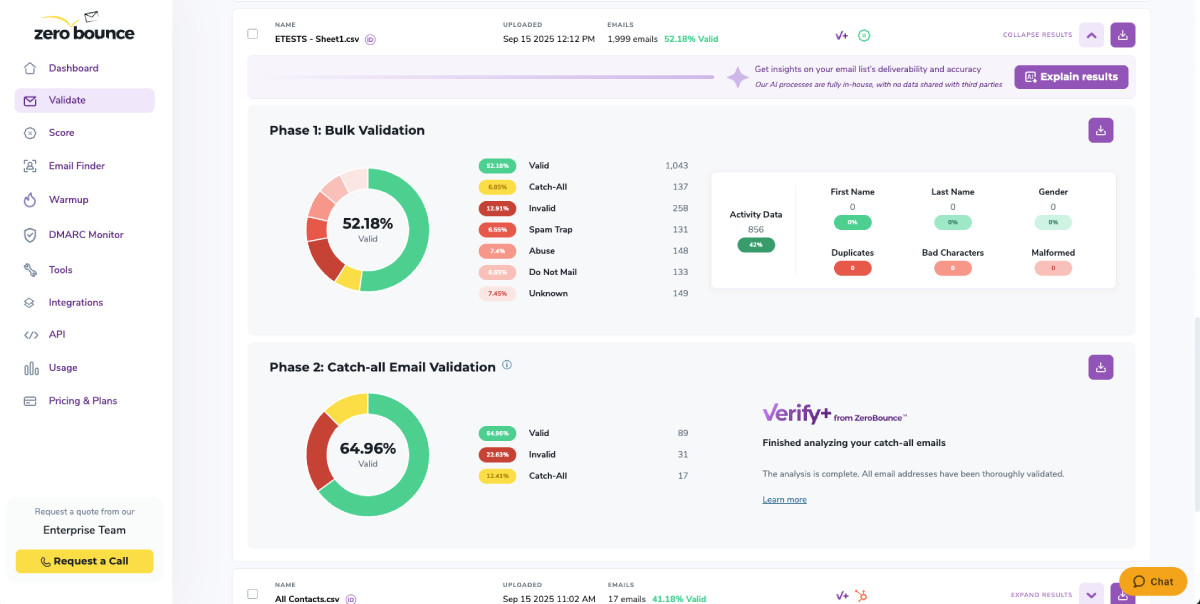
Skip this if: You plan to use their Email Finder heavily. Each successful Email Finder query burns 20 credits, not 1. That's a 20x multiplier that can drain your balance fast if you're prospecting at volume. For pure verification, ZeroBounce runs about $64/10K at 133K emails/hour - adequate, not spectacular.
Emailable
Two million emails per hour. That's 0.012 seconds per email, roughly 10x faster than most competitors. If you have a 500K-record marketing database that needs cleaning before tomorrow's campaign, Emailable is the only tool that can realistically finish overnight with room to spare.
Pricing starts at EUR 25.50/mo, with bulk rates around $50/10K. You get 250 free credits to test and access to 92 integrations - the highest count in this list. I'll be honest: for pure throughput, nothing else in this category is even close.
If you want a head-to-head, check Emailable vs Generect.
Skip this if: You need email finding or prospecting features. Emailable is a pure verification play. Pair it with a prospecting tool if you need both capabilities.
Clearout
Use this if: Support quality matters to your team. Clearout scores a 9.5/10 for quality of support on G2 across 507 reviews with a 4.6/5 overall rating - one of the highest support scores in the category. Verification runs at 160K emails/hour, pricing lands around $58/10K with plans starting at $31.50/mo, and you get 100 free credits plus 38 integrations.
Skip this if: You're optimizing purely on price. Clearout isn't expensive, but EmailListVerify undercuts it significantly.
Hunter
Hunter's real strength is its educational content and the email-finding-plus-verification combo. The free plan includes 100 verifications per month, and paid plans start at $49/mo with 24 integrations. It's used by 6+ million users and is a good fit for small teams that want a clean, simple interface for both finding and verifying emails. Think of Hunter as a quality generalist - competent at everything, best-in-class at nothing.
If you're shopping around, compare Hunter alternatives.
NeverBounce
NeverBounce offers 88 integrations, second only to Emailable, and processes 100K emails/hour at roughly $50/10K. The G2 rating sits at 4.2/5 (141 reviews) - noticeably lower than Bouncer or Clearout. Recurring complaints on G2 center on the credit system and pricing transparency. If your stack demands broad integration coverage and you're less price-sensitive, NeverBounce works. Otherwise, Bouncer gives you better value with cleaner billing.
EmailListVerify
The budget pick. At $24/10K, EmailListVerify is the cheapest verifier on this list by a wide margin. You get 100 free credits to test. The trade-off is real, though - only 11 integrations (the lowest count here) and catch-all handling is weaker than premium options. Community feedback consistently flags support responsiveness as a pain point. Use it for one-off list cleans where you don't need ongoing workflow integration.
Kickbox
Kickbox runs about $80/10K - expensive for a standalone verifier. Hard to justify on price alone when Bouncer and ZeroBounce deliver comparable verification at 25-30% less.
Verifalia
Verifalia offers a free single-email checker that's widely used for quick spot checks. Useful for one-offs. Bulk features at the free tier are limited, so it's more of a utility than a production tool for teams processing lists at scale.
Snov.io
Snov.io is positioned as a broader outbound suite, and its verification pricing comes out to roughly $189/10K. That's steep if you only need validation. If you're already using Snov.io for outbound campaigns, the built-in verifier is convenient. As a standalone email validation tool, there are better options at half the price.
If you're also evaluating list-building, start with our guide to email list providers.

Most teams pay for one tool to find emails and another to validate them - then still hit 5%+ bounce rates on catch-all domains. Prospeo's 5-step verification pipeline handles catch-all detection, spam-trap removal, and honeypot filtering automatically on every email it finds. Meritt dropped from 35% bounces to under 4%. Snyk cut bounces from 40% to under 5% across 50 AEs.
Stop splitting your workflow. Find and verify in one pass at $0.01/email.
Pricing and Speed Comparison
Pricing
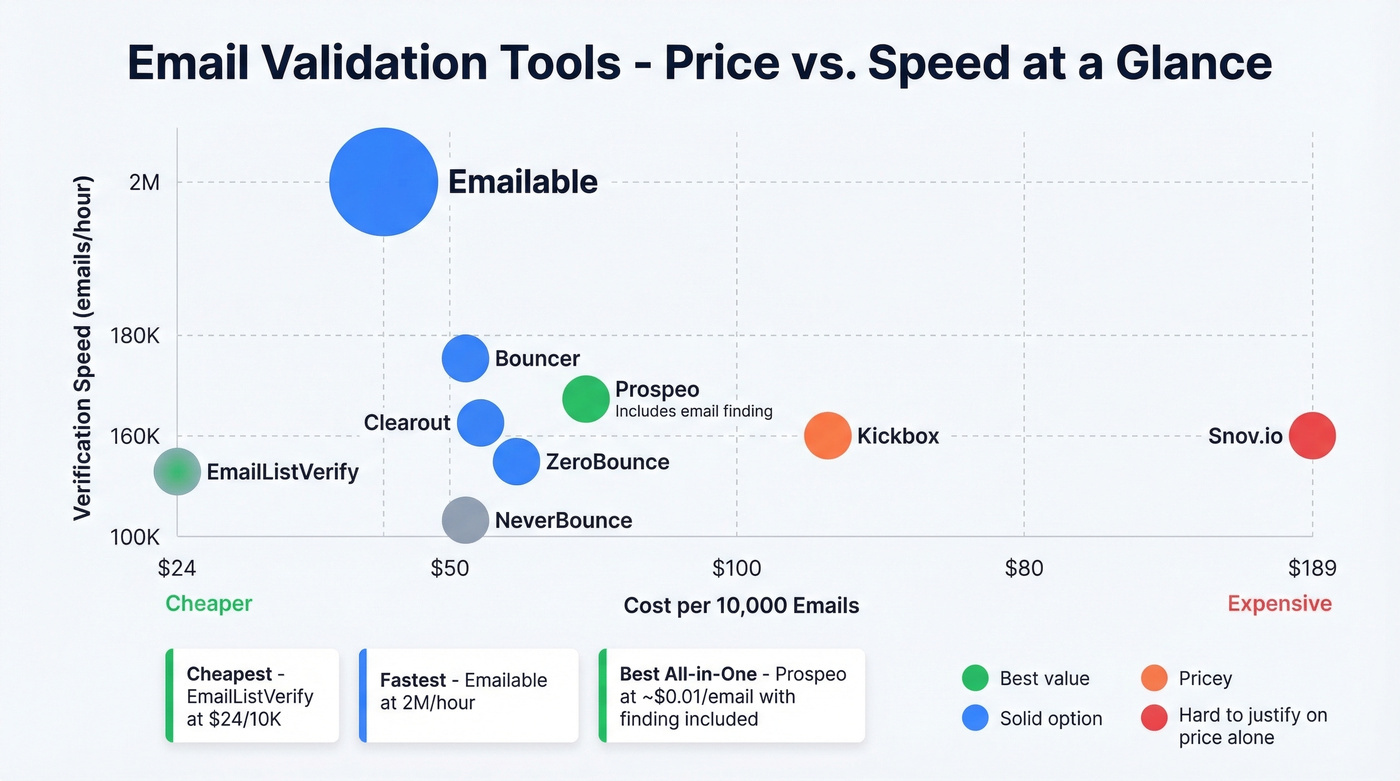
| Tool | Cost/10K | Free Tier | Credits Expire? |
|---|---|---|---|
| Bouncer | $60 | Free credits available | Never |
| ZeroBounce | $64 | 100/mo | Never |
| Emailable | ~$50 | 250 credits | No |
| Clearout | $58 | 100 credits | No |
| Hunter | ~$49/mo plan | 100/mo | Monthly reset |
| NeverBounce | $50 | None | Varies |
| EmailListVerify | $24 | 100 credits | No |
| Kickbox | ~$80 | 100 credits | No |
| Snov.io | ~$189 | Trial credits | Monthly reset |
\Includes email finding + verification. Pure verification tools only validate addresses you already have.*
Speed and Integrations
| Tool | Speed | Integrations | G2 Rating |
|---|---|---|---|
| Emailable | 2M/hr | 92 | 4.5/5 |
| Bouncer | 180K/hr | 16 | 4.8/5 |
| Clearout | 160K/hr | 38 | 4.6/5 |
| ZeroBounce | 133K/hr | 45+ | 4.4/5 |
| NeverBounce | 100K/hr | 88 | 4.2/5 |
The Catch-All Problem
Let's be honest: most email validation articles skip this entirely. Catch-all domains are the #1 reason "verified" emails still bounce. A catch-all server responds "yes, that mailbox exists" to every SMTP query - even for addresses that don't actually work. Your verifier marks it valid. You send the email. It bounces.
This isn't theoretical. On r/coldemail, practitioners regularly report catch-all verification tools returning false positives - addresses flagged as valid that bounce on first send. Some teams resort to running lists through a second verifier like MillionVerifier just to cross-check catch-all results, which is a frustrating tax on time and budget that shouldn't be necessary in 2026.
The tools that handle this best use multi-step verification pipelines that go beyond a single SMTP check to analyze mailbox behavior patterns, historical deliverability data, and server response signatures. Bouncer takes a smart approach - they don't charge for unknown results, so catch-all addresses that can't be definitively verified don't cost you credits. Both strategies beat the worst approach: treating every catch-all response as a confirmed valid address.
If your verification tool doesn't have a specific catch-all handling strategy, you're going to bounce on enterprise domains. Microsoft 365 and Google Workspace domains with catch-all enabled are everywhere in B2B.
If you're seeing deliverability issues, it’s usually not just list hygiene - use an email deliverability guide to diagnose the full stack.
Email lists decay at 41% per year. If your validation tool checks against a database refreshed every 6 weeks, you're verifying against stale data. Prospeo refreshes all 300M+ profiles every 7 days - so your verified emails actually stay verified. 98% accuracy, catch-all handling included, no contracts.
Freshest data wins. Validate against emails refreshed every 7 days, not 6 weeks.
Five Mistakes That Kill Deliverability
1. Treating verification as a one-time event. Your list decays every day. People change jobs, companies switch email providers, domains expire. A list verified in January is significantly degraded by May. Build verification into your workflow as a recurring process, not a launch-day checkbox.
2. Not removing disposable and temporary emails. Services like Guerrilla Mail and Temp Mail generate addresses that work for hours, then die. If your signup forms don't filter these out, they'll inflate your list with addresses that bounce on the next send. Most good verification tools flag disposable domains - make sure you're actually filtering them.
3. Ignoring catch-all results. Marking every catch-all address as "valid" is the single fastest way to spike your bounce rate. Treat catch-all results as a separate category that needs additional verification or conservative handling - don't just dump them into your active send list.
4. Skipping deduplication before verification. Duplicate emails waste verification credits and create messy campaign data. Dedupe your list before you verify, not after. Bouncer handles this automatically by not charging for duplicates, but most tools don't.
5. Not re-verifying after four months. With 41% annual professional turnover, a quarterly re-verification cadence is the minimum. We've seen teams run monthly re-verification on their highest-value segments and quarterly on the rest. The cost of re-verifying is trivial compared to the cost of a damaged sender reputation.
How to Choose the Right Tool
The decision tree is simpler than you'd think.
Running outbound prospecting? You need a tool that finds and verifies in one workflow. Prospeo's 98% accuracy and 7-day data refresh make it the strongest pick for teams sending at volume. Hunter is a lighter-weight option for smaller teams.
If you're sending at scale, also watch your email velocity so you don’t trip provider limits.
Cleaning a marketing database? Bouncer and ZeroBounce are the safest standalone choices - both offer credits that never expire and don't charge for unknowns. Bouncer wins on price ($60 vs. $64 per 10K) and review scores.
For speed-critical teams, look at Emailable. At 2M emails per hour, nothing else comes close for overnight bulk processing.
Budget-constrained? EmailListVerify at $24/10K is unmatched on price. Just know you're trading integration depth and catch-all accuracy for that savings.
Complex martech stacks demand broad integration support. Emailable (92 integrations), NeverBounce (88), and ZeroBounce (45+) all play nicely with multi-tool environments.
Need real-time verification at signup? Look for tools with API-based verification - ZeroBounce, Emailable, and Kickbox all offer real-time API endpoints that validate addresses before they enter your database. If you're building custom integrations, Python's email_validator library can handle format and DNS checks at the code level, though it won't replace a full verification service for SMTP-level confirmation. This is email hygiene at the point of entry, which is always cheaper than cleaning a dirty list after the fact.
Want browser-based validation without installing anything? Most tools here offer web dashboards where you upload a CSV and get results. Verifalia and ZeroBounce are particularly easy for quick, no-setup checks.
Compliance matters. If you're selling into the EU or handling sensitive data, check for GDPR compliance and DPAs. Bouncer, ZeroBounce, and Prospeo all offer GDPR-compliant processing with DPAs available. Don't skip this - a data breach involving unverified email lists is a regulatory nightmare.
FAQ
What's the difference between email validation and verification?
Validation checks whether an email address has correct format, syntax, and a real domain. Verification goes further by confirming the mailbox actually exists and can receive mail through MX and SMTP server checks. Most modern tools perform both steps automatically in a single process.
How often should I re-verify my email list?
Every four months at minimum. Professional turnover averages 41% annually, meaning roughly 10% of contacts go stale each quarter. High-value segments benefit from monthly re-verification. The cost of re-verifying is always less than the cost of bounced campaigns and degraded sender reputation.
Why do verified emails still bounce?
Catch-all domains are the most common culprit. These servers accept all incoming mail at the SMTP level regardless of whether the specific mailbox exists. A standard verification check sees "accepted" and marks the address valid, but the email bounces when the server can't actually deliver it internally.
Can I validate emails for free?
Several tools offer free tiers. Prospeo provides 75 free verified emails per month plus 100 Chrome extension credits. ZeroBounce gives 100 free monthly verifications with a business domain. Hunter includes 100 free verifications on its free plan. Bouncer offers free credits to test with no credit card required.
What's a good email bounce rate?
The average hard bounce rate across industries is 0.21%. Once you cross 2%, your sender reputation starts actively degrading - ESPs flag your domain, inbox placement drops, and even valid emails land in spam. Keep hard bounces under 1% as a practical target, and investigate immediately if you see a spike above 2%.