

Emailchaser vs LeadEngine.ai: Which Cold Email Platform Deserves Your Budget?
One starts at $37/month. The other starts at $99/month. If you're weighing Emailchaser against LeadEngine.ai, the real question isn't whether you're getting 3x the value - it's whether you're getting 3x the complexity you don't need.
The cold email software market has grown from $1.2B in 2023 to a projected $3.5B by 2032, and these two platforms take completely different approaches to getting there.
30-Second Verdict
Emailchaser is the simpler, cheaper option - built for solo founders or small teams that want a straightforward cold email workflow. It starts at $37/month and keeps things predictable.
LeadEngine.ai goes all-in on AI automation with a five-agent system, dedicated infrastructure, and credit-based pricing starting at $99/mo. It's built for teams that want full autopilot and don't mind a steeper learning curve.
Skip both if your real problem is bad lead data, not your sending platform. Neither tool is a data provider. Pair either one with a dedicated source like Prospeo for verified contacts at 98% email accuracy - the best sending infrastructure in the world can't fix a garbage list.
Feature Comparison
| Feature | Emailchaser | LeadEngine.ai |
|---|---|---|
| Email accounts | 1 / 3 / unlimited | Unlimited (all tiers) |
| AI capabilities | [GPT-based spintax](https://help.leadfwd.com/hc/en-us/articles/13365737215507 - Spintax-Make-Each-Email-Unique) | 5-agent system + RevAI reply automation |
| CRM | Built-in Sales CRM | Unlimited CRM/workspaces |
| Verification | Dual-provider (BounceBan + Enrichley) | Waterfall + catch-all scoring |
| Infrastructure | Inbox rotation (unlimited on Professional) | 4-tier dedicated + rotating IPs |
| Lead sourcing | Chrome extension for prospecting | ScaledMail domain/inbox provisioning |
| Integrations | Webhooks | Native + ScaledMail partnership |
| Users | Unlimited seats | Unlimited users |
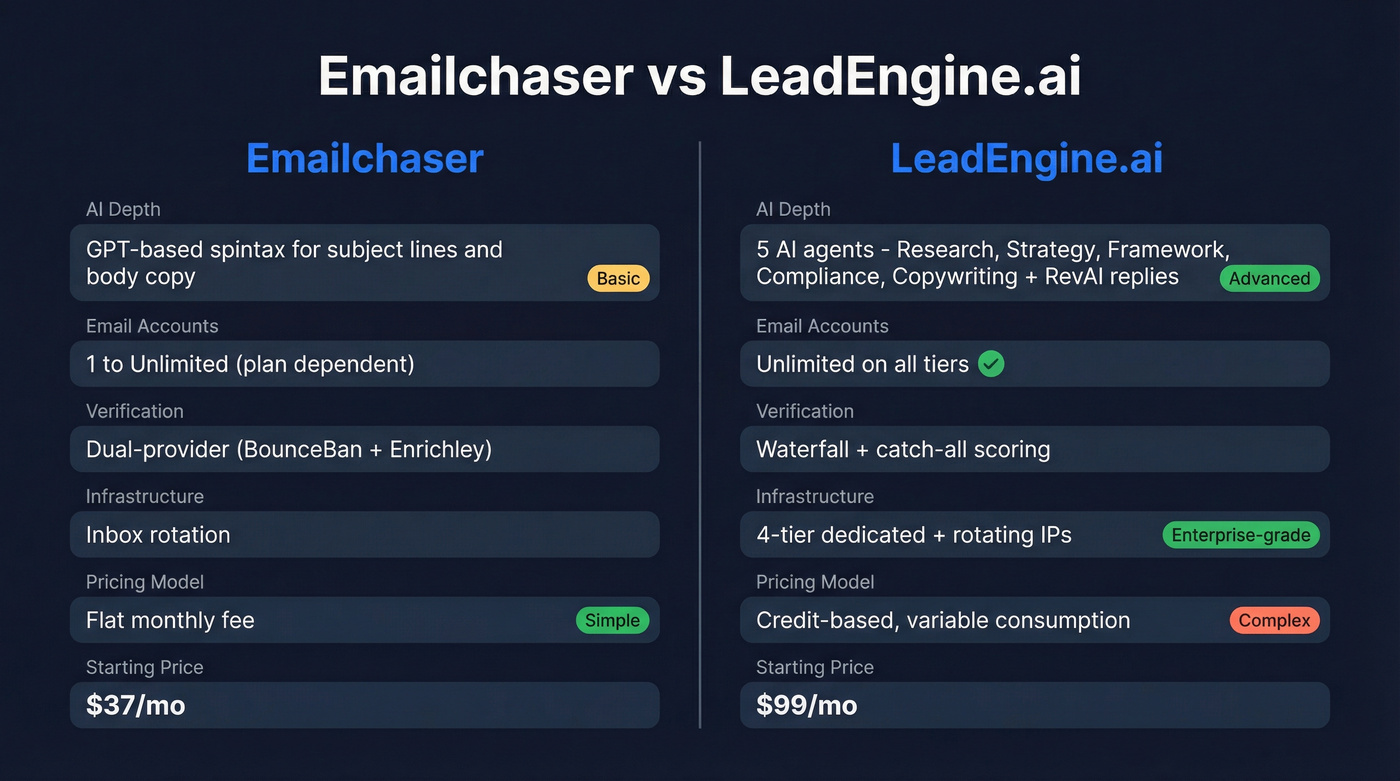
LeadEngine's five AI agents - Deep Research, Strategy, Framework, Compliance, and Copywriting - handle everything from lead research to personalized copy generation. RevAI automates replies to campaign responses on top of that, which is a genuine time-saver for high-volume operations. Emailchaser's AI is limited to GPT-based spintax for subject lines and body variations. That's a meaningful gap if you're running campaigns where manual personalization isn't feasible.
Where Emailchaser fights back is simplicity. The built-in Sales CRM with pipeline tracking, the Master Inbox for centralized replies, the Chrome extension for sourcing leads from websites and professional profiles - it's a tighter, more predictable workflow. LeadEngine partners with ScaledMail to spin up domains and inboxes automatically, which is infrastructure provisioning Emailchaser doesn't offer. But you'll spend more time configuring it all.
One notable LeadEngine philosophy: no link tracking, no images, no attachments. They strip out everything that triggers spam filters. It limits campaign design, but the deliverability logic is sound.
Pricing Breakdown
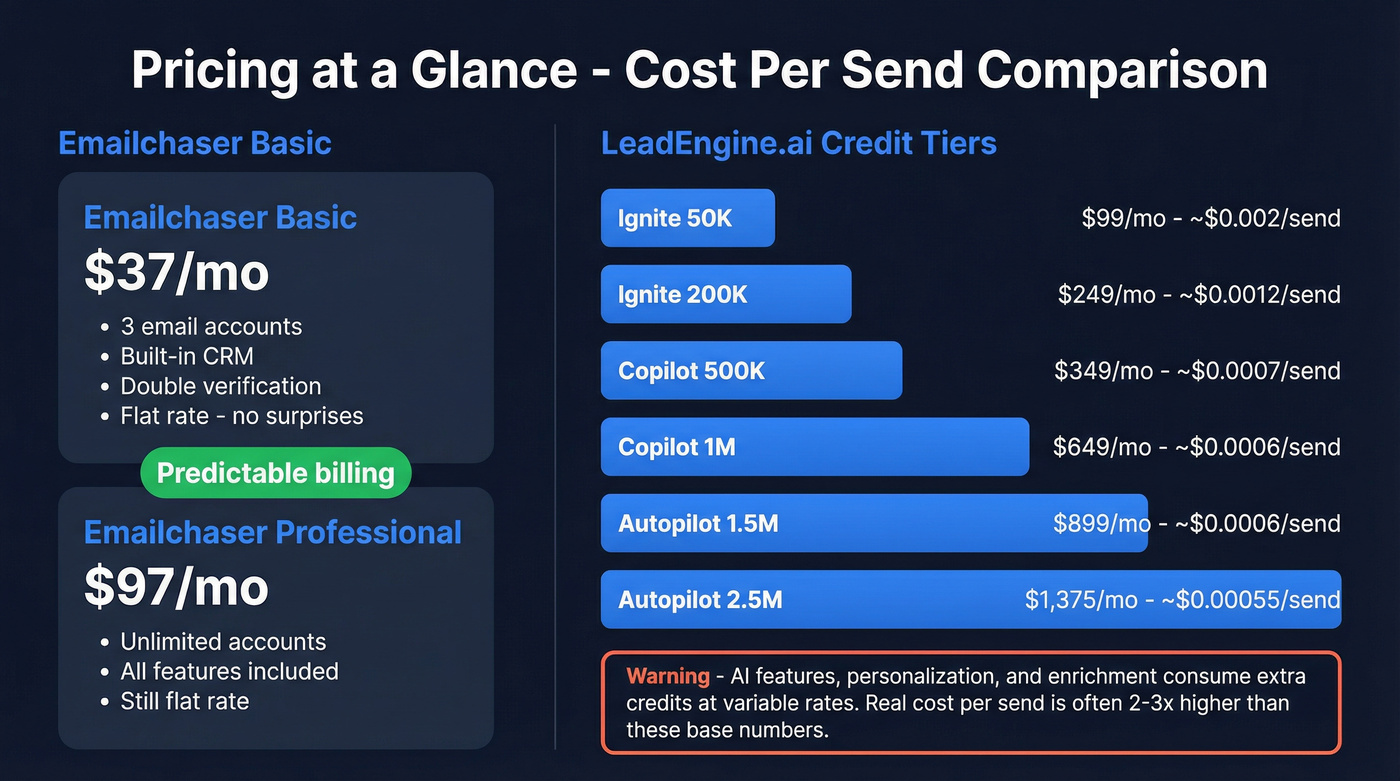
We mapped out both pricing models side by side, and LeadEngine's requires a calculator to decode.
| Plan | Price | What You Get |
|---|---|---|
| Emailchaser Basic | $37/mo | 3 accounts, CRM, double verification, webhooks, Master Inbox |
| Emailchaser Professional | $97/mo | Unlimited accounts |
| LeadEngine Ignite 50K | $99/mo | 50K credits, unlimited users |
| LeadEngine Ignite 100K | $149/mo | 100K credits, unlimited users |
| LeadEngine Ignite 200K | $249/mo | 200K credits, unlimited users |
| LeadEngine Copilot 500K | $349/mo | 500K credits, AI personalization |
| LeadEngine Copilot 750K | $499/mo | 750K credits, AI personalization |
| LeadEngine Copilot 1M | $649/mo | 1M credits, AI personalization |
| LeadEngine Autopilot 1.5M | $899/mo | 1.5M credits, dedicated server |
| LeadEngine Autopilot 2M | $1,150/mo | 2M credits, dedicated server |
| LeadEngine Autopilot 2.5M | $1,375/mo | 2.5M credits, dedicated server |
Now the math that matters. LeadEngine uses credits, and one basic email send equals one credit.
- Ignite at 50K credits ($99/mo) works out to ~$0.002 per send.
- Copilot at 500K credits ($349/mo) drops to ~$0.0007 per send.
Those numbers look great - until AI features, advanced personalization, and enrichment start consuming extra credits at variable rates. In our experience, the credit system gets confusing fast. A team leaning heavily on Copilot or Autopilot agents will burn through credits faster than the headline numbers suggest.
Emailchaser is the opposite: flat monthly pricing. You know exactly what you're paying regardless of feature usage.
Two details worth flagging: LeadEngine's unused credits roll over period-to-period, and annual plans save 33%. Both soften the credit risk.

Emailchaser and LeadEngine.ai are sending platforms - not data providers. The best deliverability infrastructure can't save a bad list. Prospeo gives you 143M+ verified emails at 98% accuracy for ~$0.01 each, refreshed every 7 days. Pair it with either tool and watch your bounce rate stay under 3%.
Fix the data before you optimize the send.
Deliverability Approaches
These two platforms have fundamentally different philosophies about deliverability - and one of them is contrarian enough to be interesting.
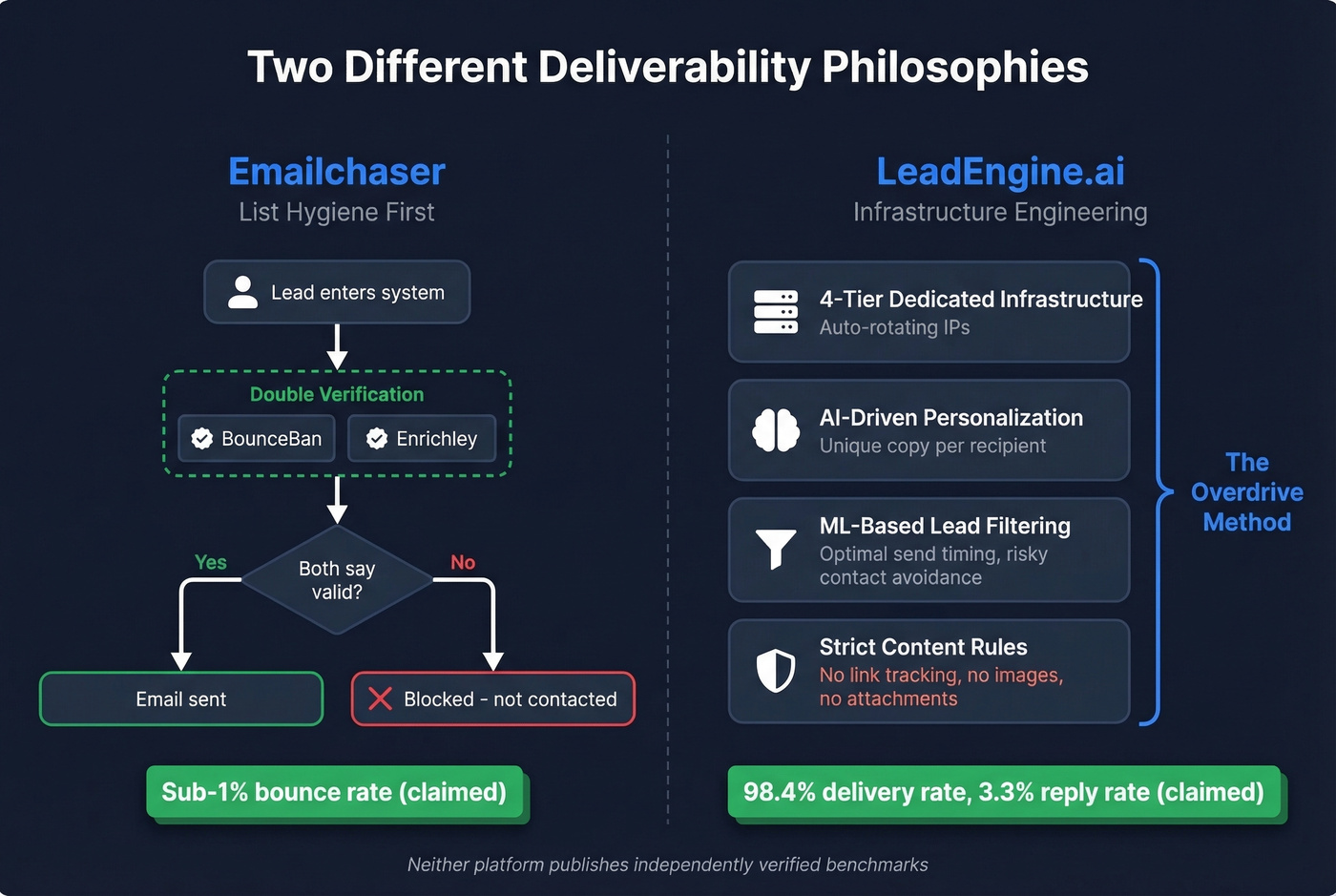
Emailchaser leans hard into list hygiene. It uses "double-verification" with two services, BounceBan and Enrichley. If a lead isn't marked valid by both, Emailchaser won't contact them. They publish sub-1% bounce rates, which is aggressive but plausible if the dual-provider approach catches what a single verifier misses.
LeadEngine.ai goes the opposite direction with infrastructure-level engineering. Their Overdrive Method combines four components: 4-tier dedicated infrastructure with auto-rotating IPs, AI-driven personalization, ML-based lead filtering that times sends and avoids risky contacts, and the strict no-tracking/no-images/no-attachments policy. LeadEngine publishes a 3.3% average reply rate and 98.4% average delivery rate across their 5,000+ business user base.
Neither platform publishes independently verified benchmarks. For context, industry averages sit around 23% open rates and ~3% response rates for cold email, so LeadEngine's numbers are in line with what good operators achieve - not outlier claims.

Where Each Falls Short
Here's the thing: there isn't much community discussion to lean on for either tool. Reddit threads exist, but independent validation is harder than it'd be for established platforms like Instantly, Mailshake, or Woodpecker.
Emailchaser's weak spots:
- Webhooks-only integrations - no big native ecosystem
- Basic plan caps you at 3 email accounts, limiting scale
- Shallow automation depth compared to AI-native platforms
- If you need heavy AI personalization, you'll hit the ceiling quickly
LeadEngine.ai's weak spots:
- Credit-based pricing is confusing - AI features consume credits at variable rates nobody can predict upfront
- Five AI agents create a real learning curve before you're productive
- Limited third-party reviews make it harder to validate claims independently
- $99/mo entry price is steep for a solo founder just testing cold email
Which One Fits Your Team
Solo founders and small teams: Emailchaser. It's cheaper, simpler, and the double verification keeps bounces low without requiring you to understand credit economics. You'll know when you've outgrown it.
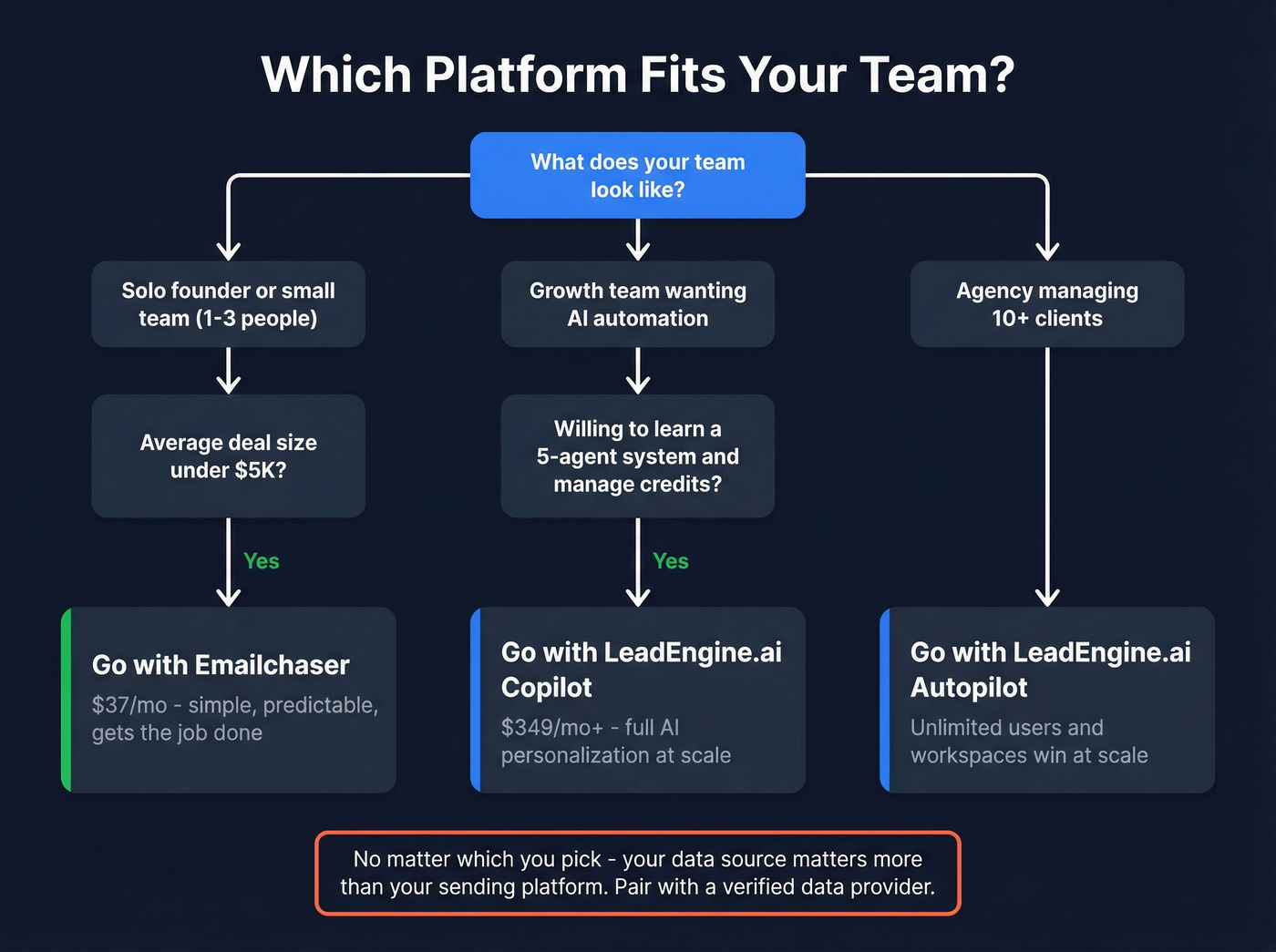
Teams wanting full AI automation and willing to invest: LeadEngine.ai. The Overdrive Method and five-agent system aren't just another Instantly clone with a GPT wrapper - this is a genuinely different approach to cold email infrastructure.
Agencies managing multiple clients: LeadEngine's unlimited users and workspaces beat tools that charge per seat at scale. For teams running campaigns across 10+ clients, the math often favors LeadEngine even at higher tiers.
Let's be honest: if your average deal size is under $5K, you probably don't need LeadEngine's AI sophistication. Emailchaser at $37/mo with clean data will outperform a $349/mo Copilot plan fed with bad contacts every single time. The bottleneck is almost never the sending platform.
The Data Layer Neither Provides
Neither Emailchaser nor LeadEngine.ai is a data provider. They're sending platforms. And we've seen it over and over again - campaign quality lives or dies on contact data, not sending infrastructure. A team we worked with recently switched from a $500/mo sending setup to a $97/mo one, kept their data source the same, and saw zero drop in reply rates. The platform wasn't the variable. The list was.
Prospeo fills that gap with 300M+ professional profiles, 98% email accuracy, and a 7-day data refresh cycle. The 5-step verification handles catch-all domains, spam traps, and honeypots before your first email sends. It integrates natively with Instantly, Smartlead, and Lemlist - so whether you pick Emailchaser, LeadEngine, or something else entirely, your list quality stays consistent.
If you want to go deeper on the data side, start with data enrichment and a repeatable lead generation workflow.
Dual verification and waterfall scoring sound impressive - until you realize they're cleaning data that was already stale. Prospeo's 5-step verification and 7-day refresh cycle means your contacts are accurate before they ever hit your sending platform. That's how teams like Snyk cut bounce rates from 35% to under 5%.
Stop cleaning bad data. Start with good data.
FAQ
Does LeadEngine.ai offer a free trial?
Yes - LeadEngine offers a free trial with no credit card required. Emailchaser offers a 7-day free trial. Both let you test before committing, though LeadEngine's trial credit limits aren't publicly documented.
Is Emailchaser or LeadEngine.ai cheaper for a 5-person team?
Emailchaser is simpler to budget: $37/mo for Basic or $97/mo for Professional, flat rate regardless of team size. LeadEngine starts at $99/mo with 50K credits. If your team sticks to basic sends, cost-per-email is extremely low. Lean heavily on AI agents and enrichment, and credits burn 2-3x faster than expected.
Can I use a separate email finder with either platform?
Yes - both accept imported lead lists via CSV. Pairing either tool with a dedicated data provider gives you cleaner contacts than relying on either platform's built-in sourcing. Upload verified emails and push them straight into your sending tool.