


EmailChaser vs ZoomInfo: They Don't Compete - Here's What You Need
You're comparing a bicycle to a freight truck. EmailChaser is a cold email sending platform with a lightweight email finder bolted on. ZoomInfo is a $15K-$75K/year enterprise data platform with intent signals, org charts, and 500M+ profiles. The fact that both tools touch "email" doesn't make them competitors.
One Reddit user put it bluntly: "We have used ZoomInfo for the past year and we absolutely hate it." That frustration usually isn't about the data - it's about paying enterprise prices for features you never touch.
30-Second Verdict
Choose EmailChaser if you need a dirt-cheap cold email sender at $1/mo and already have a data source feeding your campaigns.
Choose ZoomInfo if you're an enterprise team with $30K+ budget, dedicated RevOps, and genuine need for intent signals and org charts.
What Each Tool Actually Does
ZoomInfo
ZoomInfo is a full-stack B2B data platform covering 500M+ professional profiles, 174M verified email addresses, and 70M+ direct dial phone numbers. It holds a 4.5/5 on G2 from over 9,000 reviews - but the most common cons tags tell a different story: "Outdated Data," "Inaccurate Data," and "Outdated Contacts."
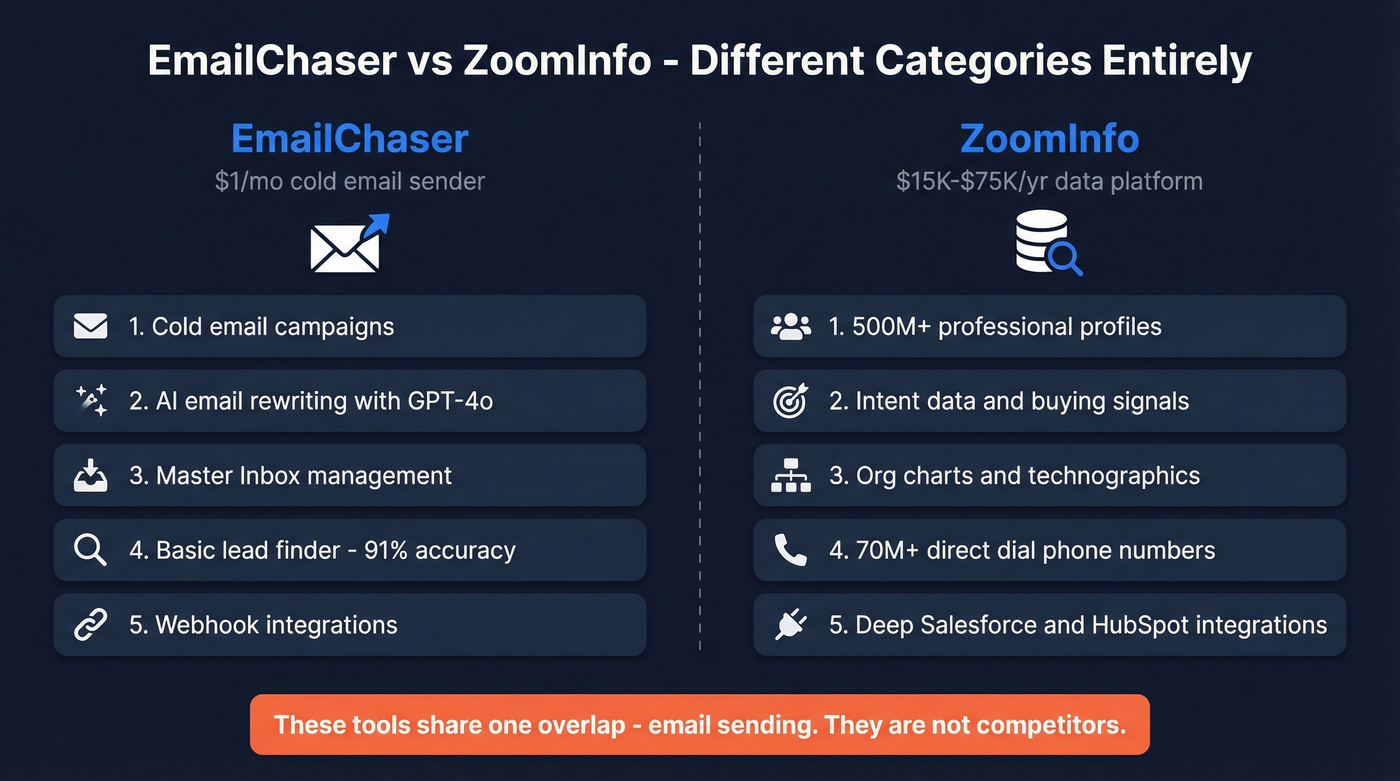
The platform processes over one billion buying signals each month and layers in intent data, technographics, org charts, and advanced segmentation. Native Salesforce and HubSpot integrations run deep. Implementation takes about a month, and contracts are annual-only starting around $15K. That's the floor, not the ceiling.
EmailChaser
EmailChaser is a cold email sending tool first, data tool second. The core product is campaign management - Master Inbox, GPT-4o email rewriting, AI spintax, and scheduling. It also includes a Lead Finder commonly listed at up to 91% email-finding accuracy in third-party comparisons.
Here's the thing: the tool's review footprint is thin. A Reddit thread requesting "legitimate" EmailChaser reviews turned up mostly crickets. Integrations center on webhooks rather than deep native CRM connections, and you won't get intent data. It's built for solo operators who want to send cold email cheaply and don't need much else.
Feature-by-Feature Comparison
| Primary function | Cold email sending | B2B data platform | B2B data platform |
| Database size | 200M+ leads | 500M+ profiles | 300M+ profiles |
| Email accuracy | Up to 91% | 92-95% in US | 98% verified |
| Mobile numbers | ❌ | 70M+ direct dials | 125M+ verified |
| Intent data | ❌ | ✅ | ✅ 15K topics |
| Email sending | ✅ core feature | ✅ Engage | ❌ Use any sender |
| CRM integrations | Webhooks | Salesforce, HubSpot | Salesforce, HubSpot |
| Data refresh | Unknown | ~90 days | 7 days |
| Contract | Monthly, flexible | Annual only, $15K+ | Monthly, flexible |
| Starting price | $1/mo (1 account) | ~$15K/yr | Free / ~$0.01/email |
This table makes the category mismatch obvious. EmailChaser and ZoomInfo share exactly one row where they both say "yes" - email sending - and ZoomInfo's Engage product gets torched in reviews. These tools occupy completely different spaces.

EmailChaser's finder tops out at 91% accuracy. ZoomInfo refreshes data every 90 days. Prospeo delivers 98% verified emails on a 7-day refresh cycle - at roughly $0.01 per email. Separate your data layer from your sending layer and stop overpaying for stale contacts.
Pair Prospeo with any cold email sender and outperform both tools combined.
Pricing Breakdown
ZoomInfo Pricing
ZoomInfo doesn't publish pricing, which tells you something. Based on procurement data and community reports, here's what teams actually pay:
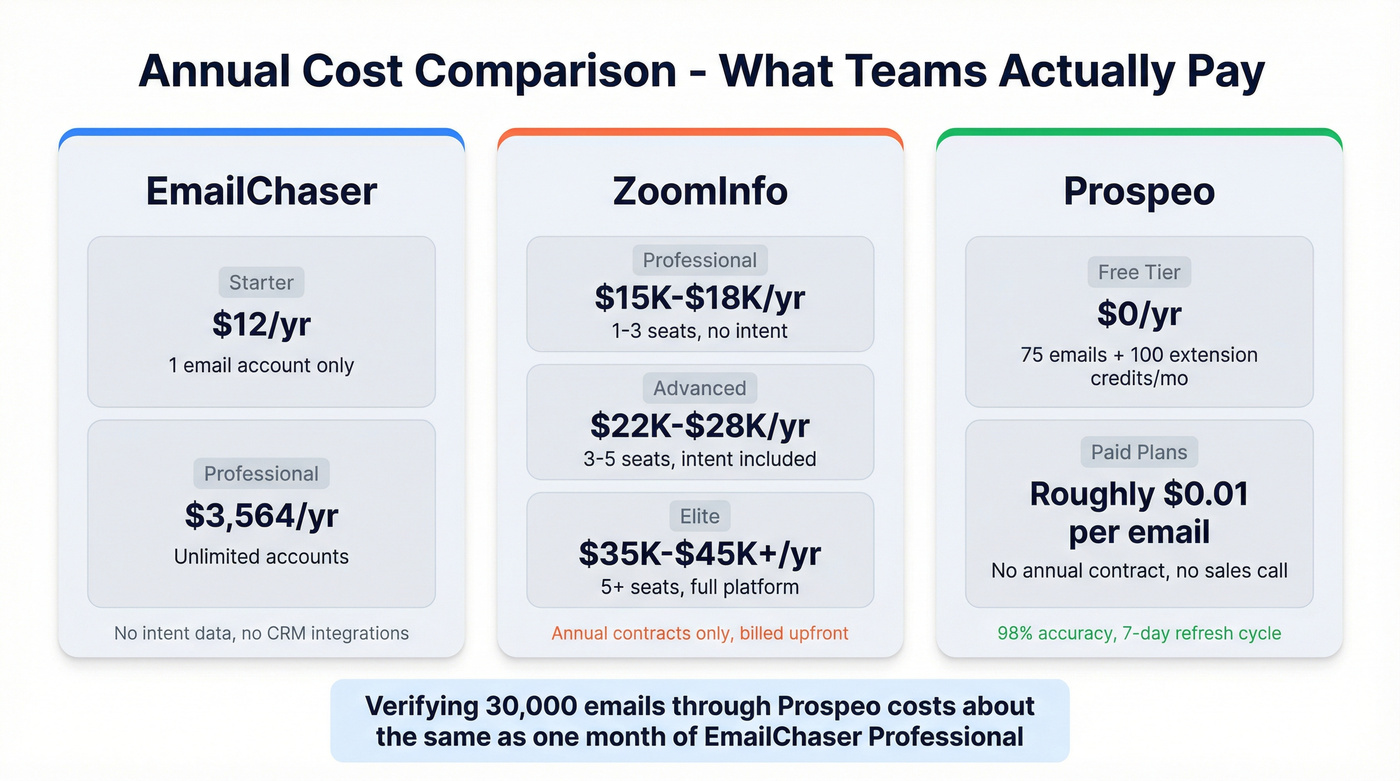
- Professional: $15K-$18K/year for 1-3 seats with ~5,000 credits, no intent data
- Advanced: $22K-$28K/year for 3-5 seats with intent and technographics
- Elite: $35K-$45K+ for 5+ seats with org charts and advanced segmentation
Most teams land in the $30K-$75K range once you add seats and modules. Contracts are annual-only, billed upfront. Discounts of 30-65% off list are common if you negotiate hard - but you need to know the list price first, and ZoomInfo's sales team isn't exactly forthcoming. As one Reddit user noted, this is "absolutely insane for solo consultants and small teams."
EmailChaser Pricing
Starter runs $1/mo for one email account. Professional jumps to $297/mo for unlimited accounts. Older reviews cite $37 and $97 tiers - those plans no longer exist. The $1-to-$297 gap is steep, and the single-account limit on Starter makes it essentially a trial with a price tag.
What We've Seen Work Better
Roughly $0.01 per verified email through Prospeo. The free tier gives you 75 emails and 100 Chrome extension credits per month. Paid plans scale from there with no annual contracts and no sales calls required. Verifying ~30,000 emails costs about what one month of EmailChaser Professional costs.
Data Accuracy and Freshness
ZoomInfo's email accuracy runs 92-95% in the US, which is solid but not exceptional. The bigger problem is freshness: ZoomInfo validates records roughly every 90 days. We've seen firsthand what 90-day-old data does to deliverability - bounced emails, wasted sequences, and sender reputation damage pile up fast.
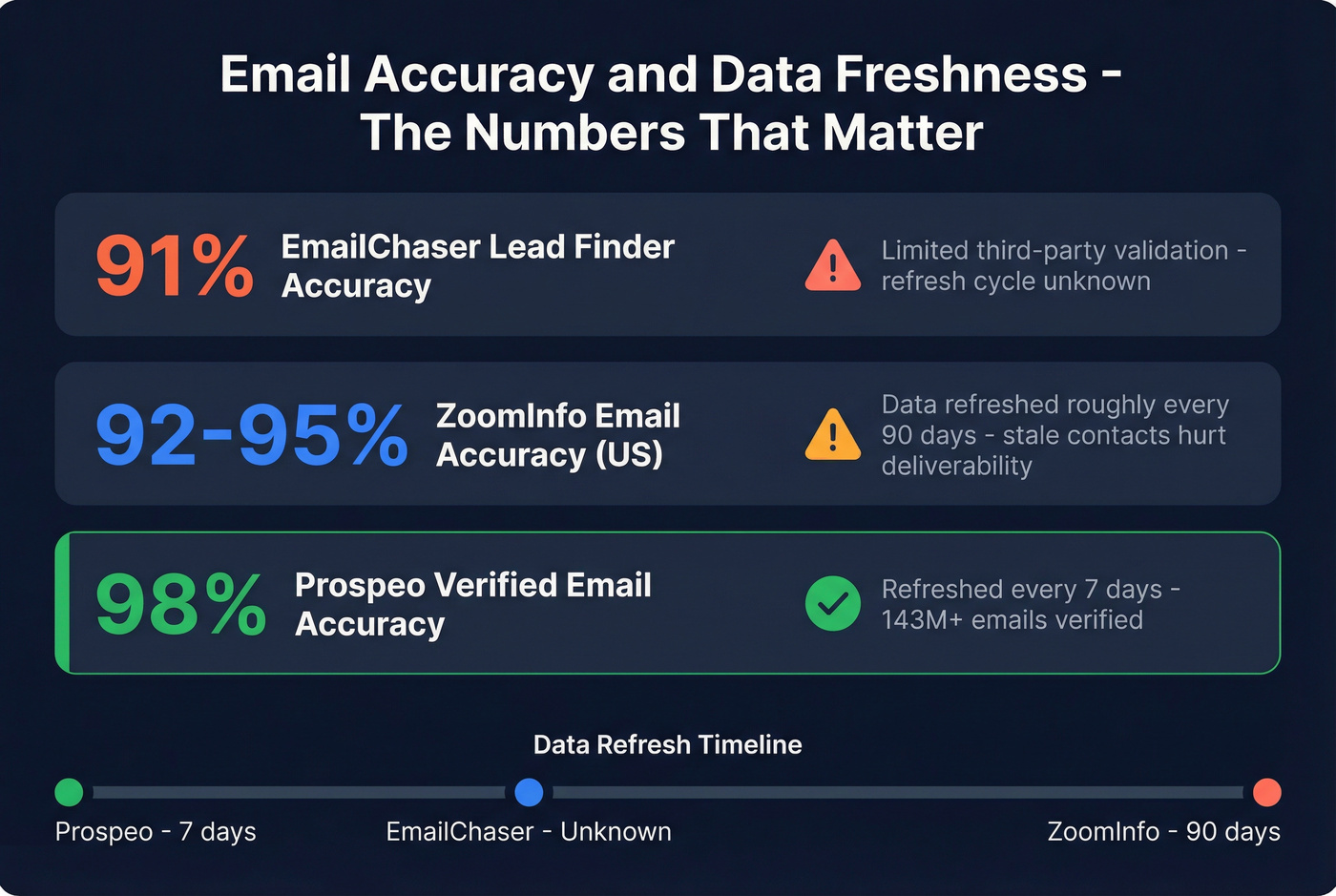
EmailChaser lists up to 91% accuracy on its Lead Finder, but meaningful third-party review volume is limited. Hard to verify that number independently.

Let's be honest: if your average deal size is under five figures, you almost certainly don't need ZoomInfo-level data infrastructure. You need accurate emails fed into a good sending tool - two products doing what they're best at, not one product doing everything at enterprise prices.
Who Should Use Which
EmailChaser makes sense for solo operators running simple outbound campaigns who already have a reliable contact data source. You're paying $1/mo for a sender, not a data platform. Don't expect the built-in finder to carry your prospecting.
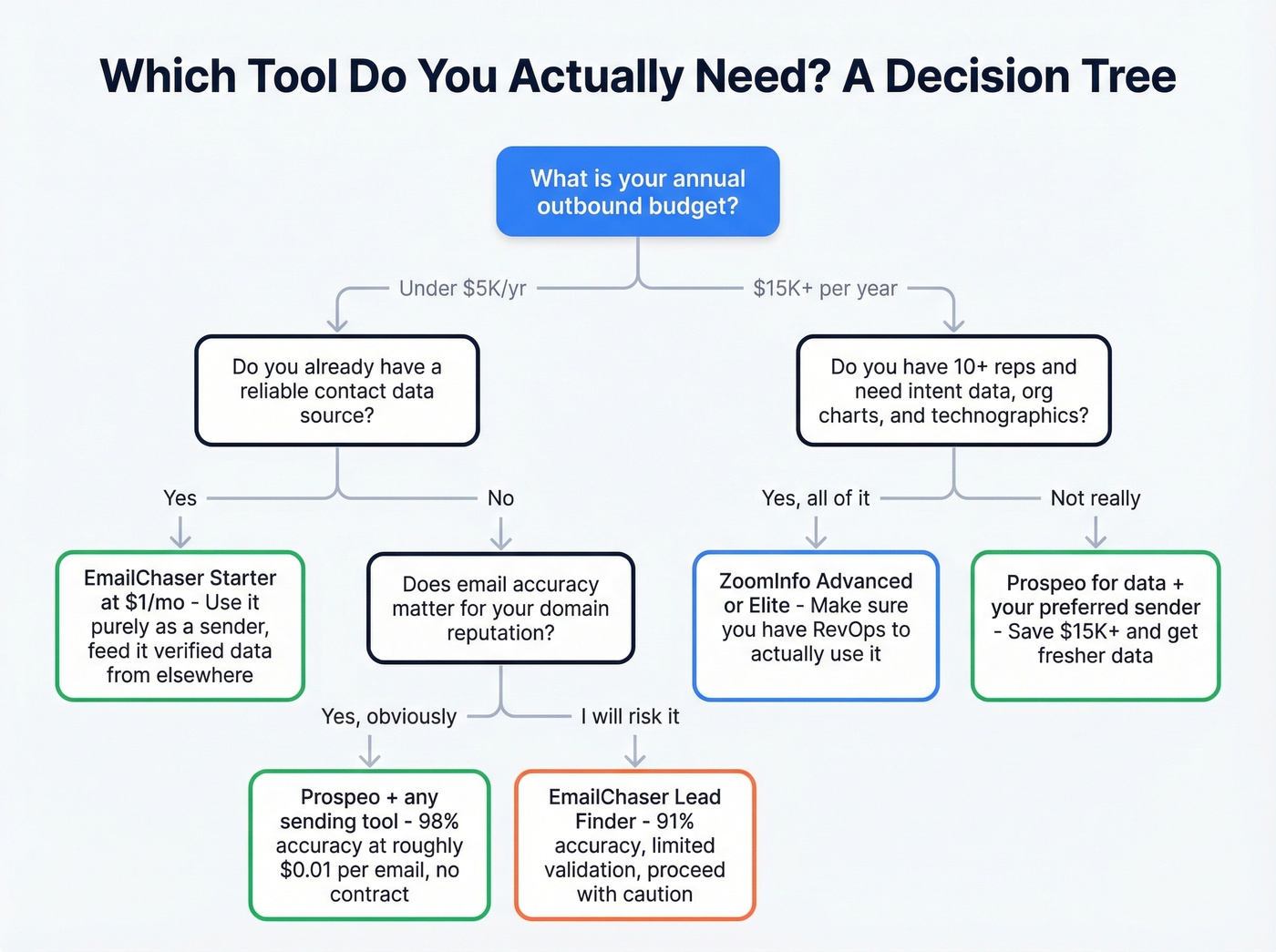
ZoomInfo earns its price tag when you're an enterprise team with dedicated RevOps, $30K+ annual budget, and genuine need for org charts, intent signals, and technographics in one platform. US market depth matters more to you than global coverage or data freshness.
For everyone in between - and that's most teams searching EmailChaser vs ZoomInfo - the answer is neither tool alone. Snyk's 50 AEs increased their sourced pipeline 180% and generated 200+ new opportunities per month after switching to verified data with a weekly refresh cycle. Meritt tripled their pipeline from $100K to $300K per week and cut bounce rates from 35% to under 4%. The pattern is clear: accurate data paired with any capable sending tool beats an all-in-one platform that compromises on freshness.
Skip ZoomInfo if you're under 10 reps and don't need intent data. Skip EmailChaser's Lead Finder if accuracy matters to your sender reputation. Separate your data layer from your sending layer, and you'll outperform teams paying 10x more for a bundled solution that does both things worse.

Meritt tripled pipeline to $300K/week and cut bounce rates from 35% to under 4%. Snyk's 50 AEs generated 200+ opportunities per month. The difference wasn't the sending tool - it was switching to weekly-refreshed, verified data. No $15K contracts. No accuracy gambles.
Stop debating EmailChaser vs ZoomInfo - start with data that actually works.
FAQ
Can EmailChaser replace ZoomInfo?
No. EmailChaser handles sending; ZoomInfo handles data. They solve fundamentally different problems. You'd need a separate data source alongside EmailChaser to match ZoomInfo's core function.
Is ZoomInfo worth it for small teams?
For most teams under 10 reps, no. ZoomInfo's value lives in enterprise-scale intent signals and deep CRM workflows that require dedicated RevOps. If you mainly need verified emails for outbound, there are self-serve options with 98% accuracy starting free - without annual contracts or auto-renewal traps.
What's the most accurate email finder in 2026?
Prospeo leads with 98% verified email accuracy across 143M+ emails, refreshed every 7 days. ZoomInfo runs 92-95% in the US with a ~90-day refresh cycle. EmailChaser is listed at up to 91% with limited third-party validation. TechCrunch and G2's email finder category are good places to cross-reference claims.
Can I use EmailChaser and a data platform together?
Yes - and that's the recommended approach. Use a dedicated data platform for verified contact discovery, then push those contacts into EmailChaser or any sending tool for campaign execution. Separating data from sending gives you best-in-class accuracy without vendor lock-in.